Nontyphoidal Salmonella (NTS) infections, predominantly Salmonella enterica serotypes Typhimurium and Enteritidis, are a major cause of self-limiting foodborne gastroenteritis worldwide. However, invasive NTS disease can cause significant morbidity and mortality in children, immunosuppressed persons, or HIV-infected individuals, especially in Africa.Reference Pegues and Miller 1 – Reference Wadula, von Gottberg and Kilner 5 Although most NTS infections are foodborne, intrafamilial, daycare, and infrequently, nosocomial outbreaks can result in person-to-person transmission.Reference Graham, Molyneux, Walsh, Cheesbrough, Molyneux and Hart 4 , Reference Wadula, von Gottberg and Kilner 5
Multidrug resistance is increasingly reported in Salmonella and is mediated by resistance genes associated with plasmids, transposons, and integrons.Reference Graham, Molyneux, Walsh, Cheesbrough, Molyneux and Hart 4 – Reference Krauland, Marsh, Paterson and Harrison 9 Extended-spectrum β-lactamase (ESBL)–producing S. enterica serotype Isangi and S. Typhimurium have become common in South Africa,Reference Wadula, von Gottberg and Kilner 5 , Reference Kruger, Szabo and Keddy 7 , Reference Usha, Chunderika, Prashini, Willem and Yusuf 8 and ESBL S. Isangi has been implicated in nosocomial outbreaks.Reference Wadula, von Gottberg and Kilner 5
In September 2015, an ESBL S. Isangi was isolated from stool cultures of 2 patients at an 800-bed tertiary-care hospital in southeastern Michigan. We initiated an investigation to determine the source of infection and prevent further transmission. This report describes the investigation, patient characteristics, and risk factors associated with S. Isangi transmission as well as the control measures implemented to contain the outbreak.
METHODS
Outbreak Investigation
Case Definition
A case was defined as the occurrence of S. Isangi isolated from culture of any specimen collected during the outbreak period from September 2, 2015 through October 22, 2015. Case patients were patients or healthcare workers (HCWs) from whom these culture specimens were collected.
Initial Case Finding
The initial 2 cases were identified in a 40-bed cardiothoracic unit (CTU). Salmonella isolates were sent to the Michigan Department of Health and Human Services (MDHHS) laboratory, where they were identified as S. Isangi.
Active surveillance of patients potentially exposed to S. Isangi during the outbreak was performed to prospectively identify additional cases; patients were informed of the testing and the test results. These included (a) all patients in the CTU and (b) all patients who underwent solid organ transplantation (SOT) from August 9, 2015 (date of index patient’s surgery), through October 14, 2015 (~2 weeks from date of last patient’s surgery). SOT recipients who were discharged were screened during follow-up visits. Stool samples of symptomatic patients with diarrhea were screened for Clostridium difficile and S. Isangi, while asymptomatic patients were screened for S. Isangi with perirectal swabs using enriched broth media.
Screening of employees for S. Isangi was mandated. HCWs who had contact with case patients were identified through patient records and assignment logs. In the CTU, all clinical and ancillary staff members and environmental services personnel were screened. The operating room (OR) staff who participated in surgeries involving the case patients were also screened. For the rest of the employees, data analytics generated a list of employees who had >3 contacts with case patients. Screening was prioritized based on the number of exposures to case patients. HCWs were screened with self-performed perirectal swabs that were cultured using enriched broth media.
Case-Control Study
A case-control study was performed to identify risk factors for S. Isangi transmission. Our initial investigation of the index case suggested transmission through equipment possibly contaminated during surgery. Non-SOT surgical patients housed in the CTU and all SOT patients who underwent surgeries from August 9, 2015, through October 14, 2015 with negative stool cultures for Salmonella were selected as control participants. Patient characteristics, procedures, HCW exposure, location, and antibiotic use were assessed.
Epidemiological Investigation
Assessment of surgical procedures, reprocessing of equipment, infection control practices, and cleaning of environment were performed in the operating room (OR), the CTU, and other patient care units. Interviews of OR personnel, including anesthesia and surgical teams, and direct observation of surgeries were conducted by the infection control (IC) team. Intraoperative transesophageal echocardiogram (TEE) probes were used during surgery in almost all cases; hence, detailed assessment of reprocessing procedures of probes was conducted. All special equipment used during transplant surgeries was examined.
Environmental cultures were collected from TEE probes, glidescopes, OR surfaces, gels, slush and ice machines, coolers, and surfaces in patient-care areas. Cultures of TEE probes and glidescopes were performed in enriched broth media using the soaking method recommended by MDHHS.
Microbiologic and Molecular Studies
Identification of Salmonella to the genus level and antimicrobial susceptibility patterns were determined using MALDI-TOF mass spectrometry and Vitek (bioMerieux, Durham, NC) in the clinical microbiology laboratory, respectively. All isolates were sent to MDHHS for confirmation; serotyping was performed using traditional antisera to O and H antigens.Reference Brenner and McWhorter-Murlin 10 ESBL-mediated resistance was suspected and confirmed by real-time PCR (RT-PCR) using universal CTX-M ESBL primers.Reference Grobner, Linke and Schutz 11
Strain relatedness was determined using pulsed-field gel electrophoresis (PFGE). Genomic DNA samples were prepared in agarose plugs, digested with XbaI (New England BioLabs, Beverly, MA), and run on a CHEF-DR III (Bio-Rad Laboratories, Hercules, CA). BioNumerics software (Applied Maths, Kortrijk, Belgium) was used to calculate the percent similarity (Dice coefficient) of XbaI PFGE banding patterns. Isolates were considered related if their patterns were ≥80% similar.Reference Donabedian, Chow, Shlaes, Green and Zervos 12 – Reference Swaminathan, Barrett, Hunter and Tauxe 14
Statistical analysis
Data were analyzed using univariate analysis. A t test was used for continuous variables, whereas χ2 or Fisher’s exact test was used for categorical variables. The crude odds ratio (OR) and 95% confidence intervals (CI) for each exposure were calculated. All P values were 2-sided; statistical significance was defined as P<.05. Multivariable regression analysis was performed using backward selection to exclude variables with P>.05 from the univariate analysis. Analyses were performed using SAS 9.4.
RESULTS
Case Patients
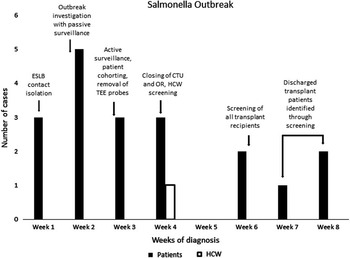
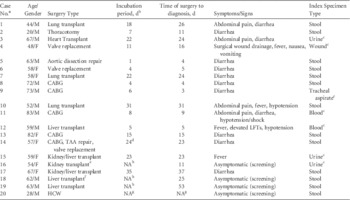
Of the 84 patients tested, the cultures of 19 patients (22%), including 10 SOT patients, and 1 HCW, showed S. Isangi isolates: stool (65%), urine (15%), blood (10%), wound (5%), and tracheal aspirate (5%) (Fig. 1, Table 1). Case patients ranged in age from 20 to 83 years (median, 59 years), and 60% were male. The length of stay of these patients ranged between 8 and 100 days (median length of stay, 16 days). In total, 16 case patients were symptomatic; 13 had gastrointestinal symptoms; 2 had bacteremia; and 1 had a polymicrobial surgical site infection (ie, infection with S. Isangi, K. pneumoniae, and E. coli). The mean incubation period, estimated as date of surgery to symptom onset, was 22 days for SOT patients and 9 days for non-SOT patients.
Timeline of Salmonella Isangi cases identified among surgical patients and a single HCW and selected features of epidemiologic investigation and infection control measures. CTU, cardiothoracic unit; HCW, healthcare worker; OR, operating room; TEE, transesophageal echocardiogram.

Characteristics of Surgical Patients and Healthcare Worker with Salmonella Isangi Isolated on Culture

NOTE. CABG, coronary artery bypass grafting; HCW, healthcare worker; LFT, liver function test; TAA, thoracic aortic aneurysm.
a Case number was assigned in the order of date of diagnosis, except the HCW, who is listed as case 20.
b The incubation period was defined as date of surgery to symptom-onset.
c All case patients, with the exception of 9 and 15, had positive stool cultures for Salmonella. Case patient 9 developed diarrhea 3 days after index culture but expired from cardiac complications. Case patients 15 had 2 negative stool cultures.
d Screening stool culture was positive the day before symptom-onset.
e No intraoperative transesophageal (TEE) probe was used in case 16.
f Case patient 18 underwent liver transplantation after the replacement of TEE probes on September 21, 2015.
g Asymptomatic HCW who tested positive during active surveillance.
During the outbreak, 10 of 51 SOT patients (19.6%) had cultures positive for S. Isangi; 7 of these were symptomatic. Also during the outbreak, 33 non-transplant patients housed in the CTU had negative cultures. All employees were asymptomatic, and 1 of 625 HCWs who were screened (0.16%) had a positive culture for S. Isangi. The HCW with a positive S. Isangi culture, a nurse, had contact with 3 case patients.
The index patient (ie, the first identified case patient) underwent lung transplantation on August 9, 2015. A stool culture obtained on September 2, 2015, when he developed diarrhea and abdominal pain, was positive for ESBL S. Isangi. The patient was born in the Middle East but was a resident of Venezuela and had traveled to Mexico, Colombia, and Spain. Subsequently, 18 additional case patients were identified; all underwent surgeries performed in 4 ORs between August 9 and October 2, 2015. Postoperatively, 12 case patients, including the index case, were transferred to the CTU; 6 were transferred to the surgical ICU, and 1 was transferred directly to the transplant unit. Subsequently, all case patients were discharged or were transferred to the transplant or general unit.
All but 2 case patients were treated with antibiotics: 7 were treated with trimethoprim/sulfamethoxazole; 6 were treated with carbapenems; and 4 were treated with fluoroquinolones. The mean duration of treatment was 14.3 days for nontransplant patients and 15.5 days for transplant patients. Asymptomatic immunocompromised case patients were treated with 14 days of therapy to reduce risk of invasive salmonellosis.Reference Pegues and Miller 1 The HCW was treated and allowed to return to work after two negative cultures were recorded.
Laboratory analysis
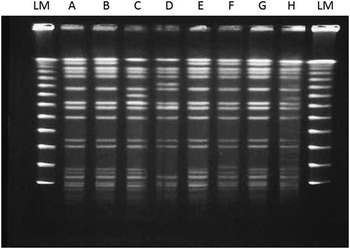
PFGE indicated that 14 of isolate patterns were identical and that the remaining isolates differed by ≤3 bands, for an overall relatedness of 89.5% (Fig. 2).
Pulsed-field gel electrophoresis (PFGE) of Salmonella enterica serotype Isangi clinical isolates. Strain relatedness using PFGE of all isolates was determined (8 representative isolates shown in lanes A–H). PFGE indicated that 14 of isolate patterns were identical and that the remaining isolates differed by ≤3 bands, for an overall relatedness of 89.5%. Lanes A–H represent patient isolates, and lanes LM represent λ markers.

Isolates from cases 1 through 18 and the HCW were resistant to ampicillin, ampicillin/sulbactam, ceftriaxone, cefepime, and nalidixic acid and were susceptible to meropenem with variable susceptibilities to piperacillin/tazobactam and ciprofloxacin. All isolates were susceptible to trimethoprim/sulfamethaxazole, with the exception of isolates from cases 15 and 16. The isolate from case 19 was susceptible to all antibiotics. RT-PCR demonstrated the presence of a CTX-M15 ESBL in all phenotypically resistant S. Isangi isolates.
Case-control study
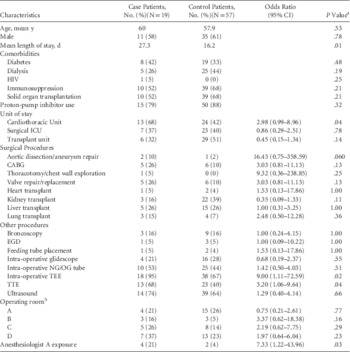
Overall, 19 case patients and 57 control participants (16 non-SOT and 41 SOT) had similar characteristics and surgical procedures (Table 2). Case patients had significantly longer lengths of stay (27 vs 16 days, P=.01) and were more likely to be housed in the CTU postoperatively. Intraoperative TEE probes were used on 18 (95%) case patients and 38 (67%) control patients (adjusted OR=9.00; 95% CI, 1.11–72.59; P=.02). At our institution, 4 specific TEE probes are routinely used during all heart, lung, and liver transplantations and cardiothoracic surgeries. Only 2 surgical patients were identified with S. Isangi after the replacement of these probes on September 21, 2015. A total of 13 case patients (68%) and 23 controls (40%) had transthoracic echocardiograms (TTEs) postoperatively (OR=3.20; 95% CI, 1.06–9.64; P=.04). No significant differences were identified relative to exposure to specific surgeons or OR personnel. Four case patients (21%) and 2 control patients (4%) were exposed to anesthesiologist A (OR=7.33; 95% CI, 1.22–43.96; P=.03). The following variables were included in the multivariate regression analysis: TTE and intraoperative TEE use, CTU stay, and exposure to anesthesiologist A. However, only TEE was retained in this model (Table 3).
Comparison of Clinical Characteristics and Risk Factors for Salmonella Isangi Infection

NOTE. CABG, coronary bypass graft; EGD, esophagogastroduodenoscopy; HIV, human immunodeficiency virus; ICU, intensive care unit; NG, nasogastric; OG, orogastric; TEE, transesophageal echocardiogram; TTE, transthoracic echocardiogram.
a P<.05 was considered statistically significant.
b Cardiothoracic surgeries (coronary artery bypass graft, valve surgery, heart and lung transplants) were done in operating rooms C and D and kidney and liver transplants in operating rooms A and B.
Multivariate Regression Analysis of Variables Associated with Salmonella Isangi Infection

NOTE. CTU, cardiothoracic unit; TEE, transesophageal echocardiogram; TTE, transthoracic echocardiogram.
Epidemiological Investigation
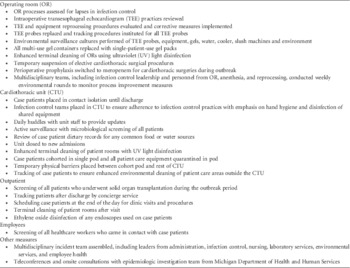
The infection control assessment focused on reprocessing of TEE probes and shared equipment. TEE probes were not wiped down immediately after use to prevent desiccation of bodily fluids. The rest of the reprocessing procedure revealed no breaches; manual cleaning, manual high-level disinfection using 0.55% ortho-phthaladehyde (Cidex OPA), rinsing, drying, and storage were performed according to the manufacturer’s recommendations. 15 Visual inspection and electronic leak testing was routinely performed during reprocessing, and no damage to the probes was observed. Serial numbers of the 4 TEE probes used were not documented in operative notes; thus, tracing of probes to patients was not possible. Reprocessing of other equipment was consistent with manufacturers’ recommendations. Single-use gel packs were always used for intubation and TEE procedures. Single- or multi-use gel containers were used for noninvasive imaging such as TTE.
Environmental assessment identified inconsistencies in practice during routine and terminal cleaning of patient rooms and shared equipment in the OR and patient-care units. All 109 environmental cultures were negative for Salmonella, including 10 gel samples, TEE probes, and glidescopes.
Infection Control Measures
Several process improvement measures were sequentially implemented to prevent further transmission of S. Isangi (Table 4 and Fig. 1). TEE reprocessing was modified to ensure that probes were wiped down immediately after use. Although no defects were found, the probes were removed from use. Routine terminal cleaning of patient rooms, OR, and equipment was complemented by Pulsed Xenon ultraviolet (UV) light disinfection (Xenex Germ-Zapping Robots, Xenex Disinfection Services, San Antonio, Texas). 16
Infection Control Assessment and Control Measures

DISCUSSION
This report describes the investigation and control of an outbreak of a novel ESBL S. Isangi among surgical patients that affected 19 patients and 1 HCW. The only reported nosocomial outbreak of S. Isangi occurred in South Africa among 41 children and resulted from cross-transmission through beds and cubicles shared with the index case patient. In total, 75% percent of these children had comorbid HIV infection, and infection was associated with 22% mortality.Reference Wadula, von Gottberg and Kilner 5
S. Isangi isolates in our report were highly related according to PFGE, suggesting clonal dissemination through a single or limited vector(s). Although no definite source was identified, our case-control analysis and epidemiological investigation suggested that exposure to TEE probes was associated with transmission in most cases. Acquisition of S. Isangi by the HCW is suggestive of cross-transmission in the unit and possibly in cases 16 and 18. Exposure to anesthesiologist A was significant in the case-control analysis. However, the anesthesiologist was involved in the care of only 4 case patients prior to the removal of the TEE probes and was asymptomatic with negative cultures. Because no definite source of transmission was identified, employee screening was conducted. Transmission from patients to HCWs can occurReference Tauxe, Hassan, Findeisen, Sharrar and Blake 17 – Reference Standaert, Hutcheson and Schaffner 20 ; however, staff-to-patient transmission has not been reported.Reference Pegues and Miller 1 , Reference Tauxe, Hassan, Findeisen, Sharrar and Blake 17
Salmonella can survive for weeks in low-moisture environments or months in water, facilitating foodborne outbreaks and cross-contamination. Salmonella have developed adaptive mechanisms to survive in a desiccated state.Reference Magwadere, Rauff, Klerk, Keddy and Dziva 21 – Reference Hiramatsu, Matsumoto, Sakae and Miyazaki 24 Salmonella plated onto paper disks were detected for up to 35 days, 70 days, and 24 months when stored at 35°C, 25°C, and 4°C, respectively.Reference Hiramatsu, Matsumoto, Sakae and Miyazaki 24 The ability of Salmonella to persist in the environment may have contributed to this outbreak. All environmental cultures, including those of TEE probes, were negative. However, repeated reprocessing of equipment and environmental cleaning could have affected the results. Acquisition of ESBL S. Isangi might have been affected by the use of perioperative meropenem during the outbreak and/or by the use of trimethoprim/sulfamethoxazole prophylaxis in transplant patients.
Intraoperative non-channeled TEE probes are increasingly utilized during cardiothoracic surgery. Transmission of pathogens by TEE probes has been reported and was due to the use of unfiltered tap water, inadequate disinfection and storage of probes, and damaged probes.Reference Levy, Teysseire, Etienne and Raoult 25 – Reference Bancroft, English, Terashita and Yasuda 28 High-level disinfection is recommended for the reprocessing of TEE probes because sterilization can damage the transducers. 29 Periodic testing of endoscopes and TEE probes and the addition of single-use disposable sheaths for TEE probes are being evaluated at our institution.Reference Swaminathan, Barrett, Hunter and Tauxe 14 , Reference Kanemitsu, Endo and Oda 26 , Reference Seki, Machida, Yamagishi, Yoshida and Tomono 27 The ability of Salmonella to survive in the environment highlights the importance of environmental cleaning and enhanced measures such as UV disinfection.
The S. Isangi identified is believed to be a unique strain; we were unable to locate its match in the National PulseNet database (personal communication, Dr Rudrik MDHSS). The S. Isangi isolates were ESBL producers and may have persisted because β-lactams were used for perioperative antibiotic prophylaxis. CTX-M15, identified in 19 of 20 cases, is encoded by plasmids and confers resistance to third-generation cephalosporins.Reference Usha, Chunderika, Prashini, Willem and Yusuf 8 Additional molecular characterization of the isolates is ongoing. A total of 8 isolates were sent by MDHHS to the Centers for Disease Control and Prevention (CDC) for whole-genome sequencing.
In NTS infections, the incubation period can last up to 7 days.Reference Pegues and Miller 1 In this outbreak, the incubation period was variable and lasted up to 3 weeks in transplant patients, necessitating a broad screening strategy in this group. Transplant recipients are immunosuppressed and receive antibiotics; this might have extended the incubation period and predisposed the organisms to antibiotic resistance. For instance, cases 15 and 16 received trimethoprim/sulfamethoxazole prophylaxis, and their S. Isangi isolates were trimethoprim/sulfamethoxazole resistant. The duration of Salmonella carriage is typically 5 weeks, but it can be prolonged in children and immunocompromised patients.Reference Pegues and Miller 1 , Reference Graham, Molyneux, Walsh, Cheesbrough, Molyneux and Hart 4 , Reference Wadula, von Gottberg and Kilner 5 , Reference Tauxe, Hassan, Findeisen, Sharrar and Blake 17 Follow-up cultures in 7 of 10 transplant patients remained positive at 12 weeks; no patients have been lost to follow-up. Screening of transplant case patients is ongoing; monthly stool cultures will continue until 2 negative cultures are recorded. Anticipating prolonged shedding, a concierge service was established to track case patients and to implement measures to prevent cross-transmission (Table 4).
No patient died as a result of S. Isangi infection. The outbreak was contained 2 months after the implementation of control measures (Table 4). The CTU was reopened after terminal cleaning, and elective cardiothoracic surgeries were resumed after 2 weeks.
We are aware of several limitations in this investigation. All patients who underwent transplant surgery during the outbreak period were screened for S. Isangi. Non-transplant patients were screened only if they were present in the CTU during the outbreak; thus, the precise attack rate is unknown in this group. Antibiotic use could have eradicated carriage and may have resulted in underestimating the number of patients affected. The variable incubation periods made it difficult to epidemiologically link acquisition of S. Isangi to probe use. However, the results of this case-control study suggest that transmission was most likely associated with exposure to a contaminated TEE probe.
CONCLUSIONS
This outbreak illustrates challenges in identifying potential sources of transmission of a human-adapted gastrointestinal pathogen that can survive in the environment for prolonged periods. It also highlights the consequences of transmission of such pathogens in an immunosuppressed population and the extensive resources required to contain such an outbreak.
ACKNOWLEDGMENTS
We wish to thank Meghan Weinberg, Noreen Mollon, Michael Balke, and James Rudrik of the Michigan Department of Human and Health Services for their guidance and assistance with the investigation and with laboratory identification of the Salmonella isolates.
Financial support: No financial support was provided relevant to this article.
Potential conflicts of interest: All authors report no conflicts of interest relevant to this article.