1. Introduction
The Ollo de Sapo Formation (Parga-Pondal, Matte & Capdevila, Reference Parga-Pondal, Matte and Capdevila1964) is the largest accumulation of pre-Variscan igneous rocks in the Iberian Peninsula. It crops out at the core of an antiform, the Ollo the Sapo anticlinorium, which extends for 600 km from the Cantabrian coast near Viveiro southwards to Hiendelaencina following the trend of Variscan structures in the Iberian Peninsula (Fig. 1). Its stratigraphic position, until recently a matter of debate, was clearly established inside a siliciclastic sedimentary sequence (Capas de los Montes Formation; Riemer, Reference Riemer1963) located between the Arenigian Armorican-type Quartzite and the lower Cambrian Vegadeo Limestone (Arias, Farias & Marcos, Reference Arias, Farias and Marcos2002). The Ollo de Sapo Formation mostly consists of felsic metavolcanic rocks, ignimbrites and rhyodacitic tuffs (Navidad, Reference Navidad1978; Navidad, Peinado & Casillas, Reference Navidad, Peinado, Casillas, Gutiérrez-Marco, Saavedra and Rábano1992; Díez-Montes, Reference Díez-Montes2007; C. Talavera, unpub. PhD thesis, 2008) transformed into gneisses during the Variscan Orogeny. These metavolcanites are sometimes interbedded with immature feldspathic greywackes, pelites or sandstones (e.g. Ortega et al. Reference Ortega, Carracedo, Larrea, Gil-Ibarguchi and Demaiffe1996; Díez-Montes, Reference Díez-Montes2007). Metagranites are also common but far less abundant than metavolcanic rocks (Montero et al. Reference Montero, Talavera, Bea, Lodeiro and Whitehouse2009).
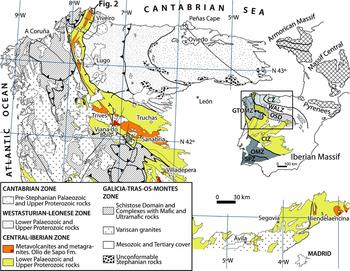
Simplified geological map of the NW Iberian Peninsula showing the outcrops of the Ollo de Sapo Formation and the location of the study area (partially based on Parga-Pondal et al. Reference Parga-Pondal, Parga-Peinador, vegas and Marcos1982). The inset in the top right shows the zones in which the Iberian Variscan belt is divided: CZ – Cantabrian Zone; WALZ – West Asturian-leonese Zone; GTOMZ – Galicia Tras-Os-Montes Zone; CZI – Central Iberian Zone (OSD, Ollo de Sapo Domain); OMZ – Ossa Morena Zone; and SPZ – South Portuguese Zone (based on Lotze, Reference Lotze1945; Julivert et al. Reference Julivert, Fontbote, Ribeiro and Conde1972a ; Farias et al. Reference Farias, Gallastegui, González-Lodeiro, Marquínez, Martín-Parra, Martínez-Catalán, de Pablo-Maciá and Rodríguez-Fernández1987).

In the Ollo de Sapo metavolcanic sequence two main facies can be differentiated: coarse-grained in the lower part of the sequence and medium–fine-grained in the upper part. The main difference between them is the presence in the former of large (5–15 cm) K-feldspar megacrystals and oligoclase phenocrysts surrounded by a fine-grained and strongly foliated felsic peraluminous groundmass, which is common to both facies. Both facies show quartz phenocrysts with a noticeable blue colour resulting from sagenitic rutile inclusions (Parga-Pondal, Matte & Capdevila, Reference Parga-Pondal, Matte and Capdevila1964). Based on geological (lack of coeval regional metamorphism and deformation), chemical, isotopic and chronological evidence, this Cambro-Ordovician magmatic event has been recently associated with a rifting geodynamic environment (i.e. with the northern Gondwana break-up; Valverde-Vaquero & Dunning, Reference Valverde-Vaquero and Dunning2000; Bea et al. Reference Bea, Montero, González-Lodeiro and Talavera2007; Montero et al. Reference Montero, Talavera, Bea, Lodeiro and Whitehouse2009; Díez-Montes, Martínez-Catalán & Bellido-Mulas, Reference Díez-Montes, Martínez-Catalán and Bellido-Mulas2010; Ballevrè et al. Reference Ballèvre, Fourcade, Capdevila, Peucat, Cocherie and Mark Fanning2012).
Dating the Ollo de Sapo Formation protolith has historically been difficult because of the unusually elevated fraction of inherited zircon components, c. 70–80 % and in some cases nearly 100 % (Bea et al. Reference Bea, Montero, González-Lodeiro and Talavera2007; Montero et al. Reference Montero, Bea, González-Lodeiro, Talavera and Whitehouse2007). Early attempts at dating the Ollo de Sapo Formation yielded ages ranging from Ediacaran to Ordovician (Lancelot, Allegret & Iglesias-Ponce-de-León, Reference Lancelot, Allegret and Iglesias-Ponce-de-León1985; Viallete et al. Reference Viallete, Casquet, Fúster, Ibarrola, Navidad, Peinado and Villaseca1986, Reference Viallete, Casquet, Fúster, Ibarrola, Navidad, Peinado and Villaseca1987; Wildberg, Bischoff & Baumann, Reference Wildberg, Bischoff and Baumann1989; Fernández-Suárez et al. Reference Fernández-Suárez, Gutiérrez-Alonso, Jenner and Tubrett1999, Reference Fernández-Suárez, Gutiérrez-Alonso, Jenner and Tubrett2000) and it was not until the beginning of the last decade that Valverde-Vaquero & Dunning (Reference Valverde-Vaquero and Dunning2000) published the first reliable Early Ordovician U–Pb crystallization ages. The first comprehensive studies of crystallization age along and across the Ollo de Sapo Formation using a U–Pb high-resolution technique were performed by Bea et al. (Reference Bea, Montero, Talavera and Zinger2006) and Montero et al. (Reference Montero, Bea, González-Lodeiro, Talavera and Whitehouse2007, Reference Montero, Talavera, Bea, Lodeiro and Whitehouse2009), who applied U–Pb spot analysis (ion microprobe and laser ablation inductively coupled plasma mass spectrometry; LA-ICP-MS) and Pb–Pb single-grain zircon analysis. Montero et al. (Reference Montero, Talavera, Bea, Lodeiro and Whitehouse2009) constrained the age of the Ollo de Sapo Formation in the Iberian Peninsula as late Cambrian – Early Ordovician and revealed that the magmatism of the Ollo de Sapo Formation was synchronous and generally short-lived. Leaving aside the spatially associated San Sebastian metagranite that yielded an age of 470 ± 3 Ma, the ages obtained so far showed that the Ollo de Sapo Formation in the NW area of the Iberian Peninsula (Sanabria, Trives and Viveiro regions) spanned 492 ± 4 to 486 ± 3 Ma (less than 13 Ma of volcanic activity). Particularly remarkable is the case of the northernmost area, the Viveiro region, in which Montero et al. (Reference Montero, Talavera, Bea, Lodeiro and Whitehouse2009) found the same age from top to bottom of the Ollo de Sapo Formation (486 ± 3 Ma; 95 % confidence level). In contrast to those data, the SE area (Hiendelaencina region) showed that the metavolcanic rocks of the Ollo de Sapo Formation spanned 495 ± 5 to 483 ± 3 Ma (12 ± 8 Ma of volcanic activity), with a punctual plutonic episode at 474 ± 4 Ma (Montero et al. Reference Montero, Bea, González-Lodeiro, Talavera and Whitehouse2007, Reference Montero, Talavera, Bea, Lodeiro and Whitehouse2009). Close to the Hiendelaencina region, Valverde-Vaquero & Dunning (Reference Valverde-Vaquero and Dunning2000) previously reported a zircon U–Pb (lower intercept) age of 480 ± 2 Ma in the metavolcanic facies of the Ollo de Sapo (Cardoso gneiss). This age would increase the time span of the Ollo de Sapo volcanic event in the SE area to 15 ± 7 Ma.
In the Viveiro region, published geological maps (see Arce-Duarte, Fernández-Tomás & Monteserín-López, Reference Arce-duarte, Fernández-Tomás and Monteserín-López1977; Bastida et al. Reference Bastida, Marcos, Marquínez, Pérez-Estaún and Pulgar1984; M.A. Lopez-Sanchez, unpub. Ph.D. thesis, 2013) show that the top of the Ollo de Sapo Formation and the bottom of the Capas de los Montes Formation are interdigitated; some Ollo-de-Sapo-type lithosomes are found in the Capas de los Montes Formation and vice versa. It is also clear that in this area the top of the Ollo de Sapo Formation and the bottom of the Arenigian Armorican-type Quartzite are stratigraphically closer towards the north (Lopez-Sanchez, unpub. Ph.D. thesis, 2013). These stratigraphic features clearly indicate some degree of local diachronism during the deposition of the Ollo de Sapo Formation. At Area Grande beach, there is an isolated decametre-thick (≥ 35 m) level of fine-grained gneiss less than 200 m below the bottom of the Arenigian-Armorican-type quartzite that we consider as the top of the Ollo de Sapo Formation in Viveiro region.
Precise knowledge of crystallization ages along and across the Ollo de Sapo Formation is a key requirement to understand the duration and tectonic significance of the Cambro-Ordovician magmatism in the Iberian Peninsula. To test the inferences stated by Montero et al. (Reference Montero, Talavera, Bea, Lodeiro and Whitehouse2009) – that is, the age span of Ollo de Sapo volcanic event in the NW area of the Iberian Massif is shorter (c. 492–486 Ma) and ceased before than that in the southern Hiendelaencia region (c. 495–483 Ma) – the aim of this study is to date the uppermost layer of the Ollo de Sapo Formation in its northernmost outcropping locality, the Viveiro region (Figs 1, 2). Since spatial resolution is in most cases a key issue to date this rock successfully, the U–Pb zircon analysis was performed using a sensitive high-resolution ion microprobe reverse geometry (SHRIMP-RG).
(a) Geological sketch map in the vicinity of Area Grande beach, NW of Viveiro (partially based on Arce-Duarte, Fernández-Tomás & Monteserín-López, Reference Arce-duarte, Fernández-Tomás and Monteserín-López1977). (b) Synthetic stratigraphic column of the area.

1.a. Geological setting and previous ages in Viveiro region
The Viveiro region is the northernmost section across the Ollo de Sapo anticlinorium. The Ollo de Sapo Formation is exposed along the coast between the Xilloi and Area Grande beaches (Fig. 2). These rocks form part of the reverse limb of a great east-verging antiform, and show a pervasive and strongly developed tectonic foliation (Arce-Duarte, Fernández-Tomás & Monteserín-López, Reference Arce-duarte, Fernández-Tomás and Monteserín-López1977; Bastida et al. Reference Bastida, Marcos, Marquínez, Pérez-Estaún and Pulgar1984; M.A. Lopez-Sanchez, unpub. Ph.D. thesis, 2013). The metamorphic grade is greenschist facies conditions (chlorite to garnet zones; Bastida et al. Reference Bastida, Marcos, Marquínez, Pérez-Estaún and Pulgar1984). The Ollo de Sapo in the coast section consists of coarse-grained and medium–fine-grained gneisses (Ortega et al. Reference Ortega, Carracedo, Larrea, Gil-Ibarguchi and Demaiffe1996). The coarse-grained gneiss (≥675 m thick) is the oldest rock cropping out in the region (Fig. 2a) and it is overlaid by c. 360 m of medium–fine-grained gneiss. Interbedded quartzites and mica-schist occur in some places (Fig. 2b).
Zircons from the lower and upper Ollo de Sapo metavolcanics on the Xilloi and Area Grande beaches (see Fig. 2 for location) were dated for the first time by Fernández-Suárez et al. (Reference Fernández-Suárez, Gutiérrez-Alonso, Jenner and Tubrett1999) using U–Pb LA-ICP-MS. They obtained ages ranging from 443 to 460 Ma (Late Ordovician), with late Neoproterozoic (c. 570–620 Ma), Mesoproterozoic (c. 1.0–1.2 Ga) and Palaeoproterozoic (c. 1.9–2.0 Ga) inheritances. Subsequently, Montero et al. (Reference Montero, Talavera, Bea, Lodeiro and Whitehouse2009) dated three metavolcanic samples in the same area, two fine-grained and one coarse-grained. All of them yielded a Pb–Pb plateau age at 486 ± 3 Ma (95 % confidence level), identical to the U–Pb age of the youngest concordant zircon population. These ages were considered as the crystallization age of the Ollo de Sapo Formation in Viveiro region, discarding the previous Late Ordovician ages obtained by Fernández-Suárez et al. (Reference Fernández-Suárez, Gutiérrez-Alonso, Jenner and Tubrett1999). Furthermore, the samples yielded inherited abundant concordant populations at 608 Ma, two concordant points at c. 1000 Ma, several concordant points at c. 2000 Ma and a discordia line with an upper intercept at c. 2600 Ma (Montero et al. Reference Montero, Talavera, Bea, Lodeiro and Whitehouse2009).
2. Materials and methods
2.a. Petrological description of the dated samples
About 10 kg of fresh meta-volcanic sample (DAT-02) was collected from the uppermost part of the Ollo de Sapo Formation at the Area Grande beach (NW of Viveiro, location 43° 43′ 04.96′′ N; 7° 37′ 21.16′′ W; Fig. 2).
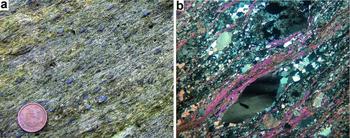
Sample DAT-02 is a strongly foliated, quartz-feldspatic, acidic meta-igneous rock that can be described as a medium–fine-grained gneiss. Its porphyroclasts are mainly albitic plagioclase and quartz, with grain size ranging from hundreds of microns to 1.5 mm (Fig. 3a). Remnants of former K-feldspar (microcline) are still preserved in the cores of the albite porphyroclasts showing that the original microcline was replaced, most probably during deformation (Reche, Martínez & Arboleya, Reference Reche, Martínez, Arboleya, Treloar and O’Brien1998). Some idiomorphic igneous zircons occur within the porphyroclasts. Quartz porphyroclasts (former igneous phenocrystals) are polycrystalline or show strong undulose extinction due to deformation (Fig. 3b). The matrix is strongly foliated; the foliation being mainly defined by muscovite and polycrystalline quartz ribbons. Most of the quartz in the matrix and some minor feldspar are recrystallized into fine-grained equant grains sandwiched between parallel-oriented muscovite grains. The matrix foliation wraps around the porphyroclasts. The absence of relic biotite and the relative abundance of secondary muscovite suggest a peraluminous protolith. The preceding petrographic features and the field structural relations enable the protolith to be considered as a fine-grained, porphyritic, leucocratic, quartz-feldspathic metavolcanic rock.
(a) Outcrop aspect of Ollo de Sapo Formation in the east of Area Grande Beach showing blue quartz phenocrysts. Coin is 21 mm in diameter. (b) Photomicrograph showing the mineralogy and texture of sample DAT-02. Field of view 8 mm.

2.b. U(Th)–Pb SHRIMP-RG dating
Zircon crystals were separated after rock crushing using conventional heavy liquid and magnetic properties at Centro de Geociencias (UNAM). Zircon standard (R33) plus unknowns were mounted in epoxy resin and polished down to expose the near-equatorial section. The mounts were cleaned in distilled water and in 1 N HCl and gold-coated for maximum surface conductivity. Cathodoluminiscence (CL) imagery was performed with a JEOL 5600 instrument (SEM) at Stanford University.
The SHRIMP-RG U(Th)–Pb analyses were performed on individual zircon grains using the ion microprobe housed at Stanford University, California. The detailed procedures used in this study are similar to those reported in Williams (Reference Williams, McKibben and Shanks1998) and Nourse et al. (Reference Nourse, Premo, Iriondo, Stahl, Anderson, Nourse, McKee and Steiner2005). Briefly, the primary oxygen ion beam (O2−), operated at c. 2–4 nA, excavated an area of c. 20–40 μm in diameter (adjustable depending on grain size) to a depth of c. 1–2 μm; sensitivity was within the range 5–30 cps per ppm Pb. Data for each spot were collected in sets of five scans through the mass range. Nine peaks were measured sequentially for zircons with a single collector: 196Zr2O, 204Pb, background (0.050 mass units above 204Pb), 206Pb, 207Pb, 208Pb, 238U, 248ThO and 254UO. The reduced ratios were normalized to the zircon standard R33 (Black et al. Reference Black, Kamo, Allen, Davis, Aleinikoff, Valley, Mundil, Campbell, Korsch, Williams and Foudoulis2004). For the closest possible control of Pb/U ratios, one standard was analysed after every 4–5 unknown samples. Uranium concentrations were monitored by analysing a standard (MAD) with c. 4200 ppm U composition. The U and Th concentrations are accurate to c. 10–20 %.
Ion microprobe isotopic raw data were reduced using the software Squid (Ludwig, Reference Ludwig2001). Data were projected to the Tera–Wasserburg concordia diagram along a model common Pb line based on Stacey & Kramers (Reference Stacey and Kramers1975). All the U(Th)–Pb age data presented in Table 1 were plotted using the software Isoplot/Ex 3.75 (Ludwig, Reference Ludwig2012).
SHRIMP-RG U(Th)–Pb data for zircon from the uppermost levels of the Ollo de Sapo Formation in Viveiro region.

*Isotopic ratios are corrected relative to R33 standard zircon (418.9 ± 0.4 Ma; Black et al. Reference Black, Kamo, Allen, Davis, Aleinikoff, Valley, Mundil, Campbell, Korsch, Williams and Foudoulis2004).
†All errors in isotopic ratios and ages are given at the 1σ level
‡Rho is the correlation error between errors in the207Pb/235U and 206Pb/238U ratios
§Percentage of discordance obtained using the equation (100*[(age 207Pb/235U)–(age 206Pb/238U)]/age 207Pb/235U). Positive and negative values indicate normal and inverse discordance, respectively.
||Atomic ratios and ages corrected for initial Pb using the amount of 204Pb.
2.c. Zircon selection criteria
Previous attempts at dating the Ollo de Sapo Formation show that in general euhedral stubby zircon prisms yield inherited ages while euhedral needle-like zircon prisms yield crystallization ages (see Valverde-Vaquero & Dunning, Reference Valverde-Vaquero and Dunning2000). Taking this into account, we discarded the stubby zircon prisms in order to avoid mixtures of inherited cores and magmatic overgrowths. Furthermore, the application of cathodoluminescence imaging combined with the SHRIMP-RG technique allowed us to analyse the zircons rims when the selected needle-like zircon grains show different features between the inner cores and the rims.
3. Results
3.a. Sample DAT-02
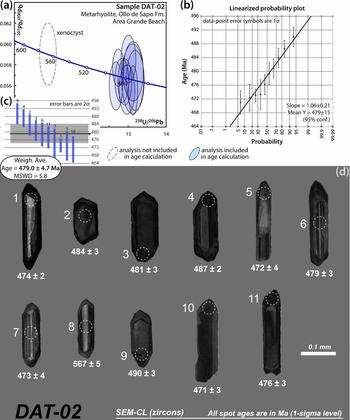
The selected zircon grains from the sample DAT-02 range between 130 and 250 μm (long axes) in size. They are mainly euhedral, with aspect ratios between 1:1.8 and 1:5.2, and display double-terminated prismatic shapes. With the exception of zircon number 10, all of them show brighter inner cores than the rims under CL (Fig. 4d). Some of the inner cores display a clear growth zoning. In the case of zircons 1 and 5 the inner core zoning is cut by the CL-dark rims, although this is not the general case. Most of the rims are unzoned or show a faint and broad zoning. In the case of zircons 5 and 8, rims display a weak sector zoning.
U–Pb SHRIMP zircon geochronology data for the volcanic sample DAT-02. (a) Tera–Wasserburg concordia plot. Solid-line filled ellipses represent data used to estimate the age. Dotted-line error ellipses represent data points excluded from the age calculation. Data-point error ellipses are 2σ. (b) Linearized probability plot of the data used to estimate (c) the age 206Pb/238U weighted mean plot. (d) SEM-CL image of dated zircons for sample DAT-02. Circles and the adjacent numbers represent the spot size (c. 30 μm) and the spot number, respectively. Zircons are sorted by spot number. These are 206Pb/238U ages reported in Ma at the 1σ level of precision.

Results obtained from the zircon grains are listed in Table 1. Individual zircon data plotted in a Tera–Wasserburg concordia diagram (Fig. 4a) show that there is a group of concordant data points (n = 10) that form a coherent array yielding a weighted average 206Pb/238U age of 479.0 ± 4.7 Ma (95 % conf.; MSWD = 5.8; probability of fit = 0; Fig. 4c). Analysis number 8, which provides an older concordant age at 567 ± 5 Ma but presents no noticeable differences in SEM-CL compared to the younger grains, is a xenocryst (Fig. 4d).
The weighted average age yields a high and unsatisfactory MSWD value (> 2) (Wendt and Carl, Reference Wendt and Carl1991). This indicates that the scatter of the data exceeds the expected scatter from the analytical errors estimated. If we assumed that the ‘internal’ assigned errors of the data points are well estimated, we think there are two possible causes that can lead to this high value of MSWD. The former may be due to the presence of an external source of error in addition to the assigned data point errors, which would produce an error underestimation. The alternative would arise from the possible presence of slightly older zircons within the population forming at different stages of the Ollo de Sapo Formation (i.e. antecryst in the sense of Charlier et al. Reference Charlier, Wilson, Lowenstern, Blake, Van Calsteren and Davidson2005). However, there is no evidence of the presence of antecryst based on zircon morphologies (Fig. 4d). We also test whether the age population obtained conform to a normal distribution. For this, we plotted the data in a normal probability plot (Ludwig, Reference Ludwig2012) and performed a Shapiro–Wilk test (Shapiro and Wilk, Reference Shapiro and Wilk1965). As can be seen in the plot shown in Figure 4b, the data almost follow the same linear trend which means that the data approximately follow a normal distribution. Furthermore, the results of the Shapiro–Wilk test yield a p-value of 0.40 (≫0.05), indicating that we cannot reject the possibility that the suite of concordant ages obtained came from a normally distributed population. Since we cannot derive a bimodal or multimodal population of ages from the dataset considered, this means that there is no convincing reason to establish with certainty that there are antecryst within the suite of zircons considered. Consequently, the high MSWD value has to be caused by the presence of an unknown external error not considered in the individual assigned errors of the data points or, less probably, by the presence of zircon antecrysts within the zircon population which could not be proved due to the precision of the technique used. Hence, the 479 ± 5 Ma age is the best estimation for the crystallization age.
4. Discussion and conclusions
The 479.0 ± 4.7 Ma age (Tremadocian, Early Ordovician) obtained is the youngest reliable crystallization age found so far for the Ollo de Sapo volcanic rocks. If we compare the zircon population ages from our sample DAT-02 to those obtained by Montero et al. (Reference Montero, Bea, González-Lodeiro, Talavera and Whitehouse2007, Reference Montero, Talavera, Bea, Lodeiro and Whitehouse2009) in Viveiro (486 ± 3 Ma) and Hiendelaencina (483 ± 3 Ma, upper metavolcanics) regions performing a Welch's t-test (Welch, Reference Welch1947), we determine that the probabilities of sample DAT-02 being younger are 99.47 % and 91.96 % respectively (Table 2). This means that the Cambro-Ordovician volcanism in the NW of the Iberian Peninsula is not as short-lived as previously thought and that the cessation of this volcanic event in Viveiro was younger than in the SE Hiendelaencia region, although similar to the age reported by Valverde-Vaquero & Dunning (Reference Valverde-Vaquero and Dunning2000) at 480 ± 2 Ma (zircon U–Pb, lower intercept) in the Cardoso gneiss (Fig. 5).
Welch t-test results for different samples compared to the sample DAT-02.

*Data from table 9: single-grain stepwise evaporation 207Pb/206Pb ages
†Data from table 3ESM (http://earthref.org/ERDA/724/)
‡Number of single age data considered to perform the Welch t-test
§Probability (%) of being younger than sample DAT-02
Zircon U-Pb crystallization ages of the Cambro-Ordovician magmas in the Central Iberian Zone and the Southern Armorican Massif. All ages in the Iberian Peninsula are in the Ollo de Sapo Formation, with the exception of the K-bentonite ash-fall bed in the Cantabrian Zone and the Canigó Massif in the Pyrenees. *Montero et al. Reference Montero, Talavera, Bea, Lodeiro and Whitehouse2009; †Valverde-Vaquero & Dunning, Reference Valverde-Vaquero and Dunning2000; ‡Gutiérrez-Alonso et al. Reference Gutiérrez-Alonso, Fernández-Suárez, Gutiérrez-Marco, Corfu, Brendan-Murphy, Suárez, Nance, Kraft and Zulauf2007; §Ballèvre et al. Reference Ballèvre, Fourcade, Capdevila, Peucat, Cocherie and Mark Fanning2012; ∥Deloule et al. Reference Deloule, Alexandrov, Cheilletz, Laumonier and Barbey2002.

Recently, Ballevrè et al. (Reference Ballèvre, Fourcade, Capdevila, Peucat, Cocherie and Mark Fanning2012) found that the felsic volcanic layers that outcrop in the South Armorica domain (Variscan belt, France) yielded ages spanning from 494 ± 4 to 472 ± 4 Ma. If we compare the zircon population ages from sample DAT-02 to the youngest ages obtained by Ballèvre et al. (Reference Ballèvre, Fourcade, Capdevila, Peucat, Cocherie and Mark Fanning2012) in the Porphyroid Nappe (478 ± 2 Ma) and the para-autochthon (472 ± 4 Ma), the probabilities of sample DAT-02 being older are 25.77 % and 97.22 %, respectively (Table 2). Hence, the age obtained in the sample DAT-02 has a c. 75 % chance of being similar to the youngest age obtained in the Porphyroid Nappe. These results reinforce the interpretation made by Ballèvre et al. (Reference Ballèvre, Fourcade, Capdevila, Peucat, Cocherie and Mark Fanning2012), who correlated and compared the age, geochemistry and structural position of the metavolcanics of the Porphyroid Nappe in South Armorica domain to the Ollo de Sapo Formation in the Central Iberian zone.
The age obtained represents the cessation of Ollo de Sapo Cambro-Ordovician volcanism during the break-up of the northern Gondwanan margin in this part of the Ibero-Armorican Arc (i.e. at the northernmost tip of the Iberian Peninsula), but not the end of the rifting process itself; this continued, at least in this part of the Iberian Massif, until Late Ordovician time according to the important changes in thickness recorded in the Upper Ordovician stratigraphic sequence (Julivert, Marcos & Truyols, Reference Julivert, Marcos and Truyols1972b ; Marcos, Reference Marcos1973; Pérez-Estaún et al. Reference Pérez-Estaún, Bastida, Martínez-Catalán, Gutiérrez-Marco, Marcos, Pulgar, Dallmeyer and Martínez1990; Martínez-Catalán et al. Reference Martínez-Catalán, Hacar-Rodríguez, Villar-Alonso, Pérez-Estaún and González-Lodeiro1992, Reference Martínez-Catalán, Gutiérrez-Marco, Hacar, Barros-Lorenzo, Gonzále-Clavijo, González-Lodeiro and Vera2004; Marcos et al. Reference Marcos, Bastida, Martínez-Catalán, Gutiérrez-Marco, Pérez-Estaún and Vera2004). Considering all the volcanic ages discussed here, they seem to suggest that the cessation of the Cambro-Ordovician volcanism along the Ibero-Armorican Arc was synchronic or perhaps slightly diachronic with younger ages towards the north (in present-day geographical coordinates; Fig. 5).
Additionally, the 479 ± 5 Ma age obtained is consistent with the age of the volcanic levels that crop out within the Arenigian Armorican-type quartzite in the Cantabrian Zone at 477 ± 1 Ma (Gutiérrez-Alonso et al. Reference Gutiérrez-Alonso, Fernández-Suárez, Gutiérrez-Marco, Corfu, Brendan-Murphy, Suárez, Nance, Kraft and Zulauf2007) and with the Ordovician magmatism that built up the protoliths of the Variscan Pyrenean axial zone gneiss domes (Deloule et al. Reference Deloule, Alexandrov, Cheilletz, Laumonier and Barbey2002; Castiñeiras et al. Reference Castiñeiras, Navidad, Liesa, Carreras and Casas2008; Denele et al. Reference Denele, Barbey, Deloule, Pelleter, Olivier and Gleizes2009; Martínez et al. Reference Martínez, Iriondo, Dietsch, Aleinikoff, Peucat, Cirés, Reche and Capdevila2011; Fig. 5).
Acknowledgements
This work was funded by the Spanish Ministry of Science and Innovation (grant references CGL2006–08822, CGL2006–09509, CSD2006–0041 and CGL2010–14890). Marco A. López-Sánchez acknowledges a doctoral fellowship (BP07–120) in the Severo Ochoa Program (FICYT, Principado de Asturias, Spain). A. Iriondo is grateful to Joe Wooden, Frank Mazdab, Bettina Wiegand and Brad Ito from the US Geological Survey at Stanford University for their close supervision of zircon mount preparations and imaging (CL), the SHRIMP-RG U–Pb zircon analyses and data reduction and with careful instrument tuning. Thanks are also due to Dan Miggins from the US Geological Survey in Denver and Aldo Izaguirre of Universidad Nacional Autónoma de México in Querétaro for their help in imaging and analysing the zircons. We thank Clara T. Bolton and Sergio Llana-Fúnez for providing language help. Finally, we thank both anonymous reviewers for insightful comments and suggestions that greatly improved this manuscript.
5. Declaration of interest
None