Introduction
Gender is globally recognized as a critical dimension of health inequality (Sen et al., Reference Sen, Östlin and George2007). Gender-biased contexts in society are theorized to shape peoples’ lives in important ways (Martin, Reference Martin2004). Though researchers have long studied individual-level gendered health effects, few have examined gendered contextual effects on health. India is an informative case because its gender contexts differ – in some cases greatly – from many other countries. Widespread gendered practices such as dowry-giving vary substantially across geographic contexts within India, as does women’s health (Kapadia, Reference Kapadia1998; Desai et al., Reference Desai, Dubey, Joshi, Sen, Shariff and Vanneman2010). India also ranks third out of 134 countries in the size of gender gaps in health, and with a female longevity advantage among the most blunted in the world (Arber & Thomas, Reference Arber, Thomas and Cockerham2006; Hausmann et al., Reference Hausmann, Tyson and Zahidi2010).
The objective of the current study was to extend prior research by using two waves of national multilevel panel data from India to assess whether changes in contextual-level dowry-giving are associated with changes in women’s overall health over time. This analysis extended prior research at the intersection of contextual effects, gender and health that typically (a) focused on Western countries, (b) did not use nationally representative data, (c) rarely assessed the role of gender contexts, and (d) did not examine the relationship between changes in local dowry practice and women’s overall health over time (Read & Gorman, Reference Read and Gorman2010). A greater understanding of the role of local dowry practice in how gender shapes women’s overall health in India can yield important insights into the social drivers of women’s health in diverse cultural settings.
Background
Research has increasingly underscored the importance of contextual factors in human health (Smith-Greenaway, Reference Smith-Greenaway2017). Work in this area has focused on general characteristics of contexts such as social capital, socioeconomic disadvantage and infrastructure. Little attention, however, has been paid to aspects of gendered contexts that particularly impact women (what researchers have referred to as ‘gendered structural determinants of health’) – gendered beliefs, social arrangements or practices comprising a local gender context shaping women’s exposure to noxious influences on health (Sen et al., Reference Sen, Östlin and George2007).
The few studies in this area have typically measured state- or community-level gender ideology, economic equality or political representation and have found that gender equality has a salutary association with women’s health (Jun et al., Reference Jun, Subramanian, Gortmaker and Kawachi2004; Chen et al., Reference Chen, Subramanian, Acevedo-Garcia and Kawachi2005; McAlister & Baskett, Reference McAlister and Baskett2006). The importance of a gendered practice such as dowry is consistent with scholarship that has increasingly highlighted not just local beliefs, but ‘system[s] of social practices’ as especially significant ‘bearers of gender’ across gender contexts (Elson, Reference Elson1999, p. 611; Martin, Reference Martin2004; Risman, Reference Risman2004; Ridgeway, Reference Ridgeway and Correll2007, p. 311; Desai & Andrist, Reference Desai and Andrist2010). In India, dowry can generally be defined as a groom-price given from a bride’s family to a groom’s at the time of marriage and may come in the form of large gifts (e.g. a refrigerator) and cash transfers. Though illegal since the Dowry Prohibition Act of 1961, dowry still often serves as an important symbolic resource and can be one of the most effective ways of signalling status in local communities (Roulet, Reference Roulet1996). Prior work has theorized that geographic variation in dowry-giving is associated with a variety of outcomes (e.g. female infant mortality rates), but has rarely studied adult health, has not studied overall health and has not utilized longitudinal data (Jejeebhoy, Reference Jejeebhoy, Presser and Sen2000; Stroope, Reference Stroope2015a).
Gender contexts, dowry and health in India
Women’s health varies substantially across geographic contexts within India (Desai & Wu, Reference Desai and Wu2010). Despite globalization, gendered practices such as dowry-giving remain widespread and norms regarding this practice vary regionally across the country and are associated with a range of outcomes (Miller, Reference Miller1981; Mandelbaum, Reference Mandelbaum1988; Kapadia, Reference Kapadia1998; Derné, Reference Derné2008; Stroope, Reference Stroope2015a). The current study extends this work and assesses whether geographic variation in dowry practice also shapes women’s overall health.
There are several reasons to anticipate that women in districts with greater dowry prevalence will be more likely to experience poor health compared with their counterparts in districts with lower dowry prevalence. First, dowry prevalence can erode women’s health by diminishing the status of women in an area. Dowry-giving, through repeated symbolic enactment, can reinforce lower status for women and norms of gender subordination in a local area (Caldwell et al., Reference Caldwell, Reddy and Caldwell1983; Kapadia, Reference Kapadia1998). In addition to eroding health through psychosocial mechanisms, women’s lower status in a locale affects health by creating barriers to accessing health care, health knowledge and other health-promoting resources (Mumtaz & Salway, Reference Mumtaz and Salway2005).
Second, local dowry prevalence fosters status inequality, which negatively affects health. Health social scientists have theorized that prestige and social status are among the ‘core’ determinants of health (Phelan et al., Reference Phelan, Lucas, Ridgeway and Taylor2014, p. 22). High levels of social status inequality in an area can harm residents’ health through reduced social cohesion, lower sense of control and anxiety related to social status comparisons (Wilkinson & Pickett, Reference Wilkinson and Pickett2009). Dowry is known to be an especially important marker of status in India. Bridal families use dowry to compete for the prestige associated with high-status grooms (Caldwell et al., Reference Caldwell, Reddy and Caldwell1983; Mandelbaum, Reference Mandelbaum1988; Schlegel, Reference Schlegel1993). Dowry frequently marks men’s and women’s social recognition, prestige and value (Srinivas, Reference Srinivas1977; Raheja & Gold, Reference Raheja and Gold1994; Roulet, Reference Roulet1996, p. 93; Philips, Reference Philips2004; Srinivasan, Reference Srinivasan2005). Regardless of whether a woman’s own family practises dowry, widespread dowry-giving in an area can impact women’s health by heightening local status competition, increasing status anxiety and eroding women’s sense of control (Dickerson & Kemeny, Reference Dickerson and Kemeny2004; Seeman et al., Reference Seeman, Stein Merkin, Karlamangla, Koretz and Seeman2014).
Third, local dowry prevalence can shape health through determining the local resource context. Local access to resources and opportunities is a way that gender influences health. Regardless of whether dowry-giving is practised in a woman’s household, she can face resource and opportunity constraints in local areas shaped by the prevalence of dowry practice. Dowry is a groom-price and can be a motivating factor for parents to invest in sons more than daughters because considerable – sometimes enormous – financial resources must be used for a daughter’s dowry. A daughter will join a groom’s family and will not be a long-term contributor to her parents’ household. Dowry has a direct effect on the comparative costs of sons and daughters and on differential investments in resources and opportunities for females from early life onward (Caldwell et al., Reference Caldwell, Reddy and Caldwell1983; Schlegel, Reference Schlegel1993; Lahiri & Self, Reference Lahiri and Self2007). In local areas with a high prevalence of dowry-giving, these differential investments will influence the demand for (and thus availability of) resources in a local area, reducing women’s chances of acquiring health-maintaining resources and making ‘female-specific services … more likely to be neglected’ in a locale (Dyson & Moore, Reference Dyson and Moore1983, p. 50).
Finally, dowry prevalence will increase the frequency of health-damaging network events. Traumatic experiences such as witnessing violence against others in one’s community are linked to health problems including depression, sleep disorders, anxiety and other physiological difficulties (Hill & Needham, Reference Hill and Needham2013; e.g. White et al., Reference White, Bruce, Farrell and Kliewer1998). In particular, an undesirable event causing stress in the life of someone in one’s social network can impact one’s health, and previous research has found that women tend to be especially impacted (Kessler & McLeod, Reference Kessler and McLeod1984; House, Reference House1987; Fuhrer et al., Reference Fuhrer, Stansfeld, Chemali and Shipley1999; Kawachi & Berkman, Reference Kawachi and Berkman2001). Dowry’s growth in the Indian sub-continent and adoption by different sectors of society ‘has been rapid and traumatic,’ and is linked to worsening women’s social standing (Caldwell et al., Reference Caldwell, Reddy and Caldwell1983 p. 348; Kapadia, Reference Kapadia1998). Dowry-related trauma for women may take the form of verbal abuse, guilt, neglect, violence, rape or killing, and typically occurs when the dowry is lower than desired by the groom or his family (Das Gupta, Reference Das Gupta1987; Mandelbaum, Reference Mandelbaum1988; Sharma, Reference Sharma and Uberoi1993; Jejeebhoy & Cook, Reference Jejeebhoy and Cook1997; Rao, Reference Rao1997; Bloch & Rao, Reference Bloch and Rao2002; Samuel, Reference Samuel2002; Kumar, Reference Kumar2003; Kumar & Kanth, Reference Kumar and Kanth2004; Kumar et al., Reference Kumar, Jeyaseelan, Suresh and Ahuja2005; Rastogi & Therly, Reference Rastogi and Therly2006; Jeyaseelan et al., Reference Jeyaseelan, Kumar, Neelakantan, Peedicayil, Pillai and Duvvury2007; Srinivasan & Bedi, Reference Srinivasan and Bedi2007; Diamond-Smith et al., Reference Diamond-Smith, Luke and McGarvey2008; Rocca et al., Reference Rocca, Rathod, Falle, Pande and Krishnan2009; Acharya et al., Reference Acharya, Sabarwal and Jejeebhoy2012). Dowry demands, threats and abuse can persist long after the wedding, leading to physical and psychological problems (Kumari, Reference Kumari1989; Raguram et al., Reference Raguram, Weiss, Keval and Channabasavanna2001; Kumar et al., Reference Kumar, Jeyaseelan, Suresh and Ahuja2005; Kermode et al., Reference Kermode, Herrman, Arole, White, Premkumar and Patel2007; Pereira et al., Reference Pereira, Andrew, Pednekar, Pai, Pelto and Patel2007; Shidhaye & Patel, Reference Shidhaye and Patel2010). Just as the health effects of exposure to violence extend beyond the victims, dowry-related trauma and stress reaches beyond brides to other women in their families, social networks and local areas.
To recap, local widespread dowry practice legitimates and reinforces gender-biased beliefs, behaviours and distributions of resources. Districts with a high frequency of dowry practice can shape women’s health through affecting local status of women, status inequality, gender-biased resource contexts and network events. Based on this background, this study hypothesizes that district-level dowry prevalence will be associated with greater odds of poor overall health among women.
Methods
The analysis examined the relationship between changes in district-level dowry prevalence and women’s overall health using data from Waves 1 and 2 of the India Human Development Survey (IHDS) (https://ihds.umd.edu). For simplicity, ‘district’ is used throughout and refers to urban/rural portions of districts described below. The IHDS was a nationally representative panel conducted in 2004/2005 (IHDS-I) and 2011/2012 (IHDS-II) across more than 30 states and union territories in India (18 women were re-interviewed in 2013). Eighty-three per cent of the 41,554 households in IHDS-I were re-interviewed in IHDS-II. The IHDS response rate was 92% and its demographic profile compared favourably with the 2001 Census of India and the 2004–2005 National Sample Survey. Questions about overall self-rated health and gender relations were only asked of one randomly-selected ever-married woman (aged 15–50) in each household and were not asked for men. The present study analysed data on focal measures for 23,785 ever-married women aged 15–50 at Wave 1 who were re-interviewed at Wave 2 between 2011 and 2012. List-wise deletion was used because there were a relatively small number of missing values (6.64%) after restricting the data as indicated – an acceptable level of missing data for a complete case analysis approach (Allison, Reference Allison2001).
Dependent variable
The analysis examined change in self-rated health (SRH) between Wave 1 and Wave 2 interviews. To measure SRH, at Wave 1 one ever-married woman (men were not asked) aged 15–50 in each household was asked by interviewers to rate their health with the question: In general, would you say your own health is: (1) ‘very good,’ (2) ‘good,’ (3) ‘ok,’ (4) ‘poor,’ or (5) ‘very poor?’ This question was asked again at Wave 2. At Wave 1, women reported an average score of 2.24. For the present outcome, the SRH score at Wave 1 was subtracted from the SRH score at Wave 2. Negative values on change in SRH indicated decreases in poor health (i.e. improved health), while positive values indicated worsened poor health. Approximately 64.5% of women reported a change in SRH across waves: 36.7% reported improved health, whereas 27.8% reported worsened health.
Individual-level control variables
A variety of potentially confounding Wave 1 variables were controlled, including caste, religion, age, age at cohabitation, distance to natal place, number of children, SES, local infrastructure, women’s seclusion, women’s mobility restrictions, state fixed-effects and number of years between waves. Respondent’s caste was categorized as: Other Backward Caste, Scheduled Caste Scheduled Tribe and ‘other’. Hindu, Muslim, Sikh and ‘other’ religious identities were also controlled. Age (15–24, 25–34, 35–44 and 45–50) and age at guana (the age the respondent came to live with her husband) were controlled. Respondents’ number of children and natal place distance (number of hours it takes to travel to the natal place) were included. Socioeconomic status is an important potential confounder (Bhan et al., Reference Bhan, Millett, Subramanian, Dias, Alam and Williams2017) and several SES measures were controlled: the respondents’ educational attainment was categorized by number of years of education (0, 1–5, 6–9, 10–11 and 12 or more), a household asset index (a sum of 30 items measuring household property and housing quality [alpha=0.914]) and a government housing aid indicator.
Local health care facilities were categorized as follows, with each category taking coding precedence over the next: (1) primary health centre/urban area, (2) community health centre/hospital, (3) health sub-centre, (4) other clinic/centre/facility, (5) pharmacy/midwife, (6) none. Following prior work, the analysis controlled for urban/rural residence and infrastructural development (Desai & Wu, Reference Desai and Wu2010): metro area, other urban, rural with low infrastructural development and rural with high infrastructural development. High infrastructure rural areas were defined as those with at least one of the following facilities: electricity, paved road, grocery store, bazaar, bank, post office, police station, bus stop or mobile access to telephone and landline. To isolate the effects of district-level dowry perception, an individual-level indicator of dowry perception in the community was included (described below). Women’s seclusion was measured with a question that asked: Do you practise ghungat/purdah/pallu? (yes=1, else 0)? Women’s mobility restrictions were measured with a sum of items that asked whether the woman must seek permission from a senior member of the family to visit a health clinic, bazaar/grocery store or friends/relatives. A series of 22 state of residence indicators (several adjacent north-eastern states with small sample sizes were collapsed) were controlled (reference = Uttar Pradesh) but were not presented to conserve space. To adjust for any changes in health explained by the passage of time, the analysis controlled for the number of years between Wave 1 and Wave 2 interviews.
District-level variables
To measure contextual characteristics, this study used districts as the basis of its contextual units. Districts are administrative units a level below India’s states and union territories. Because contemporary urban and rural contexts in India differ dramatically, IHDS districts were divided into 485 contextual units in keeping with prior work (Desai & Andrist, Reference Desai and Andrist2010; Desai & Wu, Reference Desai and Wu2010). Variables were aggregated from the Level 1 data at the contextual unit level. In other words, using a given Level 1 variable, a mean score within each contextual unit was calculated to create the corresponding contextual measure.
Key independent variable
The key predictor was change in district-level dowry-giving from Wave 1 to Wave 2. Dowry was a dichotomous measure (0, 1) tapping local perceptions or expectations regarding frequent dowry-giving. It was coded as ‘1’ if the respondent answered affirmatively that any of the following items are usually given as dowry in their community for a daughter’s marriage for a family like theirs: land, cash, TV, car, scooter or refrigerator. Such items are often given as dowry payment in contemporary India (Srinivasan & Bedi, Reference Srinivasan and Bedi2007; Waheed, Reference Waheed2009). District-level dowry was calculated as the within-district proportion of respondents coded as ‘1’ on the above dowry variable.
District-level control variables
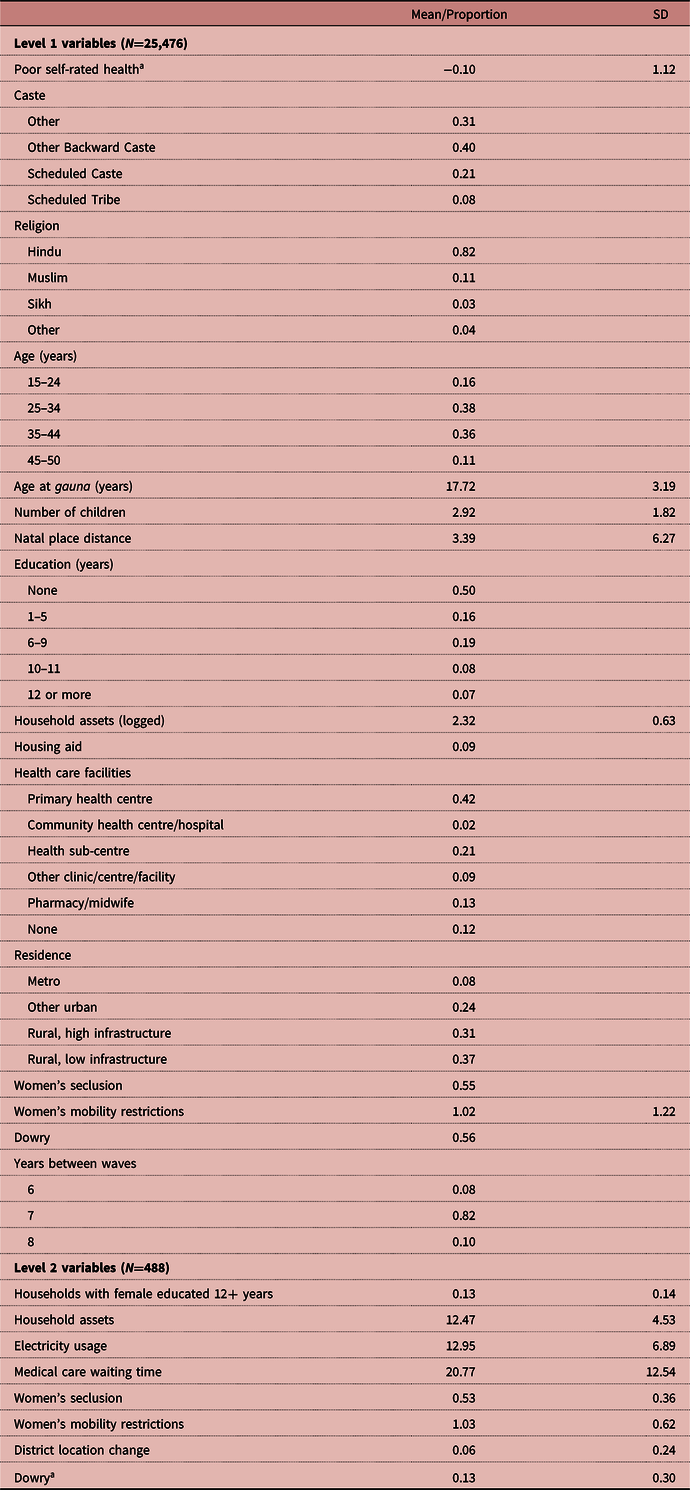
District-level control variables included female education in the household, household assets, electricity usage, medical care waiting time, women’s veiling and women’s mobility restrictions. Female education in the household was calculated as the district-level percentage of the highest educated females in a household who completed 12 or more years of schooling. An index of household assets was constructed as the district-level average of the 30-item household assets index described above. Electricity usage was measured as the mean number of hours of electricity used per day within each district unit. The IHDS interviewers asked how many minutes the respondent must wait for medical treatment when visiting a clinic, hospital or healer for a minor illness – a measure of access to health care. This item was aggregated to the district level as a measure of medical care waiting time. Women’s seclusion information was aggregated to the district level to create a contextual measure of women’s seclusion. District-level women’s mobility restrictions came from taking the mean score of women’s mobility restrictions within each district unit. Reliability coefficients were computed to assess the reliability of contextual measures (Jones & Norrander, Reference Jones and Norrander1996). The aggregate mean values for these coefficients indicated that they were highly reliable contextual measures: female with 12+ years of education 0.971, household assets 0.988, electricity usage 0.991, medical care waiting time 0.946, seclusion 0.985, mobility restrictions 0.951 and dowry practice 0.982. Finally, because about 4.6% of the sample changed districts between Waves 1 and 2, analyses controlled for respondent change in districts. Study variable descriptive statistics are shown in Table 1.
Descriptive statistics for study variables

Source: India Human Development Survey 2004–05, 2011–12.
a Wave 1−Wave 2 change score. State of residence indicators not shown.
Analytic method
The analysis employed multilevel linear regression to examine whether change in self-rated poor health across waves was significantly predicted by change in district-level dowry-giving across waves. Results from multilevel ordered probit regression were the same as those from the linear regression model. Results from the linear regression are reported for ease of interpretation.
Modelling change in the dependent variable as a function of change in the independent variable reduced the chances that any significant findings were due to individuals of poorer health living in districts with more prevalent dowry practices. Additionally, multilevel modelling was used to examine associations between change in district-level dowry practices and change in individual-level poor health. Since gender is not limited to individual-level attributes, but also comprised of social arrangements in environments, this study focused on the prevalence of dowry-giving – a gendered characteristic of district-level units. For this reason, analyses did not simply cluster standard errors at contextual units but estimated district-level associations with individual-level self-rated health using multilevel modelling. Unlike single-level regression, multilevel modelling appropriately produces estimates of standard errors of contextual measures, uses the correct degrees of freedom for contextual units and corrects for correlated errors among persons in the same contextual units. The analysis estimated variation in change in health between and within districts, adjusting for non-independence stemming from clustering within districts (Raudenbush & Bryk, Reference Raudenbush and Bryk2002). Contextual associations were estimated simultaneously with individual-level associations, which was necessary given this study’s multilevel conceptual framework. The results presented were based on unweighted models since the stratified nature of the sample was addressed in multilevel modelling. State of residence fixed-effects were also included but not displayed to conserve space.
Results
Before assessing focal relationships, an unconditional or ‘null’ model (not shown) was estimated. This model assessed the presence of significant between-district variation in change in poor health (p<0.001). Calculating an intra-class correlation coefficient (ICC) from the null model indicated that the correlation of change in poor health between two indiscriminately chosen persons in the same randomly selected district was 0.212. In other words, 21% of the variation in change in health is attributable to individuals’ district of residence – a sizeable ICC but within the range of other research. Furthermore, likelihood ratio tests comparing the null model versus a model without accounting for clustering within-districts indicated that nesting individuals within districts significantly improved model fit (χ 2 = 4459.57; p<0.0001).
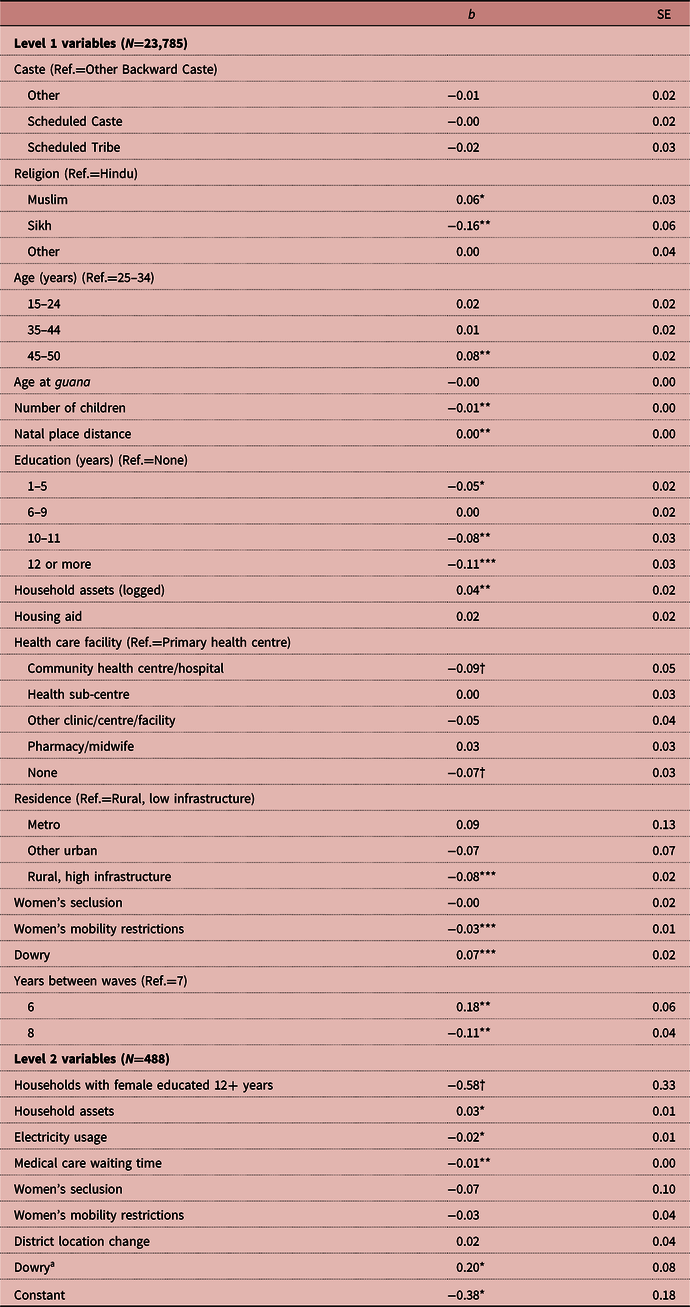
Table 2 presents results from the multilevel linear regression of change in poor health on change in district-level dowry-giving. The model estimated the association between Wave 1 to Wave 2 changes in district-level dowry prevalence and Wave 1 to Wave 2 changes in poor health, net of controls for district mobility, time and other Level 1 and Level 2 characteristics. The results showed that increases in district-level dowry prevalence were significantly associated with increases in women’s poor health (p<0.05) across waves. It is important to emphasize that this contextual association between increased district-level dowry prevalence and increased levels of poor health over time was net of the passage of time between waves, whether respondents changed districts between waves and key covariates including socioeconomic status, state of residence fixed-effects and local infrastructure measures.
Multilevel linear model of change in poor self-rated health among ever-married women

Source: India Human Development Survey 2004–05, 2011–12.
a Wave 1−Wave 2 change score. State of residence indicators are included in model but not shown. b=unstandardized coefficient; SE=standard error.
***p<0.001, **p<0.01, *p<0.05; †p<0.10.
Discussion
Gender scholars have highlighted the salience of gendered practices in constituting local institutions and shaping women’s lives (Martin, Reference Martin2004). Prior theory and evidence has indicated that geographic variations in dowry practice are important for a range of women’s demographic outcomes. The current study significantly advanced this literature by examining changes in local dowry prevalence and changes in Indian women’s overall poor health using nationally representative multilevel panel data. Results showed that increases in local dowry-giving were associated with increases in women’s poor health. Notably, this relationship remained robust when controlling for potentially confounding individual and contextual characteristics such as socioeconomic status (SES), local infrastructure, geographic mobility and state of residence.
These results support and expand a growing literature on the consequences of dowry for individual well-being (Rastogi & Therly, Reference Rastogi and Therly2006; Naved & Persson, Reference Naved and Persson2010; Acharya et al., Reference Acharya, Sabarwal and Jejeebhoy2012; Jeyaseelan et al., Reference Jeyaseelan, Kumar, Jeyaseelan, Shankar, Yadav and Bangdiwala2015; Stroope, Reference Stroope2015a), and has implications for social structural and status-related theories of health determinants. Fundamental cause theory looks to broader structural determinants of health and argues that prestige ‘is one of the core resources people draw on to improve their health, and thus the theory directly ties status to health outcomes’ (Phelan et al., Reference Phelan, Lucas, Ridgeway and Taylor2014, p. 22). Extending these insights, the current study finds that the local prevalence of a gendered practice associated with prestige and status – especially prestige for men (Roulet, Reference Roulet1996) – is linked to poor health for women. This finding joins research showing how overall status-seeking behaviour, especially of a higher-status group (e.g. men), may harm the health of a lower-status group in society (e.g. women) (Lukachko et al., Reference Lukachko, Hatzenbuehler and Keyes2014; Stroope, Reference Stroope2015b). Indeed, if groups can inadvertently shape – for good or ill – their own health through status-seeking dispositions and behaviour (Cockerham, Reference Cockerham2008), so too might they shape the health of others. A dominant group may exert symbolic power through practices (e.g. dowry) that impute legitimacy into the power-relationship between the dominant and subordinate group (Bourdieu, Reference Bourdieu1990). In this way, members of a dominant group need not necessarily engage in direct interpersonal discrimination to affect subordinate group members’ health. Enacting symbolic power through cultural practices can be enough to reinforce social structures injurious to subordinate group members’ health.
If group-level status-seeking behaviour maintains power differentials benefiting a dominant group at the expense of a subordinate group’s health, one task going forward is to examine potential intervening mechanisms. As with other research on gendered structures and structural discrimination (Lukachko et al., Reference Lukachko, Hatzenbuehler and Keyes2014; Stroope & Baker, Reference Stroope and Baker2018), the mechanisms through which biased contexts influence health are not well understood. Future research that explains the operative mechanisms will advance knowledge regarding how gendered structures can shape health. The present study underscores the importance of this task and the value of undertaking this research in diverse cultural settings.
Prestige and social status are among the ‘core’ determinants of health (Wilkinson & Pickett, Reference Wilkinson and Pickett2009; Phelan et al., Reference Phelan, Lucas, Ridgeway and Taylor2014, p. 22); one mechanism particularly worthy of future study is how local dowry prevalence fosters status inequality, which negatively affects health. Prior scholarship suggests that gendered practices such as dowry-giving can enhance status (Srinivas, Reference Srinivas1977). Local areas where such status-enhancing gendered practices are widespread may indicate the presence of local status inequality and heightened status seeking (Dickerson & Kemeny, Reference Dickerson and Kemeny2004; Seeman et al., Reference Seeman, Stein Merkin, Karlamangla, Koretz and Seeman2014). If this is the case, then the current study’s findings may speak to debates about measurement of local status inequality in relation to health. Income inequality is often used to measure local status inequality, but status inequality is about much more than income comparisons (Goldthorpe, Reference Goldthorpe2010; Layte & Whelan, Reference Layte and Whelan2014; Präg et al., Reference Präg, Mills and Wittek2014). This may be especially true in countries such as India where forms of consumption and gendered practices such as dowry are important symbolic resources, which can be more effective than income in signalling status (Roulet, Reference Roulet1996).
Several strengths and limitations in the current study suggest potentially fruitful avenues of inquiry for future research. First, this study was focused in its examination of change in global self-rated health – a powerful health indicator. Self-rated health is among the strongest predictors of mortality, physical health and mental health, and includes biological, social and psychological dimensions of health (Larsson et al., Reference Larsson, Hemmingsson, Allebeck and Lundberg2002; Frankenberg & Jones, Reference Frankenberg and Jones2004; Jylhä, Reference Jylhä2009). Self-rated health is also advantageous in that it reduces measurement error associated with diagnosis of disease variability across sub-populations (Gornick et al., Reference Gornick, Eggers, Reilly, Mentnech, Fitterman and Kucken1996). Using data from India, researchers have found that self-rated health is a valid indicator as assessed through its inverse association with SES (Subramanian et al., Reference Subramanian, Subramanyam, Selvaraj and Kawachi2009). Though beyond the scope of the current analysis, future research can assess and build on the present results in the context of other specific health outcomes such as psychological distress, biomarker measures and life expectancy.
Second, like most multilevel studies, this study was limited by its use of available administrative geographic units, which could be potentially improved upon by using novel geographic units available in localized samples (e.g. Luke & Xu, Reference Luke and Xu2011). Additionally, analyses of rural villages and micro-social contexts (e.g. households) could add important insight on this topic. Third, though this study was the most comprehensive longitudinal examination of the relationship between local dowry prevalence and adult women’s health in India to date, the measurement of dowry prevalence is at a relatively early stage of development. The validity of the dowry measure is a strong point of this study’s data (Desai & Andrist, Reference Desai and Andrist2010; Desai et al., Reference Desai, Dubey, Joshi, Sen, Shariff and Vanneman2010); however, even more granular measurement and additional measurement strategies could be employed to yield further insights into how local dowry practices get ‘under the skin’ to influence health (McFarland et al., Reference McFarland, Hayward and Brown2013, p. 376). Although this analysis specified a contextually relevant input to Indian women’s health (dowry prevalence), dowry is not unique to India. Dowry is practised in various forms and is interwoven in societies spanning from North Africa to East Asia (Skinner, Reference Skinner, Kertzer and Fricke1997). Though it is possible that dowry practice may take a unique form in the Indian sub-continent, this remains a matter for empirical study. Research in this area would be advanced by examining dowry practice and its effects on health in other countries where it is prevalent such as other countries in Asia, Africa and among diaspora communities.
Policy implications also potentially follow from the results of this study. Dowry has long been deemed unlawful in India and has been the focus of substantial public activism (Purkayastha et al., Reference Purkayastha, Subramaniam, Desai and Bose2003). Public opinion data also indicate widespread concern, with roughly two-thirds of Indian women expressing disapproval of dowry in regional data (Srinivasan & Lee, Reference Srinivasan and Lee2004). Despite legal and public opposition, dowry has grown in modern India (Anderson, Reference Anderson2003). Renewed calls have been made for more-effective enforcement of dowry prohibition laws and promotion of cultural norms favourable to the status of women in Indian society (Srinivasan & Lee, Reference Srinivasan and Lee2004). Public health interventions to improve population health frequently target health care, pharmacological treatment, sanitation, nutrition and exercise. The results of this analysis suggest that the prevalence of a growing gendered cultural practice – dowry-giving – may also be a contributing factor in poor population health for women. This study can contribute to public health interventions by emphasizing the public health costs of dowry practice. More specifically, it has identified women who reside in areas with high prevalence of dowry-giving as a vulnerable population for whom allocation of health resources and programmatic initiatives may be especially warranted. Additionally, public health education campaigns targeted at changing the cultural beliefs undergirding dowry practices could contribute to long-term change and health promotion.
In conclusion, population health research has a tradition of tying residential context characteristics (e.g. social capital, perceived local disorder and economic disadvantage) to health and well-being. The current study has underscored the value of a cultural focus by emphasizing a gendered element of residential contexts. Though local characteristics such as economic disadvantage can certainly have cultural dimensions, widespread gendered practices such as dowry-giving in India more closely instantiate a complex cultural nexus that reflects and upholds local gender relations. This study illustrates the utility of tying health to contexts while incorporating the importance of local social norms. More focused attention to symbolic elements of contexts may prove a beneficial direction for understanding how local culture can shape diverse health outcomes around the world.
Acknowledgments
The authors thank Dee Anne Anderson, Paul Froese, Jeff Levin, Jerry Park, Chris Pieper, Jessica Stroope, Brian Thiede and Charlie Tolbert for comments on an earlier draft. An earlier version of this paper was presented at the 2014 meeting of the Population Association of America in Boston, MA, USA.
Funding
The National Science Foundation provided funding to the first author for this research through an SBE Doctoral Dissertation Research Improvement Grant (SES-1203263). The India Human Development Survey 2004–2005 was funded by the US Department of Health and Human Services, National Institutes of Health, Eunice Kennedy Shriver National Institute of Child Health and Human Development (R01HD041455, R01HD046166). The data collection was funded by grants R01HD041455 and R01HD046166 from the National Institutes of Health to the University of Maryland.
Conflicts of Interest
The authors have no conflicts of interest to declare.
Ethical Approval
The authors assert that all procedures contributing to this work comply with the ethical standards of the relevant national and institutional committees on human experimentation and with the Helsinki Declaration of 1975, as revised in 2008.