Introduction
The genus Metaxonchium is a widespread dorylaimid taxon, recorded repeatedly in the USA and Europe (Czech Republic, Hungary, Netherlands, Romania, Serbia, Spain, Switzerland and the former Yugoslavia), but also known in Africa (South Africa), Asia (India, Iran, Japan and South Korea), Central America (Costa Rica) and New Zealand (unpubl.). Its taxonomy was the subject of a contribution by Peña-Santiago et al. (Reference Peña-Santiago, Niknam, Álvarez-Ortega and Jabbari2014), who listed a total of 25 valid species, two synonyms and one species inquirenda, and provided a key to their identification.
The occurrence of Metaxonchium species in tropical America is limited to M. micans (Thorne, 1939) Andrássy, 1996, six females of which were reported by Loof & Zullini (Reference Loof and Zullini2000) from Costa Rican rainforests. A nematological survey conducted in 2016 in natural and semi-natural areas of this country yielded an interesting sample belonging to this genus. Its detailed study revealed that it belongs to a non-described species, which is presented in the following, including the first molecular analysis of a representative of the genus.
Materials and methods
Sampling, extraction, mounting and drawing
Soil samples were collected during July and August 2016 at Bajos del Toro, Valverde Vega and San Vicente, Ciudad Quesada, both in Alajuela province, Costa Rica. Five soil samples were taken in an area of 50 m2. Each sample was a composite of ten cores, taken 1 m away from each other to a depth of 15 cm, with a 5-cm-diameter Dutch auger. The samples were transported in labelled plastic bags to the Laboratorio de Nematología of the Instituto Tecnológico de Costa Rica, Sede San Carlos and processed.
Nematodes were extracted from five subsamples of 100 g of soil each, using the protocol described by the California Department of Food and Agriculture (CDFA, 2015), killed by heat, fixed in formaldehyde 4% solution, processed to pure glycerin using Seinhorst's method (Seinhorst, Reference Seinhorst1966), and mounted on permanent glass slides to allow handling, observation and measuring.
Measurements were obtained using a micrometric eyepiece and/or a drawing tube attached to an Olympus BHS light microscope (Olympus, Tokyo, Japan). Some of the best preserved specimens were photographed with a Nikon Eclipse 80i microscope and a Nikon DS-U1 control box (Nikon, Tokyo, Japan). Raw photographs were edited using Adobe® Photoshop® CS. After their examination and identification, a single specimen preserved in glycerin was re-processed for its observation by scanning electron microscopy (SEM) following the protocol by Abolafia & Peña-Santiago (Reference Abolafia and Peña-Santiago2005). The nematode was hydrated in distilled water, dehydrated in a graded ethanol and acetone series, critical-point dried, coated with gold, and observed with a Zeiss Merlin microscope (Carl Zeiss, Jena, Germany).
DNA extraction, PCR and sequencing
Nematode DNA was extracted from single individuals as described by Castillo et al. (Reference Castillo, Vovlas, Subbotin and Troccoli2003), and the D2–D3 expansion segments of 28S rDNA were amplified using the D2A (5′-ACAAGTACCGTGAGGGAAAGTTG-3′) and D3B (5′-TCGGAAGGAACCAGCTACTA-3′) primers (De Ley et al., Reference De Ley, Felix, Frisse, Nadler, Sternberg and Thomas1999). The polymerase chain reaction (PCR) was performed using 2 μl of the extracted DNA and a PCR mix containing 1 × PCR buffer (Dream Taq™ buffer), 200 m of each deoxyribonucleoside triphosphate (dNTP), 0.4 μm of each primer, 2 mm of MgCl2 and 1.25 U of Dream Taq DNA polymerase (Thermo Fisher Scientific, Waltham, Massachusetts, USA) to a final volume of 25 μl. Amplification conditions consisted of an initial denaturation at 94°C for 4 min; followed by 35 cycles of denaturation at 94°C for 1 min, annealing at 55°C for 90 s and extension at 72°C for 2 min. A final extension was performed at 72°C for 5 min. PCR products were purified using the Wizard® SV Gel and PCR Clean-Up System kit (Promega, Madison, Wisconsin, USA), quantified with a Nanodrop spectrophotometer and directly sequenced in both directions using the primers referred to above. The sequencing reactions were performed using the sequencing service from Macrogen Inc. (Korea). The newly obtained sequences were submitted to the GenBank database under accession numbers MG018767, MG018768 and MG018769.
Phylogenetic analyses
The newly obtained sequences were aligned with other dorylaimid 28S rRNA gene sequences available in GenBank using MUSCLE (Edgar, Reference Edgar2014). Outgroup taxa used for phylogenetic reconstruction were those used by Peña-Santiago et al. (Reference Peña-Santiago, Abolafia, Álvarez-Ortega, Ye and Robbins2013). Sequence alignments were visualized using BioEdit (Hall, Reference Hall1999) and edited by Gblocks ver. 0.91b (Castresana, Reference Castresana2000) using options for a less stringent selection (minimum number of sequences for a conserved or a flanking position: 50% of the number of sequences + 1; maximum number of contiguous non-conserved positions: 8; minimum length of a block: 5; allowed gap positions: with half). Phylogenetic analyses were performed with Bayesian inference (BI) and Maximum Likelihood (ML) methods using MrBayes 3.2.6 (Ronquist et al., Reference Ronquist, Teslenko, van der Mark, Ayres, Darling, Höhna, Larget, Liu, Suchard and Huelsenbeck2012) and MEGA 6 (Tamura et al., Reference Tamura, Stecher, Peterson, Filipski and Kumar2013), respectively. The best fit model of DNA evolution was obtained using jModelTest v2.1.10 (Darriba et al., Reference Darriba, Taboada, Doallo and Posada2012) with the Akaike information criterion (AIC). The best-fit model, a general time-reversible model with invariable sites and a gamma-shaped distribution (GTR + I + G) was used in BI. The Bayesian analysis was initiated with a random starting tree and run with four Metropolis-coupled Markov chain Monte Carlo (MCMC) cycles for 2 × 10⁶ generations. The MCMC were sampled at intervals of 100 generations. Two runs were performed for each analysis. After discarding burn-in samples and evaluating convergence, the remaining samples were retained for further analyses. The topologies were used to generate a 50% majority rule consensus tree. Posterior probabilities (PP) are given on appropriate clades. ML analysis was implemented under the same evolutionary model as in BI, and 1000 bootstrap replications. The trees were visualized with the program FigTree v 1.4.3 (http://tree.bio.ed.ac.uk/software/figtree/) and drawn with Adobe Acrobat XI Pro 11.0.1.
Results and discussion
Metaxonchium toroense n. sp.
Description
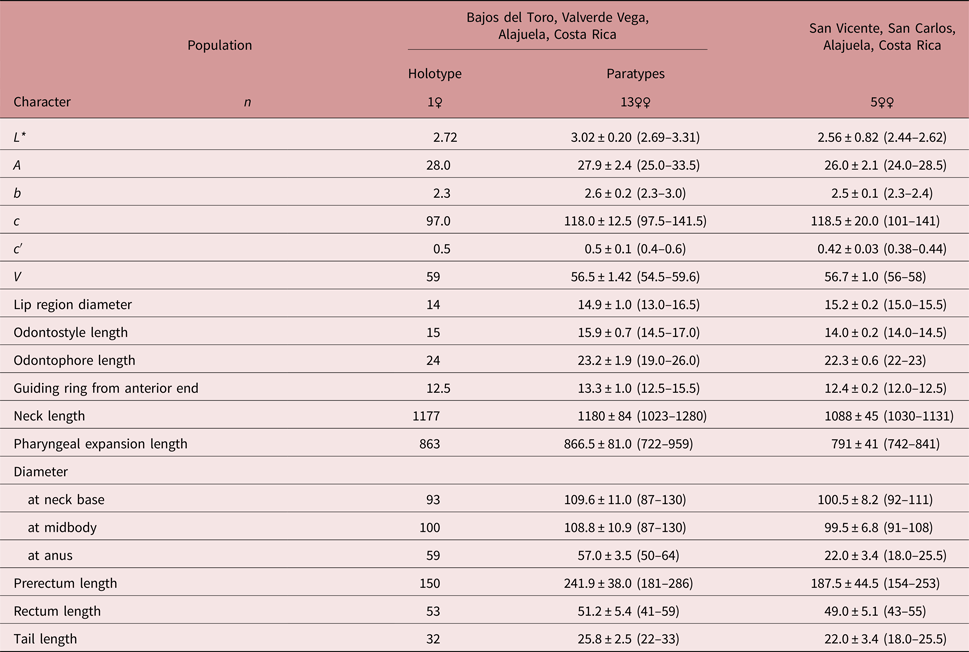
Morphometrics. See table 1.
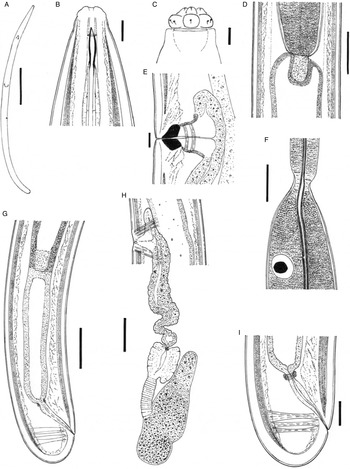
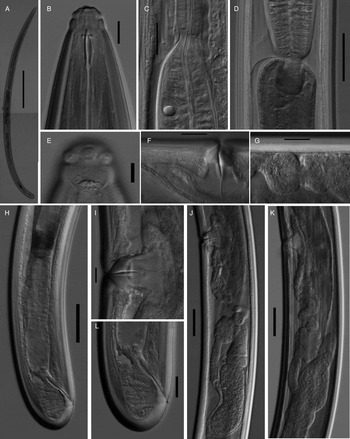
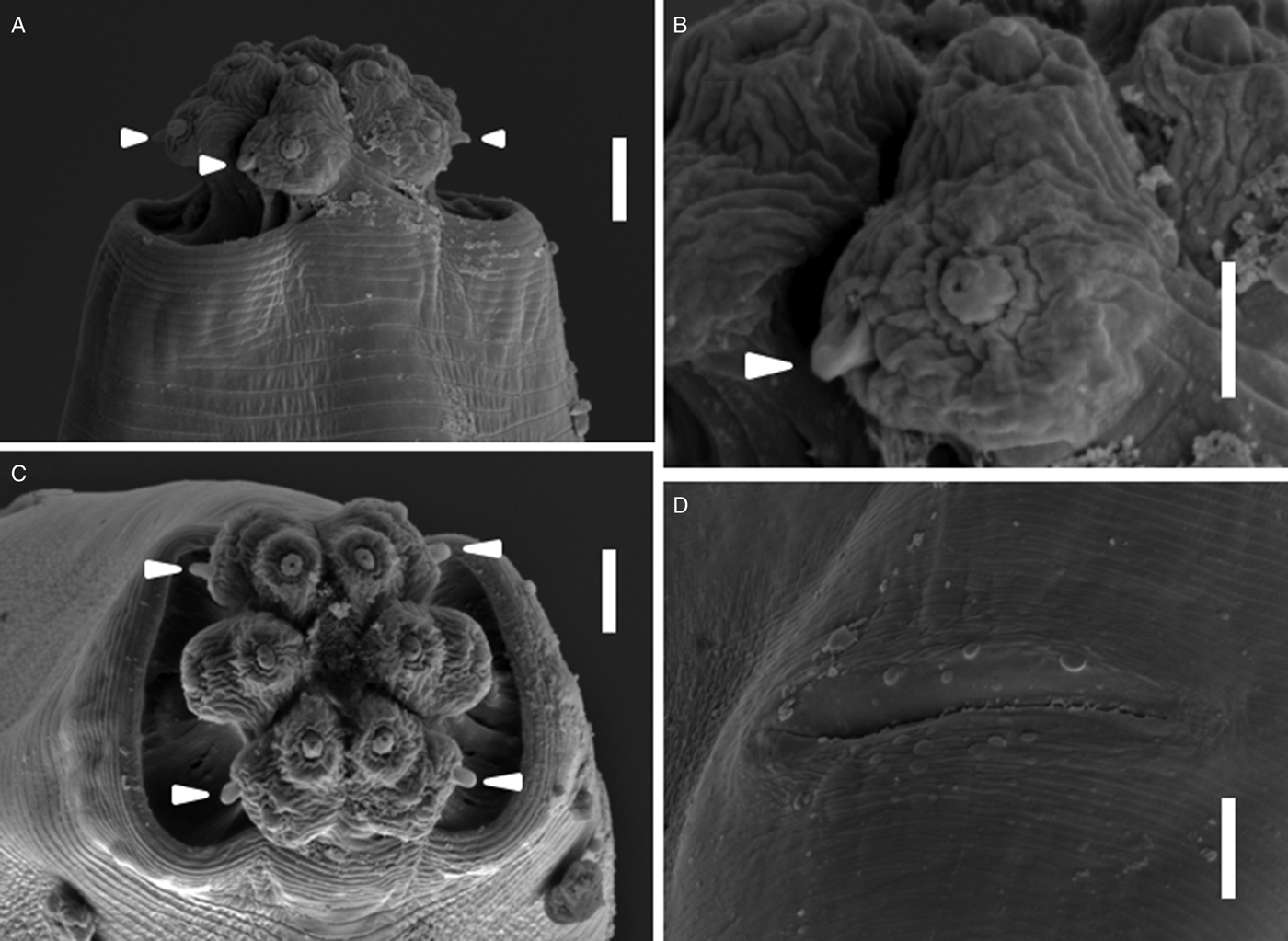
Female. See figs 1–3. Moderately slender to slender nematodes (a = 24–34) of medium to large size, 2.45–3.31 mm long. Body cylindrical, visibly tapering towards the anterior end, less so towards the posterior end, since the caudal region is short and rounded. Upon fixation, habitus curved ventrad, to a more or less open ‘C’ shape. Cuticle two-layered, 4.5–6.5 μm thick at the anterior region (at level of odontostyle), 4.5–8.0 μm in mid-body and 7.5–12.0 μm on dorsal side of tail; outer layer thin, with constant thickness throughout the body, nearly smooth under LM but showing fine but distinct transverse striation (fig. 3A) when observed by SEM; inner layer much thicker than the outer one, especially obvious at caudal region where it bears visible radial striation. Lateral chord very narrow, nearly indistinguishable. Body pores obscure in general. Lip region cap-like, offset by constriction, 1.5–2.6 times as broad as high and less than one-sixth (12–17%) of body diameter at neck base. SEM observations (fig. 3): lips distinctly separated by very deep radial incisures, their inner part differentiated in perioral liplets, which, however, are not distinctly offset from their respective outer part; labial papillae low, button-like, not interfering with the labial contour, and surrounded by one or two concentric incisures; cephalic papillae much more protruding than the labial ones, appearing as short, bevelled, tube-like structures; oral opening not observed with sharpness, but apparently a small oval orifice; oral field comparatively small as the perioral liplets are close to the oral orifice. Body visibly narrower than the adjacent body a very short (about 4 μm) distance behind the lip region. Amphidial fovea cup-like, its aperture 6.5–9.5 μm wide or occupying up to four-fifths of lip-region diameter. Cheilostom a truncate cone, lacking any differentiation. Odontostyle small, somewhat fusiform, 3.0–5.5 times as long as wide, hardly longer (1.0–1.2 times) than lip-region diameter, and 0.44–0.60% of body length; aperture 4.5–6.5 μm long, occupying one-third of total length. Guiding ring thin, simple but visibly refractive, at 12.5–15.5 μm or 0.7–1.0 times the lip region diameter from the anterior end. Odontophore rod-like, bearing a very weak thickening at about its middle. Pharynx consisting of a slender and weakly muscular anterior portion, separated from the basal expansion by a short isthmus-like narrowing, and lacking any other differentiation; basal expansion 10–18 times as long as broad, 6.0–9.7 times longer than body diameter at neck base, and occupying up to three-quarters (69–76%) of total neck length; a very distinct spiral muscular sheath, with nearly straight muscular bands, envelopes the whole basal expansion; gland nuclei obscure except that of dorsal gland (DN) that is located at 29–30% of total neck length from the anterior end, with its outlet (DO) very close to it. Cardia tongue-like, 31–52 × 27–40 μm, surrounded by a thick cover of intestinal tissue. Genital system monodelphic–opisthodelphic. Anterior branch reduced to a uterine sac 22–57 μm long, up to one-half of body diameter or 1–2% of body length. Posterior branch 212–422 μm long or 6–13% of total body length, with reflexed ovary 84–275 μm long and oocytes arranged first in several rows and then in a single row; oviduct joining the ovary subterminally, 43–221 μm long or 0.4–2.1 times body diameter, and consisting of a tubular part made of prismatic cells and a well-developed pars dilatata with perceptible lumen; a distinct sphincter separating oviduct and uterus; uterus 162–205 μm or 1.5–1.9 times the body diameter – these morphometrics, however, should be taken with caution as the uterus often appears more or less convoluted – and tripartite, i.e. differentiated into a relatively long and thick proximal region with very wide lumen, a short and narrow intermediate region, and a large spherical distal pars dilatata; vagina 39–53 μm long, extending inwards less than one-half (32–49%) of the corresponding body diameter; pars proximalis, 22–30 × 23–40 μm, with weakly (distally) divergent walls and surrounded by moderately developed, circular musculature; pars refringens (in lateral view) consisting of two trapezoidal pieces measuring 14–22 × 7–15 μm and with a combined width of 18–32 μm; pars distalis 4.5–10.0 μm long; vulva a somewhat posterior, c. 15 μm long, transverse slit. Prerectum 2.5–4.9 and rectum 0.7–1.1 anal body diameters long. Caudal region short and rounded to hemispheroid; caudal pores two pairs at the middle of tail, one sublateral, another subdorsal.
Male. Unknown.
Metaxonchium toroense n. sp. from Costa Rica (female). (A) Entire; (B) anterior region in lateral, median view; (C) lip region in lateral surface view; (D) pharyngo-intestinal junction; (E) vagina; (F) pharyngeal enlargement; (G) posterior body region; (H) genital system; (I) caudal region. Scale bars: (A) 500 μm; (B, E) 10 μm; (C) 5 μm; (D, G, H) 50 μm; (E) 5 μm; (F, I) 20 μm.

Metaxonchium toroense n. sp. from Costa Rica (female, light microscopy). (A) Entire; (B) anterior region in lateral, median view; (C) pharyngeal isthmus; (D) pharyngo-intestinal junction; (E) lip region in lateral surface view; (F, I) vagina; (G) oviduct–uterus junction; (H) posterior genital branch; (J, K) genital system; (L) caudal region. Scale bars: (A) 500 μm; (B, I) 10 μm; (C, F, G, L) 20 μm; (D, H, J, K) 50 μm; (E) 5 μm.

Metaxonchium toroense n. sp. from Costa Rica (female, scanning electron microscopy). (A) Lip region in ventral view; (B) detail of right subventral lip, showing the peculiar shape of cephalic papillae; (C) detail of right subventral lip in face view; (D) vagina. Arrowheads in (A)–(C) point at cephalic papillae. Scale bars: (A, C) 2 μm; (C) 1 μm; (D) 4 μm.

Morphometrics of Metaxonchium toroense n. sp. All measurements are in μm, except L which is in mm, and in the form: mean ± SD (range).

* L to V are Demanian ratios: L = body length in mm; a = body length/maximum width; b = body length/neck length; c = body length/tail length; c′ = tail length/body diameter at anus; V = distance from anterior end to vulva as a percentage of total body length.
Taxonomic summary
Etymology. The specific epithet refers to Bajos del Toro, the type locality of the new species.
Type locality and habitat. Costa Rica, Alajuela province, Valverde Vega, Bajos del Toro (10°12′56″N latitude, 84°12′52″W longitude, altitude 1653 m asl), in soil of a pre-montane tropical forest. This locality is situated within the Parque Nacional del Agua.
Other locality and habitat. Costa Rica, Alajuela province, San Carlos, Ciudad Quesada, San Vicente (10°16′45″N latitude; 84°22′47″W longitude, altitude 1687 m asl), in soil of a combined species plantation encompassed by eucalyptus (Eucalyptus sp.) and cypress (Cupressus lusitanica). This locality is also situated within the Parque Nacional del Agua.
Type material. Eleven females (holotype and ten paratypes) deposited with Laboratorio de Nematología, Instituto Tecnológico de Costa Rica. Three female paratypes with University of Jaén (Spain) nematode collection.
Molecular characterization
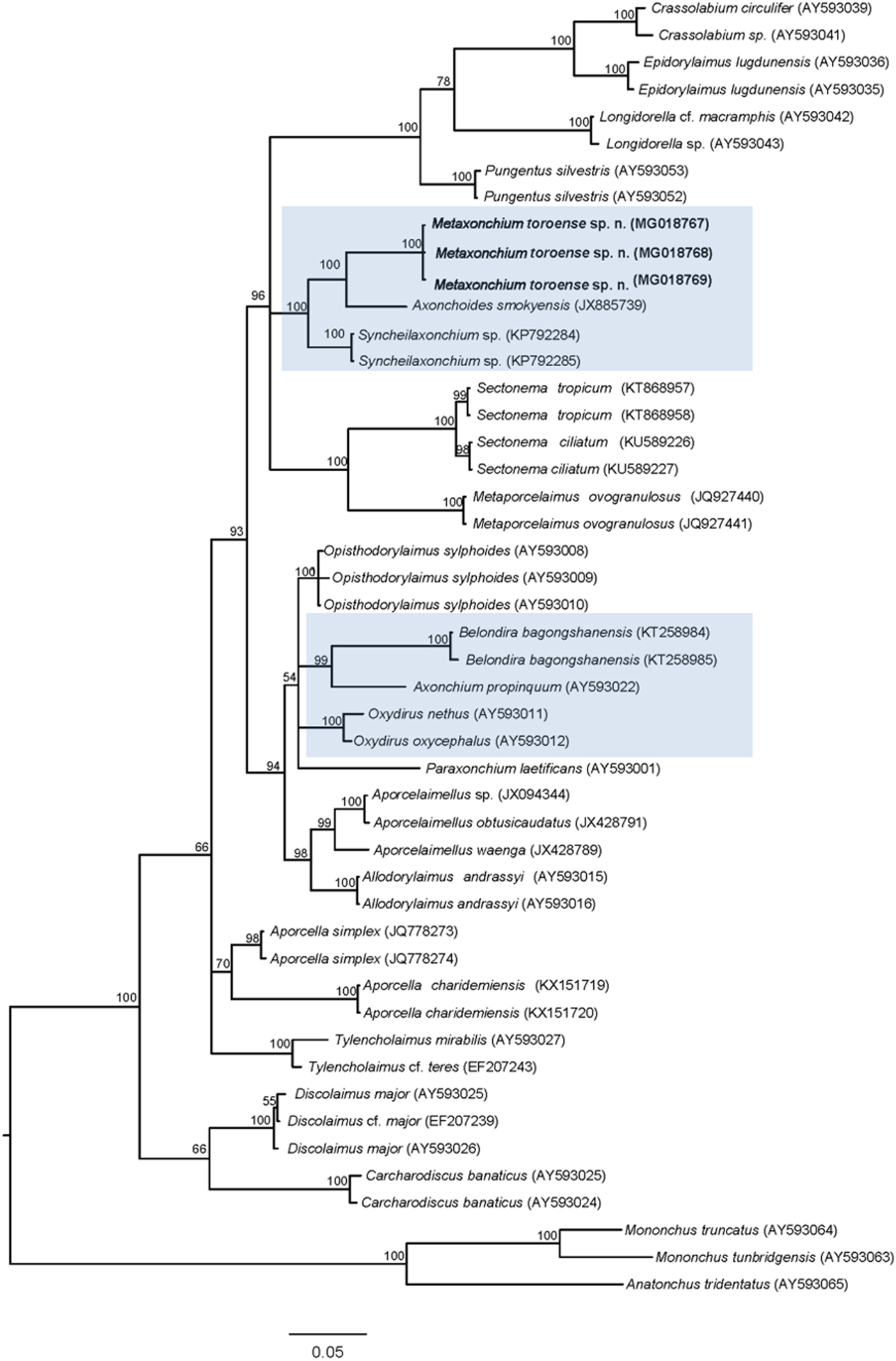
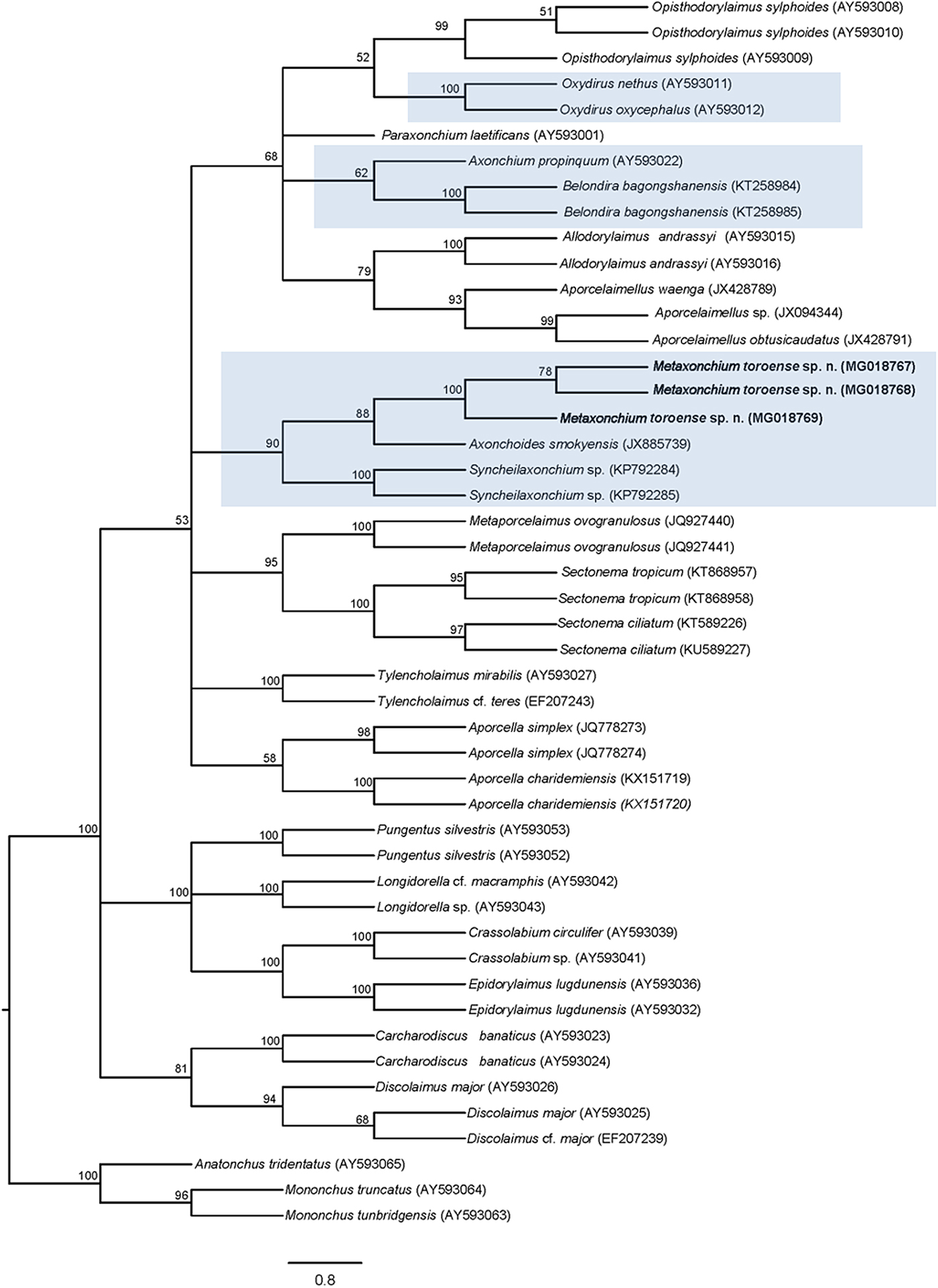
Three D2–D3 28S rDNA sequences were obtained, each 707 bp long. These are the first sequences to be obtained for a Metaxonchium representative. Their analysis has allowed us to explore the evolutionary relationships of the genus. The results are presented in figs 4 and 5 and are discussed below.
Phylogenetic relationships of Metaxonchium toroense n. sp. Bayesian 50% majority rule consensus tree as inferred from D2–D3 expansion segments of 28S rDNA sequence alignments under the GTR + G + I model. Posterior probabilities are given for appropriate clades. Newly obtained sequences are indicated by bold letters. Belondirid clades are highlighted.

Phylogenetic relationships of Metaxonchium toroense n. sp. Maximum Likelihood tree as inferred from D2–D3 expansion segments of 28S rDNA sequence alignments under the GTR + G + I model. Bootstrap values are given for appropriate clades. Newly obtained sequences are indicated by bold letters. Belondirid clades are highlighted.

Diagnosis and relationships
Metaxonchium toroense n. sp. is characterized by its 2.44–3.31 mm body length (range including both populations), lip region offset by constriction and 13.0–16.5 μm wide, odontostyle fusiform and 14–17 μm long, neck 1023–1280 μm long, both parts of the pharynx separated by a short, isthmus-like narrowing, pharyngeal expansion 722–959 μm long and occupying 69–76% of the total neck length, female genital system monodelphic–opisthodelphic, anterior genital branch reduced to a short uterine sac 22–57 μm long or 1–2% of body length, posterior uterus long and tripartite without apophyses (non-echinophor), distance from anterior end to vulva as a percentage of total body length (V) = 55–60, caudal region short and rounded to hemispheroid (18–32 μm, body length/tail length (c) = 97–141, tail length/body diameter at anus (c′) = 0.4–0.6), and male absent.
In having a comparatively large general size (body length more than 2.4 mm), odontostyle up to 17 μm long and non-echinophor uterus, the new species resembles M. coronatum (Thorne & Swanger, 1936) Coomans & Nair, 1975; M. coxi (Yeates, 1979) Peña-Santiago et al., 2014; M. serpens (Thorne, 1939) Andrássy, 1996; and M. zealandicum (Naz et al., 2007) Peña-Santiago et al., 2014 (see the updated key to species identification by Peña-Santiago et al., Reference Peña-Santiago, Niknam, Álvarez-Ortega and Jabbari2014). The new species can be easily separated from all of the species listed above, in its stouter body (body length/maximum width (a) = 24–34 vs. a > 35) and the morphology of the anterior genital branch (a short uterine sac up to one-half of body diameter long vs. more developed genital branch, at least 2.5 times the body diameter long). Besides, it differs from M. coronatum in having (vs. lacking) perioral liplets, pars distalis vaginae not surrounding (vs. atypically surrounding) the pars refringens, and male absent (vs. present); from M. coxi in its shorter (c′ = 0.5–0.6 vs. c′ = 0.7–0.8) and rounded to hemispheroid (vs. more conoid) female tail; from M. serpens in its more posterior vulva (V = 55–60 vs. V = 47–55, n = 16), more rounded to hemispheroid (vs. conoid) female tail, and male absent (vs. present); and from M. zealandicum in its shorter (c′ = 0.5–0.6 vs. c′ = 0.7–0.8) and rounded to hemispheroid (vs. more conoid) female tail, and male absent (vs. present).
Evolutionary relationships of Metaxonchium as derived from molecular analyses
The phylogeny of M. toroense n. sp. is shown in two trees obtained using BI and ML methods (figs 4 and 5, respectively) based upon partial sequences of 28S rDNA D2–D3. As already mentioned, no other Metaxonchium sequence is available for comparative purposes, so the internal phylogeny of this taxon is impossible to discuss yet. The most relevant result of the present molecular analysis is the confirmation of a close relationship among Metaxonchium and other belondirid genera with remarkable morphological similarity, namely Axonchoides and Syncheilaxonchium, as all of them are positioned in a highly supported clade in both trees. Actually, Metaxonchium and Syncheilaxonchium were originally proposed by Coomans & Nair (Reference Coomans and Nair1975) as subgenera of Axonchium. Another remarkable novelty is the position of Axonchoides smokyensis, the evolutionary relationships of which were not satisfactorily elucidated in its original description by Peña-Santiago et al. (Reference Peña-Santiago, Abolafia, Álvarez-Ortega, Ye and Robbins2013). The relationships of this belondirid clade with other dorylaimida taxa significantly differ, however, when the two trees are compared. The BI tree shows that the belondirid clade forms a highly supported clade with members of the families Aporcelaimidae (Sectonema and Metaporcelaimus species), Dorylaimidae (Crassolabium species), Nordiidae (Longidorella and Pungentus species) and Qudsianematidae (Epidorylaimus lugdunensis), which is not confirmed in the ML tree.
More difficult to explain, but not surprising, is the separate position of the previous belodirid taxa from the remaining representatives of Belondiridae in the tree, namely Belondira bagongshanensis, Axonchium propinquum, Oxydirus nethus and O. oxycephalus, whose internal and external evolutionary relationships are not resolved in either of the two trees, where they form an unsupported clade with members of the families Aporcelaimidae (Aporcelaimellus species), Qudsianematidae (Paraxonchium laetificans) and Thornenematidae (Opisthodorylaimus sylphoides). This suggests the possible existence of at least two recognizable evolutionary lines within Belondiridae. In this context, the position of the representative of the genus Axonchium is especially notable, being, morphologically very similar to the first clade of belondirid taxa, which should be the subject of deeper analyses when other sequences are available.
Finally, the trees do not reveal any further novelty regarding the phylogeny of Dorylaimina. Thus, the systematics of this group remains unsatisfactory.
Acknowledgements
The authors thank the technical staff of ‘Centro de Instrumentación Científico-Técnica (CICT)’, University of Jaén, for their assistance and use of equipment in the SEM study of nematodes.
Financial support
This study was supported financially by the Vicerrectoría de Investigación, Instituto Tecnológico de Costa Rica. The first author (I.V.) received a grant from Ministerio de Ciencia, Tecnología y Telecomunicaciones of Costa Rica and Consejo Nacional para Investigaciones Científicas y Tecnológicas for her stay at the Universidad de Jaén. The second author (R.P.S.) received financial support from Ministerio de Ciencia, Tecnología y Telecomunicaciones of Costa Rica and Vicerrectoría de Investigación, Instituto Tecnológico de Costa Rica, for a short stay at the Instituto Tecnológico de Costa Rica, San Carlos.
Conflict of interest
None.