

Introduction
Crop production on Zambian smallholder farms is constrained by biophysical and socio-economic challenges (Giller et al., Reference Giller, Witter, Corbeels and Tittonell2009; Cobo et al., Reference Cobo, Gerd and Cadisch2010). The soils of Zambia are highly degraded, acidic and low in organic matter and water holding capacity (Mafongoya and Kuntashula, Reference Mafongoya and Kuntashula2005; Muchabi et al., Reference Muchabi, Lungu and Mweetwa2014). Nitrogen (N) and phosphorus (P) are inherently low (Muchabi et al., Reference Muchabi, Lungu and Mweetwa2014) and maize yields are limited to less than 2 t ha−1 on average (Aagaard, Reference Aagaard2007).
The negative impact of low soil fertility on crop production is further aggravated by erratic rainfall distribution during the cropping season (Cook et al., Reference Cook, Reason and Hewitson2004; Tadross et al., Reference Tadross, Hewitson and Usman2005). Significant crop yield reductions and total failure in most years are now a common feature on smallholder farms (Cooper et al., Reference Cooper, Dimes, Rao, Shapiro, Shiferaw and Twomlow2008) and are projected to increase in the next decades (Lobell et al., Reference Lobell, Burke, Tebaldi, Mastrandrea, Falcon and Naylor2008; Cairns et al., Reference Cairns, Hellin, Sonder, Araus, Macrobert, Thierfelder and Prasanna2013). Recently, the El Nino phenomenon in the 2015/16 cropping season affected most of the cereal crops on smallholder farms in the Zambia, Zimbabwe, Malawi and Mozambique, leading to widespread food deficits (Bonifacio, Reference Bonifacio2015; Dawson et al., Reference Dawson, Perryman and Tom2016). Cropping systems that are more resilient to the highly variable rainfall being experienced could be a long-term solution for smallholders in southern Africa (Pretty et al., Reference Pretty, Toulmin and Williams2011; Thierfelder et al., Reference Thierfelder, Matemba-Mutasa, Bunderson, Mutenje, Nyagumbo and Mupangwa2016).
Economically, smallholder farming systems are constrained by high mineral fertilizer prices, and fertilizer use in sub-Saharan Africa is the lowest Worldwide (Morris, Reference Morris2007). Alternative soil fertility amendments such as organic manure are in short supply due to decreasing livestock numbers (Homann-Tui Kee et al., Reference Homann-Tui Kee, Bandason, Maute, Nkomboni, Mpofu, Tanganyika, Van Rooyen, Gondwe, Dias, Ncube, Moyo, Hendricks and Nisrane2013; Nyamushamba et al., Reference Nyamushamba, Mapiye, Tada, Halimani and Muchenje2016) and lack of improved manure handling practices that conserve more nutrients in the manure. Grain legumes offer an alternative for soil fertility improvement but their inclusion in the smallholder farming systems is often limited by lack of improved seed, lack of knowledge on how to grow them as rotational or intercrops, and low producer prices for grain on the output markets (Mazvimavi and Twomlow, Reference Mazvimavi and Twomlow2009; Nyanga, Reference Nyanga2012).
Grain legumes have traditionally been grown either as sole or intercrops with species such as soybean (Glycine max (L.) Merrill) and groundnuts (Arachis hypogaea L.) being favored as sole crops on smallholder farms (Ncube et al., Reference Ncube, Twomlow, Van Wijk, Dimes and Giller2007; Giller et al., Reference Giller, Murwira, Dhliwayo, Mafongoya and Mpepereki2011). When grown in rotation or intercropping systems with cereals, cowpea (Vigna unguiculata (L.) Walp.) and soybean can accumulate between 9–120 and 14–188 kg N ha−1 over their growing cycle, respectively (Giller, Reference Giller2001; Ncube et al., Reference Ncube, Twomlow, Van Wijk, Dimes and Giller2007).
Under conservation agriculture (CA) systems, rotation and intercropping of grain legumes with cereals substantially increase yields under farmers’ conditions (Ngwira et al., Reference Ngwira, Aune and Mkwinda2012a, Reference Ngwira, Thierfelder and Lambertb; Thierfelder et al., Reference Thierfelder, Mutenje, Mujeyi and Mupangwa2014). In land constrained smallholder systems, intercropping of cereals with grain legumes often increases land productivity compared with sole cropping (Rusinamhodzi et al., Reference Rusinamhodzi, Corbeels, Nyamangara and Giller2012; Smith et al., Reference Smith, Snapp, Dimes, Gwenambira and Chikowo2016). In conventional agriculture systems, land equivalent ratios (LER) of 1.01–1.46 have been observed in maize/bean and sorghum/cowpea intercropping systems (Kutu, Reference Kutu2012; Chimonyo et al., Reference Chimonyo, Modi and Mabhaudhi2016). In hand dug basin CA system, LERs of 2.02–2.86 were observed in maize/cowpea intercropping under semi-arid conditions of southern Zimbabwe (Dube et al., Reference Dube, Madanzi, Kapenzi and Masvaya2014). In addition, these legumes contribute towards suppression of parasitic Striga weed species (Striga asiatica L. (Kuntze)) common on degraded soils of sub-Saharan Africa (Kagot et al., Reference Kagot, Okoth, Kanampiu, Okoth and Mageto2014). Grain legumes also increase diversification by spreading the risk of crop failure and increasing sources of income and protein for the farming family (Sanderson et al., Reference Sanderson, Archer, Hendrickson, Kronberg, Liebig, Nichols, Schemer, Tanaka and Aguilara2013).
CA, a cropping system based on the principles of minimum soil disturbance, use of permanent/semi-permanent soil cover and crop rotations/associations (FAO, 2015), has the potential to improve and stabilize crop yields, buffer smallholder cropping systems against highly variable rainfall and increase farm profits in some agro-ecological zones of southern Africa (Ngwira et al., Reference Ngwira, Thierfelder, Eash and Lambert2013; Mupangwa et al., Reference Mupangwa, Mutenje, Thierfelder and Nyagumbo2016). When practiced together, these principles can result in increased crop yields, soil water conservation and improved soil physical and chemical properties under a wide range of agro-ecological conditions (Wall et al., Reference Wall, Thierfelder, Ngwira, Govaerts, Nyagumbo, Baudron, Jat and Graziano de Silva2013). However, in some studies, CA practices neither increased crop yields nor improved soil properties in the short term (Nyamangara et al., Reference Nyamangara, Masvaya, Tirivavi and Nyengerai2013). Economic returns for smallholders investing in CA practices could be limited by some biophysical and socio-economic conditions of southern Africa (Mafongoya et al., Reference Mafongoya, Jiri and Phophi2016), which could make it applicable only for a small proportion of smallholder farmers (Giller et al., Reference Giller, Witter, Corbeels and Tittonell2009). Nevertheless, other findings suggest that CA systems are more profitable than the traditional farmer practices in different agro-ecological zones of southern Africa (Ngwira et al., Reference Ngwira, Aune and Mkwinda2012a, Reference Ngwira, Thierfelder and Lambertb; Ram et al., Reference Ram, Singh, Saini, Kler, Timsina and Humphreys2012; Mupangwa et al., Reference Mupangwa, Mutenje, Thierfelder and Nyagumbo2016).
The suitability of CA or no-tillage systems for a heterogeneous group of smallholders whose farming is centered on mixed crop/livestock production has often been questioned given the farmers’ resource endowment and farming objectives (Giller et al., Reference Giller, Witter, Corbeels and Tittonell2009; Palm et al., Reference Palm, Blanco-Canqui, Declerck, Gatere and Grace2014; Pittelkow et al., Reference Pittelkow, Liang, Linquist, Van Groenigen, Lee, Lundy, Van Gestel, Six, Venterea and Van Kessel2014). Another school of thought is that research and development practitioners should focus beyond CA if low productivity and the need to generate income in the smallholder farming systems are to be properly addressed (Andersson and D'Souza, Reference Andersson and D'souza2013; Giller et al., Reference Giller, Andersson, Corbeels, Kirkegaard, Mortensen, Ernstein and Vanlauwe2015) although another group suggests that the niche for CA is large than we expect (Baudron et al., Reference Baudron, Jaleta, Okitoi and Tegegn2014, Reference Baudron, Thierfelder, Nyagumbo and Gerard2015). Adoption studies on the use of CA practices have shown that smallholders often practice minimum tillage (Ngwira et al., Reference Ngwira, Johnsen, Aune, Mekuria and Thierfelder2014; Manda et al., Reference Manda, Alene, Gardebroek, Kassie and Tembo2015). Less than 30% of smallholders practicing CA in Zimbabwe strategically use crop rotations (Mazvimavi and Twomlow, Reference Mazvimavi and Twomlow2009). Challenges related to limited CA adoption include lack of adequate knowledge on crop production using CA practices, weed pressure during the cropping season where herbicides are not used, and unavailability of appropriate equipment for mechanized CA systems (Wall et al., Reference Wall, Thierfelder, Ngwira, Govaerts, Nyagumbo, Baudron, Jat and Graziano de Silva2013). In agro-ecological zones where CA has been adopted, CA uptake has been driven by reduced labor for land preparation and weeding, increased water harvesting thus reduced negative impact of dry-spells on crops, the realization of high crop yields in the medium term, spreading of household labor during the cropping season and increased farm profits (Nyanga et al., Reference Nyanga, Johnsen, Aune and Kalinda2011; Wall et al., Reference Wall, Thierfelder, Ngwira, Govaerts, Nyagumbo, Baudron, Jat and Graziano de Silva2013; Baudron et al., Reference Baudron, Thierfelder, Nyagumbo and Gerard2015).
In Eastern Zambia, manual dibble stick planting increased the available seeding options for smallholder farmers (Thierfelder et al., Reference Thierfelder, Mwila and Rusinamhodzi2013a, Reference Thierfelder, Chisui, Gama, Cheesman, Jere, Bunderson, Eash, Ngwira and Rusinamhodzib) who had already been introduced to the hand dug planting basins (90 cm × 70 cm × 20 cm spacing) by the Commercial Farmers Union (CFU) (Aagaard, Reference Aagaard2007). Basins are small planting pits dug before the onset of the rain and the sizes vary from 90 cm × 70 cm × 20 cm to 15 cm × 15 cm × 15 cm in southern Africa (Aagaard, Reference Aagaard2007; Twomlow et al., Reference Twomlow, Urolov, Jenrich and Oldrieve2008). Animal traction (AT) ripline and direct seeding systems were introduced to some communities in the eastern province of Zambia in 2011 through the Sustainable Intensification of Maize-Legume Systems for the Eastern Province of Zambia (SIMLEZA) project (Manda et al., Reference Manda, Alene, Gardebroek, Kassie and Tembo2015). The purpose of this paper is to demonstrate the crop yield and economic benefits derived from manual and AT CA systems on smallholder farms where the ridge and furrow tillage system is the traditional practice (Thierfelder et al., Reference Thierfelder, Mwila and Rusinamhodzi2013a, Reference Thierfelder, Chisui, Gama, Cheesman, Jere, Bunderson, Eash, Ngwira and Rusinamhodzib). The study hypothesis was that the use of the dibble stick, AT ripline and direct seeding was more productive and profitable for smallholders currently practicing the ridge and furrow system in Eastern Zambia. The objectives of the study were: (1) to determine the maize (Zea mays L.), cowpea and soybean yields in dibble stick, AT ripline and direct seeding CA systems compared with the ridge and furrow farmer practice, (2) quantify the effects of rotating and intercropping maize with cowpea and soybean on crop yield in CA systems, including LERs, and (3) define the economic benefits of manual and AT CA systems compared with the traditional ridge and furrow system.
Materials and methods
Study site description
The 4-year study was conducted in the Eastern Province of Zambia (Fig. 1). The province lies between latitude 10°–15°S, and longitude 30°–33°E (Mafongoya and Kuntashula, Reference Mafongoya and Kuntashula2005). Daily rainfall was additionally recorded manually from 2012 to 2015 using a rain gauge located at each trial site. Annual rainfall ranges from 750 to more than 1000 mm per annum and its seasonal variability has continued to increase over the years (Chabala et al., Reference Chabala, Kuntashula and Kaluba2013). The rainfall season is unimodal, stretching from November to April and is characterized by in-season dry spells that are more frequent in January/February.
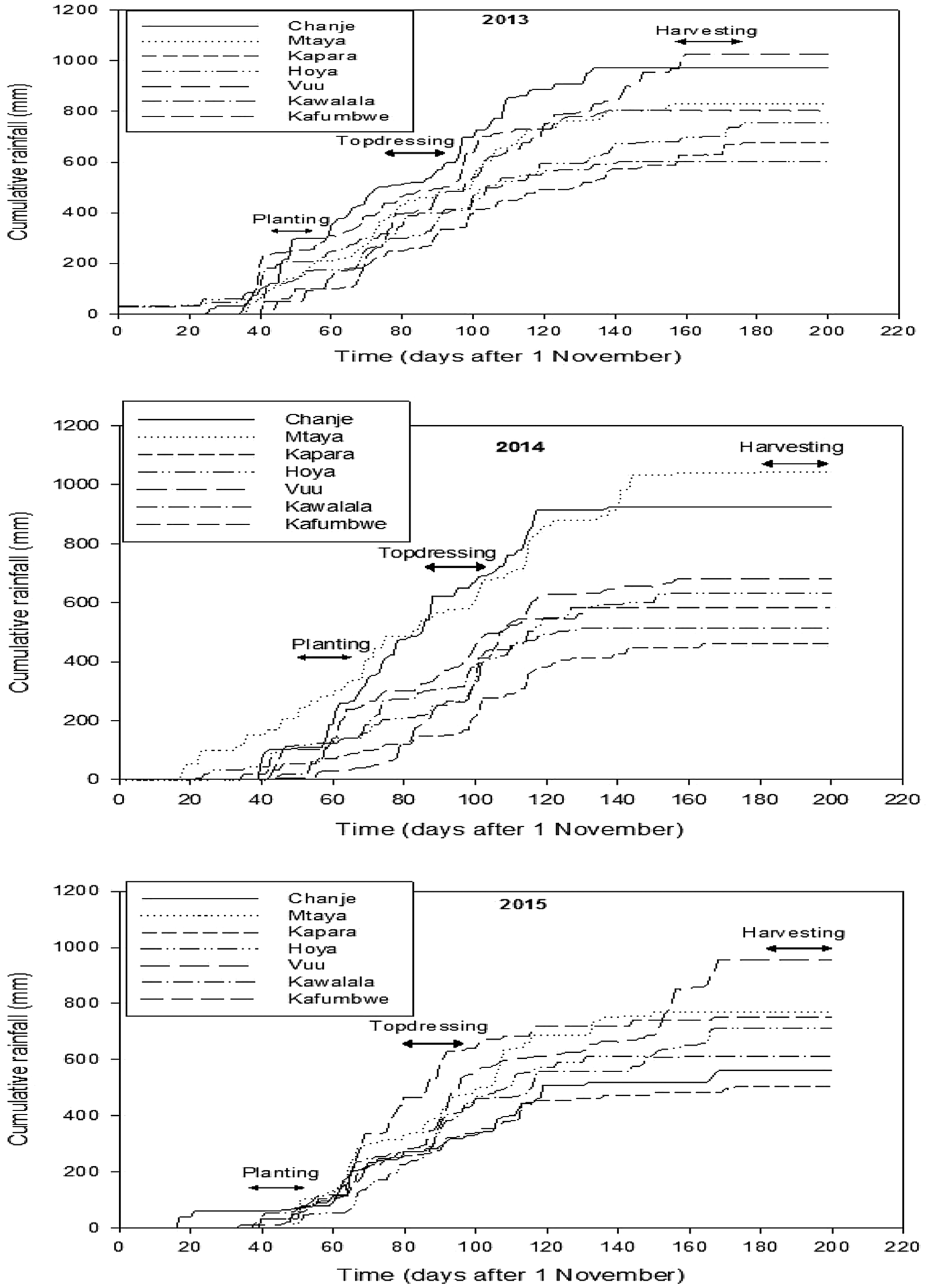
Seasonal rainfall patterns at the seven agricultural camps used for experimentation in 2012/13, 2013/14 and 2014/15 seasons in the Eastern province of Zambia.

During 2012–2015 cropping seasons rainfall was well distributed during the December–February period. The March–April period had erratic rainfall across the experimental sites. In 2012/13 season, the start of growing season differed across the sites with some receiving effective rains at the end of November, a week earlier than the other experimental sites (Fig. 1). Rainfall events of 20 mm or more per day were well distributed during the December–March period and the longest dry spell lasted 12 days. Seasonal rainfall ranged from 602 to 1027 mm in that particular season. The 2013/14 season experienced an early cessation of the rains at all experimental sites. The longest dry spell also lasted 12 days and total seasonal rainfall ranged from 462 to 1045 mm. In 2014/15 season rainfall events of 20 mm or more per day were concentrated in January and February 2015, and dry spells of 18–33 days were experienced in the March–April period. Total seasonal rainfall ranged from 505 to 955 mm.
The maximum daily temperature ranges from 24°C during winter to 32°C during the September–October period (Chabala et al., Reference Chabala, Kuntashula and Kaluba2013). Soils are inherently low in fertility with pH (0.01 M CaCl2) of 4.5–5.5, soil organic carbon of 0.4–1.0 mg kg−1, and exchangeable bases below the critical levels for most crops (Simute et al., Reference Simute, Phiri and Tengnas1998; Mafongoya et al., Reference Mafongoya, Jiri and Phophi2016). Soil texture was variable across the experimental sites where the study was conducted. Chipata has predominantly Luvisols with pockets of Lixisols and Acrisols occurring in some parts of the district (Mafongoya and Kuntashula, Reference Mafongoya and Kuntashula2005). In the Katete and Lundazi districts, the predominant soil types are Alfisols and Acrisols with low water and nutrient holding capacities (Mafongoya and Kuntashula, Reference Mafongoya and Kuntashula2005). The farming system is mixed crop and livestock at subsistence level, and maize is the dominant cereal crop. The dominant grain legumes are cowpea, common beans (Phaseolus vulgaris L.), soybean and groundnuts, and these are often grown as intercrops or in rotation with maize (Nyanga, Reference Nyanga2012; Manda et al., Reference Manda, Alene, Gardebroek, Kassie and Tembo2015). A survey by Mutenje et al. (Reference Mutenje, Kassie, Alene, Malwa, Manda and Chikwekwete2012) showed that 28–30 and 10–15% of cultivated land is often allocated to maize and legumes, respectively, in Chipata, Katete and Lundazi districts. Cattle (Bos indicus L.), goats (Capra hircus L.) and chickens (Gallus domesticus L.) are the major livestock species kept on smallholder farms.
Experimental design and treatments
The on-farm trials were conducted in seven agricultural camps spread across Chipata, Katete and Lundazi districts of the eastern province of Zambia. In each agricultural camp, eight farmers hosted the trial and each farmer was a replicate in each cropping season. The manual dibblestick CA planting was implemented in Chanje, Mtaya, Kafumbwe and Vuu communities of eastern Zambia. The ripline system was implemented in Hoya and Kawalala communities while the direct seeding CA was tested in Kapara. The treatments in each of the three on-farm trial set are described below and each treatment was applied to a 50 m × 20 m plot size at all sites with a 1 m pathway between plots.
Manual dibble stick system
The manual CA system trial consisted of four CA treatments (2–5) and these were compared with a conventional ridge and furrow farmer practice (treatment 1) at each farmer's field. The treatments are summarized below:
(1) Conventional ridge and furrow with continuous sole maize (CRF): ridges were formed before the beginning of each cropping season using hand hoes. The ridges were reformed every cropping season and crop residues were removed before the ridging operation. The ridges were spaced at 90 cm and, on each ridge, maize was planted at 25 cm apart with one plant per station, giving a maize population of 44,444 plants ha−1.
(2) Dibblestick CA system with continuous sole maize (DBM): a pointed stick was used to make holes for planting and basal fertilizer placement through the mulch at seeding. Maize was spaced at 90 cm × 25 cm with one plant per station, giving a target population of 44,444 plants ha−1. Holes for basal fertilizer placement were also drilled adjacent to the maize planting station. At the beginning of each cropping season, 2–3 t ha−1 crop residues (on a dry weight basis) were applied as mulch.
(3) Dibblestick CA system with maize intercropped with cowpea (DBMCI): a pointed stick was used for drilling holes for seed and basal fertilizer placement at seeding. Planting holes were drilled through the mulch and maize was spaced at 90 cm × 25 cm with one plant per station (44,444 plants ha−1). Cowpea was spaced at 45 cm × 15 cm with one plant per station, giving 148,148 plants ha−1. At seeding, two rows of cowpea were fitted between every two rows of maize. Maize residues were applied as mulch at 2–3 t ha−1 at the onset of season.
(4) Dibblestick CA system having maize rotated with cowpea (maize phase), (DBMCR): a pointed stick was used for planting maize at 90 cm × 25 cm with one plant per station (44,444 plants ha−1). Holes for basal fertilizer placement were also drilled adjacent to the maize planting station. A soil cover was applied at 2–3 t ha−1 crop residues at the onset of each cropping season.
(5) Dibblestick CA system having cowpea rotated with maize (cowpea phase), (DBCMR): a pointed stick was used for making holes for cowpea seed and basal fertilizer placement at seeding. Cowpea was spaced at 45 cm × 15 cm with one plant per station, giving 148,148 plants ha−1. Crop residue mulch was carried over from the maize phase in the previous season and no new mulch was applied in the cowpea phase.
AT ripline seeding
The AT ripline CA system consisted of three CA treatments (2–4) that were compared with a ridge and furrow conventional farmer practice (treatment 1) at each host farmer's field. The ripper is drawn by two oxen and opens furrows where basal fertilizer and seed were dropped into the furrow by hand. The planting furrows were covered by a hand hoe. The treatments, with maize and soybean as test crops, are summarized below:
(1) Conventional ridge and furrow with continuous sole maize (CRF): ridges were formed before the beginning of each season using hand hoes. The ridges were reformed every cropping season and crop residues were removed before ridging. The ridges were spaced at 90 cm and on each ridge maize was planted at 25 cm apart with one plant per station, giving a maize population of 44,444 plants ha−1.
(2) Animal traction (AT) ripline seeding with continuous sole maize (RM): A Magoye furrow opener was attached to a beam of a conventional plough (VS 100®) and was used for opening planting furrows spaced at 90 cm apart. Maize in-row spacing was 25 cm with one plant per station, aiming at a target population of 44,444 plants ha−1. The planting furrows opened at 10–15 cm soil depth in one pass, were maintained in the same positions throughout the 4 years of experimentation. The furrows were reopened at the onset of each season after receiving effective planting rains, about 20–30 mm over 3 consecutive days. Mulch was applied at 2–3 t ha−1 at the onset of each season.
(3) Animal traction (AT) ripline seeding having maize rotated with soybean (maize phase), (RMS): A Magoye ripper attached to a beam of a conventional plough (VS 100®) was used for opening planting furrows spaced at 90 cm apart following the same spacing and procedures as in RM. Maize residues were applied as mulch at 2–3 t ha−1 at the beginning of each season.
(4) Animal traction (AT) ripline seeding with soybean rotated with maize (soybean phase), (RSM): A Magoye ripper as in RM and RMS was used for opening planting furrows in one pass after receiving effective planting rains. Soybean was spaced at 45 cm between rows and 5 cm in-row with one plant per station, aiming at a target population of 444,444 plants ha−1. In the soybean phase, left over maize residue mulch from the maize phase were carried over in the legume phase with no new mulch applied.
AT direct seeding
The AT direct seeded trial had three CA treatments (2–4) and a conventional ridge and furrow conventional practice (treatment 1) tested at each host farmer's field. The direct seeder opens planting furrow, drops basal fertilizer and seed, and covers the furrow in one pass. The direct seeder used in the trial is shown in Plate 1 (supplementary information). Four treatments were tested with maize and soybean as the test crops.
(1) Conventional ridge and furrow tillage with continuous sole maize (CRF): ridges were formed before the beginning of each cropping season using hand hoes. The ridges were reformed every year and residues were removed before ridge preparation. The ridges were spaced at 90 cm and maize was spaced at 25 cm in-row with one plant per station (44,444 plants ha−1).
(2) Animal traction (AT) direct seeding with continuous sole maize (DSM): A Brazilian made Fitarelli direct seeder (Irmãos Fitarelli, Brazil, model #12) was used for seeding maize and applying basal fertilizer. Maize rows were spaced at 90 cm and the direct seeder was calibrated to give an in-row spacing of 25 cm with one plant per station (44,444 plants ha−1). Mulch was applied at 2–3 t ha−1 at the onset of each cropping season before planting.
(3) Animal traction (AT) direct seeding having maize rotated with soybean, (maize phase), (DSMS): A Brazilian made Fitarelli direct seeder (Irmãos Fitarelli, Brazil, model #12) was used for seeding maize and applying basal fertilizer. Maize rows were spaced as in DSM and mulch applied at the same rate.
(4) Animal traction (AT) direct seeding with soybean rotated with maize (soybean phase), (DSSM): A Brazilian made Fitarelli direct seeder (Irmãos Fitarelli, Brazil, model #12) was used for seeding soybean and applying basal fertilizer. Soybean rows were spaced at 45 cm and the direct seeder was calibrated to give an in-row spacing of 5 cm (target population 444,444 plants ha−1). Left over maize residue mulch from the maize phase was carried over in the legume phase with no new mulch applied to the soybean.
Trial management
All treatments (e.g., dibble stick, AT ripline and direct seeding) received the same quantity of basal fertilizer at seeding in each cropping season. Basal fertilizer was applied annually at 165 kg ha−1, supplying 16.5 kg N ha−1, 14.4 kg P ha−1 and 7.3 kg K ha−1. In the AT ripline seeding system basal fertilizer was dribbled alongside the seed in the planting furrow. Cowpea and soybean sole cropping also received basal fertilizer at seeding as soils at the experimental sites were very low in plant nutrients (Simute et al., Reference Simute, Phiri and Tengnas1998; Mafongoya et al., Reference Mafongoya, Jiri and Phophi2016). Legumes such as cowpea and soybean require some starter N and P on inherently low fertile soils of southern Africa (Kumwenda and Gilbert, Reference Kumwenda, Gilbert, Waddington, Murwira, Kumwenda, Hikwa and Tagwira1998). At seeding soybean was inoculated using rhizobium inoculant provided by Mount Makulu Research Station of the Zambia Agricultural Research Institute (ZARI) in Chilanga, Lusaka. The commercial maize varieties used were of the medium maturity group (i.e., DKC 8053 (120–140 days to maturity), PAN 53 (125–135 days to maturity), and MRI 624 (135–140 days to maturity)). The cowpea variety Lutembwe was used in all cropping seasons. Lutembwe is drought tolerant, suitable for intercropping because it tolerates shading and takes 96–100 days to reach maturity. Lukanga soybean variety was used in the animal traction CA trial sites.
Weed control in all conventional treatment was done manually, following conventional practices using hand hoes while reforming the ridges at the same time. In the CA treatments, the first weed control was achieved by applying a combination of glyphosate [N-(phosphonomethyl) glycine] at 2.5 l ha−1 (1.025 l ha−1active ingredient) at seeding or 2–3 days after seeding in treatments that had maize and/or legumes in the rotation or intercropped. In sole maize treatments, glyphosate was applied at 2.5 l ha−1 in combination with bullet® [25.4% Alachlor (2-chloro-N-(2,6-diethylphenyl)-N-(methoxymethyl) acetamide) and 14.5% atrazine (2-chloro-4-ethylamino-6-isopropylamino-1,3,5-triazine)] as residual herbicide at 3 l ha−1. Subsequent weed control in CA treatments was done manually using hand hoes whenever necessary. Management of trials and the decision on when to weed the trial during the cropping season was taken by the host farmer in consultation with the resident extension officer from the Ministry of Agriculture and Livestock or field coordinators from the regional NGO Total Land Care. Aphids (Aphis craccivora L.) and leaf eaters in cowpea and soybean were controlled by spraying carbaryl [1-naphthyl methylcarbamate, 85% active ingredient].
Agronomic data collection
All crops were harvested at physiological maturity. Maize cobs and above-ground biomass were collected from 10 sample plots of 2 rows × 5 m (9 m2) for maize from each treatment. For cowpea and soybean, pods and biomass were collected equally from 10 sample plots of 4 rows × 5 m (9 m2) in each cropping system. Cobs, pods and biomass samples were weighed in the field before taking sub-samples for determining grain and biomass moisture content. Grain and stover sub-samples were air dried for 5 weeks before determining dry grain and biomass weight. Grain moisture content was measured using the mini GAC® moisture tester (DICKEY-John, USA).
LER were calculated as described by Rusinamhodzi et al. (Reference Rusinamhodzi, Corbeels, Nyamangara and Giller2012) in equation (1);
 $${\rm LER}\;{\rm total} = {\rm \;} \displaystyle{{Y_{{\rm im}}} \over {Y_{{\rm sm}}}} + \displaystyle{{Y_{{\rm ic}}} \over {Y_{{\rm sc}}}} $$
where LER is the land equivalent ratio; Y im (kg ha−1) and Y ic (kg ha−1) are respective yields of intercropped maize and cowpea per intercropping area; Y sm (kg ha−1) and Y sc (kg ha−1) are yields of maize and cowpea in sole crop treatments.
If LER is greater than 1.00, there is a yield advantage by intercropping – if it is below, then there is a yield penalty due to competition.
Socio-economic data collection
The economic analysis was conducted for each crop and CA system. Net-benefit (profit) ha−1 was estimated for each maize and legume yield (kg ha−1) produced by each trial treatment based on 2012–2015 domestic maize and legume prices and the variable costs of each treatment (conventional ridge tillage, CA sole maize, CA maize + cowpea intercropping system, and CA with cowpea or soybean rotation; n = 168 for each technology). These variable costs were recorded using standardized protocols developed by CIMMYT (CIMMYT, 1988) and implemented by the government and NGO resident extension officers working with farmers in each target community (Thierfelder et al., Reference Thierfelder, Matemba-Mutasa, Bunderson, Mutenje, Nyagumbo and Mupangwa2016). Although maize and cowpeas are mainly produced for home consumption in Eastern Zambia, gross margins are useful for assessing the production and economic efficiency of different technologies and making comparisons between conventional and CA enterprises (Lampkin, Reference Lampkin2001). All labor (family and/or hired) resources were standardized using the adult male equivalents to minimize the quantity, quality and customs dimension following McConnell and Dillon's recommendations (Reference McConnell and Dillon1997). Labor was valued at prevailing local market prices in order to avoid distortions when farmers used family labor. The value of crop residues or other plant materials used as soil cover and the effects of crop rotation (residual N carry-over) on crop yields were taken into consideration in the economic analysis. The input and output prices were converted from the Zambian Kwacha to US dollars using the official exchange rates for this time period posted by the Reserve Bank of Zambia. The effects of different treatments on the economic-performance of parameters were statistically compared using pair-wise t-test.
Stochastic dominance analysis that compares the cumulative distributions of the net benefits (outcomes) was employed. It focuses on the distribution of the mean and the variance of this economic measure to determine if risk affects the decision to use one tillage/cropping system relative to other alternatives. This study uses the first two rules of stochastic dominance to rank the tillage and cropping systems. The first-degree stochastic dominance (FSD) rule states that if one cumulative distribution is to the left of another cumulative distribution for all levels of outcome, the technology with the distribution to the right is dominating the technology whose distribution is to the left. This type of dominance is called ‘first degree stochastic dominance’. The second stochastic dominance rule (SSD) assumes that human beings are risk-averse and they prefer to avoid lower outcomes. Graphically, a technology is dominating if the area under its cumulative probability curve is smaller at every outcome level than that of the alternative. Thus, the alternative with the smallest area under the curve at any given outcome level has the lowest probability of low-value outcomes.
Statistical analyses
Maize, cowpea and soybean yield data were subjected to tests for normality using the Statistix 9 for personal computers program (Statistix, 2008). Maize and cowpea data were subjected to analysis of variance (ANOVA) using the randomized complete block design with cropping system as treatment factor and farmer as a replicate. Soybean data were analyzed by t-test in Statistix 9 program. Crop yield data collected in each season was analyzed separately because the three cropping seasons experienced different rainfall distribution patterns. An across season analysis was also conducted to assess the overall treatment effects in each CA system. Where the F-test was significant, means were separated by least significance difference (LSD) at P < 0.05.
Results
Maize, cowpea and soybean performance under the different CA systems
Maize, cowpea and soybean final plant population
No significant differences in maize plant population were observed in the dibble stick CA system during the 4 years of experimentation (Table 1) although the final plant population was 4914–12,279 plants ha−1 lower than the target population. In the AT CA systems, significant maize population differences were recorded in 2012/13 season only, when the CRF control had more plants ha−1 than the ripline seeded CA treatments. Again, the actual plant population was 1722–12,629 plants ha−1 lower than the target population. The AT direct seeded treatments had higher final maize population than the traditional practice in 2012/13 season. Sole and intercropped cowpea had similar plant population at harvest during the four seasons, although the target population of 148,148 plants ha−1 was exceeded in most circumstances. Soybean population significantly varied across experimental farms in both the AT ripline and direct seeding CA systems (Table 1).
Plant population (ha−1) of maize, cowpea and soybean in the dibblestick, AT ripline and direct seeding CA systems at harvesting across experimental sites used in 2012, 2013, 2014 and 2015 seasons

Means in the same column with the same letter in each harvest year are not significantly different at 5%. ns, not significant; nd, not determined.
Maize and cowpea yields from dibble stick-planted CA system
In the 2011/2012 season the DBM, DBMCI and DBMCR treatments had similar maize grain yields but higher (P = 0.0396) than the CRF control (Fig. 2). The CA treatments had 20–36% more grain than the traditional ridge and furrow practice. In 2012/13 the lowest maize grain yield was recorded in the maize/cowpea intercrop and the CRF, DBM and DBMCR treatments had 7, 22 and 20% more grain than the maize/cowpea intercrop treatment, respectively. In 2013/14 season maize yields were depressed in the intercrop and rotation treatments and the traditional practice had similar grain yield with these two treatments. In 2014/15 the DBM, DBMCI and DBMCR treatments had 46–85% more maize grain than the CRF control. Across the four seasons, the DBM and DBMCR treatments had a similar effect on maize grain yield and CA treatments out yielded the traditional practice by 6–18%. DBMCI had depressed yields and was similar to CRF.
Effects of different treatments on maize grain yield responses to different treatments applied in the dibblestick CA system for harvest years 2012, 2013, 2014 and 2015 on farmers’ fields. Means with the same letter in each harvest year are not significantly different at 5%.

Sole and intercropped cowpea had similar grain yield in 2011/12, 2012/13 and 2013/14 seasons. However, in 2014/15 season sole cropped cowpea had 62% more (P = 0.0119) grain than the intercropped treatment (Table 2). Across the four seasons, sole and intercropping cowpea with maize had similar (P = 0.0686) effect on cowpea grain yield.
Cowpea and soybean grain yield (kg ha−1) from intercropping and sole cropping treatments under the dibblestick CA system

Means in the same column with the same letter in each harvest year are not significantly different at 5%. ns, not significant; SE, standard error; n, number of observations; nd, not determined.
In 2011/12 season intercropping of maize with cowpea was more productive than sole cropping in the dibble stick CA system (Table 3). However, in 2012/13 season maize and cowpea yields from DBMCI treatment were 75 and 94% of yields achieved with sole cropped maize and cowpea in DBMCR and DBCMR treatments. In 2013/14 season intercropping cowpea with maize was more productive than sole cropped cowpea. However, maize yield from sole cropped DBMCR treatment was only 96% of the yield achieved in the DBMCI treatment. In 2014/15 season sole cropping cowpea was more advantageous than intercropping it with maize (LER = 0.64). However, with the maize crop, rotation was more productive than maize–cowpea intercropping.
Land equivalent ratios of maize and cowpea production in the dibblestick CA system from 2012–2015 on smallholder farms in Eastern Zambia

SE, standard error; n, number of observations.
Maize and soybean yield from AT rip-line and direct seeded CA systems
No significant maize grain yield differences were recorded in the 2011/12 season (Fig. 3). In 2012/13 season RM and RMS had 30–34% more maize grain than the CRF control. There were no significant yield differences across the three treatments in 2013/14 season. In 2014/15 season the CA treatments had a higher grain yield than the CRF control with RM and RMS yielding 41 and 84% more than the traditional CRF practice. Across the four cropping seasons, the RMS had 12 and 28% higher grain yield than RM and CRF control treatments.
Effects of different treatments on maize grain yield in the AT ripline CA system for harvest years 2012, 2013, 2014 and 2015 on farmers’ fields. Means with the same letter in each harvest year are not significantly different at 5%. ns stands for not significant.

In 2012/13 season the DSM and DSMS treatments had 22–30% more maize grain than the CRF control (Fig. 4). However, in 2013/14 season the CRF outperformed the DSM and DSMS by 17 and 10%. In 2014/15 the direct seeding treatments had 23–34% higher grain yield than the CRF practice. Across the three cropping seasons, the three treatments had the same effect on maize grain yield with CA treatments having insignificantly 8–9% more grain than the traditional ridge and furrow practice.
Effects of different treatments on maize grain yield in the AT direct seeding CA system for harvest years 2013, 2014 and 2015 on farmers’ fields. Means with the same letter in each harvest year are not significantly different at 5%. ns stands for not significant.

Soybean yield varied significantly across experimental farms in each season under ripline and direct seeding CA systems (Table 2). In the ripline CA system, soybean yield also varied significantly across the 4 years of experimentation.
Economic benefits of the different treatments
The economic analyses for the 2012–2015 period showed the higher profitability of CA cropping systems relative to the conventional ridge and furrow practice (Table 4). For the manual dibble stick CA system labor reduction ranged from 45 to 55% relative to the conventional practice. The gross margins for the manual dibble stick system indicated that mineral fertilizer and labor inputs accounted for the highest proportion (55 and 22%, respectively) of the total variable costs incurred (Table 4). Gross margin analysis of manual CA system also showed that intercropping maize with cowpea produced the highest net benefits in 2012/13, 2013/14 and 2014/15 cropping seasons compared with the other treatments tested.
Gross margin analysis (US$ ha−1) and returns to labor (US$/labor day) of dibble stick CA system on farmers’ fields in Eastern Zambia (2012–2015)

Net-benefits means sharing the same letter in a row, are not different at the 5% level of significance (t-test). One labor day is equivalent to 8 h.
The gross margins for the rip-line CA system showed that maize-soybean rotation was more profitable than the conventional ridge and furrow practice in all cropping seasons (Table 5). The AT direct seeding system had higher net benefits than the conventional practice in 2012/13 and 2014/15 cropping seasons (Table 6). However, in 2013/14 season the traditional ridge and furrow practice had more net benefits than the direct seeded CA treatments. The average labor cost ranged from US$33.36 ha−1 (17.3 man labor days ha−1) for the direct seeded maize-soybean rotation to US$ 43.23 (22.4 man labor days ha−1) for the rip-line CA sole maize system compared with US$104.40 for the conventional system (54.09 man labor days ha−1).
Gross margin analysis (US$ ha−1) and returns to labor (US$/labor day) of ripline seeding on farmers’ fields in Eastern Zambia (2012–2015)

Net-benefits means sharing the same letter in a row, are not different at the 5% level of significance (t-test). One labor day is equivalent to 8 h.
Gross margin analyses (US$ ha−1) and returns to labor (US$/labor day) of animal traction direct seeding on farmers’ fields in Eastern Zambia (2012–2015)

Net-benefits means sharing the same letter in a row, are not different at the 5% level of significance (t-test). One labor day is equivalent to 8 h.
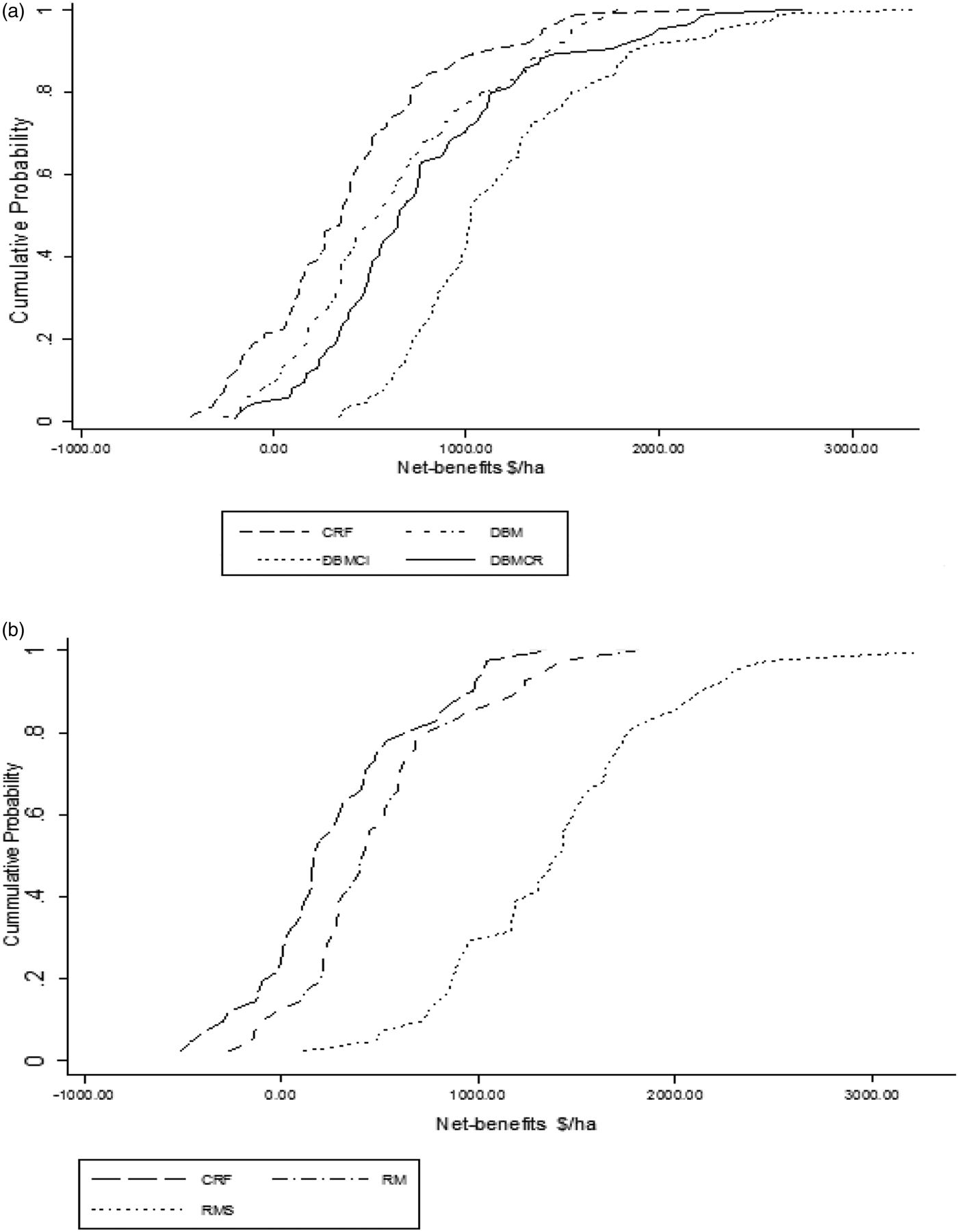
The cumulative distribution functions of maize–cowpea intercropping and maize-cowpea rotation in the dibble stick CA system showed a greater probability of higher net benefits (e.g., CA curves are more to the right than the conventional practice treatment) under the prevailing farmer conditions in Eastern Zambia. The stochastic dominance analyses indicated that maize–cowpea intercropping in the dibble stick CA system was more profitable and less risky than the maize monoculture practices in CA and traditional ridge and furrow systems (Fig. 5). Maize-cowpea rotation using the dibble stick CA system was also more profitable and less risky than the traditional farmer practice. Similarly, in the rip-line CA system, maize-soybean rotation was more profitable and less risky than maize monocropping in CA and the traditional ridge and furrow practice.
Cumulative distribution functions of net benefits (US$ ha−1) from the dibblestick CA (DMB, DMBCI, DMBCR) (left) and ripline CA (RM, RMS) (right) systems tested against the ridge and furrow farmer practice (CRF) in Eastern Zambia (2012–2015).

Discussion
Maize and legume performance under different CA systems
The performance of maize, cowpea and soybean crops varied according to the seasonal rainfall distribution in all cropping systems tested across the trial sites in Eastern Zambia. Average long-term annual rainfall usually ranges between 750 and 1000 mm and the amounts received in 2012/13 season at most trial sites were within the normal range for Eastern Zambia (Chabala et al., Reference Chabala, Kuntashula and Kaluba2013). In 2013/14 season, rainfall at most sites was below average with only Chanje and Mtaya camps receiving above average amounts. In 2014/15 rainfall was below average in all camps except Vuu, which received 955 mm during the cropping season. The rainfall patterns in 2013/14 and 2014/15 seasons confirms the fact that rainfall distribution has a greater impact on cropping than its total, a fact previously emphasized in other studies (Adiku et al., Reference Adiku, Dayanda, Rose and Dowuona1997). Smallholder cropping systems remain exposed to the severe impact of in-season dry spells and the variability in start and end of adequate rains for crop production.
Crop responses to CA and the traditional ridge and furrow systems varied from season to season, depending on the rainfall pattern experienced. In the manual dibble stick system, CA treatments outperformed the ridge and furrow practice in the first season of experimentation and this is attributed to higher soil water availability under CA during the short dry spells that were experienced during that season. In 2012/13 season-low maize yields in the maize/cowpea intercropping treatment under the dibble stick CA system was caused by excessive competition between the two companion crops because farmers either planted cowpea on the same day with maize or 1–5 days after planting the maize crop. In the following cropping seasons, cowpea was planted 14 days after maize and there was no more maize yield penalty recorded across the trial sites. The time of planting a relayed legume into the main cereal crop is a critical factor whenever intercropping is practiced (Lu et al., Reference Lu, Watkins, Teasdale and Abdul-Baki2000; Mhlanga et al., Reference Mhlanga, Cheesman, Maasdorp, Mupangwa, Munyoro, Sithole and Thierfelder2016). A study in Zimbabwe showed that planting cowpea 28 days after maize had no yield penalty when 60 kg N ha−1 is applied to the cereal in the intercrop system (Jeranyama et al., Reference Jeranyama, Hesterman, Waddington, Waddington, Murwira, Kumwenda, Hikwa and Tagwira1998). Another study from Eastern Zambia by Thierfelder et al. (Reference Thierfelder, Mwila and Rusinamhodzi2013a, Reference Thierfelder, Chisui, Gama, Cheesman, Jere, Bunderson, Eash, Ngwira and Rusinamhodzib) also showed the critical importance of the right timing of intercropping in CA systems. The results show the need for adaptive research to the site and farmer conditions to have a flexible approach in how a CA system is being employed and not a fixed recipe that can be applied regardless of the environmental conditions (Wall et al., Reference Wall, Thierfelder, Ngwira, Govaerts, Nyagumbo, Baudron, Jat and Graziano de Silva2013).
In the AT CA systems higher maize yields than traditional practice in 2012/13 season can be attributed to better precision at planting reflected by the final plant stand differences. In 2014/15 season higher maize yield in the AT CA systems can also be attributed to soil moisture conservation under CA and the rotational effect of soybean to the maize. However, overall there was no significant benefit of AT direct seeding systems in the short duration of the study. Other studies have shown that it takes 2–5 cropping seasons until a continued positive yield trend towards CA can be established (Thierfelder et al., Reference Thierfelder, Matemba-Mutasa and Rusinamhodzi2015).
Generally, maize yields were suppressed in 2013/14 and 2014/15 cropping seasons and this can be attributed to the poor seasonal rainfall distribution experienced during the February–April period across the trial sites. Similar maize yields between CA and traditional ridging practice in 2013/14 can be attributed to the severe soil moisture stress that was experienced in the second half of the season because rains ended at the beginning of March 2014. Soils at trial sites were predominantly light textured and have inherently low water holding capacity (Mafongoya and Kuntashula, Reference Mafongoya and Kuntashula2005). The retained soil moisture under the different cropping systems could not sustain the maize crop during grain filling stage. In the 2014/15 season, CA systems outperformed the traditional practice despite 18–33 days without rainfall across the trial sites. This could be attributed to the fact that soil quality might have started to improve and the residual soil moisture under CA was now able to sustain the maize crop until more rainfall was received during the grain filling stage of the maize crop. This further highlights the soil moisture conservation benefit of CA practices in seasons with poor rainfall distribution (Thierfelder and Wall, Reference Thierfelder and Wall2009; TerAvest et al., Reference TerAvest, Carpenter-Boggs, Thierfelder and Reganold2015). In addition, improved soil fertility in the CA practices including rotational benefits could have enhanced the utilization of conserved soil moisture by maize crop, resulting in a higher yield in the rotation treatments. It is now increasingly acknowledged that CA practices increase soil biological activity, pH, organic carbon, calcium and total N in the 0–20 cm soil layer (Muchabi et al., Reference Muchabi, Lungu and Mweetwa2014; Banda, Reference Banda2016), which increases productivity and resilience of the farming system over time.
Effects of rotations and intercropping
Rotating maize with cowpea and soybean increased maize yields across the experimental sites. The benefits of rotating cereals and legumes in CA systems of southern Africa are well documented (Mupangwa et al., Reference Mupangwa, Twomlow and Walker2012; Thierfelder et al., Reference Thierfelder, Cheesman and Rusinamhodzi2012; TerAvest et al., Reference TerAvest, Carpenter-Boggs, Thierfelder and Reganold2015). Intercropping maize with cowpea at similar plant populations had a similar yield effect with a full rotation of the two companion crops in the majority of the cropping seasons. When cowpea was planted 14 days after maize in CA system, competition between the two crops was minimized and this allowed maximization of yields of both crops regardless of the season quality. The Lutembwe cowpea variety used has an erect growth habit and is ideal for intercropping because it withstands shading from the companion cereal crop. This important characteristic enabled the intercropped system to perform as good as the full maize-cowpea rotation. Cowpea yields from sole and intercropping treatments were also affected by season quality. Despite having the highest plant stand at harvest, the lowest cowpea yields were achieved in 2013/14, a season that experienced early cessation of rains. As with the maize crop, severe soil moisture stress during grain filling reduced the final yield across the cropping systems tested.
LER indicated that, at the same plant population, intercropping maize and cowpea in CA system is more productivity than a full rotation of the two companion crops. With small land holdings in some southern Africa countries (e.g., Malawi), intercropping maize with cowpea in CA systems has the potential to offer opportunities for intensification in smallholder farming systems without compromising yields of the component crops. Land can be freed up from producing the main food crops through intercropping and smallholders could diversify into production of other crops for income generation.
This shift is currently happening in Eastern Zambia where the land area can be freed up when farmers increase their maize-legume combinations. The ‘gained’ land area is then used for the production of sunflower, cotton, groundnuts and tobacco, which are common cash crops in the province (Manda et al., Reference Manda, Alene, Gardebroek, Kassie and Tembo2015).
Livestock plays a critical role in the mixed smallholder farming systems of southern Africa including Zambia, as a source of income, buffer against adverse weather patterns for cropping, a source of protein from the meat and milk and to perform traditional functions (Homann-Tui Kee et al., Reference Homann-Tui Kee, Bandason, Maute, Nkomboni, Mpofu, Tanganyika, Van Rooyen, Gondwe, Dias, Ncube, Moyo, Hendricks and Nisrane2013; Sanderson et al., Reference Sanderson, Archer, Hendrickson, Kronberg, Liebig, Nichols, Schemer, Tanaka and Aguilara2013). However, in land limited situations it is complicated to grow sufficient fodder for livestock that depends on supplementary feed during the dry season (Mupangwa and Thierfelder, Reference Mupangwa and Thierfelder2014). Production of forage crops on land freed up by intercropping could, therefore, be an additional alternative in some agro-ecologies of southern Africa (Masikati et al., Reference Masikati, Manschadi, Van Rooyen and Hargreaves2014), with soil fertility improvement being realized at the same time. In the face of decreasing communal grazing lands as a result of human population growth, production of forage legumes should be increasingly being incorporated into the maize-based cropping systems of the smallholder farming sector (Sanderson et al., Reference Sanderson, Archer, Hendrickson, Kronberg, Liebig, Nichols, Schemer, Tanaka and Aguilara2013).
Economic benefits of maize-legume associations in different CA systems
Uncertainty regarding the economic advantages of CA practices and negative short-term economic benefits are often cited as a major limitation to wide-scale uptake of these technologies in sub Saharan Africa (Giller et al., Reference Giller, Witter, Corbeels and Tittonell2009; Grabowski and Kerr, Reference Grabowski and Kerr2014). The findings of this study revealed that reduction in labor cost particularly during planting and weeding (when herbicides are used) in CA systems contributed significantly towards higher net-benefits compared with the farmer practice. Overall, a significant reduction in labor cost was more apparent in manual CA cropping system relative to the conventional ridge and furrow system. Thierfelder et al. (Reference Thierfelder, Matemba-Mutasa and Rusinamhodzi2015, Reference Thierfelder, Matemba-Mutasa, Bunderson, Mutenje, Nyagumbo and Mupangwa2016) reported similar farm labor reductions of 36–39 labor days per hectare in the manual CA maize-legume systems of Malawi. Generally, agronomic efficiency and profitability are often significantly and positively correlated (Thierfelder et al., Reference Thierfelder, Matemba-Mutasa and Rusinamhodzi2015). A cropping system that had increased land productivity such as maize–cowpea intercropping in the dibblestick CA and maize-soybean rotation under the ripline CA also had better labor use efficiency reflected by higher net benefits. The results also showed that these CA practices were more resilient to the high in-season rainfall variability compared with the conventional ridge and furrow as shown by the cumulative distribution function of net benefits and the stochastic dominance. This implies that sustainable agricultural intensification through these labor and land productivity-enhancing technologies would greatly improve food and income security for smallholder farmers in southern Africa. Intensification of maize production through maize–cowpea intercropping using dibblestick CA and rotation in either manual or mechanized CA systems would sustainability meet farmers’ triple objectives of food security, increased income and production risk reduction.
Generally, smallholder farmers in marginal environments evaluate agricultural technologies based on their capacity to moderate production risks (Ngwira et al., Reference Ngwira, Thierfelder, Eash and Lambert2013). Risk, not only affects the potential for widespread adoption of technologies but also farmers’ response to market incentives is also heavily influenced by the riskiness of a technology (Dillon and Anderson, Reference Dillon and Anderson1990). In this study, to account for the riskiness of net returns in CA and conventional systems, stochastic dominance analyses were used. Our results showed that maize-cowpea in dibble stick CA was less risk, an observation which was contrary to the findings of Ngwira et al. (Reference Ngwira, Thierfelder, Eash and Lambert2013). These results suggest that in farming systems where land is limiting, maize–legume intercropping systems are a good option for smallholders. Similarly, in mechanized CA systems, rotating maize with soybean brings higher net benefits and is less risky for the risk-averse smallholder farmers compared with the traditional practice.
Conclusion
Grain yields under CA systems were generally greater than under conventional ridge-tillage system in Eastern Zambia. However, maize, cowpea and soybean crop performance was dependant on the seasonal rainfall distribution pattern regardless of the cropping system used. Early cessation of rains in March 2014 resulted in suppressed maize yields in both conventional and CA systems. In seasons with dry spells of 18–33 days, yield benefits were higher from the CA systems than the conventional practice. In these seasons the soil moisture retained under CA systems demonstrated that dry spells occurring during the cropping period can be bridged, highlighting the importance of CA in reducing and buffering farmers from the negative impact of rainfall variability.
Rotation of maize with cowpea and soybean increased yields of the cereal crop regardless of the CA system used. The rotation effect became more pronounced in the third and fourth cropping seasons of experimentation. Intercropping maize and cowpea at the same plant populations as the sole crops gave the same yields of the two companion crops. However, it was important to delay planting cowpeas by 14 days after the maize to avoid too much competition and yield penalties on the maize crop. Also, the type of cowpea used was more shade-tolerant than other cultivars, which is an important factor in selecting the right companion crops and varieties. Smallholders practicing CA on limited land sizes can, therefore, make use of intercropping systems without compromising the yields of maize and cowpea.
Based on the LER results, intercropping maize and cowpea led to higher land productivity compared with full rotation of the two crops under CA. Smallholder farmers in Eastern Zambia would need more than double the land size to produce the same maize and cowpea yields under full rotation than through an intercropping system. Freeing up more land through intercropping cereal and legumes offers smallholders an opportunity to diversify crops they grow, including possible cash and forage crop species, and this could result in more diversified income sources for improved livelihoods on the farm. Gross margin assessment showed that manual dibble stick and mechanized rip line and direct seeding CA systems are more profitable and less risky than the traditional ridge and furrow system on smallholder farms of Eastern Zambia. Higher labor productivity under CA systems would free up some of the family labor which can be used in other income-generating activities that improve the livelihoods of the smallholder farmers.
Supplementary Material
The supplementary material for this article can be found at https://doi.org/10.1017/S1742170517000606
Acknowledgement
We are grateful for financial support from USAID's Feed the Future program and Africa RISING, who supported the study through the years. The work is embedded in the MAIZE CGIAR Research Program which is led by CIMMYT and IITA and supported by numerous national partners. Their technical contribution is highly acknowledged. Special thanks go to the extension officers from the Ministry of Agriculture of Zambia and the field coordinators of Total Land Care who substantially helped in the data collection.