Introduction
Researchers and educators alike have long recognized the essential role of vocabulary in student academic achievement. To succeed in school, children must become skilled at acquiring new vocabulary from context (Common Core State Standards Initiative, 2015). Due to the sheer scope and volume of vocabulary acquisition from the primary through secondary grades, there is general agreement that words encountered in context are the greatest source of new vocabulary (Nagy & Herman, Reference Nagy, Herman, McKeown and Curtis1987; Sternberg, Reference Sternberg, McKeown and Curtis1987). Moreover, to succeed academically, children must become skilled at acquiring new vocabulary from context (Common Core State Standards Initiative, 2015).
Although the process of word learning from context remains poorly understood, evidence indicates that oral language ability may play a role (Steele & Watkins, Reference Steele and Watkins2010; Wagovich, Hill, & Petroski, Reference Wagovich, Hill and Petroski2015). Findings suggest that executive function (EF) skills may influence the word learning process among young children in oral contexts (Kapa & Colombo, Reference Kapa and Colombo2014; Yoshida, Tran, Benitez, & Kuwabara, Reference Yoshida, Tran, Benitez and Kuwabara2011), yet fewer studies have examined the role of EF in word learning from context among school-age children (Cain, Oakhill, & Lemmon, Reference Cain, Oakhill and Lemmon2004). Moreover, very little is understood about how language and EF skills might interact in the word learning process to support children's word knowledge growth. The current study examined the relations of language and EF ability to the process of word learning from context among school-age children. (For the purposes of this study, we defined ‘learning’ as the initial mapping of a word to its relevant concept, sufficient for the child to respond accurately to a question about the word.)
Word learning from context in school-age children
Carey (Reference Carey, Halle, Bresnan and Miller1978) described word learning as a two-part process that calls on the learner to construct a mapping between the conceptual and lexical domains. For word learning to occur, both domains must be restructured; the conceptual domain is altered to create a ‘conceptual niche’ for the concept encoded by the new word, and the lexical domain is altered to accommodate the new word. Carey's findings showed that even a single encounter with a word may suffice to set such restructuring into motion. Information gathered during initial ‘fast mapping’ often includes the knowledge that the new word actually is a word but may also involve a rough sense of the word's phonological, morphosyntactic, and semantic aspects. The initial, incomplete hypotheses that are formed during fast mapping are tested, expanded, and further refined during subsequent encounters with the word, until more complete and stable word knowledge is achieved (Carey, Reference Carey, Halle, Bresnan and Miller1978).
According to the lexical quality hypothesis (Perfetti & Hart, Reference Perfetti, Hart, Verhoeven, Elbro and Reitsma2002), all words possess three constituents: phonology, orthography, and semantics (with morphosyntactic aspects of words subsumed under semantics). As learning proceeds, links are created between the form-related (phonological and orthographic) and meaning-related (semantic) aspects of words, resulting in the formation of lexical representations. Acquiring word knowledge is seen as a process of building increasingly higher-quality lexical representations. Knowledge of each constituent accrues gradually over time with repeated exposure to a word across contexts. Relatedly, individual differences in vocabulary knowledge are thought to occur because learners vary in the quality of their lexical representations.
Modest yet significant gains in meaning-related (semantic) aspects of word knowledge can occur after a first exposure to unfamiliar or novel words in narrative text (Biemiller & Boote, Reference Biemiller and Boote2006; Swanborn & de Glopper, Reference Swanborn and de Glopper1999). Among typically developing kindergarten, first-, and second-grade children, Biemiller and Boote (Reference Biemiller and Boote2006) reported an average 12 percent improvement in word knowledge from pretest when children were exposed to unfamiliar words in read-aloud story contexts. Similarly, a meta-analysis of incidental word learning during reading by Swanborn and de Glopper (Reference Swanborn and de Glopper1999) found mean gains in word knowledge of 15 percent for novel or unfamiliar words encountered in written passages. This is not to imply that any word is learned completely after a single exposure. Rather, learners are continually engaged in a process of accumulating partial knowledge of multiple words simultaneously (Bloom, Reference Bloom2000). Word knowledge growth occurs along a continuum that begins with no knowledge whatsoever and progresses through stages of context-dependent understanding to fully decontextualized word knowledge (Christ, Reference Christ2011).
Relatively few studies have focused on the influence of oral language ability on semantic word knowledge growth during exposure to narratives (Steele & Watkins, Reference Steele and Watkins2010; Wagovich et al., Reference Wagovich, Hill and Petroski2015). Steele and Watkins (Reference Steele and Watkins2010) examined novel word learning during silent reading among school-age children with language-learning disability (LLD) and same-age peers with typical language skills. Results showed that children with LLD gained significantly less syntactic and semantic knowledge of target words than their typically developing classmates. Wagovich et al. (Reference Wagovich, Hill and Petroski2015) compared syntactic and semantic word knowledge growth during silent reading among students with lower language skills (at least 1.0 SD below the mean on receptive or expressive language) to that of peers with higher language skills. Students with lower language skills gained less overall knowledge of target words than their more-skilled age-mates. However, a subsequent analysis revealed that the rate of word knowledge growth was similar for both groups (Hill, Wagovich, & Manfra, Reference Hill, Wagovich and Manfra2017).
Executive function in school-age children
Executive function comprises a set of higher order, top-down processes for regulating attention and engaging in purposeful, goal-directed behavior (Garon, Bryson, & Smith, Reference Garon, Bryson and Smith2008). EF skills are involved in numerous aspects of adaptive functioning, from goal selection and strategic planning to self-regulation and emotional control (Anderson, Reference Anderson2002). Individual differences in EF are related to a wide range of outcomes across the lifespan, including academic and occupational attainment as well as aspects of both mental and physical health (Diamond, Reference Diamond2013). In school settings, EF skills contribute to children's ability to self-regulate (McClelland & Cameron, Reference McClelland and Cameron2012).
EF is thought to include three separate but correlated skills: working memory, inhibitory control, and cognitive flexibility (Miyake et al., Reference Miyake, Friedman, Emerson, Witzki, Howerter and Wager2000). Working memory involves the active manipulation, not merely passive storage, of information. Inhibitory control signifies the ability to suppress a dominant or prepotent response in favor of an alternative response. Cognitive flexibility refers to the ability to flexibly switch from one mental set or rule to another. The moderate correlations among the three EF skills is thought to stem from a shared underlying factor such as controlled attention (Miyake et al., Reference Miyake, Friedman, Emerson, Witzki, Howerter and Wager2000). The structure of EF in school-age children may resemble that of adults; Lehto, Juujärvi, Kooistra, and Pulkkinen (Reference Lehto, Juujärvi, Kooistra and Pulkkinen2003) found that the same three skills as those reported by Miyake et al. (Reference Miyake, Friedman, Emerson, Witzki, Howerter and Wager2000) were interrelated in their typically developing eight- to thirteen-year-old children. Although EF skills show a protracted course of development throughout childhood and into adulthood (Romine & Reynolds, Reference Romine and Reynolds2005), individual differences in EF appear to be stable across development (Harms, Zayas, Meltzoff, & Carlson, Reference Harms, Zayas, Meltzoff and Carlson2014).
Executive function and vocabulary
Several studies suggest that EF skills are related to individual differences in vocabulary among school-age children (Best, Miller, & Naglieri., Reference Best, Miller and Naglieri2011; Nicolay & Poncelet, Reference Nicolay and Poncelet2013; Wilbourn, Kurtz, & Kalia, Reference Wilbourn, Kurtz and Kalia2012). For example, inhibitory control and shifting were both correlated with receptive vocabulary in typically developing five- to eight-year-old children (Wilbourn et al., Reference Wilbourn, Kurtz and Kalia2012), and planning skills were correlated with expressive vocabulary in a nationally representative sample of five- to seventeen-year-old students (Best et al., Reference Best, Miller and Naglieri2011). Nicolay and Poncelet (Reference Nicolay and Poncelet2013) followed a group of typically developing children who were enrolled in second language immersion programs and found that auditory attention and cognitive flexibility skills at age five predicted gains in second language vocabulary over the following two years.
Executive function and word learning
Findings of significant associations between EF ability and vocabulary are suggestive, but they can provide only indirect evidence as to how EF might influence the word learning process itself. On a theoretical level, it seems reasonable that EF skills would play a role in word learning. When words are novel or unfamiliar, learners must rely on purposeful cognitive control in order to form and access new semantic associations (Mestres-Missé, Rodriguez-Fornells, & Münte, Reference Mestres-Missé, Rodriguez-Fornells and Münte2007). It stands to reason that working memory might contribute to word learning from context, because learners must hold surrounding context in mind while attempting to infer the meaning of a newly encountered word. As Cowan (Reference Cowan2014) pointed out, working memory is heavily taxed when learners are asked to form new associations. Inhibitory control may also be essential to the word learning process, as studies have shown that learners may discard many incorrect inferences while narrowing down potential word meanings (Fukkink, Blok, & de Glopper, Reference Fukkink, Blok and de Glopper2001). Cognitive flexibility may be central to word learning as well, as learners are called on to shift between multiple simultaneous tasks: generating potential meanings, discarding untenable ones, and maintaining overall comprehension (Fukkink, Reference Fukkink2005).
Indeed, numerous research findings have shown a positive correlation between children's phonological short-term memory storage capacity and their performance on experimental word learning tasks (e.g., Côté, Rouleau, & Macoir, Reference Côté, Rouleau and Macoir2014; Gathercole, Hitch, Service, & Martin, Reference Gathercole, Hitch, Service and Martin1997), based on Baddeley's (Reference Baddeley1986) model of working memory. However, such studies do not address the contribution of the EF-related aspect of working memory, which involves not merely passive storage but manipulation of information, to the word learning process (Gathercole, Reference Gathercole1999).
Although findings are few, there is some evidence that working memory may influence word learning. A pair of studies by Cain and colleagues (Cain, Oakhill, & Elbro, Reference Cain, Oakhill and Elbro2003; Cain et al., Reference Cain, Oakhill and Lemmon2004) explored the role of working memory in word learning during reading among children with either average or poor reading comprehension skills. The first study (Cain et al., Reference Cain, Oakhill and Elbro2003) examined how the positioning of informative context relative to target words might affect children's performance on a novel word learning task. Compared with their typically developing peers, seven- to eight-year-old children with poor reading comprehension skills learned fewer novel word meanings when informative context was placed further from target words. The authors suggested that the learning of children with poor comprehension was hampered when the task imposed greater working memory demands. In a later study with nine- to ten-year-old children (Cain et al., Reference Cain, Oakhill and Lemmon2004), scores on a task of verbal working memory were significantly related to novel word learning performance, but only when informative context was positioned further from target words. Not all results agree, however. Steele and Watkins (Reference Steele and Watkins2010) found that position of informative context did not affect word learning performance for school-age children with language learning disability or their typically developing peers.
Skills in inhibitory control of attention and attention shifting may also contribute to word learning, although studies so far have been conducted primarily with young children rather than with school-age children (Kapa & Colombo, Reference Kapa and Colombo2014; Yoshida et al., Reference Yoshida, Tran, Benitez and Kuwabara2011). Yoshida et al. (Reference Yoshida, Tran, Benitez and Kuwabara2011) explored the relation between executive attention and novel adjective learning among groups of bilingual or monolingual two- to three-year-old children. They reported that bilingual children were more accurate than their monolingual counterparts on an executive attention task, and also outperformed their monolingual peers on a task of novel adjective learning. Regression analyses indicated that, for bilingual but not monolingual children, performance on the adjective learning task was related to performance on the task of executive attention. The authors interpreted their findings in terms of greater inhibitory control on the part of bilingual children, and suggested that, because bilingual children are often required to inhibit one language in favor of another, they may be better equipped than their monolingual counterparts to inhibit any prepotent tendency to map novel word forms as nouns and thus better able to interpret unfamiliar words as adjectives.
EF skills have also been found to relate to word learning in the context of artificial language. Kapa and Colombo (Reference Kapa and Colombo2014) explored the relation between artificial language learning and performance on tasks of inhibitory control, attentional monitoring, and attention shifting among both adults and four- to five-year-old children. Participants, who were all monolingual, were introduced to both novel nouns and verbs. Hierarchical regression analyses controlling for both receptive vocabulary and digit span revealed that performance on the tasks of attention and inhibitory control were related to novel vocabulary learning for both children and adults, but the patterns differed according to age. Artificial language scores were associated with inhibitory control in adults and with attention shifting in children. Still unclear, however, is how a range of EF skills might relate to word learning from context among children of school age.
Purpose of the study
Strong word learning ability is vital to children's academic success, yet there are many significant gaps in the literature concerning the single and joint contributions of language ability and EF skills to the process of vocabulary acquisition from context among school-age children. The current study sought to address these gaps by examining (a) oral language ability and (b) the EF skills of working memory, inhibitory control, and cognitive flexibility, in relation to typically developing school-age children's performance on an experimental word learning task. We hypothesized that oral language ability and all three EF skills would relate significantly to children's growth in semantic word knowledge when children encountered unfamiliar target words in context. We also sought to explore the ways that children's language and EF skills might interact to support semantic word knowledge gains from context.
Method
Participants
Fifty children between the ages of 9;0 and 11;11 (years;months) took part in the study (M = 10;5, SD = 0.93; 19 girls, 31 boys). Participants were recruited with electronic advertisements and posted flyers in a small city in a Midwestern state. According to caregivers, 80 percent of children were White and non-Hispanic, 10 percent were of Asian ancestry, 6 percent were of Hispanic ethnicity, 2 percent were Black or African American, and 2 percent were of mixed race. Caregivers’ educational levels ranged from less than high school to postgraduate doctoral or professional degrees (average = some college or technical training).
All participants had normal or corrected-to-normal vision and normal hearing per caregiver report, and all passed a bilateral hearing screening administered as part of the study. Caregivers reported no history of neurological impairment, developmental or acquired, and no diagnosis of learning disability or receipt of special educational services. All participants were native speakers of English, per caregiver report and examiner observation; caregivers of seven children reported that a second language in addition to English was spoken at home.
All children were making satisfactory progress in school, according to caregivers. Forty-eight of the 50 participants earned scores no lower than 1.0 SD below the population mean on norm-referenced measures of oral language, reading decoding, and non-verbal cognition, as described below. One participant scored 1.33 SD below the population mean on language (standard score of 80). The same child, along with one other participant, also scored 1.13 SD below the population mean on non-verbal cognition (standard scores of 83). However, neither participant was excluded from the study based on two considerations: (a) caregivers of both children indicated that they were developing normally and progressing satisfactorily in school; and (b) analyses excluding both participants resulted in a very similar pattern of results as analyses including both participants.
Procedures
Each participant took part in two sessions of 60–75 minutes each that were held in a quiet room in the experimenter's laboratory. In Session 1, after obtaining informed consent from caregivers and assent from participants, standardized measures of language, non-verbal cognition, and reading decoding were administered along with a hearing screening, to verify that children qualified for the study. Caregivers were asked to complete a questionnaire with information about their children's developmental history and caregiver level of education. Participants also completed a set of computerized multiple-choice items as a pretest during Session 1 to assess pre-existing knowledge of target words.
Participants returned for Session 2 approximately one week later (range = 5 to 11 days). During Session 2, children completed three pairs of EF tasks. In addition, children were asked to read and listen to two short stories, one at a time, with order randomized across participants. Each story was presented by visual and auditory routes simultaneously on a desktop computer, as described below. After both stories were presented, the computerized multiple-choice items were re-administered as a posttest.
Measures
Oral language
Four subtests comprising the Core Language composite of the Clinical Evaluation of Language Fundamentals-5 (CELF-5; Wiig, Semel, & Secord, Reference Wiig, Semel and Secord2013) were administered: (a) the Word Classes subtest measures receptive understanding of semantic relationships between words; (b) the Formulated Sentences subtest assesses the ability to generate grammatically and semantically correct sentences; (c) the Recalling Sentences subtest measures ability to repeat spoken sentences of increasing length and complexity; and (d) the Semantic Relationships subtest evaluates the ability to interpret spoken sentences that include comparisons such as time or serial order as well as sentences expressed in passive voice. Split-half reliabilities for the four subtests are between .80 and .95, with test–retest reliabilities between .73 and .89 (Wiig et al., Reference Wiig, Semel and Secord2013). The Core Language composite has a mean of 100 and a standard deviation of 15. For the current study, scores on the CELF-5 were used to screen participants for typical language skill and were also included as an independent variable in analyses of children's experimental word knowledge gains.
Reading decoding
The Basic Skills cluster of the Woodcock Reading Mastery Test, Third Edition (WRMT-III Basic Reading; Woodcock, Reference Woodcock2011) was administered during Session 1 to determine whether participants possessed reading decoding skills in the typical range. Children were asked to pronounce orthographically presented words and non-words of increasing difficulty. Test–retest reliability for the cluster is .95 (Woodcock, Reference Woodcock2011). The Basic Skills cluster has a mean of 100 and a standard deviation of 15.
Non-verbal cognition
The Test of Nonverbal Intelligence-4 (TONI-4; Brown, Sherbenou, & Johnsen, Reference Brown, Sherbenou and Johnsen2010) was also administered during Session 1 as a screening measure to verify that participants’ non-verbal cognitive skills were within the typical range. Test–retest reliability for the TONI-4 is .88 and .93 (Brown et al., Reference Brown, Sherbenou and Johnsen2010); the test has a mean of 100 and a standard deviation of 15.
EF measures
During Session 2, participants completed three pairs of tasks to assess individual differences in working memory, inhibitory control, and cognitive flexibility. Each pair of tasks took approximately five to ten minutes to administer.
Working memory
The Number Memory Forward and Number Memory Reversed subtests of the Test of Auditory Processing Skills, Third Edition (TAPS-3; Martin & Brownell, Reference Martin and Brownell2005) were used to assess participants’ working memory. Digit lists of increasing length were presented orally at a rate of one digit per second, and children were asked to repeat each list in either the same (Number Memory Forward) or reversed (Number Memory Reversed) order. A greater decrement in performance on Number Memory Reversed relative to Number Memory Forward indicates greater difficulty with manipulating information in working memory, beyond simple storage capacity. To derive an estimate of EF-related working memory that is separate from simple short-term memory (Miyake et al., Reference Miyake, Friedman, Emerson, Witzki, Howerter and Wager2000), Number Memory Forward scores were entered as covariates in all analyses of participants’ Number Memory Reversed performance. Reliability of the TAPS-3 (internal consistency; coefficient alpha) is between .85 and .90 (Martin & Brownell, Reference Martin and Brownell2005). All raw scores were converted to T-scores (mean = 50, SD = 10).
Inhibitory control
The Stroop color word interference task (Stroop, Reference Stroop1935) has seen widespread use as a measure of inhibitory control for 80 years. The Stroop Color and Word Test, Children's Version (Stroop task; Golden, Freshwater, & Golden, Reference Golden, Freshwater and Golden2003) is appropriate for use in children aged five to fourteen years. As used in the current study, the task included two pages with 100 items each. The first page presented a series of XXX's printed in various colors of ink (color naming condition), and children were asked to name the colors, in order, as quickly as possible. The second page presented a series of color words, each printed in a contrasting color of ink (e.g., blue in red ink; interference condition), and children were asked to ignore the words themselves and name the ink color of each word, in order, as quickly as possible. For both pages, a child's raw score was the number of colors named correctly within 45 seconds. Less deterioration in performance in the interference condition relative to the color naming condition is taken as evidence of greater inhibitory control, while more deterioration in performance is taken as evidence of poorer inhibitory control (Miyake et al., Reference Miyake, Friedman, Emerson, Witzki, Howerter and Wager2000). Test–retest reliability for the Stroop task is .83 for color naming performance and .91 for the interference effect (Baron, Reference Baron2004). All raw scores were converted to T-scores, and participants’ T-scores for color naming were included as covariates in all analyses of performance in the interference condition.
Cognitive flexibility
The Comprehensive Trail Making Test (CTMT; Reynolds, Reference Reynolds2002) was used to assess participants’ cognitive flexibility. Children were first given a sheet of paper (Trail 1) with the numerals 1 through 25 scattered around the page in random order, and were asked to draw a line connecting the numerals, in order, as quickly as possible. A second page (Trail 5) included both numerals and letters, and children were asked to draw a line, alternating between letters and numbers (i.e., 1-A-2-B and so on) as quickly as possible. Any errors were corrected by the examiner as they occurred. The raw score on each portion of the task was the time taken to connect all items in the correct order. According to the generally accepted interpretation (e.g., Vakil, Blachstein, Sheinman, & Greenstein, Reference Vakil, Blachstein, Sheinman and Greenstein2009), lower scores on Trail 5 relative to Trail 1 indicate greater difficulty with the increased cognitive flexibility demands of Trail 5. Internal consistency of the CTMT is between .84 and .86 (Stanczak & Triplett, Reference Stanczak and Triplett2003). Children's raw scores were converted to T-scores, and scores on Trail 1 were included as a covariate in all analyses of children's Trail 5 performance.
Experimental stimuli
Rare words
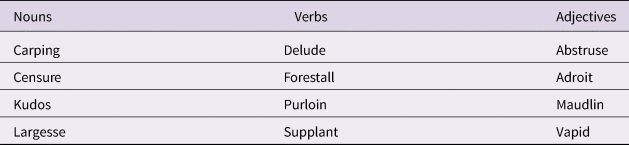
Twelve rare target words were chosen from online GRE word lists (majortests.com, 2015). A list of the target words is presented in Table 1. All were two syllables in length and conformed to standard English orthographic patterns (i.e., no exception words). Four of the words were nouns, four were verbs, and four were adjectives. The 12 target words had a mean frequency of 0.27 per million (SD = 0.25) and a mean age of acquisition of 13.52 years (SD = 0.77; Kuperman, Stadthagen-Gonzalez, & Brysbaert, Reference Kuperman, Stadthagen-Gonzalez and Brysbaert2012).
Target words

Six target words (two nouns, two verbs, two adjectives) were inserted into each of two stories (described below) as substitutes for more common words, with each target word appearing only once. A target word density of approximately one target word per 150 words of text was chosen to maximize participants’ word knowledge growth, based on Swanborn and de Glopper's (Reference Swanborn and de Glopper1999) finding that the likelihood of semantic word learning was greatest when the density of target words was held to one in 150 words or lower. Target words were distributed as evenly as possible within the stories; one target word appeared in the first third of each story, three target words appeared in the middle third, and two target words appeared in the final third. Nouns, verbs, and adjectives were distributed throughout the three sections of the stories to avoid confounding word type with story position. All target words were embedded within the predicate of a sentence, with six of the words appearing in sentence-medial position and six appearing in sentence-final position. Because of syntactic constraints, all verbs appeared in sentence-medial position; three of the words in sentence-final position were nouns, and three were adjectives. The text of the stories was altered as necessary to provide contextual support for target word meaning. Supportive context appeared within the same sentence for eight of the target words and in an immediately adjacent sentence for four of the words. Target words in each story were highlighted in a bold colored font to draw participants’ attention to the words. Explicit definitions or synonyms were not included for any of the words.
Common words
In addition to rare target words, three two-syllable common words (one noun, one verb, one adjective) that were presumably already familiar to the participants were highlighted in a bold colored font in the stories. These words were morning, review, and early. The common words had a mean frequency of 187.28 per million (SD = 222.9) and a mean age of acquisition of 6.05 years (SD = 2.5; Kuperman et al., Reference Kuperman, Stadthagen-Gonzalez and Brysbaert2012). Participants’ responses to common words were included in analyses of word knowledge gains to control for overall attentiveness and understanding of task demands.
Stories
Two stories of 835 and 925 words, respectively, were presented during Session 2 to serve as context for the target words (ReadWorks.org, 2015). Both stories contained themes thought to be of general interest among nine- to eleven-year-old children (a student plays a practical joke on his classmates and teacher; a girl tries to avoid a summer activity she dislikes). Lexile levels for the two stories were between 500 and 600 (i.e., third-grade reading level).
Based on a procedure outlined by Beck, McKeown, and McCaslin (Reference Beck, McKeown and McCaslin1983), a prior pilot study examined the extent to which story contexts served to support target word meaning. Sentences containing target words from the stories were presented to a group of 46 college undergraduate volunteers, but with target words blanked out. Volunteers were asked to supply a word they thought would best complete each sentence. It was not expected that volunteers would supply the actual target words, because these words are relatively rare. However, common synonyms of target words were supplied by volunteers an average of 85 percent of the time (SD = 0.23). In a similar study with adult participants, Beck et al. found that correct target words (or synonyms) were supplied 86 percent of the time in contexts that were intended to be highly directive or supportive of word meaning, and 49 percent of the time in contexts that were generally supportive but not as highly directive. Therefore, it was concluded that the stories used in the current study provided good overall contextual support for target word meaning.
In presenting the stories, the intent was twofold: (a) to maximize the likelihood that the text would be decoded accurately; and (b) to avoid floor effects by minimizing the effort needed for reading decoding and thus allowing greater cognitive resources to be available for comprehending text and inferring word meaning (Just & Carpenter, Reference Just and Carpenter1992; Perfetti, Reference Perfetti1984, Reference Perfetti, McKeown and Kucan2010). Prior studies of word learning from context among school-age children have failed to show significant gains in semantic word knowledge after exposure to target words during silent reading tasks (e.g., Wagovich & Newhoff, Reference Wagovich and Newhoff2004). In addition, a more recent study with school-age children demonstrated that gains in semantic knowledge of target words appearing in story contexts were greater when children were exposed to stories by both listening and reading rather than by either listening or reading alone (Valentini, Ricketts, Pye, & Houston-Price, Reference Valentini, Ricketts, Pye and Houston-Price2018). Therefore, children in the current study were asked to listen as the text of the stories was narrated aloud in the first author's voice via computer speakers, and to read along silently as the same text was simultaneously presented in visual mode on a computer screen. Stories were narrated at an average rate of 108 words per minute; text appeared in a 28-point font with an average of 44 words per screen.
Multiple-choice items
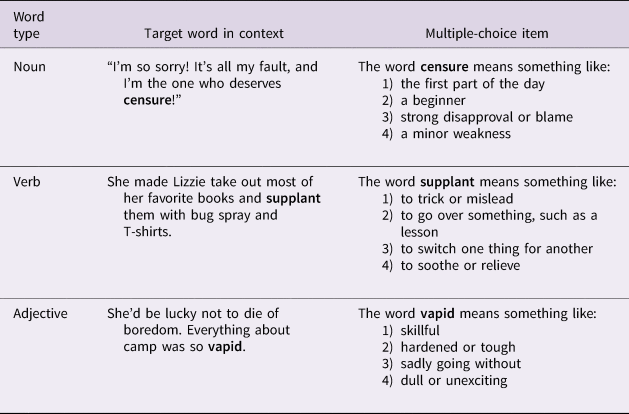
A set of 12 four-option multiple-choice items assessed participants’ receptive understanding of target word meanings, and three multiple-choice items assessed participants’ receptive understanding of common words. The stem for each item was presented both visually and auditorily by computer, with the target word highlighted (e.g., “The word vapid means something like … ”). Participants selected one response from among four options presented on the computer screen via text only. This was done to make the task more efficient and to minimize the possibility that children would fail to maintain focused attention on the task. Foils were constructed to be sufficiently different from target word meanings so as to call on general semantic domain knowledge rather than detailed knowledge. Correct answer choices occurred an equal number of times in first, second, third, and fourth position among the available answer choices. The order in which items were presented was randomized across participants, and different randomizations were administered at pretest and posttest for each participant. An initial practice item was presented to familiarize participants with the procedure, but responses to the practice item were not included in analyses. Responses to all other items were coded as either 1 (correct) or 0 (incorrect); thus, possible scores ranged from zero to 12. Examples of target words along with supportive context and corresponding multiple choice items are provided in Table 2.
Examples of target words with supportive context and corresponding multiple-choice items

Note. Target words appear in bold font.
Analyses
As an initial step, descriptive statistics were computed for all variables. Zero-order correlations were calculated to evaluate bivariate relations among the independent variables (oral language ability, working memory, inhibitory control, and cognitive flexibility) and the dependent variable (multiple-choice posttest scores).
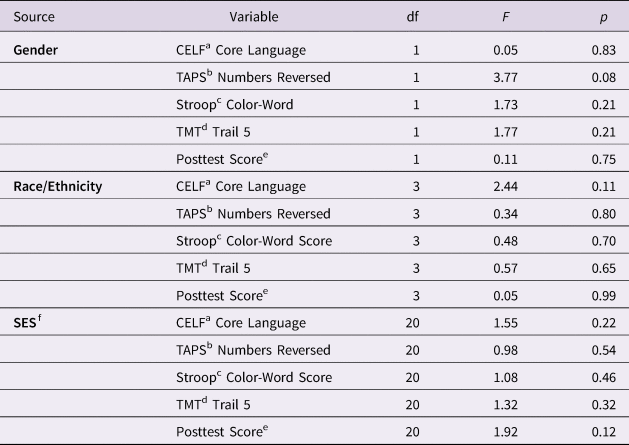
The next step was to evaluate factors related to word knowledge gains. Adjusting for age and pretest scores, multiple regression models were used to explain posttest scores on the multiple-choice measure. Because results of a MANOVA revealed no significant effects of gender, race/ethnicity, or socioeconomic status on independent or dependent variables, analyses were collapsed across demographic categories. (See Table 3 for MANOVA results.) Scores for each participant on baseline measures of EF were included as covariates when appropriate. In addition, total scores on common words were included as covariates to account for participants’ attention to the task. Main effects on multiple-choice posttest scores were examined for (a) oral language, (b) working memory, (c) inhibitory control, and (d) cognitive flexibility. Interaction terms were used to analyze moderation among predictor variables, and simple slopes analyses were used to examine in more detail the nature of any significant interactions. An alpha level of p = .05 was used for all analyses.
MANOVA results for gender, race/ethnicity, and caregiver education

Notes. aClinical Evaluation of Language Fundamentals, Fifth Edition (Wiig et al., Reference Wiig, Semel and Secord2013). bTest of Auditory Processing Skills, Third Edition (Martin & Brownell, Reference Martin and Brownell2005). cStroop Color and Word Test, Children's Version (Golden et al., Reference Golden, Freshwater and Golden2003). dComprehensive Trail Making Test (Reynolds, Reference Reynolds2002). eMultiple-choice posttest score. fHousehold socioeconomic status based on Four Factor Index of Social Status (Hollingshead, Reference Hollingshead1975).
Results
The purpose of this study was to examine the relations of language ability and the EF skills of working memory, inhibitory control, and cognitive flexibility to children's initial growth in semantic word knowledge from context. We first calculated descriptive statistics and bivariate correlations among all variables. Next, a multiple regression analysis was used to examine children's gains in word knowledge in relation to language and the three EF abilities.
Descriptive statistics
Standardized test scores
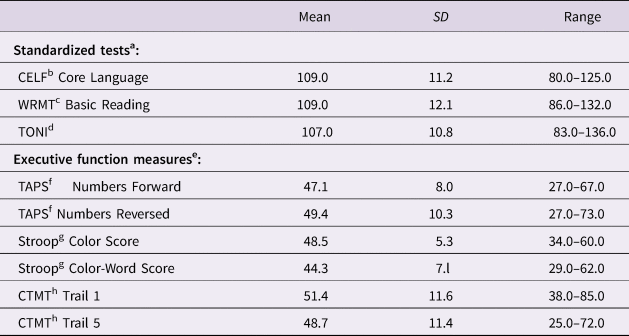
There was wide variation in performance within the typical range on standardized measures of language, reading decoding, and non-verbal cognition. Standardized test scores are displayed in Table 4.
Descriptive statistics for standardized tests

Notes. aStandard scores, M = 100, SD = 15. bClinical Evaluation of Language Fundamentals, Fifth Edition (Wiig et al., Reference Wiig, Semel and Secord2013). cWoodcock Reading Mastery Test, Third Edition (Woodcock, Reference Woodcock2011). dTest of Nonverbal Intelligence, Fourth Edition (Brown et al., Reference Brown, Sherbenou and Johnsen2010). eT-Scores, M = 50, SD = 10. fTest of Auditory Processing Skills, Third Edition (Martin & Brownell, Reference Martin and Brownell2005). gStroop Color and Word Test, Children's Version (Golden et al., Reference Golden, Freshwater and Golden2003). hComprehensive Trail Making Test (Reynolds, Reference Reynolds2002).
Executive function measures
Scores also ranged widely on the tasks of working memory, inhibitory control, and cognitive flexibility. T-scores (population mean = 50, SD = 10) for all measures are displayed in Table 4.
Word learning measure
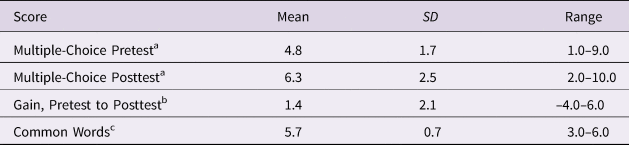
Performance ranged widely on the multiple-choice measure at both pretest and posttest. Descriptive statistics are displayed in Table 5. Overall scores on the multiple-choice pretest were higher than chance (t(49) = 20.1, p < .001), suggesting that participants had at least some pre-existing familiarity with target words. This was not unexpected, due to the nature of our sample; some of our participants lived in households with highly educated parents and earned above-average scores on the standardized assessments of language, reading decoding, non-verbal cognition, and EF. Given the nature of our multiple-choice measure, in which children were asked to indicate receptive knowledge of general, rather than detailed, semantic content of target words, it is not surprising that some children scored above chance levels on the pretest. For these children, some of the target words may have been partially known ‘frontier’ words, occupying “the frontier region between the point where every word is known and the point where no words are known” (Trembly, Reference Trembly1966, p. 229).
Descriptive statistics for multiple-choice measure

Notes. aMaximum score = 12. bMaximum score = 12; gains did not differ across the two orders of story presentation (t(24) = 0.26, p = .80). Pairwise comparisons revealed that gains did not differ between nouns and verbs (t(49) = –0.96, p = .34), between nouns and adjectives (t(49) = –1.64, p = .11), nor between verbs and adjectives (t(49) = –0.58, p = .56). cMaximum score = 6 (averaged across pre- and posttesting occasions).
Importantly, mean target word knowledge also increased significantly after exposure to the words in stories (t(48) = 4.63, p < .001, d = 0.67), demonstrating that significant initial learning had taken place. Average multiple-choice scores increased by 29.5 percent from pretest to posttest (range = –70 to 500, SD = 81.1), corresponding to an average gain of 1.4 points. Gains were not distributed evenly across the two stories; scores for target words encountered in Lizzie Escapes increased by1.09 points on average (SD = 1.37) but by only 0.39 points on average (SD = 1.47) for target words contained in Davy Is Absent, a difference that was statistically significant (t = 2.71, p = .009). Importantly, however, gains did not differ as a function of which story was presented first (F(1,48) = 0.03, p = 0.86).
To explore the extent to which working memory may have constrained children's performance on individual target words, we examined whether the order in which children encountered target words affected their gains on those words. We compared each participant's gain scores on the target word he or she encountered (a) first; and (b) last in narrative context to his or her gains on all other target words. Results showed that, although children made greater gains, on average, on target words encountered first (M = 0.22, SD = 0.62) than on other target words (M = 0.11, SD = 0.19), the difference was not significant (t(48) = 1.24, p = .22). Thus, we did not find evidence of a primacy effect on children's word learning performance. For target words encountered last by each child, we found that average posttest scores represented no gain relative to pretest scores (mean gain score = –0.02, SD = 0.59); in contrast, children did show gains on all other target words (M = 0.14, SD = 0.19). As with target words encountered first, however, the difference between words appearing last and all other words was not significant (t(48) = 1.90, p = .06). These results suggest that there was no evidence of a recency effect on children's word learning.
About two-thirds of participants demonstrated gains; scores increased at least one point from pretest to posttest for 34 participants, remained the same for seven participants, and decreased by at least one point for nine participants. Most children responded correctly to five or six of the six common words on both testing occasions.
Bivariate correlations
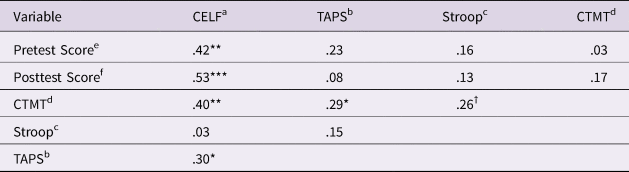
Zero-order Pearson correlations were calculated among variables to examine bivariate relations. Correlations among variables are displayed in Table 6. Scores on the multiple-choice measure were significantly correlated with language but not with any of the EF tasks.
Pearson correlations among variables (two-tailed)Footnote 1

Notes. †p < .10; *p < .05; **p < .01; ***p < .001. aCore Language Composite of Clinical Evaluation of Language Fundamentals, Fifth Edition (Wiig et al., Reference Wiig, Semel and Secord2013). bTest of Auditory Processing Skills, Third Edition (Martin & Brownell, Reference Martin and Brownell2005), Number Memory Reversed scores. cStroop Color and Word Test, Children's Version (Golden et al., Reference Golden, Freshwater and Golden2003), Color-Word scores. dComprehensive Trail Making Test (Reynolds, Reference Reynolds2002), Trail 5 scores. eMultiple-choice pretest score. fMultiple-choice posttest score.
Factors associated with word knowledge gains
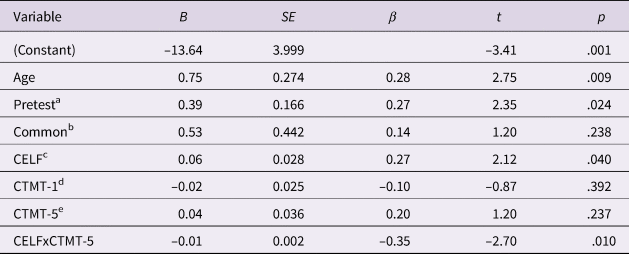
The major aims of this study were to explore the relations of language ability and EF skills to children's gains in semantic word knowledge from context. Multiple regression analyses controlling for age, pretest scores, and scores on common words were used to examine the variables associated with children's scores on the multiple-choice posttest.Footnote 2 Baseline EF scores were included as appropriate. Coefficients are presented in Table 6. The overall model was significant (F(7, 41) = 9.14, p < .001), and accounted for 61.0 percent of total variance in posttest scores. For brevity, only the most parsimonious models with significant predictors are shown in Table 7. All other pertinent findings are described in the sections that follow.
Model coefficients for multiple-choice posttest

Notes. aMultiple-choice pretest score. bMultiple-choice score on common words. cCELF-5 Core Language Composite. dCTMT Trail 1 T-score (baseline trail-drawing task). eCTMT Trail 5 T-score (cognitive flexibility task).
Language
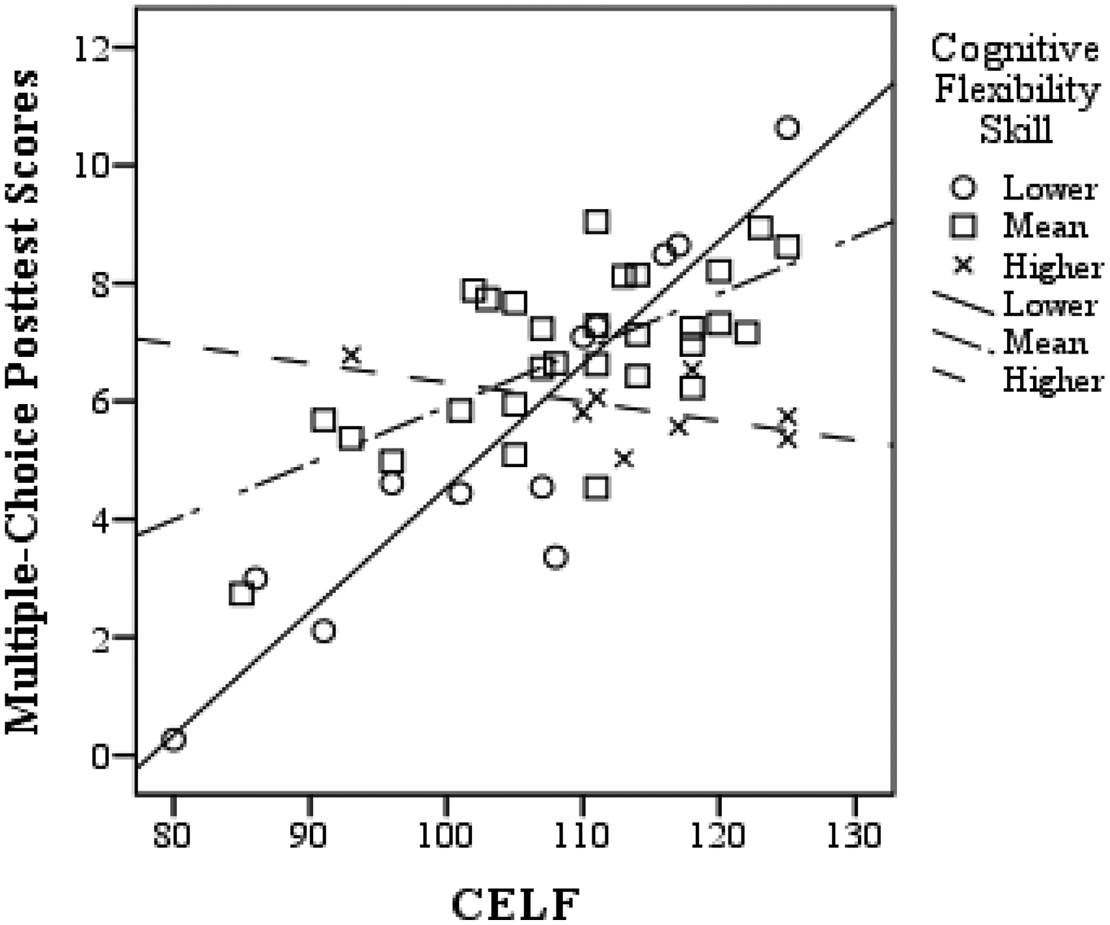
Results of regression analyses showed a significant interaction between language and cognitive flexibility in relation to word knowledge gains. The moderating role of cognitive flexibility in the relation between language ability and posttest scores is illustrated in Figure 1. The interaction represented a medium effect (8.1 percent of total variance; Cohen's f2 = 0.21).
Effect of language on posttest scores: moderation by cognitive flexibility.

To explore how the contribution of language ability to multiple-choice posttest scores might differ according to children's skills in cognitive flexibility, a simple slopes analysis was performed. The effect of language ability on posttest scores was compared for children with cognitive flexibility, as measured by CTMT Trail 5 scores within 1.0 SD of the sample mean (n = 30) to that of children with lower cognitive flexibility (CTMT Trail 5 scores at least 1.0 SD below the sample mean; n = 12) and higher cognitive flexibility (CTMT Trail 5 scores at least 1.0 SD above the sample mean; n = 8). Findings of the analysis are presented in Figure 1. Results showed that the effect of language on posttest scores was positive and significant for children with lower cognitive flexibility (β = 0.52, t(41) = 4.01, p < .001) and for children with cognitive flexibility at the sample mean (β = 0.27, t(41) = 2.12, p = .04). However, the effect of language was not significant for children with higher cognitive flexibility (β = –0.01, t(41) = –0.04, p = .97). Thus, language ability made a positive contribution to posttest scores among children with cognitive flexibility at the sample mean or lower, but not among children with higher cognitive flexibility.
There were no significant interactions between language and the other EF skills. Results were as follows: language in interaction with working memory (β = –0.13, t(37) = –0.94, p = .35); language in interaction with inhibitory control (β = 0.05, t(38) = 0.37, p = .71). The lack of significant interaction between language and either of these EF skills suggests that any contribution of language ability to children's word knowledge gains was independent of their skills in working memory and inhibitory control.
Executive function
It was hypothesized that children's EF skills would relate to their experimental word knowledge gains. However, after adjusting for control variables, no significant main effects were found for either working memory or inhibitory control. Results were as follows: main effect of working memory (β = –0.16, t(42) = –1.04, p = .30); main effect of inhibitory control (β = 0.10, t(43) = 0.71, p = .48).
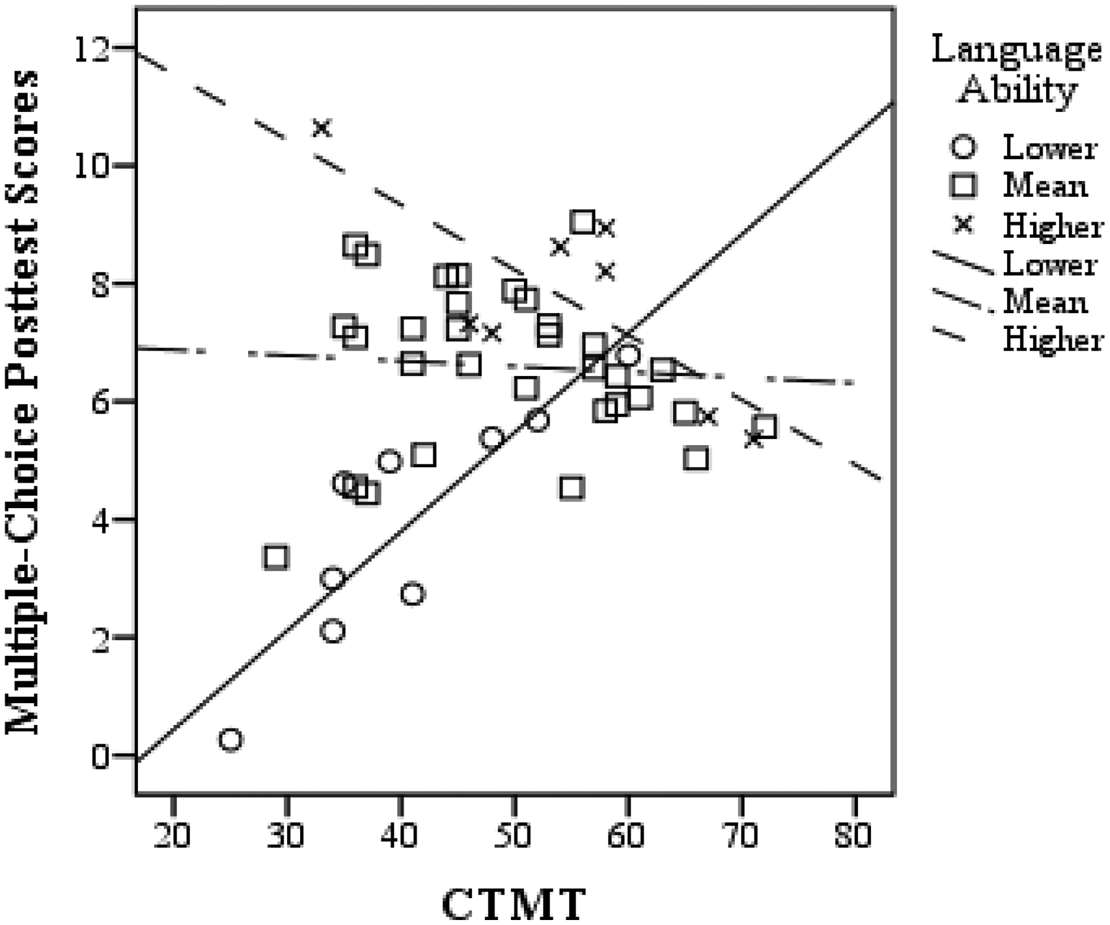
As mentioned, significant interaction was found between cognitive flexibility and language ability. To examine how the contribution of cognitive flexibility to multiple-choice posttest scores might differ according to children's language ability, a second simple slopes analysis was performed. The effect of cognitive flexibility on posttest scores for children with language ability within 1.0 SD of the sample mean (n = 32) was compared to that of children with lower language ability (1.0 SD or more below the sample mean; n = 10) and higher language ability (1.0 SD or more above the sample mean; n = 8). It is important to note that, in the current sample, language ability 1.0 SD below the sample mean corresponded to a standard score still well within the typical range. Results are illustrated in Figure 2.
Effect of cognitive flexibility on posttest scores: moderation by language.

Whereas the effect of cognitive flexibility for children with lower language ability was significant and positive (β = 0.50, t(41) = 2.23, p = .03), there were no significant effects of cognitive flexibility for children with higher language ability (β = –0.04, t(41) = –0.26, p = .80), nor for children with language ability at the sample mean (β = 0.20, t(41) = 1.20, p = .24). Thus, cognitive flexibility made a significant positive contribution to posttest scores for children with relatively lower language ability, but not for children with language ability at the sample mean or higher.
Discussion
The purpose of this study was to examine the acquisition of new word meanings from context among typically developing school-age children in relation to oral language ability and the three EF skills of working memory, inhibitory control, and cognitive flexibility. Results revealed that both language ability and the EF skill of cognitive flexibility may play direct roles in semantic word knowledge gains. Findings also suggest that children may naturally rely more heavily on either language or cognitive flexibility in the initial stages of word learning if one of the skills is relatively weak.
Language, EF, and word knowledge gains
It should be noted at the outset that the current study differed from many previous investigations of contextual word learning among school-age children in one important respect: children were exposed to target words and their surrounding context by two routes simultaneously. Participants were asked to read along silently from a computer screen while also listening as stories containing target words were read aloud. Thus, any gains in word knowledge that occurred may have resulted from reading, listening, or both. This method was chosen to ensure that two sources of form-related information about target words (phonological and orthographic) would be available for children to link with meaning-related (semantic) aspects of word knowledge that the story contexts provided (Perfetti & Hart, Reference Perfetti, Hart, Verhoeven, Elbro and Reitsma2002). We also hoped to minimize the floor effects that have plagued previous studies of word learning from context (e.g., Wagovich & Newhoff, Reference Wagovich and Newhoff2004), and maximize the chance that children would glean significant semantic information about target words (Valentini et al., Reference Valentini, Ricketts, Pye and Houston-Price2018). In addition, our procedure resembles a pedagogical method that seeks to maximize learning by introducing new vocabulary through simultaneous visual and auditory routes.Footnote 3
Results of the current study's multiple-choice measure showed that, after encountering target words in context, participants demonstrated significant and practically meaningful gains in word knowledge, with an average gain of 29.5 percent over pretest. Moreover, it is reasonable to infer that the increase in scores from pretest to posttest in the current study resulted specifically from children's encounters with target words in context in the stories, rather than from mere repeated exposure to the words on the multiple-choice measure. Previous studies have failed to show that multiple encounters with unfamiliar words, in the absence of meaningful context, resulted in significant gains in semantic word knowledge (e.g., Adlof, Frischkoff, Dandy, & Perfetti, Reference Adlof, Frischkoff, Dandy and Perfetti2016; Wagovich et al., Reference Wagovich, Hill and Petroski2015). Even with the supportive context provided by the stories in our study, about a third of the participants (16 out of 50) earned scores at posttest that were the same or lower than the scores they had earned at pretest, supporting the notion that the process of learning new word meanings from context is a slow and incremental process (Carey, Reference Carey, Halle, Bresnan and Miller1978).
Language
It was hypothesized that children's language ability would relate to their performance on the experimental word learning measure. Verbal short-term memory capacity, along with the ability to comprehend semantic relationships and to produce grammatically correct and semantically appropriate sentences, as assessed by the CELF-5, should, at least in theory, aid children in inferring new meanings from surrounding context. Previous studies of semantic word learning from context have found that school-age children with higher language skills outperform their peers with lower language ability on experimental word learning tasks (Steele & Watkins, Reference Steele and Watkins2010; Wagovich et al., Reference Wagovich, Hill and Petroski2015). However, prior studies have not taken EF skills such as cognitive flexibility into account.
Findings of the current study suggest that, for children with language development in the typical range, the contribution of language ability to the word learning process may vary according to children's cognitive flexibility skills. Among children with lower cognitive flexibility (at the sample mean or below), language ability was positively related to semantic word knowledge gains. In contrast, results showed no significant relation between language ability and word knowledge gains among children with high cognitive flexibility (1.0 SD above the same mean). Thus, language ability may be especially critical to the word learning process for children with weaker cognitive flexibility skills, and may play an important compensatory role in supporting word learning from context if cognitive flexibility is lacking.
In contrast, no significant interactions were found between language and working memory or inhibitory control in relation to semantic word knowledge gains. At least for this sample of typically developing children, language ability was positively related to word knowledge gains regardless of children's levels of working memory or inhibitory control. Whether this result would hold for children with development outside the typical range is uncertain and deserves further study.
Executive function
It was hypothesized that the EF skills of working memory, inhibitory control, and cognitive flexibility would relate to children's performance on the word learning measure. On a theoretical level, it was expected that working memory might aid children in remembering contextual semantic information about target words, that inhibitory control might assist children in suppressing irrelevant information, and that cognitive flexibility might enable children to switch between comprehending text and making inferences about word meaning. Although empirical studies are few, previous findings suggest that children's EF skills may predict performance on experimental word learning tasks (e.g., Cain et al., Reference Cain, Oakhill and Elbro2003, Reference Cain, Oakhill and Lemmon2004; Côté et al., Reference Côté, Rouleau and Macoir2014; Kapa & Colombo, Reference Kapa and Colombo2014; Yoshida et al., Reference Yoshida, Tran, Benitez and Kuwabara2011). However, this hypothesis was only partially supported. Results showed no significant relation between working memory or inhibitory control and semantic word knowledge gains, either as main effects or in interaction with language ability.
Although only speculative, it is possible that the tasks chosen to assess EF in the current study were not adequately representative of children's skills in working memory or inhibitory control. In addition, any effects of EF abilities on word learning might be revealed more effectively through direct manipulation of the EF demands inherent in experimental word learning tasks. For example, children's performance could be compared across contexts designed to be relatively more or less demanding in terms of working memory (e.g., by including helpful context that is relatively near or far from target words; Cain et al., Reference Cain, Oakhill and Elbro2003). Likewise, the effects of inhibitory control on word learning might be studied by varying the level of extraneous or irrelevant information included in the context surrounding target words. On the other hand, it is also possible that, in this sample of typically developing children, skills in working memory and inhibitory control were not sufficiently limiting to interfere with gains in semantic word knowledge.
Of the three EF skills included in the current study, only cognitive flexibility was shown to relate to children's word knowledge gains. In addition, the relation of cognitive flexibility to multiple-choice posttest scores differed according to language ability. Cognitive flexibility made a positive contribution to posttest scores among children whose language ability, though still well within the typical range, was relatively weaker (1.0 SD or more below the sample mean). However, no relation between cognitive flexibility and word knowledge gains was found among children with stronger language ability. Thus, cognitive flexibility may be especially crucial to the initial stages of the word learning process for children with lower language ability, and may serve in a compensatory role when language is relatively weak. These findings mirror the results, already discussed, suggesting a greater impact of language ability on word knowledge gains for children with lower cognitive flexibility skills. Either language or cognitive flexibility may, in parallel fashion, support the word learning process when the other set of skills is relatively limited.
Practical and theoretical implications
The current study's finding of a relation between cognitive flexibility and vocabulary acquisition suggests that these two processes may share, at least in part, a common set of underlying skills. That cognitive flexibility might be related to the semantic mapping process is not surprising; in making inferences about word meaning from context, learners are called upon to shift between multiple simultaneous tasks: generating potential meanings, discarding untenable ones, and maintaining overall context comprehension (Fukkink, Reference Fukkink2005). Moreover, recent neuroimaging findings point to a relation between cognitive flexibility and word learning at the neural level. Tasks of contextual word learning and cognitive flexibility are associated with similar patterns of activation in areas of the prefrontal cortex (Frishkoff, Perfetti, & Collins-Thompson, Reference Frishkoff, Perfetti and Collins-Thompson2010; Shenhav, Botvinick, & Cohen, Reference Shenhav, Botvinick and Cohen2013). When words are novel or unfamiliar, learners must recruit brain areas supporting purposeful cognitive control in order to both form and access new semantic associations (Mestres-Missé et al., Reference Mestres-Missé, Rodriguez-Fornells and Münte2007). In this way, learners gradually form more robust and high-quality lexical representations (Frischkoff et al., Reference Frishkoff, Perfetti and Collins-Thompson2010).
Findings also suggest that, for the word learning process, there might be some trade-off between language ability and cognitive flexibility. Children with language abilities that are relatively lower, though still within the typical range, might rely more heavily on cognitive flexibility in learning the meanings of target words, while children with weaker cognitive flexibility might rely more on language ability. At a basic level, this pattern of results suggests that children may naturally draw upon those abilities that come more easily to them and thereby self-compensate for areas which may be weaker. On the other hand, it is important to point out that our sample included children with very high scores in language (up to 1.7 SD above the population mean) and cognitive flexibility (up to 2.2 SD above the population mean). Our pattern of findings suggests that children who are particularly gifted in either language or cognitive flexibility may also preferentially rely on their stronger skill for making inferences about the meanings of words encountered in context. From an educational standpoint, these results suggest that, in the classroom, children benefit from both continuing to develop their strengths, as well as strengthening areas of weakness.
Limitations and future directions
Several limitations to the current study should be noted. As with any correlational design, findings can point to patterns of association among variables but cannot provide any definitive evidence of causality. Admittedly, we did not directly assess children's comprehension of the stories; we chose to address comprehension indirectly, through (a) our choice of participants with average to above-average language, cognitive, and reading skills; (b) our selection of stories with a developmentally appropriate (i.e., third-grade) reading level; and (c) our presentation of the stories in two modes simultaneously (i.e., listening and reading). The significant gains in semantic word knowledge that children demonstrated from pretest to posttest provide further evidence that the story contexts were comprehended well enough to support increased knowledge of embedded target word meanings.
Presenting the word learning task through simultaneous oral and textual routes had many advantages (e.g., increasing the likelihood that learning would be observed, standardizing presentation of stimuli). However, we acknowledge one limitation, in that children are not often exposed to new vocabulary in this fashion in typical classroom environments; more often, children are expected to learn new words through oral or text exposure alone. Therefore, had we used a different type of task, the profile of learning we observed might have been more similar to that observed in more naturalistic contexts. Of note, even with a task incorporating simultaneous oral and textual routes, the overall magnitude of word knowledge gains from the experimental task was modest, this was expected due to the incremental nature of the word learning process.
Another limitation concerns our measures of EF. A greater variety of measures may have better gauged participants’ overall EF skills (Yang & Gray, Reference Yang and Gray2017). Some researchers have recently suggested that, to demonstrate more convincing relations between language and domain-general cognitive skills such as EF, studies should incorporate visually based, non-linguistic EF tasks (e.g., Kaushanskaya, Park, Gangopadhyay, Davidson, & Ellis Weismer Reference Kaushanskaya, Park, Gangopadhyay, Davidson and Ellis Weismer2017; Yang & Gray, Reference Yang and Gray2017). However, the visual/linguistic dichotomy may not be an entirely valid distinction, because all experimental EF measures necessarily involve a certain verbal component. At the very least, participants must comprehend, remember, and follow verbally presented instructions and prompts when performing EF tasks. Admittedly, our participants’ EF skills may have been taxed to a greater degree if the target words had not been highlighted and if the stories had been presented through a single modality rather than through simultaneous listening and reading. However, we felt this approach to be necessary in order to support measureable semantic word knowledge gains.
Although the current study's sample size was not large, power analyses indicated that the sample was adequate for detecting clinically and educationally relevant medium to large effects. Admittedly, the sample was not balanced in terms of either gender or race/ethnicity; more boys than girls took part in the study, and the great majority of participants were White and non-Hispanic. However, there were no significant differences in any of the independent or dependent variables based on either gender or race/ethnicity. No follow-up sessions were included in the current study, because the intent was only to examine children's initial gains in semantic word knowledge from context (i.e., fast mapping). Further studies might include additional follow-up sessions to evaluate children's short- or long-term retention of newly acquired word meanings.
The present study focused only on typically developing children. Future studies should be extended to examine the joint contribution of EF skills and language ability to the contextual word learning process among children with development outside the typical range. For example, a recent study found weaker EF skills among young children with language disorders than in peers with typical language development (Yang & Gray, Reference Yang and Gray2017). However, it is still unknown whether such differences exist among school-age children or whether the contribution of EF skills to the word learning process might differ between children with language disorders and children with typical development. Current findings suggest that, for typically developing children, cognitive flexibility might serve to compensate for relatively weaker language skills in the word learning process; yet for children with developmental disorders such as autism spectrum disorders or attention-related problems, EF skills may be especially problematic (Craig et al., Reference Craig, Margari, Legrottaglie, Palumbi, de Giambattista and Margari2016). Ultimately, future studies could shed light on whether interventions targeted to improve cognitive flexibility skills might also support contextual word learning for both children with language impairment and children with neurodevelopmental disorders.
Acknowledgments
The study was completed by the first author in partial fulfillment of the requirements for the degree of Doctor of Philosophy, Department of Communication Science and Disorders, University of Missouri. We gratefully acknowledge Bryan T. Brown for his assistance in the development of experimental stimuli.