


LEARNING OBJECTIVES
After reading this article you will be able to:
-
• describe the limitations of current suicide risk assessment tools
-
• describe two conceptual and methodological challenges associated with the topic of suicide
-
• describe the four stages of the SPSM model.
Suicide is a relatively rare phenomenon (Nock Reference Nock2014: pp. 121, 197, 361, 367). This is why rates are typically presented per 100 000 population. According to the latest figures from the World Health Organization (WHO), the global annual suicide rate stands at 9.2 per 100 000 (World Health Organization 2024). Despite its rarity, this translates to over 700 000 deaths by suicide each year (World Health Organization 2024). Each of these deaths has a profound impact on family, friends and clinicians, often raising questions such as ‘Was it predictable?’ and ‘Was it preventable?’. The question of why someone took their own life can be specially tormenting, particularly for family members.
The question of ‘why’ is a question of motive(s). In this article, I argue that this is the core question and that a clear framework for approaching it is essential for our knowledge and practice. I also argue that risk assessment and management should be grounded in such a framework. This is particularly important because current risk assessment tools have been found to have little clinical utility (Appleby et al 2018). Recent guidelines (National Institute for Health and Care Excellence 2022; Mughal et al Reference Mughal, Burton and Fletcher2023) suggest abandoning these tools in favour of a personalised approach to psychosocial assessment. To achieve that, a simple model that can be taught to professionals from different backgrounds is needed. Such a model needs to be comprehensive by including the different types of motive and accommodating current findings.
The newly developed model presented in this article, the source–problem–solution–motive (SPSM) model, aims to provide a structure for this personalised framework. The focus of the model is not on prediction – a challenging task owing to the inherent complexities of the phenomenon, as I will discuss – but rather on prevention through understanding.
Beyond its primary clinical function, the model could serve as a framework for future theoretical and empirical research owing to its comprehensive, unifying nature and its ability to incorporate current models, which has been suggested as an essential requirement (Jacobson and Batejan Reference Jacobson, Batejan and Nock2014; Díaz-Oliván et al Reference Díaz-Oliván, Porras-Segovia and Barrigón2021).
Before presenting the SPSM model, I will describe current clinical and academic aspects of the field and discuss the conceptual and methodological challenges faced in studying and dealing with suicide/self-harm. This discussion is essential before formulating my approach to the subject at the clinical and academic levels. I then present potential solutions to these challenges, providing the foundational principles of the SPSM model.
Current situation
Clinical: tools of suicide risk assessment
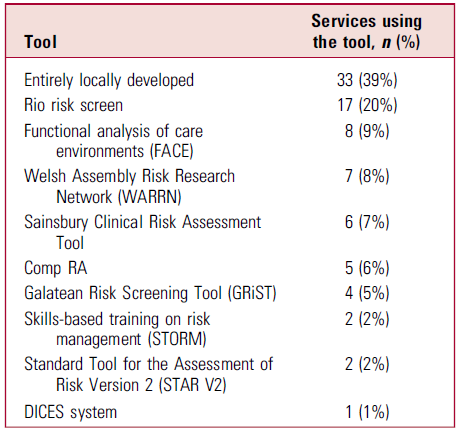
A comprehensive study by the National Confidential Inquiry into Suicide and Safety in Mental Health (NCISH) examined the use of suicide risk assessment tools across all 85 NHS mental health trusts and health boards in the UK. It identified 156 tools, 85 of which were used service-wide (Table 1) and were examined in the study report (NCISH 2018). The rest were modified to be used in specific patient groups. In addition, five services gave their clinicians the option to use suicide risk scales (e.g. SAD PERSONS, PATHOS, the Beck Hopelessness Scale, the Columbia Suicide Severity Rating Scale), in conjunction with the main tool.
Summary of the tools used service-wide across the 85 NHS mental health trusts and health boards in the UK

Comp RA, two-step risk approach, using a standardised risk screening tool for all patients, followed by a comprehensive clinical risk assessment and management tool where required; DICES, describe the risk, identify the options, choose your preferred option(s), explain your choice, share your thinking; Rio risk screen, a risk summary embedded within the electronic patient record system Rio.
Source: adapted from utility National Confidential Inquiry into Suicide and Safety in Mental Health (2018).
Key findings from the NCISH report can be summarised as follows:
-
there is inconsistency across services in the length, content or structure of the tools used;
-
most of the tools (85%) were checklists, although options were given for clinicians to add information;
-
94% of the services used risk categorisation (stratification), for example into high/medium/low, red/amber/green or numerical risk categories (e.g. 1–10); and this has determined management outcomes;
-
the majority of tools focused on prediction using the above risk stratification systems;
-
almost all of the items related to suicidal thoughts and behaviour included in tools fell within the domain of risk factors: motives or reasons for the behaviour were scarcely mentioned.
The NCISH report also gathered insights from clinicians, patients and carers through surveys and interviews. Many clinicians felt that risk assessment tools should not replace clinical judgement and suggested removal of the scoring systems. Patients advocated for the use of a personalised approach rather than a checklist, for a focus on the suicidal thoughts and for carer involvement. The main clinical messages of the report included the need to move away from prediction and checklists towards building relationships, to collect high-quality information and to involve family and carers. Another very important message is that management should be personalised, and treatment decisions should not be based on the outcome category or score (NCISH 2018).
Recommendations in the National Institute for Health and Care Excellence (NICE) guideline on self-harm are very similar and even more bold (NICE 2022). NICE strongly recommends that mental health professionals should not use risk assessment tools, scales or risk stratification (into low, medium or high risk) ‘to predict future suicide or repetition of self-harm’ or to ‘determine who should and should not be offered treatment’ (p. 16). Instead, they are encouraged to undertake a risk formulation as part of every psychosocial assessment (p. 16). The rational for these clear statements is that such tools and scales ‘cannot accurately predict risk of self-harm or suicide’ and that using them to make treatment decisions could lead to ‘repeat self-harm, distress and lower patient satisfaction’ (p. 53). The guideline argues that ‘the potential harms of risk stratification, including the implication that risk is static instead of dynamic, outweigh any benefits’ (p. 53).
Academic: Theoretical models of suicide
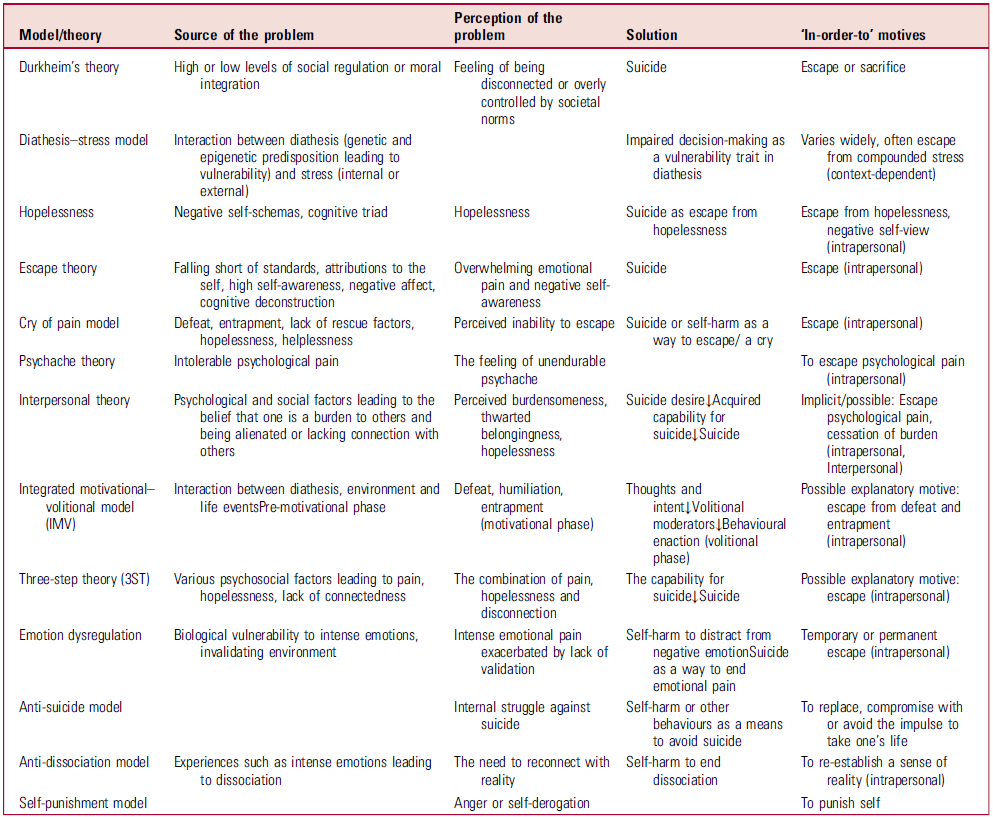
Many theoretical models have been proposed to explain suicidal behaviour and most focus on one aetiological domain. The diathesis–stress model is an example of a biological model. Models that focus on psychological/cognitive domains variously explain suicidal behaviour in terms of hopelessness, escape, a cry of pain and psychache. Durkheim’s theory is a well-known example of a social model of suicide. Some models try to integrate different aspects of the phenomenon, such as interpersonal theory, the integrated motivational–volitional model and three-step theory. The main components of current models are outlined in Table 2 and limitations of some of these will be discussed later in this article. Full references for the models mentioned here are given in the supplementary material, available online at https://doi.org/10.1192/bja.2025.18. A more detailed discussion is beyond the scope of this article but can be found elsewhere (e.g. Jacobson and Batejan Reference Jacobson, Batejan and Nock2014; Selby et al Reference Selby, Joiner, Ribeiro and Nock2014).
Integration of current theoretical models of suicide and self-harm into the source–problem–solution–motive (SPSM) model

Conceptual and methodological challenges
Intent and the problem of definition
There are several definitions of suicidal and non-suicidal self-harming behaviours (for a discussion, see Van Orden et al Reference Van Orden, Witte and Cukrowicz2010; Posner et al Reference Posner, Brodsky, Yershova and Nock2014). The presence of intent to die is often considered to be the feature distinguishing suicidal from non-suicidal self-harming behaviours. However, intent is subjective, non-categorical, dynamic and difficult to measure (Posner et al Reference Posner, Brodsky, Yershova and Nock2014). As a result, one proposed definition of intent is a ‘non-zero’ wish to die (O’Carroll et al Reference O’Carroll, Berman and Maris1996). In this article I use non-suicidal self-harming behaviour to cover terms like deliberate self-harm and non-suicidal self-injury.
Suicidal and non-suicidal self-harming behaviours often co-occur (Stanley et al Reference Stanley, Winchel and Molcho1992; Nock et al Reference Nock, Joiner and Gordon2006) and can share similar risk factors (Andover et al Reference Andover, Morris and Wren2012). Here I adopt the view that these behaviours exist on a continuum of self-harm (Stanley et al Reference Stanley, Winchel and Molcho1992; Linehan Reference Linehan and Maris2000). The SPSM model can be utilised to understand, assess and manage this broad range of thoughts and behaviours. This approach addresses the issues of distinction mentioned earlier and, more importantly, advocates a shift in focus from prediction to prevention through understanding.
The low base rate and the problem of prediction
The challenge of predicting suicide is closely tied to the low base rate problem (Pokorny Reference Pokorny1993; Brown et al Reference Brown, Beck and Steer2000). This statistical problem arises when a particular event is rare in the general population. When an event has a low base rate, a model’s positive predictive value (PPV) – the likelihood that those identified as being at high risk will actually engage in the behaviour – tends to be low, even with a statistically robust model (with high sensitivity and specificity). This problem is evident in the difficulty in predicting suicide (Chan et al Reference Chan, Bhatti and Meader2016; Runeson et al Reference Runeson, Odeberg and Pettersson2017). The difficulty in prediction is made worse by the fact that in a large number of cases the person is not known to mental health services: for example in the UK only 26% of people who died by suicide between 2011 and 2021 had been in contact with mental health services in the 12 months before their death (NCISH 2024).
The focus on risk factors
Most of the research into suicide and self-harm focuses on risk (and protective) factors (Klonsky et al Reference Klonsky, May and Saffer2016). Although these factors are relatively common in the general population, only a small percentage of those at risk will actually die by suicide, leading to the low predictive power of risk factors (Chan et al Reference Chan, Bhatti and Meader2016; Runeson et al Reference Runeson, Odeberg and Pettersson2017).
At the clinical level, most suicide risk assessment tools rely on identifying risk factors in individuals presenting with suicidal and self-harming thoughts and behaviour (NCISH 2018). These factors are important for assessment and management (as discussed in the source section of the SPSM model below), but they offer limited predictive value (Chan et al Reference Chan, Bhatti and Meader2016; Runeson et al Reference Runeson, Odeberg and Pettersson2017). The SPSM model proposes shifting the focus from risk factors to motives, emphasising prevention through understanding rather than prediction.
The nomothetic versus idiographic approach: the problem of generalisation
The dilemma of using the nomothetic versus the idiographic approach is not unique to suicide and self-harm research. The nomothetic approach, dominant in psychiatric and psychological research, seeks to identify generalisable patterns and universal laws by studying large groups, focusing on common risk factors and statistical correlations. This approach helps in identifying population-level trends and suggesting broad preventive strategies.
In contrast, the idiographic approach involves detailed examination of individual cases to understand the unique constellation of factors and personal narratives, offering a richer contextual understanding. However, idiographic methods do not lend themselves to generalisation, which is necessary for advancing scientific knowledge. The ‘ideal type’ methodology (Weber Reference Weber1949), as I will discuss, provides a solution to this issue.
Causal explanation versus empathic understanding
This problem is closely related to the previous one and is well illustrated by comparing the approaches of Emile Durkheim and Max Weber, two foundational figures in sociology. Durkheim, a positivist, believed that sociology’s subject matter consists of ‘social facts’. His macro-sociological approach sought to uncover these facts influencing individual behaviours, as seen in his 1897 seminal work Le Suicide (Durkheim Reference Durkheim1951),Footnote a where he analysed statistical data to identify social integration and regulation as key factors. The individual’s role is often viewed as passive in his analysis, leading to the concept of ‘waves of suicide’ in society.
Weber (Reference Weber1949), although agreeing that causal explanation extends to sociocultural phenomena, focused on ‘social actions’. His emphasis on verstehen (understanding) required in-depth exploration of personal intentions and cultural contexts, advocating for idiographic methods. Weber also recognised the need for generalisation in scientific pursuits, introducing the concept of the ideal type as a methodological solution to this problem.
Conceptual and methodological foundations for the SPSM model
The SPSM model is grounded in the contributions of three prominent sociologists: Schütz, Weber and Baechler. Schütz’s distinction between ‘because’ motives and ‘in-order-to’ motives, along with Weber’s emphasis on understanding, guide a phenomenological approach to empathic interpretation. Weber’s ideal type addresses the limited generalisability of idiographic approaches. Baechler’s subsequent application of these principles to suicide research – viewing suicide as a solution to a problem and developing a typology – provides a foundation for the SPSM model.
Alfred Schütz
Schütz, an Austrian philosopher and sociologist, made significant contributions to understanding social action and motives through his phenomenological approach, first published in the 1930s (Schütz Reference Schütz1984). He distinguished between ‘because’ motives (past experiences leading to action) and ‘in-order-to’ motives (future-oriented goals). Most suicide/self-harm research focuses on the first type, often in the domain of risk factors, while the second type is either overlooked or only partially addressed. The SPSM model covers both types of motive.
Max Weber
Weber, a well-known German sociologist, emphasised that empathic understanding is crucial for studying psychological phenomena. His work, largely published between 1903 and 1917, significantly influenced the work of Karl Jaspers, the founding father of psychopathology (Walker Reference Walker2014). Weber’s concept of the ideal type (Weber Reference Weber1949) captures empathic understanding while also providing a template for generalisable research. By highlighting the essential features and characteristics of a particular social (and psychological) phenomenon it is possible to create an abstract model – the ideal type. This ideal type is not meant to represent reality perfectly but it serves as a benchmark against which real-life cases can be compared and analysed. Psychiatric diagnoses are very good examples of ideal types.
Jean Bachler
Jean Baechler, a French sociologist, expanded on Schütz’s and Weber’s contributions in his seminal 1975 work Les Suicides (Baechler Reference Baechler1979). Baechler viewed suicide and self-harm as a meaningful, goal-directed behaviour – a means to an end (the ‘in-order-to’ motive) and a solution to a real or perceived problem. According to Baechler, the behaviour is logical (the means is appropriate to achieve the end as seen by the actor). The behaviour can even be rational if an objective observer agrees with this logic. He analysed numerous case studies, categorising behaviour based on the ‘in-order-to’ motive into 11 ideal types. Baechler’s use of the ideal type allowed him to accommodate the uniqueness of each case while producing abstract types that serve as templates for examining real cases.
In previous research, colleagues and I used Baechler’s typology to develop a new questionnaire for eliciting these types/motives (Abbas et al Reference Abbas, Mohanna and Diab2017). The SPSM model builds on Baechler’s work by providing a structured model that incorporates both types of motive, can be easily taught and offers a clinically meaningful framework for suicide risk assessment and management.
The SPSM model: integrating causal explanation and empathic understanding
The SPSM (source–problem–solution–motive) model provides a comprehensive framework for understanding suicidal and self-harming behaviours by integrating causal explanation with empathic understanding.
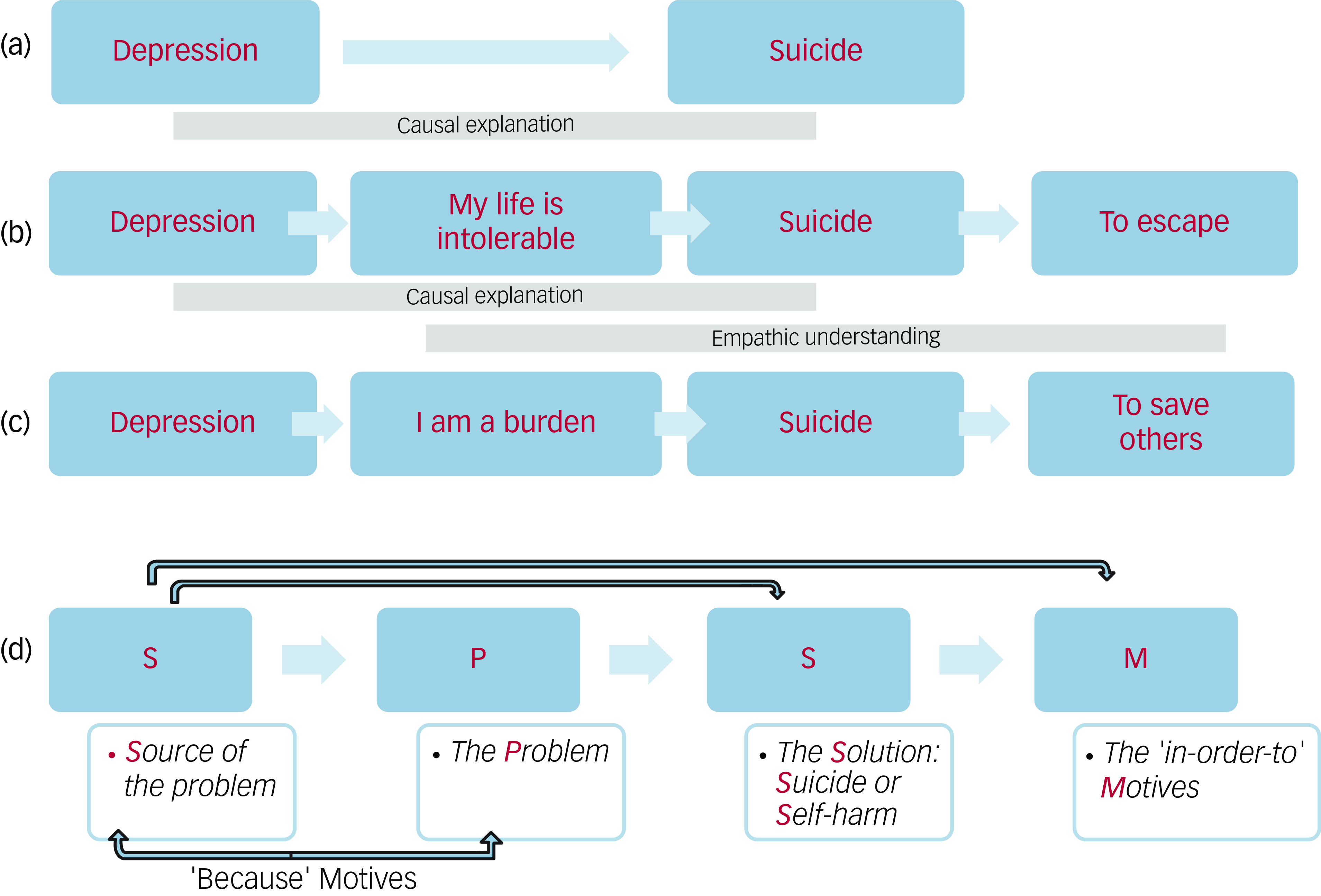
As illustrated in Fig. 1, the model highlights that although identifying risk factors (causal explanation, Fig. 1(a)) is crucial, it is not sufficient in isolation. It is equally important to grasp the internal logic that drives an individual to view suicide or self-harm as a viable solution and an appropriate means to achieve a goal, i.e. ‘in-order-to’ motives (empathic understanding, Fig. 1(b) and (c)). This understanding is achieved by analysing four interconnected stages: the source of the problem, the perception of the problem, the solution (suicide/self-harm) and the ‘in-order-to’ motives (Fig. 1(d)).
The source–problem–solution–motive (SPSM) model: linking causal explanation with empathic understanding. (a) The causal explanation; (b) and (c) empathic understanding; (d) analysing the four interconnected stages – the source of the problem, the problem, solution and motive.

Stage 1 The source of the problem
The source of the problem is rarely attributable to a single cause; instead, it typically involves multiple risk factors that span biological, psychological and social domains. These factors can be distal (e.g. genetic predisposition) or proximal (e.g. recent job loss) and vary in their amenability to change. Extensive research has identified numerous risk factors for suicide and self-harm, which are discussed below.
Clinically, these factors can be explored using tools like the biopsychosocial model or the integrated case formulation (Abbas et al Reference Abbas, Walton and Johnston2012), which provides a narrative that integrates these factors to explain how they contribute to the perception of a problem. This narrative approach helps in understanding the complex interplay of various risk factors and how they lead to a perceived insurmountable problem.
Stage 2 The perception of the problem
Baechler (Reference Baechler1979) highlighted that problems can be either real or perceived, but all problems have a subjective component influenced by the individual’s cognitive and emotional characteristics. Someone with rigid thinking, low self-esteem or hopelessness might perceive a situation as intolerable or unsolvable, even if it is not objectively so. Common perceptions of problems among those who consider suicide or self-harm include ‘My life is intolerable’, ‘I am a burden’, ‘I am unloved’, ‘I am angry with myself’, ‘I am angry with someone else’, ‘I need something specific from someone’. Both the source and the problem are within the realm of the ‘because’ motives of the behaviour
Stage 3 The solution: suicide/self-harm
From an evolutionary perspective, humans tend to rely on a set of solutions to address a wide range of problems (Cosmides and Tooby Reference Cosmides, Tooby, Barkow, Cosmides and Tooby1992). Solutions to problems like the ones mentioned above might include constructive attempts to change the conditions of the problem. This could include removing or changing the factors that constitute the source of the problem. It could also include changing the perception of the problem by incorporating a different perspective or a wider context. Suicide, however, is one available solution. When the person does not exist, the problem disappears. Sometimes, the person sees self-harm as a reasonable solution to the problem they face. The factors that influence the choice of the solution will be discussed later in this article. The second (problem) and third (solution) stages of the model view the behaviour as a solution to the problem, something that has already been suggested (Patsiokas et al Reference Patsiokas, Clum and Luscomb1979; Schotte and Clum Reference Schotte and Clum1982, Reference Schotte and Clum1987; Reinecke Reference Reinecke and Ellis2006).
Stage 4 The ‘in-order-to’ motives
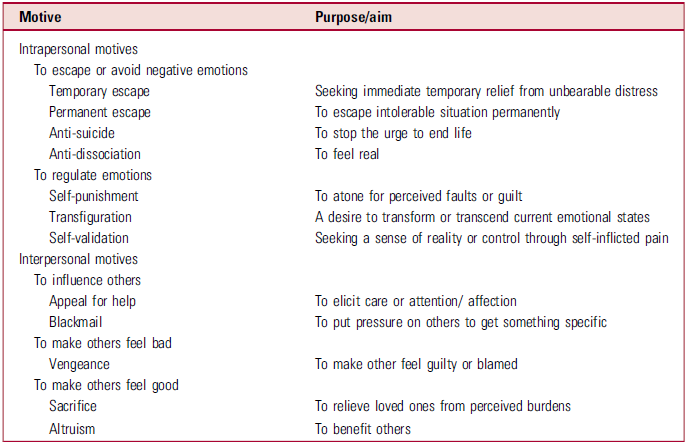
Ideomotor theory suggests that human action is motivated by the mental representation or the imagined outcome/effect of the behaviour (Pezzulo et al Reference Pezzulo, Baldassarre and Butz2007). Human behaviour is inherently goal-directed, and suicidal or self-harming behaviours are no exception. These behaviours are seen as a means to an end, the ‘in-order-to’ motives. These motives can vary widely, from a desire to escape intolerable situations to a need to influence others or achieve a sense of control. Baechler (Reference Baechler1979) identified a number of these motives, which have been supported in further research (e.g. Abbas et al Reference Abbas, Mohanna and Diab2017). Other studies found similar motives (for a review see Taylor et al Reference Taylor, Jomar and Dhingra2018). Table 3 outlines the most common ‘in-order-to’ motives.
‘In-order-to’ motives of suicidal and self-harming behaviours

Source: after Taylor et al (Reference Taylor, Jomar and Dhingra2018).
The choice of solution, risk factors and intent
The choice between self-harm, suicide or other non-self-harming solutions depends on the interplay of the four stages described in the model. The internal logic that binds these stages (i.e. identifying a problem, perceiving suicide as a solution and believing it will achieve the desired goal) drives the development of the suicidal/self-harming thoughts and the progression from thoughts to action. Factors such as the number and severity of risk factors (source), the perceived solvability of the problem (problem), the mental state at the time of the behaviour and the individual’s cognitive and emotional traits, for example the ability to explore alternative solutions (Dombrovski et al Reference Dombrovski, Hallquist and Brown2019), all contribute to this internal logic. The goal to be achieved by the behaviour (the ‘in-order-to’ motive), as part of that internal logic, plays an important part in the choice. In some cases (e.g. blackmail, appeal for help, anti-dissociation), self-harm can be a sufficient solution. In others (such as escape/flight) suicide might be seen as the only solution.
In the SPSM model, the intent to die emerges when the individual concludes that suicide is a necessary solution to achieve their goal. However, intent is not categorical; ambivalence is common (Henriques et al Reference Henriques, Wenzel and Brown2005), reflecting the internal conflict between the desire to achieve the goal (benefit) and the irreversible nature of suicide (cost). This ambivalence can be influenced by factors such as rigid thinking, impulsivity and social support, which affect the individual’s ability to fully commit to the decision.
Integrating previous evidence: risk factors
Research on suicide and self-harm has identified a number of biological, psychological and social risk factors. Any new model needs to accommodate these factors. As outlined below, the SPSM model suggests that these factors influence one or more stages of the model, eventually strengthening the internal logic that drives the behaviour. Absence of these factors or the presence of protective factors can attenuate this logic, making the choice of alternative solutions more possible.
Most of the factors listed below contribute, individually or in synergy, to stage 1 of the model – the source of the problem. This contribution to the source of the problem is straightforward and it is therefore mentioned here to avoid repetition when each factor is described. Some factors extend their influence across other stages of the model, as indicated. References to the evidence supporting each risk factor are given in the online supplementary material.
Demographic and social factors
Low educational achievement, unemployment, low-income, homelessness and lower socioeconomic status have all been found to be risk factors for suicide. They can lead to financial stress and fewer opportunities, which can create perceptions such as ‘I’m a failure’, ‘I’m trapped’, ‘I’m powerless’, ‘I’m worthless’ or ‘I’m a burden’. This makes suicide seem like a solution to escape from these perceived failures or an act of sacrifice to relieve others from perceived burdens.
Being single, divorced or widowed can lead to feelings of isolation and loneliness. This can constitute the problem itself or exacerbate other life problems through the lack of social support. In such cases, motives like escape or an appeal may arise.
Stressful life events such as childhood abuse, combat exposure or incarceration can lead to feelings of being overwhelmed, hopeless and unable to cope, thereby clouding the perception of available solutions and increasing the likelihood of suicidal thoughts.
Exposure to family conflicts or violence can lead to a sense of fear, insecurity and a lack of safety. This can make it difficult to trust others and make suicide seem like a way to escape.
Psychiatric disorders
Any mental disorder is a risk factors for suicide. It can cause intense emotional pain, distorted thinking and a loss of perspective. This can make it difficult to see the value in life and make suicide seem like a way to escape the suffering. Different psychiatric disorders can influence the internal logic in different ways.
Depression is usually associated with feelings of hopelessness, worthlessness and being burden. These problems can make it difficult to enjoy life and make suicide seem like a way to escape the suffering or like an act sacrifice. Hopelessness can distort the patient’s perception of the problem or the availability of other solutions.
Schizophrenia and bipolar disorders can distort reality. This can lead to problems such as perceived threat or danger. Suicide can become an escape from those feelings, a way of saving others or a solution to other distorted motives, depending on the content of the delusional or hallucinatory symptoms. The huge impact of these conditions on the person’s life and their family can be perceived as an insurmountable problem, making suicide seem like a solution to escape that suffering or to relieve the burden.
People with personality disorders can have feeling of emptiness (a problem), difficulties with relationships (a problem or lack of support to solve problems), and poor emotion regulation and impulse control (facilitating the choice of self-harm or suicide as a solution). The appeal for help, blackmail, vengeance and temporary or final escapes are possible motives.
The role of autism spectrum disorder and attention-deficit hyperactivity disorder in contributing to suicide might rest on psychological traits (rigid thinking, impulsivity) that affect perception of the problem or the choice of solution.
Substance misuse
Alcohol and other substance misuse and its consequences can become a central problem. This can make individuals feeling trapped and unable to stop, making suicide seem like a solution to escape this entrapment. Alcohol and other substances can have an immediate effect on decision/(solution)-making through disinhibition, impulsivity or impaired judgement.
Physical illness
Physical illnesses can cause pain, fatigue and a loss of independence. This can create a sense of an intolerable life or being a burden on others and make suicide seem like a way to escape suffering and spare others.
Cognitive, personality and psychological factors
Low IQ and poor cognitive function can lead to problem-solving deficits and difficulties in life that result in the perceived problem of an intolerable/trapped situation, leading to the need to escape. Self-harm can be seen a way of dealing with distress or of influencing others to achieve something vague (affection/attention) or specific (blackmail).
Impulsivity can contribute to suicide distally through the accumulation of unwise decisions that can lead to difficulties in a life, the problem. Proximally, it can impair the problem-solving skills and speed up decision-making.
Problem-solving deficits fit very well with one of the main principles of the SPSM model by limiting the range of solutions available to solve problems, making self-harm or suicide seem like reasonable ones.
Hopelessness can be the problem itself or it can shape the perception that the problem is not solvable, making suicide seem like the only solution to escape.
The combination of thwarted belongingness and perceived burdensomeness can either constitute the problem itself or it can affect the perception of other problems because of lack of social support or the exaggeration of the perceived burden on others.
The acquired capability for suicide can reduce the fear of death, making suicide a more viable option.
Previous suicide attempts
A history of previous suicide attempts is associated with increased suicide risk and is the single best predictor of eventual suicide. Previous attempts can establish a learned problem-solving behaviour that may be deployed in future crises. However, while this may provide short-term relief, the failure to achieve a long-term solution can lead to a perception that ‘nothing will change’, prompting consideration of more drastic measures. The desensitisation effect of previous attempts can make subsequent attempts easier.
Clinical implications
As mentioned above, the NCISH (2024) and NICE (2022) advocate a personalised approach and that risk assessment tools should not focus on prediction. Barriers to implementing these recommendations include the need for a change of culture among mental health professionals and the current absence of multidisciplinary education and training. The SPSM model might fill a gap in this area because of its simplicity and suitability for all professional groups.
The main theme of the NICE guideline is the need for empathy, the use of psychosocial assessment not risk assessment, a move from a ‘risk-focused’ to a ‘safety-focused’ culture and from tick-box approaches to holistic risk formulation (Mughal et al Reference Mughal, Burton and Fletcher2023). It also highlights the need explore the function of self-harming behaviour, something that is central in the SPSM model. The SPSM model, with its focus on understanding the internal logic of suicidal behaviour, supports this shift by providing a structured yet flexible approach to assessment and management.
Using the SPSM model
An overview
In clinical practice, the SPSM model can guide the use of current interventions (such as the Attempted Suicide Short Intervention Program; Gysin-Maillart et al Reference Gysin-Maillart, Schwab and Soravia2016) or the development of interventions that address each stage of the behaviour. The following is a very brief outline of its application.
Source: Change or remove factors that constitute the source of the problem, for example, treat mental disorder, help the individual with financial and employment issues.
Problem and its perception: Explore and challenge the person’s perception of the problem. This can be done through careful examination of the details of the problem and any discrepancy between the problem and its perception, exploring the factors that have led to this discrepancy (e.g. the current mental state) and highlighting the temporary nature of such factors. Improving problem-solving skills is an important component here.
Solution: The main aim here is to help the individual realise that there are solutions to the problem other than self-harm or suicide. Techniques could include exploring other solutions that the individual has used in the past, the failure of self-harm in solving the problem in the long term and even suggesting to the individual some extreme hypothetical solutions, highlighting their lower cost compared with irreversible death by suicide.
Motive: Challenge the rationality of the internal logic. This could be done through exploring with the individual why this means is not appropriate for that end. Other, more effective, means could be explored. The previous failure of the logic could be explored, particularly in repeated self-harm. Another technique is to challenge the necessity of achieving the identified goal/‘in-order-to’ motive in the first place.
Case vignettes
The SPSM model’s flexibility and structured nature make it applicable across diverse clinical settings and multidisciplinary teams. Most patients with suicidal and self-harming behaviours are first seen in emergency settings. Because of its simplicity, the model could be used to provide a clinically meaningful assessment framework to produce a risk formulation. It could also provide a structure to start risk management, complementing safety planning. This management part might need further sessions following the immediate presentation.
Boxes 1 and 2 give two examples of using the SPSM model for assessment and management of suicidal and self-harming behaviours. The fictitious cases are presented using the integrated case formulation model (Abbas et al Reference Abbas, Walton and Johnston2012) followed by SPSM analysis.
Case vignette 1: integrated case formulation
Mr B is a 42-year-old, married, White British man with two children. He works as a software developer and lives with his family in a rented apartment. He was admitted after a significant overdose.
His father suffered from depression and died by suicide when Mr B was 8. This suggests a genetic vulnerability to depression and suicidality. Pregnancy, birth and early developmental milestones were within normal limits, with no significant insults to the brain identified. Mr B had a difficult childhood. His father’s suicide and his mother’s subsequent emotional withdrawal left him with feelings loss and emotional deprivation. The genetic factors and these experiences might explain his low self-esteem, self-criticism and introversion. These traits contribute to persistent feelings of worthlessness and hopelessness. However, Mr B has been able to maintain his job for over 15 years, although he has minimal social interactions outside of his immediate family. His relationship with his wife has become strained owing to his withdrawal and emotional unavailability.
Mr B has had two prior depressive episodes, the first occurring at age 28 following the death of his mother. He was treated with cognitive–behavioural therapy (CBT) and sertraline. His second episode occurred at age 36, which was treated with fluoxetine, but he discontinued treatment prematurely. His current depressive episode began 8 months ago, following a job demotion. He describes severe affective, cognitive and biological symptoms of depression. Three months ago, he attempted suicide by overdosing on his prescribed antidepressants. He was admitted to hospital after being found unconscious by his wife and has been receiving psychiatric care since. Despite treatment, he continues to struggle with hopelessness and believes he is a burden to his family. His suicidal thoughts continue.
The diagnosis is recurrent depressive disorder, current episode severe, with suicidal behaviour.
Source–problem–solution–motive (SPSM) analysis (assessment and management)
Stage 1 Source The combination of genetic vulnerability (father’s suicide), early emotional deprivation, trauma, current stressors (job demotion, family strain) and depression has led to significant risk factors. The focus of management here is on changing or removing the risk factors as follows.
-
Treating the depressive disorder: Mr B requires a comprehensive treatment plan involving both pharmacotherapy and psychotherapy. His current antidepressant regimen should be reviewed, and alternative medications or augmentation strategies could be considered. Electroconvulsive therapy may be an option if this fails.
-
Addressing the work-related stressors: Since Mr B’s job demotion triggered this depressive episode, involving an occupational therapist or vocational support may help him either adjust to the current situation or explore new opportunities.
-
Family support: His wife’s involvement in the treatment process will be crucial. Psychoeducation for both Mr B and his family can help create a supportive home environment and reduce his feelings of being a burden.
Stage 2 Perception of the problem Mr B perceives his situation as insurmountable, believing he has failed in both his professional and personal life. His hopelessness distorts his view, making it difficult to see alternatives. Challenging Mr B’s distorted perception of his problems will be essential, for example through the following.
-
Cognitive restructuring: CBT will focus on identifying and challenging maladaptive beliefs, such as ‘I’m a failure’ or ‘I’m a burden’. These thoughts need to be re-evaluated in light of evidence that contradicts them.
-
Problem-solving therapy: By improving Mr B’s problem-solving skills, he could better handle future stressors. He could work on identifying alternative ways to deal with job-related criticism and explore strategies to rebuild his self-esteem.
-
Highlighting temporality: Mr B’s cognitive distortions are likely fuelled by his current mental state. Helping him understand that his current depressive episode is temporary and treatable could reduce feelings of hopelessness.
Stage 3 Solution Mr B perceives suicide as a way to escape his emotional pain and relieve his family of the burden he feels he has become. His father’s suicide may have normalised this as a potential solution. His hopelessness and tunnel vision due to depression reinforce this. Exploring alternative solutions to suicide is crucial, as follows.
-
Past coping strategies: Help Mr B recall any effective coping strategies he has used during previous depressive episodes. The fact that he has recovered from depression before could be reassuring.
-
Explore extreme but non-lethal hypothetical solutions: This could involve discussions of significant life changes, such as switching careers, moving to a new location or taking a sabbatical – highlighting that these have lower costs than suicide and provide an escape from the current perceived problem without the finality of death.
-
Review outcomes of failed suicide attempts: Mr B’s overdose failed to ‘solve’ his problems and only caused more pain for his family, reinforcing that suicide is not a viable long-term solution.
Stage 4 ‘In-order-to’ motives: His suicide attempt was driven by a desire to end his suffering (escape/flight) and alleviate his perceived burden on his family (sacrifice). Challenging the logic behind the suicide attempt is essential to reduce his suicidal intent.
-
Exploring goals: Discuss why he felt that suicide was necessary to relieve his family of burden and challenge the idea that his death would make their lives better. Highlighting his value to his family and how they would actually suffer more if he were gone can shift this internal logic.
-
Reframing the necessity of goals: Challenge whether relieving others of a perceived burden is truly necessary, and help Mr B redefine his role in his family by promoting shared responsibilities rather than burdening himself with unrealistic expectations. The need to escape could also be challenged based on the fact that the problem that led to this logic is reversible.
-
Rationality of the means: Explore the irrationality of suicide as a solution to a temporary emotional state. Discuss other, more effective means of achieving goals, such as regaining self-worth through therapy and family involvement.
Case vignette 2: integrated case formulation
Ms C is a 27-year-old, single woman of South Asian heritage with no children. She lives in a shared apartment and works part-time as a waitress. She presented to the accident and emergency department following an impulsive overdose.
Her mother has a diagnosis of borderline personality disorder and there is a history of mood disorders on both sides of the family, suggesting a genetic predisposition to emotion dysregulation and impulsive behaviours. Pregnancy and birth were unremarkable, and Ms C reached developmental milestones on time. No known insult to the brain is reported.
Ms C’s early years were marked by a chaotic home environment. Her parents frequently argued, leading to inconsistent and often harsh parenting. She experienced emotional neglect and frequent rejection by her mother, who struggled with her own mental illness. Her father was largely absent, and there were periods where she was cared for by other relatives.
These experiences might have contributed to a number of maladaptive personality traits. Ms C is emotionally volatile, impulsive and has a deep-seated fear of abandonment. She has a pattern of intense but unstable relationships and is highly sensitive to perceived slights or rejections. These traits make her vulnerable to emotion dysregulation and self-harming behaviour when she feels rejected or abandoned. Ms C has struggled with maintaining stable relationships and employment. Her impulsivity and emotional volatility have led to frequent job changes and unstable friendships. Her interpersonal difficulties are exacerbated by her intense fear of being alone, leading to self-harming behaviours during times of perceived abandonment.
Like her mother, Ms C has a diagnosis of borderline personality disorder. She has had multiple admissions for overdoses and superficial self-harm. Her psychiatric history includes brief psychotherapy interventions, but she has not engaged consistently with services. Recently, Ms C had an argument with her partner, who threatened to leave her. In response, she impulsively ingested a non-lethal dose of over-the-counter medication. She called a friend shortly after and was taken to the emergency department. She reported feeling overwhelmed by emotions of rejection but denied a clear desire to die, expressing regret shortly after the attempt. Her presentation fit with the diagnosis of borderline personality disorder with a recent overdose.
Source–problem–solution–motive (SPSM) analysis (assessment and management)
Stage 1 Source The genetic predisposition to emotion dysregulation, negative early life experiences and other maladaptive traits are risk factors. The recent relationship conflict acted as a trigger for Ms C’s impulsive behaviour. her emotional instability and interpersonal conflicts are the key sources of her distress. These could be addressed through the following.
-
Dialectical behaviour therapy (DBT): Since DBT is a well-established treatment for borderline personality disorder, it can be employed to help Ms C regulate her emotions, improve interpersonal effectiveness and reduce self-harming behaviour.
-
Support for relationship difficulties: Involvement in therapy focused on improving communication with her partner or addressing relationship difficulties could be valuable. Couples therapy may help reduce the intensity of interpersonal conflicts that trigger self-harm episodes.
Stage 2 Perception of the problem Ms C perceives her situation as one of intense emotional pain and rejection, which she feels unable to cope with. Her cognitive distortions, such as ‘I am unlovable’, amplify the emotional intensity of her reactions. Challenging Ms C’s distorted perception of rejection and abandonment is key.
-
Cognitive restructuring: She can learn to identify and challenge cognitive distortions like ‘I’m unlovable’ or ‘Everyone leaves me’. The therapy should also address black-and-white thinking, helping her see that relationship conflicts do not automatically lead to rejection.
-
Validation and reality testing: Using DBT techniques, the therapist can validate Ms C’s emotions while helping her test the reality of her beliefs. For instance, her partner’s threat to leave may not be as inevitable as she fears, and discussions could explore healthier ways to address conflicts.
-
Problem-solving skills: improving problem-solving skills could enable Ms C to deal with relationship challenges without resorting to self-harm or suicide attempts.
Stage 3 Solution Ms C perceives self-harm and overdose as solutions to manage her emotional distress and possibly as a way to communicate her emotional pain to others, particularly her partner. There is less of a desire to die and more of a need to express her emotional turmoil. The goal is to help Ms C realise that there are better ways to manage her distress than self-harm.
-
Highlighting past failures of self-harm: Discuss how previous self-harm episodes, while offering temporary relief, have failed to solve underlying emotional problems.
-
Alternatives to self-harm: Explore alternative coping strategies, such mindfulness or distress tolerance techniques, to manage intense emotions without resorting to harmful behaviours. Encouraging her to keep a journal, reach out to friends or engage in physical activity can provide healthier outlets for her distress.
-
Exploring hypothetical solutions: Discuss with Ms C other dramatic life changes that do not involve self-harm or suicide, such as ending the relationship, moving to a new environment or taking a break.
Stage 4 ‘In-order-to’ motives The overdose appears to be driven by a desire for care, attention and possibly reconciliation, rather than a genuine wish to die. Her impulsive behaviour reflects her difficulty in regulating emotions rather than a calculated suicide attempt. Challenging the logic behind Ms C’s overdose could be done through the following.
-
Exploring her goals: Help her understand that the overdose may not have been about wanting to die, but rather about seeking care and attention. Challenge her belief that she can only receive emotional support through dramatic gestures like self-harm.
-
Reframing the necessity of goals: Work with Ms C to challenge the necessity of her ‘in-order-to’ motives (e.g. needing constant validation or attention to feel secure). By helping her develop more secure attachment behaviours and strategies for self-soothing, she can move away from harmful gestures.
-
Explore the failure of previous logic: Highlight how previous self-harm episodes have failed to achieve long-term emotional stability and how more effective solutions exist to meet her goals of feeling cared for, supported and emotionally regulated.
Strengths, limitations and research implications
A detailed critique of theoretical models of suicidal behaviour can be found elsewhere (Jacobson and Batejan Reference Jacobson, Batejan and Nock2014; Selby et al Reference Selby, Joiner, Ribeiro and Nock2014). However, one general theme that is addressed by the SPSM model is the focus of most models on a single domain (Jacobson and Batejan Reference Jacobson, Batejan and Nock2014; Díaz-Oliván et al Reference Díaz-Oliván, Porras-Segovia and Barrigón2021). This domain is usually risk factors. I have already addressed the limitations of an approach based on risk factors. In addition, risk factors usually fall into the category of ‘because’ motives, leaving the other type of motive – ‘in-order-to’ motives – unaddressed. Some theories do address ‘in-order-to’ motives, but they often treat them in isolation, such as viewing suicide solely as a form of escape or a response to feelings of burdensomeness, hopelessness or psychic pain. As I have outlined above, other ‘in-order-to’ motives might be part of the internal logic of the behaviour.
The need for unifying models has been highlighted before (Jacobson and Batejan Reference Jacobson, Batejan and Nock2014; Díaz-Oliván et al Reference Díaz-Oliván, Porras-Segovia and Barrigón2021). The SPSM model, with its unifying comprehensive nature, might be one such model. It can easily incorporate previous models and theories (Table 2). It can also incorporate risk factors found in previous empirical research, as shown above. The model covers both types of motive and can be used to understand both suicidal and non-suicidal self-harming behaviours. Studying these behaviours together could have some ‘conceptual advantage’ (Crowell et al Reference Crowell, Derbidge, Beauchaine and Nock2014).
Although the SPSM model provides valuable insights into the understanding and management of these behaviours, its ability to predict suicide remains limited owing to the inherent challenges in predicting rare events. Future research should explore the utility of the model as a framework for empirical studies. The model’s emphasis on understanding the internal logic of behaviour may offer a new avenue for research that bridges the gap between theoretical understanding and clinical practice.
MCQs
Select the single best option for each question stem
-
1 The main limitation of traditional suicide risk assessment tools as highlighted in the NCISH report is that they:
-
a focus too much on patient narratives
-
b are primarily based on predictive models and checklists
-
c involve too much input from the patient and family members
-
d lack any scientific basis
-
e rely heavily on psychiatric diagnoses rather than holistic care.
-
-
2 In the SPSM model, ‘P’ represents:
-
a prediction
-
b problem
-
c prevention
-
d personality
-
e psychiatry.
-
-
3 Which sociologist contributed to the SPSM model by distinguishing between ‘because’ motives and ‘in-order-to’ motives?
-
a Emile Durkheim
-
b Max Weber
-
c Karl Jaspers
-
d Alfred Schütz
-
e Jean Baechler.
-
-
4 The main reason suicide prediction is difficult is:
-
a the lack of standardised diagnostic criteria for mental disorders
-
b the low base rate of suicide in the general population
-
c overreliance on pharmacological treatments
-
d inadequate training of clinicians in using risk assessment tools
-
e the increasing prevalence of cyberbullying.
-
-
5 In this article, the ‘ideal type’ is:
-
a a statistical tool for predicting suicide risk
-
b a perfect representation of reality to be used in clinical practice
-
c an abstract model highlighting essential features of a phenomenon for comparison and analysis
-
d a diagnostic criterion used in psychiatric evaluations
-
e a method of quantifying mental health symptoms numerically.
-
MCQ answers
-
1 b
-
2 b
-
3 d
-
4 b
-
5 c
Supplementary material
Supplementary material is available online at https://doi.org/10.1192/bja.2025.18.
Data availability
Data availability is not applicable to this article as no new data were created or analysed in this study.
Funding
This research received no specific grant from any funding agency, commercial or not-for-profit sectors.
Declaration of interest
None.




eLetters
No eLetters have been published for this article.