Introduction
The theorization of well-being has followed two distinct paradigms, one that focuses on ‘hedonic’ well-being (centred on the pursuit of happiness) and the other on ‘eudaimonic’ well-being (resulting from the development of human potential). Research on hedonic well-being has mainly focused on the assessment of Subjective Well-Being (SWB), which is understood as having an affective component (i.e. a balance between positive and negative affect) and a cognitive component (judgements concerning one's life satisfaction) (Ryan & Deci, Reference Ryan and Deci2001).
The term ‘eudaimonia’ was first used by Ryff in her formula of positive psychological health, in which Psychological Well-Being (PWB) is explicitly concerned with the individual's self-realization (Ryff & Singer, Reference Ryff and Singer2008). Ryff's conception of PWB is based on six dimensions (i.e. self-acceptance, positive relations with others, autonomy, environmental mastery, purpose in life, and personal growth), which have been operationalized in Ryff's Scales of Psychological Well-Being (SPWB; Ryff, Reference Ryff1989). The original SPWB included 20 items for each dimension, but three shorter forms have been developed and include scales with 14 items (Ryff et al. Reference Ryff, Lee, Essex and Schmutte1994), nine items (van Dierendonck, Reference van Dierendonck2005) and three items per dimension (Ryff & Keyes, Reference Ryff and Keyes1995). Despite some methodological problems, especially in the internal consistency of each dimension (Keyes et al. Reference Keyes, Shmotkin and Ryff2002; van Dierendonck, Reference van Dierendonck2005; Lindfors et al. Reference Lindfors, Berntsson and Lundberg2006), the SPWB with three items per dimension has gained increasing popularity, given that it is easy to use and requires less time to administer.
Both SWB and PWB have been linked to numerous positive outcomes, including health. A review by Pressman & Cohen (Reference Pressman and Cohen2005) showed that high positive affect (in terms of general feelings of happiness, joy, contentment, excitement, and enthusiasm) predicts reduced health symptoms and pain, in addition to lower morbidity and increased longevity. Positive emotional style has been found to be associated with better endocrine function (Cohen et al. Reference Cohen, Doyle, Turner, Alper and Skoner2003; Polk et al. Reference Polk, Cohen and Doyle2005), reduced sleep problems (Nes et al. Reference Nes, Røysamb, Reichborn-Kjennerud, Tambs and Harris2005), higher levels of antibody production (Marsland et al. Reference Marsland, Cohen, Rabin and Manuck2006), and higher resistance to illness (Cohen et al. Reference Cohen, Alpen, Doyle, Treanor and Turner2006). Happier individuals have also been found to have lower inflammatory response and lower blood pressure when exposed to mental stress in the laboratory (Steptoe et al. Reference Steptoe, Gibson, Hamer and Wardle2006).
Higher SWB has also been found to be associated with lower scores on several psychopathology scales of the Minnesota Multiphasic Personality Inventory (Diener & Seligman, Reference Diener and Seligman2002). In children and adolescents, higher SWB has been reported to be associated with fewer symptoms of anxiety and depression, less delinquency and aggression, less internalizing and externalizing behaviour, and increased self-efficacy and self-esteem (Huebner, Reference Huebner2004).
With regard to PWB, older women with higher levels of purpose in life, personal growth and positive relationships have been found to have lower cardiovascular risk and better neuroendocrine regulation (Ryff et al. Reference Ryff, Dienberg Love, Urry, Muller, Rosenkranz, Friedman, Davidson and Singer2006). Older women with positive relationships and purpose in life had lower inflammatory factors (Friedman et al. Reference Friedman, Hayney, Dienberg Love, Urry, Rosenkranz, Davidson, Singer and Ryff2005). PWB has also been linked with greater left (as opposed to right) prefrontal cortex activation (Urry et al. Reference Urry, Nitschke, Dolski, Jackson, Dalton, Mueller, Rosenkranz, Ryff, Singer, Richard and Davidson2004), which has been found to be associated with a reduced likelihood of depression (Davidson, Reference Davidson1998).
Of particular importance is whether well-being can be a protective factor against mental illness. Studies have found that lower levels of PWB are associated with residual psychiatric symptoms, which are highly prevalent and of prognostic value (Fava et al. Reference Fava, Tomba and Grandi2007), especially in persons with recurrent depression and anxiety disorders (Fava et al. Reference Fava, Ruini, Rafanelli, Finos, Salmaso, Mangelli and Sirigatti2005). Furthermore, a recent longitudinal study has shown that low PWB predicts future depression (Wood & Joseph, Reference Wood and Joseph2010). To evaluate the causes and dynamics of well-being, its association with personality has been investigated. Regarding SWB, extraversion has been found to be related to positive affect and neuroticism to negative affect (e.g. Costa & McCrae, Reference Costa and McCrae1980; Diener & Lucas, Reference Diener, Lucas, Kahneman, Diener and Schwarz1999). In a meta-analysis by DeNeve & Cooper (Reference DeNeve and Cooper1998), extraversion and agreeableness were positively correlated with overall SWB, and neuroticism was negatively correlated. Personality has also been related to SWB reactivity; and neuroticism and openness to experience were found to be predictors of increased negative affect after a stressful life event (Kling et al. Reference Kling, Ryff, Love and Essex2003).
Fewer studies have been conducted on the potential correlation between PWB and personality. Schmutte & Ryff (Reference Schmutte and Ryff1997) correlated PWB and personality using the NEO Five-Factor Inventory (NEO-FFI; Costa & McCrae, Reference Costa and McCrae1992) and the 84-item version of Ryff's SPWB (Ryff et al. Reference Ryff, Lee, Essex and Schmutte1994). Apart from neuroticism, extraversion and conscientiousness, which were associated with self-acceptance, environmental mastery and purpose in life, other aspects of PWB had distinctive personality correlates; openness to experience was found to be a strong predictor of personal growth whereas agreeableness was linked primarily with positive relations and autonomy was predicted by multiple traits, though most strongly by neuroticism.
A twin study by Weiss et al. (Reference Weiss, Bates and Luciano2008) tested the hypothesis that well-being is genetically correlated with personality, and showed that heritable differences in SWB were entirely accounted for by the genetic architecture of the personality domains in the Five-Factor Model. Similar genetic correlations had been reported previously for dominance (a personality domain that includes extraversion and low neuroticism) and SWB in chimpanzees (Weiss et al. Reference Weiss, King and Enns2002).
Research on the heritability of SWB has predominantly used the twin design, which is based on the comparison between monozygotic (MZ) twins (who share all of their genes) and dizygotic (DZ) twins (who share, on average, 50% of their genes). Twin studies show heritability estimates in the range 40–50%, with the remaining variance explained by non-shared environmental influences (Tellegen et al. Reference Tellegen, Lykken, Bouchard, Wilcox, Segal and Rich1988; Lykken & Tellegen, Reference Lykken and Tellegen1996; Røysamb et al. Reference Røysamb, Harris, Magnus, Vitterso and Tambs2002, Reference Røysamb, Tambs, Reichborn-Kjennerud, Neale and Harris2003; Stubbe et al. Reference Stubbe, Posthuma, Boomsma and de Geus2005; Nes et al. Reference Nes, Røysamb, Tambs, Harris and Reichborn-Kjennerud2006). Most twin studies have provided evidence of non-additive genetic effects on SWB; however, some studies have found sex-specific additive effects (Nes et al. Reference Nes, Røysamb, Tambs, Harris and Reichborn-Kjennerud2006) or both additive and non-additive genetic effects (Bartels & Boomsma, Reference Bartels and Boomsma2009). A recent study supports the idea that family resemblance for SWB is in large part the result of both additive and non-additive genetic effects, and is different in males and females (Nes et al. Reference Nes, Czajkowski and Tambs2010). Of interest is the recent finding that genomic regions that contribute to the heritability of subjective happiness have been identified on chromosomes 1 and 19; these two regions do not overlap with those found for contrasting phenotypes such as depression (Bartels et al. Reference Bartels, Saviouk, de Moor, Willemsen, van Beijsterveldt, Hottenga, de Geus and Boomsma2010).
In developing interventions to support individuals with recurrent depression or anxiety disorders, a key question is whether PWB can be promoted among those who do not naturally possess such life outlooks. Determining the extent to which PWB is attributable to a genetic predisposition, so that there is not much that we can do, or to the environment can be of great importance in developing psychosocial interventions for improving PWB.
The objective of the present study was to evaluate the magnitude of genetic and environmental effects on each dimension of self-reported PWB, as measured by the three items per dimension SPWB, using the twin design and multivariate genetic models. We also evaluated the factorial validity of the three items per dimension SPWB, which has not been definitively established.
Method
Participants
The study sample was derived from the population-based Italian Twin Register (ITR; Stazi et al. Reference Stazi, Cotichini, Patriarca, Brescianini, Fagnani, D'Ippolito, Cannoni, Ristori and Salvetti2002; Fagnani et al. Reference Fagnani, Brescianini, Cotichini, D'Ippolito, Dukic, Giannantonio, Medda, Nisticò, Patriarca, Pulciani, Rotondi, Toccaceli and Stazi2006), which currently contains information on approximately 23 000 twins. In 2007, 2930 twins aged 23–24 years, who were enrolled in the ITR, were invited to participate in a mail survey and were sent questionnaires for eliciting data on PWB. Of these twins, 758 (25.7%) agreed to participate and returned the questionnaires. No significant differences were found between respondents and non-respondents with respect to zygosity, gender, education or geographical area of residence.
Zygosity had been previously assigned with a standard questionnaire regarding the twins' physical similarity during infancy (Kyvik et al. Reference Kyvik, Green and Beck-Nielsen1995), which is known to have an accuracy of approximately 95%. Zygosity was unknown for 16 twins, who were excluded; thus the analysis included 742 twins. Of these twins, 333 (44.9%) were male, 666 (89.8%) had completed high school, and 733 (98.8%) were unmarried. The 742 twins belonged to 284 complete pairs and 174 unmatched pairs. Of the 284 complete pairs, 137 were MZ (65 male, 72 female) and 147 were DZ (39 male, 58 female, 50 opposite gender); the 174 unmatched twins were from 73 MZ pairs (35 male, 38 female) and 101 DZ pairs (21 male, 28 female, 52 opposite gender). No significant differences emerged between twins from complete pairs and unmatched twins with respect to PWB item–response profiles and correlations in PWB dimensions.
Assessment
Ryff's SPWB
We used the version of Ryff's SPWB with three items per dimension. In our study, the internal consistency (α) for the scales was found to be generally modest, with values of 0.45 for positive relations, 0.47 for personal growth, 0.52 for purpose in life, 0.55 for autonomy, 0.64 for environmental mastery, and 0.73 for self-acceptance. These estimates were consistent with those of previous studies using the same version of the SPWB, and they probably reflected the small number of items per scale and the fact that the items were originally selected based on conceptual criteria related to the constructs (Ryff & Keyes, Reference Ryff and Keyes1995).
Scale dimensionality
To determine the dimensionality of the SPWB, we considered its structure, which consists of both negatively and positively worded items, to prevent acquiescence response style (Cloud & Vaughan, Reference Cloud and Vaughan1970; Nunnally, Reference Nunnally1978; Pedhazur & Pedhazur Schmelkin, Reference Pedhazur and Pedhazur Schmelkin1991). However, according to empirical studies, in most cases this practice worsens the fit of factor analysis models. For example, positive and negative items tend to load on separate factors, which may represent artefactual variance in the relationships between items; controlling for these methodological artefacts is essential to the reliable identification of the structure of balanced instruments.
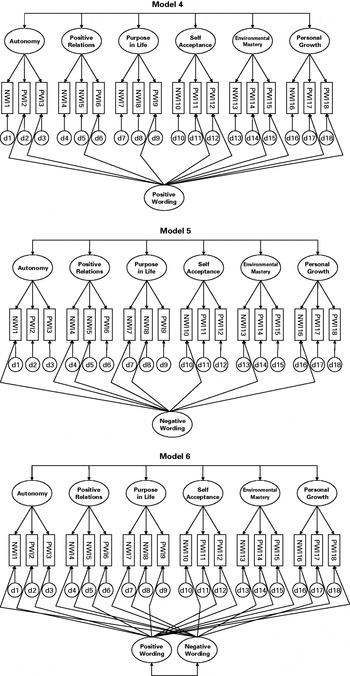
Accordingly, we tested for method effects on the SPWB through confirmatory factor analysis (CFA) within the correlated traits, correlated methods (CTCM) and the correlated uniqueness (CU) frameworks, based on previous recommendations (DiStefano & Motl, Reference DiStefano and Motl2006). Whereas in the CTCM, method effects are posited as one-dimensional and may be correlated, the CU hypothesizes method effects as multi-dimensional and uncorrelated. Fig. 1 shows the alternative models. Model 1 entails six factors and no method effects. Models 2 and 3 use correlations among uniquenesses to represent multi-dimensional method effects on positively and negatively worded items. Models 4 and 5 include, along with the six substantive PWB factors, one method factor associated with method effects on positively and negatively worded items. In model 6, positive and negative method effect factors are included simultaneously and correlated.
Alternative factorial models for Ryff's Scales of Psychological Well-Being (SPWB). Model 1 is the base six factor model including no method effects. Models 2 and 3 include correlations among uniquenesses (d) to represent the effect of multi-dimensional method effects on positively worded items (PWIs) and negatively worded items (NWIs). Models 4 and 5 include one method factor associated with method effects on PWIs or NWIs. In model 6, positive and negative method effect factors are included simultaneously and left to be correlated. All the six latent dimensions of psychological well-being (i.e. autonomy, positive relations, purpose in life, self-acceptance, environmental mastery and personal growth) are correlated.

Statistical analyses
Sample descriptive
For the six SPWB dimensions, individual total scores were computed. Descriptive statistics were estimated using Stata version 9.2 (Stata Corporation, USA).
Factor analysis
All models were tested using Mplus 4.01 (Muthén & Muthén, Reference Muthén and Muthén2004). In the analysis, we took into account the dependence of twin data within pairs by using an estimation procedure that is based on a Taylor series-like function (Stapleton, Reference Stapleton2006). The following criteria were used to evaluate the goodness of fit: the χ2 likelihood ratio statistic, the Tucker–Lewis Index (TLI), the Comparative Fit Index (CFI), and the Root Mean Square Error of Approximation (RMSEA) with associated confidence intervals (CIs). The χ2 likelihood ratio statistic is sensitive to large sample sizes and easily produces a significant result (Kline, Reference Kline1998). We accepted TLI and CFI values greater than 0.95 (Hu & Bentler, Reference Hu and Bentler1999) and RMSEA values lower than 0.07 (Browne & Cudeck, Reference Browne, Cudeck, Bollen and and Long1993). The Akaike Information Criterion (AIC) was used to compare non-nested models. The minimum value of AIC suggests the best balance between goodness of fit and parsimony.
Using the best-fitting model, factor scores from each dimension were derived and used as continuous variables in subsequent analyses.
Correlations
For the six SPWB dimensions, we evaluated and interpreted under the assumptions of the twin design (Neale & Cardon, Reference Neale and Cardon1992) the following correlations: (i) among dimensions within an individual (referred to as ‘phenotypic’), (ii) between twin and co-twin for the same dimension (‘cross-twin/within-trait’) in MZ and DZ pairs separately, and (iii) between one dimension in a twin and another dimension in the co-twin (‘cross-twin/cross-trait’) in MZ and DZ pairs separately. To estimate these correlations, the maximum-likelihood method was used. A multivariate saturated model was fitted to raw data from MZ and DZ twins, using the software Mx (Neale et al. Reference Neale, Boker, Xie and Maes2006). The model was specified by constraining the mean, the variance, and the covariance of dimensions to be the same for twin and co-twin, and for MZ and DZ twins, and by constraining cross-twin/cross-trait covariance between dimensions (e.g. ‘autonomy’ in a twin with ‘positive relations’ in the co-twin and vice versa) to be equal within MZ and DZ groups. This entails the assumption that there is symmetry between twin and co-twin within pairs, and that twins (as individuals) come from the same reference population.
Genetic structural equation modelling
Genetic modelling was performed by maximum-likelihood estimation with the software Mx (Neale et al. Reference Neale, Boker, Xie and Maes2006), using raw data from MZ and DZ twins as input.
For the six SPWB dimensions, a Cholesky decomposition (Neale & Cardon, Reference Neale and Cardon1992) incorporating additive genetic (A), non-additive genetic (D) and non-shared environmental (E) latent sources of variance and covariance was fitted. Additive genetic effects originate from the additive effects of alleles at all contributing genetic loci, without allelic or gene–gene interaction. Dominance (allelic interaction within a gene) or epistasis (gene–gene interaction) is responsible for non-additive genetic effects. Non-shared environmental effects are those effects that are specific to an individual, thus contributing to differences among family members; measurement error is also included in this latent source.
The model allows for the variance of dimensions and the covariance between the dimensions to be distinguished as genetic and environmental components. Important statistics that can be derived from the model include: (i) heritability of each dimension, defined as the proportion of variance due to genetic factors and reflecting the contribution of inter-individual genetic differences to inter-individual phenotypic differences observed in a dimension; and (ii) genetic correlation among dimensions, which measures the extent of overlap of genetic factors that affect the dimensions. Model fitting started with a full ADE model; we then compared the full model with submodels by χ2 likelihood-ratio tests. The test assumes that the difference between twice the negative log-likelihood of two nested models has a χ2 distribution with degrees of freedom equal to the difference between the number of parameters in the two models. Parameter estimates were obtained using the best-fitting model.
Results
Sample descriptive
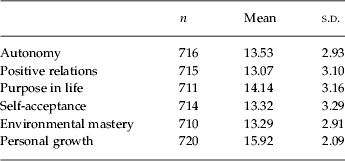
The mean total scores and standard deviations for the six SPWB dimensions, for twins as individuals, are shown in Table 1. No significant differences emerged between MZ and DZ twins in any of the scales. There were also no significant differences between males and females for any of the scales; thus gender was not considered further in twin modelling.
Descriptive statistics of the total raw scores of the six dimensions of psychological well-being (PWB)
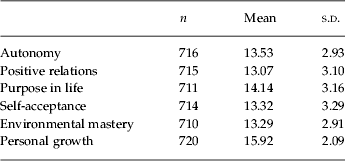
n, Number of individuals; s.d., standard deviation.
Factor analysis
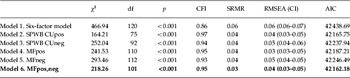
Although models 2, 4 and 6 had well-fitted empirical data (Table 2), according to the AIC, model 6 provided the best balance between fit and parsimony. In this model, the variance of each item is explained by a substantive PWB factor plus one method factor that depends on item wording. Given that wording bias and substantive construct variance are definitively separated, latent factors represent more reliable measures of the individual PWB scores.
Results of the confirmatory factor analyses

SPWB, Ryff's Scales of Psychological Well-Being; CUpos, correlated uniqueness among residual variances of the positively worded items (PWIs); CUneg, correlated uniqueness among residual variances of the negatively worded items (NWIs); MFpos, six factors representing the structure of the psychological well-being (PWB) method factor underlying NWIs; MFneg, six factors representing the structure of the PWB method factor underlying NWIs; MFpos,neg, six factors representing the structure of the PWB method factor underlying both PWIs and NWIs; df, degrees of freedom; CFI, Comparative Fit Index; SRMR, Standardized Root Mean Square Residual; RMSEA, Root Mean Square Error of Approximation; CI, confidence interval; AIC, Akaike Information Criterion.
The best-fitting model is shown in bold.
All loadings on substantive factors were significant, ranging from 0.30 to 0.75 (mean=58, s.d.=0.20). Correlations among substantive factors ranged from low (0.13 for autonomy with purpose in life) to very high (0.79 for personal growth with purpose in life). Loadings on both positive method factors (from 0.35 to 0.66, mean=0.49, s.d.=0.11) and negative method factors (from 0.43 to 0.69, mean=0.54, s.d.=0.09) were all significant. These factors were found to be correlated (ϕ=0.50), suggesting the co-occurrence of positive and negative wording bias.
The internal consistency was further investigated through factor score determinacy coefficients (Muthén & Muthén, Reference Muthén and Muthén2004): they were 0.72 (autonomy), 0.73 (positive relations), 0.80 (purpose in life), 0.86 (self-acceptance), 0.81 (environmental mastery) and 0.87 (personal growth).
Correlations
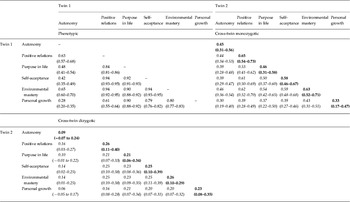
The correlations for the six SPWB dimensions are shown in Table 3. MZ cross-twin/within-trait correlations were moderate to substantial (range 0.33–0.65), and were higher than DZ correlations (range 0.09–0.26), suggesting the importance of additive genetic effects. Only for personal growth was there a small difference in the correlation when comparing MZ and DZ pairs, suggesting shared environmental effects (e.g. family exposures). For all of the remaining dimensions, the correlation was more than twice as high in MZ pairs, compared to DZ pairs, which is consistent with possible non-additive genetic effects. For this reason, genetic modelling was started with an ADE model.
Correlations for the six dimensions of psychological well-being (PWB)

‘Phenotypic’ denotes correlations between different dimensions at the individual level.
‘Cross-twin’ denotes correlations between twin 1 and twin 2 either for the same dimension (‘within-trait’, in bold) or for different dimensions (‘cross-trait’, in italics).
Values in parentheses are 95% confidence intervals.
Except for autonomy and personal growth, which showed a modest correlation (0.28), phenotypic correlations were generally moderate to extremely high (range 0.42–0.94). This may result from the effect of factors that are common to the different PWB facets. Information on whether these shared factors are genetic or environmental is provided by cross-twin/cross-trait correlations, which were much stronger in MZ pairs (range 0.30–0.62) than in DZ pairs (range 0.06–0.25), indicating a genetic link among dimensions.
Genetic structural equation modelling
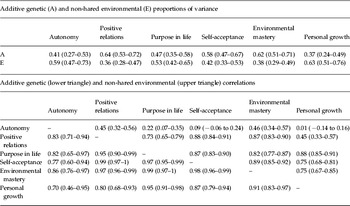
Regarding the comparison of models, dropping the non-additive genetic component did not reduce significantly the fit of the full ADE model (χ2=4.41, df=21, p=1.00), whereas for the AE model there was a significant reduction in the fit of the model when dropping genetic correlations (χ2=108.40, df=15, p<0.001) or non-shared environmental correlations (χ2=5172.25, df=15, p<0.001). Therefore, the AE model was considered to have the best fit.
The estimates from the best-fitting model are reported in Table 4. Genetic factors accounted for a moderate to substantial proportion of variance in the six SPWB dimensions, with heritability estimates between 37% and 64%. Genetic correlations were very high (range 0.77–0.99), indicating that genetic factors that influence the different PWB facets may be shared to a large extent. Non-shared environmental correlations ranged from substantial to high (range 0.45–0.89), with the exception of the correlation of autonomy and the dimensions of purpose in life (0.22), self-acceptance (0.09) and personal growth (0.01). To test specific mechanisms underlying the observed genetic and environmental correlations, a common pathway (CP) and an independent pathway (IP) model including A and E latent sources were also fitted to the data. Both models performed significantly worse than the AE Cholesky decomposition (likelihood-ratio χ2 tests relative to Cholesky: Δχ2=4048.3, Δdf=23, for CP; Δχ2=3636.5, Δdf=18, for IP). This suggests that the genetic and environmental architecture of PWB dimensions may be much more complex than that implied by stringent models such as the CP and the IP.
Estimates of genetic and environmental components and correlations for the six dimensions of psychological well-being (PWB)

Values in parentheses are 95% confidence intervals.
Discussion
SWB and PWB, which derive respectively from the hedonic and the eudaimonic approach, are often considered as distinct and opposite pursuits, yet each may contribute to well-being in different ways. To date, several genetic studies have explored the related constructs of SWB. We aimed to contribute to the existing literature by investigating the genetic and environmental influences on a broader measure of well-being that includes several facets that have not been extensively studied as the focus of evaluation, such as sense of purpose, meaning in life, autonomy, and self-determination.
With regard to PWB, the added benefits of understanding its aetiology can be questioned, because the causes of individual differences in PWB could be the same as those for SWB. Keyes et al. (Reference Keyes, Myers and Kendler2010) recently investigated whether emotional well-being (i.e. SWB), PWB and social well-being have different aetiologies or are just distinct representations of a single concept of well-being. The authors found that, for all three measures, the majority of genetic variance came from one common factor, which they identified as ‘propensity to mental well-being’. However, the three measures differed in the degree to which they reflected the common genetic factor as their primary source. This ranged from 61% for social well-being to 65% for emotional well-being and 99% for PWB, suggesting that trait-specific genetic effects were considerable for social and emotional well-being and nearly non-existent for PWB. Similarly, the proportions of unique environmental variance of the three measures due to the common factor ranged from 19% for social well-being to 24% for emotional well-being and 42% for PWB. These results suggest two conclusions. First, there is substantial, though not complete, overlap between genetic and environmental influences on SWB and those on PWB; thus SWB and PWB seem to be distinct constructs. Second, for the purposes of evaluating a latent propensity to mental well-being, both SWB and PWB are good indicators, though PWB may be more reliable.
Like Keyes et al. (Reference Keyes, Myers and Kendler2010), we assessed PWB using the 18-item SPWB. However, Keyes et al. summed all 18 items, obtaining overall SPWB scores, whereas we adopted a different approach, given that our main objective was to investigate genetic and environmental influences on each dimension of SPWB. To do so, we first established the factorial structure of SPWB by comparing six models representing alternative interpretations of the empirical covariance observed among the 18 items. The best-fitting model resulted in one factor with two additional correlated factors, accounting for the empirical covariance among the scale's items that remained unexplained by the substantive factors. These results support the theory that, in addition to the six PWB components, there are other sources of variability in the items of the SPWB that are associated with individual response tendencies.
Consistent with the results of Keyes et al. (Reference Keyes, Myers and Kendler2010), we found that the heritability of factor scores on the PWB scales were moderate to substantial, with estimates ranging from 0.37 to 0.64, and that these scores were influenced by additive genetic and unique environmental factors. We also found a large genetic overlap among PWB dimensions, with genetic correlations ranging from 0.70 to 0.99. One implication of this finding is that specific genes that predispose the individual to high levels of autonomy may also predispose the individual to high levels of positive relations, purpose in life, self-acceptance, environmental mastery and personal growth. Another implication is that the common genetic effects may indicate that an umbrella construct exists, such as PWB. A fundamental question is whether these common genetic influences indicate that PWB is mediated by more stable features of the individual, such as personality. As mentioned, there is evidence that the six PWB dimensions are distinguished by unique personality correlates (Schmutte & Ryff's, Reference Schmutte and Ryff1997). Moreover, previous studies have shown that there were only small to moderate correlations between personality and PWB facets, when controlling for affect (Burns & Machin, Reference Burns and Machin2010). Therefore, whereas there exist associations between PWB and personality, it seems conceptually incorrect to hypothesize that the heritable component of PWB could be explained by the same genetic factors that influence different aspects of personality. It may be hypothesized that PWB dimensions are mediated by a propensity towards mental well-being or positive mental health, which is in accordance with the suggestions of Ruini et al. (Reference Ruini, Ottolini, Rafanelli, Tossani, Ryff and Fava2003) and the results of Keyes et al. (Reference Keyes, Myers and Kendler2010) .
In addition to heritability, non-shared environmental factors also explained a considerable proportion of variance in PWB dimensions, with estimates ranging from 0.36 to 0.63, suggesting that much of what explains individual differences can be ascribed to influences not shared by family members. Previous studies have stressed the contribution of specific non-shared environmental factors to mental health, such as maternal protectiveness, conflictual parent–child relationships, current stressful life events, financial difficulties, a history of phobia, nicotine dependence, and divorce (Kendler & Gardner, Reference Kendler and Gardner2001). Some authors found clear evidence that the quality of marital relationships is correlated with well-being in women due to non-shared environmental factors (Spotts et al. Reference Spotts, Pederson, Neiderhiser, Reiss, Lichtenstein, Hansson and Cederblad2005).
Recent studies have evaluated the hypothesis that positive mental health may influence biological functioning and ultimately health. To this regard, in the past decade numerous studies have shown that low PWB in fact makes people more vulnerable to physical and mental ill-being. Of psychiatric interest is the finding that low PWB was strongly associated with residual symptomatology of affective and anxiety disorders (Fava et al. Reference Fava, Rafanelli, Cazzaro, Conti and Grandi1998), suggesting that people who have low PWB may be at risk for relapse and recurrence of these disorders. Furthermore, very recent research has implicated impaired PWB levels in the aetiology of depression (Wood & Joseph, Reference Wood and Joseph2010), suggesting that the improvement of PWB may have psychiatric implications.
The considerable non-shared environmental contribution found in our study suggests that PWB may increase when engaging in a variety of adaptive and positive cognitive activities, although there may also exist an individual genetic predisposition to PWB. For psychiatrists and clinical psychologists it remains to be determined whether these findings are of use only for improving well-being in healthy individuals or whether they can also be applied for developing interventions to alleviate clinical disorders such as generalized anxiety or major depression. Some clinicians have acknowledged the importance of techniques and strategies for nurturing positive behaviours and emotions in clinical populations, ranging from individuals with schizophrenia (Ahmed & Boisvert, Reference Ahmed and Boisvert2006) to incarcerated sex offenders (Ward & Stewart, Reference Ward and Stewart2003). One example includes a relatively recent strategy that focuses on the dimensions of PWB defined by Ryff; this strategy, known as Well-Being Therapy (WBT), has been shown to improve remission profiles among patients with recurrent depression (Fava et al. Reference Fava, Rafanelli, Cazzaro, Conti and Grandi1998, Reference Fava, Ruini and Sonino2003). Fava et al. (Reference Fava, Rafanelli, Cazzaro, Conti and Grandi1998, Reference Fava, Ruini, Rafanelli, Finos, Salmaso, Mangelli and Sirigatti2005) noted that positive strategies can be most effective in the residual phase of affective disorders; however, other researchers have demonstrated that positive psychotherapies may be used as the primary form of treatment (Seligman et al. Reference Seligman, Rashid and Parks2006). This evidence has paved the way for the development of psychotherapeutic strategies for improving PWB, which could potentially lead to innovative care and preventive measures for depression; such measures could also be evaluated for treating other mental disorders with an affective component, such as addictions and eating and personality disorders.
Limitations
Our results cannot be generalized beyond the sample and the measures used. Furthermore, we cannot exclude the possibility that genetic influences vary over time or that different genes affect PWB at different ages. Finally, the sample size did not allow us to test for gender differences in the genetic and environmental architecture of PWB dimensions.
Conclusions
This study provides evidence of individual-specific environmental influences on PWB. In light of these findings, attempts to design interventions for enhancing PWB in psychiatric populations should be encouraged. Although the concern with enhancing PWB is relatively new, much has already been accomplished by psychiatrists and clinical psychologists. There are strategies that they may integrate into their daily clinical practice for treating residual symptoms (Fava et al. Reference Fava, Rafanelli, Cazzaro, Conti and Grandi1998) and preventing future relapse for formerly depressed patients (Seligman et al. Reference Seligman, Rashid and Parks2006).
Declaration of Interest
None.