


INTRODUCTION
A tale of two cities
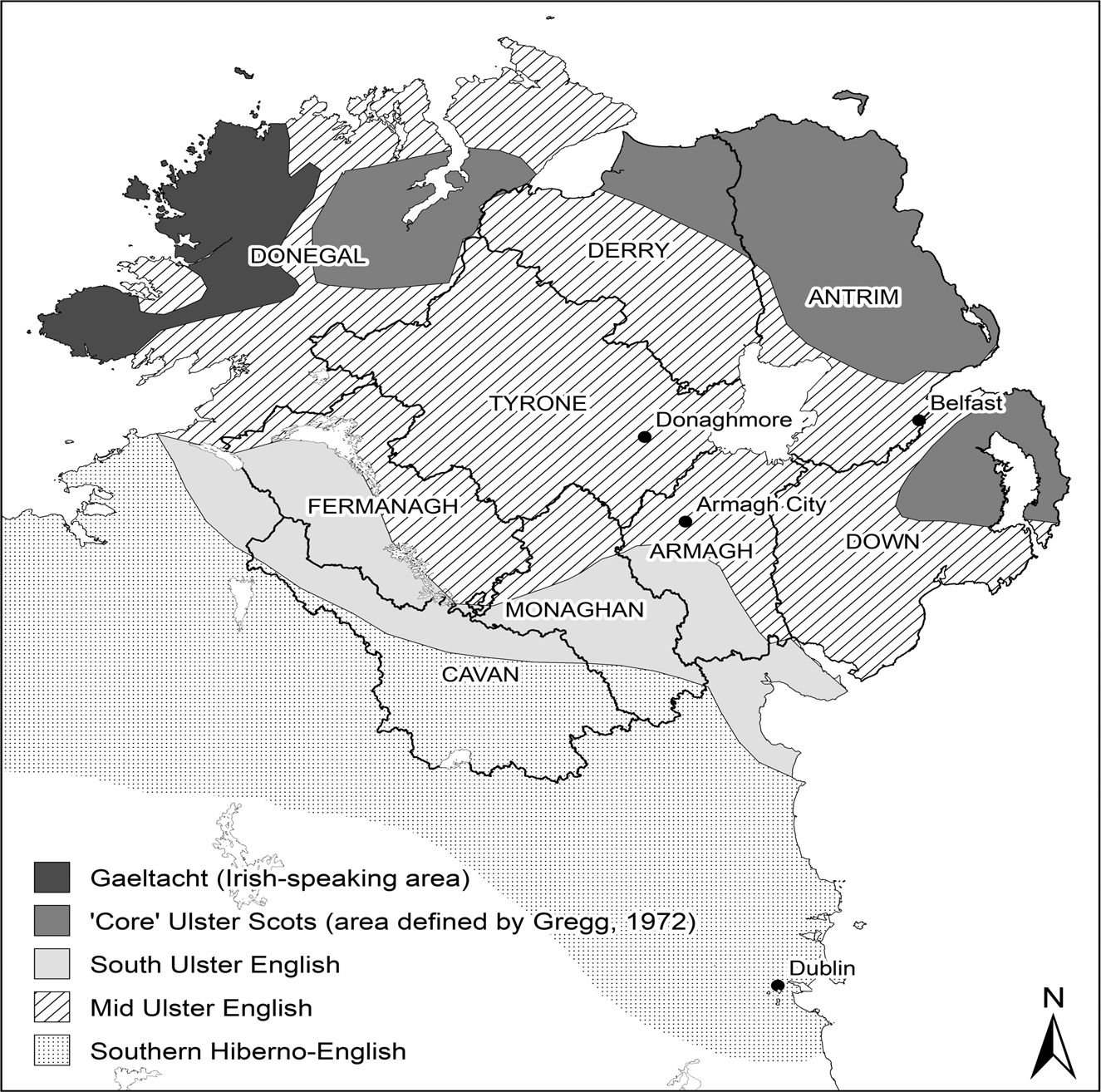
Immigration is a new phenomenon on the island of Ireland, which was once synonymous with emigration (Corrigan Reference Corrigan2010:124–26; Kallen Reference Kallen2013:34). Language acquisition is a key consequence of such processes. Here we compare the adoption of a well-documented characteristic of Irish-English (IE), the discourse-pragmatic marker like (henceforth like), by migrant populations in two urban contexts. The former is Armagh city in Northern Ireland (NI) and within the dialect region known variously as Northern Irish-English/Hiberno-English/Ulster English (NIE/HE/UE) (Corrigan Reference Corrigan2010). The latter is Dublin, capital of the Republic of Ireland (ROI), and associated typologically with Southern Irish-English/Hiberno- English (SIE/HE) (Kallen Reference Kallen2013; see Figure 1).
Locations of Armagh City and Dublin.Footnote 2

NIE/HE/UE and SIE/HE have long been recognised as dialectologically distinct from other non-Celtic influenced Englishes (Barron & Schneider Reference Barron and Schneider2005; Corrigan Reference Corrigan2010:31; Kallen Reference Kallen2013:224–29) because of their language contact origins. Thus, dialects across the island share unique features such as retaining the Irish contrastive verbal categories ‘punctual’ versus ‘habitual’. Although this distinction is productive island-wide, NIE/HE/UE favours a habitual be variant while do + be predominates in SIE/HE (Corrigan Reference Corrigan2010:63–64; Kallen Reference Kallen2013:90–93). The existence of morphosyntactic variation alongside the extensively documented phonological differences north and south of the border (Corrigan Reference Corrigan2010:ch. 2; Kallen Reference Kallen2013:ch. 2) piqued our interest in investigating whether there might likewise be regional variation at the level of discourse-pragmatics and whether it could be replicated by newcomers.
Here we focus on like, a feature that is subject to variation and change with respect to ‘overall frequency, social meaning and positioning’ (Schweinberger Reference Schweinberger, Amador-Moreno, McCafferty and Vaughan2015:114) across many English dialects (D'Arcy Reference D'Arcy2008, Reference D'Arcy2017), making it an excellent choice for investigating migrants’ acquisition of regional varieties. We specifically address the position of like, tracking the use and adoption of clause-initial and clause-medial variants, but particularly focusing on a clause-final variant, reported to be typical of British Isles’ Englishes (Truesdale & Meyerhoff Reference Truesdale and Meyerhoff2015:9–10), and especially Irish Englishes (Diskin Reference Diskin2013; D'Arcy Reference D'Arcy2017), leading it to be viewed as somewhat ‘emblematic’ of Irish identity (Diskin Reference Diskin2017).
Studies addressing the adoption of discourse-pragmatic features by second language (L2) speakers of SIE/HE have been expanding, for example, Diskin (Reference Diskin2017), Nestor, Ní Chasaide, & Regan (Reference Nestor, Ní Chasaide, Regan, Migge and Chiosáin2012), and Migge (Reference Migge, Amador-Moreno, McCafferty and Vaughan2015). However, the acquisition of NIE/HE/UE by L2 speakers remains a tabula rasa. Moreover, our study is the first ever to conduct a quantitative sociolinguistic investigation of the same feature in two distinct dialect zones on the island amongst both locally born populations and migrants.
The research contributes to our theoretical understanding of how sociolinguistic competence is acquired in ‘superdiverse’ settings (Vertovec Reference Vertovec2007). Of particular concern is the manner in which L2 learners not only develop competence in what Howard, Mougeon, & Dewaele (Reference Howard, Mougeon, Dewaele, Bayley, Cameron and Lucas2013:340) define as ‘Type I Variation’ but also ‘Type II Variation’. The former consists of alternation between L2 variants (including non-native forms). The latter, which is our focus, refers instead to the successful acquisition of native-like patterns of sociolinguistic variation. Like, in particular, has been proposed to be a ‘powerful tool in the identikits of both L1 and L2 speakers’ of SIE/HE and has thus been implicated as crucial to the indexing of social identities in ROI (Nestor et al. Reference Nestor, Ní Chasaide, Regan, Migge and Chiosáin2012:342). As such, the research also offers a preliminary analysis of the extent to which like usage accomplishes identity work north as well as south of the border, with respect to what Bucholtz & Hall (Reference Bucholtz, Hall and Duranti2004:383–84, Reference Bucholtz and Hall2005:599–601) term distinction and adequation.
BACKGROUND
Discourse like
Discourse like is a panlectal feature, which has grammaticalised from its original adverbial or comparative prepositional status to that of a discourse marker (D'Arcy Reference D'Arcy2017). It has been extensively researched in North American Englishes (Fuller Reference Fuller2003; D'Arcy Reference D'Arcy2005, Reference D'Arcy2008, Reference D'Arcy2017; Kastronic Reference Kastronic2011; Tagliamonte Reference Tagliamonte2016), as well as in British dialects (Miller & Weinert Reference Miller and Weinert1995; Levey Reference Levey2006; Bartlett Reference Bartlett2013; Truesdale & Meyerhoff Reference Truesdale and Meyerhoff2015), Australasian English (Sharifian & Malcolm Reference Sharifian and Malcolm2003; Miller Reference Miller, Peters, Collins and Smith2009) and IE/HE (Siemund, Maier, & Schweinberger Reference Siemund, Maier, Schweinberger, Pentillä and Paulasto2009; Nestor et al. Reference Nestor, Ní Chasaide, Regan, Migge and Chiosáin2012; Nestor Reference Nestor, Singleton, Regan and Debaene2013; Corrigan Reference Corrigan, Amador-Moreno, McCafferty and Vaughan2015; Schweinberger Reference Schweinberger, Amador-Moreno, McCafferty and Vaughan2015; Diskin Reference Diskin2017).
Like has been found to vary considerably with regard to its clausal positioning, and occurs in three principal types of maximal projection vis-à-vis the clause, namely, initially in (1), medially in (2), and finally in (3).Footnote 3
(1) Like if you want to work in Macau (Jemma, Dublin)Footnote 4
(2) Friends in there they're like laughing (Elzbieta, Armagh)
(3) I hadn't a clue like (Katherine, Armagh)
D'Arcy (Reference D'Arcy2005:4) tracks like’s emergence, reporting on attestations in the OED dating back to the late eighteenth century where it ‘generally occurs in clause-final position’. She also makes an important distinction between like’s function as a discourse marker or pragmatic particle. The former refers to the encoding of relations that are textual such as connecting new information to discourse that has already been uttered. The latter, by contrast, is reserved for signalling interpersonal connections and thus conveys subjectivity beyond the text (D'Arcy Reference D'Arcy2017:2–3). The discourse marker in clause-initial position, later followed by the discourse particle in clause-medial position, grammaticalised out of the traditional clause-final form (D'Arcy Reference D'Arcy2017:80).
Evidence points to clause-final and clause-initial like behaving similarly, in the sense that they both possess scope over the entire following or preceding clause, as in (1) and (3), unlike clause-medial like, where the scope is more restricted (Schweinberger Reference Schweinberger, Amador-Moreno, McCafferty and Vaughan2015). This has led some to view clause-marginal like (initial and final positions combined) as one entity operating in competition with clause-medial like (Siemund et al. Reference Siemund, Maier, Schweinberger, Pentillä and Paulasto2009; Nestor et al. Reference Nestor, Ní Chasaide, Regan, Migge and Chiosáin2012). From this perspective, clause-marginal like has been found to be favoured by both native and non-native speakers of SIE, which contrasts with speakers of, for example, Canadian English, who prefer it clause-medially (D'Arcy Reference D'Arcy2005). However, others have argued that the clause-final position specifically is unique in its predominance in IE/HE (Corrigan Reference Corrigan, Amador-Moreno, McCafferty and Vaughan2015:49–50; Schweinberger Reference Schweinberger, Amador-Moreno, McCafferty and Vaughan2015:132). Moreover, this type is also readily attested in other so-called ‘Celtic Englishes’ such as the Scots data examined in Miller & Weinert (Reference Miller and Weinert1995). Thus, there may be some mileage in viewing its frequency in IE/HE and Scots as being due to the influence of historical contact with Goidelic Celtic in which discourse markers are also preferred in clause-marginal positions (Ó Curnáin Reference Ó Curnáin, Lenoach, Giollagáin and Curnáin2012 and see below). Clause-final like has also been reported in Northern British Englishes (Andersen Reference Andersen2001:222), including Tyneside (Bartlett Reference Bartlett2013), which have been affected by Irish/Scots in-migration historically (Beal & Corrigan Reference Beal, Corrigan, Penttilä and Paulasto2009:231–32). However, it has been suggested that this phenomenon may be receding here in favour of clause-initial or clause-medial like (Bartlett Reference Bartlett2013; Diskin Reference Diskin2013).
Language-internal constraints on discourse like
D'Arcy (Reference D'Arcy2017:80) shows that clause-initial (or discourse ‘marker’) like in British English first occurred before matrix complementizer phrases, followed by subordinate complementizer and tense phrases. The discourse particle appeared initially on the left periphery of determiner and verb phrases (DP/VP), later generalising to noun and degree phrase contexts (NP/DegP). Previously, Andersen (Reference Andersen2001:284) had proposed a principle of lexical attraction, stating that like ‘tends to occur immediately before the lexical material of a phrase rather than before grammatical words’. He found that like is more frequent before NPs, as in (4) and VPs as in (5) than before prepositional (PP) (see (6)) or adjectival (AP) phrases (see (7)).
(4) Half of the dress is like lace (Iera, Armagh)
(5) We go the fields and like catch fish (Yanmei, Dublin)
(6) Like with Nadia I don't have any problem (Sara, Dublin)
(7) And everyone's like moody (Elzbieta, Armagh)
This predilection may also be due to its tendency to co-occur with ‘discourse-new’ in (8), rather than ‘discourse-old’ (previously mentioned) or ‘discourse-inferred’ (general knowledge) information in (9) (Prince Reference Prince1981; Cheshire Reference Cheshire2005:483; Labelle-Hogue Reference Labelle-Hogue2013).
(8) He'd asked me to draw like a shark face (Iera, Armagh)Footnote 5
(9) You could spot my mum from like a mile away (Iera, Armagh)Footnote 6
Thus, the nature of lexicogrammatical material following like, as well as its relationship to the information structure of the clause in which it is embedded, are two key themes underpinning our research. Furthermore, it is predicted that native and L2 speakers may use like differently in this regard, in the sense that while the latter may well have acquired the form and employ it at similar frequencies to local speakers, their usage may be both structurally different (employed in a restricted range of syntactic positions) and less complex (not encompassing the full array of discourse-pragmatic functions, although this issue is not specifically addressed here; see Diskin Reference Diskin2017).
Discourse like and L2 speakers
In addition to the numerous studies that focus on like usage amongst native speakers of diverse Englishes, there has been some research investigating like in the speech patterns of L2 English acquirers, that is, focusing on their acquisition of sociolinguistic variation, or ‘Type II Variation’ with respect to this variable (Howard et al. Reference Howard, Mougeon, Dewaele, Bayley, Cameron and Lucas2013:340). Thus, Truesdale & Meyerhoff (Reference Truesdale and Meyerhoff2015) found that Polish teenagers in Edinburgh had lower frequencies of like usage than local peers, and that the full set of discourse-pragmatic functions of like, which the locals deployed, had not yet successfully been transferred by the L1 Polish cohort to their L2 English. In a study of like frequency, Fuller (Reference Fuller2003) found that even highly proficient speakers did not match the frequencies of native speakers’ like usage. Similarly, Müller (Reference Müller2005) and Buysse (Reference Buysse and Witczak-Plisiecka2010), investigating German and Dutch L1 and L2 speakers, respectively, established that L2 speakers had consistently lower like rates. Hellermann & Vergun (Reference Hellermann and Vergun2007) report that the more acculturated L2 speakers were, the more likely they were to use native-like frequencies. Likewise, but in the context of Anglophones acquiring French, Sankoff, Thibault, Nagy, Blondeau, Fonollosa, & Gagnon (Reference Sankoff, Thibault, Nagy, Blondeau, Fonollosa and Gagnon1997) note that native-like mastery of discourse markers depends on fluency, which was correlated with speakers’ degree of integration. These studies indicate that proficiency, and potentially other factors such as length of residence (LOR) and how the migrant views the host community and is perceived by them, may be implicated in the adept acquisition of discourse-pragmatic markers as proxies for the degree to which one might expect L2 speakers to have acculturated and assimilated to local (linguistic) norms.
Research questions
Based on this literature and the contexts in which the Armagh and Dublin corpora were collected, outlined below, we address the following research questions.
(i) Do L2 speakers of NIE/HE/UE and SIE/HE differ in their rates of discourse like usage when compared to native speakers?
(ii) Do more proficient L2 speakers use like at similar rates to native speakers and does LOR play any role?
(iii) Is like usage amongst native and L2 speakers bound by internal constraints such as clausal position, discourse newness and the principle of lexical attraction?
METHODOLOGY
Locations and demolinguistics
The relative geographical positions of Armagh and Dublin are illustrated in Figure 1. Armagh is a modest urban centre with a population, according to the 2011 census, of just 14,749 (Russell Reference Russell2015:7), 5.4% of whom are non-nationals (Kerr Reference Kerr2014:14). Speakers of Polish (2,910) and Lithuanian (1,730) constitute the largest nonindigenous groups (Northern Ireland Statistics and Research Agency 2012; Kerr Reference Kerr2014:14). The Dublin conurbation had a population of 1,270,603 at the time of the 2011 census (Central Statistics Office 2011:2), where 15.7% of residents declared themselves to be non-Irish nationals (Central Statistics Office 2012:39) and Poles and Chinese were counted among the top ten largest such communities.
Participant recruitment and sociolinguistic interviews
All participants were recorded using a semi-structured sociolinguistic interview method, the main aim of which was to allow free conversation on the one hand, with minimal interviewer intervention, but to also gather attitudinal and other information about participants’ daily lives (see Labov Reference Labov1972).
Armagh
In Armagh, twenty-five speakers participated (Table 1). The interviews were recorded between 2013 and 2016 by Corrigan using a judgement sample method to ensure that interviewees were already acquainted with one another via friendship or kinship networks. The corpus amounts to over 118,220 transcribed words, from which a total of 2,985 tokens of like were extracted/coded (with certain instances being discounted subsequently if they proved not to be part of the variable context, as detailed below).
Armagh participants.

The Armagh school interviews (approximately one hour long) were conducted in social spaces outside classrooms in a secondary school. Participants were between the ages of twelve and twenty and the L2 speakers’ residency lengths ranged from 1.5 to eight years, with an average of 3.5 years.Footnote 7 Their competence in English, for our purposes, was based on teachers’ assessments using the Common European Framework of Reference for Languages (CEFR) (Council of Europe 2001).Footnote 8 This is an international standard for language proficiency used to assess L2 speakers’ skills.
Teacher CEFR assessments in Armagh ranged from the A2 (‘basic user’) category to B1 (‘independent’) with the majority of newcomers (n = 7) in this sample assigned to B1, followed by an equal distribution in the A2 category (n = 5) and an ‘A2B1’ category (n = 5), which was an intermediary unofficial category created by the teachers. The pupils categorised as B1 were on average five years older than pupils in the A2B1 and A2 categories, and had been in Northern Ireland on average two years longer than the A2B1 cohort, and five years longer than the A2 cohort. Thus, the results in the present article for LOR and proficiency should be interpreted with knowledge that age, proficiency, and residency are somewhat collinear.
Dublin
A total of forty-one native and migrant adults were recruited in Dublin (Table 2) and interviewed one-to-one by Diskin throughout 2012 and early 2013. Recruitment was primarily via the friend-of-a-friend and snowballing approaches, with contacts also provided by migrant-led organisations.
Dublin participants.

The Dublin interviews were collected using a similar protocol to the Armagh study and each session likewise lasted approximately one hour. This corpus was recorded not in an educational setting but in either a public place or in the participants’ homes. For this analysis, a twenty-minute segment from the middle portion of every interview was coded, so that both corpora would each total approximately fourteen to fifteen hours of speech. This resulted in a total of 788 like tokens being extracted/coded (with exclusions applied later, as noted below).
The Dublin participants were aged between nineteen and forty-nine and for the migrants their residencies ranged from one to eleven years, with an average of 4.5 years. During the interview, the migrant participants were administered a written Common European Framework-type questionnaire where they were requested to self-assess proficiency. Scores per speaker ranged from A2 (the lowest) to C2 (the highest) with the average assessment in this case being close to a B2 (‘independent user’). In this sample, proficiency and residency were not collinear, as many migrants received schooling in English prior to migrating. As such, the Armagh and Dublin samples are not exactly commensurate in this regard. Moreover, there are other potentially confounding factors regarding these diverse populations that may have important implications for interpreting the findings, which are discussed below.
A tale of two populations
In addition to their north versus south locations, there is another important difference between the two populations, namely, their life stages. This arises as an artefact of the differing methodologies and orientations of the earlier projects from which this collaborative research derives (Diskin Reference Diskin2017; Corrigan Reference Corrigan2020). From a chronological or etic perspective, the Armagh participants are in what Kirkham & Moore (Reference Kirkham, Moore, Chambers and Schilling2013:277) describe as the ‘second decade of life’ with a mean age of 16.3 years (SD = 2.46). By contrast, while there is some overlap between the groups with respect to chronological age, the speakers in Dublin had a considerably higher mean age of 29.7 years (SD = 6). Hence, the cohorts in each location can be considered emically to by and large have had rather diverse life histories prior to data collection. Nonetheless, since the Armagh participants at least—irrespective of their chronological ages—all continue to be bound by what Eckert (Reference Eckert2003:112) defines as ‘the constraints (and opportunities)’ of school conditions, we can assume for present purposes that the cohort at this life stage is somewhat homogeneous, as regards the predictions that are made regarding their behaviours.Footnote 9
Additionally, one might also argue, for the native speakers at least, that grouping adolescents from the earliest phase of their second decade (Armagh) with adults (Dublin) may run counter to arguments regarding processes of acquisition, incrementation, and stabilisation, as articulated in Labov (Reference Labov1994:446–47) and Tagliamonte (Reference Tagliamonte2016), inter alia. Indeed, this article focuses on group behaviour and neither personally patterned variation (Dorian Reference Dorian2010), nor intra-speaker malleability (Buchstaller, Krause, Auer, & Otte Reference Buchstaller, Krause, Auer and Otte2017:4) are major foci here. However, while vernacular stabilisation (Labov Reference Labov1994:85–86; Chambers Reference Chambers2009:175; Tagliamonte & D'Arcy Reference Tagliamonte and D'Arcy2009:66) has been proposed to occur between ages fourteen and seventeen (thus coinciding with the mean age of the Armagh cohort, though not its upper and lower ends), real-time investigations of individual speakers from their teens into their third and subsequent decades have problematised this stabilisation proposal somewhat (Sankoff & Blondeau Reference Sankoff and Blondeau2007; Cukor-Avila & Bailey Reference Cukor-Avila, Bailey, Chambers and Schilling2013; Buchstaller et al. Reference Buchstaller, Krause, Auer and Otte2017). Lability of this type is especially associated with the phonological level. However, Buchstaller (Reference Buchstaller2015:460) has argued on the basis of real-time evidence regarding quotative usage in Tyneside English that ‘older speakers can display adaptive behaviour’.
More crucial in our case is the evidence from research on diverse child and adolescent populations that the functions of discourse like amongst native speakers is learned ‘after age ten’ in Miller & Weinert's (Reference Miller and Weinert1995:366) conservative estimate or possibly even before then by research on preadolescents in Britain and Canada reported in Levey (Reference Levey2006, Reference Levey2016). Similarly, D'Arcy (Reference D'Arcy2017:149) found that Canadians between the ages of ten and twelve are fully conversant with the use of like and thus that: ‘discourse features and the strategies related to their use are in place before adolescence’. Many lines of evidence therefore point to the probability that this feature will have already stabilised even in the speech of the youngest Armagh participants, who can then more reasonably be compared with those from Dublin, either already in or closer to their third decade.
The variable context
While discourse like cannot be considered to be a sociolinguistic variable sensu stricto, as it does not constitute ‘two or more ways of saying the same thing’, in accordance with the principle of synonymy (Weiner & Labov Reference Weiner and Labov1983:30), it has nonetheless been examined quantitatively (D'Arcy Reference D'Arcy2005, Reference D'Arcy2017; Müller Reference Müller2005; Levey Reference Levey2006; Labelle-Hogue Reference Labelle-Hogue2013; Nestor et al. Reference Nestor, Ní Chasaide, Regan, Migge and Chiosáin2012; Schweinberger Reference Schweinberger, Amador-Moreno, McCafferty and Vaughan2015; Diskin Reference Diskin2017), perhaps taking a broader variational rather than variationist perspective.Footnote 10 Here we adopt a normalisation procedure, where we examine the frequency of eligible discourse likes per 1,000 words, thus accounting for differences such as variability in the number of words per speaker.Footnote 11 Our approach is thus not, strictly speaking, a variationist one, and so is not stringently governed by the principle of accountable reporting (Labov Reference Labov1994:223), in the sense that it does not include all instances where like could have occurred, but did not (the method underpinning D'Arcy Reference D'Arcy2005 and Kastronic Reference Kastronic2011). The strictly variationist approach results in an overwhelming number of potential contexts for occurrence, which can become unwieldy when coding manually (see Diskin Reference Diskin2017:148). D'Arcy (Reference D'Arcy2005) overcame this by using a randomly selected subsample. In doing so, however, one might argue, as Walker (Reference Walker2010:77) does, that this process creates an ‘artificial overall rate’ that may, in fact, render such analyses not strictly accountable either, in the absolute sense of Labov (Reference Labov1994:223). The variationist construct was initially, of course, not designed to handle variation on linguistic levels ‘above and beyond phonology’ (Sankoff Reference Sankoff, Bailey and Shuy1973), and there are well-rehearsed arguments in the field regarding the extent to which it can indeed ever be strictly applied to discourse-pragmatics or morphosyntax (Cornips & Corrigan Reference Cornips, Corrigan, Auer, Hinskens and Kerswill2005:99; Cheshire Reference Cheshire2005, Reference Cheshire2007; Pichler Reference Pichler2010; Walker Reference Walker2010; Truesdale & Meyerhoff Reference Truesdale and Meyerhoff2015:9–10). As such, our analysis instead takes a ‘form-based’ approach, whereby the variable context includes all instances of discourse like (but no other ‘competing’ variants). It thus operationalises discourse like according to Pichler's general definition that regards such features as ‘formally heterogeneous’, ‘syntactically optional’, and not contributing to ‘truth-conditional meaning’ (Pichler Reference Pichler2013:4). Hence, like in the combined Armagh and Dublin datasets was investigated by first isolating all instances and examining each manually, in order to ascertain its eligibility with respect to the list of exclusions outlined below.
Exclusions
There were several instances of like that were not part of the variable context, such as its (rare) use as a suffix or infix or before relative clauses (after D'Arcy Reference D'Arcy2005:80). Exclusions also included like as verb in (10), noun in (11), comparative preposition in (12), conjunction in (13), adverb in (14) or as part of a general extender in (15) (see Cheshire Reference Cheshire2007; Tagliamonte & Denis Reference Tagliamonte and Denis2010). Like in false starts in (16) (see Nestor et al. Reference Nestor, Ní Chasaide, Regan, Migge and Chiosáin2012:338) and, following Levey (Reference Levey2006:424), frozen or semifrozen usages such as in (17) were also omitted. Excluded too was the well-attested quotative in (18), in line with recent work considering the phenomenon to be part of a separate variable context (see Tagliamonte, D'Arcy, & Rodríguez Louro Reference Tagliamonte, D'Arcy; and Louro2016, inter alia).
(10) I wouldn't like to be a Protestant. (Iera, Armagh)
(11) What I'm looking to do after I finish my A-Levels in Saint Pat's [is] to head to the likes of Jordanstown (Dara, Armagh)
(12) My dad's forty-one. He looks like he's twenty (Iera, Armagh)
(13) I was terrified, I felt like I'm losing something (Aleksander, Dublin)
(14) I was jumping like that. (Elada, Armagh)
(15) I dunno, maybe twenty minutes or something like that (Dominik, Dublin)
(16) To be fair if they was like- we'd be good at the radio for younger ones (Katherine, Armagh)
(17) So it's like maybe, what's it? Three times [the size of] Galway? (Janusz, Dublin)
(18) And I was like “Oh yeah…” (Magda, Dublin)
RESULTS
Frequency of like
The results of the overall normalized frequencies of like in both cities are summarised in Table 3, and visualised in Figure 2. Within each locale, there is striking consistency across the three nationality groups, suggesting that in both regions the L2 speakers have adopted the frequency of usage typical of their respective community norms, although the box plots indicate visible individual variation, particularly among the Armagh Poles, that is worthy of future investigation.
Frequency of like by nationality in Armagh and Dublin.

Average number of likes per 1,000 words by nationality in Armagh and Dublin.

Across each community, there appear to be distinctions in like rates, with higher frequencies found in Armagh than in Dublin. However, a chi square test revealed no significant differences (χ 2(3) = 1.94, p = 0.59).
Differences in the clausal position of like
Armagh
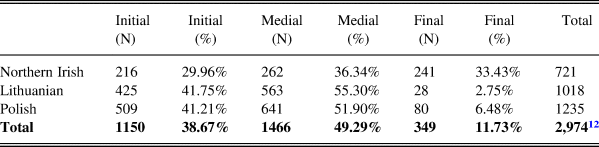
When like was examined from the perspective of its clausal positions, there were more obvious differences compared to the overall average frequencies of usage. The breakdown for Armagh is presented in Table 4. It shows that individuals of Polish and Lithuanian heritage are using like in broadly similar ways to one another, with about 40% of their likes in clause-initial position, over 50% medially, and a minority clause-finally. Polish participants used more clause-final like than their Lithuanian peers at 6.48% versus 2.75%. However, even this rate does not come close to the Armagh natives’ considerably higher proportion of like in this position at 33.43%. The latter group's proportions of clause-initial (29.96%) and clause-medial like (36%) are also, by contrast, lower than those of the migrant cohorts. These lower rates may be the result of a ‘trade-off’. In other words, the Armagh natives’ preference for clause-final like usage may be taking the place of clause-initial and medial like, which conversely is more likely to be favoured by migrants.
The clausal position of like in Armagh.

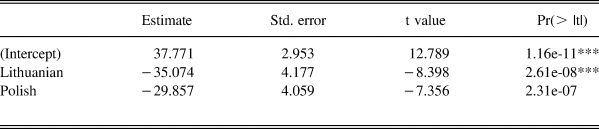
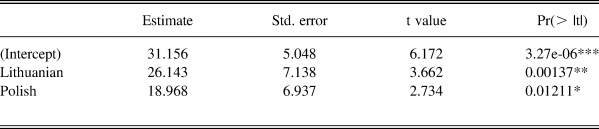
A variety of fixed effects regression models were run to test whether there were significant differences in how each of the three different nationality groups in Armagh were using (i) clause-initial like, (ii) clause-medial like, and (iii) clause-final like. Results revealed no significant differences in like usage in the left periphery (clause-initial). However, the Armagh natives significantly favoured clause-final like and significantly disfavoured clause-medial like, as compared to their peers of Lithuanian and Polish heritage (Tables 5 and 6).
Generalised linear regression model for proportion of clause-final like by nationality in Armagh.

Null deviance: 7330.1 on 24 degrees of freedom
Residual deviance: 1535.0 on 22 degrees of freedom
AIC: 181.88.
*p ≤ 0.05; **p ≤ 0.01; ***p ≤ 0.001.
Generalised linear regression model for proportion of clause-medial like by nationality in Armagh.

Null deviance: 7418.5 on 24 degrees of freedom
Residual deviance: 4484.3 on 22 degrees of freedom
AIC: 208.68.
*p ≤ 0.05; **p ≤ 0.01; ***p ≤ 0.001.
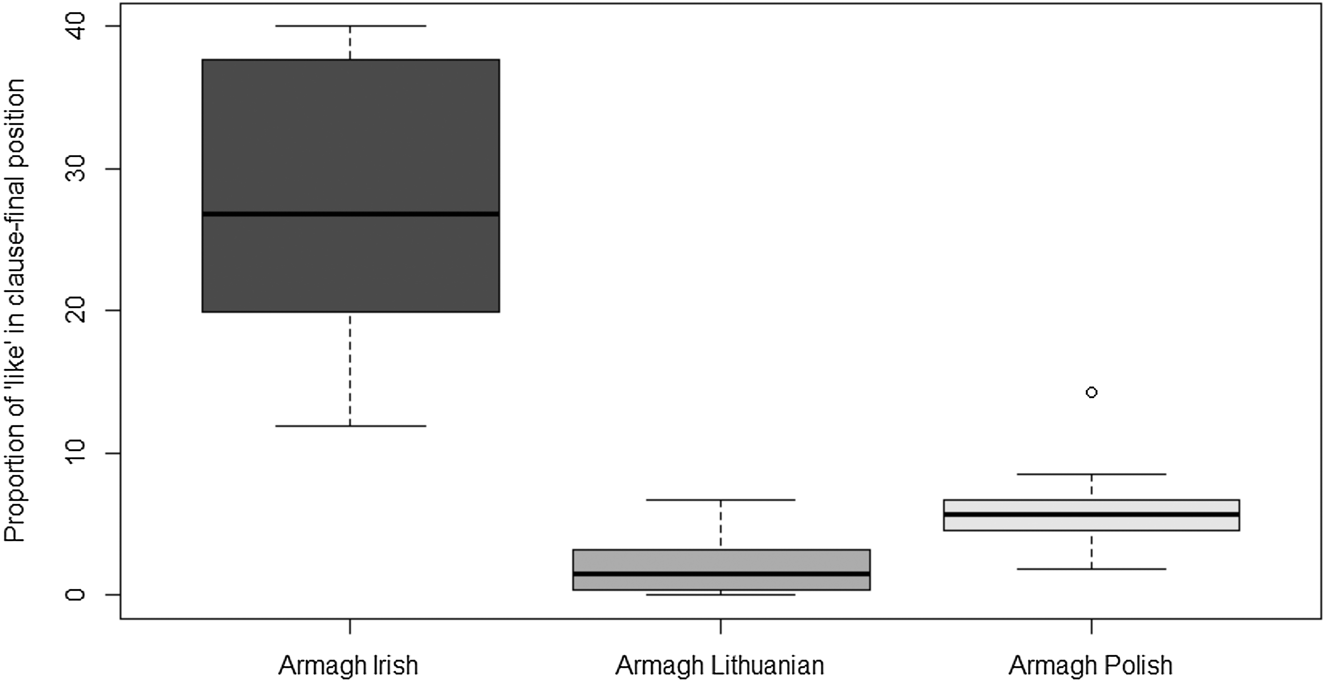
Figure 3 illustrates the diverse proportions of clause-final like usage in Armagh (displayed as a percentage of the total number of likes used) and clearly demonstrates the distinct preference for locals to employ it in the right periphery. The boxplots also show that whereas the Armagh natives display a notable degree of individual variation for this variant, the Poles and Lithuanians are quite uniform as a group in their (low) proportions of clause-final like usage.
Proportion of clause-final like by nationality in Armagh.

Dublin
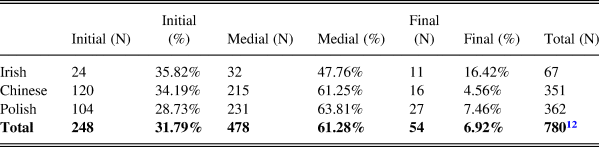
The clausal distribution of like in Dublin is presented in Table 7, showing several differences when compared to the Armagh dataset. Firstly, and most strikingly, the native Irish in Armagh use over twice as much clause-final like than the native Irish in Dublin do (33.43% versus 16.42%). This also results in the Dublin natives having higher rates of clause-initial like as compared to Armagh locals (35.82% versus 29.96%), as well as higher rates of clause-medial like (47.76% versus 36.34%).
The clausal position of like in Dublin.

When it comes to the migrants, the Dublin Chinese use over one and a half times the amount of clause-final likes as the Armagh Lithuanians do (4.56% versus 2.75%). The Polish groups in both cities have higher proportions of clause-final like as compared to the other L2 cohorts, and are quite commensurate in their rates of clause-final like usage (7.46% in Dublin; 6.48% in Armagh). However, the Armagh Poles use clause-initial like more often than their peers in Dublin do (41.21% versus 28.73%). This is compensated for by the preference for clause-medial like amongst Poles in Dublin (63.81% in Dublin versus 51.90% in Armagh).
Overall, it can be said that in both Dublin and Armagh the L2 speakers use clause-final like quite minimally (averaging 6.01% in Dublin and 4.62% in Armagh across both L2 groups in each location). This is in stark contrast to the preferences displayed by locals in each city. What is most notable here is that although L2 speakers are mirroring the overall rates of like usage (see above), they are not replicating the patterns of use, in the sense that their favoured positioning of like differs considerably from local norms.
The effect of proficiency in English on like and its clausal position
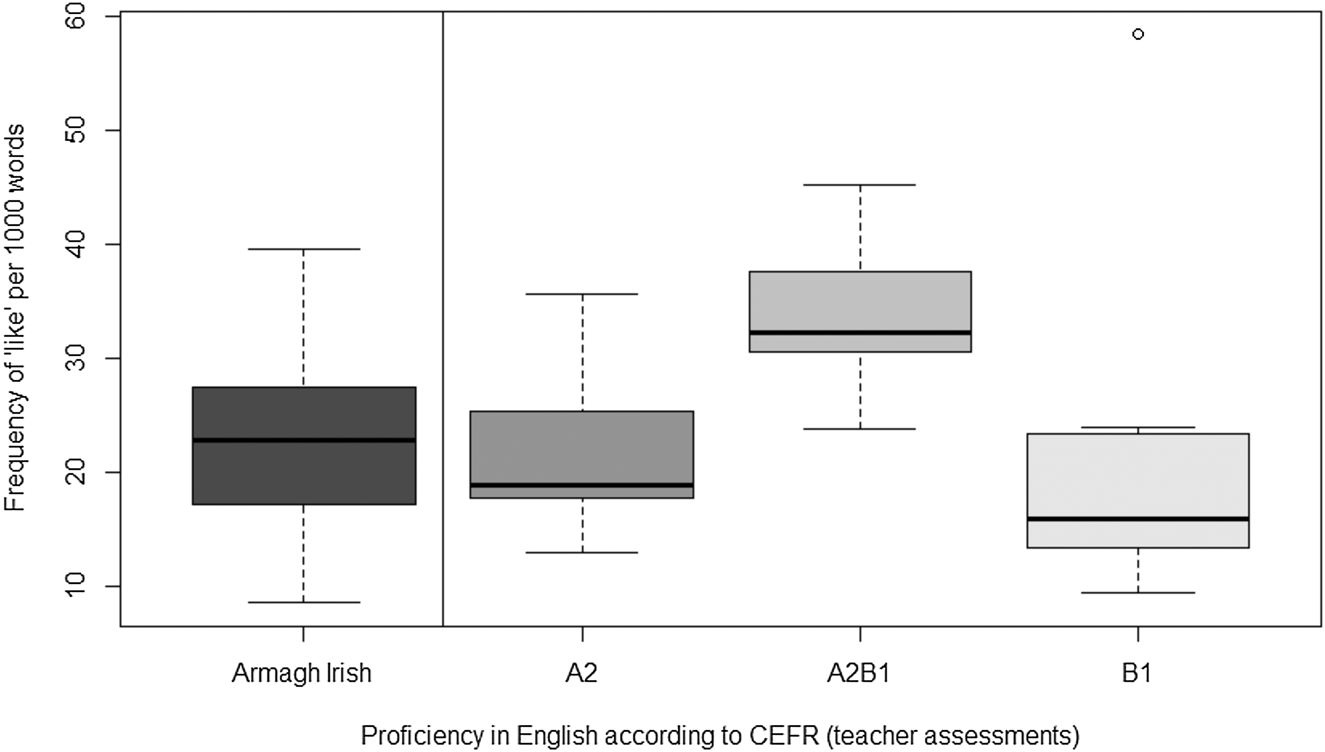
On the basis of Hellermann & Vergun (Reference Hellermann and Vergun2007) as well as Sankoff et al. (Reference Sankoff, Thibault, Nagy, Blondeau, Fonollosa and Gagnon1997), it had been predicted that proficiency would have an effect on the degree to which local patterns of like usage would be adopted by L2 speakers. However, in neither Armagh nor Dublin was this so. Figure 4 illustrates the frequency of like amongst the three Common European Framework proficiency bands assigned to non-native speakers in Armagh, as compared to their native peers. It is clear that there is no correlation between increased proficiency and like usage, as the most proficient L2 speakers (B1) actually have some of the lowest rates of like (although with some overlap) by comparison to the native Irish, and when compared to speakers from the other proficiency categories.
Frequency of like by proficiency levels in Armagh.

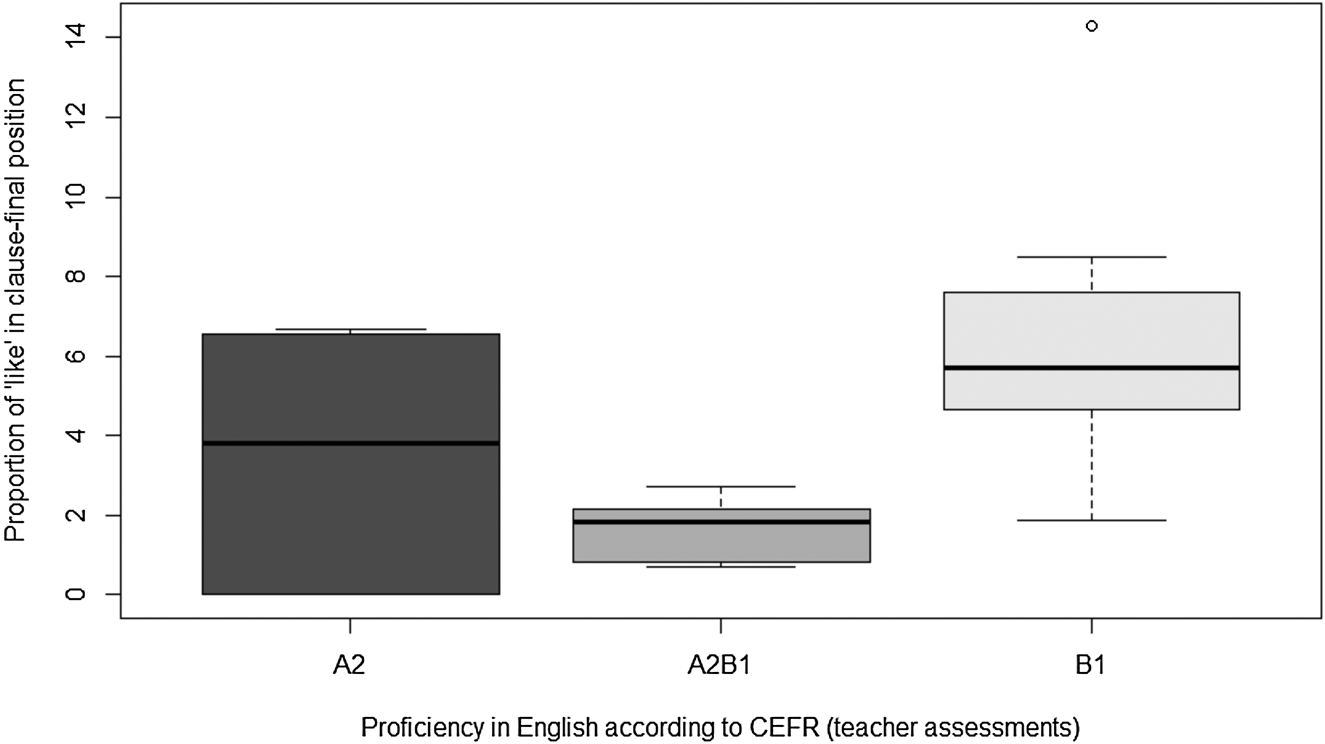
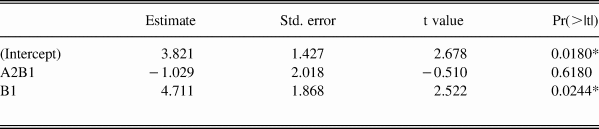
However, when examined by clausal position, there was an effect in Armagh for proficiency, whereby L2 speakers at B1 were more likely to be using clause-final like as a proportion of their overall likes than their peers with lower CEFR scores. This trend is clearly visible in Figure 5 (and note that, as outlined earlier, the B1 migrants were also older and had been in NI longer than the lower proficiency cohorts). It is also apparent that as proficiency improves from A2 to A2B1, there is no increase in the use of clause-final like—in fact, there is a slight decrease in frequency. It is only in the transition from A2B1 to B1 that the difference becomes significant, which was confirmed by the results of a fixed effects regression model (Table 8).
Proportion of clause-final like usage by proficiency in Armagh.

Generalised linear regression model for proportion of clause-final like by proficiency in Armagh.

Null deviance: 257.62 on 16 degrees of freedom
Residual deviance: 142.52 on 14 degrees of freedom
AIC: 92.39.
*p ≤ 0.05; **p ≤ 0.01; ***p ≤ 0.001.
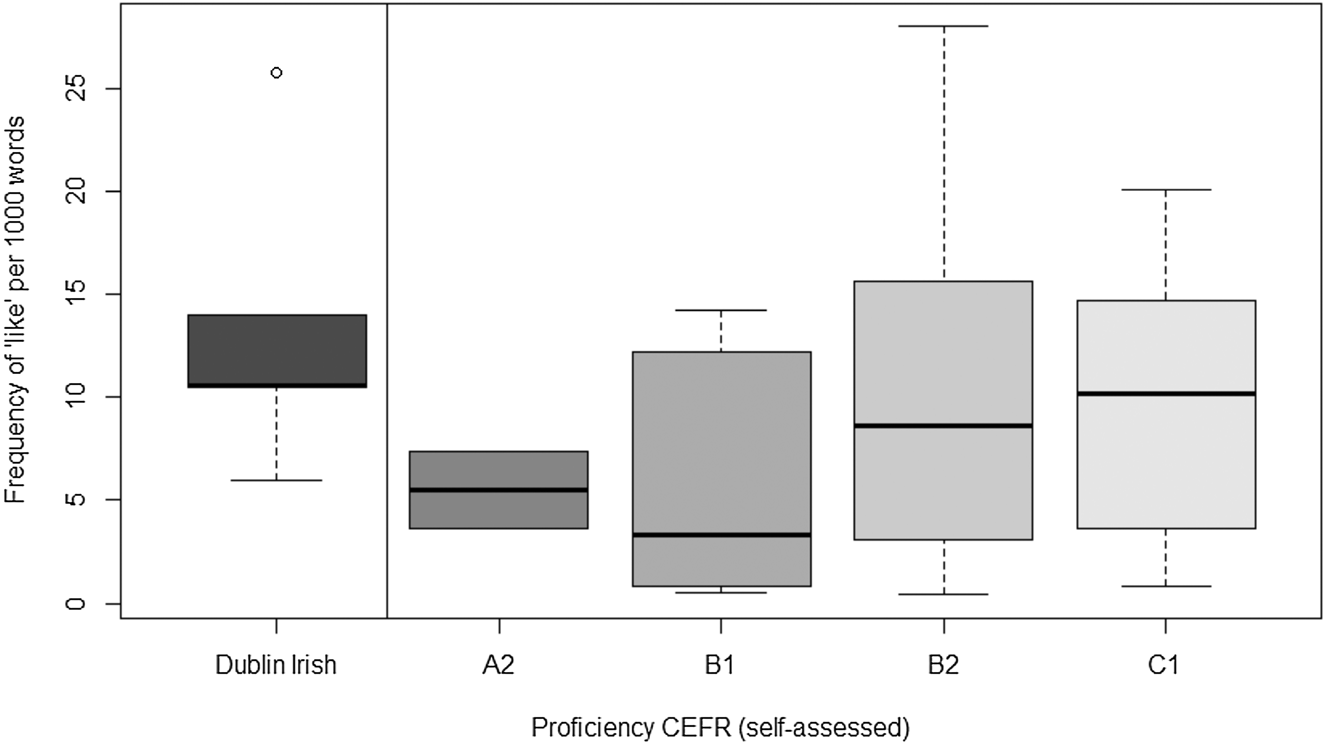
The impact of proficiency on like usage frequencies in Dublin is presented in Figure 6, where there is a visible increase in rates between categories B1 and B2 particularly (a transition that is not comparable with the Armagh data due to the previously noted proficiency discrepancies between both groups). The upward trend in Dublin is, however, not statistically significant since a Pearson correlation test showed only a weak positive correlation at r(40) = 0.37, p < 0.02. By contrast to the Armagh results, when analysed by clausal position, no significant effect was found for proficiency and either initial, medial, or final like in Dublin.
Frequency of like by proficiency levels in Dublin.

Length of residence (LOR) effects
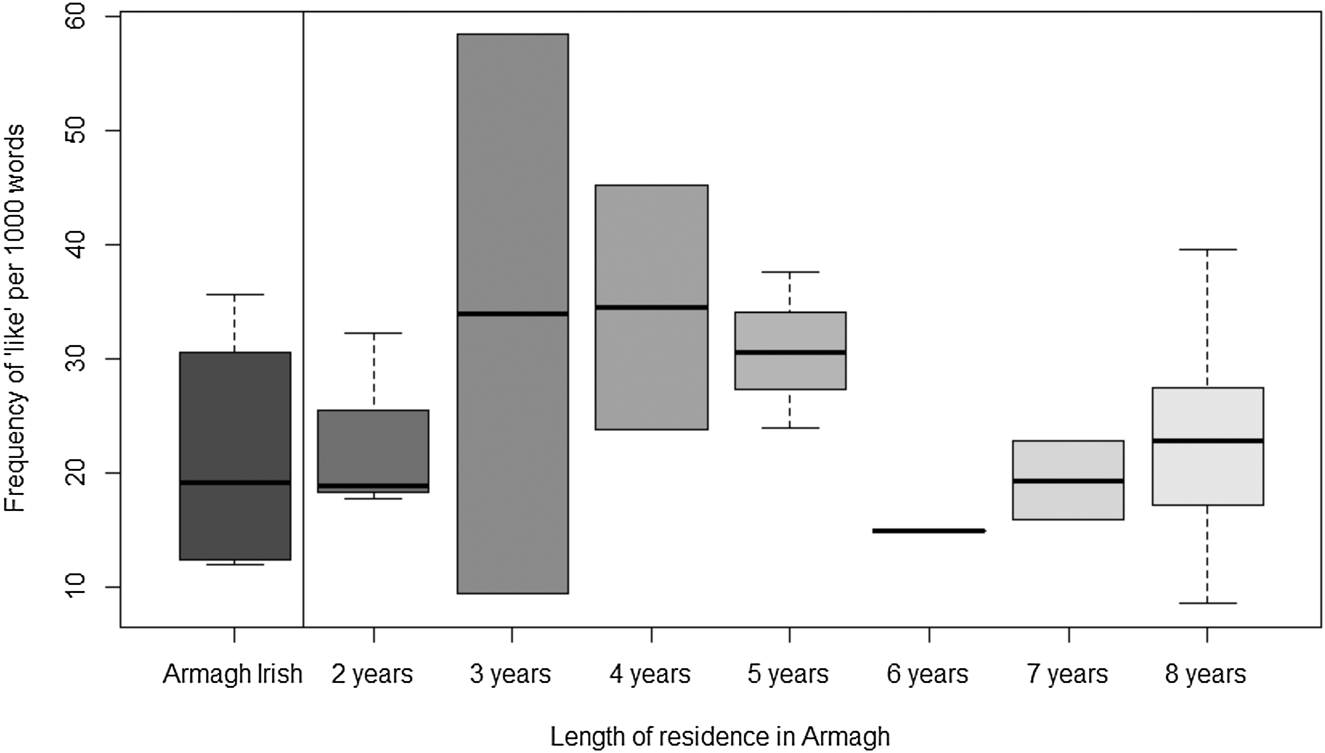
Figure 7 shows no correlation between the allied metric that normally relates to L1 exposure, that is, LOR, and frequency of like usage in Armagh. L2 speakers with a LOR of just two years appear to be equally liable to use like as their peers who have resided in Armagh four times longer. There were no statistically significant differences between the various stages of LOR in this case. Moreover, when divided into its three positions, like was not found to have any direct or significant linear relationship with LOR in Armagh. Even though, as previously noted, LOR and proficiency are somewhat collinear in this sample, proficiency emerged as a stronger predictor of like and clause-final like usage than LOR did. A similar situation was found in Dublin, with no effect detected for LOR on the frequency of like overall, or on its use across different clausal positions.
Frequency of like by LOR in Armagh.

Language-internal factors
Discourse newness
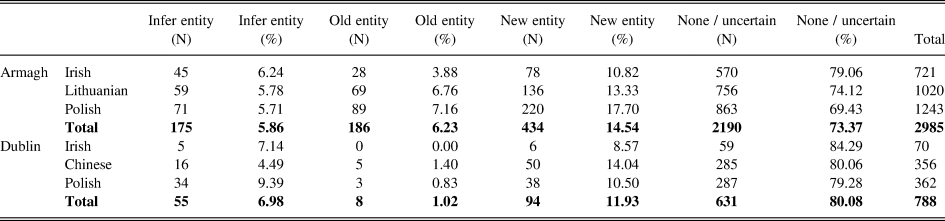
It was predicted that like would precede items that were discourse-new. Table 9 presents our results, showing that for all participants, like is indeed more likely to precede discourse-new entities (11.93% of the time in Dublin versus 14.54% of the time in Armagh) than it is to go before discourse ‘old’ items (1.02% in Dublin and 6.23% in Armagh). This difference for the discourse-old items between the cities could perhaps be explained by the fact that the entire interview in Armagh was analysed, whereas in Dublin only a short segment was extracted. It can be presumed that the longer an interview lasts, the more likely it is that a previously mentioned item will recur, although this effect is arguably outweighed by the pragmatic importance and thematic prominence of the previously mentioned item, which is not examined systematically here.
Discourse newness following like in Armagh and Dublin.

It is also worth noting that 70–80% of cases could not be coded, as there was no entity following like, or the context was too ambiguous. Nonetheless, when assessing the impact of discourse-old versus discourse-new in isolation, there does seem to be a visible trend in both datasets for like to precede new entities, which is in line with the predictions of Cheshire (Reference Cheshire2005) and Labelle-Hogue (Reference Labelle-Hogue2013).
Regarding native versus L2 differences, the Polish group in Armagh had fewer ‘none’/‘uncertain’ cases (69.43% versus 74.12% for the Lithuanians and 79.06% for the native Irish) alongside slightly higher proportions in the other categories, particularly for discourse ‘new’ (17.70% versus 13.33% for the Lithuanians and 10.82% for the locals). In Dublin, the main difference was the Chinese preference for like before discourse ‘new’ items (14.04% versus 10.50 for the Polish and 8.57% for Dubliners) and their relative dispreference for it preceding inferrable entities (4.49% versus 9.39% for the Polish and 7.14% for the locals). Overall, it can be said that the preference for like to precede discourse-new items was being replicated unproblematically by the L2 speakers. However, the low token counts for Dubliners—especially once the ‘none’/‘uncertain’ category is excluded—renders any conclusive findings for all Dublin cohorts tentative at this stage, though there may be mileage in future research investigating this phenomenon with larger datasets.
The principle of lexical attraction
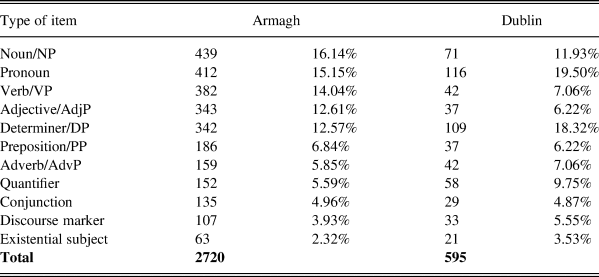
In line with Andersen (Reference Andersen2001), it was predicted that like would more readily precede NPs and VPs than PPs or APs. Table 10 presents the total number and proportion of lexical and grammatical material that occurred after like, once nonapplicable tokens (265 in Armagh; 185 in Dublin) were removed. The figures show that the most likely items to follow like were nouns/NPs, pronouns, and verbs/VPs in Armagh, and pronouns, determiners/DPs and nouns/NPs in Dublin. The high number of pronouns following like could be explained by the fact that clause-initial like, often at the head of a CP, was included in this analysis, unlike, for example, Andersen (Reference Andersen2001), which only focused on medial like. Based on the summary above, it could be said that the principle of lexical attraction holds in both locales in the sense that the overall pattern is [NP, VP] > [PP, AP]. However, these results remain indicative since the analysis did not apply a strictly accountable variationist approach—whereby all possible instances where lexical/grammatical material could have occurred before NPs, VPs, and so on, but did not—were accounted for. There are, however, some interesting dialectal differences worth noting, namely, like was more likely to precede DPs in Dublin than it was in Armagh, where there was a preference for like to precede NPs. This lends some support to D'Arcy's (Reference D'Arcy2008) claim that part of the grammaticalisation of like is generalisation from the higher functional projection (e.g. the DP) to the lower lexical one (the NP). Considering the fact that the Armagh speakers are younger than those in Dublin, this sign of later stage development is congruent with the notion that younger speakers will be at the ‘peak’ of linguistic change (Tagliamonte & D'Arcy Reference Tagliamonte and D'Arcy2009). Thus, the younger native speakers in Armagh may be more advanced than older Dubliners in their use of clause-initial and clause-medial like, while still retaining conservative clause-final like for other purposes, such as indexing a sense of regional identity reported to be ‘emblematic’ of Irishness (Diskin Reference Diskin2017). In that light, this outcome may not necessarily contradict the finding that the Armagh natives are also users of the more conservative clause-final variant of like. This, of course, warrants further careful qualitative examination.
Summary of lexicogrammatical material occurring after like in Armagh and Dublin.

DISCUSSION
We have examined the frequency of discourse like usage across two locales and within speech cohorts that typify diverse linguistic heritages. One of the most striking findings that offer insights into the acquisition of IE/HE as an L2 is that like was used at similar rates within both Armagh and Dublin, but not necessarily across each city. Thus, rates of like usage in Dublin were uniform, regardless of native/L2 speaker status, and the same was true for Armagh. This overarching finding also did not depend on L2 speakers’ linguistic backgrounds. Newcomers of any heritage were ably using like at almost identical rates to their native-speaking peers thus indicating the degree to which like may be viewed as a viable resource within L2 linguistic repertoires. Interestingly, our result somewhat contradicts the findings of Davydova & Buchstaller (Reference Davydova and Buchstaller2015), Mougeon, Rehner, & Nadasdi (Reference Mougeon, Rehner and Nadasdi2010), and Müller (Reference Müller2005). They instead suggest that the frequency of discourse pragmatic variants in L2 speakers was disproportionately lower than that of native speakers even when the former were advanced learners. Our outcomes may also signal the extent to which newcomers have become sensitive to some local IE/HE constraints on this variable, though one should be wary of assuming that surface parallels in rates across diverse cohorts conclusively indicate acquisition of ‘Type II’ variation by L2 speakers. In fact, such results may hide subtle underlying grammatical differences, as Poplack, Zentz, & Dion (Reference Poplack, Zentz and Dion2012) have demonstrated in their analysis of preposition stranding in North American French.Footnote 13
Moreover, proficiency—implicated to be important for distinguishing between non-native speakers in their acquisition of variable constraints by Hellermann & Vergun (Reference Hellermann and Vergun2007) and Sankoff et al. (Reference Sankoff, Thibault, Nagy, Blondeau, Fonollosa and Gagnon1997)—had surprisingly little effect on like frequencies in either location. L2 speakers in Armagh and Dublin with low proficiencies were just as capable of using like as their peers with higher Common European Framework scores. Residency duration, a factor commonly also examined in tandem with proficiency, was likewise not found to have a significant impact either. Interestingly, these outcomes echo the findings of Meyerhoff & Schleef (Reference Meyerhoff, Schleef and Lawson2014:109) who state that such external factors ‘almost invariably failed to be chosen as significant in our analyses’. Very importantly, however, increased proficiency in Armagh, which was somewhat collinear with residency and age, was a significant predictor of clause-final like usage, lending weight to the argument advanced further below that the clause-final variant may have a different status vis-à-vis L2 acquirers.
One of the more marked differences between the cities was the relative frequencies and proportions at which like was being used, since like proved to be twice as likely to occur in Armagh than in Dublin, both overall, and in clause-final position (although statistically significant differences were only found for the latter). There are at least three possible explanations which each have some merit and require further investigation in subsequent research. Firstly, although we have already argued that like stabilises early, this finding may in the end prove to be an age-grading effect, since the Armagh interviews were with adolescents, whereas the Dublin participants were adults. The result may thus support Andersen's (Reference Andersen2001) suggestion and related arguments by Tagliamonte (Reference Tagliamonte2016:14) that ‘teenagers use an overwhelming number of likes’. Secondly, as noted earlier, previous research has reported nuances regarding the clausal positioning of like that isolate IE/HE from other non-Celtic Englishes. These may be related to language contact effects (Ó Curnáin Reference Ó Curnáin, Lenoach, Giollagáin and Curnáin2012), on account of the propensity for a wide range of discourse markers in Irish to occupy clause-peripheral rather than medial positions, as exemplified for Irish ach ‘but’ in (19) which likewise occurs in IE both utterance-finally (Harris Reference Harris1984:132) and initially (Corrigan Reference Corrigan, Amador-Moreno, McCafferty and Vaughan2015:39).Footnote 14

This predilection in the dialect is reflected in this study across both locales whereby the native speakers, who are, after all, descendants of the first L2 speakers of IE, were far more liable to use like in clause-final position than the newcomers. The divergence between Armagh and Dublin locals could possibly be conceived of as reflecting the different periods when Irish declined in each city, with the shift in Dublin happening considerably earlier (Corrigan Reference Corrigan2010). As such, Armagh speakers may retain clause final like appropriated from their late Modern English models of spoken English on account of the fact that their ancestors’ L1 reinforced the penchant for clause-marginal discourse marking. By comparison, the shift to English in Dublin began in the middle ages when the discourse marker function was not yet attested. Since most regions of Ireland outside of the large cities shifted to English around the same period as conjectured for Armagh, the feature has come to be regarded as stereotypical for IE/HE more broadly and is one that is subject to social comment (see Corrigan Reference Corrigan2010:80). Indeed, tracking this feature closely over time as D'Arcy (Reference D'Arcy2017) has done for Canadian English could reveal important trends, not just for IE, but for varieties of English globally and may give further insights into D'Arcy's (Reference D'Arcy2017) proposal regarding like’s cline of grammaticalisation.
Finally, although models of how innovation diffuses spatially have been criticised (Britain Reference Britain, Chambers and Schilling2013:606–11), perhaps there is nevertheless mileage too in reflecting upon the possibility that contemporary differences between native and non-native cohorts residing in these cities arise instead from the fact that Dublin is a cosmopolitan urban space at the forefront of innovation whereas Armagh is decidedly different in this regard. Changes such as internal clause like usage in this view might be seen to be in the process of diffusing down an urban hierarchy from capitals to smaller cities. We note that D'Arcy (Reference D'Arcy2017) posits that like is undergoing a process of change from the clause periphery to internal clause positions. Our findings for clause-initial and clause-medial like show that Armagh native speakers favour clause-initial like, whereas their peers in Dublin prefer the clause-medial variant. Moreover, the proportion of clause-final like usage was lower amongst all speakers there than it was in Armagh (16.42% versus 33.43%). One might conjecture that the Dublin speakers are further advanced along the path of grammaticalisation of like, which is also consistent with the ‘gravity’ or ‘cascade’ model of diffusion, whereby large urban centres are taken to be the epicentres of linguistic change (Trudgill Reference Trudgill1974). In the same vein, Nestor (Reference Nestor, Singleton, Regan and Debaene2013) argued that clause-marginal like was more common in rural areas in Ireland than in Dublin, suggesting that clause-medial like could be viewed as an ‘urban’ trend away from the ‘traditional (and obsolescing) British pattern’ (D'Arcy Reference D'Arcy2005:5). Armagh's city designation has already been noted, and while it has considerably higher status sociohistorically than the rural community studied in Nestor (Reference Nestor, Singleton, Regan and Debaene2013), it comes as no particular surprise that the Armagh natives may be exhibiting a preference for ‘local’, traditional clause-marginal like rather than the more ‘urban’ and global clause-medial type. It is interesting to note the opposite tendency amongst their migrant peers who prefer clause-medial like and do so perhaps because they are more oriented to current ‘global’ trends in Ireland such as those found in Dublin. Capitals generally have higher migrant populations, are composed of more ‘fluid’ social networks, and are better connected to the rest of the world. It is therefore not difficult to imagine that a migrant to a small city like Armagh may be less inclined to participate in local practices (especially those that are indexical of the host community to which they are a newcomer) than they would be to orient towards more fluid, cosmopolitan trends elsewhere that are not strongly indexical of any one community. Indeed, there was some evidence of this amongst the migrants in Armagh, many of whom appeared to have loose local ties, and spoke of plans to return ‘home’ or to follow relatives to a different migrant destination.
It can also be assumed of course that the clause-final variant is not one that L2 acquirers would have been aware of prior to arrival, whereas they may have had some experience of like in other positions (via exposure to North American English media rather than ‘classroom learning’ in the sense of Sankoff et al. Reference Sankoff, Thibault, Nagy, Blondeau, Fonollosa and Gagnon1997:212). Nonetheless, if like is acquired with relative ease clause-initially and medially, and since the clause final variant features in the native speaker datasets (Armagh and Dublin) at a frequency of 16–33%, and thus is part of their naturalistic input as L2 learners, there may well be cognitive or other factors at play regarding like adoption in this position that are not our present concern. However, it must be noted that the proportion of clause-final like usage increased with proficiency among Armagh migrants, suggesting that it requires at least a baseline of competence (sociolinguistic, or otherwise) in English to be used at similar rates to those of native speakers. That said, in Dublin, proficiency levels had no impact on clause-final like frequencies (albeit average levels of proficiency for non-native speakers across the two cities were not identical and were measured in different ways).
Leaving proficiency aside, it would appear that L2 speakers in both locales are exhibiting some resistance to clause-final like. Recent trends in Third Wave sociolinguistics have indicated that certain variables constitute ‘a constellation of ideologically related meanings’, that can be activated in the situated use of a specific variable (Eckert Reference Eckert2008:453). Clause-final like, due to its marginal status on the stage of world Englishes, could be considered to be or to have become indexical of ‘Irishness’ (D'Arcy Reference D'Arcy2017:13; Nestor et al. Reference Nestor, Ní Chasaide, Regan, Migge and Chiosáin2012; Nestor Reference Nestor, Singleton, Regan and Debaene2013) in a manner similar to the appropriation of final particle but by Australians (Mulder, Thompson, & Penry Williams Reference Mulder, Thompson, Williams, Peters, Collins and Smith2009). In this sense, it can be seen as belonging to a ‘local ethnographic category’ (Bucholtz & Hall Reference Bucholtz and Hall2005: 587) and thus becomes a variable that can only be used ‘genuinely’ by native speakers (Bucholtz & Hall Reference Bucholtz and Hall2005:585). Should an L2 speaker of IE/HE avail of this feature in linguistic interactions (as many of the proficient Armagh teens do), it is interpretable as an ‘emergent’, boundary crossing performance of sorts that would be incongruent with their assigned social grouping as ‘migrant’ (Bucholtz & Hall Reference Bucholtz and Hall2005:588). Indeed, the local associations of clause-final like might, in fact, be an undesirable identity resource for such speakers to perform during linguistic interactions island-wide, particularly those who are not planning to reside there permanently. Their avoidance of like in clause-final position may thus be construed as a signal that it is being used in some process of ‘distinction’ in the terms of Bucholtz & Hall (Reference Bucholtz, Hall and Duranti2004:383–84). Hence, while native speaker groups on the island of Ireland have appropriated this variant in linguistic interactions so as to place their similarities to the fore in pursuit of ‘adequation’ (Bucholtz & Hall Reference Bucholtz, Hall and Duranti2004:383–84), L2 speakers of IE/HE may actually be distancing their social identities from ‘local ethnographic categories’ (Bucholtz & Hall Reference Bucholtz and Hall2005:587) by dispreferring clause-final like.
CONCLUSIONS AND IMPLICATIONS
We have shown that tracking the same variable in two different locales raises important questions pertaining to language variation and change, such as the significance of large urban centres as focal points for linguistic change and the place of L2 speakers within these processes. Nonetheless, a number of inconsistencies across the datasets render direct comparisons problematic. The L2 speakers in Armagh are youngsters who moved there as children. This differs broadly from the adults in Dublin, who spent their formative years abroad. Moreover, Armagh newcomers are more closely aligned to a ‘Generation 1.5’ than are Dublin migrants and this likely has repercussions for the roles of identity construction and integration more broadly. Furthermore, the age differences shed light on the broader question of the acquisition of discourse-pragmatic variables by non-native speakers at different life stages (see Diskin & Levey Reference Diskin and Levey2019).
Discourse-pragmatic variables convey layers of meaning, such as the signalling of new information, and perform complex roles in interaction like floor-holding, or mitigating. In the case of IE, at least, like also appears to fulfil a socioindexical role of signalling regional identity. Future work would be well-placed to examine the perception of like in a variety of utterance types to better assess the levels of processing that are required to retain its complex, inter-related meanings and how these might connect with prior experience, input, and social information about the speakers who favour it.
Another area for re-evaluation concerns the diverse L1 backgrounds of the speaker samples—especially when a key reason why IE/HE differs from other Englishes is its original development as an L2 contact language (Corrigan Reference Corrigan2010; Kallen Reference Kallen2013). Is it possible to compare individuals who have acquired Chinese, Polish, and Lithuanian as their L1 and treat them as comparable L2 learners without also examining whether or not discourse like equivalents also feature in any of these languages (see Levey Reference Levey2006:418)? While there have been attestations of worldwide grammaticalisation of like from simile to complementiser in genetically unrelated languages, there remains a paucity of research on the ‘areal and genetic distribution of this process’ (Heine & Kuteva Reference Heine and Kuteva2002:274) and whether these grammatical developments were interrelated or operated independently of one other. Moreover, to the best of our knowledge, there is almost no published research on the forms/functions of discourse like equivalents in the L1s of our migrant cohorts.Footnote 15 Exploring these issues, however, will be crucial to furthering our understanding of how variation and change within discourse-pragmatic systems interact with L2 acquisition processes both cross-dialectally and cross-linguistically.
The sociopolitical context of both communities is a topic that could likewise benefit from further investigation. For instance, in NI, the strict ethnoreligious division between Protestant and Roman Catholic communities results in complex local social networks, which have been shown to have sociolinguistic repercussions (see McCafferty Reference McCafferty2001; Corrigan Reference Corrigan2010, Reference Corrigan2020). How do L2 speakers orient towards these networks, to what extent does immigrant prejudice impact upon a new speaker's ability to integrate, and how are these practices manifested linguistically (see Corrigan Reference Corrigan2020)? For the time being, it suffices to say that migration to the island of Ireland offers a lens into language variation and change that is considerably more complex and multifaceted than simply observing the behaviour of native speakers.