Maternal plasma concentrations of vitamin E usually decrease from late gestation to parturition, reaching a nadir around birth and returning towards baseline values within a few weeks of lactation. This phenomenon has been reported for cows and sows (Hidiroglou et al. Reference Hidiroglou, Farnworth and Butler1993; Goff et al. Reference Goff, Kimura and Horst2002). Due to limited placental transfer, piglets are born with low vitamin E content even when the dietary intake of vitamin E by the gestating mother is high and her plasma vitamin E is elevated (Lauridsen et al. Reference Lauridsen, Engel, Jensen, Craig and Trabe2002; Pinelli-Saavedra and Scaife, Reference Pinelli-Saavedra and Scaife2005). Since piglets are born with low tissue vitamin E depots, unless they receive significant amounts in the sows’ milk they may at weaning suffer an important decline of serum vitamin E (Lauridsen et al. Reference Lauridsen, Engel, Jensen, Craig and Trabe2002), thus leading to increased oxidative status and disease susceptibility. These effects may be explained by the fact that vitamin E is the most effective chain-breaking antioxidant present in cell membranes and, therefore, plays an important role in cell survival by capturing free radicals and other reactive substances (Halliwell, Reference Halliwell1994). Owing to its antioxidant function in biological processes, there is evidence that vitamin E enhances cellular and humoral immune responses in various animal species including pigs (Pharazyn et al. Reference Pharazyn, Den Hartog and Aherne1990; Hidiroglou et al. Reference Hidiroglou, Batra, Farnworth and Markham1995; Brennan et al. Reference Brennan, Morris, Wasson, Hanningan and Barnett2000). For instance, Hayek et al. (Reference Hayek, Mitchell, Harmon, Stahly, Cromwell, Tucker and Barker1989) indicated that IgG could be increased by injection with 1000 IU of vitamin E to sows on day 100 of gestation. This supplementation sometimes results in increased growth performance and immunity, and improved oxidative status (Jensen et al. Reference Jensen, Fossum, Ederroth and Hakkarainen1988; Fragou et al. Reference Fragou, Fegeros, Xylouri, Baldi and Politis2004; Lauridsen and Jensen, Reference Lauridsen and Jensen2005; Pinelli et al. Reference Pinelli-Saavedra, Caldero´n de la Barca, Hernández, Valenzuela and Scaife2008; Pinelli-Saavedra and Scaife Reference Pinelli-Saavedra and Scaife2005). Prior to nursing, however, the α-tocopherol concentration in the serum of neonatal piglets is low whether or not the dam is provided with adequate 44 mg/kg vitamin E (NRC, 1998). Thus, the present study examined the effects of a high concentration of vitamin E supplementation in sow diet during the last week of gestation and lactation on the performance, milk composition, immunological variables and antioxidative parameters in sows and piglets.
Materials and methods
The protocols used in this experiment were approved by the Northeast Agricultural University Institutional Animal Care and Use Committee.
Animals and experimental design
Forty-eight crossbred pregnant sows (Large White × Landrace) on day 107 of gestation were randomly allocated to two groups (n = 24 sows per group), accounting for parity (in the range of 3–5) and expected delivery date. The diets were supplemented with 44·0 and 250·0 IU/kg of vitamin E, respectively. The vitamin E product used in the experiment contained 50% isomers. The experiment started on day 107 of gestation and lasted until the piglets were weaned on day 21 of lactation. All diets were formulated to meet or exceed requirements for all nutrient standards (NRC, 2012). The ingredients and chemical composition of the basal diet are shown in Supplementary Table S1.
Housing, feeding and management
The experiment was initiated on day 107 of gestation when the sows were moved to the same farrowing house: sows were offered experimental supplements until weaning at day 21. The sows were housed in pens (2·1 m × 1·5 m) with slatted floors. The farrowing room was strictly controlled, and the inner temperature was always kept at 18–20 °C. The parturitions were observed in all groups, and disturbances were avoided as far as possible during the farrowing interval. A piglet corner with a heating lamp was available for the piglets. Sows were initially fed 3·0 kg/d before parturition. On the day of farrowing, sows were not fed. After farrowing, sows were initially fed 1·5 kg on day 1 and this was increased daily by 0·5 kg until day 7 postpartum, depending on sows’ feed consumption and recovery postpartum. From day 7 postpartum, sows had free access to their diets until weaning. The sows and piglets had free access to water from nipple drinkers during the whole experiment.
On day 3, the piglets received an iron injection (Iron Dextran, Jiangxi Chuangdao Animal Health Co., Ltd, Nanchang, China). Commercial creep feed (15·8 MJ metabolisable energy/kg, 210·0 g CP/kg, and 15·6 g lysine/kg) was offered to the piglets at day 7 after birth. Intake of the creep feed was not recorded.
Collection and analysis of diets
Samples of feed were obtained from each dietary treatment. The diets were analysed for crude protein, calcium, phosphorus and the content of vitamin E. Vitamin E was measured by high-performance liquid chroma-tography (HPLC) according to Jensen et al. (Reference Jensen, Fossum, Ederroth and Hakkarainen1998).
Sow and litter performance
Sow weights were recorded at entry into the farrowing room (day 107 of gestation) and at the time of weaning (day 21 of lactation). Daily feed intake was recorded for each sow. Backfat thickness was measured at the P2 position (left side of the 10th rib and 6 cm lateral to the spine) during times of weighing using a B-mode ultrasound (Renco Lean Meater type 7, Minneapolis, MN, USA).
The numbers of piglets born alive and stillborn were recorded. The numbers of piglets at weaning were also recorded and the survival rates of all treatments were calculated. The piglets of every litter were individually weighed at farrowing and weaning and average daily gain (ADG) was calculated.
Collection and analysis of colostrum and milk samples
During parturition and on day 21 of lactation, about 30 ml of colostrum or milk from 24 sows per group was collected from the functional glands after injection of 2 ml of oxytocin. The samples were immediately frozen at −20 °C for later analysis. The whey was partially transferred into a 1·5 ml tube after samples of approximately 10 ml were centrifuged with an ultracentrifuge at 1000 × g at 4°C for 10 min to remove free fat and then centrifuged at 6000 × g to collect whey (Pinelli-Saavedra A et al. 2008). The whey and milk samples were immediately stored at −20 °C until analysis. The colostrum and milk samples were analysed for lactose, protein, fat and total solids with a fully automatic milk analyser (Milko ScanTM FT+ Analyser, Foss). ELISA kits were used for the analysis of IgG and IgA with an enzyme-labeled instrument (Labsystems Multiskan MS, Finland). The final values of IgG and IgA were expressed in grams per litre (g/l). The colostrum or milk from every sow were analysed. The inter-assays coefficient of variation of IgG kits was 4·8% while that of IgA kits was 5·6% (Pinelli-Saavedra et al. Reference Pinelli-Saavedra, Caldero´n de la Barca, Hernández, Valenzuela and Scaife2008).
Collection and analysis of serum samples
Blood samples of 48 sows were collected before the morning feeding from the ear marginal vein on day 0 (farrowing) and day 21 of lactation, and subsequently centrifuged at 1000 × g for 15 min. Serum was aliquoted and stored at −20°C for later analysis. The samples were analysed to determine their IgG and IgA concentrations.
During the suckling period, after having an empty stomach for 24 h, blood samples (5 ml) from one piglet per litter were collected from the anterior vena cava by puncture into heparin tubes at weaning (day 21). The blood samples were immediately placed on ice until they were centrifuged at 1000 × g for 15 min. The plasma was immediately stored at −80 °C until further analysis. IgG and IgA concentrations were determined as for maternal plasma.
Total antioxidant capacity (T-AOC), glutathione peroxidase (GSH-Px), and catalase (CAT) in the serum of piglets were assayed using colorimetric methods on a spectrophotometer (UV-2401PC, Shimadzu Corp, Tokyo, Japan). The assays were conducted using assay kits purchased from the Nanjing Jiancheng Institute of Bioengineering (Nanjing, Jiangsu, China). The inter-assays coefficient of variation of T-AOC kits was 3·2% while that of GSH-Px kits was 3·1% and coefficient of variation of CAT kits was 1·9%.
Statistical analyses
Data were analysed using independent-sample t-test (2012, IBM-SPSS Inc., Chicago, IL, USA). The results were presented using mean values and the standard error of the mean (sem). Differences between treatment means were considered significant if P < 0·05.
Results
Performance of sows and piglets
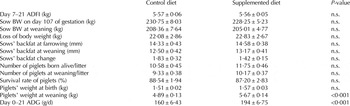
There were no differences in terms of ADFI, loss of body weight and backfat change in sows from day 107 of gestation to day 21 of lactation (weaning) (P > 0·05) between the treatments (Table 1). Piglet weight at weaning and ADG were significantly improved by the addition of 250 IU/kg of vitamin E to the maternal diet (P < 0·001, Table 1).
Effect of dietary vitamin E on sow and piglet performance (n = 24)

Vitamin E levels: Control diet: 44 IU/kg, Supplemented diet 250 IU/kg.
ADFI, average daily feed intake; BW, body weight; ADG, average daily gain.
Data are expressed as mean ± sem, n = 24.
α-Tocopherol concentration and immunologic variables of plasma from sows
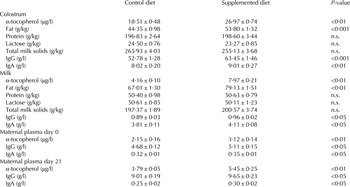
Concentrations of α-tocopherol, IgG and IgA in sow plasma were significantly (P < 0·01) increased on both day 0 (farrowing) and day 21 by dietary supplementation with 250 IU/kg vitamin E (Table 2).
Effects of dietary vitamin E on the composition and immunoglobulin levels of colostrum, milk and maternal plasma

Vitamin E levels: Control diet: 44 IU/kg, Supplemented diet 250 IU/kg.
IgG, immunoglobulin G; IgA, immunoglobulin A.
Data are expressed as mean ± sem, n = 24.
Composition and immunoglobulin levels of colstrum and milk
Table 2 shows the composition of colostrum and milk. The concentrations of lactose, protein and total milk solids in colostrums and milk were not affected by the level of vitamin E, but fat concentrations were increased significantly by supplementation in both colostrum (P < 0·001) and milk (P < 0·01). The IgG and IgA concentrations were higher in colostrum than in milk and in both cases were significantly increased by supplementation (P < 0·05 or better).
α-Tocopherol concentration, immunoglobulin levels and antioxidative parameters of piglet plasma
Data for piglet plasma on d21 is in Table 3. There were significant increases in α-tocopherol (P < 0·01), IgG and IgA (both P < 0·05) concentrations as a result of supplementation of the maternal diet. The levels of T-AOC and CAT in piglet plasma were significantly increased by adding vitamin E (P < 0·05), but the numerical increase in GSH-Px did not achieve significance.
Effects of dietary vitamin E on piglet plasma α-tocopherol concentration, immunoglobulin levels and antioxidative parameters on day 21 of lactation

Vitamin E levels: Control diet: 44 IU/kg, Supplemented diet 250 IU/kg.
IgG, immunoglobulin G; IgA, immunoglobulin A; T-AOC, total antioxidant capacity; GSH-Px, glutathione peroxidase; CAT, catalase.
Data are expressed as mean ± sem, n = 24.
Discussion
Performance of sows and piglets
In the present study, piglet weight at weaning and ADG were significantly improved by the addition of 250 IU/kg of vitamin E. There are many diffeerent reasons that might cause such phenomenon. Adding fat as oil to the diet of sows could be beneficial for sow and piglet nutrition and health (Tanghe et al. Reference Tanghe, Missotten, Raes, Vangeyte and De Smet2014; Tummaruk et al. Reference Tummaruk, Sumransap and Jiebna2014) through higher colostral fat concentration (Jackson et al. Reference Jackson, Hurley, Easter, Jensen and Odle1995; Christon et al. Reference Christon, Saminadin Lionet and Raeon1999), while vitamin E could prevent the oxidisation of the soybean oil (Asghar et al. Reference Asghar, Gray, Booren, Gomaa, Abouzied, Miller and Buckley1991) and cause the improvement of immune status. This might account for the higher piglet weight at weaning and ADG. It is not possible to differentiate these reasons to identify and understand the exact mechanisms responsible. Therefore, further research is warranted.
Composition and immunologic variables of colostrum and milk
As one of the most effective lipid soluble antioxidants present in the cell membrane, vitamin E plays a major role in maintaining its integrity by limiting lipid peroxidation initiated by reactive oxygen species and free radicals in all cells, including those of immune systems (Pinelli et al. Reference Pinelli-Saavedra, Caldero´n de la Barca, Hernández, Valenzuela and Scaife2008). Results of the present study might be explained by the humoral immunity provided by vitamin E. However, reports about effects of vitamin E on IgG and IgA are inconsistent. Some reports showed that IgG could be increased by injection with 1000 IU of vitamin E to sows on day 100 of gestation (Hayek et al. Reference Hayek, Mitchell, Harmon, Stahly, Cromwell, Tucker and Barker1989) while others suggested that the supplementation of vitamin E did not improve IgG and IgA contents in sow colostrum or milk (Nemec et al. Reference Nemec, Buter, Hidiroglou, Farnworth and Nielsen1994; Pinelli et al. Reference Pinelli-Saavedra, Caldero´n de la Barca, Hernández, Valenzuela and Scaife2008). Therefore, further research is warranted to identify and understand the exact mechanisms responsible.
Immunologic variables of sows and piglets
One obvious explanation for the results obtained for the immunologic variables might be that the concentrations of vitamin E in sow milk, plasma and piglet plasma increased with the increasing supplementation of vitamin E (Hidiroglou et al. Reference Hidiroglou, Farnworth and Butler1993; Mahan, Reference Mahan1994; Mahan et al. Reference Mahan, Kim and Stuart2000). Piglets could obtain vitamin E from colostrum and milk (Pinelli-Saavedra and Scaife Reference Pinelli-Saavedra and Scaife2005). Vitamin E supplementation (Fragou et al. Reference Fragou, Fegeros, Xylouri, Baldi and Politis2004) to sows or injections (Hidiroglou et al. Reference Hidiroglou, Batra, Farnworth and Markham1995) to piglets both could improve sow and piglet immune status.
Antioxidative parameters in plasma
The key elements of cell antioxidant defence are antioxidant enzymes. Both GSH-Px and CAT provide first-line antioxidant protection in any cells (Halliwell, Reference Halliwell2006). Our findings suggested that the combination of antioxidant vitamins stimulated the activity of antioxidant enzymes in erythrocytes of the supplemented sows, an interpretation consistent with earlier studies (Rodriguez-Porcel et al. Reference Rodriguez-Porcel, Lerman, Holmes, Richardson, Napoli and Lerman2002; Tauler et al. Reference Tauler, Aguilo, Fuentespina, Tur and Pons2002). In particular, Rodriguez-Porcel et al. (Reference Rodriguez-Porcel, Lerman, Holmes, Richardson, Napoli and Lerman2002) observed increased activity of both GSH-Px and CAT in pig myocardial tissues after a 12-week supplementation with vitamin E at a dose of 100 mg/kg of fodder and vitamin C at a dose of 1·0 g per animal. Interestingly, Zaidi and Banu (Reference Zaidi and Banu2004) found that vitamin E, both alone and in combination with vitamins A and C was effective at enhancing the activity of CAT in stressed rats. The mechanisms by which exogenous vitamins affect the endogenous system of antioxidant defence have not yet been fully explained. It is likely that the expression of genes encoding the synthesis of antioxidant enzymes is somehow altered (Franco et al. Reference Franco, Odom and Rando1999).
The α-tocopherol concentration of sow plasma and milk, and piglet plasma
The concentration of α-tocopherol in sow colostrum, milk and plasma all increased significantly with extra dietary vitamin E (Hidiroglou et al. Reference Hidiroglou, Farnworth and Butler1993; Mahan Reference Mahan1994; Mahan et al. Reference Mahan, Kim and Stuart2000). These disparities are most likely due to differences in the composition of diets, or the supplementation period or both. The increased content of vitamin E in sow colostrum and milk was maintained in their offspring at weaning, suggesting that α-tocopherol was successfully transferred via colostrum and milk. Vitamin E concentration was significantly higher in newborn piglet plasma from sows supplemented with vitamin E compared with those born from sows not supplemented as such. This agrees with Mahan et al. (Reference Mahan, Kim and Stuart2000) and Hidiroglou et al. (Reference Hidiroglou, Farnworth and Butler1993), who all previously reported that vitamin E concentration in piglet plasma increased after intake of colostrum and milk from sows supplemented with vitamin E.
Conclusions
The addition of high concentration of vitamin E in the sow diet from day 107 of gestation until weaning (day 21) significantly affected the composition and immunoglobulin levels of colostrum and milk; it also improved the weight of piglets at weaning, and enhanced humoral immune function and antioxidant activity in sows and piglets. We suggest that the high concentration of vitamin E is beneficial to sows and piglets during late week of gestation and lactation, but further research is still needed to clarify mechanism underpinning the results reported in this study.
This work was supported by China Agriculture Research System (CARS-36) and the Key Program of Heilongjiang Province (WB13B101). We also thank the Dawan Pig Breeding Farm (Mudanjiang, China) for their assistance.
Supplementary material
The supplementary material for this article can be found at https://doi.org/10.1017/S0022029916000650