Introduction
Emergency Medical Services (EMS) has developed in the United States (US) based on a model in which paramedical personnel with remote medical oversight provide emergency out-of-hospital care. The basis for this model of care (Anglo-American) is to assess patients and provide on-scene emergency medical or surgical care, and then to transport rapidly to hospital Emergency Departments (EDs) for definitive care. Other EMS models have developed, including the Franco-German model, where physicians respond to the scene, providing advanced care or surgery. In the physician-based model, definitive care may be provided at the scene, and patients either left at the scene or transported to hospital inpatient wards, bypassing the ED.Reference Al-Shaqsi 1 Physician involvement at the scene in the prehospital environment in the US has been limited. An exception to this model has been physicians responding to provide on-scene amputations when patients have been trapped (such as in a crushed automobile) and cannot otherwise be extricated.
On-scene surgical amputation in the United States was first described by a physician in 1979Reference Stewart, Young, Kenney and Hirschberg 2 and later by prehospital personnel in 1997.Reference Kelly, Thompson and Gervin 3 Since that time, six other case reports describing surgical amputation of limbs in the field have been published.Reference Stewart, Young, Kenney and Hirschberg 2 - Reference Jaslow, Barbera, Desai and Jolly 10 The first report of a team dedicated to the mission of field surgical amputation was created in Dallas in 1986.Reference Dunn, Wynn and Polanco 4 Sharp et al reported multiple activations with field amputations, and highlighted the need in advance of an event to develop teams to respond rapidly in the event of a request.Reference Sharp, Mangram, Lorenzo and Dunn 8 Since that time, other authors have described multi-purpose teams with the addition of field surgical capabilities that can augment the EMS personnel already assembled at an emergency scene.Reference Ho, Conterato, Mahoney, Miner and Benson 5 In spite of these reports and numerous calls for development of such teams,Reference Blank-Reid and Santora 7 - Reference Foil, Cunningham, Hale, Benson and Treurniet 11 only two US EMS systems have established protocols for on-scene extremity amputation by a physician.Reference Blank-Reid and Santora 7
In 1992, Los Angeles County developed a policy to address the issue of physician deployment to the prehospital setting. The original intent was to provide on-scene medical oversight and advanced medical care during mass-casualty incidents (MCI). Since physician deployment policy inception, several MCIs related to large-scale transportation accidents and natural disasters led to modification of Los Angeles County EMS Agency policy in 2008 to provide on-scene advanced surgical care as a primary mission. 12 , Reference Cryer, Hiatt and Eckstein 13 Because of the large numbers of EMS providers in Los Angeles County with mutual aid agreements, it became clear that the original intent to provide on-scene medical care by physicians was not needed; rather an advanced level response by physicians was necessary to provide care such as field amputation. With the 2008 revision of the policy, several hospital emergency response teams (HERTs) were created. Currently, the Los Angeles County EMS Agency HERT policy allows for pre-designated hospital-based medical personnel to be notified when there is an incident requiring the team. Once the HERT is deployed, the Los Angeles County EMS Agency coordinates the transport of the team to the scene and back to the hospital. This objective of this paper is to describe the development and implementation of the HERT at Harbor-UCLA Medical Center, Torrance, California, USA.
The Hospital Emergency Response Team
Purpose
Patients often require extrication as part of their initial management following severe injury.Reference Stewart, Young, Kenney and Hirschberg 2 - Reference Porter 6 , Reference Foil, Cunningham, Hale, Benson and Treurniet 11 Because of mechanical limitations, timely extrication in the field is sometimes not possible, delaying advanced resuscitation and management of other life-threatening injuries. In rare circumstances, to address life-threatening injury, amputation of an extremity in the field may become necessary in order to extricate and transport a patient to the nearest trauma center. A Los Angeles County EMS system HERT provides out-of-hospital, on-scene, surgical consultation in the event of a prolonged, or impossible, extrication. The HERT is equipped to perform advanced medical and surgical procedures in the field; safely extending the duration extrication can be attempted. By providing advanced vascular access and airway support, the use of conscious sedation, and temporization of shock, rescue personnel are afforded additional time to free a trapped victim. In the event that all extrication attempts fail, the HERT can perform surgical amputation rapidly to free a trapped victim in the most humane way possible. It should be emphasized that amputation in the field is performed only if the patient's life is in immediate danger, or if delay would risk further injury.
HERT Activation Procedures
Within Los Angeles County, the HERT is requested by an on-scene Incident Commander through the Medical Alert Center (MAC), the communication center for the Los Angeles County EMS Agency. The decision to activate the HERT rests with the field Incident Commander, although the on-call trauma surgeon and the senior emergency physician at Harbor-UCLA Medical Center are available for consultation by standard paramedic voice communication channels. The EMS Agency communication center arranges logistical support for deployment of hospital-based HERT teams. When HERT support has been requested by on-scene personnel, the MAC contacts the HERT on-call trauma surgeon who acts as the Team Leader. The Team Leader then notifies the Emergency Department and HERT on-call nursing staff, and evaluates the need for additional personnel based on the field logistics and number of patients at the scene. Once a request is made, the Team Leader has 20 minutes to assemble the necessary supplies and personnel and report for ambulance transport to the scene.
HERT Composition
Team composition can be tailored to the needs of a specific incident, but always includes specialized personnel and equipment for airway management and advanced surgical procedures, as well as nursing personnel to administer medications, administer blood transfusions, document interventions and assist with procedures. While other teams report success with two surgeons and a nurse,Reference Dunn, Wynn and Polanco 4 or with emergency medicine physicians alone,Reference Ho, Conterato, Mahoney, Miner and Benson 5 , Reference Sharp, Mangram, Lorenzo and Dunn 8 the Harbor-UCLA HERT represents a combination of surgical and emergency medicine disciplines. For standard HERT activations, the team is led by a surgeon with certification in surgical critical care and trauma surgery, assisted by an emergency medicine physician and a nurse with significant trauma experience. Harbor-UCLA is a university-affiliated hospital with a minimum of two emergency medicine senior residents and two emergency medicine attending physicians in-house at all times. In the event of activation, the emergency medicine HERT member may be either a senior resident (post-graduate year three) or an attending physician. Nursing staff are selected for participation on the HERT based on interest, experience, and availability. Consultation with a surgical subspecialist (such as orthopedics) may be provided to a deployed HERT as needed by paramedic radio. All HERT team members, with the possible exception of the nurse, are on duty within the hospital performing regular duties when on-call for possible deployment. Once the HERT is activated, team members are assembled, and if in-hospital coverage is needed, back-up physicians or nurses are called to cover HERT member duties until they return from the deployment. The multidisciplinary on-scene involvement of both emergency medicine and trauma surgery enables the emergency physician to concentrate effort on airway control and analgesia, and allows the surgeon to focus on management of injuries. Each three-person HERT team is on call for a 24-hour period.
Transport of the HERT Team to and from an Incident
Upon request by the on-scene EMS provider, the MAC will determine the location of the incident with relation to the on-call HERT and the environment in which the incident is located. Depending on location, terrain, and helicopter availability, air or ground ambulance is arranged by the MAC. If transport via helicopter is deemed appropriate, the Los Angeles County Fire Air Operations Unit has four aircraft available for HERT transport including an AgustaWestland 139 (payload 4000 lbs), Bell 412 (payload 3000 lbs), Sikorsky Firehawk S-70 (payload 7000 lbs), and Sikorsky H3 (payload 3000 lbs). In the event a Los Angeles County Fire helicopter is not immediately available, the Los Angeles County Sheriff's Department Air Operations Unit can provide use of a Sikorsky AH-3 H (payload 3000 lbs). While it may be ideal for the HERT to travel and transport patients in the largest aircraft available, the team is configured to meet the constraints of the smallest aircraft in the fleet. Payload restrictions include flight crew, equipment and supplies, and during fire season, a tank holding water for air drops on dual-use fire helicopters. With these considerations, all supplies are pre-packaged, clearly labeled, and weighed to provide immediate and accurate weight and volume information to flight crews prior to takeoff.
HERT Team Equipment and Supplies
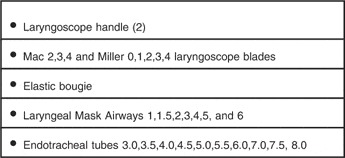
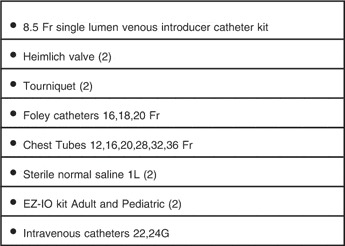
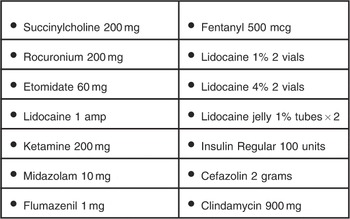
In considering necessary supplies for HERT, efforts are made to avoid duplicating supplies routinely available from on-scene paramedics. Although supplemental oxygen may be all that is necessary on scene for many trauma patients, those who have an altered sensorium or undergo emergent surgical procedures often require control of the airway. Typical equipment for airway management (nasopharyngeal/oropharyngeal airways, laryngoscopes and blades, cuffed endotracheal tubes, and supra-glottic airways) is carried by ground and flight paramedics in Los Angeles County (Table 1). Advanced airway tools utilized by HERT members include lighted endotracheal tube stylets and video-fiberoptic laryngoscopes. Percutaneous cricothyroidotomy kits are carried for situations in which a surgical airway is needed (Table 2). Medications for analgesia and sedation are also included in the HERT supplies (Table 3). While morphine and midazolam are stocked on paramedic ambulances, other analgesics and anxiolytics are not. Fentanyl has been used with good success in field amputations in conjunction with midazolam,Reference Sharp, Mangram, Lorenzo and Dunn 8 as have morphine,Reference Stewart, Young, Kenney and Hirschberg 2 , Reference Jaslow, Barbera, Desai and Jolly 10 nitrous oxide,Reference Dunn, Wynn and Polanco 4 and ketamine.Reference Ho, Conterato, Mahoney, Miner and Benson 5 The HERT carries fentanyl, midazolam, and ketamine for procedural analgesia and sedation. For rapid sequence induction and intubation, etomidate and succinylcholine are carried, with rocuronium reserved for patients who need prolonged paralysis in the field. Lidocaine is used for local-regional nerve blocks (Table 3). If blood is expected to be required, two units of uncrossmatched type O-negative blood are obtained from the Blood Bank prior to departure. In addition, a trauma nursing flow-sheet is included in the HERT pack for documentation purposes.
Airway supplies

Miscellaneous supplies

Medications

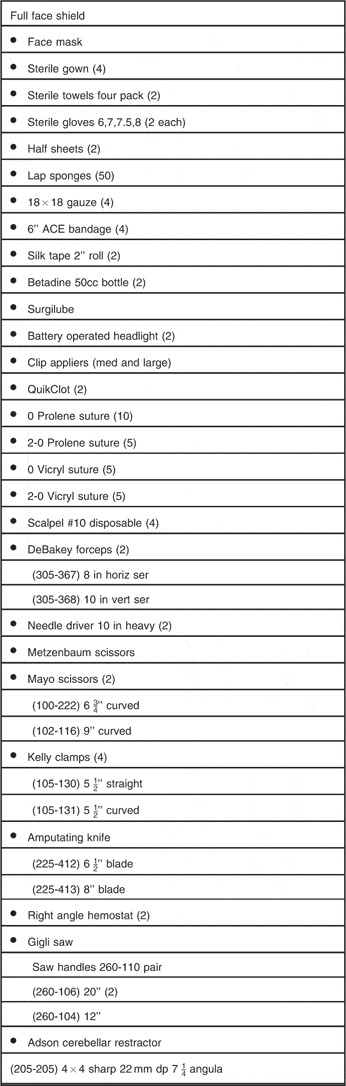
The need for field amputations requires the inclusion of a number of surgical supplies and wherever possible, creation of a sterile field for performing the procedure. Such supplies include instruments for dissection and control of hemorrhage. Los Angeles County paramedics do not carry surgical supplies, and all necessary instruments must be packed and transported with the HERT (Table 4). Two complete packs of HERT supplies, including surgical instrument trays, are kept ready for deployment at all times. As most of these supplies are not disposable, their proper accounting and return to the hospital with the team is a consideration.
Surgical supplies

Hospital-based emergency personnel are not accustomed to being exposed to industrial machinery, metal shards, broken glass, dangerous chemicals or fire, all of which may be risks at an accident scene. Therefore the HERT must don appropriate protective apparel upon scene arrival. Personal protective equipment for HERT members is specified and determined by the Los Angeles County Fire Department. This equipment includes blue extrication helmets, gloves, eye and ear protection, National Fire Protection Association (NFPA)-approved boots, and Nomex jump suits. While the core group of HERT members maintains their own equipment, additional gear in a range of sizes is available for use by rotating HERT responders.
On-Scene Command and Control
Scene safety is of highest importance, and stabilization of vehicles, machinery or structures is the responsibility of the responding public safety agencies before HERT members are allowed onto the scene. In the US, EMS agencies have well-established on-scene command and control hierarchies with which emergency physicians are often familiar. The Incident Commander remains responsible for the scene as a whole, and directs the rescue effort. The HERT team physicians may initially act in an advisory capacity for the paramedic crew on scene, until such time that a higher level of medical or surgical intervention is required. At that point HERT assumes responsibility for the patient and directs patient care.
Patient Transport
Once a patient is extricated, transport begins at the direction of the Incident Commander; often, the destination is the nearest Trauma Center. Mode of transportation depends on various factors, including estimated transport times, space and weight restrictions, availability of aircraft, and weather. Choosing the mode of transportation is a decision made by the scene Incident Commander, often in concert with the HERT team leader on the scene. In rare situations, only one or two HERT members will be able to accompany the patient because of space and weight limitations. Any decisions about how to divide team personnel are made by the HERT Team Leader in conjunction with the field Incident Commander. Considered in decisions about which HERT members accompany a patient during transport are the need for ongoing administration sedatives and analgesics, maintenance of a secure airway, and temporizing surgical procedures. The newly extricated patient may quickly develop significant cardiovascular (hypotension, arrhythmias), metabolic (acidosis, hyperkalemia), and hematologic (bleeding, coagulopathy) abnormalities which require advanced levels of resuscitation during transport, and rapid transfer to the operating room. In many cases, the destination facility will not be the same facility from which the HERT originated.
Reintegration of the Team into the Hospital
Los Angeles County comprises 4,752 square miles, and has >10 million residents, 72 acute care hospitals, and 13 trauma centers. It is likely that the HERT base hospital will not be the closest, most appropriate receiving hospital for the patient after extrication. It is also possible that the team will be divided, with one or two members transporting the patient and the others staying on scene. The MAC arranges transport of HERT members back to their base hospital following delivery of the victim to a receiving hospital. Los Angeles County EMS ambulances are often used to return personnel to the hospital, allowing restocking of equipment and preparation for future deployment.
HERT Activation Drill
As with any specialized medical team, particularly one used infrequently, it is critical to have regular reviews of the HERT protocols and coordinated internal and external multi-agency drills. Drills are conducted quarterly to test and maintain the various aspects of the HERT activation and response capabilities. Coordination of services is critical to the deployment of a HERT and must be centralized. It is essential that HERT activation drills be realistic. This enables evaluation of the key aspects of deployment, including the time required to assemble the team and equipment, transportation to the scene, simulated care of the patient, transport of the patient to the identified receiving center, “hand-off” of the patient to the receiving care team, and return of HERT members back to the base hospital. Having uninvolved observers evaluate the performance of the team is helpful for quality and process improvement.
HERT Activations
There have been four HERT activations in Los Angeles County since the 2008 implementation:
-
(1) In April 2008, the HERT was activated for a pedestrian struck by a car, with his leg pinned under the vehicle. Before the HERT mobilized, local EMS providers freed the patient, and the HERT activation was cancelled.
-
(2) In September 2008, the HERT was activated following a commuter train derailment. Simultaneously, an unsanctioned group of surgeons from a local hospital arrived on the scene, and were restricted from the scene as they were inadequately equipped, improperly dressed, and had not been requested by the Incident Commander. This situation highlighted the need to develop a formal policy and train HERT team members on issues such as scene safety. There were no interventions performed by the physicians at the scene, and they were transported back to the hospital.
-
(3) In July 2010, the HERT was activated for a man trapped in a vehicle lodged in the side of a residence. Extrication of the patient became prolonged, and the HERT was mobilized due to concern that a field amputation may be required. EMS providers successfully extricated the entrapped patient, and the activation was cancelled prior to the HERT arriving at the scene.
-
(4) In September 2010, the Los Angeles City Fire Department requested the HERT to assist with extrication of a man whose arm was trapped in a conveyor belt in an industrial accident. Fire Department personnel were able to free the man without need for an amputation, and the HERT was canceled prior to dispatch.
Conclusion
With modern extrication techniques, the need for life-saving amputations or other advanced surgical procedures in the field is rare. However, when the need arises, policies should be in place to allow for the rapid deployment of appropriately equipped and trained resources such as a HERT to provide advanced surgical care at the scene. This report presented an outline of the considerations made in developing an EMS system on-call HERT based at Harbor-UCLA Medical Center in Los Angeles County. The purpose, composition, equipment, activation, intervention, return, and training of the HERT is tailored to regional variations in resources and reviewed regularly. Because deployment is rare, the hospital-based HERT team model with team members drawn from daily functions allows for a cost-effective approach for the provision of advanced medical/surgical needs within an EMS system.
Abbreviations
- ED:
-
Emergency Department
- EMS:
-
Emergency Medical Services
- HERT:
-
Hospital Emergency Response Team
- MAC:
-
Medical Alert Center
- MCI:
-
mass-casualty incident
Supplementary Material
To view supplementary material for this article, please visit http://dx.doi.org/10.1017/S1049023X12000660.