




No CrossRef data available.
Article contents
Body height, body mass index, waist-hip ratio, fluctuating asymmetry and second to fourth digit ratio in subjects with latent toxoplasmosis
Published online by Cambridge University Press: 22 February 2005
Abstract
Between 20% and 60% of the population of most countries are infected with the protozoan Toxoplasma gondii. Subjects with clinically asymptomatic life-long latent toxoplasmosis differ from those who are Toxoplasma free in several behavioural parameters. Case-control studies cannot decide whether these differences already existed before infection or whether they were induced by the presence of Toxoplasma in the brain of infected hosts. Here we searched for such morphological differences between Toxoplasma-infected and Toxoplasma-free subjects that could be induced by the parasite (body weight, body height, body mass index, waist-hip ratio), or could rather correlate with their natural resistance to parasitic infection (fluctuating asymmetry, 2D[ratio ]4D ratio). We found Toxoplasma-infected men to be taller and Toxoplasma-infected men and women to have lower 2D[ratio ]4D ratios previously reported to be associated with higher pre-natal testosterone levels. The 2D[ratio ]4D ratio negatively correlated with the level of specific anti-Toxoplasma antibodies in Toxoplasma-free subjects. These results suggest that some of the observed differences between infected and non-infected subjects may have existed before infection and could be caused by the lower natural resistance to Toxoplasma infection in subjects with higher pre-natal testosterone levels.
Keywords
Information
- Type
- Research Article
- Information
- Copyright
- © 2005 Cambridge University Press
INTRODUCTION
Approximately 30% of people in the Czech Republic and about 20–60% of the population worldwide are infected with the protozoan parasite Toxoplasma gondii. Life-long latent toxoplasmosis is usually considered to pose no health threat to immunocompetent persons. However, Toxoplasma-infected and Toxoplasma-free subjects differ in several personality traits and certain psychomotor performance parameters (Flegr et al. 1996, 2002, 2003). Since some of these differences (e.g. psychomotor performance, personality traits Superego Strength in men and Affectothymia in women) increase with the duration of latent toxoplasmosis or with concentration of anti-Toxoplasma antibodies (personality trait Novelty Seeking) (Flegr, Kodym & Tolarova, 2000; Havlicek et al. 2001), they are likely to be induced by the presence of the parasite in the host organism. Other personality differences seem not to correlate with the duration of infection (e.g. personality trait Protension) (Flegr et al. 1996) and therefore may have existed before infection, being linked to higher susceptibility of certain individuals to the infection. Individuals with higher fluctuating asymmetry (FA), i.e. with more pronounced random deviations from the right-left symmetry of the body, have been shown to be typically more prone to infections (Watson & Thornhill, 1994; Møller, 1996). Susceptibility to several infections also positively correlates with prenatal and adult testosterone levels (Zuk & McKean, 1996; Schuster & Schaub, 2001). The average testosterone level in humans and other mammalian species can be estimated on the basis of the 2D[ratio ]4D ratio, i.e. the ratio between the lengths of the second and fourth digits (Manning, 2002). Individuals with a lower 2D[ratio ]4D ratio (i.e. those with a relatively longer ring finger) were exposed to higher pre-natal testosterone levels (Manning et al. 1998). There is some evidence that the baseline pre-natal and post-natal testosterone levels are positively correlated (Sorenson, Meier & Campbell, 1993) but 2D[ratio ]4D is not reliably correlated with adult testosterone levels (Neave et al. 2003). Manning (2002, pp. 95–99) has considered the evidence that links pre-natal testosterone, 2D[ratio ]4D and compromised immune function, and has suggested that low 2D[ratio ]4D (high pre-natal testosterone) is likely to be correlated with susceptibility to parasitic infections.
The major aim of the present study was to search for differences in morphology between Toxoplasma-infected and Toxoplasma-free subjects that could be either indicative of health status (body weight, body height, body mass index, waist-hip ratio) or could correlate with natural resistance to parasitic infection (possibly fluctuating asymmetry, most likely the 2D[ratio ]4D ratio). Human cytomegalovirus (CMV) was used as a control for non-specific effects of a neurotropic pathogen infection.
MATERIALS AND METHODS
Study subjects
Undergraduate biology students of the Faculty of Sciences, Charles University, Prague, were addressed during regular biology lectures and were invited to participate in the study on a voluntary basis. Two hundred and sixty-eight of the students (35%), 93 males and 175 females, mean age 21·2 years, S.D.=1·85, were enrolled in the study after signing informed consent forms. They underwent anthropometric measurements and provided 2 ml of blood for serological testing. Both the probability of Toxoplasma infection and certain antropometric parameters could correlate with the size of place of residence of the subjects, therefore, this variable must be controlled for in all statistical analyses. Reliable information on the size of place of residence was obtained from 262 study subjects, subsequently divided into 3 categories[ratio ] those living in villages and small cities (<5 thousand population), those living in larger cities (5–100 thousand population) and those living in the Czech capital Prague (1·2 million population). The results of all analyses were virtually the same if the study subjects were divided into 4 categories (<5 thousand, 5–10 thousand, 10–100 thousand, >100 thousand). The recruitment of the study subjects and data handling were in accordance with Czech legislation in force.
Anthropometry
The following anthropometric parameters were measured double blind to the enrollee's Toxoplasma-infection status on the right and left sides using a sliding caliper and a spreading caliper with a resolution of 0·5 mm[ratio ] ear length, ear width, ear insertion height, wrist breadth, hand breadth, hand length (on the ventral surface of the hand from the basal crease to the tip of the third digit), lengths of all fingers (the ventral surface of digits 1 to 5, from the basal crease of the digit to the tip), elbow breadth (biepicondylar breadth of the humerus), knee breadth (biepicondylar breadth of the femur) and ankle breadth. An anthropometer (measuring to the nearest 0·5 cm), a personal scale (weighing to the nearest 0·1 kg) and a flexible metric tape (measuring to the nearest 0·1 cm) were used for basic anthropometric measurements (body height, body weight, minimum waist circumference, hip circumference). Martin-Saller's method (Martin & Saller, 1957) was used for measurement of all parameters but the hand length and finger lengths measured using the method of Knussmann (1988). All measurements were made by the same person (M.H.). The fluctuating asymmetry for each trait was calculated as the absolute difference between the right and left sides divided by the average of the right and left sides. The total fluctuating asymmetry for each subject was obtained by averaging the asymmetries of all 15 traits, see Table 1.
Table 1. Differences in anthropometric parameters between Toxoplasma-free and Toxoplasma-infected subjects, and between men and women (P and F values show the results of GLM analysis with factors age, body weight, body height, size of place of residence, gender and toxoplasmosis. P for difference between Toxoplasma-infected and Toxoplasma-free subjects of the whole study set, mean for Toxoplasma-infected subjects, mean for Toxoplasma-free subjects, P for women, P for men, P for difference between men and women, F for difference between men and women, mean for women and mean for men are given in columns 2–9, respectively. Measured distances: ear length (superaurale-subaurale), ear breadth (praeaurale-postaurale), ear insertion height (otobasion superius-otobasion inferius), forehead breadth (tragion-glabella), wrist breadth (supracarpale ulnare scu-supracarpale radiale scr), hand breadth (metacarpale radiale-metacarpale ulnare), hand length (ventral surface of the hand, from the basal crease to the tip of the third digit), finger length (ventral surface of digits 1 to 5, from the basal crease of the digit to the tip), elbow breadth (biepicondylar breadth of the humerus), knee breadth (biepicondylar breadth of the femur), ankle breadth (bimalleolar breadth). Significant P values are printed in bold and significant after Bonferroni's correction are labelled with b. The traits significantly correlated with concentration of anti-Toxoplasma antibodies are labelled with * (P<0·05) and *** (P<0·001). Except the ear insertion height, all other correlations were positive.)

Immunological tests for toxoplasmosis and CMV
Specific anti-Toxoplasma IgG and IgM antibody concentrations were determined by ELISA (IgG: SEVAC, Prague, IgM: TestLine, Brno), optimized for early detection of acute toxoplasmosis (Pokorný et al. 1989), and complement fixation test (CFT) (SEVAC, Prague) which is more sensitive and therefore more suitable for the detection of old T. gondii infections (Warren & Sabin, 1942). Titres of antibodies to Toxoplasma in sera were measured at dilutions between 1[ratio ]8 and 1: 1024. The subjects testing IgM negative by ELISA (positivity index<0·9) and having CFT titres higher than 1: 8 were considered latent-toxoplasmosis positive. Specific anti-Cytomegalovirus (CMV) IgG antibodies were measured by quantitative ELISA (ETI-CYTOK-G plus, DiaSorin). Antibody concentration was expressed in arbitrary units (AU). Individuals with AU <40 were considered seronegative for CMV.
Statistical analysis
The Statistica® v.6.0 general linear models module was used for all statistical testing i.e. for log-linear analyses, ANCOVA and multiple linear regression. The results of testing of ANCOVA assumptions, namely the normality of data distribution, normality of residuals and homogeneity of variances, were non-significant for all studied models.
RESULTS
Twenty-nine (16·6%) out of 175 females and 20 (21%) out of 93 males were Toxoplasma-infected. The difference in prevalence of toxoplasmosis between females and males was not significant (χ2=0·75, D.F.=1, P=0·39, log-linear analysis, factors: toxoplasmosis, gender, place of residence). The only significant interaction in the model was the association between toxoplasmosis and size of place of residence (χ2=6·62, D.F.=2, P=0·037). The prevalence rates of toxoplasmosis were 31·8% among 44 residents of villages and small cities, 18·8% among 101 residents of middle-size cities, and 13·7% among 117 residents of the capital Prague; for 6 subjects the residence address was not available. Anthropometrical data were available for 157 females and 85 males. The females had a significantly higher body mass index (BMI) (22·27 g/cm2) than males (20·91 g/cm2) (F1,249=17·49, P=0·000, GLM, factors: age, place of residence, toxoplasmosis, gender) and a significantly lower waist-hip ratio (WHR) (0·729) than males (0·821) (F1,227=285·3, P=0·000, GLM, factors: age, place of residence, toxoplasmosis, gender, WHR). The difference in fluctuating asymmetry (FA) between females and males was not significant (0·0243 and 0·0251, respectively) (F1,225=1·66, P=0·199, GLM, factors: age, place of residence, toxoplasmosis, gender, FA). The 2D[ratio ]4D ratio for the right hand was significantly higher in females (0·986) compared to males (0·972) (F1,229=8·7, P=0·0035, GLM, factors: age, place of residence, toxoplasmosis, gender), while the difference between females and males for the left hand (0·981 and 0·979, respectively) was not significant (F1,229=1·2, P=0·314). As expected (Wilson, 1983; Manning, 2002), the 2D[ratio ]4D ratio for the right but not the left hand negatively correlated with another testosterone-dependent morphological trait, the WHR (right hand: beta=−0·17, F1,232=3·4, P=0·034, left hand: beta=0·02, F1,232=0·0, P=0·42, GLM, one-tailed tests, factors: age, place of residence, gender, toxoplasmosis, WHR).
Toxoplasma-infected and Toxoplasma-free subjects did not differ in BMI (21·25 g/cm2 posit. vs 21·47 g/cm2 negat., F1,249=0·03, P=0·857, GLM, factors: age, place of residence, gender, toxoplasmosis), WHR (0·772 posit. vs 0·759 negat., F1,227=0·75, P=0·387, GLM, factors: age, place of residence, gender, toxoplasmosis) or FA (F1,225=0·349, P=0·555, GLM, factors: age, place of residence, gender, toxoplasmosis). A significant toxoplasmosis-gender interaction, however, existed with respect to body height (F1,249=6·4, P=0·012, GLM, factors: age, place of residence, gender, toxoplasmosis), as shown in Fig. 1. Infected men had higher body height, another trait expected to correlate positively with testosterone levels (Heald et al. 2003). A nearly significant 3-way interaction size of place of residence-toxoplasmosis-gender was found with respect to BMI (F2,249=3·0, P=0·052, GLM, factors: age, place of residence, gender, toxoplasmosis), see Fig. 2. Toxoplasma-infected subjects had a lower 2D[ratio ]4D ratio for the left hand (0·972 vs 0·984, F1,229=5·3, P=0·022, GLM, factors: age, place of residence, toxoplasmosis). At the same time, they did not differ in the 2D[ratio ]4D ratio for the right hand (0·977 vs 0·982, F1,228=0·6, P=0·46). In separate analyses, the Toxoplasma-infected and Toxoplasma-free females did not differ in the 2D[ratio ]4D ratio for the left hand (0·977 vs 0·985, F1,150=2·1, P=0·15), the difference in males being significant (0·966 vs 974, F1,78=4·3, P=0·041), as can be seen in Fig. 3.

Fig. 1. Differences in height between Toxoplasma-free and Toxoplasma-infected women and men. The figures indicate the numbers of study subjects in particular categories. The P values are given for separate GLM analyses for men and women, with factors age and size of place of residence.

Fig. 2. Differences in body mass index between Toxoplasma-free and Toxoplasma-infected women and men. The figures indicate the numbers of study subjects in particular categories. The results of post hoc tests of differences of BMI between Toxoplasma-free and Toxoplasma-infected subjects for 6 particular categories were not significant.

Fig. 3. Differences in 2D[ratio ]4D ratio for the left hand between Toxoplasma-free and Toxoplasma-infected women and men. The figures indicate the numbers of study subjects in particular categories. The P values are given for separate GLM analyses for men and women.
A lower 2D[ratio ]4D ratio can be primarily ascribed either to a relatively shorter index finger or to a relatively longer ring finger. Raw anthropometrical data presented in Table 1 show that Toxoplasma-infected in comparison with Toxoplasma-free subjects as well as males in comparison with females had longer digits (mainly on the right hand). However, the difference was very small for the index finger of the left hand, which resulted in a decreased 2D[ratio ]4D ratio for the left hand of Toxoplasma-infected subjects.
After removing the effects of confounding variables age, body weight, size of place of residence, and gender, the 2D[ratio ]4D ratio and several other traits (Table 1) correlated with the concentration of anti-Toxoplasma antibodies in the sera of the study subjects. The correlation was stronger for the right hand and Toxoplasma-free subjects (right hand: β=−0·16, F1,189=5·1, P=0·025, left hand: β=−0·14, F1,189=3·8, P=0·052) compared to Toxoplasma-infected subjects (right hand: β=−0·26, F1,39=3·9, P=0·075, left hand: β=−0·034, F1,39=0·04, P=0·836), Fig. 4. Neither a difference in prevalence of infection between low and high 2D[ratio ]4D ratio subjects (right hand: F1,184=0·5, P=0·461, left hand: F1,184 1·0, P=0·309), nor correlation between the 2D[ratio ]4D ratio and level of specific IgG (right hand: β=−0·04, F1,202=0·0, P=0·937, left hand: β=−0·04, F1,202=0·3, P=0·608) was observed for another common pathogen, the human cytomegalovirus (with the prevalence rates of 60·9% and 65·5% in females and males, respectively).

Fig. 4. Correlation between the concentration of specific anti-Toxoplasma antibodies and 2D[ratio ]4D ratio for the right hand in Toxoplasma-free subjects.
DISCUSSION
We have the following results. After all potential confounders (age, size of place of residence, and gender) were controlled for, Toxoplasma-infected and Toxoplasma-free subjects had similar BMI and FA. Toxoplasma-infected subjects had lower 2D[ratio ]4D ratios for the left hand, longer fingers, and longer or wider ears, forehead, hands and legs. Several anatomical parameters including the 2D[ratio ]4D ratio correlated with the level of anti-Toxoplasma antibodies which was also true of Toxoplasma-free subjects. However, such correlation was not found for specific anti-cytomegalovirus antibodies. Therefore, higher levels of anti-Toxoplasma antibodies in low 2D[ratio ]4D ratio subjects seem to reflect stronger (already cleared) infection rather than higher levels of all antibodies (stronger humoral immunity) and resulting stronger cross-reactivity with anti-Toxoplasma antibodies in serological tests.
It is generally supposed that the 2D[ratio ]4D ratio is more or less stable after 2 years of age (Manning et al. 1998; Phelps, 2004). The pre-natal testosterone level is considered the most important non-genetic factor influencing this ratio (Manning et al. 1998). Lower 2D[ratio ]4D ratios are found in males compared to females as well as in patients with congenital adrenal hyperplasia, a condition characterized by overproduction of pre-natal androgens (Okten, Kalyoncu & Yaris, 2002; Brown et al. 2004). In normal men and women the 2D[ratio ]4D ratio correlates with several testosterone-associated traits, including fecundity and fertility (Manning et al. 1998, 2000), WHR (Manning, Trivers & Singh, 1999), assertiveness and male physical aggression (Wilson, 1983; Manning, 2002). As the genital and limb development is influenced by the same Hox gene complexes (Herault et al. 1997; Peichel, Prabhakaran & Vogt, 1997), the authors suggest that the timing of Hox gene expression could be responsible for the correlation between the testosterone level and the 2D[ratio ]4D ratio (Manning et al. 1998). In view of extensive short-term and long-term fluctuations in testosterone levels, the 2D[ratio ]4D ratio could in fact be a better predictor of the in utero testosterone level than the result of a single direct measurement of its concentration (Shirtcliff, Granger & Likos, 2002; Dermitzakis et al. 2003).
The average oestrogen level correlates negatively with cellular immunity and positively with humoral immunity while the testosterone level correlates negatively with both cellular and humoral immunity (Roberts, Walker & Alexander, 2001; Schuster & Schaub, 2001). The immunocompetence handicap hypothesis (Folstad & Karter, 1992) suggests that because of a negative influence of testosterone on the immunocompetence of an individual, the testosterone-dependent secondary sexual characters can be used as honest signals of male genetic quality. Females can safely choose the best mates according to their expression of the secondary sexual characters because the low-quality males with strongly expressed secondary sexual characters have a higher probability to be eliminated from the population by infectious diseases. Students of the handicap hypothesis have found the expected negative correlation between the immunocompetence of an individual and the testosterone level in different intraspecies studies (Barnard, Behnke & Sewell, 1994; Zuk, Johnsen & MacLarty, 1995; Poiani, Goldsmith & Evans, 2000; Buchanan, Evans & Goldsmith, 2003).
The lower 2D[ratio ]4D ratios observed in subjects with either latent toxoplasmosis or higher levels of anamnestic anti-Toxoplasma antibodies may be ascribed to higher pre-natal testosterone levels and resulting lower immunity against Toxoplasma infection. Higher pre-natal testosterone levels may also be responsible for the observed higher prevalence of toxoplasmosis in men compared to women (21% vs 16·6%) and some of the reported differences in personality traits (Flegr et al. 1996). According to our knowledge, higher prevalence of toxoplasmosis in low 2D[ratio ]4D ratio subjects as well as the negative correlation between the level of anti-Toxoplasma antibodies and 2D[ratio ]4D ratio seem to be the first indirect evidence for lower anti-Toxoplasma immunity in humans with higher pre-natal testosterone levels. The results also suggest that at least some of the reported behavioural differences between Toxoplasma-infected and Toxoplasma-free subjects, namely the changes that do not increase during the infection, e.g. Protension in men, can be ascribed to higher testosterone levels in Toxoplasma-infected subjects rather than to manipulation by the parasite.
Dr John T. Manning is especially acknowledged for helpful discussion and encouragement. This research was supported by the Czech Ministry of Education (grant 0021620828).
References
REFERENCES
BARNARD, C. J.,
BEHNKE, J. M. &
SEWELL, J. (
1994).
Social behaviour and susceptibility to infection in house mice (Mus musculus): Effects of group size, aggressive behaviour and status-related hormonal responses prior to infection on resistance to Babesia microti.
Parasitology
108,
487–496.CrossRefGoogle Scholar
BROWN, W. M.,
HINES, M.,
FANE, B. A. &
BREEDLOVE, S. M. (
2004).
Masculinized finger length patterns in human males and females with congenital adrenal hyperplasia.
Hormones and Behavior
42,
380–386.Google Scholar
BUCHANAN, K. L.,
EVANS, M. R. &
GOLDSMITH, A. R. (
2003).
Testosterone, dominance signalling and immunosuppression in the house sparrow, Passer domesticus.
Behavioral Ecology and Sociobiology
55,
50–59.CrossRefGoogle Scholar
DERMITZAKIS, E. T.,
REYMOND, A.,
SCAMUFFA, N.,
UCLA, C.,
KIRKNESS, E.,
ROSSIER, C. &
ANTONARAKIS, S. E. (
2003).
Evolutionary discrimination of mammalian conserved non-genic sequences (CNGs).
Science
302,
1033–1035.CrossRefGoogle Scholar
FLEGR, J.,
HAVLICEK, J.,
KODYM, P.,
MALY, M. &
SMAHEL, Z. (
2002).
Increased risk of traffic accidents in subjects with latent toxoplasmosis: a retrospective case-control study.
BMC Infectious Diseases
2,
11.CrossRefGoogle Scholar
FLEGR, J.,
KODYM, P. &
TOLAROVA, V. (
2000).
Correlation of duration of latent Toxoplasma gondii infection with personality changes in women.
Biological Psychology
53,
57–68.CrossRefGoogle Scholar
FLEGR, J.,
PREISS, M.,
KLOSE, J.,
HAVLICEK, J.,
VITAKOVA, M. &
KODYM, P. (
2003).
Decreased level of psychobiological factor novelty seeking and lower intelligence in men latently infected with the protozoan parasite Toxoplasma gondii. Dopamine, a missing link between schizophrenia and toxoplasmosis?
Biological Psychology
63,
253–268.Google Scholar
FLEGR, J.,
ZITKOVA, S.,
KODYM, P. &
FRYNTA, D. (
1996).
Induction of changes in human behaviour by the parasitic protozoan Toxoplasma gondii.
Parasitology
113,
49–54.CrossRefGoogle Scholar
FOLSTAD, I. &
KARTER, A. J. (
1992).
Parasites, bright males, and the immunocompetence handicap.
American Naturalist
139,
603–622.CrossRefGoogle Scholar
HAVLÍČEK, J.,
GAšOVÁ, Z.,
SMITH, A. P.,
ZVÁRA, K. &
FLEGR, J. (
2001).
Decrease of psychomotor performance in subjects with latent ‘asymptomatic’ toxoplasmosis.
Parasitology
122,
515–520.CrossRefGoogle Scholar
HEALD, A. H.,
IVISON, F.,
ANDERSON, S. G.,
CRUICKSHANK, K.,
LAING, I. &
GIBSON, J. M. (
2003).
Significant ethnic variation in total and free testosterone concentration.
Clinical Endocrinology
58,
262–266.CrossRefGoogle Scholar
HERAULT, Y.,
FRAUDEAU, N.,
ZAKANY, J. &
DUBOULE, D. (
1997).
Ulnaless (Ul), a regulatory mutation inducing both loss-of-function and gain-of-function of posterior Hoxd genes.
Development
124,
3493–3500.Google Scholar
KNUSSMANN, R. (
1988).
Anthropologie.
Gustav Fischer Verlag, Stuttgart.
MANNING, J. T. (
2002).
Digit Ratio: A Pointer to Fertility, Behavior, and Heatlh.
Rutgers University Press,
New Jersey.
MANNING, J. T.,
BARLEY, L.,
WALTON, J.,
LEWIS-JONES, D. I.,
TRIVERS, R. L.,
SINGH, D.,
THORNHILL, R.,
ROHDE, P.,
BERECZKEL, T.,
HENZI, P.,
SULER, M. &
SZWED, A. (
2000).
The 2nd: 4th digit ratio, sexual dimorphism, population differences, and reproductive success. Evidence for sexually antagonistic genes?
Evolution and Human Behavior
21,
163–183.CrossRefGoogle Scholar
MANNING, J. T.,
SCUTT, D.,
WILSON, J. &
LEWIS-JONES, D. I. (
1998).
The ratio of 2nd to 4th digit length: a predictor of sperm numbers and concentrations of testosterone, luteinizing hormone and oestrogen.
Human Reproduction
13,
3000–3004.CrossRefGoogle Scholar
MANNING, J. T.,
TRIVERS, R. &
SINGH, D. (
1999).
The mystery of female beauty.
Nature, London
399,
214–216.CrossRefGoogle Scholar
MARTIN, R. &
SALLER, K. (
1957).
Lehrbuch der Anthropologie in systematischer Darstellung.
Gustar Fischer Verlag, Stuttgart.
MØLLER, A. P. (
1996).
Parasitism and developmental instability of hosts: A review.
OIKOS
77,
189–196.CrossRefGoogle Scholar
NEAVE, N.,
LAING, S.,
FINK, B. &
MANNING, J. T. (
2003).
Second to fourth digit ratio, testosterone, and perceived male dominance.
Proceedings of the Royal Society of London, B
270,
2167–2172.CrossRefGoogle Scholar
OKTEN, A.,
KALYONCU, M. &
YARIS, N. (
2002).
The ratio of second- and fourth-digit lengths and congenital adrenal hyperplasia due to 21-hydroxylase deficiency.
Early Human Development
70,
47–54.CrossRefGoogle Scholar
PEICHEL, C. L.,
PRABHAKARAN, B. &
VOGT, T. F. (
1997).
The mouse Ulnaless mutation deregulates posterior HoxD gene expression and alters appendicular patterning.
Development
124,
3481–3492.Google Scholar
PHELPS, V. R. (
2004).
Relative index finger length as a sex-influenced trait in man.
American Journal of Human Genetics
4,
72–89.Google Scholar
POIANI, A.,
GOLDSMITH, A. R. &
EVANS, M. R. (
2000).
Ectoparasites of house sparrows (Passer domesticus): an experimental test of the immunocompetence handicap hypothesis and a new model.
Behavioral Ecology and Sociobiology
47,
230–242.CrossRefGoogle Scholar
POKORNÝ, J.,
FRUHBAUER, Z.,
POLEDŇÁKOVÁ, S.,
SÝKORA, J.,
ZÁSTĚRA, M. &
FIALOVÁ, D. (
1989).
Assessment of antitoxoplasmatic IgG antibodies with the ELISA method.
Československá Epidemiologie
38,
355–361.Google Scholar
ROBERTS, C. W.,
WALKER, W. &
ALEXANDER, J. (
2001).
Sex-associated hormones and immunity to protozoan parasites.
Clinical Microbiology Reviews
14,
476–488.CrossRefGoogle Scholar
SCHUSTER, J. P. &
SCHAUB, G. A. (
2001).
Experimental Chagas disease: the influence of sex and psychoneuroimmunological factors.
Parasitology Research
87,
994–1000.Google Scholar
SHIRTCLIFF, E. A.,
GRANGER, D. A. &
LIKOS, A. (
2002).
Gender differences in the validity of testosterone measured in saliva by immunoassay.
Hormones and Behavior
42,
62–69.CrossRefGoogle Scholar
SORENSON, J. C.,
MEIER, R. J. &
CAMPBELL, B. C. (
1993).
Dermatoglyphic asymmetry and testosterone levels in normal males.
American Journal of Physical Anthropology
90,
185–198.Google Scholar
WARREN, J. &
SABIN, A. B. (
1942).
The complement fixation reaction in toxoplasmic infection.
Proceedings of the Society for Experimental Biology and Medicine
51,
11–16.CrossRefGoogle Scholar
WATSON, P. J. &
THORNHILL, R. (
1994).
Fluctuating asymmetry and sexual selection.
Trends in Ecology and Evolution
9,
21–25.CrossRefGoogle Scholar
WILSON, G. D. (
1983).
Finger-length as an index of assertiveness in women.
Personality and Individual Differences
4,
111–112.CrossRefGoogle Scholar
ZUK, M.,
JOHNSEN, T. S. &
MacLARTY, T. (
1995).
Endocrine-immune interactions, ornaments and mate choice in red jungle fowl.
Proceedings of the Royal Society of London, B
260,
205–210.CrossRefGoogle Scholar
ZUK, M. &
McKEAN, K. A. (
1996).
Sex differences in parasite infections: Patterns and processes.
International Journal for Parasitology
26,
1009–1023.CrossRefGoogle Scholar
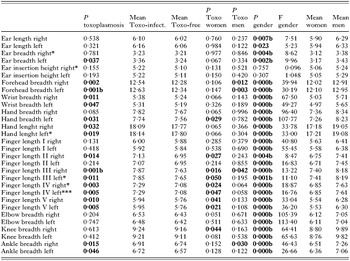
Table 1. Differences in anthropometric parameters between Toxoplasma-free and Toxoplasma-infected subjects, and between men and women
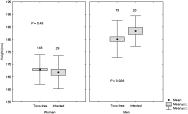
Fig. 1. Differences in height between Toxoplasma-free and Toxoplasma-infected women and men. The figures indicate the numbers of study subjects in particular categories. The P values are given for separate GLM analyses for men and women, with factors age and size of place of residence.
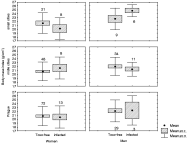
Fig. 2. Differences in body mass index between Toxoplasma-free and Toxoplasma-infected women and men. The figures indicate the numbers of study subjects in particular categories. The results of post hoc tests of differences of BMI between Toxoplasma-free and Toxoplasma-infected subjects for 6 particular categories were not significant.
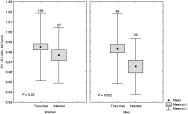
Fig. 3. Differences in 2D[ratio ]4D ratio for the left hand between Toxoplasma-free and Toxoplasma-infected women and men. The figures indicate the numbers of study subjects in particular categories. The P values are given for separate GLM analyses for men and women.
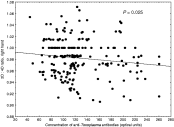
Fig. 4. Correlation between the concentration of specific anti-Toxoplasma antibodies and 2D[ratio ]4D ratio for the right hand in Toxoplasma-free subjects.
 You have
Access
- 53
- Cited by