Introduction
Deliberate self-harm (DSH) is recognized worldwide as a major public health problem, with a severe impact on the individual, their family, and the health services (World Health Organization, 1999). In the Republic of Ireland, the highest rates of hospital-treated DSH are among 15- to 19-year-old girls (639 per 100 000) and 20- to 24-year-old men (433/100 000) (National Suicide Research Foundation, 2009). Young Irish men are also over-represented among those who die by suicide, with peak rates among those aged 20–24 years, unlike most European countries where suicide rates increase with age (National Suicide Research Foundation, 2009). DSH includes a range of behaviours associated with different levels of medical severity and varying levels of suicidal intent.
Population-based studies reveal the prevalence of DSH to be much higher than indicated by hospital presentations. The school-based Child and Adolescent Self-harm in Europe (CASE) study, on which this study is based, reported that 9.1% of Irish adolescents surveyed had harmed themselves at some point, of whom 45.9% reported repeated episodes (Morey et al. Reference Morey, Corcoran, Arensman and Perry2008). This was a higher prevalence than previously reported by smaller-scale school-based studies (O'Sullivan & Fitzgerald, Reference O'Sullivan and Fitzgerald1998; Lynch et al. Reference Lynch, Mills, Daly and Fitzpatrick2006). Self-harm was much more common among girls than boys. Self-cutting and overdose were the most common DSH methods (Morey et al. Reference Morey, Corcoran, Arensman and Perry2008).
International comparisons of the prevalence of DSH have been aided by the development of rigorous methodologies including clear definitions of DSH, such as that used by seven international centres involved in the CASE study, including the present study based on the data of the Irish CASE centre. Lifetime prevalence of DSH in adolescents ranges from 5.7% (The Netherlands) to 17% (Australia) among girls and 2.4% (The Netherlands) to 6.5% (Belgium) among boys (Madge et al. Reference Madge, Hewitt, Hawton, de Wilde, Corcoran, Fekete, van Heeringen, De Leo and Ystgaard2008).
Less than one-fifth of adolescent self-harm comes to the attention of the health services, with approximately one-third seeking help from their social circle only, and around half not seeking help at all (Ystgaard et al. Reference Ystgaard, Arensman, Hawton, Madge, van Heeringen, Hewitt, de Wilde, De Leo and Fekete2009). However, a history of self-harm is a major risk factor for repeated self-harm and subsequent suicide (Gunnell et al. Reference Gunnell, Hawton, Ho, Evans, O'Connor, Potokar, Donovan and Kapur2008; Tidemalm et al. Reference Tidemalm, Langstrom, Lichtenstein and Runeson2008). A retrospective study of young people who died by suicide found that almost half had a known history of DSH (Hawton et al. Reference Hawton, Houston and Shepperd1999). Suicide is the leading cause of death in men aged 15–34 years in the Republic of Ireland, and suicide rates among young people aged 15–19 years in the Republic of Ireland are the third highest in the European Union (Eurostat, 2009). Enhanced knowledge of the factors associated with self-harm is essential in developing appropriate education, prevention and screening programmes, which have been identified as important components of suicide prevention policies (Garland & Zigler, Reference Garland and Zigler1993; Evans et al. Reference Evans, Hawton and Rodham2004; Scott et al. Reference Scott, Wilcox, Schonfeld, Davies, Hicks, Turner and Shaffer2009). A growing number of population-based studies have examined various factors potentially associated with self-harm among young people (Evans et al. Reference Evans, Hawton and Rodham2004). Our school-based study aimed to examine a broad range of factors potentially associated with DSH in boys and girls from psychological, life-style and life event domains, using the novel and rigorous CASE methodology.
Method
Design and participants
The study was conducted using a cross-sectional design. Data were gathered in schools in the counties of Cork and Kerry in the Republic of Ireland during late 2003 and early 2004. Power calculations indicated that a minimum of 3000 students was required to return a 95% confidence interval (CI) of 9.0–11.0% for a postulated prevalence of DSH of 10%. A list of all schools within Cork and Kerry was obtained and each school was categorized by region as well as by type of school: co-educational, all boys or all girls. Using a random selection, 54 schools were invited to take part and 39 schools participated in the survey.
Principals and teaching staff were informed about the study procedure in advance. An information sheet and opt-out form were sent to parents. Students were also given the opportunity to opt out on the day of the survey. Ethical approval for the study was granted by the Clinical Research Ethics Committee of the Cork Teaching Hospitals. The questionnaire was administered with a member of the research team present and completed by students in a class setting. After participants had completed the survey there was a general discussion about the help and support available for young people in their local communities and each participant received a resource kit. Students who wished to ask further questions could approach the facilitators after the session.
Measures
The survey in the Republic of Ireland was part of the CASE study (Madge et al. Reference Madge, Hewitt, Hawton, de Wilde, Corcoran, Fekete, van Heeringen, De Leo and Ystgaard2008). A standardized, internationally validated, anonymous questionnaire was designed by CASE collaborators and used for data collection by each of the seven centres involved in the study (six centres in Europe and one in Australia). The questionnaire comprised a wide range of variables, including demographics, life-style factors and questions about DSH and self-harm thoughts. The questionnaire also included three validated psychological scales. Depressive symptoms and anxiety were measured using the Hospital Anxiety and Depression Scale (HADS), which has been validated for use with an adolescent population (White et al. Reference White, Leach, Sims, Atkinson and Cottrell1999). Cronbach's α for our sample was 0.71 and 0.79 for the depression and anxiety subscales, respectively. Impulsivity was measured using six items from the Plutchik impulsivity scale (Plutchik et al. Reference Plutchik and Van Praag1989). This scale assesses impulsivity that is independent of aggressive behaviour and has shown good internal consistency and concurrent validity in adolescents (Plutchik & Van Praag, Reference Plutchik and Van Praag1989; Grosz et al. Reference Grosz, Lipschitz, Eldar, Finkelstein, Blackwood, Gerbino-Rosen, Faedda and Plutchik1994). Self-esteem was measured using an eight-item version of the self-concept scale (Robson, Reference Robson1989). Strong convergent and discriminant validation of the scale has been reported (Addeo et al. Reference Addeo, Greene and Geisser1994). Cronbach's α for our sample was 0.71 for the impulsivity scale and 0.91 for the self-esteem scale. The selection of variables included in the questionnaire was based on empirical findings of smaller-scale studies conducted previously which showed potential associations between DSH and various factors, as well as the theoretical literature concerning the self-harm process.
A distinctive aspect of this study was that participants who reported self-harm were asked to describe, in their own words, the method(s) they had used to harm themselves. This description was later coded according to a standardized definition of deliberate self-harm: ‘An act with non-fatal outcome in which an individual deliberately did one or more of the following: initiated behaviour (for example, self cutting, jumping from a height), which they intended to cause self-harm; ingested a substance in excess of the prescribed or generally recognizable therapeutic dose; ingested a recreational or illicit drug that was an act that the person regarded as self-harm; or ingested a non-ingestible substance or object’ (Madge et al. Reference Madge, Hewitt, Hawton, de Wilde, Corcoran, Fekete, van Heeringen, De Leo and Ystgaard2008). Episodes of DSH were classified as a ‘yes’, ‘no’ or ‘no information given’ by three independent raters using the standardized definition above (Cohen's κ=0.77). When participants reported that they had harmed themselves in the past but did not describe the act, they were classified ‘no information given’ and were not included as a DSH case. The definition used allowed for a wide range of motives and levels of suicidal intent. Self-harm thoughts were defined as having thoughts of harming oneself without acting on them on that occasion.
Most questions relating to history of various negative life events were answered by ‘yes’ or ‘no’, and included the timing of the event (more than 1 year ago or within the previous year). Additional questions relating to alcohol consumption included number of drinks consumed in a typical week and number of times drunk. For the purposes of this analysis, respondents were classified into four categories based on alcohol consumption and drunkenness pattern. Heavy drinking was defined as four or more episodes of drunkenness in the past year (Rossow et al. Reference Rossow, Ystgaard, Hawton, Madge, van Heeringen, de Wilde, DeLeo, Fekete and Morey2007), and heavy drinkers were compared with all other patterns of alcohol consumption (abstainers, light and moderate drinkers).
Smoking behaviour was categorized to include all current smokers in one category while non-smokers and ex-smokers formed the second category. Use of illegal drugs was assessed by questions relating to five different categories of illegal drug. Respondents with and without illegal drug use in the past year were included in two separate categories. Information obtained on living arrangements was recoded into either living with both parents or any other family structure for the purpose of this analysis.
Sample
Of the 54 schools invited to participate, 39 schools took part in the study. Of the 4583 students invited to complete the questionnaire, 3881 participated in the survey (85% response rate). Of the surveys, eighty were then disregarded as these did not fit the age criterion of 15, 16 or 17 years, were not filled in seriously, or gender was missing. Surveys were judged to have not been completed seriously if responses were inconsistent or if they included statements indicating that the questionnaire was not taken seriously. A total of 52% of the participants were girls and the majority (53.1%) of students were aged 16 years.
Statistical analyses
Proportions of boys and girls reporting self-harm and self-harm thoughts were compared by calculating 95% CIs assuming a t approximation. To investigate the associations between DSH and potential associated factors, χ2 tests were performed. Because there was clear evidence that associations were modified by gender (i.e. interaction) all analyses were carried out separately for boys and girls. For each potential associated factor, we computed crude age-adjusted odds ratios (ORs) for lifetime DSH. A multivariate logistic regression model was constructed. The method used was backward with the usage of likelihood ratios. The probability for stepwise removal was set at 0.01. A low threshold for removal was set due to the large sample size giving adequate power and the fact that a wide range of variables was included with many statistically significant crude associations. All categorical variables entered in this model were dichotomous. To check the consistency of the model a forward approach with a probability of stepwise entry of 0.005 was also used. The data were analysed using the statistical software package SPSS 16.0.2 (SPSS Inc., USA).
Results
Prevalence of DSH
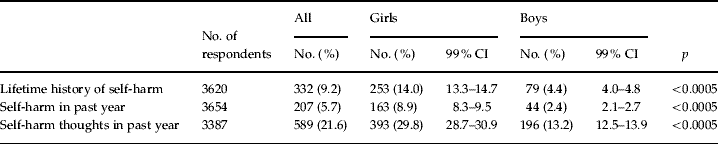
More detailed findings on the prevalence of self-harm in our population have been reported elsewhere (Morey et al. Reference Morey, Corcoran, Arensman and Perry2008). Marked gender differences were evident in the prevalence of DSH, with more than three girls for every one boy reporting a lifetime history of DSH, DSH in the previous year and self-harm thoughts (Table 1).
Prevalence of self-harm and self-harm thoughts (adapted from Morey et al. Reference Morey, Corcoran, Arensman and Perry2008)

CI, Confidence interval.
Univariate analyses: association between lifetime history of DSH and risk factors
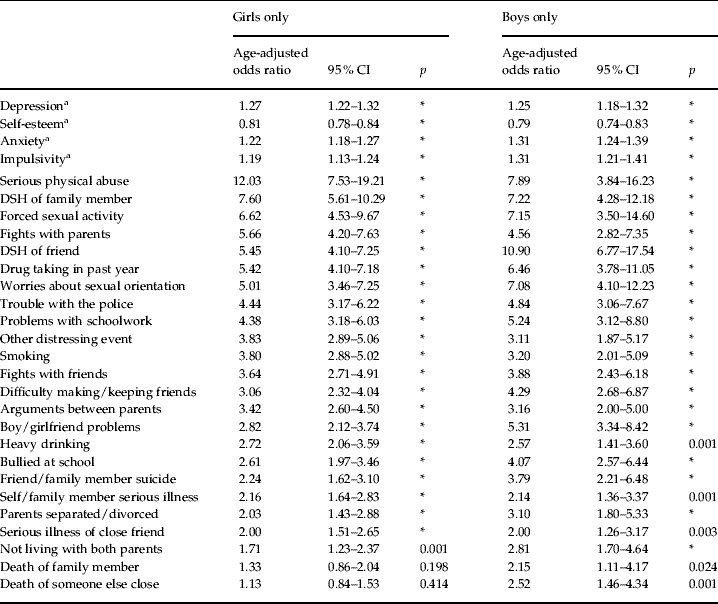
Lifetime history of DSH was associated with a range of mental health, psychological, life-style and life event factors (Table 2). All four psychological scales/subscales were strongly associated with DSH for both genders. ORs for anxiety, self-esteem and impulsivity and DSH were higher for boys than for girls, with higher ORs for increased levels of depressive symptoms among girls than among boys.
Factors associated with lifetime history of self-harm

CI, Confidence interval; DSH, deliberate self-harm.
a Odds ratio for one point increase in score.
* p<0.0005.
Among girls, the factor most strongly associated with self-harm was serious physical abuse (OR 12.03, 95% CI 7.53–19.21). Among boys, knowing a friend who engaged in DSH was the factor most strongly associated with DSH (OR 10.90, 95% CI 6.78–17.54). Both boys and girls who knew of a family member who engaged in DSH were more likely to report DSH themselves. For both genders, all negative life events examined were associated with DSH at the 0.0005 level, with the exception of death of a family member among both girls and boys and death of someone else close among girls. ORs for problems with a boyfriend or girlfriend were higher among boys (OR 5.31, 95% CI 3.34–8.42) than among girls (OR 2.82, 95% CI 2.12–3.74), as were worries about sexual orientation. Having experienced bullying at school was also more strongly associated with self-harm among boys than girls.
Potential associations between DSH and several life-style factors were examined. Those adolescents who had used illegal drugs in the past year reported more DSH than those with no drug use. The association between drug use and DSH was the strongest of all factors examined for both genders. Smoking and heavy drinking (defined by at least four episodes of drunkenness in the past year) were also significantly associated with DSH.
Multivariate analyses: association between lifetime history of DSH and risk factors
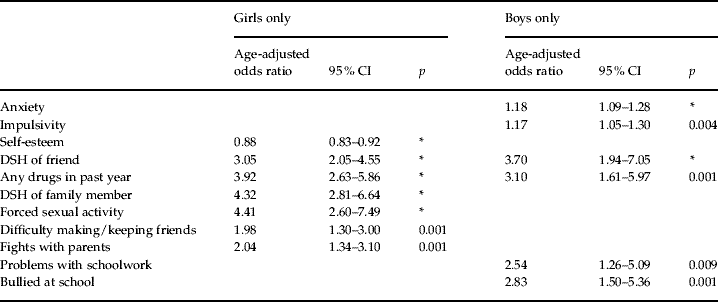
Based on multivariate analysis, six factors remained associated with DSH among boys and seven factors among girls (Table 3). The only common factors that remained in the final model among both boys and girls were knowing a friend who had engaged in DSH and drug use in the past year. Of the four psychological scales/subscales included in the analysis, only self-esteem remained in the final model for girls. For boys, both anxiety and impulsivity remained. For boys, two school-related factors were in the model: problems with keeping up with schoolwork and having experienced bullying at school. For girls, there were two factors in the domain of relationships: problems in making or keeping friends and serious fights with parents. Having been forced to engage in sexual activity against their will remained for girls only, as did knowledge of a family member who had engaged in DSH.
Multivariate logistic regression for lifetime history of DSH

DSH, Deliberate self-harm; CI, confidence interval.
* p<0.0005.
In terms of broad domains of risk factors, psychological and school-related factors featured strongly in the final model for boys, while interpersonal and relationship factors had greater importance for girls. The knowledge of self-harm by friends as well as drug use were common to both genders.
Discussion
This school-based study sought to identify the factors associated with DSH among Irish adolescents. In our large representative sample we found that the factors strongly associated with the reporting of a lifetime history of DSH differed by gender, with each set of factors suggesting a profile of at-risk youth. The specific female profile is one involving low self-esteem, relationship problems (difficulties with parents and friends) and forced sexual activity. The male profile involves anxiety, impulsivity and school problems (bullying and schoolwork difficulties). Additionally, the factors shared by girls and boys relate to drug taking and knowing others who engage in DSH.
Our finding that knowledge of self-harm by a friend was strongly associated with DSH for both genders lends support to previous studies pointing to the contagion of suicidal behaviour (Borowsky et al. Reference Borowsky, Ireland and Resnick2001; Marusic et al. Reference Marusic, Roskar and Hughes2004). The strong association that we found between DSH and knowledge of DSH in a friend was also reported by other CASE study centres in Australia (De Leo & Heller, Reference De Leo and Heller2004) and the UK (Hawton et al. Reference Hawton, Rodham, Evans and Weatherall2002). The clustering of suicidal behaviour has been found to be a particularly distinctive feature among adolescents only (Gould et al. Reference Gould, Petrie, Kleinman and Wallenstein1994). Therefore, the school setting may be appropriate for interventions to limit possible ‘copycat’ effects of self-harming behaviour. However, due to the cross-sectional design, investigation of pathways to self-harm was not possible.
Drug use in the past year was associated with DSH for both genders. It is worth noting that the majority of adolescents in this sample reported drug use, making this a relatively commonplace event among those who had not harmed themselves as well as those who had. However, unlike heavy drinking and smoking, use of illegal drugs remained in the multivariate analysis for both genders. It may be that motives for drug taking and for DSH are similar. The mostly commonly reported motive for self-harm in this group of young people was ‘to get relief from a terrible state of mind’ (Morey et al. Reference Morey, Corcoran, Arensman and Perry2008). Self-medication for psychological distress has also been reported to be a central motive in adolescent drug use (Sattar et al. Reference Sattar, Soundy, Inamdar and Din2007). Therefore, it may be that young people experiencing distress attempt to relieve these negative feelings through drug use and, in some cases, self-harm.
Consistent associations between depression and suicidal behaviour in adolescents have been reported elsewhere (Evans et al. Reference Evans, Hawton and Rodham2005). Although significantly associated with DSH in our univariate analyses, depressive symptoms did not remain in the multivariate analysis for either gender. This echoes the findings of Harrington et al. (Reference Harrington, Pickles, Aglan, Harrington, Burroughs and Kerfoot2006), who reported that the independent contribution of major depression to risk of self-harm among adolescents was not significant (Harrington et al. Reference Harrington, Pickles, Aglan, Harrington, Burroughs and Kerfoot2006). Hawton et al. (Reference Hawton, Rodham, Evans and Weatherall2002) reported that, for the English CASE centre, psychological factors were more strongly associated with DSH among girls than boys and that depression, anxiety, impulsivity and self-esteem all remained in the final model for girls. In contrast, we found that mental health/psychological factors were more important for boys, with the exception of depression. Anxiety and impulsivity remained in the final model for boys, indicating a profile of young male self-harm in the Republic of Ireland which is distinct in its psychological correlates. The finding that self-esteem remained in the final model for girls is in keeping with other studies (Beautrais et al. Reference Beautrais, Joyce and Mulder1999).
Adolescents who had self-harmed had significantly higher levels of anxiety, depression and impulsivity and lower self-esteem than those who had not, supporting the view that adolescent self-harmers of both genders form a subgroup with more severe psychopathology (Voros et al. Reference Voros, Fekete, Hewitt and Osvath2005). However, our findings that certain life events, exposure to DSH in others, and drug use have stronger associations with DSH than some mental health factors offer alternative indicators for the identification of at-risk youth.
This study was carried out using a cross-sectional design, which makes it difficult to draw conclusions on causal or temporal relationships between risk factors and DSH. The study examined self-harm episodes reported to have happened at any time in the past, and therefore reported self-harm did not necessarily occur after the various associated factors and events, making it difficult to draw conclusions on causality. The psychological scales and life-style items measured current state and life-style at one time point only, which may have been up to several years after any reported DSH. Controlled longitudinal studies are recommended in order to examine the direction of the effect and specificity of the risk factors associated with DSH.
This study does not examine the severity of self-harming behaviour. Further research should focus on the subgroup of adolescents who report repeated DSH, as these may constitute a group at high risk of further self-harm and suicide. A continuum of severity could be postulated which ranges from no self-harm thoughts or behaviour, through self-harm thoughts only, single-episode DSH and repeated DSH. A prospective study has reported that the factors associated with a first act of DSH in adolescence differ from those associated with a repeat act (O'Connor et al. Reference O'Connor, Rasmussen and Hawton2009a), underlining the importance of examining different stages of the self-harm process. This study focused on identifying factors associated with risk of self-harm in adolescents. There may also be positive configurations of life-style and psychological factors which confer resilience to suicidal behaviour, and which should be the focus of further research due to their relevance to promotion of positive mental health among adolescents.
Despite these methodological limitations, the strengths of our study include the use of multivariate analysis to describe a range of factors associated with DSH for each gender. The wide range of risk factors identified by the survey supports a life-course model of the aetiology of DSH, in which risk of developing suicidal behaviour depends on accumulation of psychological and social factors and a broad variety of negative life events across the lifespan from childhood into adolescence (Fergusson et al. Reference Fergusson, Woodward and Horwood2000). The associations we have identified between lifetime history of certain life events and DSH may reflect the importance of childhood experiences as well as more age-specific stressors associated with adolescence.
Research examining whether national trends and cross-national differences in prevalence of DSH are mirrored in suicide rates has revealed contradictory findings (Portzky et al. Reference Portzky, De Wilde and van Heeringen2008; O'Connor et al. Reference O'Connor, Rasmussen, Miles and Hawton2009b). However, it is worth noting that a remarkable characteristic of Irish suicide rates in recent years is the sharp increase in suicide among young men since the 1990s (Department of Public Health, 2001). Prospective studies of those treated for DSH have found strong links between DSH and subsequent suicide (Hawton et al. Reference Hawton, Fagg, Platt and Hawkins1993; Tidemalm et al. Reference Tidemalm, Langstrom, Lichtenstein and Runeson2008). The relatively low prevalence of DSH among boys, combined with the high rates of suicide in males in this age group, may indicate that the subgroup of boys who report DSH is a particularly high-risk group. It is also a possibility that some boys were reluctant to disclose details of their self-harm, resulting in artificially low prevalence (Keeley, Reference Keeley, Arensman, Corcoran and Hannon2008). The profile of the male adolescent self-harmer described here as involved in drug use, with high levels of impulsivity and anxiety and with peers who have also self-harmed bears a close resemblance to the profile of young men who die by suicide (Walinder & Rutzt, Reference Walinder and Rutzt2001). Interestingly, such a profile does not mirror that reported by the English CASE centre, which found anxiety and impulsivity to be most associated with DSH among girls (Hawton et al. Reference Hawton, Rodham, Evans and Weatherall2002).
As well as striking similarities in terms of the importance of factors such as knowledge of DSH in others and drug use, there are some important differences between our findings and those of the English and Scottish CASE studies, nearest geographically to the Republic of Ireland. Forced sexual activity was associated with DSH among girls in our multivariate analysis but this was not the case in the English or Scottish studies. This association warrants further examination in terms of prevalence and correlates among the Irish sample. Among boys, the strength of the association between two school-related factors – school bullying and, in particular, problems with schoolwork – was unique among CASE centres. Problems with schoolwork were the most frequently reported of all negative life events for both genders among our sample (Sullivan et al. Reference Sullivan, Arensman, Keeley, Corcoran and Perry2004). The associations between DSH and schoolwork problems and school bullying may reflect the particular social and educational pressures of second-level education in the Republic of Ireland.
Given the fact that DSH is common among adolescents, schools have an important role to play in its prevention. Our findings also underline the importance of school-based risk factors among boys, bringing the focus onto the school as central in preventing self-harm and suicide in boys. This in keeping with the recommendations of the Irish ‘Reach Out’ strategy for suicide prevention (Health Service Executive, 2005). Primary prevention strategies should aim to modify factors associated with self-harm through promotion of positive mental health among all students, and through equipping students with the skills to positively manage stress, and interpersonal conflict (Sullivan et al. Reference Sullivan, Arensman, Keeley, Corcoran and Perry2004). Our findings also point to the importance of anti-bullying initiatives and drugs education. Secondary prevention strategies could be aimed at individuals who have been identified as at risk of suicidal behaviour. School-based screening has been found to identify suicidal and emotionally troubled adolescents who had not been identified as at risk by school staff (Scott et al. Reference Scott, Wilcox, Schonfeld, Davies, Hicks, Turner and Shaffer2009). Early support and help for young people who have harmed themselves are crucial to prevent further episodes, as environmental influences on suicidal behaviour have been shown to be most pronounced early in the suicidal process, but less so following repeated episodes (Neeleman et al. Reference Neeleman, de Graaf and Vollebergh2004). School welfare staff are ideally placed to provide this support, and specific training in managing self-harm has been found to increase their confidence and skills (Robinson et al. Reference Robinson, Gook, Yuen, McGorry and Yung2008). The school environment is also a critical arena in which the stigma surrounding mental health problems must be tackled (Health Service Executive, 2005). Knowledge of the gender- and country-specific profile of young people who engage in self-harm can inform prevention strategies and aid identification of those at risk.
Acknowledgements
We thank the National Suicide Review Group, the Ireland Funds and the Pobal-Dormant Accounts Fund who provided funding for this study. We also thank Carolyn Morey for her leading role in the data collection and for her input in the data entry and data analysis, Rachel Farrow and Eric Kelleher who were involved in the data collection, Eileen Williamson for her programme support, the school staff who helped us with the study, the students who participated and Dr Nicola Madge and Dr Erik Jan de Wilde for coordinating the study at the international level. The research was conducted in collaboration with the Child and Adolescent Self-harm in Europe (CASE) study. The work was done by the National Suicide Research Foundation, Cork, Republic of Ireland.
Declaration of Interest
None.