Introduction
Herpothallon Tobler (Tobler Reference Tobler1937) includes byssoid species in the Arthoniaceae which typically have a loosely attached thallus, a pigmented pro- and/or hypothallus and pseudoisidia; confluentic acid and chiodectonic acid are common thalline compounds (Aptroot et al. Reference Aptroot, Thor, Lücking, Elix and Chaves2009). Herpothallon species are usually sterile and the genus is largely defined by thallus morphology and chemical characters. The present concept of the genus is rather broad and also includes species with a closely adnate thallus lacking a well-defined hypothallus and pigments (Aptroot et al. Reference Aptroot, Thor, Lücking, Elix and Chaves2009). It is thought to be closely related to Cryptothecia Stirt. (Stirton Reference Stirton1876), where several of the species were previously accommodated (Thor 1991, Reference Thor1997; Elix Reference Elix2007, Reference Elix2008). The absence of an amyloid medulla and ascospores having straight instead of wavy septa (observed in a single species, H. fertile Aptroot & Lücking) were used as key characters for separating these two genera (Aptroot et al. Reference Aptroot, Thor, Lücking, Elix and Chaves2009). Thirty-two Herpothallon species are presently known, most of which have been recently described (Aptroot et al. Reference Aptroot, Thor, Lücking, Elix and Chaves2009; Jagadeesh Rahm et al. Reference Jagadeesh Ram, Sinha and Singh2009; Frisch et al. Reference Frisch, Thor and Elix2010).
Until recently Herpothallon has been overlooked in Australia. Herpothallon mycelioides (Vain.) Aptroot, Lücking & G. Thor (as Chiodecton mycelioides Vain.) and H. rubrocinctoides (G. Thor) Aptroot, Lücking & G. Thor (as Cryptothecia rubrocinctoides G. Thor) were the first species recorded from the continent (Thor Reference Thor1997). Four additional species have since been described: H. australasicum (Elix) Elix & G. Thor, H. confluenticum Aptroot & Lücking, H. echinatum Aptroot, Lücking & Will-Wolf and H. queenslandicum (Elix) Elix (Aptroot et al. Reference Aptroot, Thor, Lücking, Elix and Chaves2009; Elix Reference Elix2007, Reference Elix2008). All species were collected in tropical rainforests in Queensland, where the greatest diversity of Herpothallon species in Australia would be expected to occur.
An additional Herpothallon species has recently been collected by the second author in the Paluma Range in north Queensland and is described here as H. biacidum. The new species fits well in Herpothallon given its loosely attached thallus, pigmented hypothallus and the presence of pseudoisidia. The distinctive thallus chemistry (norstictic and gyrophoric acids) is, however, shared by Cryptothecia eungellaeae G. Thor (Thor Reference Thor1997), a species which differs from H. biacidum in having a more closely attached thallus and the absence of a dark hypothallus and pseudoisidia (but containing empty asci). The two species will be discussed in relation to the present circumscription of Herpothallon and Cryptothecia.
Material and Methods
Morphology was studied on freezing microtome sections, 10–50 μm thick and on squash preparations. The sections were mounted in lactic cotton blue and water and studied with a Leica DMLS transmission light microscope; all measurements were made on material mounted in lactic cotton blue. For macroscopic investigation a Leica MZ6 with eyepiece graticule was used.
Secondary lichen compounds were identified with HPTLC (Arup et al. 1993), using the most stable solvent C (toluene/acetic acid 17:3 vol.). HPLC was performed according to Elix et al. (Reference Elix, Giralt and Wardlaw2003). Amyloidity of the thallus was tested using 1% and 0·2% aqueous iodine solution with and without pre-treatment with 10% aqueous potassium hydroxide (KI and I, respectively). Colour reactions of the thallus were tested using 10% aqueous potassium hydroxide (K), common household bleach (C), 1,4-phenylendiamine in 95% ethanol (PD) and short wave UV254 radiation. Calcium oxalate crystals were identified using 20% aqueous sulphuric acid.
The Species
Herpothallon biacidum Frisch, Elix & G. Thor sp. nov
Thallus corticola, byssoideus, olivaceo-griseus vel fuscescens, laxe adnatus; hypothallo byssoideo, fusco vel fusco-nigra; pseudoisidiis globularibus, claviformia vel breve cylindricis, usque ad 0·12 mm latis, usque ad 0·3 mm longis; acidum norsticticum et acidum gyrophoricum continens. Ascomata, asci et pycnidia ignota.
Typus: Australia, Queensland, Little Crystal Creek, 12 km E of Paluma, margins of rainforest along gorge, on base of tree, 330 m, 19°00′56″S, 146°15′59″E, 24 July 2006, J. A. Elix 38049 (CANB—holotypus; UPS—isotypus).
(Fig. 1)
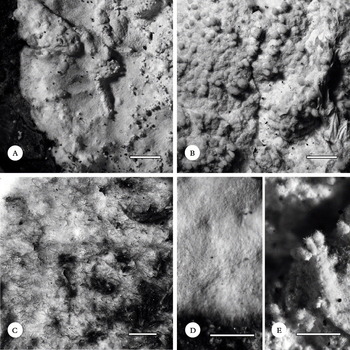
Herpothallon biacidum (isotype). A, lateral thallus with prothallus and pseudoisidia; B, central thallus with pseudoisidia; C, lower thallus surface with brown to blackish brown hypothallus; D, close-up of prothallus; E, close-up of pseudoisidia with projecting hyphae. Scales: A = 2 mm; B–E = 0·5 mm.

Thallus corticolous, byssoid, c. 6 cm diam., loosely attached to the substratum, not flaking off, ecorticate, minutely felty, pale grey-olive with a brownish tinge, heteromerous, 0·20–0·25 mm thick. Photobiont layer 30–75 μm thick; photobiont trentepohlioid, polymorphic: in the centre of the thallus filaments short and constricted at the septa or disintegrating into single cells and with irregularly globular to ovoid cells, 5–14 × 4–10 μm, while at the growing thallus margins filaments typically long, not constricted at the septa and with cylindrical cells 20–25 × 5 μm; hyphae 1·0–1·5 μm wide, densely branched and anastomosing, with numerous brownish granules attached to the outer walls; appressed hyphae short, often branched, slightly wavy, about 1 μm wide. Medulla up to 140 μm thick, formed of mainly periclinal, loosely woven hyphae, compacted and with more irregularly orientated hyphae towards the thallus centre; hyphae 1–2 μm wide, sparsely branched and anastomosing, with numerous brownish granules attached to the outer wall. Calcium oxalate crystals numerous in the thallus, 1–5(–17) μm diam. Hypothallus present throughout the otherwise white lower surface but thin and discontinuous, byssoid, brown to blackish brown, up to 100 μm thick; hyphae free, loosely woven, 2–3 μm wide, sparsely branched and anastomosing, with 0·5–1·0 μm thick, minutely warty, hyaline to dark brown walls. Prothallus up to 2 mm wide, byssoid, white to pale cream, brownish at the outer edge, loosely attached to the substratum, formed of 1·5–2·5 μm wide, loosely interwoven and radiating hyphae with brownish granules attached to the outer wall. Pseudoisidia globular to claviform to short cylindrical, up to 0·30 × 0·12 mm, minutely felty, scattered over the thallus or in small coralloid aggregations up to 0·4 mm wide, easily detached from the thallus, with numerous twisted, sparsely branched projecting hyphae up to 60 × 1·5–2·0 μm; in section hyaline, strongly conglutinated, prosoplectenchymatous, formed of branched and anastomosing hyphae with 1·0–1·5 μm wide lumina, and with photobionts being scattered across the lower portions.
Ascomata, asci and pycnidia not seen.
Chemistry. Gyrophoric acid (major) and norstictic acid (minor) detected with HPTLC and HPLC; thallus K+ yellow then red, PD+ orange, C+ red, UV−; medulla I+ and KI+ pale blue in patches.
Etymology. The name of the new species refers to the joint occurrence of norstictic and gyrophoric acids. This combination of substances has not previously been reported for the genus.
Habitat and distribution. The new species was collected from soft, rough bark at the base of a large tree. It is known only from the type locality, at the margin of a rainforest along a gorge.
Notes. Herpothallon biacidum is easily recognized by the loosely attached thallus, small globular to claviform or short cylindrical pseudoisidia with projecting hyphae, a brown to blackish brown byssoid hypothallus, the absence of yellow to red thallus pigments, and by the presence of both norstictic and gyrophoric acids. The new species fits well in Herpothallon as it is currently circumscribed (Aptroot et al. Reference Aptroot, Thor, Lücking, Elix and Chaves2009). In Australia, H. biacidum shares the dark byssoid hypothallus, pseudoisidia and the presence of norstictic acid with H. mycelioides. This latter species, however, lacks gyrophoric acid and also differs from H. biacidum in having more loosely, byssoid thalli and pseudoisidia and the olive-brown to greenish black colour of the hypothallus. Herpothallon mycelioides has recently been shown to belong to a small group of species centred on ‘Chiodecton’ polillense Vain. and will be removed from Herpothallon in a forthcoming publication (Frisch & Thor Reference Frisch and Thor2010). Herpothallon antillarum (Vain.) Aptroot, Lücking & G. Thor from tropical and subtropical America also contains norstictic acid and has a dark hypothallus but differs in having a compact hypothallus similar to the dark basal layer found in Diorygma confluens (Fée) Kalb, Staiger & Elix and D. epiglaucum (Müll. Arg.) Kalb, Staiger & Elix (Graphidaceae; Aptroot et al. Reference Aptroot, Thor, Lücking, Elix and Chaves2009) instead of a byssoid hypothallus. Furthermore, H. antillarum has larger, cylindrical pseudoisidia up to 1 mm long and produces salazinic acid as the second major metabolite.
Non-pigmented, pseudoisidiate Herpothallon species containing gyrophoric acid include H. queenslandicum, H. philippinum (Vain.) Aptroot & Lücking and H. japonicum (Zahlbr.) G. Thor. Herpothallon queenslandicum is foliicolous, produces additional confluentic acid, and has a closely adnate thallus with more slender pseudoisidia (up to 0·3 × 0·07 mm). Herpothallon philippinum and H. japonicum both lack a dark hypothallus and have larger, cylindrical isidia up to 1 mm long. In addition, H. japonicum has a closely adnate thallus which lacks calcium oxalate crystals.
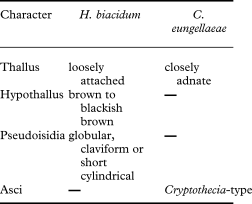
Important characters separating Herpothallon biacidum and Cryptothecia eungellaeae

In Australia, norstictic and gyrophoric acids have been shown to co-occur in Cryptothecia eungellaeae (Thor Reference Thor1997). This species is morphologically similar to H. biacidum, but the thallus is typically thicker (up to 0·5 mm), closely adnate to the substratum and it lacks pseudoisidia and a dark hypothallus (Table 1). Larger calcium oxalate crystals (10–30 μm long) are more common in C. eungellaeae. Thor (Reference Thor1997) described the thallus of C. eungellaeae as having “frequent, globose, isidia-like structures, up to 0·3 mm in diameter.” Re-investigation of the isotype in UPS confirmed that these are hemispherical to almost globular thalline warts caused by numerous calcium oxalate crystals in the photobiont layer, but differ from the pseudoisidia of H. biacidum. Typical Cryptothecia-type asci (but lacking ascospores) have been found in C. eungellaeae (Thor Reference Thor1997), but not in H. biacidum. The similarity of C. eungellaeae to Herpothallon had already been noted by Aptroot et al. (Reference Aptroot, Thor, Lücking, Elix and Chaves2009), who excluded this species from Herpothallon as it showed characters that were better accommodated within the present concept of Cryptothecia. In particular, the closely attached thallus which lacks a coloured hypothallus, the absence of pseudoisidia, the presence of (empty) asci and, more importantly, the amyloid (I+ and KI+ blue) medulla. However, the amyloidity of the medulla (and the photobiont layer) has also been observed in H. biacidum and, contrary to the information given in Aptroot et al. (Reference Aptroot, Thor, Lücking, Elix and Chaves2009), has been found in all other Herpothallon species recently re-investigated (Frisch et al. Reference Frisch, Thor and Elix2010). It should be noted, that in H. rubrocinctum, the generic type, and similar species with a bright red pro- and hypothallus, the amyloidity is typically weak and in some specimens barely discernible. The presence of Cryptothecia-like ascospores with wavy septa in H. philippinum, H. pustulatum G. Thor and H. rubromaculatum G. Thor (unpublished), raises concern about the distinction of Herpothallon as circumscribed by Aptroot et al. (Reference Aptroot, Thor, Lücking, Elix and Chaves2009) and Cryptothecia.
As presently defined, Herpothallon includes taxa exhibiting considerable morphological and chemical heterogeneity and the available data suggest that the genus is polyphyletic and needs further revision. Taxonomy in this group, however, is complicated by the fact that most species are sterile and ecological factors have probably caused a high level of homoplasy in such lichens with byssoid thalli (Rogers & Hafellner Reference Rogers and Hafellner1987; Hafellner & Vězda Reference Hafellner and Vězda1992; Elix Reference Elix2009). Furthermore, many of the species included in Cryptothecia by Makhija & Patwardhan (Reference Makhija, Patwardhan, Sarma, Saini, Trivedi and Sharma1994) are not well known and need to be revised in order to critically delimit Herpothallon from that genus and to establish a more natural classification of the cryptothecioid Arthoniaceae. Future comparative morphological and molecular investigations may help solve these problems.
A. Frisch was granted a post-doctoral fellowship by the Swedish Institute during his stay in Sweden. Photographs were taken at the Botany Section of the Museum of Evolution in Uppsala and the valuable assistance given by that institution is gratefully acknowledged.