INTRODUCTION
Understanding irony is major milestone in the development of children's social cognition (Peterson, Wellman, & Slaughter, Reference Peterson, Wellman and Slaughter2012). It involves understanding speakers’ beliefs, intentions, and attitudes (Filippova & Astington, Reference Filippova and Astington2008). Despite abundant literature, we still do not fully understood why children are unable to grasp the meaning of ironic utterances as well as adults. As irony comprehension is a mentalizing process, it relies on children's theory-of-mind abilities which, in turn, depend on the cues available in the situational context, as well as those provided by the ironic speaker (Achim, Guitton, Jackson, Boutin, & Monetta, Reference Achim, Guitton, Jackson, Boutin and Monetta2013). Hyperbole (or overstatement) is one of the cues that can support irony comprehension – provided that children interpret it correctly.
Verbal irony refers to a category of utterances in which a speaker says something pretending not to be aware that a related event in the situational context has not happened as anticipated, regarding personal expectations or, more generally, cultural norms (Attardo, Reference Attardo2000; Colston, Reference Colston2000; Utsumi, Reference Utsumi2000). This pretence leads to a discrepancy between what is said (which often reflects what was expected) and the actual situation. We refer to this discrepancy as the ironic contrast, because irony directly depends upon just such a discrepancy. The literature has consistently showed that heightening the ironic contrast by manipulating the context results in adults in a stronger perception of irony and its pragmatic functions (Colston, Reference Colston2002; Colston & O'Brien, Reference Colston and O'Brien2000; Gerrig & Goldvarg, Reference Gerrig and Goldvarg2000; Ivanko & Pexman, Reference Ivanko and Pexman2003). For instance, the ironic utterance “Thanks for being on time” is more easily understood if the addressee is 50 minutes rather than just 5 minutes late (taken from Gerrig & Goldvarg, Reference Gerrig and Goldvarg2000). Speakers often supply ironic markers with their utterances, making the ironic contrast easier to grasp (Attardo, Eisterhold, Hay, & Poggi, Reference Attardo, Eisterhold, Hay and Poggi2003). These markers hint to the hearer that the utterance could be ironic, or at least not sincere. They can be either paralinguistic (e.g., prosody or facial expressions) or linguistic (e.g., oxymoron or amplifying adverbs: “I'm so pleased to see that pest again”).
Hyperbole is a marker of irony that not only directs the hearer's attention to the ironic contrast, but also increases the magnitude of that ironic contrast. Imagine it is raining. The ironic contrast is greater if you say “Oh my gosh, it's the sunniest day of my entire life!” rather than simply “Nice weather …”. However, hyperbole is not just a marker of irony. It is also a figure of speech in its own right that is designed to overtly exaggerate reality, aside from any ironic intent (Burgers, Brugman, Renardel de Lavalette, & Steen, Reference Burgers, Brugman, Renardel de Lavalette and Steen2016; Carston & Wearing, Reference Carston and Wearing2015). For instance, back from an unpleasant trip to France, a holidaymaker might say “they're the most arrogant people in the world!” According to Colston and O'Brien (Reference Colston and O'Brien2000), hyperbole uses contrasts of magnitude (e.g., very positive comments about moderately positive situations), whereas irony uses contrasts of kind (e.g., positive comments about negative situations). Complexity occurs when these two figures are combined (e.g., very positive comments about negative situations) (Carston & Wearing, Reference Carston and Wearing2015). In this case, irony takes priority over hyperbole because the reversal impacts the meaning far more than the exaggeration. This is why hyperbole can be regarded as a marker of irony, but not the other way around. The fact that the two figures can be combined makes the literature hard to sum up, as the distinction between standard irony (“Nice weather …” when it is raining) and hyperbolic irony (“Oh my gosh, it's the sunniest day of my entire life!”) is often unclear in irony studies. More surprisingly, and more problematic, the distinction between standard hyperbole (“I'm over the moon for them [newlyweds]”, coming from a close friend of the bride) and ironic hyperbole (the same utterance but coming from an ex-boyfriend who is still in love with the bride) is also often unclear, especially in the developmental literature (Filippova & Astington, Reference Filippova and Astington2010; Recchia, Howe, Ross, & Alexander, Reference Recchia, Howe, Ross and Alexander2010; for a similar comment, see Wilson, Reference Wilson2013). In this study, we worked on the assumption that a hyperbole must be counterfactual to be ironic (Colston & O'Brien, Reference Colston and O'Brien2000; Partington, Reference Partington2007), that is, it must say more to mean less.
The fact that the use of hyperbole as a marker increases the ironic contrast and, hence, increases the ironicalness of utterances was first demonstrated in adults by Kreuz and Roberts (Reference Kreuz and Roberts1995). They asked participants to judge the ironic quality of four kinds of utterances: (a) non-ironic and non-hyperbolic utterances (“thanks for helping me out” when the help was efficient); (b) non-ironic and hyperbolic utterances (“I'll never be able to repay you for your help” when the help was efficient); (c) ironic and non-hyperbolic utterances (“thanks for helping me out” when the help was counter-productive); and (d) ironic and hyperbolic utterances (“I'll never be able to repay you for your help” when the help was counter-productive). These authors showed that the presence of hyperbole increases the likelihood that the speaker is judged to be ironic. More recently, Burgers, van Mulken, and Schellens (Reference Burgers, van Mulken and Schellens2012) confirmed this result. Colston and O'Brien (Reference Colston and O'Brien2000) showed that hyperbolic irony was more condemning, humorous, and speaker-protecting than non-hyperbolic irony. There have been no such studies among children to our knowledge.
Our interest in investigating the role of hyperbole in irony comprehension in children stemmed from the fact that hyperbole may not work in young children as it does in adults. Rather than improving understanding, it may actually impede it. It is only possible to make good use of the relative extent of the ironic contrast by considering the communication situation (i.e., utterance plus salient features of the context) as a whole. This may be challenging for young children. Children begin to understand irony in a rudimentary way at around five or six years. They recognize that speakers who make ironic remarks do not believe what they literally say, and are able to reject the literal meaning of the utterance. However, they are only able to infer speakers’ attitude and ironic intent later in childhood (Ackerman, Reference Ackerman1983; Filippova & Astington, Reference Filippova and Astington2008, Reference Filippova and Astington2010; Hancock, Dunham, & Purdy, Reference Hancock, Dunham and Purdy2000; Pexman & Glenwright, Reference Pexman and Glenwright2007). When the context does not exclude the possibility of a white lie (e.g., saying “Nice weather …” when it is obviously raining), young children tend to conclude that ironic speakers are being deceitful rather than ironic (Demorest, Meyer, Phelps, Gardner, & Winner, Reference Demorest, Meyer, Phelps, Gardner and Winner1984; Demorest, Silberstein, Gardner, & Winner, Reference Demorest, Silberstein, Gardner and Winner1983). They seem to be entirely unaware of the pragmatic functions of irony (e.g., muting criticism, teasing, being humorous) until eight or ten years (Harris & Pexman, Reference Harris and Pexman2003; Pexman, Glenwright, Krol, & James, Reference Pexman, Glenwright, Krol and James2005). Unlike adults, when six-year-old children encounter ironic contrast, they do not recognize that it is underpinned by an ironic intent, as this requires sophisticated mentalizing abilities (Filippova & Astington, Reference Filippova and Astington2008, Reference Filippova and Astington2010; Peterson et al., Reference Peterson, Wellman and Slaughter2012). Instead, they perceive a raw incongruity between the utterance and the context. To grasp what is meant, they rely either on the utterance, ignoring the context and wrongly drawing a literal interpretation (which is what the majority of children do before the age of six years), or else on the context, thus ignoring the utterance and judging the speaker to be incoherent, deceitful, or joking. From this standpoint, hyperbole is double-edged. In young children, rather than heightening the ironic contrast between what is said and the actual situation, hyperbole may simply overemphasize what is said, potentially encouraging children to rely on the utterance and thus wrongly draw a literal interpretation. Preschool children are capable of using standard hyperbole (Recchia et al., Reference Recchia, Howe, Ross and Alexander2010; Varga, Reference Varga2000), but the scant research on their understanding of this figure shows that they did not recognize it to be figurative before the age of eight or ten yearsFootnote 1 (Demorest et al., Reference Demorest, Silberstein, Gardner and Winner1983; Winner, Windmueller, Rosenblatt, Bosco, Best, & Gardner, Reference Winner, Windmueller, Rosenblatt, Bosco, Best and Gardner1987).
This double-edged hyperbole hypothesis is supported by preschoolers’ tendency to lend too much weight to lexical cues in communication situations where cues of the speaker's intent are discrepant (lexical bias; Friend & Bryant, Reference Friend and Bryant2000). This bias has been investigated in the field of emotional speech comprehension in children. Performances on speaker's mental state judgement tasks show that, unlike adults, schoolchildren up to the age of nine or ten years rely on lexical content rather than on prosody to interpret utterances with contradictory cues (e.g., happy prosody with angry content; Friend, Reference Friend2000; Moore, Harris, & Patriquin, Reference Moore, Harris and Patriquin1993; Morton & Trehub, Reference Friend2001). Lightfoot and Bullock (Reference Lightfoot and Bullock1990) conducted similar experiments with utterances where the lexical content was discrepant with facial expressions. According to these authors, five-year-old children are able to focus on the lexical or, alternatively, the facial component but, unlike their older peers, they fail to relate either of the two components to an overall communicative intent.
In the light of the above arguments, we hypothesized that age moderates the effect of hyperbole on ironic utterance understanding. We predicted that hyperbole would impede irony comprehension in six-year-old children, but support it in ten-year-old children, as it does in adults (Kreuz & Roberts, Reference Kreuz and Roberts1995). Even if irony understanding continues to improve until adolescence (Aguert & Laval, Reference Aguert and Laval2013), ten-year-olds should have sufficient pragmatic and socio-cognitive skills to relate hyperbolic utterances to the context, guided by the speaker's ironic intent.
METHOD
Participants
Forty 6-year-old children (22 girls; M = 6;2, SD = 6 months, range = 5;3–7;0) and forty 10-year-old children (19 girls; M = 10;5, SD = 6 months, range = 9;3–11;0) took part in the experiment. They attended French state schools that guaranteed a good mix of socioeconomic backgrounds.
Material
The material consisted of twelve short animated cartoons where the characters were two young girls, Léa and Marie. Each cartoon described an everyday situation characterized by a negative fact that allowed a speaker to be ironic and/or sarcastic (e.g., boring game, untidy room). An off-screen voice described the situational context and underlined this negative fact (e.g., Marie invite Léa à venir jouer dans sa chambre. Il y a plein de jouets partout ‘Marie comes to Léa's house to play. Léa's room is very untidy’). At the end of each cartoon, Marie addressed an evaluative utterance to Léa. These evaluative utterances varied according to two factors: valence (negative or positive) and hyperbole (hyperbolic or non-hyperbolic). For instance, Marie could say Ta chambre est mal rangée ‘Your room's untidy’, C'est la chambre la plus mal rangée que je n'ai jamais vue ‘It's the untidiest room I've ever seen’, Ta chambre est bien rangée ‘Your room's tidy’ or C'est la chambre la mieux rangée que je n'ai jamais vue ‘It's the tidiest room I've ever seen’. The hyperbole always took the form “It's the [evaluative term] [object or aspect of the situation] I've ever seen”. These two factors were crossed to yield four different versions of the original twelve cartoons (48 cartoons in total). Each participant was exposed to one version of each final utterance type for each of the twelve cartoons (i.e., never the same cartoon content for two different utterances).
A ten-year-old girl voiced Marie's part. The only instructions she received were to be natural and, for the hyperbolic utterances to be enthusiastic. An acoustic analysis of the utterances’ fundamental frequency (F0) using Praat software (Boersma & Weenink, Reference Boersma and Weenink2004) indicated that the mean F0 was higher for hyperbolic utterances (M = 306 Hz, SD = 26 Hz) than for non-hyperbolic ones (M = 237 Hz, SD = 21 Hz) (t(46) = 9·967, p < ·001). The standard deviation of the F0 was also higher for utterances with hyperbole (M = 68 Hz, SD = 10 Hz) than for ones without it (M = 34 Hz, SD = 11 Hz) (t(46) = 11·36, p < ·001). There was no statistical difference according to valence. Thus, half of Marie's final utterances were hyperbolic at both the semantic and prosodic levels.
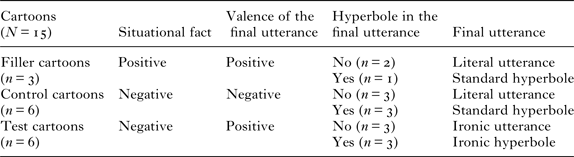
As the young actress was not asked to be ironic, the irony arose from the contrast between the negative fact and the positive valence of half of Marie's utterances. Thus, half the cartoons (control cartoons) ended with a literal statement, and half (test cartoons) with an ironic statement. Five extra cartoons were created, two serving to familiarize the participants, and three as fillers, characterized by a positive, rather than a negative, fact. Each participant therefore saw a total of fifteen cartoons in the test phase (see Table 1, and ‘Appendix’).
Characteristics of the filler, control, and test cartoons

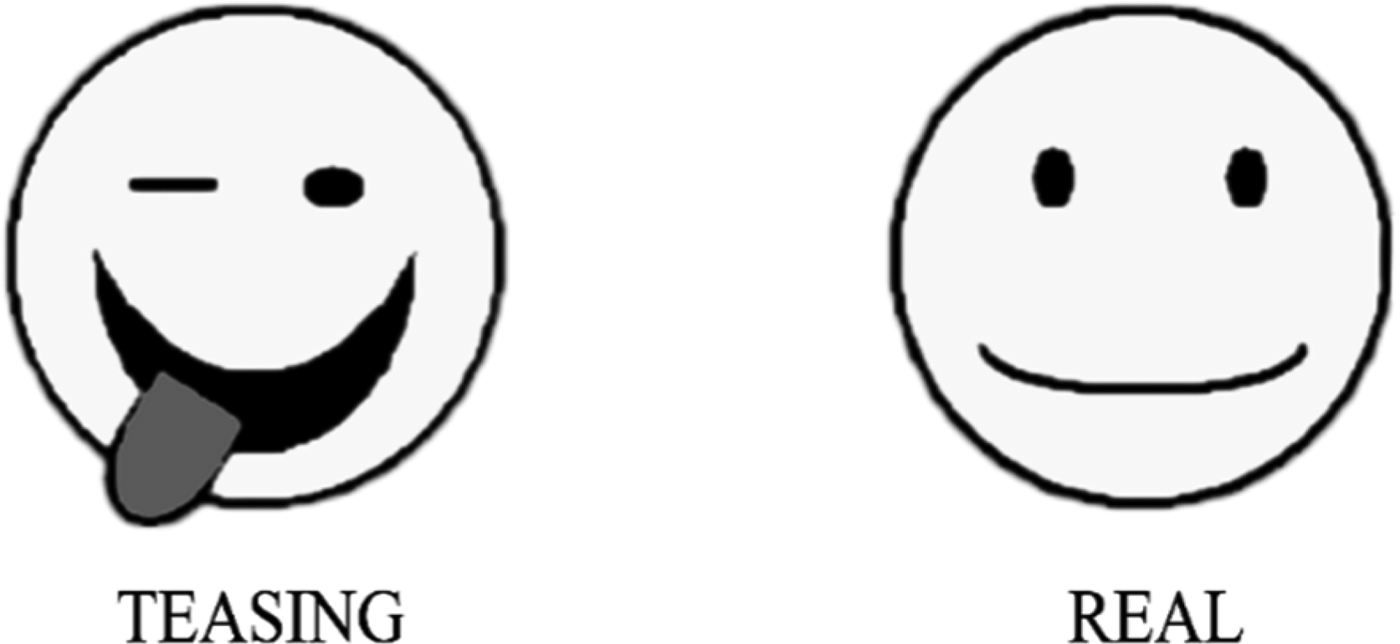
The cartoons were displayed on a laptop using dedicated software. Following each cartoon, two probe questions were asked to assess the participants’ irony comprehension: first, a question about the speaker's belief, and second, a question about the speaker's intent. A drawing of a face (see Figure 1) adapted from Pexman and Glenwright (Reference Pexman and Glenwright2007) was used to help them identify the speaker's intent.
Faces supporting the speaker's intent question.

Procedure and coding
The children were tested individually in a quiet room on their school premises. The entire procedure lasted approximately 20 minutes. Prior to testing, they were individually trained to understand the meaning of the two faces in Figure 1. Children saw the two familiarization cartoons first, followed by the twelve experimental cartoons mixed with the three filler cartoons, presented in random order. After each cartoon, they were asked the two probe questions:
-
1. Speaker's belief: “Did you hear what Marie said? [participants could listen to the utterance a second time if they wanted]. When she said that, did she mean the room was tidy or untidy?” If a participant's answer indicated that Marie's statement was a criticism, we deemed that the participant had understood the speaker's belief. If Marie's statement was interpreted as praise, we deemed that the participant had not understood the speaker's belief;
-
2. Speaker's intent: “Point to one of the faces to show me whether Marie was teasing or what she said was for real.” For the test cartoons, the teasing face was deemed to be compatible with an understanding of the speaker's intent, and the real face was deemed to be incompatible with an understanding of the speaker's intent. Reverse scoring was applied for the control cartoons.
The order of the alternatives provided by the experimenter (i.e., criticism vs. praise and teasing vs. real) was randomized across cartoons.
We settled on a stringent irony comprehension criterion: for each test cartoon, participants had to provide an irony-compatible answer both to the speaker's belief question and to the speaker's intent question. If one or both of these questions was incorrect, we concluded that the irony had not been fully understood. For instance, a child who thought the speaker was lying might give a correct answer to the speaker's belief question, but an incorrect answer to the speaker's intent question. In sum, our dependent variable was the participant's comprehensive response, which could either be correct (two correct responses to the two probe questions) or incorrect (all other cases).
RESULTS
Given that the aim of the study was to test the role of hyperbole in irony comprehension, we only analyzed the children's responses to the six test cartoons, where irony was the expected interpretation. It should be noted that participants were at ceiling with regard to the six control cartoons, for both probe questions. As the dependent variable (participants’ comprehensive responses) was dichotomous (0 or 1), we analyzed the data using a logistic mixed model with R software (lme4 library) (see Baayen, Davidson, & Bates, Reference Baayen, Davidson and Bates2008; Jaeger, Reference Jaeger2008). The analyses were conducted on the correct (1) responses. Fixed factors were age (6 or 10 years), hyperbole (yes or no) and the Age × Hyperbole interaction.
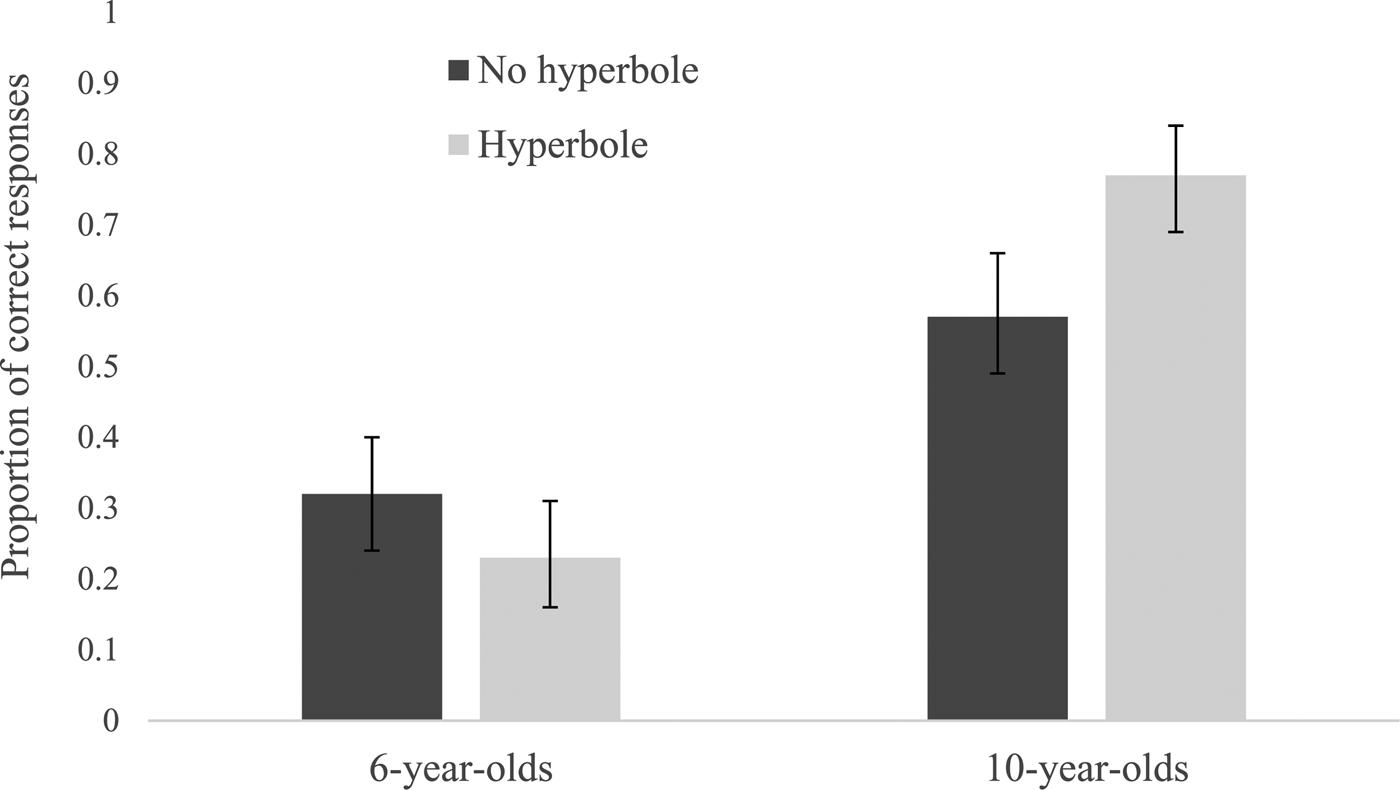
The model was characterized by random intercepts for participants and cartoons. The age factor made a significant contribution to the model in predicting correct responses (z = 5·055, p < ·001, Odds Ratio = 14·10, CI95 [5·442, 44·92]). Hyperbole was non-significant (z = 1·191, p = ·234, OR = 1·347, CI95 [0·826, 2·210]). The Age × Hyperbole interaction made a significant contribution to the model (z = 3·999, p < ·001, OR = 7·832, CI95 [2·923, 22·08]), see Figure 2. The odds of correct responses when there was no hyperbole were used as the baseline values for treatment contrasts. At age six, participants provided fewer correct responses (estimated proportion = ·23) when the utterances were hyperbolic than when they were not (estimated proportion = ·32) (z = –2·047, p = ·041, OR = 0·481, CI95 [0·235, 0·959]). The odds of providing a correct response were 0·481 times higher (that is 2·079 times lesser) when the speaker's statements were hyperbolic. At age ten, however, participants provided more correct responses (estimated proportion = ·77) when the utterances were hyperbolic than when they were not (estimated proportion = ·57) (z = 3·678, p < ·001, OR = 3·771, CI95 [1·894, 7·847]). In other words, the odds of providing a correct response were 3·771 times higher when speaker's statements were hyperbolic.
Proportion of correct responses according to age and hyperbole. Error bars show 95% CI for binomial proportions (Jeffreys method).

DISCUSSION
As hypothesized, age moderated the effect of hyperbole on irony comprehension in children: hyperbole impeded irony comprehension in the six-year-old children, but supported it in the ten-year-old children. At six years, children are only just beginning to understand irony, that is, to reject the literal positive meaning of an utterance as the genuine reflection of the speaker's belief, and give priority to an inferred and implicit negative meaning that is consistent with the situational context. This process leads them to consider that the speaker's intent is to tease and not to say something for real. However, this ability is still fragile, and six-year-olds can easily revert to the utterance as the genuine reflection of the speaker's belief. Because it overemphasizes what is said, hyperbole lends credence to the speaker's positive meaning, which is something of a paradox, given that adult speakers use hyperbole precisely as a marker of their ironic intent. By the time they have reached the age of ten years, children no longer have to choose between the utterance and the context. They can consider them as a whole, and any apparent discrepancy is overcome by attributing the right communicative intent to the speaker. Children of this age know that speakers sometimes deliberately say the opposite of what they mean or believe, in order to create pragmatic effects like teasing or surprise (Harris & Pexman, Reference Harris and Pexman2003; Pexman et al., Reference Pexman, Glenwright, Krol and James2005). By heightening the ironic contrast, hyperbole supports their irony comprehension, as it does for adults (Kreuz & Roberts, Reference Kreuz and Roberts1995). It seems that the impact of hyperbole changes during childhood, mainly because strategies for dealing with irony move from making a drastic choice between utterance and context to integrating them in the light of the speaker's ironic intent. The present data do not allow us to infer specific developmental mechanisms explaining this shift. However, given the socio-cognitive abilities involved in speaker's intent recognition, future research on this issue should seriously consider the development of mentalization after the preschool period as explanatory process. Mentalization is not fully mature at five years, which is when children master classic false-belief tasks. Rather, it continues until adolescence, closely linked to the development of irony comprehension (O'Reilly, Peterson, & Wellman, Reference O'Reilly, Peterson and Wellman2014; Peterson et al., Reference Peterson, Wellman and Slaughter2012). Another plausible avenue that deserves to be explored is children's lack of cognitive flexibility at around six years, which may result in an inability to process multiple cues at the same time (Waxer & Morton, Reference Waxer and Morton2011). In any event, this study confirms a well-established trend in young children whereby, compared with adults, they lend too much weight to what is literally said, favouring the lexical cues at the expense of para- and extralinguistic cues that reveal what is intended. This trend has been observed in the field of non-literal language comprehension (Bernicot, Laval, & Chaminaud, Reference Bernicot, Laval and Chaminaud2007), as well as in the field of emotional speech comprehension (Morton & Trehub, Reference Morton and Trehub2001).
In the present study, we did not treat hyperbole as a figure of speech, distinct from irony. Rather, we considered it as a marker of irony. In other words, ironic hyperbole is a standard ironic counterfactual statement enhanced with linguistic and/or paralinguistic intensifiers aimed at heightening the ironic contrast between what is pretended by the speaker and the actual situation. The issue of ironic markers is an important one. When faced with a discrepancy between what is said and the reality, an addressee can consider three options: the speaker is incoherent, the speaker is deceitful, or the speaker is non-literal. For children to attribute the right intent to the speaker, which is the main difficulty they encounter (Filippova & Astington, Reference Filippova and Astington2008), they have to make use of ironic markers. And yet the role of ironic markers in children's comprehension of irony remains poorly understood. Only one marker (prosody) has attracted the attention of researchers over the past thirty years, with conflicting findings (Filippova & Astington, Reference Filippova and Astington2008; Laval & Bert-Erboul, Reference Laval and Bert-Erboul2005). Here again, hyperbole is interesting because the exaggeration takes place in both linguistic (lexical) and paralinguistic (prosodic) channels. A future study could investigate whether it is more the prosodic exaggeration or the lexical exaggeration that helps ten-year-old children attribute ironic intent to a speaker. It could also be interesting to expose children to lexical hyperbole, produced with a completely non-hyperbolic, monotone prosody. The discrepancy between what was said and the reality would be combined with a discrepancy between what was said and how it was said, and could support comprehension in younger children.
APPENDIX: SAMPLE OF STORIES
-
• Non-hyperbolic test cartoons (negative situational fact, positive final utterance):
Léa et Marie font un match de foot avec des copains. Marie et Léa perdent, leur équipe n'a marqué aucun but. Léa dit : « Notre équipe est super » ‘Léa and Marie are playing soccer. Their team is losing the game and has not scored any goals. Léa says, “We've got a great team”.’
-
• Hyperbolic test cartoons (negative situational fact, positive final utterance):
Léa et Marie font un match de foot avec des copains. Marie et Léa perdent, leur équipe n'a marqué aucun but. Léa dit : « Notre équipe est la meilleure que j'ai jamais vue ! » ‘Léa and Marie are playing soccer. Their team is losing the game and has not scored any goals. Léa says, “Our team's the greatest I've ever seen!”’
-
• Non-hyperbolic control cartoons (negative situational fact, negative final utterance):
Léa et Marie font un match de foot avec des copains. Marie et Léa perdent, leur équipe n'a marqué aucun but. Léa dit : « Notre équipe est nulle » ‘Léa and Marie are playing soccer. Their team is losing the game and has not scored any goals. Léa says, “Our team's pathetic”.’
-
• Hyperbolic control cartoons (negative situational fact, negative final utterance):
Léa et Marie font un match de foot avec des copains. Marie et Léa perdent, leur équipe n'a marqué aucun but. Léa dit : « Notre équipe est la pire que j'ai jamais vue ! » ‘Léa and Marie are playing soccer. Their team is losing the game and has not scored any goals. Léa says, “Our team's the worst I've ever seen!”’
-
• Non-hyperbolic filler cartoons (positive situational fact, positive ending statement):
Léa et Marie partent faire une ballade en vélo. Il fait beau. Léa dit « C'est une bonne idée cette ballade » ‘Léa and Marie are going for a bike ride. The sun is shining. Léa says, “This ride is a good idea”.’
-
• Hyperbolic filler cartoons (positive situational fact, positive ending statement): Léa attend Marie pour partir au carnaval. Marie arrive très bien déguisée. Léa lui dit « Il est super ton déguisement » ‘Léa and Marie are going to a fancy-dress parade. Marie has a very good costume. Léa says, “It's the best costume I've ever seen”.’