This article explores how Donald Trump’s “rigged-election” rhetoric was covered by cable-news networks and the consequences of the claims and coverage for likely voter turnout and vote choice. Scholars have long noted the tendency of congressional candidates to run for office by running against Washington (Canon Reference Canon1990). Such rhetoric explains why the general public historically has loved its individual representatives and reelected them by overwhelming margins while simultaneously hating Congress as a political institution (Fiorina Reference Fiorina1989; Hibbing and Theiss-Morse Reference Hibbing and Theiss-Morse1995). More generally, anti-Washington rhetoric is connected to declining trust in American political institutions as well as declining support for redistributive policies (Hetherington Reference Hetherington2005). It also fits within larger patterns of negativity in news coverage of Congress and the presidency, reinforcing public distaste for political processes and political institutions (Cohen Reference Cohen2008; Hibbing and Theiss-Morse Reference Hibbing and Theiss-Morse1995; Reference Hibbing and Theiss-Morse2002; Lichter and Noyes Reference Lichter and Noyes1996; Patterson Reference Patterson1996).
Such rhetoric is common in congressional elections but historically it is less common during presidential elections. Fiorina (Reference Fiorina1989), for example, observed with surprise that in the 1976 presidential election, candidates ran against a corrupt and intransigent Washington establishment. Other changes have been at work coincident to the emergence of the outsider presidential-campaign strategy. Since 1976, presidential campaigns have become decidedly more negative whereas insurgent presidential campaigns have become increasingly viable (Kernell Reference Kernell2006). First, campaign advertising has become more negative in presidential elections, partly because campaign consultants believe negative ads work but mostly because they earn secondary media exposure and drive campaign agendas (Geer Reference Geer2012). Second, declining trust is associated with greater support for the opposition party, suggesting that there may be a strategic reason for outsider out-party candidates to “stoke the fires” of political distrust (Hetherington Reference Hetherington1999). In 2008, with the backdrop of an unpopular war in Iraq and an unpopular president, both Barack Obama and John McCain emphasized their credentials as political outsiders and party insurgents—despite being members of the most exclusive club in Washington: the US Senate (Walker Reference Walker2008). Once unusual, candidates with little political experience but considerable resources are now a regular feature in presidential elections (Kernell Reference Kernell2006).
Any strategic advantage in media attention and voter choice garnered from running against Washington must be weighed against evidence that declining confidence in electoral institutions is associated with declining voter turnout (Birch Reference Birch2010; Chong et al. Reference Chong, De La O, Karlan and Wantchekon2014; Norris Reference Norris2014; Reference Norris2016). Why vote, after all, if the election is rigged to assure the opposition party’s victory? Successful outsider candidates negotiate this balance, calculating the advantage in media attention and political support against a more generalized system-level mistrust. For Donald Trump, the balance tilted heavily in favor of calling out the process as “rigged.” First, the amorphous nature of his rigged-election claims connected to other aspects of his campaign (e.g., media bias and economic populism). Second, the claims garnered news coverage, stirred controversy, and drove the campaign narrative. This is why Trump repeatedly returned to the claims even after they were dismissed by news outlets covering the campaign. Third, the rigged-election claims resonated emotionally with voters who believed the economic and political system was rigged against them—and, by angering them, motivated them to vote (Best and Krueger Reference Best and Krueger2011; Huddy, Mason, and Aarøe Reference Huddy, Mason and Aarøe2015; Valentino, Gregorowicz, and Groenendyk Reference Valentino, Gregorowicz and Groenendyk2009; Valentino et al. Reference Valentino, Brader, Groenendyk, Gregorowicz and Hutchings2011, Valentino, Wayne, and Oceno Reference Valentino, Wayne and Oceno2018; Weber Reference Weber2013).
For Donald Trump, the balance tilted heavily in favor of calling out the process as “rigged.” First, the amorphous nature of his rigged-election claims connected to other aspects of his campaign (e.g., media bias and economic populism).
From a theoretical standpoint, this is an important correction to our understanding of voting behavior. The effects of “rigged-election” claims do not automatically translate into a decline in voter participation but instead are contingent on individual partisanship. Specifically, the demobilizing effects of declining confidence in political institutions—experienced primarily by Democrats and Independents—were offset by the mobilizing effects of Republican anger. The net effect benefited Donald Trump and disadvantaged Hillary Clinton. Finally, to the extent that they were believed, these rigged-election claims also persuaded Independents and weak Democrats to cast ballots for Trump.
DATA AND METHODS
To explore these questions, we utilized two unique sets of data. First, we conducted a content analysis of MSNBC, Fox News, and ABC News from September 6 to November 8. We focused primarily on cable-news programs because of their orientation for provoking outrage (Sobieraj and Berry Reference Sobieraj and Berry2011; York Reference York2013); however, we also included ABC News to serve as a baseline for comparison. Our unit of analysis was the program rather than the individual story because we included both news programs and opinion programs. The latter are notably more difficult to delineate into clearly contained story segments.
For this portion of the analysis, we included programs that contained the specific terms voter fraud, media bias, rigged elections, and rigged system, as well as a more general search for rigged within five words of election or system. This search yielded 155 results from 125 unique television programs. These programs were analyzed to identify whether the claim of a rigged election was linked to claims of voter fraud or media bias and whether rigged-election claims were challenged explicitly within the broadcast. Two independent coders read transcripts for each program to identify claims of media bias, voter fraud, or rigged elections and whether these claims were challenged within the story. We estimated intercoder reliability using Cohen’s Kappa, which accounts for chance agreement among independent coders. These estimates were as follows:
• rigged election (Kappa=0.94)
• media bias (Kappa=0.85)
• voter fraud (Kappa=0.81)
• challenged rigged-election claim (Kappa=0.82)
Levels of agreement across independent coders ranged from 91% for challenged rigged-election claims to 99% for rigged-election claims.
Second, we examined original survey data from GfK Knowledge Panels conducted from November 4 to November 8, 2016. These data included measures of intent to vote, candidate preference, partisan affiliation, and standard demographic variables (i.e., education, income, age, and race), as well as items gauging perceptions of voter fraud and media bias. The final data were weighted to match the most recently available census estimates (i.e., March 2016) and included 2,367 respondents and 1,887 likely voters.
NEWS COVERAGE OF A RIGGED ELECTION
In his seminal work, Governing with the News, Cook (Reference Cook1998) described the negotiation of newsworthiness whereby sources offer journalists access to news stories and journalists provide these sources with coverage. Throughout the campaign—but particularly during the primary season—Trump understood this negotiation and provided journalists with campaign events and tweets that played into well-known journalistic biases for negativity, conflict, and controversy (Azari Reference Azari2016; Lawrence and Boydstun Reference Lawrence and Boydstun2017; Wells et al. Reference Wells, Shah, Pevehouse, Yang, Pelled, Boehm, Lukito, Ghosh and Schmidt2016). By one widely cited estimate, Trump earned more than $5 billion in free media coverage (Harris Reference Harris2017); allowing him to campaign with relatively little television advertising.
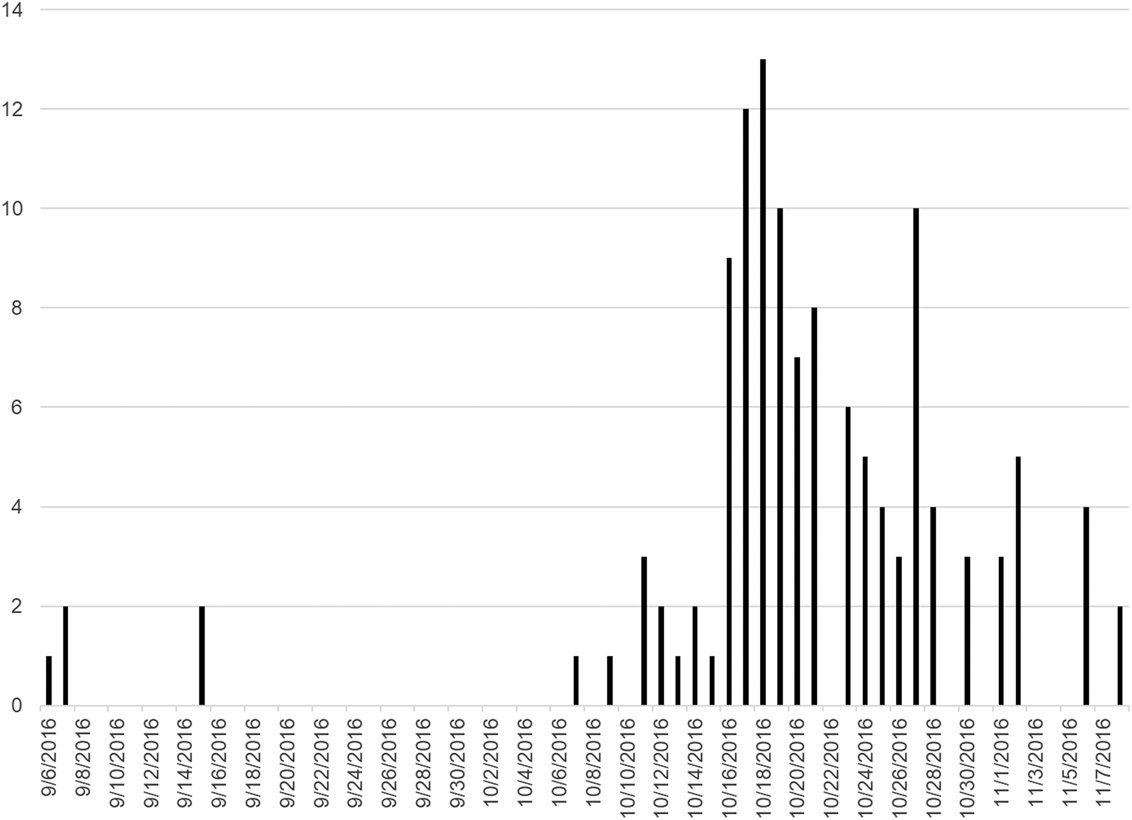
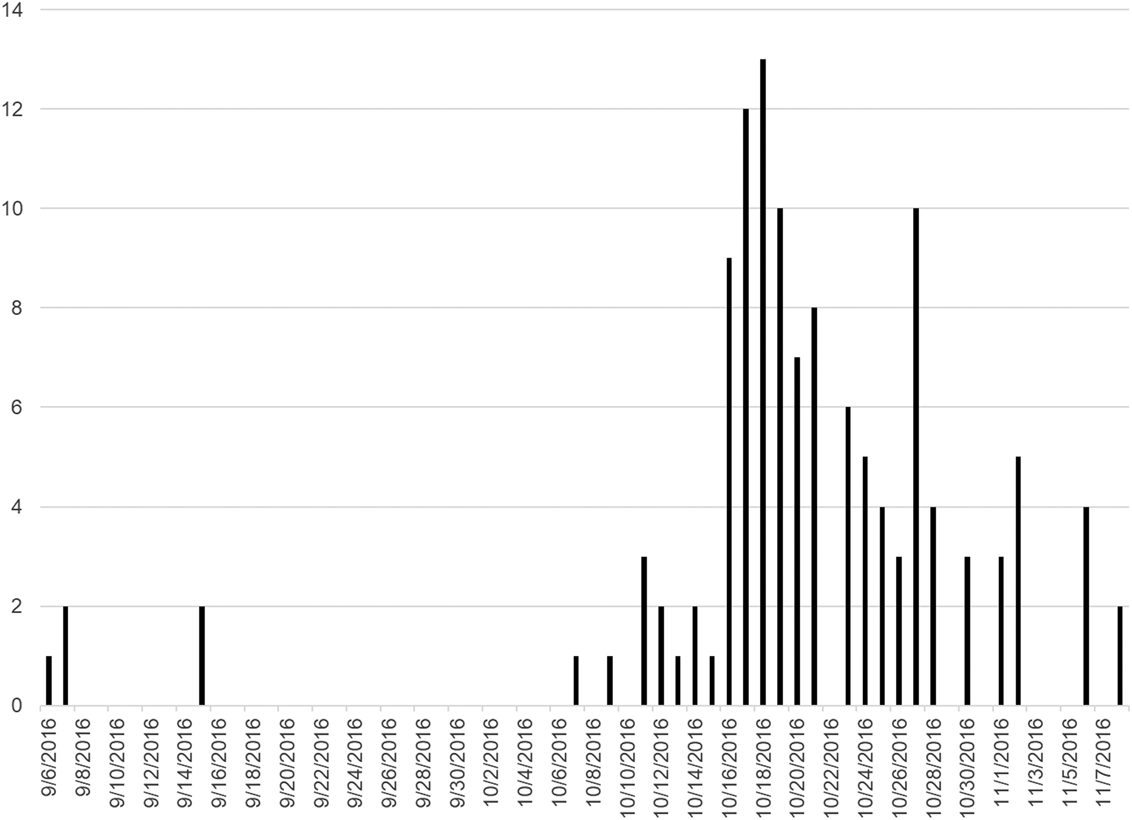
Trump’s “rigged-election” claims similarly fit into structural media biases favoring the strategic “game frame” aspects of presidential campaigns (Aalberg, Stromback, and de Vreese Reference Aalberg, Stromback and de Vreese2012; Patterson Reference Patterson1993; Valentino, Buhr, and Beckmann Reference Valentino, Buhr and Beckmann2001), as well as the need to fact-check the statements of presidential candidates—especially in light of charges that the media had been too easy on Trump during the primary. Based on previous research, there is good reason to expect that these fact checks would have had little effect on public perceptions and may have even “backfired,” thereby increasing support for the discredited claims and for Trump as a candidate (Nyhan and Reifler Reference Nyhan and Reifler2010; Thorson Reference Thorson2016). Regardless, as figure 1 reveals, the rigged-election claims set the agenda of the 2016 presidential campaign, particularly in the last several weeks of the election.
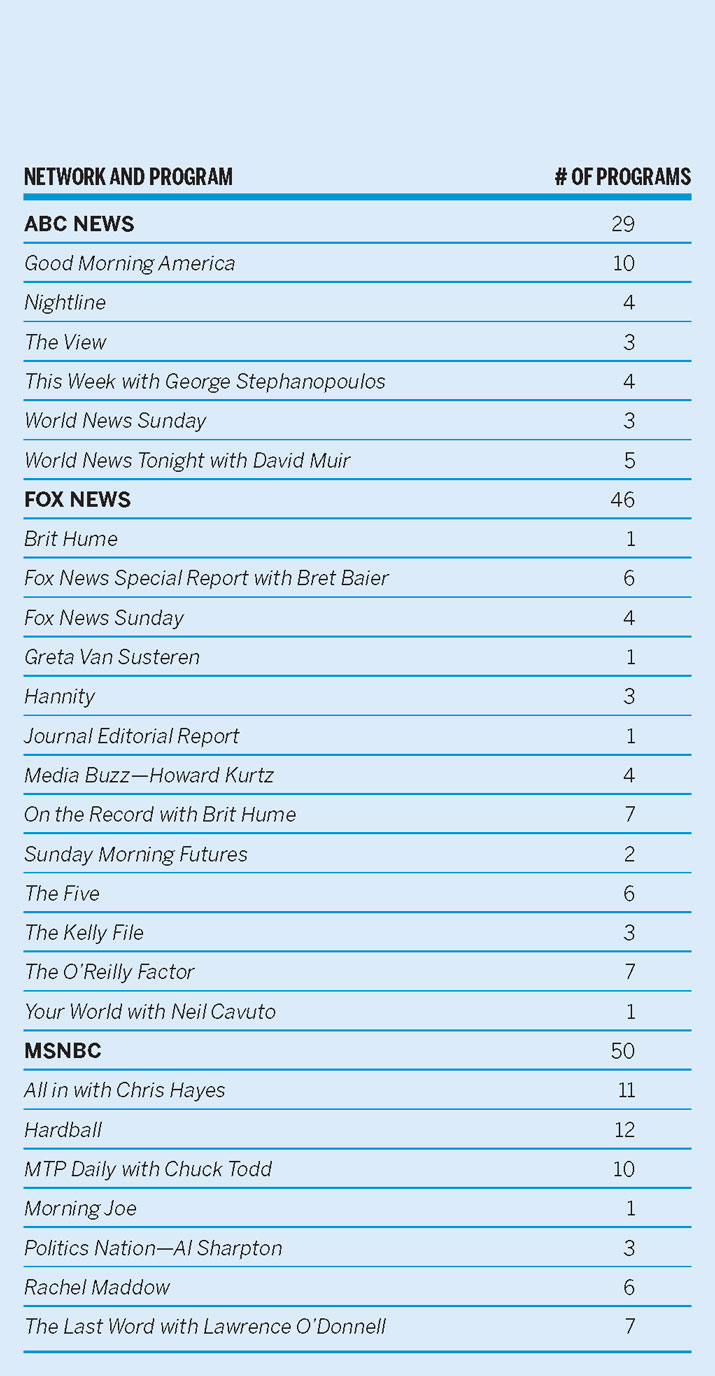
Looking across networks (see table 1), MSNBC was just as likely to cover Trump’s rigged-election claims as Fox News.
Donald Trump Rigged-Election Claims, September 6–November 8
Network and Program Coverage of Rigged-Election Claims
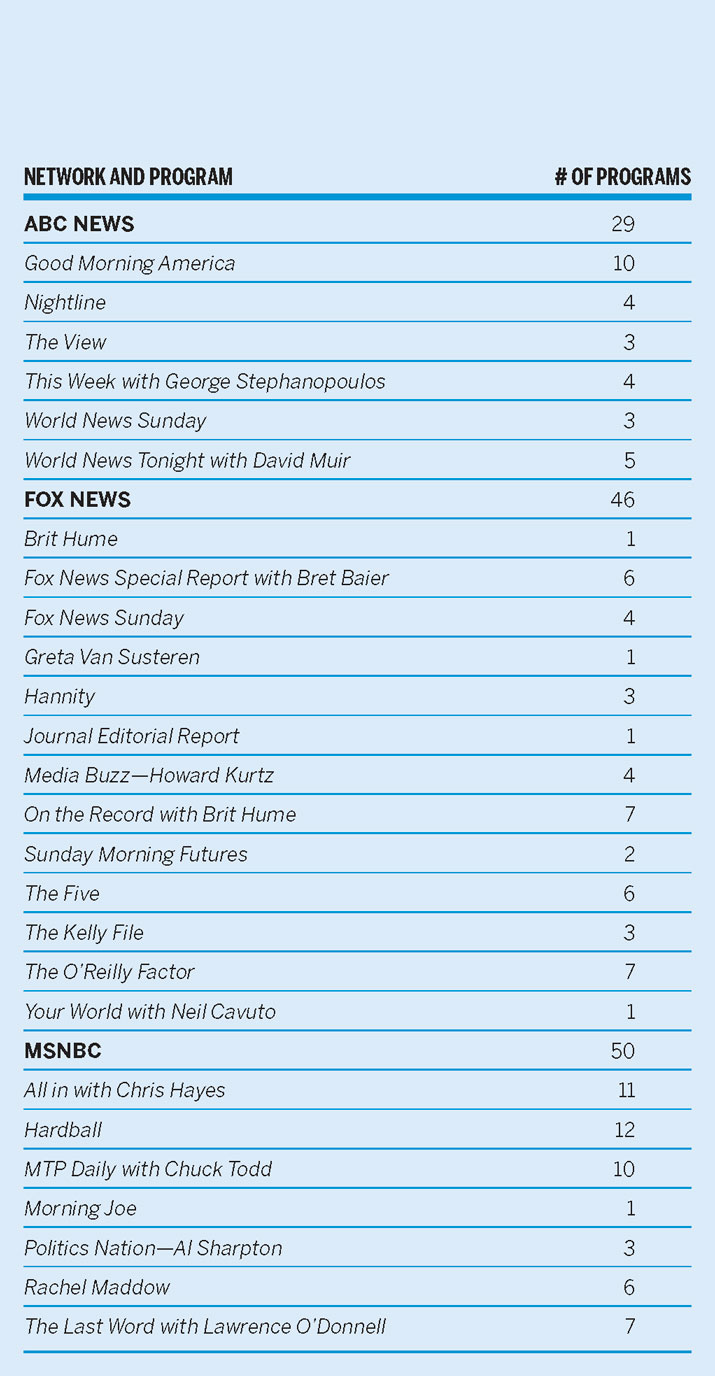
Looking across networks (see table 1), MSNBC was just as likely to cover Trump’s rigged-election claims as Fox News. ABC News covered the claims less frequently; however, this reflects format differences. We observed no clear patterns in terms of specific programs, although—perhaps surprisingly—the rigged-election claim was raised relatively frequently on ABC’s Good Morning America. The larger point is that the claim was covered relatively frequently across a number of networks and was part of the larger campaign narrative during the final weeks of the election.
Had Trump’s rigged-election claims been only about voter fraud, they might have been easily dismissed, but the claims mutated depending on to whom in the Trump campaign the media was talking and the context in which the claim was discussed. Trump’s initial claims focused on voter fraud, but the candidate and his surrogates often linked the claims to a rigged political and economic system, thereby connecting to themes of economic populism and media bias. Indeed, slightly less than 29% of the programs connected these rigged-election claims directly to questions of voter fraud, whereas 41% connected them to media bias. Rigged-election claims were stated more often in general terms and discussed in terms of their strategic meaning for the election. For example, commentators on the cable-news networks questioned whether the claims were primarily a recognition that Trump was behind in the polls and whether they would affect voter turnout. Only on Fox News did several commentators note that the claims might mobilize voters, but this was not commonplace.
It is not surprising that the networks treated these claims differently. Fox News was far more likely to connect the rigged-election claims to media bias; 61% of its programs made this connection compared to 24% on MSNBC and 38% on ABC News. In contrast, 38% of MSNBC programs connected the rigged-election claims to voter fraud compared to 24% for Fox News and 21% for ABC News.
There also were important differences among networks in how the claims were treated: 44% of all coverage was dismissive of the idea that the elections were being rigged, but it was almost universally true on MSNBC (72%) and rarely the case on Fox News (15%); ABC News fell in between (41%). The willingness to directly challenge the claims is partly accounted for by whether they were connected to voter fraud, media bias, or more general claims about the economic and political system. Connecting the rigged-election claims to voter fraud—more common on MSNBC—was easier to challenge and dismiss than broader claims about a rigged political and economic system or more general claims of media bias. Fox News, in contrast, often defended the claims by pointing to public-opinion polls showing that substantial percentages of the population believed that the elections were rigged or to similar claims made by Hillary Clinton’s primary-season challenger, Bernie Sanders.
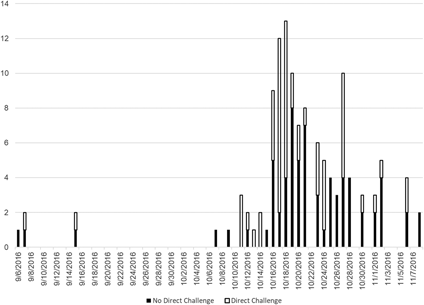
Finally, the willingness of the media to challenge Trump’s rigged-election claims changed during the course of the campaign (see figure 2). This became particularly evident as the candidate’s claims transformed from simple and refutable claims about voter turnout to more generalized claims of media bias or rigged political and economic systems. One observation, not easily characterized by the data, is how the claims changed with the electoral context. For example, sexual-assault charges were characterized by Trump as part of media efforts to rig the election for Clinton by bringing forward “unsubstantiated allegations.” The investigation into Clinton’s email server was similarly portrayed as an effort to rig the justice system and the election by not holding her accountable for alleged crimes committed as Secretary of State. Curiously, in the last week of the campaign—when FBI Director James Comey notified Congress of additional emails that required revisiting his early announcement that there was not enough evidence to pursue charges—Trump demurely observed that “Maybe it is not as rigged as I thought” (Diamond Reference Diamond2016).
Dismissive Coverage of Rigged-Election Claims, September 6–November 8

VOTER MOBILIZATION, PUBLIC OPINION, AND RIGGED ELECTIONS
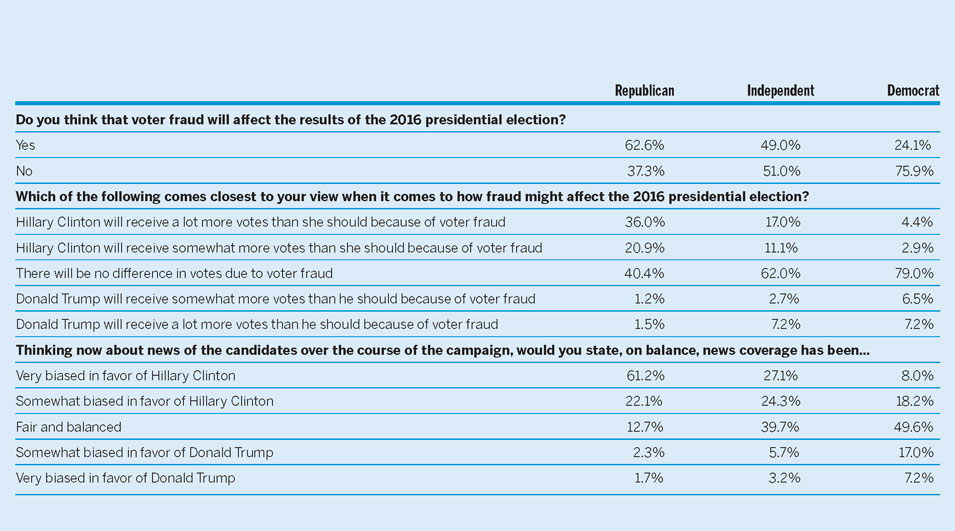
What were the effects of these claims on voters? It is not surprising that the effect largely depended on their partisan predispositions. Republicans were more likely to believe voter fraud would affect the elections and that Hillary Clinton would benefit (see table 2). They also were more likely to see the media as heavily biased against Donald Trump. Democrats were less likely to accept these claims. In addition, perceptions that Clinton would benefit from media bias and voter fraud were highly correlated (r=0.51), which suggests that at least in voters’ minds, these two issues were closely linked. The correlation was stronger for Republicans (r=0.42) and Independents (r=0.48) than for Democrats (r=0.21).
Perceptions of Voter Fraud and Media Bias by Partisan Affiliation
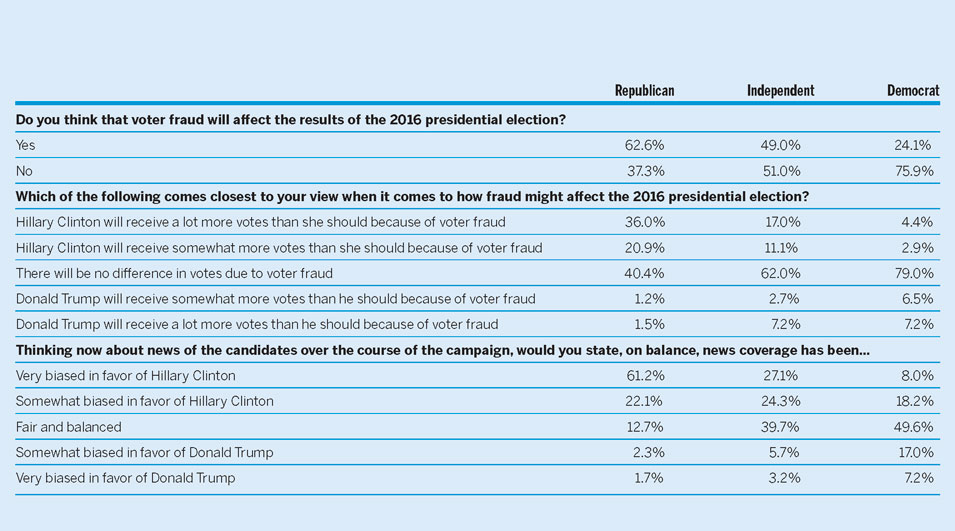
Notes: Each of these differences is significant at 0.01 or below. Partisan identification for Republicans and Democrats in the table includes partisan leaners.
To understand how these perceptions influenced the 2016 presidential election, we examined their effect first on the likelihood that individuals would vote and then on the likelihood that they would vote for Trump. For the purpose of this analysis, we measured the likelihood of voting on a 5-point scale ranging from “definitely will not vote” to “definitely will vote” or have already voted (M=4.2; SE=0.03). As with most measures of likely voter turnout, this measure was subject to social-desirability bias (Karp and Brockington Reference Karp and Brockington2005; Traugott and Katosh Reference Traugott and Katosh1979). Overall, 78% of respondents stated that they had already voted (32.5) or would definitely vote (42.1) compared to 58% who actually voted.
We used intention to vote because the data were collected before the 2016 election and other measures of self-reported or validated turnout were not available. Previous research shows that these measures not only are correlated with one another but also are associated with the same set of predictors, which suggests that researchers will not be “grossly misled” by using voter intention as an indicator of participation (Achen and Blais Reference Achen, Blais, Elkink and Farrell2015). There are, however, important differences in the relative strength of various predictors—particularly political variables such as interest and partisan affiliation (Achen and Blais Reference Achen, Blais, Elkink and Farrell2015). More generally, these results are subject to the same cautions we would offer for any work examining behavioral intent instead of actual behavior. Behavioral intent is a necessary but insufficient condition for planned behavior (Ajzen Reference Ajzen, Kuhl and Beckmann1985; Ajzen and Fishbein Reference Ajzen and Fishbein1970).
First, we have good reason to expect that Trump’s “rigged-election” rhetoric should influence individual voter intentions. Second, these shifts affect actual participation; however, the effects would be probabilistic rather than deterministic.
Within the context of electoral behavior, intent to vote shifts during the course of a campaign and in response to campaign events (Hillygus Reference Hillygus2005). This has two implications for the current study. First, we have good reason to expect that Trump’s “rigged-election” rhetoric should influence individual voter intentions. Second, these shifts affect actual participation; however, the effects would be probabilistic rather than deterministic. One limitation of this study is that we cannot be certain of the actual behavioral effects because we gauged only the effects on intent.
We measured the likelihood of voting for Donald Trump using a dichotomous variable coded 1 for respondents who stated that they would vote or already had voted for Donald Trump. Forty percent of all respondents and 42.9% of likely voters indicated that they would vote or had voted for Trump. Forty-nine percent of all respondents and 47.7% of likely voters indicated that they would vote or had voted for Hillary Clinton. The remainder reported that they would vote for Gary Johnson, Jill Stein, or another candidate.
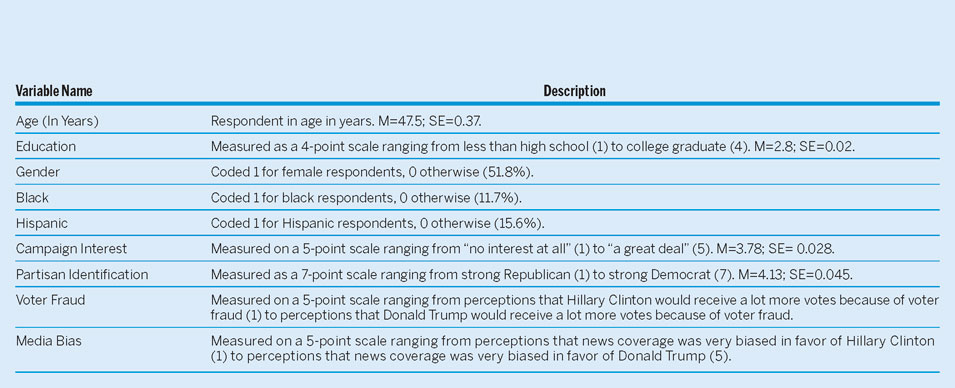
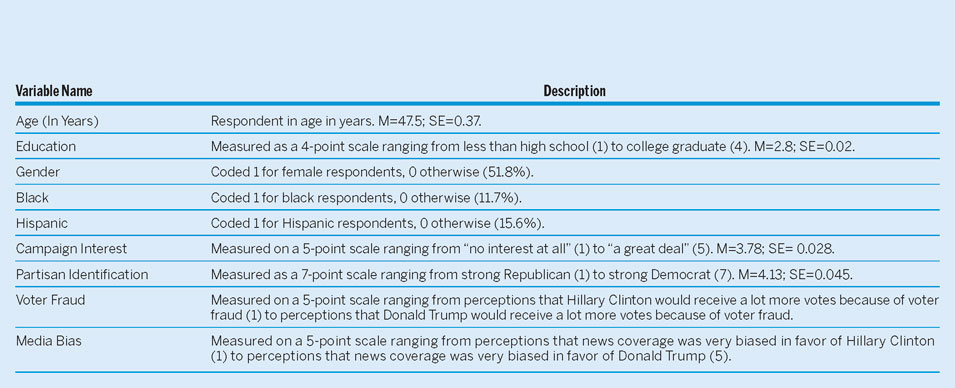
In addition to our measures gauging perceptions of voter fraud and media bias, we included partisan affiliation, age, education, race, ethnicity, gender, and income. Finally, because we expected the effect of voter fraud and media bias to be contingent on partisan affiliation, we included interactive terms for partisan affiliation/voter fraud and partisan affiliation/media bias. Coding details are in table 3.
Variable Names and Descriptions
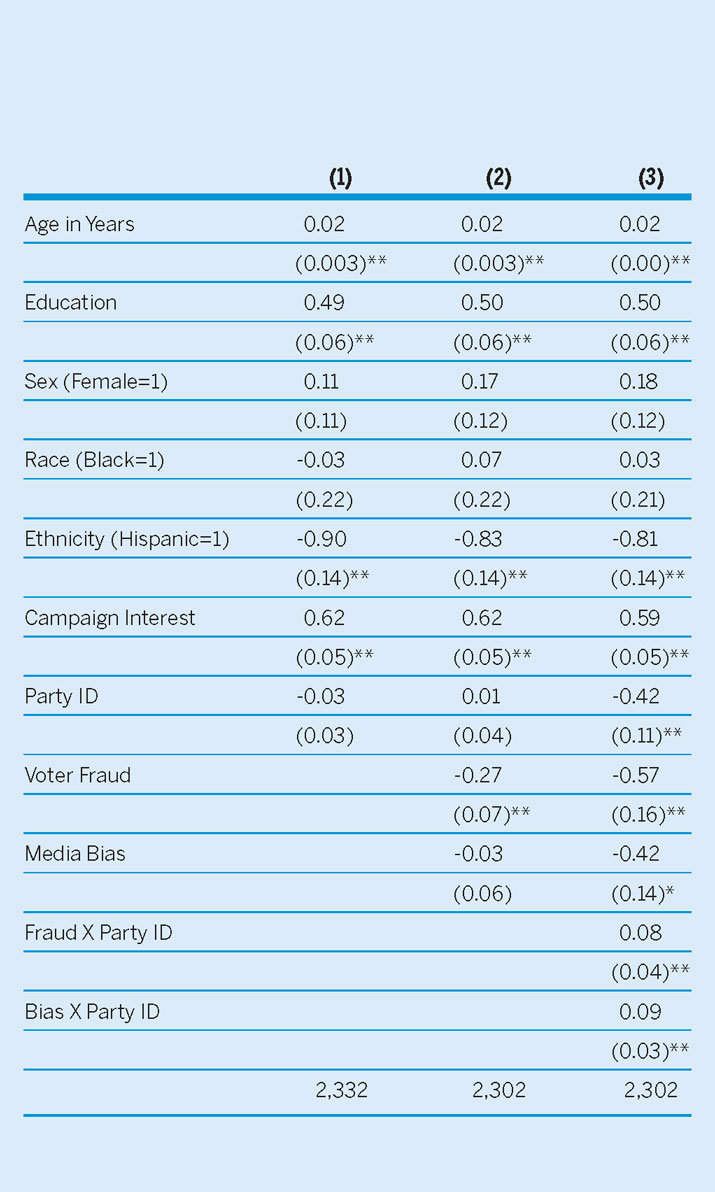
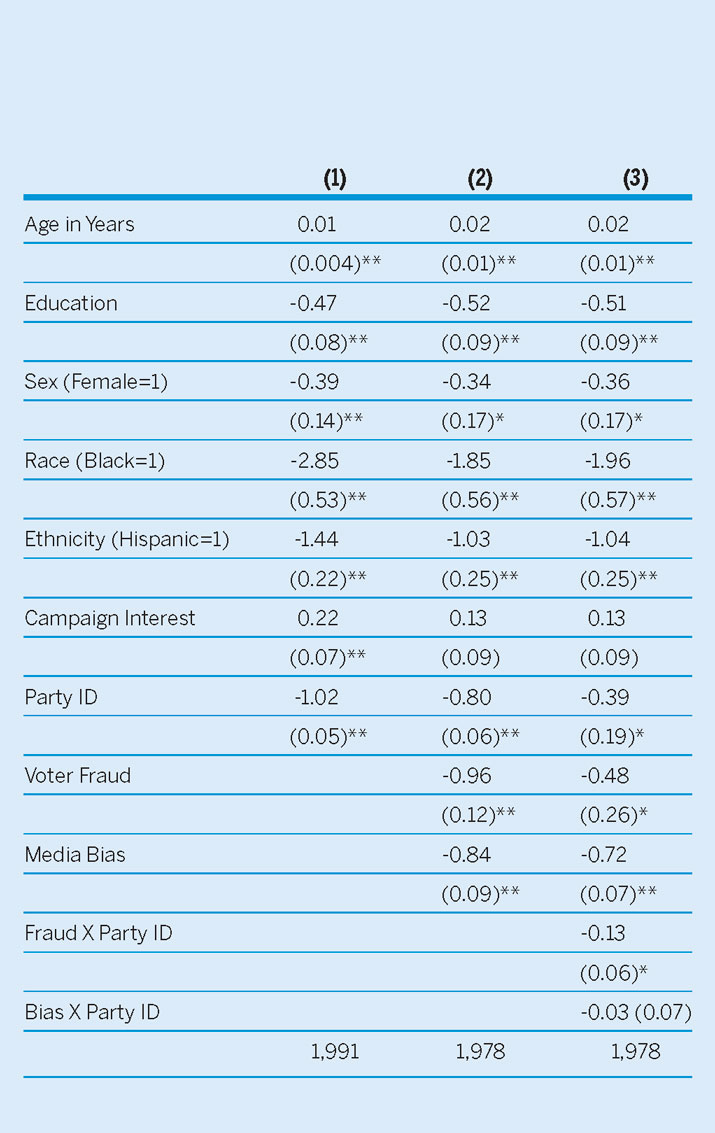
Initial results for our voter turnout models are in table 4. First, as shown in column 2, perceptions that Hillary Clinton would benefit from voter fraud are associated with a higher probability that an individual would vote in 2016 even in an additive model. This main effect is in contrast to previous research suggesting that a lack of confidence in elections should depress voter turnout (Birch Reference Birch2010; Norris Reference Norris2014). Whereas such claims may undermine confidence in democratic political institutions (a demobilizing effect), they also anger and mobilize potential voters. At least in 2016, the anger apparently outweighed any decline in institutional trust. As expected, this effect is contingent on partisan affiliation. Republicans who believed that Clinton would benefit from voter fraud were more likely to vote in the 2016 presidential election. Democrats, in contrast, were largely unaffected by these claims. We observed a similar pattern with media bias: Republicans who believed that the media were biased in favor of Clinton were more likely to vote.
Ordinal Regressions of Likelihood to Vote on Perceptions of Voter Fraud and Media Bias
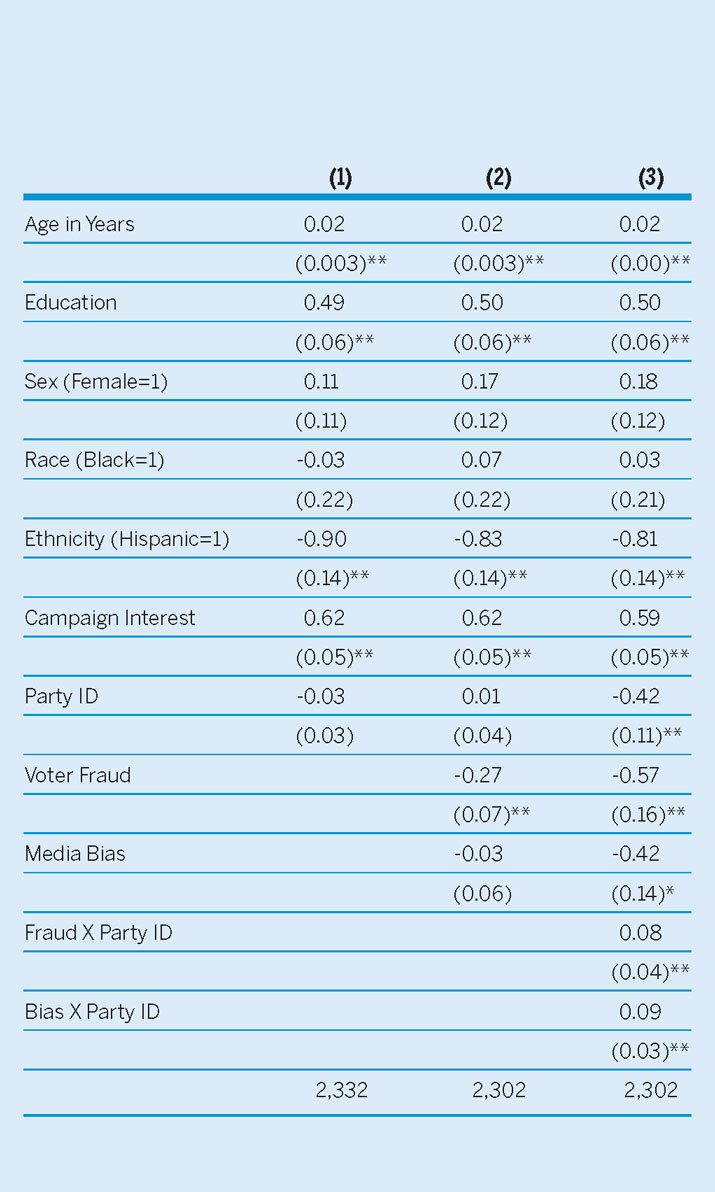
Notes: *p<0.05; **p<0.01 (one-tail tests). Coefficients and standard error for constants are not shown.
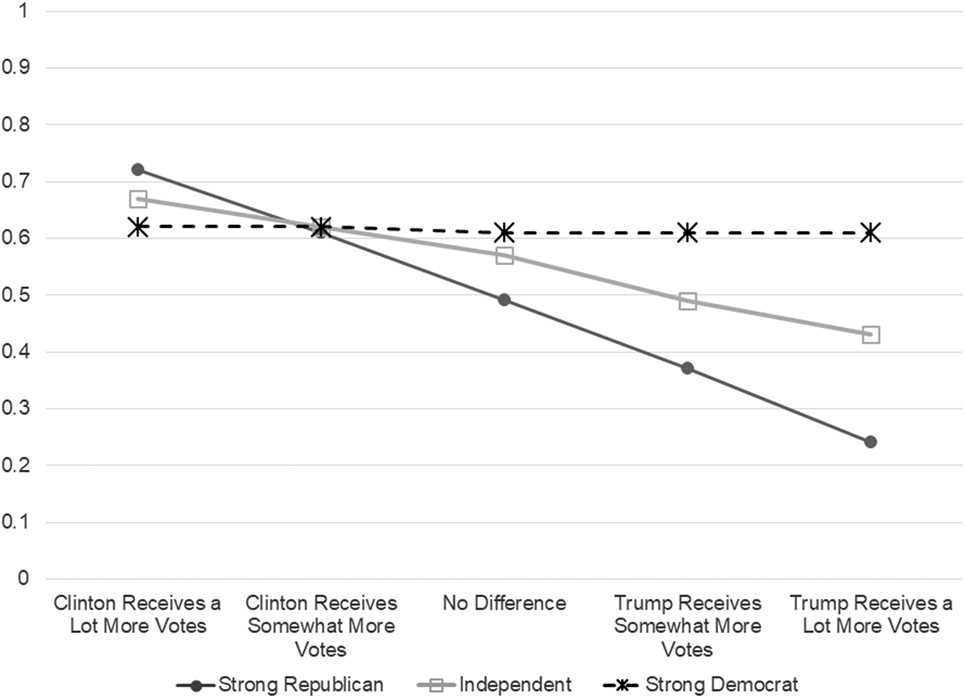
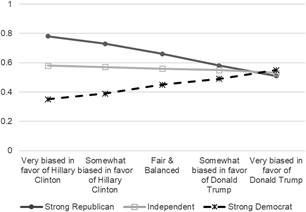
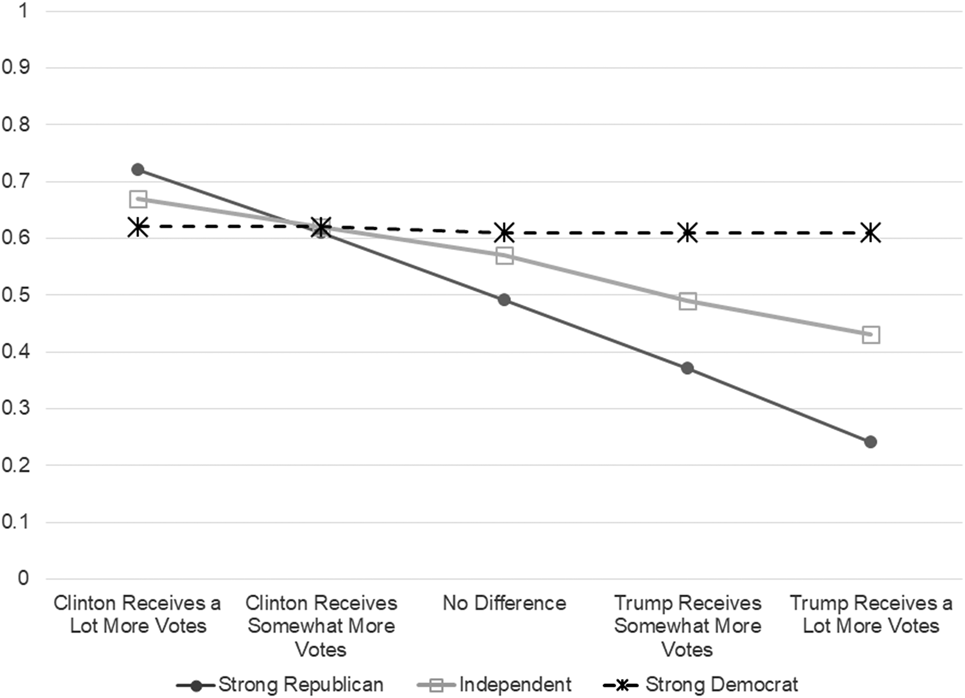
Figures 3 and 4 illustrate the contingent effects of perceptions of voter fraud and media bias on self-reported intent to vote.Footnote 1 Republicans and Independents who believed that Clinton would benefit from voter fraud were more likely to state that they would definitely vote or had already voted (figure 3). Although they were mostly unaffected by these claims, Democrats became slightly less likely to state that they would vote. We observed a similar effect for media bias illustrated in figure 4. Republicans who believed that the media were biased in favor of Clinton also were more likely to state that they would definitely vote or had already voted. Democrats who believed that the media were biased in favor of Clinton, in contrast, were less likely to vote. Trump’s rhetoric then may have had a targeted and differential effect by partisan affiliation, convincing Republicans that they needed to vote or the Democrats would steal the election.
Conditional Effect of Perceptions of Voter Fraud on Intent to Vote
Conditional Effects of Perceptions of Media Bias on Intent to Vote

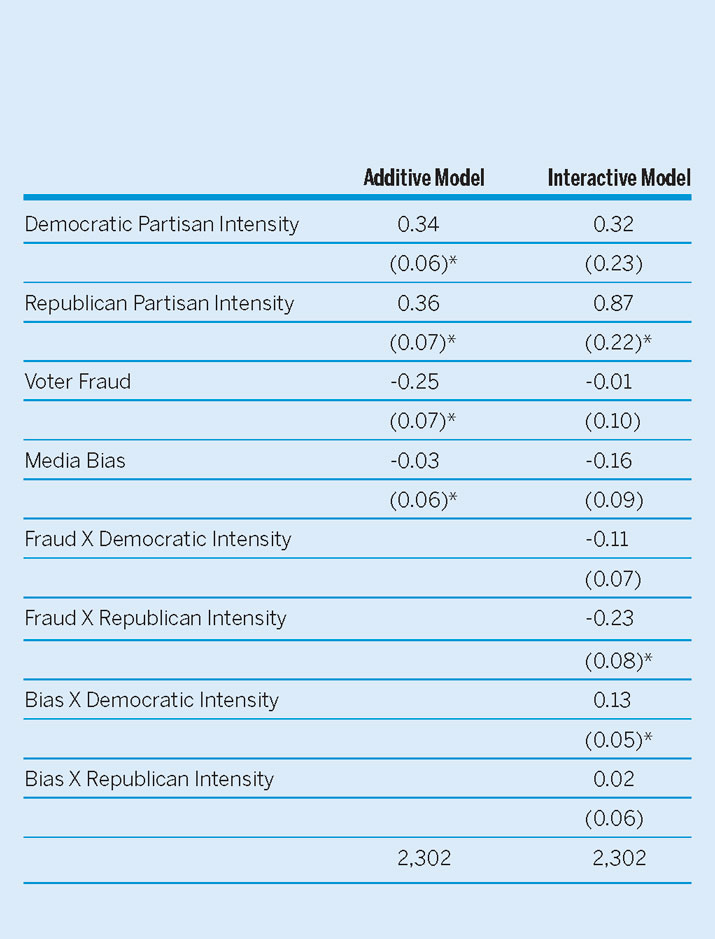
To ensure that the results presented in table 4 are not simply capturing the effects of partisan intensity, we re-ran the models including separate indicators for Democratic and Republican partisan intensity (table 5). These measures run from 0, indicating opposition partisans and Independents, to 3, indicating strong Democratic or Republican partisans. The results largely confirm the previous findings although they also offer additional nuance. In the additive model, both perceived voter fraud and perceived media bias decreased intent to vote. In the interactive model, the effects of perceived voter fraud and media bias were conditional on partisan affiliation. Republicans who believed that Hillary Clinton would receive many more votes due to voter fraud were more likely to state that they intended to vote. Similarly, Democrats who believed that the media were “very biased” in favor of Clinton were less likely to state that they intended to vote. Although two of the interactive terms are not statistically significant, there is significant multicollinearity across the model,Footnote 2 thereby decreasing the efficiency of the estimates (relative to table 4). For that reason, we prefer the estimates presented in table 4; however, it is reassuring to note that the overall pattern holds even after accounting for partisan intensity in the voter-turnout models.
Ordinal Regressions of Likelihood to Vote on Perceptions of Voter Fraud and Media Bias
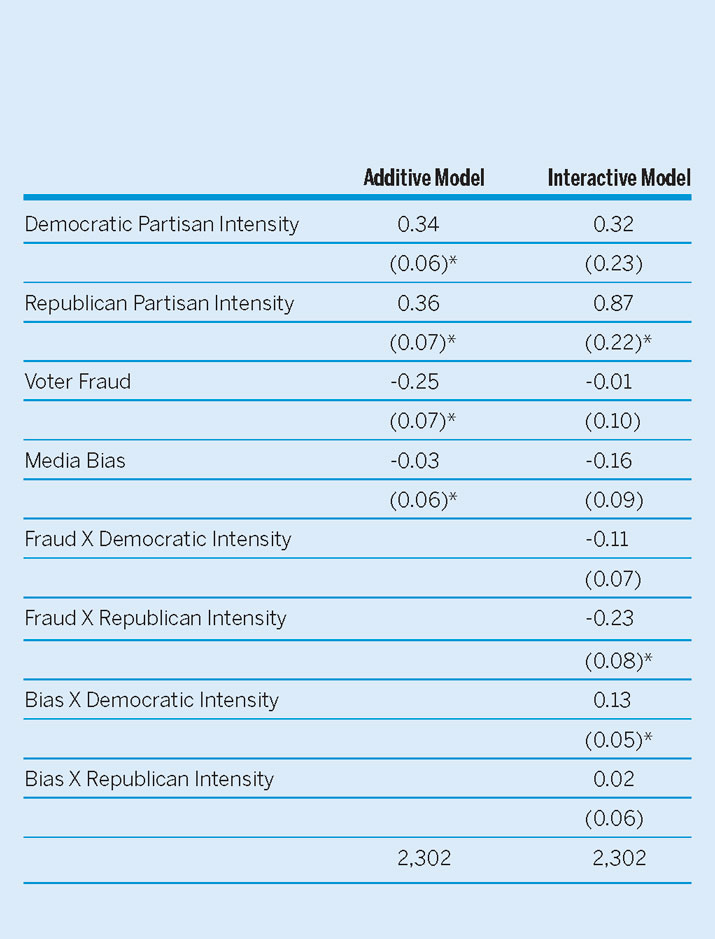
Notes: *p<0.01 (one-tail tests). The effects of the demographic variables are not shown.
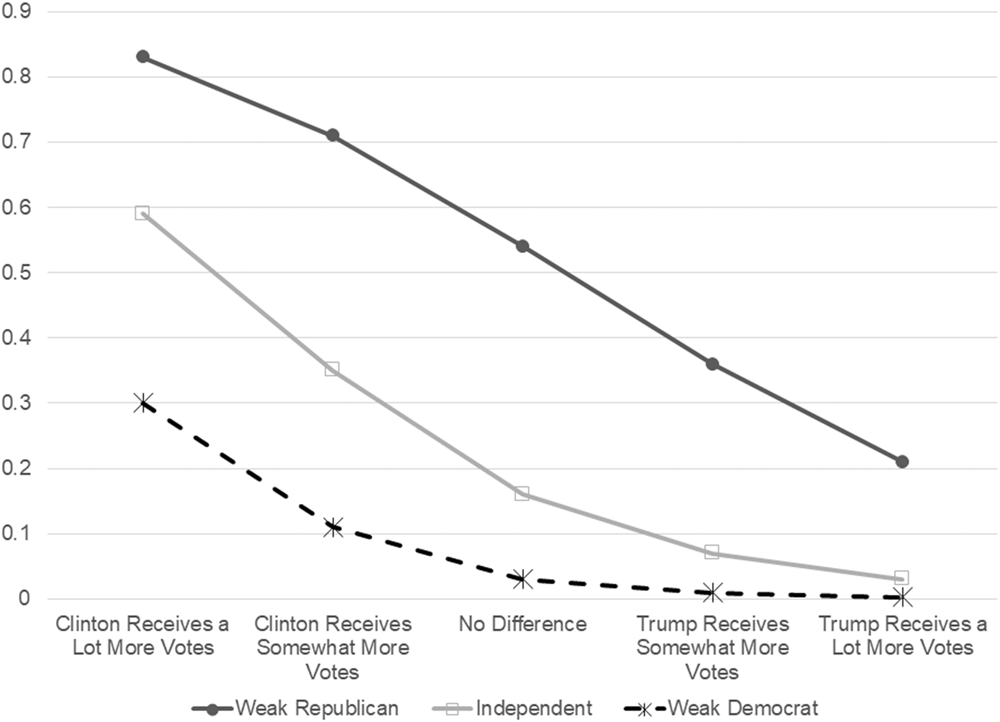
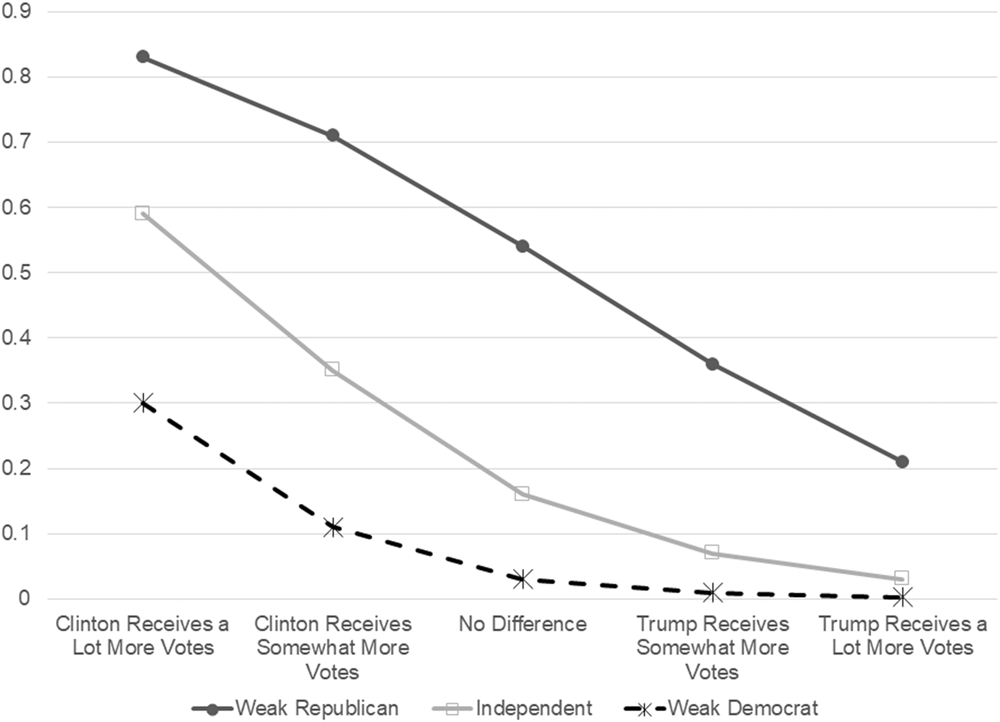
Our story does not end with voter turnout. Perceptions of voter fraud and media bias also were strongly associated with voting for Donald Trump. Looking first at the main effects (table 6), perceptions of a pro-Clinton media bias or voter fraud were strongly associated with the probability that a given respondent would vote for Trump. These effects held even after controlling for partisan affiliation, so it seems unlikely that this is only a spurious relationship capturing Republicans’ greater willingness to believe the rigged-election claims. Similar to the analysis of likely voter turnout, the effects are contingent on partisan affiliation. Self-identified Democrats and Independents who believed that Clinton would benefit from voter fraud were more likely to cast a ballot for Trump (figure 5). We found no similar effect for media bias. Believing that the media were biased in favor of Clinton increased the probability of voting for Trump, but these effects were not contingent on individual partisan affiliation.
Logistic Regress of Trump Vote on Voter Fraud and Media Bias
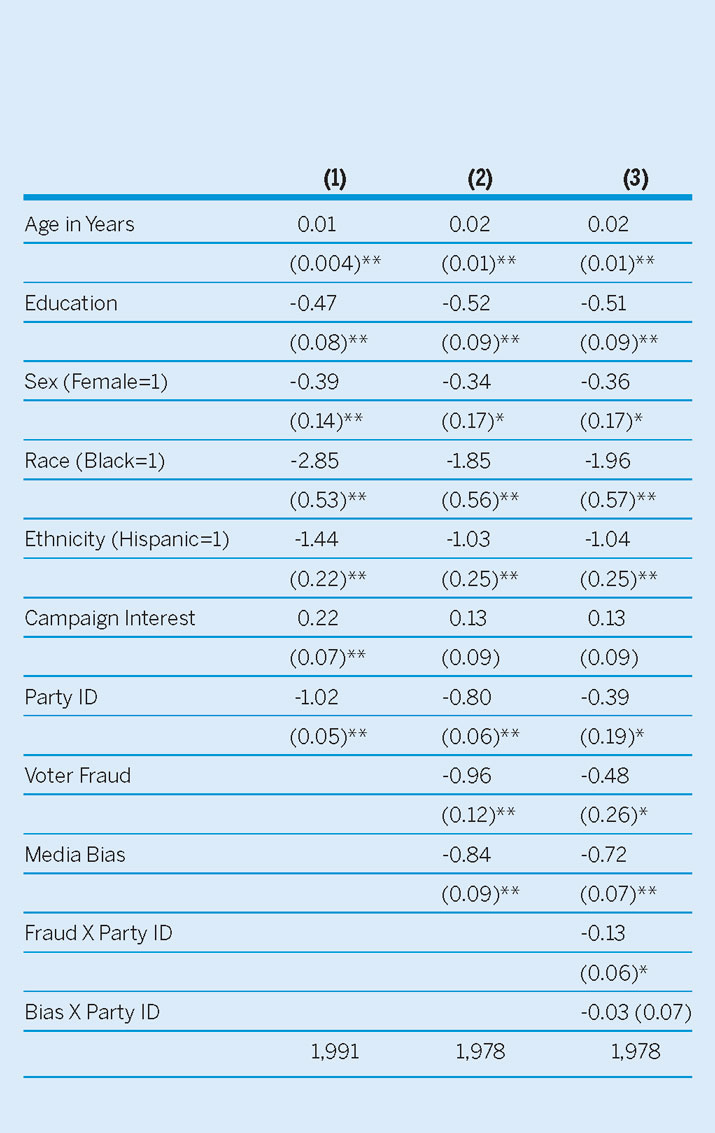
Note: *p<0.05; **p<0.01 (one-tail tests).
Conditional Effect of Perceptions of Voter Fraud on Vote for Donald Trump
CONCLUSIONS
Donald Trump’s claims of a rigged election surprised long-term political observers. Why, after all, would a candidate work to convince his supporters that the election was rigged in favor of his Democratic opponent? Such a strategy could adversely affect confidence in the electoral process and, subsequently, drive down voter participation. This article shows that, instead, the claim advanced Trump’s strategic objectives in several important ways. First, it drove the campaign agenda, focusing news coverage of the campaign on rigged-election claims in the days and weeks before the election. Second, by generalizing the claims, it served as a mechanism to discount media accounts of sexual assault as media bias while focusing attention on the FBI investigation of Hillary Clinton’s email server. Claims of rigged elections were not limited to voter fraud; they also included broader claims of media bias and a rigged economic and political system. Third, the claims drove voter turnout among Republican voters and made it more likely that Democratic and Independent voters would cast a ballot for Trump. These claims likely had adverse consequences for political trust, but they angered and mobilized Trump supporters against a political system that they perceived as rigged in favor of Clinton.
Although we found the available evidence convincing, we offer a word of caution. Because we used voter intention rather than self-reported or validated voter turnout, our estimates likely overstate the effect of Trump’s rigged-election rhetoric on actual voting behavior (Achen and Blais Reference Achen, Blais, Elkink and Farrell2015). Even so, intent to vote typically is perceived as an important precursor to voting and varies during the course of a campaign (Hillygus Reference Hillygus2005). Campaign messages matter for their potential to mobilize or demobilize groups of voters, and are reflected in subsequent shifts in intent to vote. In this case, Trump’s rhetoric had a differential effect on partisans, angering and mobilizing Republicans while demobilizing Democrats. The claims had exactly the effect desired in a polarization strategy of the type first deployed by Jesse Helms in North Carolina and later perfected at the national level by Lee Atwater in 1988. Rigged elections acted as a wedge issue and succeeded in demobilizing the opposition while emboldening loyalists in a polarized environment (Gaddie and Dye Reference Gaddie and Dye2018, 210).Footnote 3 In addition—to the extent that such claims were believed—they appeared to persuade weak partisans and Independents to support Trump over Clinton. Overall, Trump’s rigged-election claims advanced rather than undermined his campaign.