Implications
The welfare implications of piglet processing, in particular castration and tail docking, have been disputed for several years. Little is known of the stress and pain induced by ear tagging piglets, which is a routinely performed identification procedure necessary for tracing back the respective pig from the slaughterhouse to the farm where it was born. A comparison of ear tagging with other procedures performed at the same age can help evaluate the amount of distress caused by ear tagging. As assessed using changes in the cortisol response, ear tagging seemed to cause substantial distress to piglets. However, further research is needed to confirm these results.
Introduction
Piglets are subjected to several processing procedures early in life. Usually in the first 3 days of life, their teeth are grinded and they are supplied with iron. In Germany, according to the Protection of Animals Act (Federal Ministry of Justice and Consumer Protection, Reference Barz, Ritzmann, Breitinger, Langhoff, Zols, Palzer and Heinritzi2015a) tail docking without anaesthesia is allowed only when piglets are <4 days of age. In the European Union, tail docking is used as a routine means of counteracting tail biting in >90% of swine farms (EFSA, Reference Gallagher, Giles and Wynn2007). As stated in the EU directive 2008/120/EG, tail docking is only considered acceptable if other approaches to prevent tail biting have been attempted and have proven futile. However, until tail biting can be more thoroughly controlled, it is likely that the practice of tail docking will continue. By the 7th day of life, castration is performed. With this procedure, according to the German quality assurance system analgesia is required (QS Quality Scheme for Food, Reference Carroll, Berg, Strauch, Roberts and Kattesh2016) and according to the German animal protection law (Federal Ministry of Justice and Consumer Protection, Reference Barz, Ritzmann, Breitinger, Langhoff, Zols, Palzer and Heinritzi2015a) castration without anaesthesia will be prohibited by 2019, though an effective alternative has yet to be found. In most European countries, ear tagging is routinely performed. Under the German Viehverkehrsverordnung (Federal Ministry of Justice and Consumer Protection, Reference Bland2015b), an Animal Transportation and Identification Act, such identification (with a specified inscription) is obligatory before weaning in order to be able to retrace the origin of any pig. As welfare topics become increasingly important, the scrutinising of these procedures must not be neglected. Several studies have evaluated castration and tail docking and the impact that these procedures have on the welfare of the piglets (Von Borell et al., Reference Von Borell, Baumgartner, Giersing, Jaggin, Prunier, Tuyttens and Edwards2009; Sutherland and Tucker, Reference Sutherland, Bryer, Krebs and McGlone2011), their physiological and behavioural responses (Zöls et al., Reference Zöls, Ritzmann and Heinritzi2006; Llamas Moya et al., Reference Marchant-Forde, Lay, McMunn, Cheng, Pajor and Marchant-Forde2008; Torrey et al., Reference Torrey, Devillers, Lessard, Farmer and Widowski2009), the economic consequences and alternative methods (Carroll et al., 2006; Kilchling, Reference Kitchell2010; Sutherland et al., Reference Sutherland and Tucker2012). However, very few studies have evaluated the impact of ear tagging on pig welfare and none have compared the relative distress caused by ear tagging with other painful husbandry procedures (castration and tail docking) or examined the effect of analgesia. However, ear tagging is a standardised and routinely performed procedure routinely conducted on any swine farm in Germany (as well as with some other species, e.g. ruminants) as means of identification and should, therefore, be performed without causing unnecessary discomfort for the animals.
The main objective of the present study was to compare the cortisol response with ear tagging, castration and tail docking in order to illustrate the relative distress caused by these three procedures. The secondary objective was to evaluate the efficiency of analgesia (meloxicam) to reduce the cortisol response to ear tagging, tail docking and castration.
Material and methods
The protocol for the study was submitted to and approved by the government of Upper Bavaria (approval number 55.2.1.54-2532.2-26-12).
Animals
The present study was conducted in the teaching and experimental farm Thalhausen of the Centre of Life and Food Sciences Weihenstephan. The farrow-to-finish farm consisted of ~120 sows which farrowed in a 3-week batch. The piglets (common commercial cross-breds) were housed in farrowing units on slatted floor, except for the nest area which was made up of concrete floor and provided with shavings and an IR heat lamp. The sows were fed with wet feed; the suckling piglets were supplied with dry feed as of their 2nd week of life. All pigs had free access to water. Teeth were grinded by the staff on the day of farrowing. All piglets of the study received oral iron supplementation on their 1st day of life and an intramuscular iron supplementation on day 8 by the conducting person. No other painful procedures were carried out before the start of the study.
Data were collected from 210 male piglets from 62 litters in the period from August 2012 to April 2013. Inclusion criteria were a good general condition, a healthy sow and a minimum birth weight of 1300 g. Piglets from litters in which cases of thrombocytopenic purpura or myoclonia congenita occurred were excluded, as well as piglets with congenital myofibrillar hypoplasia, hernia scrotalis or hernia inguinalis. On their 1st day of life, the piglets were weighed and a consecutive number was written on their back. Within each batch, randomisation into procedure groups was performed according to their birth weight. Thus, within one litter several or all study groups were represented. The respective procedure was conducted (always by the same person) on day 3 or 4 of life.
Treatments
Each of the seven study groups consisted of 30 piglets: handling (H): control group in which the piglets were taken out of their pen and held for 30 s in the arm of an assisting person. Castration (C): the piglets were restrained in a castration device (piglet castrator; Albert Kerbl GmbH, Buchbach, Germany). The scrotal area was superficially cleaned with alcohol and wiped dry. Two scrotal incisions were set by scalpel and the testes were removed by cutting the testicular cord. The wound was disinfected. Castration with prior analgesia (CM): 30 min before castration, meloxicam (0.4 mg/kg Metacam 5 mg per ml; Boehringer Ingelheim Vetmedica GmbH, Ingelheim am Rhein, Germany) was applied by intramuscular injection (Sterican needles 0.8×25 mm; B. Braun Melsungen AG, Melsungen, Germany). The following procedure equalled that of group C. Ear tagging (ET): the piglets were held in the arm of an assisting person, while the conducting person ear tagged them with ear tag pliers (Twintag Applicator; Albert Kerbl GmbH). Ear tags for suckling piglets were used (Twin Tags, Albert Kerbl GmbH). Ear tagging with prior analgesia (ETM): 30 min before ear tagging, meloxicam (0.4 mg/kg Metacam 5 mg per ml) was applied by intramuscular injection (Sterican needles 0.8×25 mm). The following procedure equalled that of group ET. Tail docking (TD): the piglets were held in the arm of an assisting person, while the conducting person cut the tail by one-third with side cutting pliers (type V2A, straight, Schippers GmbH, Kerken, Germany). Tail docking with prior analgesia (TDM): 30 min before castration, meloxicam (0.4 mg/kg Metacam 5 mg per ml) was applied by intramuscular injection (Sterican needles 0.8×25 mm). The following procedure equalled that of group TD.
Blood analysis
From each piglet five blood samples were taken: 30 min before the procedure and 30, 60 min, 4 and 7 h post-procedure. For each sample a maximum of 3 ml blood was taken from the Vena cava cranialis (monovette ‘Primavette V Serum’, 7.5 ml; KABE Labortechnik GmbH, Nümbrecht-Elsenroth, Germany; Sterican needles 0.8×40 mm, B. Braun Melsungen AG). For sampling, the assisting person restrained the respective piglet on his/her knees with the piglet in a supine position. Always the same person was responsible for drawing blood.
Immediately after blood collection, samples were cooled down to a temperature of 4°C in ice water and centrifuged at 3000×g for 10 min at 4°C on the same day. Aliquots of serum were kept at −20°C until assayed for cortisol. Measurement was carried out in the Clinic for Swine, Ludwig-Maximilians-University Munich, Oberschleissheim, Germany, by using the device Elecsys (Roche Diagnostics GmbH, Mannheim, Germany), which is based on an electrochemical luminescence technology. The device was calibrated according to specification and the accuracy of the values was daily tested by running control samples.
Statistical methods
Cortisol data were analysed using the programs IBM SPSS Statistics 20.0 and Microsoft Office Excel 2010 with individual pigs as the experimental unit. By conducting the Kolmogorov–Smirnov test (Lilliefors significance correction applied) it was shown that data was not normally distributed. Next a Kruskal–Wallis test revealed statistical significances at the sample times 0.5, 1 and 4 h post-procedure. Subsequently, an exact Mann–Whitney U test (one-way) was used as a post hoc test. In general, a level of significance of 5.00% was applied. Correction for multiple comparisons (H with C; H with ET; H with TD; C with ET; C with TD; ET with TD) was carried out by applying the Bonferroni–Holm adjustment in order to minimise type I error; the levels of significance were therefore set to 0.83%, 1.00%, 1.25%, 1.67%, 2.50% and 5.00% starting with the most significant P value within the comparisons (Holm, Reference Keita, Pagot, Prunier and Guidarini1979). The area under the curve (AUC) was computed for each procedure group according to specification in Bland (2007), Kruskal–Wallis test showed significance and Mann–Whitney U test (one-way, exact) was likewise applied. In order to gain information on the biological importance of an effect, the effective size (Cohen’s d) was calculated as specified in Nakagawa and Cuthill (Reference Noonan, Rand, Priest, Ainscow and Blackshaw2007) with d<0.5 presupposed as small effect, d⩾0.5 as medium effect and d⩾0.8 as large effect. Data are presented as means with the standard deviation as indicator for the dispersion of the data. A pooled standard error represents the accuracy of estimate.
Results
Cortisol responses of the procedures compared with handling
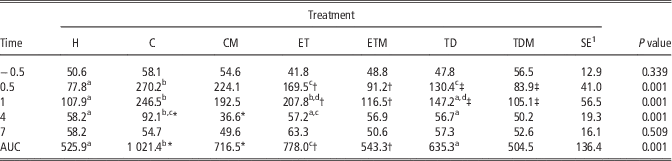
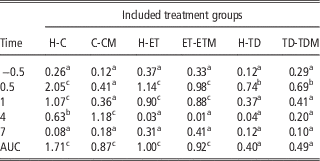
Serum cortisol in ET piglets peaked at 60 min and reached basal levels at 4 h (Supplementary Figure S1). The level was 118% higher than with H piglets at 30 min (P<0.001) and 93% higher at 60 min (P=0.001) post-procedure (Table 1). Effective sizes were large at both time points (Table 2). The AUC confirmed these observations (Supplementary Figure S1), as it also showed a significant difference between H and ET piglets (P<0.001) with a large effective size (Table 2).
Cortisol concentration (means±SD, nmol/l) of treatment groups, each piglet group with n=30 (H, C, CM, ET, ETM, TD and TDM), at single time points (h) and as area under the curve (AUC)

H=handling; C=castration without analgesia; CM=castration plus meloxicam administered at −0.5 h; ET=ear tagging without analgesia; ETM=ear tagging plus meloxicam administered at −0.5 h; TD=tail docking without analgesia; TDM=tail docking plus meloxicam administered at −0.5 h.
a,b,c,dComparison of the procedures H, C, ET and TD, means within a row with a different letter superscript differ significantly (Bonferroni–Holm adjustment applied).
*,†,‡CM, ETM and TDM are different at P<0.05 from C, ET and TD, respectively.
1 SE=pooled SE, Satterthwaite approximation applied.
Effective size (d) of cortisol of treatment groups, each piglet group with n=30 (H, C, CM, ET, ETM, TD and TDM), at single time points (h) and as area under the curve (AUC)

H=handling; C=castration without analgesia; CM=castration plus meloxicam administered at −0.5 h; ET=ear tagging without analgesia; ETM=ear tagging plus meloxicam administered at −0.5 h; TD=tail docking without analgesia; TDM=tail docking plus meloxicam administered at −0.5 h.
a Small effective size with d<0.5.
b Medium effective size with d⩾0.5.
c Major effective size with d⩾0.8.
Post-procedure cortisol concentrations of C piglets rose significantly higher (247%) than those of H piglets, peaking at 30 min (P<0.001), and effectuating a very large effective size (Tables 1 and 2). At 60 min (P<0.001; large effective size) as well as at 4 h (P=0.01; medium effective size) cortisol levels were 128% and 58% higher, respectively. At 7 h the concentrations returned to basal levels (Supplementary Figure S1). The AUC of C piglets was 94.2% higher than that of H piglets (P<0.001, large effective size).
Although rising until the 60 min value, cortisol of TD piglets differed to a significant extent from H piglets only at 30 min post-procedure (P<0.001; 68% higher cortisol concentration) and achieved only a medium effective size. The AUC of TD piglets did not differ significantly from H piglets (P=0.171) with a small effective size (Table 2). At 4 h basal levels were reached (Supplementary Figure S1).
Cortisol responses of the different procedures compared with each other
In contrast to castration, ET cortisol levels were significantly lower (59%) only at 30 min (P=0.001; large effective size) than C piglets; due to a further rise in cortisol levels in ET piglets, no significant effect could be seen at 60 min as the cortisol curve of C piglets was already on the decline (Supplementary Figure S1). Nonetheless, considering the AUC both procedures differed significantly from each other (P=0.012) with a medium effective size.
In contrast, at no time point could a significant difference from TD to ET piglets be observed and the effective size remained small. Cortisol levels of TD piglets were at 30 min 30% and at 60 min 41% lower than ET piglets. The AUC of TD was significantly smaller than with ET piglets (P=0.019).
In comparison with castration, tail docking produced a significantly lower cortisol level at 30 min (P<0.001; large effective size), 60 min (P=0.001; medium effective size) and 4 h (P=0.007; medium effective size). The corresponding cortisol levels were 107%, 67% and 63% lower than with C piglets, respectively. The AUC of TD piglets was significantly smaller than C piglets (P<0.001).
Cortisol responses of the procedures with and without pain medication
A significant analgesic effect could be found when comparing ET with ETM piglets, with ETM piglets presenting 86% lower cortisol levels at 30 min (P=0.001) and 78% at 60 min (P=0.003); at both sample times large effective sizes were attained. The AUC confirmed these observations (Supplementary Figure S2B), as it also showed a significant difference between ET and ETM piglets (P=0.001) with a large effective size (Table 2).
With tail docking, analgesia (TDM piglets) effectuated a significant difference at 30 min (P=0.003; 55% lower cortisol level) and at 60 min (P=0.036; 40% lower cortisol level). A medium effect at most was attained (Table 2). The AUC did not differ significantly (P=0.077).
Comparing the post-procedure cortisol concentrations of castrated piglets (Table 1), pain medication effectuated a large effect (AUC 29.85% lower under analgesia) when taking both duration and intensity of the cortisol elevation into account; the difference was highly significant (P of AUC<0.001). Regarding the individual sample times, a tendency towards a significant effect of pain medication could be seen at 30 min (P=0.077) and at 60 min (P=0.061); at 4 h this difference was significant (P<0.001) and a large effective size was achieved (Table 2). CM piglets reached basal levels at 4 h (Supplementary Figure S2A), whereas C piglets did so only at 7 h.
Discussion
Indirect physiological and behavioural parameters are of utmost importance when assessing pain in animals. Numerous studies corroborate the significance of cortisol as a relevant parameter to evaluate stress and pain in pigs (Keita et al., Reference Kilchling2010; Prunier et al., 2012). Langhoff (Reference Leslie, Hernández-Jover, Newman and Holyoake2008) ascertained that the level of cortisol correlates with pain-dependant changes in behaviour. A further advantage is the temporally delayed increase of cortisol (Prunier et al., Reference Prunier, Mounier, Le Neindre, Leterrier, Mormede, Paulmier, Prunet, Terlouw and Guatteo2005); thereby facilitating measuring its peak concentration. However, there are limitations to using cortisol as a singular measure of stress in animals. Some authors (Molony and Kent, Reference Nakagawa and Cuthill1997; Kluivers, Reference Langhoff2010) regard the ceiling effect of cortisol as a shortcoming for its usability as a stress and pain parameter. They argue that the true peak of a pain reaction cannot be distinguished, as the cortisol concentration does not continue to increase when its maximum concentration is reached, which is likely due to adrenal exhaustion. For the present investigation, this argument is likely only true for that the pain of C piglets is possibly underestimated. Circadian changes in cortisol was unlikely to have affected the cortisol responses of piglets in the present study as male piglets display such a pattern only from day 10 of life (Gallagher et al., Reference Holm2002). Furthermore, in order to eliminate the possibility of minor stressors or environmental factors influencing the cortisol rise, all procedures were done both with and without pain medication in the present study, thus permitting us to discern a pain-associated response. In addition, a control group was included which enabled us to differentiate a stress reaction provoked by picking up, restraining and venipuncture. By sampling blood before every procedure, we established an individual baseline cortisol value for each piglet. Only male piglets were included in the study, considering that there is no interaction between sex and tail docking or ear notching (Torrey et al., Reference Torrey, Devillers, Lessard, Farmer and Widowski2009) and castration is obviously only possible with male piglets. According to Mellor and Stafford (Reference Merlot, Mounier and Prunier2004) the magnitude of a response should be assessed, that is both duration and maximum height. The relevance of determining the AUC could be confirmed in the present study especially when comparing castration with and without analgesia: with respect to the individual sample times only at 4 h a significant difference could be seen, whereas the AUC produced a substantially significant difference. This may indicate that a larger sample size is needed for evaluating individual sample times than for evaluating an AUC, as individually varying progressions in the cortisol curves lead to greater variability in data.
Procedure groups without analgesia
Castration
In the present study the pain response of the castration group exceeded by far that of the other procedure groups, both at individual time points as well as the AUC. This is in concurrence with previous studies. Prunier et al. (Reference Prunier, Mounier, Le Neindre, Leterrier, Mormede, Paulmier, Prunet, Terlouw and Guatteo2005) for instance found that neither the distress of tail docking nor tooth resection came close to castration in regards to elevated plasma cortisol, ACTH, glucose and lactate concentrations.
Tail docking
The different ways to perform the procedure have already been described in order to identify the least stressful method (Sutherland and Tucker, Reference Sutherland, Bryer, Krebs and McGlone2011). Marchant-Forde et al. (Reference Mellor and Stafford2009) found no effect of treatment on cortisol, but cauterisation produced greater vocalisations and poorer growth rates than cold clipping with side cutting pliers. In Sutherland et al. (Reference Sutherland, Davis, Brooks and Coetzee2008) the blunt trauma cutter group and the cauterisation group equalled at 30 min. At that time point, the cauterised piglets peaked, whereas in the blunt trauma cutter group the cortisol concentration continued to rise until 60 min. However, as the behavioural observations did not show any difference between both docking methods, it can be discussed that the reason for the less elevated cortisol response is rooted in the obliteration of the nociceptors by cauterisation (Sutherland et al., Reference Sutherland, Davis, Brooks and Coetzee2008), thus the hypothalamic–pituitary–adrenal axis may not be activated to the same degree as with an open wound. Furthermore, wound healing is thought to be better when using side cutting pliers (Kilchling, Reference Kitchell2010). Tail docking is a painful process for the piglet as is already shown in several studies (Noonan et al., Reference Prunier, Mounier and Hay1994; Zhou et al., Reference Zhou, Yang, Zhao, Huang, Wang, Wang, Yin, Shen, Wang and Schinckel2013). This could be confirmed in this investigation. However, already at 60 min post-procedure the effective size was small and there was no significant difference to H piglets, thereby indicating that tail docking elicits an acute but short pain response in piglets. The same conclusion is drawn by Tenbergen et al. (Reference Tenbergen, Friendship, Cassar, Amezcua and Haley2014). In the present study, tail docking provoked a less elevated pain response than castration and ear tagging.
Ear tagging
Welfare aspects with ear tagging are scarcely described in literature, however, both Marchant-Forde et al. (Reference Mellor and Stafford2009; 2 to 3-day old piglets) and Leslie et al. (Reference Llamas Moya, Boyle, Lynch and Arkins2010; 4 to 12-day old piglets) concluded that ear tagging piglets induces an acute pain response, whereas Merlot et al. (Reference Molony and Kent2011) classified ear tagging in gilts only as a weak stressor. Comparing the AUCs of the cortisol response, in the present study the pain response of ear tagged piglets exceeded that of tail docking, but was significantly less pronounced than with castration. To our knowledge, no other study exists contrasting the cortisol response of ear tagging to castration; Marchant-Forde et al. (Reference Mellor and Stafford2009) investigated both procedures, but did not do a direct comparison. The contrast of the distress caused by tail docking and other identification methods (e.g. ear notching) is described by Noonan et al. (Reference Prunier, Mounier and Hay1994), who investigated these procedures separately. However, they concentrated on behavioural effects and were unable to quantify the level of distress imposed.
Pain can be categorised as visceral or somatic pain; the latter can be divided into superficial and deep pain (Schmidt, Reference Schmidt1989). When a piglet is castrated, different kinds of pain are induced: the incision of the scrotum presents a ‘sharp, stinging and highly localized’ cutaneous (superficial somatic) pain (Kitchell, Reference Kluivers1987), whereas cutting the spermatic cord produces a ‘dull, diffuse and poorly localized’ (Rault et al., Reference Rault, Lay and Marchant-Forde2011) visceral pain. Ear tagging and tail docking both represent deep somatic pain (Schmidt, Reference Schmidt1989). The quality of visceral pain differs to a greater extent from somatic pain (Schmidt, Reference Schmidt1989), thus it is no surprise that of the three procedures castration has the greatest effect on stress hormones.
After tail docking, a changed distribution of peripheral nerves takes place at the tail stump and often provokes the development of neuroma (Simonsen et al., Reference Simonsen, Klinken and Bindseil1991). This may even have a positive effect, as docked pigs may be motivated to ward off tail biting conspecifics at an early stage (Sutherland and Tucker, Reference Sutherland, Bryer, Krebs and McGlone2011). As for ear tagging, it is not known if there is a long-term distress resulting from the tissue destruction.
Possible reasons for the different cortisol response of ear tagged piglets in comparison with castrated or tail-docked piglets should be investigated in follow-up studies. In particular, measuring other physiological parameters in combination with behavioural analysis could provide more information if a lower cortisol response is caused only by lower pain intensity or if route and perception of nociceptive signals also depends on the respective procedure. In addition, both the best age period for ear tagging and the best ear tag size should be determined. At present, in some swine farms suckling piglets are tagged with both an individual twin tag in the 1st days of life as well as the (in Germany legally required) larger, specified ear tag at the time of weaning.
Identification of pigs is indisputably imperative; nonetheless, it is necessary to deliberate on possible alternatives whenever a procedure presents distress for animals. Marchant-Forde et al. (Reference Mellor and Stafford2009) found ear notching to cause more distress than ear tagging (longer duration, worse wound scores, greater vocalisations, higher blood cortisol concentration), which is confirmed by Leslie et al. (Reference Llamas Moya, Boyle, Lynch and Arkins2010) (behaviour, saliva cortisol), who additionally examined distress related to intraperitoneal transponder injection. The latter led to less pain-related behaviour, though the entailed costs limit their conventional usability. Furthermore, conforming to current German law the use of ear tags is mandatory. Accordingly, the use of pain medication has to be discussed.
Procedures with analgesia
Castration
On analysing the AUC of C and CM piglets, we got a highly significant difference which is supported by the literature (Barz et al., 2010; Keita et al., Reference Kilchling2010). The mere tendency but absence of significance when considering the individual sample times at 0.5 and 1 h is explained by the large individual variation found among animals in the present study.
Tail docking
When supplied with analgesia, the cortisol response was similar between TDM and H piglets. The difference to TD piglets was significant at 30 and 60 min, though the AUC did not differ significantly. Few studies have examined the effect of pain medication in tail-docked piglets, but our results are in confirmation with Kilchling (Reference Kitchell2010), who examined tail docking with side cutting pliers or cauterisation and compared both methods with each other as well as with analgesia (meloxicam or flunixin). Even though Kilchling (Reference Kitchell2010) did not perform a direct statistical comparison between tail docking with side cutting pliers+meloxicam and the control group (only handled), the rise of cortisol concentrations of both groups were approximately the same.
Ear tagging
It might be discussed that an ear tag represents a foreign body irritating the piglet and leading for this reason to a higher stress response. However, in consideration of the results of the ETM group this argumentation can be eliminated. As ETM piglets have the same visual and tactile stimulus as ET piglets they should have higher cortisol levels than H piglets if mere irritation was a factor. In our study, the cortisol response of ear tagged piglets was significantly reduced by application of meloxicam. Considering that this is the first study to compare ET and ETM groups, our findings still have to be substantiated with other physiological and behavioural parameters. Furthermore, it has to be considered that meloxicam has to be applied at least 20 min before the procedure to be fully effective, which leads to additional work load and additional handling stress for the piglets.
Conclusion
In conclusion, ear tagging and its impact on the welfare of the piglets should be thoroughly researched, as our results indicate that it can cause considerable distress and that the resulting cortisol rise be reduced by administering analgesia. Tail docking is much discussed in the literature even though this procedure resulted in lower stress hormone concentrations in our investigation. We could substantiate that castration remains the most stressful procedure performed in the 1st days of life. Further research is needed to corroborate our findings, and other physiological parameters as well as behavioural analysis should be included.
Acknowledgements
The authors wish to thank Boehringer Ingelheim Ltd for the financial support of this project.
Supplementary Material
For supplementary material/s referred to in this article, please visit http://dx.doi.org/10.1017/S1751731116000811