Introduction
Suicide is accepted as a major health problem worldwide, especially in young and middle age. It is, however, a significant health problem in older people as well,Reference De Leo, Padoani and Scocco1 as those aged 65 years and over generally have the highest suicide rates compared with all other age groups.Reference McKeown, Cuffe and Schulz2 An increase in the number of suicides among older people can be expected in the future because of the growing size of the elderly population worldwide. Furthermore, the ‘baby boom’ generation might be more vulnerable to suicide as sociological studies indicate that suicide rates tend to be higher in age groups constituting a large part of the population.Reference Lindesay3, Reference Haas and Hendin4 Therefore, suicide among older people can be considered to be a potential significant societal problem in the future. Unfortunately, research focused on older people is not exhaustive and research lines are rather limited. In the last decade, there has been a heightened interest in disentangling the phenomenon of suicide in later life, reflected in a number of reviews dedicated to this theme.Reference Cattell5–Reference Grek12 Nevertheless, there are some inconsistencies in research methodology that complicate integration and generalization of the research results.Reference Burless and De Leo13
The first issue is common in suicide research in general: ‘suicidal behaviour’ is a broad term incorporating feelings and thoughts as well as overt behaviour, hindering a clear and generally accepted definition. Silverman and colleaguesReference Silverman, Berman, Sanddal, O'Carroll and Joiner14 recently proposed several definitions in the classification of suicidal behaviour in order to improve communication in the field. Following a revision of the nomenclature of O'Carroll and colleagues,Reference O'Carroll, Berman, Maris, Moscicki, Tanney and Silverman15 they determined three terms to be essential: suicide-related ideations, suicide-related communication (suicide threats and suicide plans) and suicide-related behaviour (self-harm, suicide attempts and suicide). Suicide-related ideation includes thoughts and ideations, but this was not further specified. Suicide-related communication is ‘an interpersonal act of imparting, conveying, or transmitting thoughts, wishes, desires, or intent for which there is evidence that the act of communication is not itself a self-inflicted behaviour or self-injurious’. Suicide-related behaviour is ‘a self-inflicted, potentially injurious behaviour for which there is evidence that the person wished to use the appearance of intending to kill himself in order to attain some other end, or the person intended at some undetermined or some known degree to kill himself’. In research literature on suicidality in later life, this terminology is not generally applied and more elaborated categories have been included as well, such as ‘life is not worth living’, ‘wish to die’, ‘death ideation’.Reference Barnow and Linden16, Reference Scocco and De Leo17 Moreover, in the assessment of suicidality, different manifestations of the spectrum of suicidality are often mixed up.Reference Cohen, Gilman, Houck, Szanto and Reynolds18
Secondly, different inclusion criteria are used in defining research samples: criteria for age vary from 50 years and over,Reference Duberstein, Conwell, Conner, Eberly and Caine19 to 75 years and over.Reference Forsell20 Even though such a broad age range is used in the different studies, they are all classified as studies of suicidality in older people.
Thirdly, suicide rates are liable to cross-national trends: there is a variation of suicide rates in old age in different countries and cultures,Reference Shah21 implying that cross-national data are difficult to compare. Lastly, assessment of suicidality in later life is inconsistent: interviewer-rated, informant-rated as self-report and semi-structured interviews are used as assessment instruments.
This paper will critically review the literature on suicide and suicidality in later life published in 2000–2009. Relevant studies were identified by searching MEDLINE and PSYCINFO using the search terms ‘suicide’, ‘suicidal’, ‘death wish’, ‘death ideation’, ‘deliberate self-harm’ or ‘suicide attempt’ and ‘elderly’, ‘older’, ‘old age’ or ‘later life’. As mentioned in the Introduction, different manifestations of the broad spectrum of suicidality will be considered and special attention will be paid to the method of assessment. Firstly, prevalence rates and risk and protective factors will be mapped out. Secondly, psychological and neuropsychological correlates will be reviewed. Thirdly, the association between suicidality and help-seeking will be considered. Fourthly, potential prevention strategies are reviewed. Finally, we formulate conclusive remarks and suggestions for future research.
Prevalence and correlates of suicidality
The bulk of scientific literature on suicide and suicidality in older people consists of epidemiological studies, describing the occurrence of the different manifestations of the broad spectrum of suicidality and its correlates. It is somehow remarkable that the majority of studies are dedicated to the most ‘severe’ manifestations, such as completed suicide and attempted suicide. Less overt manifestations of suicidality, such as suicidal ideation, are investigated to a lesser extent.
Completed suicide
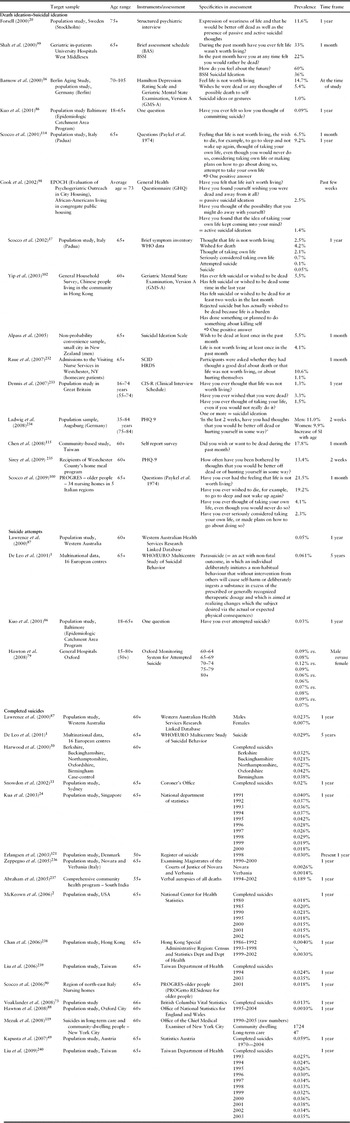
Prevalence. Rates of suicide among older people have declined in several countries in recent years,Reference Shah and Coupe22–Reference Shah32 but the risk for completed suicide is still the highest in those over the age of 65 years in comparison with younger age groups.Reference McKeown, Cuffe and Schulz2, Reference Shah21 Integrated data from 87 countries on suicide from the WHO indicate the following suicide rates for males aged 65–74 years (0.019%), males aged 75+ years (0.027%), females aged 65–74 years (0.0048%) and females aged 75+ years (0.0052%).Reference Shah, Bhat, McKenzie and Koen26 Prevalence rates of completed suicide vary strongly geographically, from 0.020% in AustraliaReference Snowdon and Baume33 and 0.016% in the United StatesReference McKeown, Cuffe and Schulz2 to 0.039% in Europe.Reference De Leo, Padoani and Scocco1 Shah and colleaguesReference Shah, Bhat, McKenzie and Koen26 reported the lowest suicide rates in the Caribbean and in Central American and Arabic countries. The highest rates are found mainly in Central and Eastern Europe and in some oriental and some western European countries. Research reports on suicide rates in specific countries and populations are reproduced in Table 1.
Prevalence of suicidality and suicide in later life (research literature 2000–2009)

Correlates. Population-based studies investigating correlates of national suicide rates revealed an association between suicide rates and various distal factors: a curvilinear association with educational attainment (U-shape),Reference Shah and Chatterjee34 urbanization (only in males) (U-shape),Reference Shah35 the human development index – a composite index measuring average achievements on dimensions of life expectancy, educational attainment and socio-economic status (inverted U-shape),Reference Shah36 fertility rates as a measure of social integration (U-shape),Reference Shah37, Reference Shah38 annual population growth rates (U-shape);Reference Shah39 a positive correlation with rates of smokingReference Shah40 and income inequality;Reference Shah, Bhat, Mackenzie and Koen41, Reference Shah42 and a negative correlation with societal crimeReference Shah43 and mean household size.Reference Shah44 There was no significant association found with tuberculosis rates,Reference Shah45 extent of gender equalityReference Shah46 and overall unemployment rates.Reference Shah47 The effect of belonging to a minority group has been researched sparsely.Reference Shah, Lindesay and Dennis48 A gender effect in old age suicide is established: more men than women complete suicide.Reference Shah21, Reference Kapusta, Etzersdorfer and Sonneck49–Reference Erlangsen, Zarit, Tu and Conwell52
Proximal correlates of suicide are mainly investigated in case-series and case-control studies, using the psychological autopsy method. Major depressive episode (MDE),Reference Koponen, Viilo and Hakko28, Reference Erlangsen, Zarit, Tu and Conwell52–Reference Conwell, Duberstein, Hirsch, Conner, Eberly and Caine65 and having a physical illnessReference Duberstein, Conwell, Conner, Eberly and Caine19, Reference Turvey, Conwell and Jones56, Reference Waern, Rubenowitz and Wilhelmson59, Reference Pompili, Innamorati and Masotti62, Reference Salib, Rahim, El-Nimr and Habeeb63, Reference Conwell, Duberstein, Hirsch, Conner, Eberly and Caine65–Reference Harwood, Hawton, Hope, Harriss and Jacoby70 are found to be robust proximal correlates independent of the presence of other factors. With regard to the presence of physical illness, it was determined that the risk was cumulatively greater when the number of physical illnesses increased.Reference Koponen, Viilo and Hakko28, Reference Juurlink, Herrmann, Szalai, Kopp and Redelmeier67 The presence of the following proximal factors was also found to contribute to an elevated risk for completed suicide: other mental disorders, such as anxiety disorders,Reference Waern, Runeson and Allebeck58, Reference Conwell, Duberstein, Hirsch, Conner, Eberly and Caine65, Reference Juurlink, Herrmann, Szalai, Kopp and Redelmeier67 psychotic disordersReference Waern, Runeson and Allebeck58, Reference Juurlink, Herrmann, Szalai, Kopp and Redelmeier67 and substance use disorders,Reference Waern, Runeson and Allebeck58, Reference Waern71 recent bereavement,Reference Harwood, Hawton, Hope, Harriss and Jacoby70, Reference Erlangsen, Jeune, Bille-Brahe and Vaupel72 financial problems,Reference Waern, Rubenowitz and Wilhelmson59, Reference Harwood, Hawton, Hope, Harriss and Jacoby70, Reference Voaklander, Rowe, Dryden, Pahal, Saar and Kelly73 poor sleep quality,Reference Turvey, Conwell and Jones56 marital status (with a higher risk for widowed or divorced people),Reference Harwood, Hawton, Hope and Jacoby50, Reference Pompili, Innamorati and Masotti62, Reference Harwood, Hawton, Hope, Harriss and Jacoby70, Reference Duberstein, Conwell, Conner, Eberly, Evinger and Caine74 social interaction,Reference Duberstein, Conwell, Conner, Eberly, Evinger and Caine74 religious involvement,Reference Duberstein, Conwell, Conner, Eberly, Evinger and Caine74, Reference Pritchard and Baldwin75 functional limitations,Reference Conwell, Lyness and Duberstein53, Reference Conwell, Duberstein, Hirsch, Conner, Eberly and Caine65 employment change,Reference Duberstein, Conwell, Conner, Eberly and Caine19 family discord,Reference Duberstein, Conwell, Conner, Eberly and Caine19, Reference Waern, Rubenowitz and Wilhelmson59, Reference Duberstein, Conwell, Conner, Eberly, Evinger and Caine74, Reference Rubenowitz, Waern, Wilhelmson and Allebeck76 cerebrovascular risk factorsReference Chan, Draper and Banerjee77 and previous suicide attempt(s).Reference De Leo, Padoani and Lonnqvist78–Reference Zahl and Hawton81 Childlessness was not retained as a correlate.Reference Salib, El-Nimr, Habeeb and Theophanous82 For the older person who completed suicide, but who did not suffer from a psychiatric illness, personality factors, physical illness and recent bereavement were more important contributory factors than sub-syndromal psychiatric disorders.Reference Harwood, Hawton, Hope and Jacoby83
Attempted suicide
Prevalence. Reports of a decrease,Reference De Leo, Padoani and Scocco1 as well as an increase,Reference Hawton, Harriss, Hall, Simkin, Bale and Bond84, Reference Shah85 of overall rates of attempted suicide in older people have been published. Only a few studies have reported population rates of suicide attempts. The WHO/EURO Multicentre Study of Suicidal BehaviorReference De Leo, Padoani and Scocco1 reported a mean rate for attempted suicide of 0.06% in the European population aged 65+ years. There are some regional rates available for Padua, Italy (0.14%),Reference Scocco and De Leo17 Baltimore, USA (0.03%),Reference Kuo, Gallo and Tien86 Western Australia (0.05%),Reference Lawrence, Almeida, Hulse, Jablensky and Holman87 Oxford, UK (0.06–0.12%)Reference Hawton and Harriss88 and Barnet, UK (0.05%).Reference Ruths, Tobiansky and Blanchard89 Scocco and colleaguesReference Scocco, Rapattoni and Fantoni90 reported a 1-year prevalence rate of 0.030% in nursing homes in north-east Italy.
Correlates. Correlates of attempted suicide are MDEReference Beautrais91–Reference Lebret, Perret-Vaille, Mulliez, Gerbaud and Jalenques93 (with or without a presence of psychotic featuresReference Lykouras, Gournellis, Fortos, Oulis and Christodoulou94), social isolation,Reference Beautrais91, Reference Lebret, Perret-Vaille, Mulliez, Gerbaud and Jalenques93 past suicide attempts,Reference Tsoh, Chiu and Duberstein92 poor ADL functioning level,Reference Tsoh, Chiu and Duberstein92 gender (generally more women than men,Reference Hawton and Harriss79, Reference Ruths, Tobiansky and Blanchard89, Reference Lebret, Perret-Vaille, Mulliez, Gerbaud and Jalenques93 except for one studyReference Hawton and Harriss79), traumatic life experiences,Reference Barak, Aizenberg, Szor, Swartz, Maor and Knobler95 history of abuseReference Talbot, Duberstein, Cox, Denning and Conwell96 and specific physical illnesses.Reference Tsoh, Chiu and Duberstein92 Marital status varies significantly according to the study: no robust correlates were found.Reference De Leo, Padoani and Scocco1, Reference Ruths, Tobiansky and Blanchard89, Reference Beautrais91, Reference Ticehurst, Carter, Clover, Whyte, Raymond and Fryer97
Suicidal ideation
Prevalence. Population studies mapping out suicidal ideation in older people differ strongly in their inclusion criteria for age. The cut-off age is seldom set at 65+ years and samples of higher age are often included. Point prevalence rates are estimated at 1% in people aged 70+ years.Reference Barnow and Linden16 One-year prevalence rates in a sample of 65+ years were estimated around 2–3%.Reference Scocco and De Leo17, Reference Kuo, Gallo and Tien86, Reference Cook, Pearson, Thompson, Black and Rabins98 One-month prevalence rates were estimated as 36% in medically illReference Shah, Hoxey and Mayadunne99 and 2.3% in older people living in a nursing home.Reference Scocco, Fantoni, Rapattoni, de Girolamo and Pavan100
Correlates. Suicidal ideation is independently associated with MDE.Reference Bartels, Coakley and Oxman101–Reference Witte, Joiner and Brown106 The presence of alcohol-related disorders revealed contradictory support.Reference Bartels, Coakley and Oxman101, Reference Awata, Seki and Koizumi104 Other significant correlates are higher age,Reference Cukrowicz, Ekblad, Cheavens, Rosenthal and Lynch107 lack of social support,Reference Bartels, Coakley and Oxman101, Reference Yip, Chi, Chiu, Chi Wai, Conwell and Caine102, Reference Awata, Seki and Koizumi104, Reference Vanderhorst and McLaren108–Reference Rowe, Conwell, Schulberg and Bruce110 limitations of daily living,Reference Hirsch, Duberstein and Conner111, Reference Dennis, Baillon, Brugha, Lindesay, Stewart and Meltzer112 lower level of education,Reference Yen, Yang and Yang103 limited community participationReference Yen, Yang and Yang103 and poor physical health.Reference Bartels, Coakley and Oxman101, Reference Yip, Chi, Chiu, Chi Wai, Conwell and Caine102
Death wish
Prevalence. Point prevalence rates of the presence of a death wish in the general population were estimated at 5%.Reference Barnow and Linden16, Reference Alpass113 Cook and colleagues reported lower rates (2.5%) for African Americans.Reference Cook, Pearson, Thompson, Black and Rabins98 One-year prevalence rates were estimated from 3.3%Reference Dennis, Baillon, Brugha, Lindesay, Stewart and Meltzer112 to 6.2%Reference Scocco and De Leo17, Reference Scocco, Meneghel, Caon, Dello Buono and De Leo114 in community-dwelling older people and up to 29.1% in a nursing home.Reference Scocco, Fantoni, Rapattoni, de Girolamo and Pavan100
Correlates. Depressive and anxiety symptoms were reported to be correlated with a death wish.Reference Bartels, Coakley and Oxman101 After controlling for depression, self-perceived health and marital discord were found to be significant correlates.Reference Chen, Yang and Yang115 Higher age, female gender and negative living conditions also seemed moderately related to the presence of a death wish and/or the presence of suicidal ideation.Reference Barnow, Linden and Freyberger116
Feeling of unworthiness of life
Prevalence. Point prevalence of feelings of unworthiness of life vary widely from 4.1%Reference Alpass113 to 14.7%.Reference Barnow and Linden16 One-year prevalence rates are estimated from 1.3%Reference Dennis, Baillon, Brugha, Lindesay, Stewart and Meltzer112 to 4.9%.Reference Scocco and De Leo17, Reference Scocco, Meneghel, Caon, Dello Buono and De Leo114 One-month prevalence rates were estimated at 33% in the medically ill,Reference Shah, Hoxey and Mayadunne99 21.5% in older people living in a nursing homeReference Scocco, Fantoni, Rapattoni, de Girolamo and Pavan100 and 3.7% in people living at home.Reference Scocco, Meneghel, Caon, Dello Buono and De Leo114
Correlates. Recent research literature reporting on correlates of feelings of unworthiness of life is not available to our knowledge.
For the sake of completeness, it is important to mention the availability of research literature reporting prevalence in which assessment has not been split up into different manifestations of the spectrum of suicidality. These reports are reproduced in Table 1. To our knowledge, there are no research data available on the occurrence of thoughts of planning to complete suicide.
Methods of suicide
The main methods used by older people to complete suicide are firearms, hanging, drug overdose, drowning and asphyxia.Reference Kapusta, Etzersdorfer and Sonneck49, Reference Harwood, Hawton, Hope and Jacoby50, Reference Voaklander, Rowe, Dryden, Pahal, Saar and Kelly73, Reference Hawton and Harriss79, Reference Salib, El-Nimr, Habeeb and Theophanous82, Reference Tadros and Salib117, Reference Salib118 It is important to highlight that trends in the methods used are liable to national differences (national policy in restriction of firearms) and to the types of residence (community versus long-term care).Reference Mezuk, Prescott, Tardiff, Vlahov and Galea119 Trends in time have been observed as well: despite a reduction in prescription of benzodiazepines, drug overdose suicides have increased in recent years.Reference Carlsten, Waern, Holmgren and Allebeck120 A gender effect has been observed as well: men tended to use more violent methods.Reference Erlangsen, Bille-Brahe and Jeune121 The use of more violent methods increased with age.Reference Erlangsen, Bille-Brahe and Jeune121
Studies of suicide attempts reported drug overdose as the main method, followed by hanging and self-injury.Reference De Leo, Padoani and Scocco1, Reference Ruths, Tobiansky and Blanchard89, Reference Lebret, Perret-Vaille, Mulliez, Gerbaud and Jalenques93, Reference Lamprecht, Pakrasi, Gash and Swann122 Studies comparing the methods used in suicide attempts and completed suicides revealed no differencesReference Salib, Tadros and Cawley123, Reference Salib and Tadros124 and the majority of people with a history of a suicide attempt used the same method in their final act as in their previous attempt.Reference Salib, Tadros and Cawley123, Reference Salib, Tadros and Cawley125
The suicide intent in attempted suicides of older people was found to be higher in comparison with younger peopleReference Harriss and Hawton126: two-thirds had significant high intent scores.Reference Hawton and Harriss79 Suicidal intent is correlated to attempt lethality.Reference Dombrovski, Szanto, Duberstein, Conner, Houck and Conwell127 Attempt lethality was found to be higher in older men and in younger women.Reference Dombrovski, Szanto, Duberstein, Conner, Houck and Conwell127
In view of the changed ratio of suicide attempts versus completed suicides (8:1 compared with 29:1 in adulthood,Reference Hawton and Harriss128 one can make an indirect assumption that suicide attempts increase in lethality by age.Reference Salib, Rahim, El-Nimr and Habeeb63 Research data seem to confirm this assumption: in a sample of suicide attempters aged 50 years and over, higher age was indeed associated with higher attempt lethality in menReference Dombrovski, Szanto, Duberstein, Conner, Houck and Conwell127 and higher degree of attempt planning overall.Reference Conner, Duberstein and Beckman129
Protective factors
A few research reports have been published aiming to explore which variables have a protective function in the development of suicidality.
Sense of belonging
‘Sense of belonging’ has been defined as the experience of being personally involved and integrated within an environment or system.Reference Hagerty, Lynch-Sauer, Patusky, Bouwsema and Collier130 Two dimensions have been discerned: an antecedent dimension (a person has the energy, interest and potential to develop a sense of belonging) and a psychological dimension (a person has to feel valued, needed and significant within the environment). Both components of sense of belonging were protective in the development of suicidality (in a sample of retired home-dwelling older people), although they operated in different ways.Reference McLaren, Gomez, Bailey and Van Der Horst131 High scorers on the antecedent dimension of sense of belonging expressed less suicidality than low scorers independently of the effect of depression, whereas high scorers on the psychological dimension of sense of belonging seemed to be protected against suicidality even when they expressed a high level of depression.
Positive future orientation
‘Future orientation’ has been defined as ‘a predisposition to think about and have a positive mood about the future and to strive toward achievement of identified goals’.Reference Hirsch, Duberstein and Conner111 Hirsch and colleaguesReference Hirsch, Duberstein and Conner111 found that in patients with MDE (50 years and over), having a positive future orientation was associated with lower reports of suicidal ideation, although this association might be due to an interaction effect with functional status: the association between functional status and the presence of suicidal ideation was weaker for patients with higher levels of future positive orientation.Reference Hirsch, Duberstein and Conner132
Positive affect
The trait Positive Affect was shown to distinguish older primary care patients (65 years and over) reporting suicidal ideation from those who did not.Reference Hirsch, Duberstein, Chapman and Lyness133
Agency
Agency measured as ‘socially desirable masculine traits’ was found to be related to suicidal ideation in Australian men, but not women, aged 65 years and over.Reference Hobbs and McLaren134 Older men with low levels of agency had a greater increase in level of suicidal ideation when depressed compared with depressed men with high levels of agency.
Reasons for living
Patients with MDE (aged 50 years and over) who reported higher levels of fear of suicide were less likely to report suicidal ideation.Reference Britton, Duberstein, Conner, Heisel, Hirsch and Conwell135 Moral objections and child-related concerns were raised by older people as reasons for not committing suicide.Reference Miller, Segal and Coolidge136
Happiness
Happiness was shown to have an attenuating effect on the relationship between the number of self-reported diseases and the report of suicidal distress in primary care patients (60 years and over): people with chronic medical problems exhibiting positive emotions as well were less distressed by thoughts of suicide.Reference Hirsch, Duberstein and Unutzer137
Psychological factors
During the last decade, personality and psychological variables have been included in suicide research in an attempt to identify their mediating role in the development of suicidality in older people exposed to risk factors. At the same time, these study designs were set up to test the hypothesis that different manifestations of suicidality might be discerned by means of differences in psychological and personality functioning. This dual approach implies that research reports on the one hand have included a wide variety of psychological and personality variables, and on the other that they have used different groups to compare expression of suicidality. This strongly hampers comparison of research results.
Personality traits
Duberstein and colleagues included personality traits as variables that might distinguish different manifestations of the spectrum of suicidality. The basic framework of personality traits that they applied was derived from the Five Factor Model, which assumes that personality attributes can be grouped along five major dimensions: Neuroticism, Extraversion, Openness, Agreeableness, and Conscientiousness.Reference McCrae and Costa138 In a series of studies, they found that different MANIFESTATIONS of suicidality could be linked to a different pattern of scores on these personality dimensions. A first study,Reference Duberstein, Conwell, Seidlitz, Denning, Cox and Caine139 with a clinical sample of depressed in-patients aged 50 years and over, revealed that a lifetime history of suicide attempts was correlated with higher Extraversion, that high scores on suicidal ideation were correlated with higher Neuroticism (this link might, however, be caused by other mediating factors as Agreeableness and Openness) and that lower scores on suicidal ideation were correlated with lower Openness. Furthermore, Heisel and colleaguesReference Heisel140 found that the presence of suicidal ideation (‘passive suicidal desire’ or ‘desire to make an active suicide attempt’) was correlated with higher Openness. Tsoh and colleaguesReference Tsoh, Chiu and Duberstein92 found that suicide attempters, in comparison with community-matched older people, were lower on Conscientiousness. Finally, Useda et al.Reference Useda, Duberstein and Conner141 reported that suicide attempters, in comparison with older people who committed suicide, were lower on Conscientiousness and higher on Neuroticism, which was a partial replication of the findings of Tsoh and colleagues.Reference Tsoh, Chiu and Duberstein92
The study of Useda and colleaguesReference Useda, Duberstein, Conner and Conwell142 included lower order personality traits (so-called facet levels) in a sample of depressed in-patients aged 50 years and over. A lifetime history of suicide attempts was correlated with lower Positive Emotion and higher Modesty. Severity of suicidal ideation was correlated with lower Warmth and higher Modesty.
Among a sample of depressed in-patients aged 65 years and over, narcissistic personality disorder and narcissistic personality traits were correlated to both the presence and the severity of suicidality (feeling that life is not worth living, wishing to be dead, thoughts of possible death, suicidal ideas and gestures or suicide attempts).Reference Heisel, Links, Conn, van Reekum and Flett143 Harwood and colleaguesReference Harwood, Hawton, Hope and Jacoby55 reported the presence of a personality disorder and personality trait accentuation as correlated with completed suicide, in comparison with a matched sample of older people who died from natural causes. In a subsample of a previous study of older people who completed suicide, but without a psychiatric disorder at time of death, personality trait accentuation was found to be common (obsessional traits were the most frequent),Reference Harwood, Hawton, Hope and Jacoby83 suggesting that in the development of suicidality, the way a person perceives and solves life problems might be more important than the problem itself.
Emotion traits, considered as a subset of the broader category of personality traits and as predispositions to experience particular emotions,Reference Izard, Shaie and Lawton144 were found to be distinctive among a sample of depressed in-patients aged 50 years and over. A history of suicide attempts after the age of 50 was correlated to lower Anxiety.
A recent qualitative, psychological autopsy studyReference Kjolseth, Ekeberg and Steihaug145 with relatives of suicide completers aged 65 years and over, indicated that three domains (life history, personality traits and relationships) are important contributory factors to suicide. The suicide completers were described as emotionally closed people finding difficulties in accepting and adapting to age-related loss of function, which might be mediated by a feeling of loss of control.
Hopelessness
In research literature on suicidality in adulthood, the concept of hopelessness takes a central place.Reference Van Heeringen146 Hopelessness, defined as a cognitive or affectively laden construct of having negative expectancies toward the future,Reference Beck, Weissman, Lester and Trexler147 was proven to be a significant predictor of suicidal ideation,Reference Beck, Steer, Beck and Newman148 of seriousness of suicide intentReference Wetzel149 and of completed suicidesReference Beck, Brown, Berchick, Stewart and Steer150 in adult populations. In literature on suicidality in later life, findings are more confusing. In some studies hopelessness was shown to be a significant predictor of suicidal ideation,Reference Witte, Joiner and Brown106, Reference Szanto, Mulsant, Houck, Miller, Mazumdar and Reynolds151, Reference Vannoy, Duberstein, Cukrowicz, Lin, Fan and Unutzer152 whereas in others this effect was neutralized when including other variables such as depression,Reference Britton, Duberstein, Conner, Heisel, Hirsch and Conwell135 positive future orientationReference Hirsch, Duberstein and Conner111, Reference Hirsch, Duberstein and Conner132 or personality traits.Reference Heisel, Duberstein, Conner, Franus, Beckman and Conwell153
Hostility-aggression
In a group of home-dwelling older people (mean age 76 years) the occurrence of death ideation or suicidal ideation was found to be correlated with the presence of feelings of hostility.Reference Scocco, Meneghel, Caon, Dello Buono and De Leo114, Reference Scocco, Meneghel, Dello Buono and De Leo154 In a study of depressed in-patients aged 50 years and over, hostility did not distinguish patients with a history of suicide attempt from those without a history of suicide attempt.Reference Seidlitz, Conwell, Duberstein, Cox and Denning155
An association between aggression and completed suicide was found, but this was moderated by age: in suicide completers aged 50 to 64 years, but not aged 65 years and older, general aggression was elevated in comparison with matched community-dwellers.Reference Conner, Conwell, Duberstein and Eberly60 These data are congruent with lifespan research data,Reference McGirr, Renaud, Bureau, Seguin, Lesage and Turecki156 demonstrating that impulsive-aggressive behaviour is mainly linked to suicide in young age, and is a less important contributor to suicide in older age.
Coping
Problem solving. In adult literature on suicidality, inability of problem-solving is determined to be closely linked to suicidality.Reference Williams, Pollock and Heeringen157 However, this hypothesis has concisely been tested in older people. In a study with a rather small sample size, it was found that suicidal attempters aged 65 years and over did not differ in their ability to generate the means to solve interpersonal problems.Reference Howat and Davidson158 In a recent study investigating the perception of problem-solving capabilities,Reference Gibbs, Dombrovski, Morse, Siegle, Houck and Szanto159 a difference was found between suicide attempters aged 60 years and over and non-suicidal depressed older people: the attempters perceived their overall ability of problem solving as deficient and more particularly, they regarded their problems more negatively and approached them in a more impulsive manner.
Emotion regulation. Lynch and colleaguesReference Lynch, Cheavens, Morse and Rosenthal160 reported that in a sample of depressed older people, emotional inhibition (thought suppression and ambivalence about emotional expression) was found to be predictive of suicidal risk (defined as a composite of hopelessness and suicidal ideation). Cukrowicz and colleaguesReference Cukrowicz, Ekblad, Cheavens, Rosenthal and Lynch107 replicated this role of thought suppression in a study with a sample of depressed people with co-morbid personality disorders, aged 55 years and over. Additionally, maladaptive coping styles (emotional coping and avoidance coping) were found to be predictive of suicide risk as well.
Attitudes toward suicide
Concerning attitudes toward suicide and suicidal risk in later life, suicide was considered as more acceptable, more strongly related to a lack of religious conviction, more lethal, more normal, more irreversible or permanent and more strongly related to individual aspects.Reference Segal, Mincic, Coolidge and O'Riley161
Dementia and neuropsychological factors
The association between dementia, neuropsychological performance and suicidality has not been investigated systematically. Recent studies are scarce and sample sizes of the available studies are small or include case studies.Reference Peisah, Snowdon, Kril and Rodriguez162 In studies associating suicidality and dementia, patients with different diagnostic subtypes of dementia and different stages of dementia are included.Reference Haw, Harwood and Hawton163 In studies associating suicidality with neuropsychological performance, a wide range of neuropsychological tests is used. This causes the results to be of limited use.
Dementia
The overall association between dementia and suicide was found to be weak.Reference Haw, Harwood and Hawton163, Reference Purandare, Voshaar, Rodway, Bickley, Burns and Kapur164 A recent study of Purandare and colleaguesReference Purandare, Voshaar, Rodway, Bickley, Burns and Kapur164 compared 118 people with dementia – who died by suicide – with age- and gender-matched non-dementia suicide cases. The methods of suicide used by patients with dementia were comparable to those used by the controls. They were less likely to have a history of suicide attempt or a history of psychiatric hospitalization compared with the control cases. In a study of psychiatric in-patients, in-patients with dementia were found to have a significantly lower risk to commit suicide than other psychiatric in-patients,Reference Erlangsen, Zarit, Tu and Conwell52 whereas out-patients diagnosed with dementia during hospitalization had an elevated risk compared with the general population.Reference Erlangsen, Zarit and Conwell165 Subtypes of dementia have not been investigated except for Alzheimer's disease (AD), which revealed inconsistent findings: an increasedReference Peisah, Snowdon, Gorrie, Kril and Rodriguez166 as well as a decreasedReference Rubio, Vestner, Stewart, Forbes, Conwell and Cox167 prevalence of AD was found in suicide completers. Suicide attempts were found to be uncommon in dementia in general and in AD.Reference Barak and Aizenberg168 Some case studiesReference Lim, Rubin, Coats and Morris169 suggested that the risk for suicide was greater at an early stage of AD than at later stages. Purandare and colleaguesReference Purandare, Voshaar, Rodway, Bickley, Burns and Kapur164 rephrased this postulation slightly: the highest risk for suicide does not present itself in the first twelve months after disclosure of the diagnosis, but at the stage of dementia where patients experience difficulties in daily living and still have a preservation of insight about their cognitive deterioration.
Neuropsychological functioning
Overall poor cognitive functioning is significantly associated with the presence of a death wish and suicidal ideation,Reference Ayalon, Mackin, Arean, Chen and McDonel Herr170, Reference Dombrovski, Butters and Reynolds171 although this link might be mediated by depression and/or hopelessness.Reference Heisel, Flett and Besser172 Global lower cognitive functioning was found to be associated with lower levels of planning in a sample of depressed suicide attemptersReference Conner, Duberstein and Beckman129 but not with the degree of lethality of a suicide attempt.Reference Dombrovski, Szanto, Duberstein, Conner, Houck and Conwell127
With regard to specific cognitive functions, depressed suicide attempters were found to have lower capacities of mental sequencing and lower flexibility compared with depressed non-attempters;Reference King, Conwell, Cox, Henderson, Denning and Caine173 depressed suicidal people were found to perform poorly on executive functioning,Reference Dombrovski, Butters and Reynolds171 although executive function was not found to be associated with severity of suicidal ideation,Reference Belderbos and Shah174 and people with a death wish were more impaired on a time orientation task.Reference Ayalon and Litwin175
Course of suicidality and efficacy of treatment
Given the robust relationship between MDE and suicidality in later life, the course of suicidality has been investigated in studies focusing on the course of depressive disorders (naturalistic studies and medication trials). The course of suicidal ideation was found to be strongly determined by the course of the depressive symptoms, a finding that was replicated in different treatment settings such as collaborative primary care,Reference Vannoy, Duberstein, Cukrowicz, Lin, Fan and Unutzer152 medication trials,Reference Szanto, Mulsant, Houck, Dew and Reynolds176, Reference Szanto, Mulsant and Houck177 a geriatric medicine wardReference Shah, Hoxey and Mayadunne99 and a naturalistic study of medication and psychotherapy,Reference Cukrowicz, Duberstein, Vannoy, Lynch, McQuoid and Steffens178
There are only few data available on the efficacy of treatment of suicidality in older people. Because of ethical considerations, suicidal patients are often excluded from randomized controlled studies. Therefore, study results are limited and far from robust. Firstly, the link between trends over time in prescription of psychotropics and changes in rates of completed suicides in older people has been investigated. Seeing that mainly ecological study designs were used rather than randomized controlled studies, causality from the data could not be accurately inferred and therefore the data should be interpreted with caution. An increased use of antidepressants was linked to a decrease in suicide rates of older people in Denmark,Reference Erlangsen, Agerbo, Hawton and Conwell179 the United Kingdom,Reference Lodhi and Shah180, Reference Shah and Lodhi181 Hungary,Reference Kalmar, Szanto, Rihmer, Mazumdar, Harrison and Mann182 Australia,Reference Hall, Mant, Mitchell, Rendle, Hickie and McManus183 JapanReference Nakagawa, Grunebaum and Ellis184 and Israel (only for men).Reference Barak and Aizenberg185 A lower use of benzodiazepines was linked to a decrease in suicide rates in the United Kingdom.Reference Lodhi and Shah180
Secondly, there are some studies reporting on data on specific groups of suicidal patients or suicide completers receiving some kind of treatment. Szanto and colleaguesReference Szanto, Mulsant, Houck, Miller, Mazumdar and Reynolds151 did not find a difference in treatment outcome (combined pharmacotherapy and psychotherapy) of MDE in older people with or without suicidal ideation, although the latter group had higher relapse rates during continuation treatment. Nelson and colleaguesReference Nelson, Delucchi and Schneider186 found that depressed out-patients (aged 60 years and over) treated with sertraline reported less death ideation and/or suicidal ideation after eight weeks compared with the placebo-controlled group. Juurlink and colleaguesReference Juurlink, Mamdani, Kopp and Redelmeier187 found an increased risk of suicide during the first month of SSRI therapy compared with other antidepressants. Barak and colleaguesReference Barak, Olmer and Aizenberg188 described retrospectively collected data on a sample of depressed hospitalized older people. The group of suicide attempters was significantly less exposed to antidepressant treatment compared with the group of non-attempters. A Danish population study revealed that 35% of men and 56% of women who had died by suicide, aged 50 years and over, were on treatment with an antidepressant.Reference Erlangsen, Canudas-Romo and Conwell189 Based on preliminary data, CrumpackerReference Crumpacker190 suggested a higher risk of suicide in older people confronted with akathisia as an adverse effect of antidepressant treatment. A case-control study of all Danish people aged 50 years and over who were started on antidepressant treatment revealed that whether antidepressant treatment was continued or discontinued at an early stage did not have a significant impact on suicide risk.Reference Erlangsen, Agerbo, Hawton and Conwell179 Some preliminary data have been reported on the association between treatment of bipolar disorder and the presence of suicidality: older patients with bipolar disorders treated with mood stabilizers and antidepressants were associated with a lower risk for suicide attempts.Reference Aizenberg, Olmer and Barak191
Contact with health care providers
It is a consistent finding that the majority of older people with a suicide attempt or with a completed suicide have had a previous contact with health care, which is a more robust finding than in younger adults.Reference Luoma, Martin and Pearson192
Suicide
Luoma and colleaguesReference Luoma, Martin and Pearson192 reported aggregated data on older suicide completers: 58 and 77% had contact with primary care within one month or within one year, respectively, before suicide, and 11 and 8.5% had contact with mental health care. In a Swedish study by Waern and colleagues,Reference Waern, Runeson and Allebeck58 42% had contact with a non-psychiatrist physician and 25% with a psychiatrist. In a Finnish study by Pitkala and colleagues,Reference Pitkala, Isometsa, Henriksson and Lonnqvist193 70% had contact with some form of health care service. In a Canadian study, more than half of the suicide cases had a consultation with a GP or specialist during the 2-week period before death.Reference Preville, Boyer, Hebert, Bravo and Seguin64 An effect of gender (males are less likely to have contact with psychiatric health care) has been reported.Reference Salib and Green194, Reference Tadros and Salib195 Furthermore, a link between suicide and a history of hospitalization has been discovered. A Danish study revealed that more than half of the people aged 65 years and over who completed suicides experienced one or more hospitalization because of medical illness during the two years before death.Reference Erlangsen, Vach and Jeune196 Also, older people who experienced previous or current psychiatric hospitalization were found to have a higher risk for suicide than those who had not.Reference Erlangsen, Mortensen, Vach and Jeune197, Reference Karvonen, Hakko, Koponen, Meyer-Rochow and Rasanen198 Karvonen and colleaguesReference Karvonen, Hakko, Koponen, Meyer-Rochow and Rasanen198 found that 30% of the completed suicides of people aged 50 years and over occurred during the first month after being discharged from a hospital.
Attempted suicide
Around 60% of suicide attempters have had contact with primary careReference Lamprecht, Pakrasi, Gash and Swann122, Reference Suominen, Isometsa and Lonnqvist199 and 33–42% of them have had contact with mental health care.Reference Ruths, Tobiansky and Blanchard89, Reference Suominen, Isometsa and Lonnqvist199, Reference Marriott, Horrocks, House and Owens200 After a suicide attempt, most older people are referred to aftercare.Reference Ruths, Tobiansky and Blanchard89, Reference Suominen, Isometsa and Lonnqvist199, Reference Marriott, Horrocks, House and Owens200
Suicidal ideation
To our knowledge, no recent data are available on help-seeking behaviour of older people with suicidal ideation. An inquiry of primary care physicians revealed that they reported less willingness to treat an older suicidal patient than a younger suicidal patient presenting with the same complaints.Reference Uncapher and Arean201
Prevention
Based on the available empirical literature, guidelines for suicide prevention in older people have been suggested.Reference Conwell6, Reference Szanto, Prigerson and Reynolds7, Reference Conwell and Duberstein202–Reference Chiu, Takahashi and Suh204 Reports on prevention identify several opportunities for intervention: improving risk assessment and detection of suicidality, treatment of at-risk people, and the development of specific prevention programmes.Reference Heisel and Duberstein203
Risk assessment and detection of suicidality
A significant proportion of older people who complete suicide have been in contact with primary or secondary care services (see above). Therefore, detection of suicidality and suicide risk in health care is of major importance. In general practice, around 6% of older patients acknowledged current suicidal ideation.Reference Pfaff and Almeida205, Reference Pfaff and Almeida206 Suicidality, however, is not always the primary complaint: a study revealed that older people, who completed suicide, had presented themselves with complaints of physical pain (39%) or depression (46%) during the last consultation with their GP.Reference Pfaff and Almeida205, Reference Szanto, Gildengers, Mulsant, Brown, Alexopoulos and Reynolds207 Consequently, suicidality and its risk factors should be assessed carefully,Reference Szanto, Gildengers, Mulsant, Brown, Alexopoulos and Reynolds207 by using validated screening instruments for depression (e.g. Geriatric Depression ScaleReference Sheikh and Yesavage208), or by using comprehensive assessment instruments of suicidal ideation or behaviour (e.g. Scale for Suicide IdeationReference Beck, Kovacs and Weissman209).
Treatment of at-risk people
The robust association between depressive disorder and suicidality in older people (both in occurrence as well as in trajectory) shows that adequate treatment of depression can indirectly lead to a decrease in suicidality.Reference Bruce, Ten Have and Reynolds210 Firstly, recent population data found a clear link between trends in prescription of psychotropics and changes in rates of completed suicides (see above). Secondly, we can assume a significant undertreatment of suicidal older peopleReference Abrams, Leon, Tardiff, Marzuk, Li and Galea211: post-mortem toxicological investigation of suicide completers revealed that antidepressants were detected only in one out of five cases. Thirdly, specific treatment programmes of depression in primary care were linked to a reduction in suicide risk. A primary care-based collaborative programme for depression has led to lower rates of suicidal ideation in comparison with controls.Reference Unutzer, Tang and Oishi212, Reference Alexopoulos, Reynolds and Bruce213 A primary care intervention, consisting of treatment guidelines tailored for older people with care management, led to a faster decline in rates of suicidal ideation in comparison with usual care.Reference Bruce, Ten Have and Reynolds210 Within the scope of the PROSPECT study (‘Prevention of Suicide in Primary Care Elderly: Collaborative Trial’),Reference Bruce and Pearson214 guidelines have been formulated for the management of suicidality in primary care settings.Reference Brown, Bruce and Pearson215 Fourthly, prevention for suicide might include a restriction of means to commit suicide among at-risk people. For example, given the association between the availability of firearms and the increased risk for suicide, the need for screening for firearm availability among older people suffering distress or suicidal ideation has been suggested.Reference Conwell, Duberstein, Connor, Eberly, Cox and Caine216, Reference Oslin, Zubritsky, Brown, Mullahy, Puliafico and Ten Have217 Shah and colleaguesReference Shah, Uren, Baker and Majeed218 suggest a similar precaution in prescription practice of benzodiazepines, paracetamol and tricyclic antidepressants, in view of drug overdose as a common method of completed suicide in older people. Inappropriate prescription of benzodiazepines, for example, might generate an increased risk of completed suicide.Reference Voaklander, Rowe, Dryden, Pahal, Saar and Kelly73 Fifthly, research data demonstrate that an attempted suicide in older people should be regarded as a ‘failed completed suicide’Reference Hawton and Harriss79, Reference Salib, Tadros and Cawley123 and is a robust risk factor for completed suicide in the future. Clinicians need to be made aware that the majority who attempt to complete suicide have a real wish and intent to be dead and that adequate treatment after a suicide attempt is indispensable.
Population prevention programmes
A provision of a telephone service (biweekly telephone calls for support and needs assessment and a 24-hour emergency alarm service) was found to have a long-term positive effect on suicide rates in Italy.Reference De Leo, Dello Buono and Dwyer219
Summary and directions for future research
During the last decade, suicide and suicidality in older people have received significant scientific attention. The volume of research literature on suicidality in later life is catching up, which has resulted in an investment in research on distal and proximal risk factors for suicide in later life. However, the bulk of the research literature is from an epidemiological point of view, implying that a comprehensive, integrative model is lacking. Only a few researchers have included factors in research designs (e.g. psychological variables, personality factors) to help understand the development of suicidality in older people in a comprehensive way. Therefore, it is important that future research lines take into account research questions that approach the essence of suicidality and suicide in later life.
Challenges in future research might be related to the following four questions:
1 How do different manifestations of the spectrum of suicidality relate to one another?
Rates of completed suicide increase with higher age, while rates of suicidal ideation and suicide attempts seem to decrease.Reference Hawton and Harriss88 This change in ratio by age raises the question to what extent different manifestations are mutually dependent: can different manifestations of suicidality be situated on a same continuum of severity or are these different entities? Epidemiological data, indicating the same correlates of different manifestations of suicidality on the one hand, and the similar characteristics of attempted suicide and completed suicide on the other,Reference Hawton and Harriss79, Reference Salib, Tadros and Cawley123, Reference Salib and Tadros124 are supportive for the first postulate. However, the fact that personality characteristics can be linked to different manifestations of suicidality is supportive for the latter. Research designs mutually comparing manifestations of the extensive spectrum of suicidality might reveal evidence for or against the categorical versus dimensional conceptualization of suicidality.
2 Why do only a minority of older people become suicidal?
The identified risk factors seem to be crucial components in the development of suicidality, but they do not seem to be sufficient by themselves. The presence of a medical illness for example is very common in old age, but only a minority exposed to this become suicidal. The role of MDE as a primordial risk factor is rather unclear as well: not all depressed older adults express suicidality – around 65% in a study by Nelson and colleaguesReference Nelson, Clary, Leon and Schneider220 – and MDE is not exclusively linked to a specific manifestation of suicidality. Moreover, the psychosocial risk factors correlated to MDE in older peopleReference Bruce221 do not seem to be different from those found for suicidality. On the other hand, it is still unclear which psychological variables (trait and/or state variables) are playing a mediating role in the development of suicidality when confronted with risk factors. Research to date has included too few psychological variables representing or including the challenges inherent to the phase of later life. Future research might need to start from the features of the old age phase and its inherent psychological adaptation to determine which factors are significant and which ones are playing a mediating role. The concept of ‘successful ageing’ might be very useful in this respect. In psychological literature, several authors have developed theories from a psychological perspective on how people can age successfully.Reference Rowe and Kahn222, Reference Baltes, Baltes, Baltes and Baltes223 Recent studiesReference Wong and Tomer224, Reference von Faber, Bootsma-van der Wiel and van Exel225 adapted and complemented these theories by integrating expert and perspectives of older people on successful ageing. These lines of enquiry might be very helpful in conceptualizing and forming a theory on development of suicidality in later life, in contrast to successful ageing.
3 Is suicidality in older people a homogenous concept?
On the one hand, in research to date, the range of age of patients included varies widely, implying that, in the research literature, the group of older people is considered as rather homogenous. The question can be raised whether this assumption is valid. Some authorsReference Baltes and Smith226 have broached an important but underestimated difference in research between the young old and the oldest old. Both groups might be confronted with specific challenges inherent to their age, which in some cases might result in a similar development of suicidality, but the phenomenology of suicidality might be dissimilar. On the other hand, research to date on suicidality in later life has been rather detached from suicidality in adult life. Considering suicidality against the background of the life cycleReference McGirr, Renaud, Bureau, Seguin, Lesage and Turecki156 is important in future research to find further evidence for the hypothesis that suicide in young or older age is characterized by different diatheses-stress models. Consequently, future research should pay attention both to the specific impact of age on suicidality in later life as well as integrating this in lifespan research on suicidality.
4 How is suicide in later life related to topics like indirect self-destructive behaviour, euthanasia and assisted-suicide?
Against the background of changing attitudes in industrialized societies on self-determination and personal control over one's life, it is striking that in research literature to date these concepts (and the possible link between them) have received only marginal attention. A few authors tried to disentangle these phenomena,Reference Fortin, Lapierre, Baillargeon, Labelle, Dube and Pronovost227–Reference Rurup, Muller, Onwuteaka-Philipsen, Van Der Heide, Van Der Wal and Van Der Maas231 but empirical data are lacking. Until now it has been unclear, for instance, how the request for euthanasia in the terminally ill is related to suicide, or to what extent indirect self-destructive behaviour can be considered as suicide. Trying to understand and integrate these phenomena might make research on suicidality in later life more complex, but it seems indispensable in the future to gain an insight into the decision process to choose the time and modus of one's own death. Considering suicidality in later life as having a multifaceted and complex character will provide better guidelines for more effective prevention policy.
Conflicts of interest
The authors report no conflicts of interest.