





Introduction
Parties across Europe are facing increasing pressure to become more responsive to their voter’s demands in what has been labeled a ‘crisis of representation’ (Kriesi Reference Kriesi2014). In response to these pressures, some parties have tried to re-invigorate the model of the mass party and built local ties to their constituents (Van Kessel and Albertazzi Reference Van Kessel and Albertazzi2021) or superficially attempted to appear more like energetic political movements (Butzlaff Reference Butzlaff2023). At the same time, new parties emerged out of the protesting social movements (Kitschelt Reference Kitschelt and Katz2006), promising new forms of political participation and a way out of the crisis (Gerbaudo Reference Gerbaudo2021; Kralj and Tranfic Reference Kralj and Tranfić2024). Various waves of protest in recent years have spurred many European parties to move closer to their electorates, or at least to appear to do so. For many parties this has also meant taking to the streets themselves (Borbáth and Hutter Reference Borbáth and Hutter2021), with especially the far right steadily increasing its involvement in protests (Pirro, Castelli Gattinara, and Froio Reference Pirro, Castelli Gattinara and Froio2024).
In parallel to these recent protest waves, populist actors have seen significant increases in their electoral support in Europe (Kriesi Reference Kriesi2014; Arato and Cohen Reference Arato and Cohen2022). They too have been avid participators in demonstrations across Europe (see e.g., Della Porta et al. Reference Della Porta, Fernández, Kouki and Mosca2017; Heinze and Weisskircher Reference Heinze and Weisskircher2022). A strand of populism scholars explains such an apparent gravitation of populist parties to protest as an ‘elective affinity’ (Jansen Reference Jansen2011: 85) between populist parties and street mobilization (e.g., Taggart Reference Taggart2004; De La Torre Reference De La Torre2010; Jansen Reference Jansen2011; Weyland Reference Weyland, Kaltwasser, Taggart, Espejo and Ostiguy2017). Arato and Cohen (Reference Arato and Cohen2022) have gone as far as claiming that populist parties necessarily have to behave like movements. The common idea of this particular perspective is that populism is successful among a population that is alienated from the existing political institutions and organizations (Laclau Reference Laclau and Panizza2005; Roberts Reference Roberts and De La Torre2015). Populist parties would use protest to show how different they are from the establishment. However, the theoretical link between populist parties and protest mobilization has seldom been empirically tested.
In this paper we investigate whether populist parties are indeed more likely to mobilize voters to protest on the streets across Europe. Building on theories of populism, specifically theories on populist mobilization (Jansen Reference Jansen2011) and style (Moffitt Reference Moffitt2016), we argue that populist parties have intrinsic and extrinsic motivations to present higher levels of mobilization: their core ideology is connected to mass movements, and their potential voters are expected to be more rewarding of protest behavior. At the same time, one must note that most populist parties in Europe also hold radical left or right ideologies (Meijers and Zaslove Reference Meijers and Zaslove2021), and prior research has found strong links between radical ideology and protest behavior (Hutter Reference Hutter2014; Torcal, Rodon, and Hierro Reference Torcal, Rodon and Hierro2016; Kostelka and Rovny Reference Kostelka and Rovny2019). By looking at a large number of parties with fine-grained data, we are able to see how different combinations between populist/non-populist and radical/non-radical parties are related to protest mobilization and whether populism and radical host ideology interact in increasing it.
To test our hypotheses, we make use of an original comprehensive dataset of politicians’ activity on the social media platform Facebook. Our dataset comprises all posts of all members of the national parliaments from all EU countries, excluding Croatia, and the UK who possessed an account between 2018 and 2021. This dataset provides unique advantages over alternative sources of data for partisan protest events. It has wide coverage across all European countries and is fine-grained enough to identify calls for protest at the daily level, including potentially minor events that only one or two politicians from a party may talk about. It also makes partisan attribution much easier: if a party MP is advertising a protest, the event is likely to be associated with the party. We use this dataset to both analyze the relative importance that different parties afford to the topic of protest in general and to specifically quantify the amount of mobilization posts for protest events that they publish on their profiles. We categorize posts as protest-related based on both a multilingual protest dictionary and annotating relevant posts with a large language model (LLM) to find posts that announce future protest events.
We choose party communication as our source for protest mobilization due to a lack of comprehensive data on actual protest events organized by parties. Following Castelli Gattinara, Froio, and Pirro (Reference Castelli Gattinara, Froio and Pirro2022), we argue that a party’s own communication channels are a powerful source to obtain data on its involvement in protest. We opt for social media instead of other channels of political communication, such as parliamentary speeches or press releases, following studies such as Wouters, Staes, and Aelst (Reference Wouters, Staes and van Aelst2022). Protest makes up an overall small part of what politicians talk about, as we also show in our empirical analysis. The less restrictive environment of social media platforms provides a significantly larger trove of data than other forms of political speech, making it more likely to find sufficient amounts of protest-related communication to answer our research question.
Our findings show that radical parties are significantly more likely to be involved in protest mobilization, with little extra explanatory power provided by populism. We find evidence for a U-shaped effect of the left-right scale placement of the parties we investigate on their involvement in protest mobilization online. Our models indicate that the role of populism, once accounting for its interplay with radicalism, is limited. Only for far-left populist parties do we find higher degrees of mobilization for protest events than for their non-populist ideological peers. But we also find important moderators to this relationship. In Central and Eastern Europe, neither populist nor radical parties appear more connected to protest mobilization than other party types. At the same time, the Covid-19 pandemic seems to have been a catalyst for protest mobilization specifically for populist parties.
By considering the role that populism plays in explaining recent increases of party-organized protest in Europe, we contribute to both the study of party-movement relationships and the study of populism. We demonstrate the only limited additional explanatory power that populism has for exploring the protest mobilization of parties in Europe. While especially the theoretical literature on populism has repeatedly assumed that populism has a distinct role for street mobilization by parties and politicians, we are for the first time able to test this empirically, with little evidence to support these assumptions. Our findings, therefore, add to an emerging literature that aims at disentangling characteristics of populism from ideological radicalism, which has been consistently finding that much of what is often attributed to populism is rather a feature of radical host ideologies. Finally, we also contribute to the field of protest event analysis by demonstrating the large potential of using social media sources and large language models to generate data on protest behavior.
Populism, radicalism, and protesting
Interactions between parties and protest/social movements are not an exclusive domain for parties outside of the political mainstream. For politicians, protests function as important cues about changing public moods (Lohmann Reference Lohmann1994; Schürmann Reference Schürmann2024). Opposition parties can signal their support for movements’ demands to put pressure on governments (Hutter and Vliegenthart Reference Hutter and Vliegenthart2018; Wouters, Staes, and Aelst Reference Wouters, Staes and van Aelst2022). Parties can profit from ties to social movements through access to activists and support networks that may help them to mobilize voters (Almeida Reference Almeida, van Dyke and McCammon2010; Blings Reference Blings2020; Borbáth and Susánszky Reference Borbáth and Susánszky2024), thereby affecting election results (Gillion and Soule Reference Gillion and Soule2018; Enos, Kaufman, and Sands Reference Enos, Kaufman and Sands2019) and reducing voter volatility (Martin, Lange, and Brug Reference Martin, de Lange and van der Brug2022). On the other side, social movements can profit from interactions with electoral politics by achieving policy changes (Wasow, Reference Wasow2020) or by gaining access to political parties and their platforms (Schwartz Reference Schwartz2010).
But while almost all parties interact with movements to some degree, regular involvement of parties in street protest is specific to certain types of parties, typically outside the political mainstream. Existing research points at two angles. First, it focuses on a party’s position within the larger party system. In this view, niche parties (Blings, Reference Blings2020) and challenger or outsider parties (Borbáth and Hutter Reference Borbáth and Hutter2021; Borbáth Reference Borbáth2023) have a particular incentive to collaborate with social movements due to their single-issue focus and the possibility of mobilization and recruitment of activists.
Second, explanations of party involvement in protest politics have typically been approached from an organizational angle, often invoking the concept of the movement party (Kitschelt Reference Kitschelt and Katz2006). Many analyses of the protest behavior of parties have relied on the movement party concept to label their objects of analysis (Della Porta et al. Reference Della Porta, Fernández, Kouki and Mosca2017; Pirro and Castelli Gattinara Reference Pirro and Castelli Gattinara2018; Castelli Gattinara and Pirro Reference Castelli Gattinara and Pirro2024). These studies focus mostly on organizational questions and typically do not compare movement parties of different ideologies. Only a few exceptions exist, where cross-ideological comparisons are made (Kim Reference Kim2023; e.g., Kralj and Tranfic Reference Kralj and Tranfić2024; Santos and Mercea Reference Santos and Mercea2024). These comparative analyses reveal important differences but still tend to emphasize the organizational divergences this entails, such as more hierarchical models for the right-wing parties.
We argue that it is important to supplement these existing approaches and to emphasize the role that party family plays in explaining why some parties are more invested in protest than others. Our argument is that certain ideological aspects interact with contentious politics to enhance a party’s messaging and, possibly, also appeal. More specifically, we theorize that populist parties have both higher intrinsic and extrinsic motivations to mobilize citizens into street protests. We elaborate on those in the next section.
Populism and protest
Our first line of argumentation posits that populism represents a ‘missing link’ in explaining why some European parties have become so active in street politics. The use of protest by populist parties has mainly been studied in theoretical or qualitative empirical work, mostly focused on Latin American countries (De La Torre Reference De La Torre2010; Jansen Reference Jansen2011; Kaltwasser Reference Kaltwasser2014; Weyland Reference Weyland, Kaltwasser, Taggart, Espejo and Ostiguy2017). While these studies mainly emphasize top-down mobilizations by the populist party or leader, other work has also pointed to the importance of grassroots movements for populist parties (Roberts Reference Roberts2006; Aslanidis Reference Aslanidis2024). Systematic cross-country quantitative analyses of the relationship between populism and protest behavior are largely missing, especially for Europe. Sawyer (Reference Sawyer2024) finds that the overall protest volume in a country only increases once populists are in power and thus provides evidence for a backlash against populist governments. Pirro and Portos (Reference Pirro and Portos2021) show that supporters of populist parties in Europe are more involved in protest politics than other party supporters, with populism providing a distinct added effect, especially on the far right.
We follow Mudde (Reference Mudde2004) and understand populism as a ‘thin-centered ideology’ (Mudde Reference Mudde2004: 544). According to this understanding of populism, it is made up of three core components: people-centrism, i.e., the construction of a homogeneous and morally good people; anti-elitism, i.e., the construction of an antagonism between the people and a small, corrupt elite that exploits the former; and finally, people sovereignty, the belief that ‘the people’ have a ‘general will’ that can be recognized and enacted by the populists without any further mediation. In accordance with the idea of populism as thin-centered, we assume that it can interact with other thick ideologies, such as socialism or right-wing radicalism, that provide definitions of who entails people and elites as well as a deeper programmatic underpinning. This definition of populism allows us two important methodological steps. First, it makes it possible to clearly define which parties are and which are not populist. Second, it enables us to analytically separate ‘thin’ populism from ‘thick’ ideology.Footnote 1
Intrinsic motivation
The central promise of populism is that of political representation of the sovereign people faced with an unrepresentative political elite (Canovan Reference Canovan1999; Mudde Reference Mudde2004; Moffitt Reference Moffitt2016). Central to this claim, therefore, is an appeal to legitimacy based on numbers: populists claim to represent a large portion of the population that has been ignored for too long, the ‘silent majority’. Mobilizing people for street action, therefore, fills these messages with substantive meaning (Moffitt Reference Moffitt2016): a party can only claim to speak for popular sovereignty when it is, well, popular.
Previous research has pointed out the importance of images of crowds in populist communication. They serve as representations of ‘the people’ and as a symbol of sovereignty (Melito and Zulianello Reference Melito and Zulianello2024: 5) or as evidence for the size of support and devotion to the leader and their connection to the people (De La Torre Reference De La Torre2010; Moffitt Reference Moffitt2022). They also allow presenting the image of an organization that is more participatory and less hierarchic than it is in reality (Moffitt Reference Moffitt2022). While the strategic use of crowd imagery to signal widespread support is not unique to populist politicians (Schill Reference Schill2012), we argue that images of protesting crowds exceed this function and can provide a comprehensive symbol of the populist worldview. The central building blocks of the populist worldview, people-centrism, elite antagonism, and the embodiment of people’s sovereignty, can all find representation in the act of protest. Thereby, the medium becomes (part of) the message:
-
People-centrism: Instances of populist politicians marching together with crowds serve to provide a manifestation of the concept of ‘the people’ that the populists claim to represent. They also allow the populists to present themselves as siding with the downtrodden and the ‘low’ (Westheuser and Ostiguy Reference Westheuser, Ostiguy, Stavrakakis and Katsambekis2024).
-
Anti-elitism: Protest politics are typically antagonistic with a clearly demarcated line between the in- and the outgroup (Gamson Reference Gamson1992). They can therefore be used to exemplify and at the same time exacerbate social conflict or even serve as a ‘performance of crisis’ (Moffitt Reference Moffitt2016). By favoring unconventional participation, populists also demonstrate their rejection of existing political institutions (Taggart Reference Taggart2004).
-
People-sovereignty: Finally, protests allow the populists to present themselves as an embodiment of a unified will of the people. The act of protest tends to formulate a few, clear goals or grievances, which are then channeled by the populist leadership (Laclau Reference Laclau and Panizza2005; Aslanidis Reference Aslanidis2024). It also functions as an immediate experience of political participation that connects to promises of direct democracy made by many populist parties (Canovan Reference Canovan1999).
Protest politics therefore are intrinsically connected to populist worldviews in a way that they are not to other ideologies. Parties whose ideology is solely defined by views of the economy, redistribution, or how humans should relate to the environment do not have such an intrinsic ideological connection to showcase supportive masses as an integral part of their appeal. Such performances should be specific to those with a populist worldview.
Extrinsic motivation
A second but connected reason why populist parties should be more likely to mobilize for street protests is connected to expected electoral benefits. Populist parties have been found to draw support particularly from citizens who are the most dissatisfied with the state of politics and democracy in their countries (Kitschelt Reference Kitschelt, Mény and Surel2002; Rooduijn, Brug, and Lange Reference Rooduijn, van der Brug and de Lange2016; Voogd and Dassonneville Reference Voogd and Dassonneville2020). Populist voting has long been associated with protest voting due to the strong nature of anti-elite appeals in its core discourse (Van Hauwaert and Van Kessel Reference Van Hauwaert and Van Kessel2018), and voters of populist parties are more involved in protest activities (Pirro and Portos Reference Pirro and Portos2021). Parties belonging to the populist family are expected to know that their potential voters, dissatisfied with the system, are attracted to strong expressions of dissatisfaction against said system. And there are few stronger expressions of dissatisfaction than street protests. Therefore, even if populist parties would not have an intrinsic motivation to protest connected to their ideology, they should still expect to reap benefits from doing so by signaling to potential voters how serious they are about channeling dissatisfaction. This is an extrinsic, or vote-maximizing, reason for populist parties to mobilize for protests.
Based on our expectations, we formulate the following hypotheses:
H1: Populist parties mobilize more for protests than non-populist parties.
H2: Populist parties draw more engagement when mobilizing for protests than non-populist parties.
H1 is derived from both possible explanations. Populist parties may mobilize more, both due to it being an integral part of their ideology and also because they expect it to play better with their most likely voters. H2 reflects specifically extrinsic motivations: are followers of populist parties indeed more responsive to protest than those of other parties? If they are, this would provide evidence in favor of such a vote-maximizing mechanism for populist parties to mobilize, regardless of ideological reasonings. We must note that, while this theory outlines a causal framework for why parties may attempt to mobilize more, our results below can ultimately only provide correlational evidence in relation to them.
Of thin and thick ideologies
There is a rich literature on the relationship between ideology and protest behavior in European democracies. After all, protest is a direct expression of ideological positions and conflicts around competing political visions. It is a consistent finding that individuals with more extreme positions on the left-right spectrum are more likely to be politically active, including participation in protests (Martín and Van Deth Reference Martín, Van Deth and Van Deth2008; Van Der Meer, Van Deth, and Scheepers Reference Van Der Meer, Van Deth and Scheepers2009; Torcal, Rodon, and Hierro Reference Torcal, Rodon and Hierro2016). As Kostelka and Rovny (Reference Kostelka and Rovny2019) argue, the increased likelihood for protest involvement of the radical fringes is likely not only related to issue positions but also a general willingness to transcend the limits of or even overthrow the liberal democratic system, including its norms of participation.
While the role of party ideology for involvement in protest politics is overall less explored than the role of individuals’ ideology, research generally points in the same direction. Existing findings on the relationship between protest behavior and political ideology across Europe have emphasized specifically the pronounced role of (radical) left (Hutter and Kriesi Reference Hutter, Kriesi, van Stekelenburg, Roggeband and Klandermans2013; Hutter Reference Hutter2014) or radical right parties (Minkenberg Reference Minkenberg2019; Castelli Gattinara, Froio, and Pirro Reference Castelli Gattinara, Froio and Pirro2022; Pirro, Castelli Gattinara, and Froio Reference Pirro, Castelli Gattinara and Froio2024). Both edges of the spectrum are more likely to mobilize for protests (Borbáth and Hutter Reference Borbáth and Hutter2021). Parties therefore mirror the protest involvement of their support base. This leads to our third hypothesis:
H3: The more ideologically radical a party is, the more it mobilizes for protest.
While the ideational approach to populism says that the thin ideology can be combined with any kind of ‘thick’ ideology, from left to right, empirical research shows that populist parties are significantly more likely to be at the extremes of the left-right spectrum than the center (Castanho Silva Reference Castanho Silva2017; Meijers and Zaslove Reference Meijers and Zaslove2021), which is also mirrored among voters (Tamaki and Jung Reference Tamaki and Jung2025). It is important to disentangle the effects of populism from the effects of its host ideology (Hunger and Paxton Reference Hunger and Paxton2022).
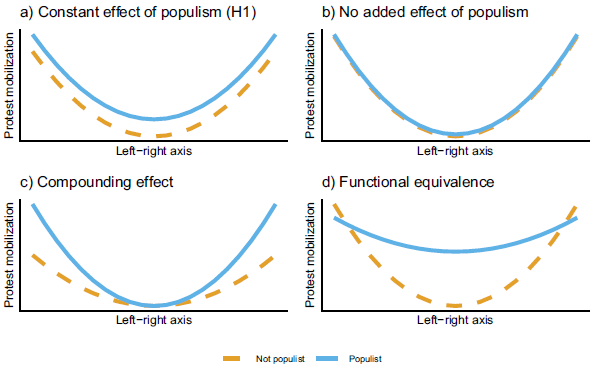
Therefore, if we observe that populist parties are more likely to mobilize, finding evidence in favor of the first hypothesis, the question remains whether (a) they are in themselves more likely to mobilize or whether (b) they do so because they also mostly tend to be radical, and in reality it is radical parties that do the heavy lifting of mobilization. Alternatively, populism and radicalism might interact such that (c) populism and radicalism in a party’s nature reinforce one another and drive protest even higher than each one individually, or (d) they are functionally equivalent, meaning that at the center populists are more likely to mobilize than non-populists, but at the extremes neither one nor the other dominates, and being only radical is the same as being both radical and populist. Figure 1 depicts these potential relationships.
Potential relationships between populism, radicalism, and protest mobilization.

Due to this correlation between populism and radicalism, the protest mobilization by centrist or ‘valence’ populist parties (Roberts Reference Roberts and De La Torre2018; Zulianello Reference Zulianello2020) becomes a crucial test case for the role of populism. These parties either focus almost exclusively on non-controversial valence issues such as the fight against corruption or the promise of new forms of participation and representation, or they blur their ideological position to such a degree that it becomes hard to sort them into any traditional party family. The prime example for the latter case is the Italian Movimento 5 Stelle. Valence populist parties are mainly a phenomenon of Central and Eastern Europe (Učeň Reference Učeň2007; Zulianello Reference Zulianello2020) due to relatively volatile party systems and a higher salience of corruption as a political issue.
Measuring protest mobilization
To ascertain the relationship between populism, host ideology, and protest mobilization, we need to find appropriate measures of protest-related behavior. Comparative protest datasets are rare, especially for party involvement. Existing datasets either contain very coarse data on party involvement due to sampling (Kriesi et al. Reference Kriesi, Wüest, Lorenzini, Makarov, Enggist, Rothenhäusler, Kurer, Häusermann, Wangen, Altiparmakis, Borbáth, Bremer, Gessler, Hunger, Hutter, Schulte-Cloos and Wang2020) or are restricted to party subgroups (Castelli Gattinara, Froio, and Pirro Reference Castelli Gattinara, Froio and Pirro2022) and therefore not suitable for our research question. We opt to collect our own dataset of party protest mobilization, based on the parties’ own communication.
Specifically, we use parties’ social media communication about protest to measure their involvement in protest mobilization. Social media are important sites to coordinate and mobilize for protest action (Jost et al. Reference Jost, Barberá, Bonneau, Langer, Metzger, Nagler, Sterling and Tucker2018). Although social media have facilitated looser, more personalized forms of activism (Bennett and Segerberg Reference Bennett and Segerberg2012), this has not made the online presence of traditional actors behind protest campaigns obsolete. Organizations with large networks at their disposal, such as traditional movement organizations or parties, are required to amplify and connect protest-related communication flows (González-Bailón and Wang Reference González-Bailón and Wang2016).
Social media, therefore, constitutes a central venue for protest mobilization by political parties. Many newly created European movement parties profited immensely from their fast adoption of emerging social media platforms (Gerbaudo Reference Gerbaudo2018). The digital realm offers ‘parties additional opportunities to act and talk like [social movement organizations] without necessarily facing the costs of recreating the membership structures of mass-based parties or the dual loyalties of party-movement alliances, while potentially reducing the trade-offs of combining electoral appeal with mechanisms of collective alignment’ (Peña Reference Peña2021:643). Social media also allow us to gather information about reactions to these protest mobilizations directly through likes and shares. Though by no means equivalent to offline protest participation, this can be a useful proxy for how well mobilizations resonate with a party’s followers.
We choose Facebook over Twitter since its structure is more favorable to the mobilization of supporters (Stier et al. Reference Stier, Bleier, Lietz and Strohmaier2018), and it is more widely used by the public in Europe (Newman et al. Reference Newman, Ross Arguedas, Robertson, Nielsen and Fletcher2025). We rely on a comprehensive dataset of Facebook communication by all national-level MPs in 27 European countries between 2018 and 2023. In our models, due to the availability of covariates, we only consider the time period until the end of 2021 and exclude Croatia. All posts were gathered by creating lists of active MP accounts at the outset of the data collection process, which were then updated after subsequent national elections. The Facebook posts were gathered through CrowdTangle, which gave access to all public Facebook posts and their associated metadata.Footnote 2 Since our interest lies in the behavior of parties, we aggregate the MP posts to their respective national parties. Our analysis dataset covers more than 4.2 million Facebook posts by 6699 MPs from 199 parties.
To detect protest-related posts, we employ a two-stage approach. In a first step, we develop a dictionaryFootnote 3 of keywords that are clearly related to protest activity while not being overly broad to avoid false positives. With this we can capture the overall emphasis in its communication that each party places on all protest-related topics. This can include a diverse range of topics such as calls for protest, discussions of past protest events including criticism, or general references to the act of or the right to protest.
We also create a second dependent variable for our social media dataset, which specifically captures announcements of protest events and thus mobilization. For this we add a second dictionary that picks up mentions of specific dates. We assume that posts that contain both references to protest as well as mentions of dates within a range of at most one sentence before or after the protest reference are more likely to relate to specific protest events rather than general discussions of the topic. All sentences that match these criteria were then run through the large language model Mistral-7b (Jiang et al. Reference Jiang, Sablayrolles, Mensch, Bamford, Chaplot, de las Casas, Bressand, Lengyel, Lample, Saulnier, Lavaud, Lachaux, Stock, Scao, Lavril, Wang, Lacroix and Sayed2023) with a few-shot prompt that provided multi-language example sentences, which we used to determine whether the post was indeed referring to a protest event announcementFootnote 4 . A manual validation of a random subset of the annotated posts yielded a F1 score of 0.86. This allows us to more concretely measure discourse related to mobilization. Protest-related posts make up a rather small share of MP’s social media communication. We find that 1.1 % of posts mention protest.
Our approach to construct our dataset exclusively based on parties with parliamentary representation has one important caveat for the exploration of our research question. A significant number of extreme left and right parties, typically not classified as populist but often involved in protest, are absent in our data due to their lack of parliamentary representation. This can restrict our ability to disentangle populism effects from ideological effects to a degree, since we are reliant on a smaller sample of these radical non-populist parties. We partially address this concern by running additional analyses based on PolDem protest event data (Kriesi et al. Reference Kriesi, Wüest, Lorenzini, Makarov, Enggist, Rothenhäusler, Kurer, Häusermann, Wangen, Altiparmakis, Borbáth, Bremer, Gessler, Hunger, Hutter, Schulte-Cloos and Wang2020), which does not share this sampling restriction, in the Online Appendix.
Independent variables
Our central independent variable captures whether a party is populist. We rely on the PopuList dataset (Rooduijn et al. Reference Rooduijn, Van Kessel, Froio, Pirro, De Lange, Halikiopoulou, Lewis, Mudde and Taggart2019), which follows the ideational approach, classifying parties as either populist or non-populist. The PopuList further distinguishes between clear and borderline cases of populism. We restrict the populist label to those parties that are not classified as borderline cases. Only considering parties that strongly emphasize a populist worldview should strengthen any distinct effects of populism that we may find. Importantly, the classification does not consider questions of party strategy or organization in determining the populist status of a party. Therefore, we do not run the risk of a tautological argument, investigating whether populist parties are more likely to protest based on a classification scheme that incorporates protest action.
From the Chapel Hill Expert Study (CHES) (Rovny et al. Reference Rovny, Polk, Bakker, Hooghe, Jolly, Marks, Steenbergen and Vachudova2025), we rely on the expert-rated overall left-right scale, ranging from 0 (far left) to 10 (far right). This scale is uni-dimensional and therefore captures both socio-economic as well as socio-cultural ideological aspects of party ideology. Both have been found to influence parties’ participation in protests (Borbáth and Hutter Reference Borbáth and Hutter2021). Alternative models with either a socio-cultural or socio-economic left-right scale (not reported) do not yield meaningfully different results but indicate that the socio-cultural left-right scale is slightly more strongly related to protest-related communication than the socio-economic one.
As briefly discussed, there is a correlation between populism and radical ideology, with most populist parties being either far left or far right. Particularly on the extreme right, there are only very few parties classified as non-populist. Disentangling the effects of populism and host ideology becomes more difficult on the extreme right. We therefore not only interact with the left-right scale with our dichotomous populism indicator but also run additional regressions with a continuous measure of the degree to which a party can be considered populist, using the first wave of the POPPA expert survey (Zaslove, Meijers, and Huber Reference Zaslove, Meijers and Huber2024).
Beyond our central explanatory variables, we explore whether populism interacts with conditions both at the party levelFootnote 5 and with broader structural factors. Analyzing how shifting opportunities for populist parties affect their relationship to protest can further elucidate whether there is something truly different about populist protest mobilization or whether it is more of an electoral strategy that is abandoned if it is not beneficial anymore.
Campaigning and governing
Protest and the involvement of parties in street politics have been shown to increase in election times (McAdam and Tarrow Reference McAdam and Tarrow2010; Borbáth and Hutter Reference Borbáth and Hutter2021). However, this effect may be reduced for populist parties that are known to engage in campaigning even when elections are far away (Conaghan and De la Torre Reference Conaghan and de la Torre2008). We include a dummy variable capturing the two months leading up to and the month with the election as the election period.
We also control for governing status. Typically, protest is the domain of opposition parties (Hutter and Vliegenthart Reference Hutter and Vliegenthart2018; Borbáth and Hutter Reference Borbáth and Hutter2021), serving as an effective tool for government attacks. Government parties may instead try to ignore protest. This may look differently for populist parties in government. Right-wing populists do not temper their rhetoric once entering government (Bobba and McDonnell Reference Bobba and McDonnell2016; Ceron, Gandini, and Lodetti Reference Ceron, Gandini and Lodetti2021; Schwörer Reference Schwörer2022). Arato and Cohen (Reference Arato and Cohen2022) claim that ‘populist anti-party movement parties cannot abandon their movement stance’ even when in government (p. 102). This might result in governing populist parties that keep on protesting, simply replacing the elites they attack. Similarly, ignoring protest that is directed against a governing party may be harder for populist parties, since they claim to represent the people. Protest against them poses an immediate challenge to this narrative and may require a strong counter-reaction to the protests by the populists. We include ParlGov information (Döring and Manow Reference Döring and Manow2024) about whether a party is part of the government in our models.
Movement and challenger parties
As we have laid out above, existing literature on party-movement interactions and party protest has often focused on the party types of the movement and the challenger party, showing that both are more present in the streets. We therefore also include an indicator on whether a party has been labeled as a movement party in the literature. We source this information from Borbáth and Paxton (Reference Borbáth and Paxton2024). We further incorporate the challenger status of a party, that is, whether it has had no previous governing experience.
The protest scene
It is well-documented that politicians are reactive to protest (Hutter and Vliegenthart Reference Hutter and Vliegenthart2018), especially on social media (Wouters, Staes, and Aelst Reference Wouters, Staes and van Aelst2022; Schürmann Reference Schürmann2024). Therefore, it is important to consider the wider protest scene when analyzing changing patterns of protest-related communication on politicians’ social media accounts. To model larger country-level protest dynamics, we use data from the PolDem protest event dataset (Kriesi et al. Reference Kriesi, Wüest, Lorenzini, Makarov, Enggist, Rothenhäusler, Kurer, Häusermann, Wangen, Altiparmakis, Borbáth, Bremer, Gessler, Hunger, Hutter, Schulte-Cloos and Wang2020)Footnote 6 . The methodology behind PolDem offers a broad, comparative overview over the protest dynamics by picking up events that were reported by major international newswires. We add a variable measuring the overall weighted protest volume in a given country at a given month. We only consider non-violent, contentious events, thereby excluding political violence as well as non-confrontational events such as petitions.
Regional differences
Finally, we control for possible regional differences across Europe, distinguishing between Central and Eastern Europe (CEE) on one side and Western and Southern Europe on the other. This follows previous findings that suggest different patterns of party involvement in protest politics between the regions (Borbáth and Hutter Reference Borbáth and Hutter2021).
Modeling strategy
Since our raw data consists of individual posts by MPs, we aggregate them to the level of their parties and sum up the number of protest-related posts of each party on a monthly basis. Our units of analysis are party-months.
For our main analyses, we analyze the relationship between populist parties and their protest-related posting behavior by first running multilevel linear regression models with the share of protest-related posts as our dependent variable and then multilevel negative binomial models with the count of protest mobilization posts as the dependent variable. We specify our models with random intercepts at the country level. We also specify an autoregressive covariance structure that assumes that residuals, clustered in parties nested in countries, are more correlated the closer they are together temporarily. That means we assume that parties are more likely to have a similar amount of protest-related posts in adjacent months than a year apart (Pinheiro and Bates Reference Pinheiro and Bates2006).
Results
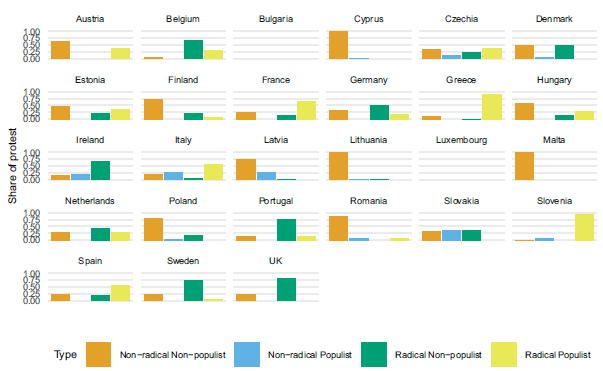
We begin by presenting a country-level overview of the degree of mobilization by different types of parties in Figure 2. We compare four types: non-radical non-populist, non-radical populist, radical non-populist, and radical populist parties. For the purpose of this visualization, we define as radical any party that scores below 2.5 or above 7.5 on the Chapel Hill left-right scale. While there are obvious country idiosyncracies in the patterns of mobilization, it becomes clear that in many countries in Western and Southern Europe, radical parties make up a larger share of the overall volume of protest mobilizations than in most CEE countries. Especially in Southern Europe, these radical parties are often populist. In CEE, parties that are neither particularly radical nor populist are often the dominant forces in party street mobilization. Non-radical populist parties do not mobilize for a majority of events in any country but are relatively prominent in Slovakia, Latvia, and Italy. Overall, populism is associated with protest mobilization more clearly when paired with radicalism.
Share of protest mobilization posts by party type (2018-2021). Bulgaria and Luxembourg had no mobilization posts in our data.

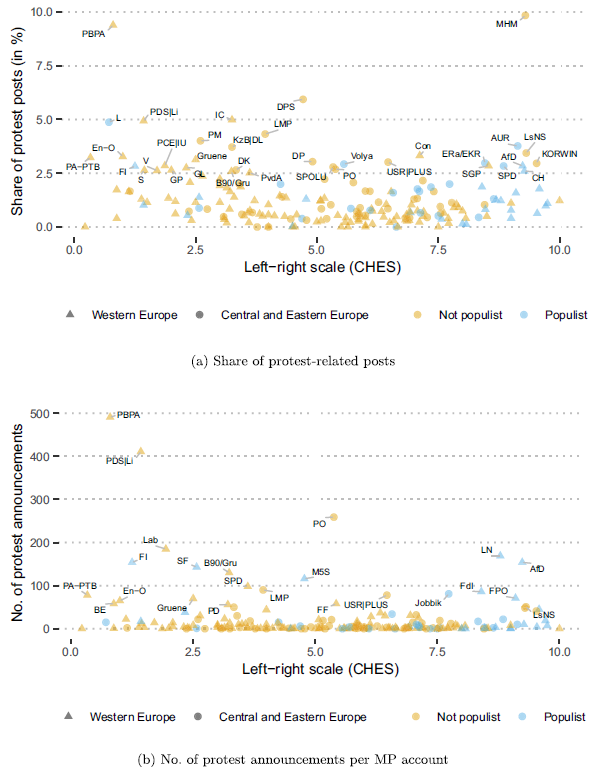
To gain a descriptive overview of the relationship between populism, host ideology, and the importance of protest on the party level, we plot the average monthly share of protest-related posts against the CHES left-right scale in Figure 3 and distinguish between populist and non-populist parties. We see a U-shaped ideological curve, with parties both on the far left and the far right affording protest-related topics much more space on their MP’s social media profiles. This applies to both populist and non-populist radical parties. More centrist parties, populist or not, talk less prominently about protest on average. There is also a clear difference between the European regions. Across the ideological spectrum, parties in Eastern Europe tend to afford more space to protest-related topics. Since this broader measure transcends concrete protest mobilizations and entails very different types of protest references, the apparent prominence of the Eastern European parties might have different explanations. For once, it might relate to the larger role that parties play in concrete protest politics due to overall weaker civil society structures compared to the rest of Europe (Borbáth and Hutter Reference Borbáth and Hutter2021). It might also reflect the more recent memories of popular protest related to the fall of Communism in 1989 (Meyer Reference Meyer, Craciun and Rammelt2025), which parties may attempt to invoke.
Protest posts of parties on Facebook by ideology and populism (2018–2021).

For protest mobilization posts, there is once more a visible U-shaped relationship between ideology and protest mobilization. The far left also features more prominently than the far right. Again, there is no clear difference between populist and non-populist parties. In the center-left field, we see especially green parties as the classic movement party type (Kitschelt Reference Kitschelt and Katz2006) that are avid online protest mobilizers. In the center, most parties, regardless of their status as populists, are less invested in protest. The sole populist standout is the Italian Movimento 5 Stelle (M5S). This does, however, not extend to the other (CEE) centrist populist parties in the sample. This presents a caveat for the testing of our interaction hypothesis. When distinguishing between European regions, M5S is the only centrist populist party in Western Europe. Thus, inference on populist parties in the central section of the ideological scale outside of CEE countries only rests on one party and needs to be treated with caution. We address this by running models with the before-mentioned continuous operationalization of populism, which provides more variance for parties in the center. Other non-populist parties in the center that were also very involved in street politics, mainly the Polish Civic Coalition and the Romanian Save Romania Union, are opposition parties that were part of larger anti-government protest campaigns. While far-right populist parties clearly make prominent use of Facebook to mobilize for protest events, this is also a function of the fact that almost all of the parties on the far right that feature in our dataset, i.e., parties with parliamentary representation, are also populist. The extreme right, which is another important actor in street politics (Castelli Gattinara and Pirro Reference Castelli Gattinara and Pirro2024), is largely absent from our analysis. Another aspect that should be noted when interpreting the figure is that it is also influenced by country population size, with more populous countries having more protest events that allow protest mobilization posts. This is one of the reasons we need to adjust for country differences in our regression analyses.
A protest announcement does not necessarily imply that the party was itself active in the event, but only that it mobilized for a protest that was taking place. This can also entail calls to join a protest event by aligned organizers. Still, in the Appendix, we show that at least for events that received a lot of mobilization posts, parties consistently also attended the events. Since multiple posts might mobilize for the same event, the counts should also not be understood as the total number of protest events that a party mobilized for during the period we investigate. Instead, it is a measure of how important the mobilization for protest events is for the parties in our dataset.
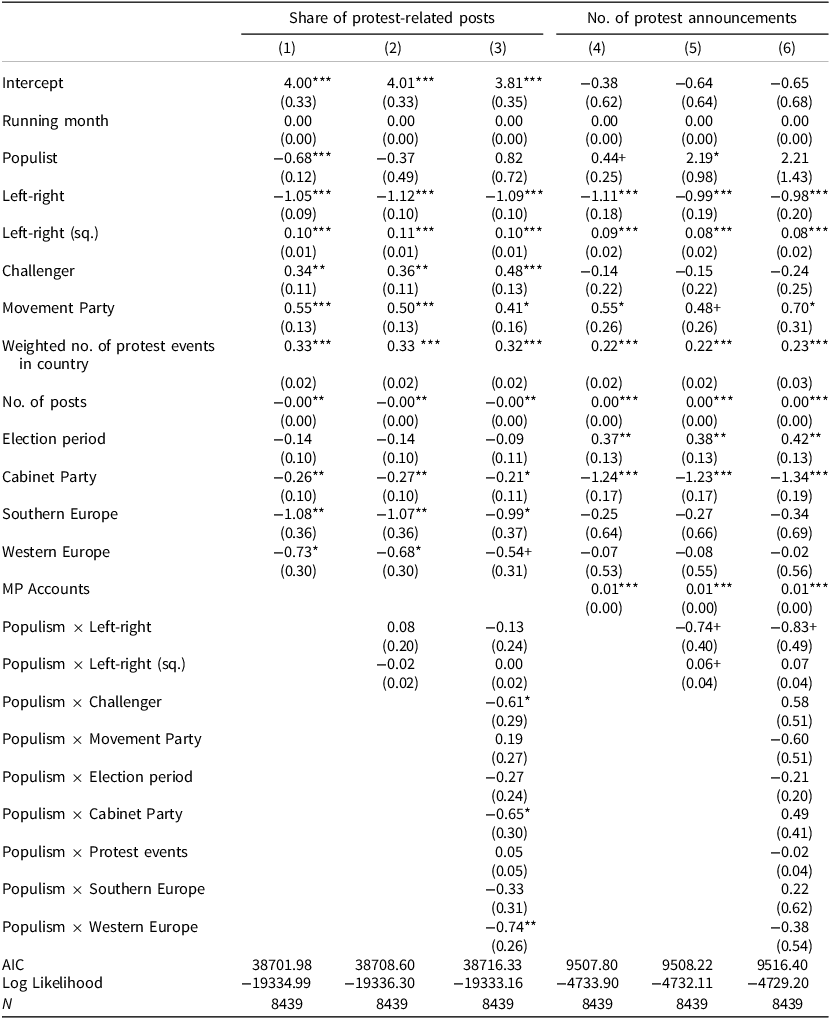
In Table 1, we present the results of our regressions on protest-related communication for the Facebook data. The table is split into two dependent variables and regression types, with models 1 to 3 displaying linear models with the share of posts dealing with protest in general as the dependent variable and models 4 to 6, which are negative binomial regression models with the monthly number of posts that contain announcements of future protest events as the dependent variable.
Regression models for protest-related posts on Facebook

Table 1. Long description
The table is structured with columns and rows comparing different variables and their impact on protest-related communication. It includes intercept values, running month, populist, left-right, left-right squared, challenger, movement party, weighted number of protest events in the country, number of posts, election period, cabinet party, southern Europe, western Europe, MP accounts, and various interaction terms. The table is divided into two main sections: models 1 to 3 display linear models with the share of posts dealing with protest in general as the dependent variable, while models 4 to 6 are negative binomial regression models with the monthly number of posts that contain announcements of future protest events as the dependent variable. Each row presents the coefficients, standard errors, and significance levels for each variable across the different models. Notable trends include the significant impact of left-right and left-right squared variables, the weighted number of protest events in the country, and the number of posts. Interaction terms such as populism with left-right, challenger, movement party, election period, cabinet party, protest events, southern Europe, and western Europe are also analyzed. The table provides a comprehensive overview of the factors influencing protest-related communication on Facebook.
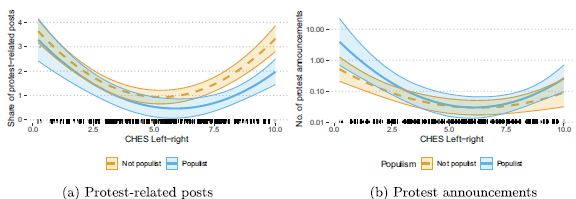
We find that the effect of populism that we have hypothesized based on our assumptions about an intrinsic motivation of populist parties to mobilize for protest only emerges for concrete protest event mobilizations and only partially. For the monthly overall share of protest-related posts (models 1 to 3), we find that populist parties in general tend to devote less of their total posting volume to protest topics than non-populist parties. We find the hypothesized U-shaped ideological relationship, with parties on the far left and far right being more likely to post about protest than centrist parties. We also see both challenger and movement parties being more likely to post about protests than other parties. Since we also control for the overall posting volume of parties, the negative finding is not simply a function of the higher amount of posts by populist parties on Facebook. In interaction with ideology, the negative effect of populism remains significant only for center-right to far-right parties. The left panel in Figure 4 indicates that the radical, non-populist parties on either side of the ideological spectrum devote more than three percent of their posts to protest-related topics and centrist parties down to one percent. For the populist parties on the left, the level is similar, while it is only two percentage points on the far right. Therefore, the ‘thick’ ideology is not only directly associated with protest-related communication but also moderates the association with populism. Further interaction effects with populism are uniformly negative. We find that populists in government are even less disposed to talk about protest in general than other governing parties, which might be related to the fact that governing populists tend to provoke protest against them (Sawyer Reference Sawyer2024). We thus have to reject the assumption that populist parties communicate more about protest, at least when it comes to the overall share of posts.
Predicted share of protest-related posts and number of protest announcements across populism and ideology.

For protest event announcements (models 4 to 6), we find that populist parties do mobilize more, with the effect size rather similar to that of movement parties. However, this effect largely disappears when interacting with the left-right scale. The ideological scale again shows a clear quadratic effect that indicates the higher involvement in protest mobilization by more radical parties. In interaction, the effect of populism becomes largely indistinguishable from that of non-populist parties with the same ideological profile (see the right panel in Figure 4). For both populist and non-populist parties, the far left is more active than the far right, with especially the populist far left being significantly more involved than the non-populist far right. While we find that populist parties do mobilize more for protest events, this difference is only present on the far-left side of the political spectrum. We find no significant interactions with other variables. Especially surprising is that populist parties are not found to behave differently to other parties when in government or during election campaigns.
As stated before, a problem in our model specification is that there is a lack of separation between the status as a populist party and being a party on the far right, as well as for the analysis of centrist populism in non-CEE countries. Therefore, in the Appendix, we provide additional models that use a continuous measure of populism. While the continuous measures are still highly correlated with the left-right scale, they offer more variation and thus information on the populism effect. The results are largely similar to the ones presented above. While we find a positive effect of populism in interaction with ideology, effect predictions demonstrate that the significant differences on the far left and especially far right mainly arise for low levels of populism that are empirically not present in the data. These findings therefore do not directly conflict with the other results presented above.
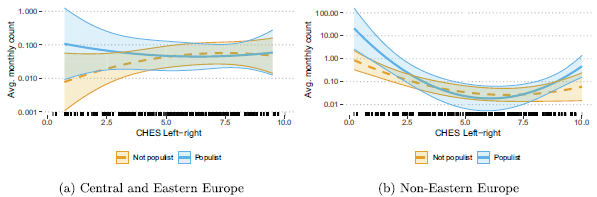
In Figure 5, we present the central interaction between ideology and populism separately for Central and Eastern Europe and non-Eastern Europe.Footnote 7 These show that both the relation of populism and host ideology to protest mobilization is less important in CEE countries. Beyond CEE, radical populist parties are significantly or almost significantly more involved in protest mobilization than their non-populist peers, while this is not the case for CEE countries. Relying on the continuous populism measure again, as reported in the Appendix, further supports the finding that outside of CEE, populism on the far left and the far right is significantly positively related to protest mobilization beyond a pure ideological effect. In contrast, in CEE neither ideology nor populism tends to be significantly related to protest mobilization. Instead, the full models demonstrate that here it seems to mainly be a function of party organizational form and context factors. Movement parties mobilize significantly more, while governing parties mobilize significantly less. These marked regional differences warrant further investigation of the possibly distinct relationship or lack thereof between populism, the left-right spectrum, and protest behavior in the CEE countries.
Predicted number of protest announcements by European regions.

We also include a robustness check by testing for the possible influence that the Covid pandemic may have had on the involvement of parties in protest mobilization. The pandemic policies imposed severe restrictions on the ability to organize protests but also may have asymmetrically mobilized radical and anti-system parties, thus potentially increasing the size of both the populism and the U-shaped ideology effects. For the left-right ideological scale, we find that the effects remain significant when restricting our sample to the time frame before March 2020, the month in which Covid-19 was declared a pandemic. For populism, we find that significance is reduced for the announcement models, with the effect of the far-left populists becoming insignificant and the slopes of the interaction effect decreasing. There is, therefore, some evidence that populist parties in particular became more involved in protest mobilization with the onset of the pandemic. This showcases the importance of moments of crisis for the mobilization of populist parties in particular. While generally, ideological radicalism is more consistently associated with party street politics, populist parties might be ‘activated’ by crises to become more involved in protest mobilization.
To validate our approach of operationalizing party protest mobilization through the analysis of social media, we provide further analyses in the Appendix. We first take a subset of protest events that received particular attention by parties and cross-validate the events with newspaper articles. For the subset, we find very strong confirmatory evidence that mobilization posts translate into party presence at the protests. Therefore, while our dependent variable should still be interpreted mainly as a measurement of mobilization behavior rather than protesting behavior, the two are likely to be strongly related. We also do another robustness check by looking at real protest event data instead of social media data. We make use of data on party-sponsored protests gathered as part of the PolDem project (Kriesi et al. Reference Kriesi, Wüest, Lorenzini, Makarov, Enggist, Rothenhäusler, Kurer, Häusermann, Wangen, Altiparmakis, Borbáth, Bremer, Gessler, Hunger, Hutter, Schulte-Cloos and Wang2020). While the dataset is much sparser and less accurately captures the involvement of parties in protest, we find further support for the observation that populism only matters for an ideological subset of the parties. However, it is the far-right populists that are more involved in protest mobilization than their non-populist peers, which is in contrast to our social media findings. This is most likely a product of either the right parties’ tendency to organize protests in isolation as opposed to the left parties’ coalitions with the social movement sector, which may lead to a clearer identification of the right’s involvement in protests in news articles, or the media sourcing of the protest event data from PolDem, which might have a reporting bias favoring far-right events (Castelli Gattinara and Pirro Reference Castelli Gattinara and Pirro2024).
Public reactions
Finally, we look for evidence of the hypothesized extrinsic motivation for protest by populist parties. We investigate how Facebook users react to calls for protest participation. We hypothesized that the support base of populist parties is made up to a large degree of people that are dissatisfied with the status quo and who are prone to protest, which may lead to a stronger resonance of protest among the followers of populist parties online. While we are not able to gather data on the actual turnout for the protest events for which we capture the mobilization posts, we can look at the engagement that Facebook users had with these posts. Liking or sharing a post on social media that calls for a protest is not the same as joining said protest, and engagement could be partially driven by bot accounts. The mobilization posts are also likely to largely remain within the orbit of party supporters. We therefore cannot measure any potential persuasive effects of protest mobilization that a party-organized protest may have on bystanders. Still, we argue that it is a good proxy for how strongly protest-related messaging resonates with the parties’ followers depending on which kind of party broadcasts it.
We employ negative binomial regression with the monthly average count of likes or shares for the protest announcement posts. We again use country random intercepts and the same AR1 autocorrelation structure from the previous models. For better comparability, we only look at those party months in which at least one protest announcement was posted, thus significantly reducing our number of observations and changing the composition of our analysis sample. Next to the independent variables we used in the above analyses, we add the average number of page likes of the party’s MPs that were active in that month as well as the average amount of likes or shares for all posts that party MP accounts made that month as a baseline. We present the full models in the Appendix.
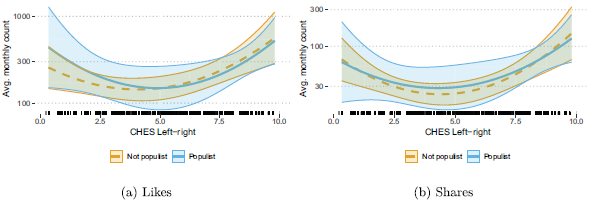
Figure 6 shows that, again, ideology is more strongly associated with the degree of engagement with protest mobilization posts. For both shares and likes, there is the familiar U-shaped effect. Whether a party is populist or not does not significantly affect the online resonance for protest mobilization posts.
Predicted monthly average count of engagements with protest announcements.

Based on these findings, we have to reject H1, since populism does not emerge as a consistently significant explanation for party protest mobilization. We also find no evidence for H2, as reactions to mobilization posts by populist parties are not stronger than for ideologically equivalent non-populist parties. We instead find strong evidence for H3. There is a clear quadratic relationship between ideology and both the overall share of protest-related communication and protest mobilization on Facebook, with the far left being more involved than the far right but both being more involved than moderate parties. Finally, regarding our assumptions about an interaction between populism and radicalism, we find only partial evidence for a compounding effect of both. Whereas in the ideological center our models show no difference in protest mobilization between populist and non-populist parties, there is some evidence for a significantly higher amount of mobilization posts if a party is both populist and on the far left. For subsamples of the data and a continuous operationalization of populism, the interactions between populism and ideology become more distinct. Outside of Central and Eastern Europe, both the far-left and the far-right populists may be more invested in protest than their non- or less-populist peers. The pandemic as a moment of political crisis seems to have increased the importance of populism, making it an open question whether the pandemic has ushered in a new era in which populism begins to matter more or whether it remains an isolated episode of populist mobilization.
Discussion and conclusion
The current wave of populist party success in Europe has often been linked with demands for better political representation (Castanho Silva and Wratil Reference Castanho Silva and Wratil2023). These demands were frequently expressed in the form of protest waves, which saw the involvement or sometimes the birth of populist parties. A strand of the literature on populism has repeatedly emphasized the role that street mobilization plays for the behavior of populist parties (Roberts Reference Roberts2006; Jansen Reference Jansen2011; Weyland Reference Weyland, Kaltwasser, Taggart, Espejo and Ostiguy2017). In this paper we have investigated whether this has also meant that populist parties are the ones to dominate the streets of Europe or whether it is actually radical parties mobilizing their followers to protest.
Using our comprehensive dataset of protest discourse and protest announcements on Facebook between 2018 and 2021, we show that the role of populism is ultimately weaker than that of radicalism. A party position on the extremes of the left-right scale serves both as a strong predictor for protest involvement on its own and as a moderator for the effect of populism, which only has a distinct effect on the far left. We find that in Western and Southern Europe, populism matters more on top of radicalism than in CEE countries. This regional differentiation warrants further investigation. Also, for the overall sample, the distinct involvement of radical populist parties only begins to emerge during the Covid crisis. This points to the importance of moments of political and social crisis for the protest politics of populist parties.
Our findings demonstrate that party protest is overall a phenomenon that lies largely in the domain of radical parties, with populism partially compounding the role of radicalism. Populist parties are therefore not fundamentally different from other parties when it comes to their protest behavior. Political moderation also seems to dissuade populist parties from protest. However, there are only a very limited number of centrist populist parties in the European parliaments and, therefore, also only a limited number of data points. The Italian Movimento 5 Stelle, as the sole centrist populist party outside of CEE, is the only outlier that bucks the trend of the clean adherence of populist parties to the ideological U-shaped effect. Despite being located in the center of the ideological spectrum, where protest mobilization tends to happen only rarely, and also being a governing party for the whole analysis period, it is one of the most prolific protest mobilizers in our data. This might be an indicator that, in Western Europe, populism can be a potent amplifier of protesting behavior for parties that are otherwise very moderate. Since the Five Star Movement is the only populist party occupying this area of the ideological spectrum, at least outside of CEE with its distinct relationship between ideology and protest, we can only speculate on this. As we have discussed before, it might be the ‘lack’ of ideology of the Five Star Movement that leads it to be such a prolific protest organizer, replacing issue politics with a more performative approach of system critique. It might also be the case that the populist claim to represent the whole people resonates better with protests that draw from a more diverse and ideologically less radical crowd. It is also likely still true that populist parties interact differently with protests than non-populist parties, e.g., by attempting to draw legitimacy from the crowds they attract. But these differences may be more qualitative than quantitative.
This paper has made contributions in two key areas. For the first time, we empirically tested theoretical assumptions regarding the distinct importance of protest for populist parties with a large-scale comparative dataset, as well as applying findings from the literature on ideological motivators behind individual protest behavior to the behavior of political parties. Our findings reinforce once more the importance of disentangling the analysis of correlates of populism from those of its host ideology (Hunger and Paxton Reference Hunger and Paxton2022). By investigating protest, a type of party behavior that is overall understudied, we provide additional crucial evidence that populist parties’ higher participation in protests can be almost entirely explained by the radical ideology they tend to hold. We also contribute methodologically by presenting the utility of using social media and large language models to collect data on protest event mobilization by organized groups or individuals. Our approach to pre-select potential posts and to then annotate them with an LLM yields a very satisfactory coding accuracy without the need to pre-train a machine learning model or to rely on human coders, thus decreasing time and costs. Since datasets on protest events are still very scarce, this is a potential avenue for future data collection, although divergences between online announcements and offline behavior still need to be accounted for.
Future research should investigate the link between populism and protest politics further. Data on parties without parliamentary representation would further refine the analysis, as would an analysis of the effects of within-party change on the populism and left-right axes. Also, the identified regional differences warrant further investigation on how mobilization practices by populist and radical parties differ between European regions. While we have pointed out that the involvement of populist parties in protest cannot be sharply distinguished from other radical parties, the effects of their protests might still be different. As we have argued above, the message of populist protest might resonate particularly well. Another worthwhile avenue would be to investigate which kinds of protest issues are more likely to be taken up by populist parties. While some issues potentially affect large parts or all of society and are therefore very suited for a populist frame of mobilization (Aslanidis Reference Aslanidis2024), other issues only encompass specific subgroups, which might make it harder for them to be incorporated into a populist mobilization.
Supplementary material
Supplemental material for this article can be found at https://doi.org/10.1017/S1475676526101686.
Data availability statement
Data and replication code are available online at https://doi.org/10.7910/DVN/GBKXXX.
Acknowledgements
For their excellent advice, we want to thank Mark Kayser, Swen Hutter, Pola Lehmann, Romain Lachat, Semih Çakir, and Stijn van Kessel, as well as the panel participants at EPSA 2025, the ECPR General Conference 2025, the CERIUMFMSH Summer School on ‘Challenges to Electoral Democracy’, and the anonymous reviewer.
Funding statement
This research was supported by a Hertie School doctoral scholarship.
Competing interests
None.
Ethical standards
This study was approved by the Hertie School Research Ethics Committee (approval no. 20250510-153) on May 27, 2025.
Use of artificial intelligence
No AI was used to generate text or figures. The use of a large language model to process data is described in detail in the methodology section and the Online Appendix.


 Open access

