1. Introduction
In recent years, the adoption of private standards concerning product attributes has significantly increased. Producers are increasingly asked to certify their products to comply with specific standards created by firms, standard setting coalitions (e.g., GFSI) and non-governmental organizations (NGOs). The goal of private standards is not only to specify the quality level and safety of food products (e.g., GlobalGAP, BRC, IFS), but also the attributes of the production process and its environmental and socioeconomic effects (e.g., Rainforest Alliance and FairTrade). Retailers are driving the creation of private standards as they have first-hand information on consumers' preferences towards different product characteristics. Moreover, they have incentives in developing successful marketing strategies to communicate private label product attributes. However, consumer preferences are not the only factor affecting the retailers' decisions about adopting private standards. The structure of the supply chain, the public minimum quality standard (MQS) set by the government and country-specific characteristics also play a fundamental role.
The creation and adoption of private standards has been studied from different points of view. First, many authors analyzed the effects that private standards have on producers and smallholders in developing countries. This literature is mainly based on case studies yielding opposite effects.Footnote 1 Second, another strand of literature analyzed the factors inducing companies to adopt private standards in the agri-food sector. These factors are firm specific, and are conditioned by the socioeconomic environment and by public policies. However, the majority of these studies provide qualitative analyses and their findings are mainly confined to specific case studies (García Martinez and Poole, Reference García Martinez and Poole2004; Codron et al., Reference Codron, Giraud-Héraud and Soler2005; Mainville et al., Reference Mainville, Zylbersztajn, Farina and Reardon2005). Third, some authors rely on the organizational innovation theory to analyze the determinants of the adoption of private standards at the international level. Within this literature, Neumayer and Perkins (Reference Neumayer and Perkins2005) and Herzfeld et al. (Reference Herzfeld, Drescher and Grebitus2011) show that established trade relations and historical links with home countries, as well as infrastructure endowment and institutional factors, are important determinants of the adoption of private standards by firms and farms.
Among the different product characteristics, the presence of ingredients obtained by genetic modification has attracted consumers' attention. Despite the fact that genetically modified (GM) crops are successfully adopted worldwide, many NGOs and green organizations in developed countries argue that GM crops can have negative effects on the agricultural production system in developing countries and that their effects on the environment and health are still unclear (Takeshima and Gruère, Reference Takeshima and Gruère2011), affecting the consumers' willingness to buy products containing GM ingredients. As a response to the demand for differentiated products not containing GM ingredients, in the middle of the 1990s some European retailers started to adopt certified GM-free private standards, selling private label products not containing ingredients obtained from GM crops. GM-free standards are now increasingly spread worldwide.
Specific studies on GM food private standards are provided by Gruère (Reference Gruère2006) and Gruère and Sengupta (Reference Gruère and Sengupta2009). The first provides important insights on the role of public regulation in ensuring consumers' ‘right to choose’ among different products in supermarkets; the second studies the effects of GM-free private standards on policy decisions in developing countries. However, neither of these two studies provides quantitative evidence, nor do they explain why retailers may decide to adopt GM-free private standards.
This paper aims to empirically analyze the factors affecting the retailers' decision to adopt GM-free private standards, an issue largely ignored in the present literature on private standards. Our analysis contributes to this literature in different ways. First, we obtained an original sample of GM private standards for 44 retailers operating in 54 countries distributed in all the continents. Second, using this wide sample we tested the hypotheses highlighted by the empirical literature using a binary response model. We found that historical, geographical, infrastructure and trade conditions significantly affect the retailer decision in adopting GM-free private standards. Finally, we also tested additional hypotheses formulated by the theoretical literature on vertical differentiation, and the political economy of private standard formation and of mass media. Our results show that public ownership of media reduces the likelihood that retailers will adopt GM-free standards. On the contrary, different biotech regulations between the home and operating country increase the probability of the adoption of GM-free standards by the retailer.
The remainder of the paper is organized as follows. In section 2 we review the theoretical literature explaining the formation of private standards and the political economy of mass media. In section 3 we present and discuss our original sample on retailers' GM private standards. In sections 4 and 5 we provide hypotheses from the empirical literature and explain the variables and methodology used in the econometric analysis. Section 6 provides the results and discusses the major findings. Finally, section 7 concludes.
2. Theoretical background
The theoretical analyses of the strategic adoption of private standards by firms follow two main approaches. The first approach uses vertical differentiation models analyzing the interaction between retailers and producers to explain the incentives of introducing private standards in the supply chain. In these models, alliances and bargaining processes in the supply chain are a tool to soften the price competition between retailers and to increase profits by product quality differentiation (Spence, Reference Spence1976). These alliances enhance private standards depending on the structure of the production sector and of the supply market. von Schlippenbach and Teichmann (Reference von Schlippenbach and Teichmann2012) provide important explanations of the interactions along the supply chain. In their study, private standards are a tool to improve the retailers' bargaining position with respect to producers. In the vertical structure, one retailer sets a relatively high private quality standard, while a second retailer has an incentive to undercut its private quality standard such that the supplier complying with the lower quality standard loses its outside option, and vice versa. The result is an improved bargaining position of the low-quality retailer. The vertical differentiation approach is particularly relevant in the case of GM-free standards, given that the supply of non-GM ingredients is conditional to identity preserved (IP) supply channels, which are driven by supply contracts and product quality certifications.
The second approach focuses on the interaction between firms' and governments' regulations, comparing the welfare effects of public vs. private standards. Private standards are strategically used by firms to preempt government regulations and to induce low (and less costly) public MQS (Lutz et al., Reference Lutz, Lyon and Maxwell2000; Maxwell et al., Reference Maxwell, Lyon and Hackett2000; McCluskey and Winfree, Reference McCluskey and Winfree2009), choosing the quality level that minimizes the negative effects on firms' revenues. Vandemoortele and Deconinck (Reference Vandemoortele and Deconinck2013) use a political economy model to show in which circumstances the retailer chooses a standard stricter than the public one. The decision depends on the retailer's market power and on the political influence of producers. Moreover, other factors affect the decision of the retailer, such as the possibility for the retailer to transfer a smaller rent and to shift the implementation cost to producers.
Further important factors affecting the retailers' decision of adopting private standards are consumer preferences and quality perception. McCluskey and Swinnen (Reference McCluskey and Swinnen2004) analyzed the political economy of mass media and the consumer's perception toward biotechnologies. They showed that mass media ownership in developed countries progressively shifted from public to private. As a consequence, mass media objectives also shifted, from political to commercial objectives. The authors argue that private media tend to publish negative aspects of news items in order to maximize their profit, according to the ‘bad news hypothesis’; that is, the marginal value of a piece of information with negative welfare effects is higher than the marginal value of a piece of information with positive welfare effects. Thus, private media are more likely to deliver potential risks associated with biotechnology rather than potential benefits, affecting the consumers' perception of products obtained with this technology. Curtis et al. (Reference Curtis, McCluskey and Swinnen2008) show that differences in media organization and media consumption between developed and developing countries can explain the differences in consumer attitudes toward genetically modified organisms (GMOs), ceteris paribus. They argue that the higher cost of information in developing countries, and the consequent lower consumption of information on biotechnology, can induce more favorable consumer perception of GMOs.Footnote 2 The reason behind this is that media in developing countries are often controlled by governments and the ideological influence of governments can increase the positive coverage of information in order to lower the risk perception of consumers.
The central aim of our analysis is to test the main hypotheses of the above-mentioned theoretical literature. Specifically, the effects of the interactions between retailers and producers will be tested using the ratio between the agricultural value added and the food value added. We expect that a greater participation of the producers in the food value chain will promote the adoption of GM-free private standards. Second, the influence of the mass media structure on private GMO standards will also be taken into account. In this respect, we expect that the public ownership of mass media will provide fewer incentives in delivering ‘bad news’, reducing consumers' aversion to biotechnology and, in turn, reducing the incentive for the retailer in adopting GM-free private standards. Finally, the interaction retailer–government will be tested by accounting for differences in the level of restrictiveness of public GMO standards. A strong heterogeneity in the public GMO regulation between the home country and the country where the retailer operates may induce the adoption of the private GM-free standard to overcome negative effects on retailers' revenues due to different levels of public standards across countries.
3. Retailers' private GMO standards
3.1. Sample selection
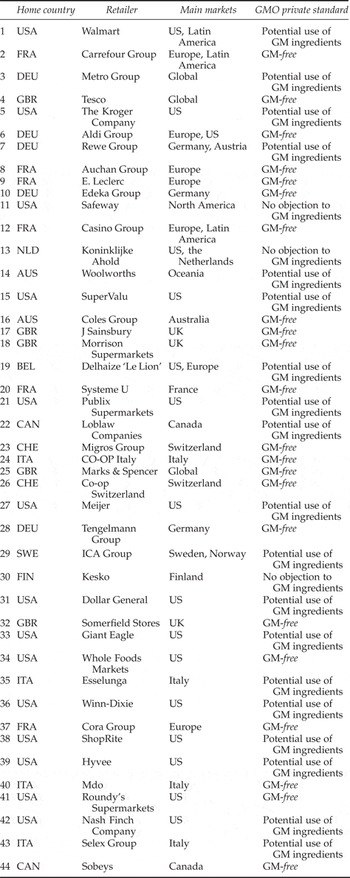
We collected an original sample of GMO private standards for 44 retailers groups, consisting of 174 different supermarket brands that include all types of stores, from hypermarkets to express stores. Our sample represents about 74 per cent of the world food retailers, ranked according to the value of retail sales in 2008 (Deloitte, 2009). Table 1 reports the complete list of retailers in the sample.
List of retailer groups and private GMO standards, ordered by retail sales according to Deloitte (2009)

Source: Authors' own data collection. See text for explanation.
We collected publicly available retailers' statements on their global GMO policies, applying three different strategies in gathering data. First, we collected retailers' statements contained in annual financial and sustainability reports for the year 2009 (published in 2010) or for the closest year available. Second, we collected similar statements from retailers' web pages accessed in the period between April and July 2010. Finally, we contacted the retailers' customer services in the same period, asking for an explanation of unclear statements and for missing information.
The focus of the sample is on GM-free standards on private label products, which represent a direct link between supermarkets and suppliers. Organic products are not treated in the sample, assuming that they are all GM-free, being subject to certification processes that do not allow for the use of GM ingredients.
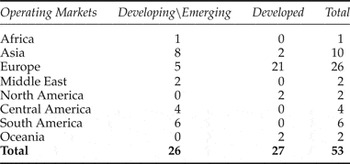
We distinguished between countries where the retailer groups are based (home country) and countries where the retailer groups have stores (operating country). Retailers are concentrated in 12 home countries: 26 retailer groups are based in Europe, 16 in North America and two in Oceania. The overall 44 retailers have stores in 53 countries, distributed over all the continents. Table 2 shows the geographical distribution of countries. Almost half of them are developing or emerging, largely located in Asia and Latin America.
Number of countries in the sample grouped into geographical regions

Notes: Classification based on the IMF's World Economic Outlook Report, April 2012.
European retailers have a wider geographical diffusion, with stores in 44 countries. The high internationalization of European retailers could be due to the internal market structure as well as to historical factors such as past colonial expansion. In contrast, North American retailers are mainly focused on their domestic markets, since they are present in only 15 countries of which seven are in South and Central America. North American retailers can rely on a larger domestic market, which reduces internal competition and the need for internationalization as a growth strategy.
Note that each retailer may have different standards in the different countries where it operates. Retailers do not always explicitly provide information on differentiated standards in the different markets (see next section for examples of standards' differentiation); hence we assume that the global standard is applied in those cases where a more specific standard is not indicated.Footnote 3
3.2. Retailers' private GMO standards
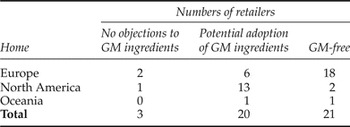
We divided the sample of retailers into three categories (see table 3). Category 1 includes retailers not adopting GMO private standards and showing no objections to the use of GM ingredients. In the second category, retailers do not have a specific GM-free standard, but they do not label their products as ‘Containing GMOs’, following the country's regulation on labeling thresholds. This means that the retailers in category 2 can (potentially) make use of GM ingredients, but in quantities below the labeling threshold, so that no label is needed, even in a mandatory labeling regime. In the third category we include retailers stating not to use GM ingredients in their private label products (GM-free). Not all the retailers in this category use GM-free labels. Indeed, many retailers are reticent in committing to GM-free labels, even if they rely on non-GM IP supply chains to ensure non-GM ingredients in their products.Footnote 4
Number of retailers grouped into GMO private standard and geographical regions

Source: Authors' own data collection. See text for explanation.
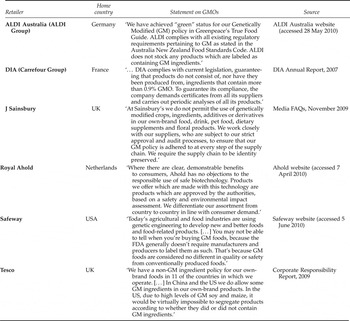
The world top 10 retailers included in our sample are divided over the categories ‘GM-free’ and ‘potential use of GM ingredients’. None of them is oriented to the use of GM ingredients. Only three retailers state that they do not have objections to the responsible use of GM ingredients. Two of them (Safeway and Kesko) operate only on the local markets, suggesting that their decision is closely linked to local consumers' preferences. The third (Koninklijie Ahold) operates in the Netherlands and in the United States, which are more open to the use of GMOs. Moreover, the Ahold's position on GM ingredients takes into account the local regulations (see table 4), adapting its strategy to the consumers' preferences in the different countries.
Examples of retailers' statements on GMO private standards

There are 20 retailers in category 2, the majority of whom are based in North America.Footnote 5 Their behavior is particularly sensitive. Many retailers are not willing to take a defined position on GMOs – i.e., adopting GM-free labels – because of uncertainties on both the supply and the demand side. On the one hand, a firm which adopts the GM-free label must purchase constant amounts of non-GM IP ingredients from one year to the next, and this is not easy to achieve on the traditional markets. To be provided with constant amounts of non-GM IP ingredients, the firm must create new and reliable supply channels that are conditional on business-to-business contracts and on certifications. Moreover, these supply channels increase economic and logistic burdens due to IP and product traceability. On the other hand, the label ‘Containing GMOs’ can be perceived by consumers as a hazard warning, even if the GM ingredients have been approved by the regulatory institutions after a health and environmental risk assessment. This warning effect can affect not only the sales of the labeled product, but also the consumer's perception of the retailer's overall ‘way to do business’. Hence, many retailers prefer to remain on the ‘safe side’, continuing to purchase the ingredients for their private label products on the traditional market and building the consumer's confidence by relying on the public regulation remaining below the labeling threshold (Tillie et al., Reference Tillie, Vigani, Dillen and Rodríguez Cerezo2012).Footnote 6
Moreover, there is a substantial difference in labeling GM-free animal products such as meat, eggs and dairy rather than plant products such as fresh produce and cooking oil made from corn and soybeans. While the latter may directly contain detectable GMO traces, the former consists of products from animals fed with non-GM feed, and it is impossible to detect GMO traces in the final product. Therefore, the certification for labeling animal products relies exclusively on the segregation of the supply chain. This involves more actors (from the collection, transportation, storage and compound feed sectors), each of them representing a potential source of admixture between GM and non-GM grains and subject to laboratory analyses to check compliance with non-GM requirements.
There are 21 retailers who have a GM-free standard (category 3), the large majority of whom are based in Europe. European retailers have driven the adoption of GM-free labels since the early 2000s. In 2004 Austria and Germany adopted the Gentechnik-frei erzeugt (GM-free produce) label for animal products, like dairy, poultry and pork, which progressively spread to other EU countries. In 2008 Germany enforced the EGGenTDurchfG Act that provided a legal base to GM-free labels.Footnote 7 More recently, in January 2012, France adopted a new decree (Sans OGM) that establishes rules for GM-free labels at national level. These two regulations will likely boost the adoption of GM-free labels in other European countries as well.
The fact that most European retailers have a GM-free standard and that the European retailers included in category 2 remain below the 0.9 per cent threshold suggests that GM private standards in Europe are stricter than public ones, in line with the theoretical findings of Vandemoortele and Deconinck (Reference Vandemoortele and Deconinck2013). However, this is not the case for North American retailers. According to public regulation, US and Canadian supermarkets do not adopt specific standards on GM ingredients.
As already mentioned in the previous section, retailers' private standards may change in different markets, adopting the best strategy according to consumer preferences and public standards. For example, Tesco, which has its core business in Europe, adopts a GM-free standard globally, with the exception of China and the United States where Tesco allows the use of GM ingredients (table 4). In the same way, Delhaize avoids adopting specific GM standards, except in Europe where it adopts a GM-free private label.
Finally, some retailers belonging to the same group apply different approaches. For example, the Walmart Group has stores all over the world, but only in the UK was a GM-free standard implemented under the brand of ASDA. DIA, which is part of the Carrefour Group, declares compliance with public regulation while Carrefour sells GM-free private label products. Similarly, while Ahold's global position is rather open to biotechnologies, Ahold's joint venture Jerónimo Martins, with stores in Poland and Portugal, has a GM-free standard.
4. Hypotheses and data description
From the sample described above, we developed a binary dependent variable based on the retailers' statement about GMO private standards. While the meaning of a GM-free standard is straightforward, for the empirical analysis the distinction between category 1 (‘no objection to GM ingredients’) and 2 (‘potential adoption of GM ingredients’) is not similarly relevant, given that both may imply the use of GM ingredients, at least in very low quantities below the threshold level. Hence, we combined the sample into two groups: retailers adopting GM-free standards and retailers not doing so. The resulting categorical variable is called GM-free and describes the behavior of the retailer concerning GMO private standards in the countries where it has stores; hence the unit of our analysis is the pair retailer-country. The dependent variable takes a value equal to 1 if the retailer uses GM-free ingredients in private label products in the country, and 0 otherwise.
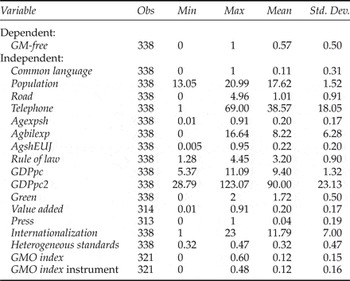
The explanatory variables are selected on the basis of the theoretical and empirical literature. Following Herzfeld et al. (Reference Herzfeld, Drescher and Grebitus2011), we selected four countries' characteristics potentially influencing the retailer's choice to adopt GM-free standards: historical and geographical conditions, infrastructures, sectorial conditions, and the quality of institutions and economic development. Table 5 reports summary statistics of the variables used.
Summary statistics of dependent and independent variables

Notes: See text for variables explanation.
Historical and geographical factors affect cultural characteristics and information flows between countries, affecting, in turn, consumers' preferences and firms' behavior. Moreover, these factors may ease the transfer of new technologies and standards explaining their adoption (Neumayer and Perkins, Reference Neumayer and Perkins2005). To test for historical and geographical conditions, we used two variables. First, a dummy variable on Common language to control for cultural and historical factors, equal to 1 if home and operating country share the official language. We expect that sharing the official language increases the likelihood of the adoption of the standard, due to easier transfer of the standard from one country to the other. Second, we control for the country size using the logarithm of the population (Population). The common language dummy variable is taken from the CEPII Gravity data set developed by Head et al. (Reference Head, Mayer and Ries2010), while the data on population is from the World Bank's WDI database.
Infrastructure factors may affect the adoption of a private standard in different ways. On the one hand, the country's provision of transport infrastructure affects internal and export transport costs, influencing firms' competitiveness both on the domestic and on the international markets. Moreover, the provision of transportation infrastructure affects the costs of segregation between GM and non-GM products carried by the retailer. On the other hand, information and communication infrastructures are vital to access information on export requirements and on competitiveness strategies of other firms (Herzfeld et al., Reference Herzfeld, Drescher and Grebitus2011). Access to telephones, faxes, email and internet increases the likelihood of interactions between adopters and potential adopters in different countries, promoting the global diffusion of business strategies and standards (Neumayer and Perkins, Reference Neumayer and Perkins2005). The development of the country transportation infrastructures is taken into account using the Road density per square kilometer (WDI database), while we use the Telephone lines per 100 people (WDI database) as a proxy for information and communication infrastructures.
Sectorial characteristics are mainly captured by the country's position on the international markets. International trade is not only a mean for the exchange of goods and services, but also a source of networks enhancing the transfer of knowledge and new practices. We used three variables. First is the agricultural export share (Agexpsh) that measures the relative importance of agricultural exports with respect to total exports. Countries with well-established agricultural exports have greater integration in the international market and higher comparative advantage in agricultural production (Herzfeld et al., Reference Herzfeld, Drescher and Grebitus2011). Second, given that intense trade relations can induce homogenous organizational practices (Neumayer and Perkins, Reference Neumayer and Perkins2005), we use the logarithm of the agricultural bilateral exports (Agbilexp) between home and operating country. The final variable is the share of agricultural products exports on total exports to the European Union, the United States and Japan (AgexpEUJ). These markets are highly competitive, promoting product differentiation strategies across retailers. Moreover, the high-income consumers can be more willing to pay a price premium for higher quality differentiated products (Gruère et al., Reference Gruère, Carter and Farzin2009). Trade data are from the UN COMTRADE, through the WITS service provided by the World Bank. In order to avoid endogeneity bias, the trade variables are calculated for the year 1995, prior to the introduction of the first commercial GM crop in 1996.Footnote 8
The fourth factor, the institutional environment, can shape market characteristics influencing retailer behavior. To control the role of public institutions we used the Rule of law index, from the World Bank Governance Indicators database (see Kaufmann et al., Reference Kaufmann, Kraay and Mastruzzi2007). This index indicates the effectiveness and the predictability of the judiciary system and the enforceability of contracts. It ranges between 0 and 5, with higher values for higher institutions quality. Empirical evidence suggests that quality management systems at the firm level are fostered by a high-quality institutional environment (Correa et al., Reference Correa, Fernandes and Uregian2008); hence, similarly, we expect that better institutions encourage the adoption of the private standard. Following Herzfeld et al. (Reference Herzfeld, Drescher and Grebitus2011), we also used the logarithm of the GDP per capita (GDPpc) to control for the level of economic development. For retailers in developing countries there can be potential disadvantages in adopting private standards due to prohibitive transaction costs. We also tested a possible non-linear relationship of the level of economic development using the squared logarithm of the GDP per capita (GDPpc2).
In addition to the above variables proposed by Herzfeld et al. (Reference Herzfeld, Drescher and Grebitus2011), we also used a set of variables particularly relevant for the analysis of GM-free private standards.
First we used a variable on the presence in the country of green NGOs. Their campaigns can influence the preferences of consumers (Gruère et al., Reference Gruère, Carter and Farzin2009) and, as a consequence, the decision of the retailer to adopt GM-free private standards. We considered two major green NGOs that are particularly active in anti-GMOs campaigns: ‘Greenpeace’ and ‘Friends of the Earth’. The variable is equal to 0 if neither is present in the country, 1 if only one is present, and 2 if both are present.
Second, to control for the structure of the supply chain and for the bargaining power among producers and retailers (von Schlippenbach and Teichmann, Reference von Schlippenbach and Teichmann2012), we used the variable Value added, calculated as the ratio between agricultural value-added and food value-added (WDI). A common interpretation for this ratio is that lower values measure the ‘maturity’ of the agri-food sector and, other things being equal, it is affected by the country's economic development (EC, 2009). Developing countries often have higher values of this ratio, because in the initial steps of the development process their agricultural value-added grows at higher rates than their food industry value-added, and vice versa in more developed countries. In our model we directly control for the level of development using the GDP per capita; hence the Value added variable captures its differential effect, which is the repartition of the value-added along the supply chain. Since we control for development, higher Value added indicates that the agricultural sector has greater participation in the creation of value along the food chain. This increased role of the agricultural production in the food value-chain results in the primary sector's greater bargaining power, thanks to better organization of the farmers, in the production of higher quantities or quality (e.g., organic, fresh produce), or in the specialization in niche products (EC, 2009).
Third, we tested the hypotheses formulated by the theoretical literature on the political economy of mass media using the share of the public press on total press (Press) taken from Djankov et al. (Reference Djankov, McLiesh, Nenova and Shleifer2003). Vigani and Olper (Reference Vigani and Olper2013) show that, in rich countries, the competition between commercial media induces information bias on food safety issues that translates into a policy bias, namely more stringent GMO standards. According to the theoretical arguments of Curtis et al. (Reference Curtis, McCluskey and Swinnen2008) and the empirical evidence of Vigani and Olper (Reference Vigani and Olper2013), we expect that a higher share of public press would negatively affect the adoption of GM-free private standards.
Fourth, we relaxed the assumption made in section 3.1 that the retailers adopt the global standard in all the countries where it has stores, adding two variables. The first, Internationalization, consists of the number of countries where the retailer has stores. It controls both for the level of international competitiveness of the retailer and for the probability that, at increasing number of countries, the retailer adopts different standards to satisfy different consumers' preferences. The second, Heterogeneous standards, is a variable equal to 1 when we have the information that the retailer adopts different GM standards in at least one country, and 0 otherwise. This variable controls for unobserved heterogeneous standards for those retailers for which we have proof that they use different standards.
Finally, in order to account for the interaction between private and public GMO standards, we used an index on the restrictiveness of the GMO public regulation (GMO index), developed by Vigani et al. (Reference Vigani, Raimondi and Olper2012) and Vigani and Olper (Reference Vigani and Olper2013). The GMO index ranges between 0 and 1, where higher values indicate a more restrictive GMO regulation. We computed a regulatory distance between countries, obtained as the absolute deviation of the GMO index between the home (i) and the operating country (j), namely GMO ij = |GMO i − GMO j |. We expect that higher heterogeneity in regulation between countries induces the retailer to adopt the private standard in order to choose the quality level that minimizes the negative effects on costs and revenues (McCluskey and Swinnen, Reference McCluskey and Swinnen2004). Moreover, different levels in the restrictiveness of the regulation may increase the incentives of the retailer not to use GM ingredients in order to avoid product transfer interruptions due to asynchronous and asymmetric approvals.
Because the GMO index may suffer from causality issues (the public standard may influence the adoption of the private standard; contrarily, the presence of private standards on the markets may influence the formation of public standards), the GMO index will be treated as endogenous and instrumented with the GMO index of the five neighboring countries weighted by the distance (see Vigani et al., Reference Vigani, Raimondi and Olper2012).
With the exception of trade and GMO index variables, all the other explanatory variables are taken for the year 2005 (or closest). This lagged period with respect to the dependent variable, which refers to information we collected in 2010, allows us to clean for further potential endogeneity issues.
5. Econometric strategy
To explain the retailers' choice between different GMO private standards, we used a binary response model to measure the retailer's probability to opt for the GM-free private standard, taking into account the country's characteristics.
The dependent variable y ij , can take on the following values:
 $$\eqalign{& y_{ij}=1 \, \hbox{if the} \, i^{th} \hbox{retailer in the} j^{th} \hbox{country chooses a GM-}free \, \hbox{standard}\semicolon \; \cr & y_{ij}=0\,\hbox{otherwise}.}$$
The binary response probability is given by:
 $$\hbox{P}\lpar y_{ij} = 1\vert x\rpar = G\lpar \beta_{o} + \beta_{1}x_{ij} + {\ldots} + \beta_{16}x_{ij}\rpar + \varepsilon_{ij} = G\lpar \beta_{0} + {\bf x {\beta}}\rpar$$
where β is a vector of coefficients to be estimated and x represents a vector of country j's characteristics. Equation (1) is estimated using a Probit model, with maximum likelihood estimators (MLE), where the probability that retailer i will adopt a GM-free standard in country j depends on all the exogenous variables that describe the country's characteristics. We tested three different specifications of this model. The first specification includes in the vector x the following variables: (1) Common language; (2) Population; (3) Road; (4) Telephone; (5) Agexpsh; (6) Agbilexp; (7) AgexpEUJ; (8) Rule of law; (9) GDPpc; (10) GDPpc2; (11) Green; (12) Value added and (13) Press. The selection of these variables relies on the hypotheses on the probability of adopting GM-free standards discussed in the previous section.
In the second and third specification we augmented the vector x by adding the variables (14) Internationalization and (15) Heterogeneous strategy. The inclusion of these two variables allowed us to control for specific limitations of our sample. Since it was not always possible to collect information on each retailer brand in each country and we had to rely on retailers' global statements, we control for unobserved heterogeneity in the GM-free standard of retailers with these two variables.
In the third specification we also added the bilateral variable (16), GMO index, to observe the probability that different public standards across countries affect the adoption of GM-free private standards by retailers. As underlined in the theoretical literature, the use of private standards is linked to the level of public standards. However, public standards can be different between the home and operating country, affecting the retailer's strategy in adopting private standards.
The same theoretical literature highlights that private standards are strategically used by firms to influence the output of the government in setting public standards. Because of this double causality influence between public and private standards, we also estimated equation (1) using an instrumental variable Probit (IV Probit). In order to account for the potential endogeneity bias of the GMO index, we used the GMO index of the five neighboring countries weighted by the distance as an instrument.
Finally, in all the specifications we included regional dummies (for EU countries, Asia, Latin America, North America and Middle East) to control for any other omitted factors.
6. Results and discussion
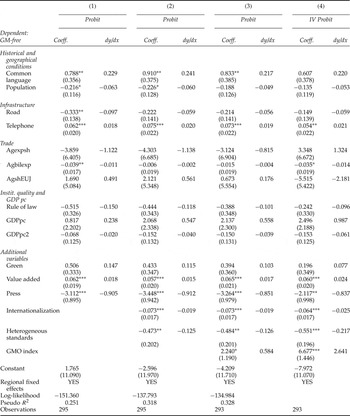
The results of the econometric model are shown in table 6. Overall, the magnitude of the coefficients and the marginal probability effects are consistent across specifications; thus the results of columns 1, 2 and 3 tend to confirm the stability of the basic model. Similar effects can be detected in column 4, where using IV Probit we account for potential endogeneity of the GMO index.Footnote 9 Overall, the majority of the hypotheses developed in section 4 are confirmed, in particular the important role of the structure of the media sector and of the public policies in the adoption of GM-free private standards by retailers.
Results from the Probit and IV Probit models

Notes: Robust standard error in parentheses. ***, ** and * indicate significance level at the 1%, 5% and 10%, respectively. Each regression includes regional fixed effects for Asia, the EU, the Middle East and North and Latin America.
Starting from historical and geographical variables, in columns 1, 2 and 3 we find that, when the home and operating country have a common language, the likelihood that the retailer will adopt a GM-free standard increases by about 22–24 per cent. The common language enhances the spread of the standard, both as a result of easier transfer of new commercial strategies and of shared consumers' and firms' characteristics. In contrast, in columns 1 and 2 the country size has a significant negative effect on the likelihood of adopting GM-free private standards. This can be due to a more complex stratification of the (large) population that makes it difficult to identify clear standards preferences.
Looking at the results of infrastructure variables, we obtain a deeper understanding of the effect of the country size. In column 1, a higher share of Roads reduces the likelihood of adopting GM-free standards. Each additional kilometer of roads per square km reduces the likelihood of adopting GM-free private standards by about 10 per cent. The negative effect found on Road is in line with the result of Herzfeld et al. (Reference Herzfeld, Drescher and Grebitus2011) that used a similar variable to study the adoption of GlobalGAP certificates by countries. However, this effect loses significance in specification (2) and (3). Thus, we have only weak evidence that a more complex infrastructure (in particular in large countries) can reduce the incentive of adopting a GM-free standard due to higher compliance costs of segregation measures. In contrast, a greater endowment of information infrastructure, such as telephone lines, significantly increases the likelihood of adopting a GM-free standard, confirming the hypothesis that more information facilities enhance the firm's integration on the international competitive markets. The variable Telephone is significant at the 1 per cent level in all the specifications.
The next group of variables suggests that the country trade position can be an important factor affecting the retailer's decision of adopting GM-free standards. In particular, high trade flows between home and operating country have a negative effect on the probability of adopting GM-free standards, even though with a small marginal effect. The Agbilexp variable is always negative and significant at 5 per cent or 10 per cent in columns 1 and 4 respectively. Indeed, well-established trade relationships may oppose the introduction of a standard that increases trade costs due to IP chains. On the contrary, the country's comparative advantage in exporting agricultural products and the higher share of agricultural exports to rich markets (i.e., European Union, Japan and the United States) do not seem to play a decisive role in driving the adoption of GM-free private standards.
None of the results on the quality of institutions, the level of development and the presence of green NGOs is statistically confirmed, while the role of the value chain and of the public press yielded important results.
The variable Value added is positive and significant at the 1 per cent level in all specifications. With a larger share of agricultural value-added, the likelihood of adopting the GM-free standard increases from 15 per cent to 24 per cent, depending on the specification. This confirms our hypothesis and also the findings of the theoretical literature on vertical differentiation strategies (von Schlippenbach and Teichmann, Reference von Schlippenbach and Teichmann2012). Better farmers' organization and high-quality and niche productions, resulting in higher share of the overall value of the food chain and a greater bargaining position of upstream farmers, enhance producers' ability to afford low productive and more costly GM-free productions (Wesseler et al., Reference Wesseler, Scatasta, El Hadji, Carter, Moschini and Sheldon2011), and to obtain production risks mitigation tools, such as supply contracts.
The hypotheses from the political economy of mass media are also confirmed. In all the specifications, results show that an increase in the public ownership of the domestic newspapers decreases the likelihood of adopting GM-free standards, and this effect is significant and particularly strong. This suggests that, since public media tend to transmit information with a less negative view than private media in order to soften food safety concerns (Curtis et al., Reference Curtis, McCluskey and Swinnen2008), public media tend to lower the consumers' aversion towards GM products, reducing the incentives for retailers to sell GM-free products.
Retailers with a higher level of internationalization and showing different private GM-free standards in different countries are less likely to adopt GM-free standards. The coefficients on Internationalization and Heterogeneous strategy are always negative and statistically significant in columns 2, 3 and 4. This suggests that, if the retailer operates in numerous markets, its willingness to adopt restrictive GM private standards (implying greater segregation costs) is lower than for retailers dependent on smaller local markets.
Finally, we tested the effect of the difference in biotech regulation between the home and operating country. An increase in the regulatory difference between countries strongly increases the probability that the retailer will adopt GM-free private standards. This result confirms the hypotheses of the theoretical literature on the interaction between private and public standards. In the presence of heterogeneous GMO regulations, the retailer is more likely to adopt its own private standard, setting the quality level that minimizes the negative effects on revenues. Moreover, in order to exploit their private label products in different markets, the best strategy is to sell products not containing GM ingredients. This allows the retailer to avoid problems such as asynchronous or asymmetric approval while transferring private label products from one country to the other, allowing exploitation of the non-GM IP supply channel on a larger (international) scale, without incurring different labeling thresholds. The adoption of a single (restrictive) private standard on a large scale permits the retailer to overcome compliance and logistic costs due to different public MQS levels in different countries, obtaining homogeneous products for markets with different regulations.
7. Conclusions
This paper contributes to the empirical literature on private standards, investigating the determinants of the adoption of GM-free private standards by retailers.
First, we provide an original sample of GMOs private standards for 44 retailers, showing that these standards can be clustered into three groups: retailers not adopting GM-free standards, retailers following the public regulation on labeling threshold, and retailers using GM-free private standards. Second, we tested four groups of variables from the theoretical and empirical literature on the private standard formation: historical and geographical factors; infrastructure; sectorial conditions and the quality of institutions and economic development. As key results, we found that a greater participation of the primary sector in the creation of value-added in the food chain induces the adoption of GM-free private standards. Moreover, a greater share of public media decreases the consumers' aversion towards GMOs, reducing the incentives for retailers to sell GM-free products. Finally, uncertainties at public regulation level, in the form of heterogeneous public standards between countries, induce the retailer to adopt private standards in order to voluntarily choose the quality level that minimizes the negative effects on revenues.
Besides identifying the factors inducing retailers to adopt GM-free standards, our results also raise important issues on the environmental and economic sustainability of these standards. First, the environmental effects of the GM-free production are questionable when the loss of the potential environmental benefits from GM crops is considered. GM crops can have important direct and indirect environmental benefits, especially for developing countries, such as the reduction of pesticide applications, lower pressure on land use and lower on-farm fuel consumption and greenhouse gas (GHG) emissions (Wesseler et al., Reference Wesseler, Scatasta, El Hadji, Carter, Moschini and Sheldon2011). All these environmental benefits are potentially lost in the GM-free production.
Second, market actors deciding to participate in the GM-free supply chain face two different sources of uncertainties, concerning commercial relationships and market stability. In the first case, the sourcing of non-GM IP products by retailers requires long-term contracts for certified non-GM products and it is costly due to segregation measures, lower productivity and higher input use of non-GM crops. In the face of these problems, European retailers recently adopted two opposing strategies. The first strategy consists of reinforcing the relationships with producers. For example, in May 2013, a group of 13 European retailers launched the initiative ‘Brussels Soy Declaration’, in order to support the Brazilian cultivation of GM-free soybean, reducing costs and creating a stronger link with Brazilian producers for the sourcing of GM-free products in the long run. In contrast, the second strategy is to reverse the private standard. Indeed, in the last two years several UK retailers (ASDA, Morrisons, Tesco, The Cooperative, Marks & Spencer and Sainsbury) abandoned their GM-free requirements on poultry products, because of the difficulties of UK farmers in sourcing enough GM-free feed. The abandoning of the GM-free standard was condemned by green groups, accusing the UK retailers of betraying their promises to customers. Hence, GM-free private standards are abandoned because they are not sustainable in the long run, but at a high cost in terms of public image and creating unreliable commercial relationships with producers.
The second source of uncertainty, market stability, derives from the possible shrinking of EU imports of GM-free protein crops. The EU is currently a net importer of non-GM soya, but the EU is seeking higher self-sufficiency through the recent reform of the CAP that included voluntary ‘coupled’ direct payments for protein crops. In Europe there are no authorized GM protein crops; hence any cultivable protein crop is non-GM, and the expected higher internal production of non-GM soya consequent to subsidization would reduce the EU demand for GM-free protein crops from foreign exporting countries.
What is most interesting is that all the above-described scenarios have large economic impacts on both farmers and market actors in developing countries deciding to produce GM-free. On the one hand, farmers in developing countries can lose important economic benefits derived from the use of GM crops, such as increased yields and simplified crop management and, consequently, lose important contributions toward food security. On the other hand, the creation of a non-GM supply chain generates fixed and variable costs for market actors in developing countries, potentially balanced by price premiums and market access. Therefore, an unexpected break of the GM-free production (either due to companies abandoning the GM-free standard or to lower market demand) would provoke the effective loss of the investments on segregation and certification infrastructures.
Given the above-mentioned economic and environmental effects of GM-free private standards, more research is needed in this field. In particular, the effects of the adoption of GM-free private standards by food multinationals and global fast-food restaurants is widely ignored in the literature, despite the fact that these companies are vital in shaping the global agri-food supply and demand.