The term “delirium” is defined as an acute mental status with features of inattention and an altered level of consciousness (Robinson and Eiseman, Reference Robinson and Eiseman2008). Delirious syndromes are a common complication in the inpatient treatment of elderly patients. While at a prevalence of 1–2%, delirious syndromes are rarely found in the community of over 65-year-olds (Davis et al., Reference Davis2013; de Lange et al., Reference de Lange, Verhaak and van der Meer2013), very high prevalence rates of up to 82% and 70% were found in hospitals (ranging from 7% to 82%) (Inouye et al., Reference Inouye, Westendorp and Saczynski2014), and nursing homes (ranging from 1.4% to 70.3%) (de Lange et al., Reference de Lange, Verhaak and van der Meer2013); such findings primarily depend on the diagnostic criteria used, the age of the patient, and the dementia rate.
Delirious syndromes occur mainly in surgical and internal medicine departments and in intensive care (Inouye et al., Reference Inouye, Westendorp and Saczynski2014; Arumugam et al., Reference Arumugam2017). In general, delirium is associated with an increased length of stay, increased care requirements, an increase in the number of institutionalizations, and ultimately an increased mortality rate (Inouye et al., Reference Inouye, Westendorp and Saczynski2014; Pendlebury et al., Reference Pendlebury2015). It is known that delirium often remains undetected in both inpatients and outpatients (e.g. de Lange et al., Reference de Lange, Verhaak and van der Meer2013; Jenkin et al., Reference Jenkin, Al-Attar, Richardson, Myint, MacLullich and Davis2016) Therefore, identifying risk factors is particularly important in order to initiate preventive measures as early as possible (e.g. Kratz et al., Reference Kratz, Heinrich, Schlauß and Diefenbacher2015; Pendlebury et al., Reference Pendlebury, Lovett, Smith, Wharton and Rothwell2017). This is especially true for preventive instruments like those that have been introduced for delirium superimposed on dementia (Richardson et al., Reference Richardson2017). The risk factors identified in the hospital sector (Vasilevskis et al., Reference Vasilevskis, Han, Hughes and Ely2012; Ahmed et al., Reference Ahmed, Leurent and Sampson2014; Inouye et al., Reference Inouye, Westendorp and Saczynski2014) included advanced age, high-clinical comorbidity, especially dementia, postoperative conditions, tumor diseases, fluid and electrolyte balance disorders, and polymedication associated with multimorbidity. In particular, the following drugs were blamed for delirious conditions: antidepressants, lithium, anti-Parkinson drugs, analgesics, and anticholinergics (Clegg and Young, Reference Clegg and Young2011). However, little is known regarding the prevalence and risk factors of delirious syndromes in primary care (Lixouriotis and Peritogiannis, Reference Lixouriotis and Peritogiannis2011; de Lange et al., Reference de Lange, Verhaak and van der Meer2013). The aim of this study is thus to determine the prevalence of documented delirium diagnoses in a large sample of patients in primary care practices in Germany and to examine whether risk factors that make the occurrence of delirium more likely can be identified.
Methods
Database
The present study is based on data from the Disease Analyzer database (QuintilesIMS), which compiles drug prescriptions, diagnoses, and basic medical and demographic data obtained directly and in anonymous format from computer systems used in physicians’ practices (Dombrwoski and Kostev, Reference Dombrwoski and Kostev2017). Diagnoses (ICD-10), prescriptions (Anatomical Therapeutic Chemical [ATC] Classification System), and the quality of reported data are monitored by QuintilesIMS based on a number of criteria (e.g. completeness of documentation and linkage between diagnoses and prescriptions).
In Germany, the sampling methods used for the selection of physicians’ practices were appropriate for obtaining a representative database of physicians (Dombrwoski and Kostev, Reference Dombrwoski and Kostev2017).
Study population
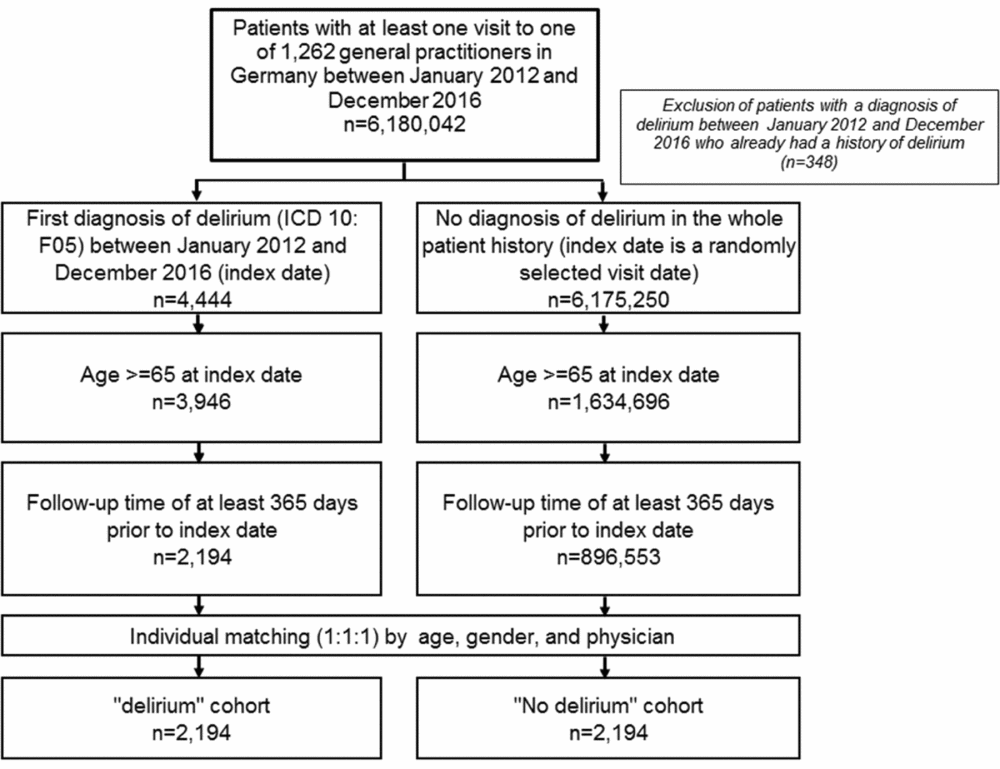
The current study sample included patients aged 65 years or older who received a first delirium diagnosis (ICD 10: F05) from German general practitioners between January 2012 and December 2016 (index date). Of 1,261 general practitioners, 851 documented a delirium diagnosis for at least one patient. Patients with a follow-up time of less than 365 days prior to the index date were excluded. After applying identical inclusion criteria, delirium patients and controls without delirium were matched (1:1) based on age, gender, and physician (Figure 1).
Selection of study patients.

Independent variables
Demographic data included age, gender, and type of residence (home vs. nursing home). Clinical data included the following diagnoses documented within 365 days prior to the index date (ICD-10 codes): hypertension (I10), obesity (E66), hyperlipidemia (E78), coronary heart disease (I24-I25), heart failure (I10), myocardial infarction (I21-I23), stroke, including TIA (I63-I64, G45), diabetes (E10-E14), renal insufficiency (N18-N19, Z49), fibrosis and cirrhosis of liver (K74), cancer (C00-99), superficial injuries (S00, S10, S20, S30, S40, S50, S60, S70, S80, S90, T00), open wounds (S01, S11, S21, S31, S41, S51, S61, S71, S81, S91, T01), fractures (S02, S12, S22, S32, S42, S52, S62, S72, S82, S92, T02, T08, T10, T12, M80), depression (F32, F33), anxiety disorder (F41), adjustment disorder (F43), all-cause dementia (F01, F03, G30), epilepsy (G40), Parkinson's disease (G20), sleep disorder (G47), hearing loss (H90-91), visual impairment including blindness (H54), senility (R54), urinary tract infection (N39.0), upper and lower respiratory infections (J00-J22), urinary incontinence (R32), and fecal incontinence (R15).
Finally, the following families of drugs documented within 365 days prior to the index date were available for analysis (EphMRA ATC classification system): antidepressants excluding lithium (N06A), neuroleptics (N05A), benzodiazepines (N06C), lithium (N06A3), anti-Parkinson drugs (N04A), antiepileptics (N03A), analgesics (N02A, M01A), corticosteroids (H02), diuretics (C03), beta blockers (N07), calcium channel blockers (C08), antibiotics (J01), antiarrhythmic agents (C01B), antihistamines (R06A), anticholinergics (R03G, R03K, R03L), other antiasthmatics (R03 excl. anticholinergics), and laxatives (M03). Furthermore, the total number of drugs prescribed within one year prior to the index date was analyzed.
Statistical analyses
Descriptive analyses were obtained for demographic, clinical, and pharmaceutical variables. Mean ± SD was calculated for age, while proportions were calculated for other variables. A logistic regression model was used to calculate the association between delirium and the different variables. Bonferroni correction was carried out to counteract the problem of multiple comparisons. With 47 variables in the regression model, p-values <0.001 (calculated as 0.05/47) were considered statistically significant. Analyses were carried out using SAS version 9.3.
Results
Among 6,180,042 patients with at least one visit to one of 1,262 general practitioners in Germany between January 2012 and December 2016, a diagnosis of delirium was documented in 4,792 patients in 851 practices. This results in a five-year-prevalence of 0.08% and an average of 0.7 (SD: 1.5) patients per practice per year. Of 4,792 patients, 4,444 patients had an initial diagnosis of delirium (no delirium diagnoses within at least 365 days prior to the index date).
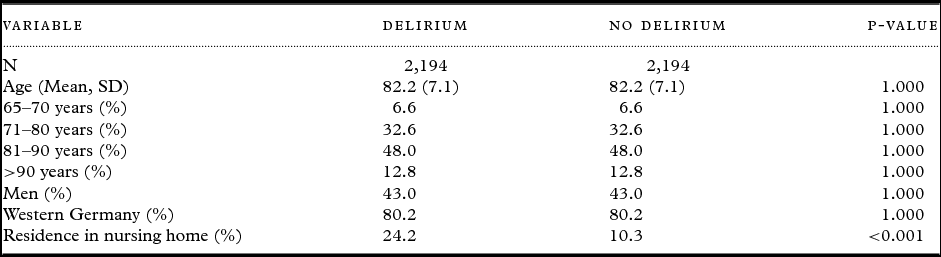
Patient characteristics are illustrated in Table 1. This study included a total of 2,194 patients with delirium diagnosis and a follow-up time of at least 365 days prior to their index date, as well as 2,194 control patients. Among the patients, 43.0% were men, and the mean age was 82.2 years (SD = 7.1 years). About 24% of delirium patients and 10% of control patients lived in nursing homes.
Characteristics of delirium patients and controls in general practices after 1:1 matching by age, gender, and physician (QuintilesIMS Disease Analyzer database)

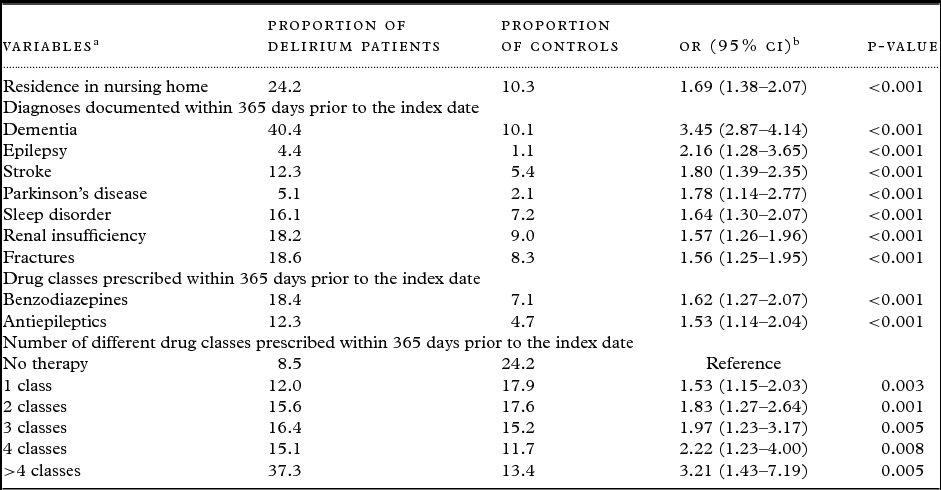
Results of the multivariate regression model are displayed in Table 2. Delirium was found to be positively associated with nursing home residence (OR: 1.69), dementia (OR = 3.45), epilepsy (OR = 2.16), stroke (OR = 1.80), Parkinson's disease (OR = 1.78), sleep disorder (OR = 1.64), renal insufficiency (OR = 1.57), and fractures (OR = 1.56). Delirium was also associated with the prescription of benzodiazepines (OR = 1.62) and antiepileptics (OR = 1.53). Finally, the number of different drug classes prescribed within one year prior to the index date was positively associated with a risk of delirium. Compared to patients without medication therapy, the OR for delirium was 1.53 for one prescribed drug class, 1.83 for two classes, 1.97 for three classes, 2.22 for four classes, and 3.21 for more than four classes.
Association between first delirium diagnosis and clinical/pharmaceutical variables in patients treated in general practices (logistic regression model)

aOnly variables with p < 0.001 are displayed; no significant effect was found for hypertension, obesity, hyperlipidemia, coronary heart disease, heart failure, myocardial infarction, diabetes, fibrosis and cirrhosis of liver, cancer, superficial injuries, open wounds, hearing loss, visual impairment, including blindness, senility, urinary tract infection, upper and lower respiratory infections, urinary incontinence fecal incontinence, prescriptions of antidepressants, lithium, anti-Parkinson drugs, analgesics, corticosteroids, diuretics, beta blockers, calcium channel blockers, quinolones, antiarrhythmic agents, antihistamines, anticholinergics, other antiasthmatics, or laxatives.
bAdjusted for residence in nursing home, diagnoses, and medications documented within 365 days prior to the index date.
No significant effect was found for hypertension, obesity, hyperlipidemia, coronary heart disease, heart failure, myocardial infarction, diabetes, fibrosis and cirrhosis of liver, cancer, superficial injuries, open wounds, urinary tract infection, upper and lower respiratory infections, urinary incontinence, hearing loss, visual impairment including blindness, senility, prescriptions of antidepressants, lithium, anti-Parkinson drugs, analgesics, corticosteroids, diuretics, beta blockers, calcium channel blockers, antibiotics, antiarrhythmic agents, antihistamines, anticholinergics, other antiasthmatics, or laxatives.
Discussion
Prevalence
The five-year prevalence rate of delirium in general practices identified here was 0.08%. In dependence of different variables, the few existing population-based studies have reported prevalence rates of between >0.5% and 10% in people over 65 years old (de Lange et al., Reference de Lange, Verhaak and van der Meer2013). The East Baltimore Survey (Folstein et al., Reference Folstein, Bassett, Romanoski and Nestadt1991) found an age-specific prevalence rate of 1.7% in 228 residents over the age of 55. In a population sample of 199 people over 85 years olds in Finland (Rahkonen et al., Reference Rahkonen2001), a delirium episode was found in 20 study participants over a period of three years, corresponding to a three-year prevalence of 10%. In Canada (Andrew et al., Reference Andrew, Freter and Rockwood2006), the prevalence rate in 10,263 residents, half of whom lived at home and half of whom lived in nursing homes, was less than 0.5%. A prevalence rate of 0.96% was reported in people over 70 years old (N = 1,460) in Spain (Vilalta-Franch et al., Reference Vilalta-Franch, Llinàs-Reglà, López-Pousa and Garre-Olmo2009). In the UK (Davis et al., Reference Davis2014), the prevalence rates among 2,179 residents in the 65–69 years and over 85 years age groups were 1.6% and 10%, respectively. Fick and colleagues reported a rate of 2.3% in an American sample of 76,688 people over 65 years old who were members of a large insurance company (Fick et al., Reference Fick, Kolanowski, Waller and Inouye2005).
It is important to note that in our sample only 851 of the 1,262 general practitioners (67.4%) issued a delirium diagnosis. Therefore, it is possible that a third of the general practitioners are not familiar with this diagnosis. Delirious syndromes may not only be underdiagnosed in both inpatients and outpatients, but the knowledge and attitudes of physicians with regard to the diagnosis of delirium may need to be improved (Jenkin et al., Reference Jenkin, Al-Attar, Richardson, Myint, MacLullich and Davis2016). Particular difficulties have been reported in the diagnosis of hypoactive delirium (Peritogiannis et al., Reference Peritogiannis, Bolosi, Lixouriotis and Rizos2015). It can be assumed that delirium diagnoses have generally been made on the basis of clinical symptoms in German general practices without using standardized assessment tools (Grover and Kate, Reference Grover and Kate2012; van Velthuijsen et al., Reference van Velthuijsen, Zwakhalen, Warnier, Mulder, Verhey and Kempen2016). This may be the difference between primary care and inpatient care, where such procedures are increasingly used for delirium prevention (Kratz et al., Reference Kratz, Heinrich, Schlauß and Diefenbacher2015; Pendlebury et al., Reference Pendlebury, Lovett, Smith, Wharton and Rothwell2017).
Institutionalization
Patients living in institutions were at a greater risk (OR = 1.69) of developing delirium. In the German healthcare system, general practitioners in private practice provide care for both patients who live at home and patients who live in an institution. In general, institutionalization is associated with a morbidity-related greater impairment of life skills (Arinzon et al., Reference Arinzon, Peisakh, Schrire and Berner2011). If institutionalization is considered an indicator of the severity of morbidity (Arinzon et al., Reference Arinzon, Peisakh, Schrire and Berner2011), comparable evidence can be found for indicators of disease severity as a risk factor in two meta-analyses in internal medicine (OR = 3.16 and 4.0, respectively) and in general surgical departments (OR = 2.5-3.5) (cf. Ahmed et al., Reference Ahmed, Leurent and Sampson2014; Inouye et al., Reference Inouye, Westendorp and Saczynski2014).
The following illness-related factors were associated with the occurrence of delirium: dementia, epilepsy, stroke, Parkinson's disease, sleep disorders, renal insufficiency, and fractures.
Dementia
In review studies, dementia is regarded as a major risk factor for the development of delirium (Inouye et al., Reference Inouye, Westendorp and Saczynski2014; Oh et al., Reference Oh2015; Yang et al., Reference Yang, Zhao, Dong, Yang, Zhang and Zhang2017). The results are comparable with the OR found in our study (OR = 3.45). For dementia, Inouye et al. (Reference Inouye, Westendorp and Saczynski2014) reported an OR of 2.3–4.7 in general medical departments and an OR of 2.8 in surgical wards. A systematic review showed that in surgeries for hip fractures, cognitive disorders were a risk factor in seven out of ten studies (Oh et al., Reference Oh2015). In a current meta-analysis, an OR of 3.21 was reported for the occurrence of delirium in the presence of dementia (Yang et al., Reference Yang, Zhao, Dong, Yang, Zhang and Zhang2017). General practices may not differ significantly from inpatient care regarding the likelihood of developing delirium in the context of dementia. Therefore, in the risk analyses of population-based studies, the occurrence of cognitive disorders and dementia was also identified as a major risk factor (de Lange et al., Reference de Lange, Verhaak and van der Meer2013).
Other neuropsychiatric disorders
In addition to dementia, other neurological and psychiatric disorders, such as epilepsy (OR = 2.16), stroke (OR = 1.80), Parkinson's disease (OR = 1.78), and sleep disorders (OR = 1.64), showed an increased risk of delirium in patients treated by general practitioners. Studies have shown that epilepsy (Naeije et al., Reference Naeije, Bachir, Gaspard, Legros and Pepersack2014; Woodford et al., Reference Woodford, George and Jackson2015), sleep disorders (Terzaghi et al., Reference Terzaghi, Sartori, Rustioni and Manni2014) Parkinson's disease (Vardy et al., Reference Vardy, Teodorczuk and Yarnall2015), and strokes (Shi et al., Reference Shi, Presutti, Selchen and Saposnik2012) are associated with an increased delirium risk. With the exception of stroke, the reviews of both population-based studies (de Lange et al., Reference de Lange, Verhaak and van der Meer2013) and inpatients (Ahmed et al., Reference Ahmed, Leurent and Sampson2014; Inouye et al., Reference Inouye, Westendorp and Saczynski2014) showed no evidence of an increased delirium risk associated with the aforementioned diseases.
The prescription of benzodiazepines (OR = 1.7) and antiepileptic drugs (OR = 1.53) constituted further risk factors. The prescribed drugs are associated with the neuropsychiatric diagnoses of sleep disorders and epilepsy.
Internal medicine and surgical diagnoses
Apart from neuropsychiatric risk factors, only renal insufficiency (OR = 1.57) and fractures (OR = 1.56) were identified as risk factors in the internal medicine and surgical fields. Renal insufficiency is a known risk factor of delirium. To the best of our knowledge, comprehensive risk studies have not been conducted. In particular, dialysis patients often suffer from a psychiatric comorbidity. Such comorbidities include depression, anxiety, and suicidal tendencies, as well as delirious syndromes (De Sousa, Reference De Sousa2008). Our study may have included patients who, in addition to being treated for renal insufficiency by general practitioners, also received dialysis at a specialist and became delirious during this treatment. Regarding surgical disorders, our results agree with the hip fractures that often occur in older age. Current review studies concerning hip fractures have shown the significance of such fractures regarding the development of delirium (Oh et al., Reference Oh2015; Yang et al., Reference Yang, Zhao, Dong, Yang, Zhang and Zhang2017). The patients included in our study were probably those treated by a general practitioner post-operatively after delirium in the course of inpatient fracture treatment, as well as those prematurely discharged from the hospital with protracted delirium (cf. Pendlebury et al., Reference Pendlebury2015; Peritogiannis et al., Reference Peritogiannis, Bolosi, Lixouriotis and Rizos2015).
Polymedication
Finally, the number of different drug classes prescribed within one year prior to the index date was positively associated with a risk of delirium. Comparable outcomes were reported for the inpatient sector (Ahmed et al., Reference Ahmed, Leurent and Sampson2014; Inouye et al., Reference Inouye, Westendorp and Saczynski2014). Of particular interest in our sample was the fact that only a higher number of prescribed substances was associated with a higher risk of delirium, but not any individual potentially delirium-inducing substances, also known as “high risk medications,” that were selected for this study (Ahmed et al., Reference Ahmed, Leurent and Sampson2014). This finding was likely due to, among other factors, the sample size and sample differences between inpatients and outpatients. The increased risk upon administration of more than one potentially deliriogenic medication was presumably due to a summation effect, an increased pharmacokinetic or pharmacodynamic interaction potential, or usage errors involving overdosing, which may occur in the context of multimedication in multimorbid and cognitively limited patients (Alegiakrishnan and Wiens, Reference Alegiakrishnan and Wiens2004; Inouye et al., Reference Inouye, Westendorp and Saczynski2014).
In summary, the prevalence of documented delirium diagnoses in general practices in Germany was very low at less than 1%.
Furthermore, it can be assumed that the inpatient and outpatient samples differ with respect to their risk profiles. While delirium in inpatients often develops as a result of acute events or following surgical interventions, the risk diagnoses in outpatients are more often diseases with a prolonged and potentially chronic course. The associated long-term monitoring of a chronically ill patient may make it easier for a GP to recognize the symptoms of delirium and to establish a delirium diagnosis because the delirious symptoms are characterized by the acute change. In addition, it should be noted that Germany has a comparatively high number of neuropsychiatric specialists who work in private practice outside of hospitals. They are obliged to provide special documentation and information to general practitioners, particularly in the case of chronic diseases of the elderly. In contrast, internationally, neuropsychiatric specialists are generally affiliated with inpatient facilities or special centers and are not so easy to reach.
This may also have been the reason why certain delirium risk factors described in the inpatient sector were not found in outpatients. These include, among others, tumor diseases, urinary tract infections, pneumonia, and treatment with antibiotics (cf. Ahmed et al., Reference Ahmed, Leurent and Sampson2014; Inouye et al., Reference Inouye, Westendorp and Saczynski2014; Pendlebury et al., Reference Pendlebury, Lovett, Smith, Wharton and Rothwell2017).
Limitations
This study consists of an evaluation of routine data, which are generated within the context of the documentation requirements and for settlement with health insurance bodies. In the German health system, ICD 10 (Dilling et al., Reference Dilling, Mombour and Schmidt2014) is used as the basis for such documentation. The diagnostic quality cannot be compared with data of a scientific study. Information about how the GPs diagnosed delirium was not available. Presumably, GPs diagnosed delirium based on clinical symptoms without conducting further tests. The diagnosis may also have been taken from the documentation of hospitals (discharge letters) or from specialists in private practice (consultation note). It is highly probable that the rate of test examinations in Germany is similarly low as in dementia diagnostics in general practices (Eichler et al., Reference Eichler2015). Specific delirium tests (Grover and Kate, 2012) are not listed as compulsory documentation in the standardized rules for outpatient care in Germany.
One of the strengths of the work is the size of the initial sample, which included more than 6 million patients. The largest sample of patients living at home or in institutions surveyed for the occurrence of delirium was N = 10,262 (Andrew et al., Reference Andrew, Freter and Rockwood2006). Evaluations of insurance data included slightly more than 75,000 patients. However, these data took into account all care sectors (Fick et al., Reference Fick, Kolanowski, Waller and Inouye2005).
Conclusions
Delirium was rarely diagnosed in primary care. Neuropsychiatric risk factors especially dementia and the number of high risk medications in German general practices were particularly important for the diagnosis of delirium compared to inpatient care. The reasons for this needed to be further investigated. Whether listing these particular diagnoses and medications in the context of interface management in hospital admissions by GPs would be useful for informing the receiving hospital of the delirium risk requires further investigation. The methodological limitations of the analysis of data from routine care must be considered.
Conflict of interest
JB has research support and speaking honoraria bei Willmar Schwabe, Inc.; KK none.
Description of authors' roles
JB formulated the research question, designed the study together with KK, and wrote main parts of the paper: introduction, results and discussion. KK was responsible for the statistical design of the study and carrying out the statistical analysis, and wrote main parts of the paper: methods and results.