1 Introduction
With this paper we wish to re-open the discussion and argue again for the need of a phonetic symbol in the IPA vowel chart for a central open vowel. This question was last debated at the 1989 IPA meeting in Kiel. The report published in JIPA (IPA 1989: 74) states:
Several proposals concerning vowels were rejected. It was decided that:
1. No means of symbolizing a central fully-open unrounded vowel with a special symbol should be provided. Specifically, small capital A [a] should not be recognized for this purpose. Print A [a], script A [ɑ], and ash [æ] should retain their present meaning.
The chairman of the vowel group in Kiel has reported that ‘quite complicated elaborations of the vowel chart were considered, including the possibility of an inner quadrilateral (giving a “home” for small cap I, turned-a (i.e. open schwa), etc.) and symbols for central open vowels. The debate was swung by an eloquent plea for simplicity [. . .] on the grounds that the chart is a practical tool and already had as many vowels as most users could manage’ (Francis Nolan, personal communication).
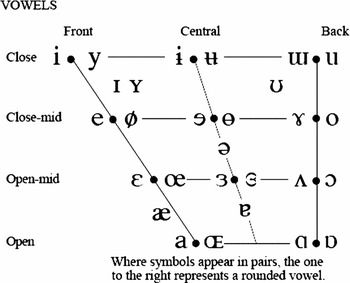
The vowel chart of the current International Phonetic Alphabet (IPA; see figure 1) shows symbols for the following groups of vowels:
• 16 primary and secondary Cardinal Vowels, i.e. unrounded and rounded variants of front vowels and back vowels at all four tongue height positions
• 6 unrounded and rounded variants of central vowels at all cardinal tongue heights positions except openFootnote 1
• 3 slightly centralised vowels [ɪ ʏ ʊ] between close and close-mid
• one nearly open front vowel [æ]
• mid-central schwa [ə] and the central near-open ‘a-schwa’ [ɐ]
If this distribution is considered from a logical point of view, it appears to us that (a) there is no reason for a front near-open vowel and that (b) a central open vowel is missing. Of course, the other intermediate vowels, [ɐ], [ɪ ʏ] and [ʊ] can also be queried.
The IPA vowel chart as revised 1999.

One could argue that a symbol for a central open vowel is not necessary if
(i) there are hardly any languages with such a vowel in their inventories, and/or
(ii) vowels in that general area tend to be centralised so that the symbol for a central near-open vowel [ɐ] is sufficient.
Of course, it is always possible in principle to use a core symbol with a diacritic to denote the exact perceived position of a vowel in the chart. In our case, this would be a lowered a-schwa [ ], or possibly a retracted open vowel [
 ] or an advanced back vowel [
 ]. This is congruent with the recommendations of the Kiel Convention (IPA 1989: 73):
For modifications on the front–back dimension a subscript plus sign to indicate advance (fronted) and a subscript minus sign for retracted (back) should be used, thus [] for advanced and [] for retracted.
It is not specified anywhere, though, how much difference is indicated by the application of a diacritic. Since a half tongue-height step would make e.g. [ ] equal to [
 ], making one or other diacritic redundant, one must assume that less than a half-step is implied. This makes [] and [] insufficient for the central open quality, though [] might be considered acceptable. But the use of a diacritically modified symbol for a ‘standard phonemic’ value appears less than satisfactory. Furthermore, the existence of established vowel distinctions like German jene ‘those; that (f)’ [ˈʲeːnə] vs. jener ‘of those; that (m)’ [ˈʲeːnɐ] vs. Jena (town in Thuringia) [ˈjeːna/ɑ/]Footnote 2 makes such a solution problematic.
2 Geometrical forms of vowel structures in the IPA Illustrations
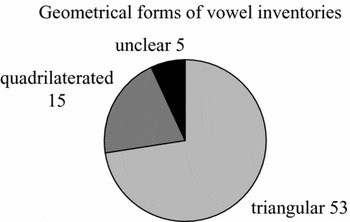
To test the first argument, we can count how many language descriptions come up with a vowel quadrilateral rather than a vowel triangle (where a central open vowel would represent the tip). The ‘Illustrations of the IPA’ provide descriptions of sound systems and symbols for 73 languages. They can be found in the Handbook of the International Phonetic Association (IPA 1999) and in issues of the Journal of the IPA from 1998 on. As can be seen in figure 2, there are twice as many languages with a triangular vowel structure as there are language descriptions with a vowel quadrilateral like the one for American or British English.
Distribution of languages in the ‘Illustrations of the IPA’ with vowel triangles (n = 53) or vowel quadrilaterals (n = 15) or unclear cases (n = 5).

This picture corresponds to the description of 317 languages in Maddieson (Reference Maddieson1984): ‘Low vowels are usually central (75.1%) and central vowels are usually low (69.4%)’ (p. 124) and later: ‘The most prevalent patterns seem to be the so-called ‘triangular’ systems’ (p. 136), evidence which is impressively illustrated in the vowel charts for each of the 317 languages in the back part of Maddieson (Reference Maddieson1984).
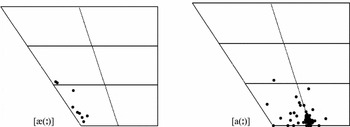
In nearly all IPA Illustrations, the authors describing the ‘triangle’ languages make use of the symbol [a], as can be seen in figure 3 (right-hand-side picture). This usage is presumably triggered by typographical convenience rather than by articulatory or auditory considerations. [a] is used even if the vowel is positioned in the back part of the open region, such as in Korean, Tukang Besi and Sindhi (see also figure 3).
Locations of the symbol [æ] or [æː] (left; n = 9) and [a] or [aː] (right; n = 63) in the vowel chart taken from the ‘Illustrations of the IPA’.

Unfortunately the symbol [a] also represents the fourth Cardinal Vowel, and this points to a number of inconsistencies in the explanatory underpinnings of the IPA vowels:
(i) Increasingly troubling, with the improved understanding of acoustic–configurational relations, is the discrepancy between the traditional articulatory explanation of the front–back dimension (highest point of the tongue dorsum) and the accepted configurational explanation, namely the point of closest approximation between tongue and palatal/pharyngeal surface. The latter identifies the narrowed pharynx as the defining property for open vowels (cf. e.g. Wood Reference Wood1979), undermining the articulatory labels used for the auditorily differentiated [a]–[ɑ] continuum.
(ii) The symbols of the IPA are intended as a tool for representing both fine phonetic differences and the ‘phonemes’ of languages.
(iii) The language-independent Cardinal Vowel qualities are defined inter alia by reference to language-specific vowel qualities.
(iv) Forward-slash vs. square-bracket, representing functional category vs. concrete phonetic quality are used inconsistently in terms of their level of representation, i.e., their degree of abstractness and generality.
These facts make the teaching of vowel qualities difficult and without accompanying vowel chart figures they can also make scientific communication problematic.
As an example of an open vowel of a triangular system, the Spanish vowel in gata, represented as [a] or /a/, is not the same as Cardinal Vowel 4 [a]. The IPA handbook (IPA 1999: 11) refers to the vowel in Southern British English cat to illustrate the sound shape of Cardinal Vowel 4, (although the cat vowel is usually represented as [æ] or /æ/). It is very hard for learners to accept that there is an important phonetic difference between the [a] in Spanish gata and the [a] as the reference quality of Cardinal Vowel 4 since exactly the same symbol is used. The consequence for learners of English can be that they produce the English cat vowel with the vowel quality of Spanish gata, a condition that enforces the foreign accent instead of making the learners' English and native vowel qualities distinct. It would seem, therefore, that the symbol [æ] (or, more correctly, /æ/) is being retained in the official IPA reference framework for the phonetic quality description of vowels merely because of the need to have a symbol for the English vowel in cat, irrespective of the phonetic quality of that vowel. This is, of course, just one of many possible examples of the dangers of defining ‘reference vowels’ in relation to an assumed quality of a vowel in a particular language.
The confusion for learners is even greater with different descriptions of English varieties. As mentioned above, Southern British English /æ/ is increasingly described as close to Cardinal Vowel 4 (see also Wells Reference Wells2001). The Australian English variant of the vowel in cart, represented phonemically as /ɑː/ in many descriptions of English, is also given as an example of Cardinal Vowel 4 [a] in an internationally used teaching work (Clark, Yallop & Fletcher Reference Clark, Yallop and Fletcher2007). This is phonetically correct but presumably confusing to readers unaware of the phonetic quality of the Australian vowel.
To summarise so far:
• There is no doubt that there is a strong tendency for the languages of the world to have one (more central than peripheral) open vowel.
• The de facto symbol used for this central vowel is /a/ or [a].
• There is a clash of the vowel quality of Cardinal Vowel 4 and the vowel quality of /a/ in many languages.
• The choice of only two open vowels, defined as peripheral, confuses further the relationship between phonetic quality and functional role.
There are several IPA-systemic arguments for having a separate symbol for the central open vowel:
• All intersections in the IPA chart have their own symbol. Why not have one for the intersection ‘central open’?
• The rare vowel [ɶ] is defined separately, presumably for reasons of symmetry. This makes the lack of a symbol for the very frequent central open vowel difficult to fathom.
• There are symbols for frequent vowels at intermediate height categories such as near-open and near-close. Why not define a symbol for a very frequent vowel at an intermediate front–back position?
It can of course be argued that differentiation of the open-vowel front–back dimension is unnecessary because the perceptual distance from [a/ɶ] to [ɑ/ɒ] is less than [i/y] to [ɯ/u], and that this fact is reflected in the narrower base of the vowel quadrilateral.Footnote 3 While this is subjectively valid (we also hear a greater ‘distance’ between [i] and [u] than between [a] and [ɒ]), we attribute much of the difference to the greater perceptual effect of lip-rounding for close vowels than for open vowels. The perceptual distance from [y] to [u] or from [i] to [ɯ] is not (for us) twice the perceptual distance from [a] to [ɑ]. We would wish to add the point that even if it was, the acceptance of [æ], [ɐ], [ɪ/ʏ] and [ʊ] and particularly the retention of [æ] (in the present chart) undermines any argument against over-differentiation of the open vowels.
3 Possible solutions
The call for two distinct symbols, front open on the one hand and central open on the other, raises the question of which symbols to use. We present the possibilities, as we see them, for discussion.
3.1 A new symbol
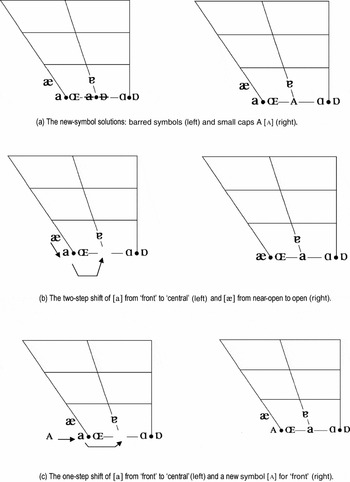
A new symbol could be established for the ‘central open’ vowel. Within this option there is a choice: small capital A [a] has been suggested, and another suggestion is a barred a [a] analogous to the ‘central close’ vowels. To maintain consistency for the central vowel series, a barred ɒ [ɒ] could be defined for the rounded version, analogous to [ɨ ɘ ɜ] and [ʉ ɵ ɞ]
Although it is typographically more complex, the second suggestion within the ‘new symbol’ solution has the advantage of following the logic behind the close-vowel series. The capital [a] suggestion has, of course, already been rejected once, but it does have a substantial following in the community and is explicitly mentioned in Pullum & Ladusaw (Reference Pullum and Ladusaw1996: 14) as being ‘occasionally used as a symbol for a fully open central unrounded vowel’. It has also been shown to be an invaluable solution to the problem of distinguishing the three open-vowel qualities in comparative studies: the vowels of a language with a quadrangular system including a front open vowel [a] and a back open vowel [ɑ] have to be contrasted with the central open vowel of a language with a triangular vowel system. The symbol [a] has been used to good effect in just such a study (cf. Stadnik Reference Stadnik2002).
3.2 Redefining [a] and [æ]
A second possibility is to redefine front near-open [æ] as front open and [a], the present Cardinal 4 as central open. It is a radical step to redefine a long established Cardinal Vowel but this possibility has a number of arguments in its favour.
Firstly, as we stated above, the de facto symbol is already [a]. Its widespread usage in triangular vowel systems would make the adoption of a new symbol unnecessary. Secondly, in Standard British English the vowel quality for words such as cat (which appears to be the anglocentric reason for the inclusion of [æ] in the first place) has become more open and is close to Cardinal Vowel 4. This change has also been described in the IPA handbook (IPA 1999: 11):
And if a vowel is produced in which the highest point of the tongue is at the front of the mouth and the mouth is as open as possible, the result is [a]. This is rather like the quality of the vowel in cat in contemporary Southern British English (other dialects may have less open qualities or less front qualities).
It would be an easy and elegant way to adapt the symbol to the place, and it would remove the illogicality of the present asymmetry due to the front near-open vowel category. Phonetic differences behind the /æ/ would have to be explained just as they are at present. An incidental third point is that, graphically, the ligature [æ] goes well with the ligature [ɶ].
3.3 Redefining [a] and introducing [a]
A third possibility that has been suggested to us is similar to the second, inasmuch as the present Cardinal Vowel 4 would move to central open. But [æ] would retain its present near-open value and [a] would become Cardinal 4 to match the small-capitals ligature for secondary Cardinal 4, [ɶ].
Figure 4 shows the modifications under discussion.
Vowel-chart illustration of the solutions presented for discussion.

4 Discussion
What are the consequences of our suggestion?
(i) We have to note, of course, that strict symmetry would still be missing if [a] were accepted as the symbol for the central open vowel, since a logical symbol for the rounded version of the central open [a] – parallel to [ɑ–ɒ] – would be [ɐ], which is at present in use for the central near-open unrounded vowel. However, a central open rounded vowel is no more likely than [ɶ] so it may be considered unnecessary to pursue strict symmetry.
(ii) What is the consequence of losing the category near-open for front vowels? In the 73 vowel inventories of the ‘Illustrations of the IPA’ there are only 9 language descriptions (12%) that make use of [æ] in contrast to 63 language descriptions out of 73 (86%) which make use of [a]. However, Finnish, Estonian, Latvian, Persian, Danish, Swiss German, Azerbaijani, some dialects of Irish and probably many other languages not yet included in the ‘Illustrations’ would also need an [æ] (Elmar Ternes, personal communication).
What are the consequences of the other suggestions?
By introducing a new symbol [a] the present Cardinal Vowel 4 could stay as presently defined (and descriptions using triangular systems would need to be adjusted). The [æ] symbol could stay, either as an IPA maverick on the chart, as it is at present, or as a ‘special symbol’ intermediate to open-mid and open but no longer strictly defined as a reference vowel on the IPA vowel chart. Symmetry could be achieved in the chart by inverting [a] as the rounded counterpart and relegating [æ] to the special symbols.
With our suggestion for an additional symbol we are consciously emphasising the theoretical separation of the IPA vowel chart definitions and the selection of a symbol inventory for any particular language. The latter is inevitably driven by a host of different considerations which range from the more local to the more global.
At present, the dominance of English in the world may distort the debate by linking IPA definition with the need for a maximally overlapping (phonemic) representation of the very disparate regional systems. Discussing alternative ways of representing the bat vowel, Wells (Reference Wells2001) states the choice very succinctly:
It is well known that the quality of the RP bat vowel has changed since the 1930's. It is now more similar to ‘cardinal [a]’ than it used to be. Hence [the] choice of the [a] symbol. A more conservative line is to stick with the familiar symbol [æ], but to redefine it as appropriate. That, after all, is what we have all done with the [ʌ] symbol for the vowel of cut, blood, which used to be a back vowel but now has a central/front quality for which the most specific IPA symbol would probably be [ɐ] (turned a). A further argument in favour of retaining the symbol [æ] is that it preserves the parallelism with American and Australian English, in which the movement towards an opener quality has not taken place.
We suggest that the wish – for some people understandable, for others incomprehensible – to retain a common, abstract /æ/ symbol for the cat vowel (which can vary from [ɪ ] to [ˑ]) while allowing an /a/ or /ɑ/ vs. /ɒ/ symbol distinction between US and British English for the less variable cot vowels (approximately [a] to [
 ]) has nothing to do with the decision about the elements of the IPA reference-vowel system.
To conclude: the present authors are not trying to ‘sell’ one of these solutions rather than another. But we are convinced that there are strong reasons, both theoretical and practical, for an independent symbol to represent the central open vowel quality.
We realise that there will be those who feel strongly the wish to correct perceived inconsistencies through (necessary) innovation and others who fear the chaotic instability from (unnecessary) change.
We therefore offer the following questions for JIPA readers to consider, with the possibility, if they wish, to communicate their points of view to the IPA Executive and Council and/or to the present authors:
1. Do you agree with the arguments presented in support of a central open vowel symbol? Please specify what you agree or disagree with and give any arguments against or any additional arguments for.
2. If you are in favour of identifying a central open vowel in the IPA vowel chart, which solution do you prefer?
(a) Keep system as defined at present, but add small caps [a].
(b) Keep system as defined at present, but add barred [a] and [ɒ].
(c) Redefine [æ] as front open and [a] as central open.
(d) Redefine [a] as central open and add small caps [a] as front open.
(e) None of these. Suggestion: . . .
Acknowledgements
We would like to thank Elmar Ternes for his insightful contribution to our discussion points and Max Mangold and John Wells for their valuable comments and advice. We are also grateful to Francis Nolan and four anonymous reviewers for their suggestions.