The current increasing global prevalence of chronic diseases is due to a combination of factors, including population ageing, successes in combating infectious diseases and improved treatment of potentially fatal ailments. 1 In high-income countries, these changes have engendered a re-orientation of healthcare, which has gradually shifted from acute care in hospitals to long-term care in patients’ residences and communities, changing how and where health workers see patients. Reference Dixon, Nancarrow, Enderby, Moran and Parker2 Thus, home care in which physicians, nurses, and other health workers visit patients’ homes to deliver necessary health services has increasingly gained prominence. Reference Kinjo, Sairenji and Koga3 This is especially true in Japan, which has achieved and maintained one of the highest life expectancies worldwide over the past several decades. Reference Nomura, Sakamoto and Glenn4
In Japan, a team of health workers (e.g., nurses and rehabilitation staff), led by primary care physicians, generally provides home care. Reference Kinjo, Sairenji and Koga3 To be qualified for such care, patients must not be independent and/or healthy enough to visit clinics and hospitals. Reference Kinjo, Sairenji and Koga3 Consequently, home care providers mainly serve terminally ill patients or those with potentially fatal conditions, including non-communicable diseases and neurodegenerative conditions. Reference Kinjo, Sairenji and Koga3 Typically, patients’ conditions are relatively stable or gradually worsening meaning they do not require immediate hospitalisation. However, because of their underlying conditions, these patients are prone to sickness (e.g., from infectious diseases). Thus, in Japan, home care health workers must respond to the concerns of patients and their families on a 24-hour basis, and emergency visits to patients’ residences and/or emergency patient transfers to tertiary hospitals may be required. Therefore, effective and reliable transport systems and infrastructure is an essential requirement.
All obstacles to home care must be identified and overcome to promote and maintain uninterrupted customised health services. A notable example of a barrier is a natural disaster, especially those which disrupt or destroy local health services and essential infrastructure. Reference Ainehvand, Raeissi, Ravaghi and Maleki5 Japan is regularly struck by, among other major hazards, earthquakes, typhoons, floods, landslides, extreme snowfall, and volcanic activity. Reference Ozaki, Horiuchi and Kobayashi6 The frequency and extent of these disastrous events are increasing in Japan and worldwide. Reference Forzieri and Cescatti7 However little is known about how such events impair home care provision.
Fukui City, in the coastal area of Fukui Prefecture, Japan, has a population of approximately 270000. In February 2018, the city was struck by unprecedented snowfall. The snow accumulation reached 147cm on February 7, 2018, although average snow accumulation in February in Fukui City is 39 cm. Generally, the area received 50 cm of snowfall from the evening of February 5 to the morning the next day, and removal efforts could not cope. Snow clearance work was performed continuously but it took 14 days to clear the snow. During the study period, 12 people died in snow-related incidents. The snow severely affected the city’s transport systems, drastically restricting the ability of local home care teams to reach the homes of their patients. Supplementary Material 1 describes the details of the situation in Fukui City during the snowfall.
This study aimed to (1) describe the actual situation and responses in a home care clinic following a huge snowfall, (2) examine whether patients incurred harm as a result, and (3) describe the situation in the clinic during the snowfall.
METHODS
Design, Setting and Participants
This retrospective observational study used patient and administrative records from Orange Home-Care Clinic, Fukui City, Fukui Prefecture, Japan, which specialises in providing home care. As at February 1, 2018, there was an average of 675 monthly visits to approximately 300 patients, accounting for over two-thirds of the city’s total visits. 8 The clinic usually forms 3 or 4 teams which consist of 1 physician and 1 or 2 paramedics. Weekdays, each team visits 7 to 8 patients’ residences a day in a home-visit car. The clinic has 5 of such cars and an additional 5 cars for use by visiting nurses. The clinic has 70 staff, including physicians, nurses, pharmacists, clerks and social workers. In Japan, physicians provide home health care by cooperating with visiting nurses. Visiting nurses separately visit patients on a regular basis, assess the patients’ situation and share the information with physicians. Some patients receive care by visiting nurses who belong to visiting-nurse stations nearby the patients’ residences.
The study period was from February 5 to February 18, 2018 when the snowfall was particularly severe.
Variables and Data Sources
We obtained data on the city’s snowfall from the Japan Meteorological Agency. 9 Relevant information about the impact of the snowfall during the study period was obtained from local newspapers, radio, and television. We also performed unstructured interviews with clinic staff regarding the situation at the clinic and their experiences during the study period. Additionally, we extracted patients’ characteristics (sex, age, long-term care insurance system qualification, and primary diagnoses) from medical records. Support and care needs are generally determined according to each patient’s physical and cognitive function. In addition to care qualification, we also extracted patients’ physical and cognitive functions, as assessed by their physicians. Physical function was categorised as independent, semi-bedridden, and bedridden; while cognitive function was classified as independent but with a cognitive disability, watching needed, assistance needed occasionally, always needs assistance, special care needed, and independent with no dementia. We also extracted daily numbers of planned home visits, actual visits, unplanned emergency transfers, and unplanned home visits. Actual visits mean the home visits which were conducted as planned. Unplanned home visits refer to the home visits which were not originally scheduled at the beginning of the day, but were made according to requests from patients or their caregivers.
Data Analysis
To elucidate the effects of the heavy snowfall on home care, we performed 3 analyses: we descriptively analysed patients’ characteristics; examined the daily trend of snow accumulation, planned patient visits, actual visits, and emergency transfers, and unplanned home visits. We reviewed and summarized the situation in the clinic during the study period using preexisting data such as medical reports, and unstructured interviews with the clinic staff. We used STATA/MP14.0 (StataCorp, College Station, TX) for all analyses.
RESULTS
Patient Characteristics
A total of 294 patients were scheduled for home care during the study period. The patients’ basic characteristics are shown in Supplementary Material 2.
Heavy Snowfall Impact on Home Care
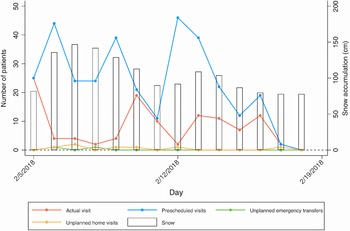
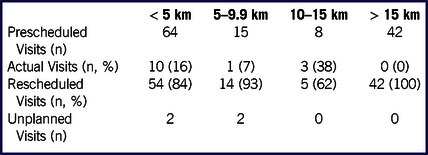
Figure 1 illustrates the daily trend of pre-scheduled home visits, actual visits, unplanned emergency transfers, unplanned home visits, and peak snow accumulation. Supplementary Material 3 describes details of home care provided from February 5 to February 18, 2018. Specifically, from the sixth to eighth of February, during which the snow continually accumulated, nearly all scheduled visits were cancelled. Visits were rescheduled for after the snow was expected to have been cleared. A part of home visits originally scheduled for this period were conducted on February 10 and 11, which was a weekend. Although home visits are not usually conducted on weekends, some visits were rescheduled for the weekend as emergency measures for this snowfall. However, most of them were rescheduled for after February 18, 2018. As for implementation of each day’s scheduled visits, less than half had been conducted by February 14. After that, home visits were gradually restarted because the snow stopped and the roads became reusable. Indeed, all prescheduled visits were completed from February 17, 2018. Table 1 describes the situation with respect to distance from the clinic to patients’ homes. There was no obvious association between distance and the proportion of actual visits.
The daily trend of prescheduled patient visits, actual visits, unplanned emergency transfers, unplanned home visits, and the peak of snow accumulation. The sudden snow accumulation decreased the number of actual home visits from February 6 to February 9, and February 12 to February 14; the number of unplanned emergency transfers and unplanned visits did not increase during the study period.

Type of Visit by distance, from February 6 to 9

Only 2 cases needed emergency medical services. The first was a 7-month-old baby with 13q monosomy, whose family consulted the clinic by phone about a high fever. The infant’s condition did not seem to require emergency services and it appeared to be manageable via a home visit. However, traffic delays meant such a visit would take at least 3 hours. Thus, the home care team suggested the family use emergency medical services at a nearby hospital. As a result, it took about 2 hours to reach the hospital. The other case was a 70-year-old male patient with dementia who spent most of the day in bed. His family consulted the clinic by phone about his high fever and phlegm accumulation. The home care team could not visit this patient because of the snow/traffic so he used the emergency services. No serious events, such as unexpected patient deaths, were recorded during the study period.
The Clinic’s Status
Supplementary Material 4 describes the situation of the Orange Home-Care Clinic during the heavy snowfall. The morning of February 6, 2018, clinic staff experienced difficulties commuting to work, taking 4 to 5 times longer than usual. The clinic’s parking lot was totally covered by snow and it took 3 hours to remove the snow around the home-visit cars. While the clinic did not have prior disaster planning, the clinic flexibly responded according to the situation. Unfortunately, in the midst of the snowfall, Fukui Prefecture and Fukui City did not provide specific assistance for home care, possibly because of limitations in expertise, experience, and communication. The clinic director requested that staff living nearby walk to work and that those living far away should stay home and await further instructions, resulting in an obvious staff shortage. Typically, a home care team comprises 1 physician and 1 medical clerk. However, because of the chaos of traffic, the home-visit cars had to be parked on the sidewalk, meaning that each team required 1 additional staff member to look after the car. Staff members at the clinic telephoned patients and asked about their condition, the availability of family and other social support and their overall wellbeing. They also decided to prioritize visits according to the severity of the patients and rearranged home visit schedules based on the discussion with each patient. For patients whose condition was stable, the clinic staff monitored their condition by phone. In addition, the clinic decided to deploy 1 doctor at the clinic to prepare for unplanned visits. Telephone and internet networks were intact during the snowfall. As a result, clinical staff were able to use both normal telecommunication and social networking-based telemedicine services with the patients. Reference Miyatake, Yamamoto, Ozaki, Kawada, Nishikawa and Beniya10 Consequently, most of the patients received attention during the snowfall.
DISCUSSION
Although this study is a descriptive study, the heavy snowfall massively disrupted traffic, highlighting the difficulties and delay in providing home care services, as well as other care services and logistics. In Fukui City, February is snow season, but extremely large amounts fell in 2018. Unsurprisingly, our analysis revealed that the number of home visits dramatically decreased during the study period. Indeed, only 121 (37%) of 326 prescheduled visits were conducted. This performance is obviously sub-optimal and needs to be improved upon in the future because the unavailability of usual home health care might endanger patients’ lives.
Corroborating these facts, interviews with clinic health workers confirmed the disruptive impact of the snowfall on the city’s infrastructure, including transportation to and from the clinic. The likely effects of extreme snowfall on home care provision would arise from the restricted or absence of access to the patients. Reference Nishikawa, Ozawa and Tsubokura11 Although a previous report covering haemodialysis in rural areas illustrated the adverse effects of extreme snowfall on care provision, Reference Nishikawa, Ozawa and Tsubokura11 to our knowledge, this is the first report detailing the possible negative impact of snowfall on home care.
Nonetheless, the number of emergency transfers fortunately did not increase in this case. With regard to emergency transports in previous years, there were 5 emergency transports covering 219 patients in February, 2016 and 3 instances covering 261 patients in February, 2017.
Several explanations can explain the clinic’s performance. First, patients were appropriately managed, even though physicians were unable to physically visit them. Health workers regularly contacted the patients and their families by telephone and via social networking services, effectively monitoring the condition of their patients. Consequently, the health workers could respond reasonably quickly to any adverse events by arranging an emergency transfer or contacting the visiting nurse station nearby the patient’s residence.
Second, the assessment mechanism functioned well in categorising the patients. Clinic staff were able to deviate from the original home visit schedule based on the specific condition and the availability of social or familial support, instead of being governed by whether a patient visit was required. Although it was difficult to predict changes in road conditions, and many visits were rescheduled, the clinic staff, although shorthanded, could properly manage the patients. The distance to patients’ homes appeared not to be directly associated with the actual proportion of visits undertaken.
Third, the health workers had built up an understanding of the patients’ social circumstances and health conditions during clinic operations in normal circumstances. In addition to the usual delivery of care, the health workers effectively communicated with patients and their families, building up an appreciation of the current conditions of each patient. They understood their patients’ medical needs as well as their concerns, housing situation, daily schedules, and so on, so they could devise effective strategies to help them cope with the weather disaster. This comprehensive understanding helped elucidate changes in patients’ conditions. Furthermore, owing to co-operation with other regional healthcare workers, when the physicians could not visit patients, they could share information and respond accordingly.
As our analysis confirmed, snowfall can cause substantial damage to health service provision. In such cases, medical care must be maintained as far as possible. Generally, communication infrastructure remains functional during heavy snowfall and, as accentuated in this case, it may be possible to implement effective remote or alternative medical treatment when home visits are not feasible. Therefore, it is important to integrate normal home care services with the proactive use of social networking systems or telephonic communication, not only with patients and families but also with other occupations, such as home-visit nurses, as practice for disaster situations. If there were no functioning communication systems, it would be difficult to know the patient’s actual situation. In such cases, it would be necessary to request the local government and disaster response teams to visit patients’ residence instead of the home care teams.
Japan’s home care system has some unique aspects, and the lessons learned in this study may not translate to other countries. However, the following 2 points may be useful, not only with respect to heavy snowfall situations, but also to other disasters, such as floods and earthquakes, where logistics and traffic may be disrupted. First, if the communication infrastructure is functioning, the ability to check and assess a patient’s condition remotely, as in this case, may be helpful. Second, understanding the normal routine and living circumstances of a patient, including their physical, psychological and social background, may allow for greater flexibility in responding in times of chaos. While it has been reported that during periods of heavy snowfall, the number of emergency outpatients decreased but high risk groups (i.e., dialysis patients) were able to receive proper care in a hospital based analysis, 12,Reference Glass, O’Hare and Conrad13 there is little information available with respect to the impact of heavy snow on home-care delivery. We thus believe that our findings may be useful in increasing the evidence base to inform future policy for provision of home care in emergency situations.
CONCLUSION
In this study, emergency transfers did not increase even though home health care visits dramatically decreased following extreme snowfall. Thorough preparedness during usual operating practices in conjunction with swift and appropriate decision-making and action during disasters are vital to effectively operate home care and protect frail patients during times of emergency. This study confirms that it is possible to adapt to the needs of patients in times of extreme weather, as well as prevent unnecessary emergency transfers, through the use of telemedicine and remote telephonic diagnoses and provision of medical advice, guidance, and support.
Author Contributions
Hirotomo M, Hidehisa M, Satoshi A, and Hiroyuki B reviewed patients’ records and collected the data. Akihiko O and Yoshitaka N conducted the analysis. Hirotomo M wrote the manuscript. All authors conceptualised and designed the study and contributed to revisions.
Acknowledgements
The authors express their sincere gratitude to all staff members, patients and caregivers involved in this study. We would also like to thank Professor Andy Crump for his expertise and guidance in the production of this article.
Conflicts of Interest
Dr. Ozaki received personal fees from MNES Inc. outside the scope of the submitted work. Dr. Nishikawa received personal fees from MRT Inc. outside the scope of the submitted work. The other authors declare no conflicts of interest.
Ethical Approval
This study was approved by the Ethical Review board of the Medical Governance Research Institute (no. MG2019-09-0928) on September 28, 2018, and it was conducted in accordance with the Helsinki Declaration (as revised in 2004).
Supplementary Material
To view supplementary material for this article, please visit https://doi.org/10.1017/dmp.2020.310