Posttraumatic stress disorder (PTSD) is a persistent and disabling condition unless there is a timely targeted intervention (Blanchard et al., Reference Blanchard, Hickling, Devineni, Veazey, Galovski, Mundy, Malta and Buckley2003). While numerous psychological and pharmacological treatments exist (Bradley et al., Reference Bradley, Greene, Russ, Dutra and Westen2005; Sullivan and Neria, Reference Sullivan and Neria2009), poor clinical response creates a need to identify new targets for therapeutic intervention (Difede et al., Reference Difede, Olden and Cukor2014). Threat-related ABs may represent such a target (Buckley et al., Reference Buckley, Blanchard and Neill2000; Brewin and Holmes, Reference Brewin and Holmes2003). Indeed, cognitive models of PTSD implicate different information processing biases in this disorder (Buckley et al., Reference Buckley, Blanchard and Neill2000; Brewin and Holmes, Reference Brewin and Holmes2003), including biased attention for threat- and trauma-related information (Chemtob et al., Reference Chemtob, Roitblat, Hamada, Carlson and Twentyman1988; Foa et al., Reference Foa, Steketee and Rothbaum1989; Litz and Keane, Reference Litz and Keane1989; Foa et al., Reference Foa, Feske, Murdock, Kozak and Mccarthy1991; Foa and Rothbaum, Reference Foa and Rothbaum1998; Ehlers and Clark, Reference Ehlers and Clark2000; Aupperle et al., Reference Aupperle, Melrose, Stein and Paulus2012).
Computerized protocols targeting AB were examined more extensively in randomized controlled trials (RCTs) of anxiety disorders than PTSD (Bar-Haim, Reference Bar-Haim2010; Linetzky et al., Reference Linetzky, Pergamin-Hight, Pine and Bar-Haim2015). The four RCTs conducted in PTSD all compared the clinical efficacy of two training variants: attention bias modification (ABM) and attention control training (ACT). ABM is designed to reduce AB to threat through systematic, implicit training (Bar-Haim, Reference Bar-Haim2010). Using an adaptation of the dot-probe task (MacLeod et al., Reference MacLeod, Mathews and Tata1986), participants are trained to shift attention to neutral over threat stimuli. ACT, originally used as a control condition for ABM protocols as it is not designed to shift attention in any specific direction (Bar-Haim, Reference Bar-Haim2010; Schoorl et al., Reference Schoorl, Putman and van Der Does2013; Kuckertz et al., Reference Kuckertz, Amir, Boffa, Warren, Rindt, Norman, Ram, Ziajko, Webb-Murphy and McLay2014a), is thought to enhance attentional control in the context of threat (Badura-Brack et al., Reference Badura-Brack, Naim, Ryan, Levy, Abend, Khanna, McDermott, Pine and Bar-Haim2015). ACT uses a balanced version of the dot-probe task, in which participants are implicitly encouraged to ignore threat-neutral locations to maximize task performance (Badura-Brack et al., Reference Badura-Brack, Naim, Ryan, Levy, Abend, Khanna, McDermott, Pine and Bar-Haim2015).
The four RCTs in PTSD have shown mixed results (Schoorl et al., Reference Schoorl, Putman and van Der Does2013; Kuckertz et al., Reference Kuckertz, Amir, Boffa, Warren, Rindt, Norman, Ram, Ziajko, Webb-Murphy and McLay2014a; Badura-Brack et al., Reference Badura-Brack, Naim, Ryan, Levy, Abend, Khanna, McDermott, Pine and Bar-Haim2015). Initial studies had shown no differences (Schoorl et al., Reference Schoorl, Putman and van Der Does2013) or greater symptom reduction for ABM over ACT (Kuckertz et al., Reference Kuckertz, Amir, Boffa, Warren, Rindt, Norman, Ram, Ziajko, Webb-Murphy and McLay2014a). A more recent paper reported data from two independent stand-alone trials of Israel Defense Forces and US Military veterans with PTSD, both showing an advantage for ACT over ABM in symptom reduction (Badura-Brack et al., Reference Badura-Brack, Naim, Ryan, Levy, Abend, Khanna, McDermott, Pine and Bar-Haim2015).
These mixed findings could arise from unique aspects of attention perturbation in PTSD. Greater variability across patients in PTSD, relative to anxiety disorders (Badura-Brack et al., Reference Badura-Brack, Naim, Ryan, Levy, Abend, Khanna, McDermott, Pine and Bar-Haim2015; Naim et al., Reference Naim, Abend, Wald, Eldar, Levi, Fruchter, Ginat, Halpern, Sipos, Adler, Bliese, Quartana, Pine and Bar-Haim2015), could limit the efficacy of traditional away-from-threat ABM procedures. Previous research reported both ABs toward (Bryant and Harvey, Reference Bryant and Harvey1997; Buckley et al., Reference Buckley, Blanchard and Neill2000; Bardeen and Orcutt, Reference Bardeen and Orcutt2011) and away from threat (Bar-Haim et al., Reference Bar-Haim, Holoshitz, Eldar, Frenkel, Muller, Charney, Pine, Fox and Wald2010; Fani et al., Reference Fani, Bradley-Davino, Ressler and McClure-Tone2011; Sipos et al., Reference Sipos, Bar-Haim, Abend, Adler and Bliese2014) in PTSD, raising questions about the most appropriate form of ABM in PTSD (Badura-Brack et al., Reference Badura-Brack, Naim, Ryan, Levy, Abend, Khanna, McDermott, Pine and Bar-Haim2015), especially as the degree and direction of pre-treatment AB were found to moderate ABM efficacy (Amir et al., Reference Amir, Taylor and Donohue2011; Kuckertz et al., Reference Kuckertz, Amir, Boffa, Warren, Rindt, Norman, Ram, Ziajko, Webb-Murphy and McLay2014a; Kuckertz et al., Reference Kuckertz, Gildebrant, Liliequist, Karlstrom, Vappling, Bodlund, Stenlund, Hofmann, Andersson, Amir and Carlbring2014b). Thus, tailoring ABM training to the nature of bias at pre-treatment may improve ABM efficacy. Alternatively, different approaches may be needed, since patients with PTSD also manifest increased within-session variability in threat-related attention than patients with anxiety disorders, a phenomenon termed AB variability (ABV; Badura-Brack et al., Reference Badura-Brack, Naim, Ryan, Levy, Abend, Khanna, McDermott, Pine and Bar-Haim2015, Naim et al., Reference Naim, Abend, Wald, Eldar, Levi, Fruchter, Ginat, Halpern, Sipos, Adler, Bliese, Quartana, Pine and Bar-Haim2015). This PTSD-specific perturbation may reflect impaired attention control as opposed to a bias in attention allocation (Bardeen and Orcutt, Reference Bardeen and Orcutt2011; Badura-Brack et al., Reference Badura-Brack, Naim, Ryan, Levy, Abend, Khanna, McDermott, Pine and Bar-Haim2015). In this case, ACT might be a more suitable training protocol for PTSD (Badura-Brack et al., Reference Badura-Brack, Naim, Ryan, Levy, Abend, Khanna, McDermott, Pine and Bar-Haim2015).
We compare the efficacy of ACT (Badura-Brack et al., Reference Badura-Brack, Naim, Ryan, Levy, Abend, Khanna, McDermott, Pine and Bar-Haim2015) and a bias-contingent-ABM (BC-ABM) protocol, in which training direction was contingent upon the direction of each patient's pre-treatment bias. Specifically, patients with a bias away from threat at baseline were trained towards threat, whereas patients with a bias towards threat at baseline were trained away from threat. We expected the BC-ABM group to manifest a change in AB and the ACT group to manifest a reduction in ABV. Clinical effects hypotheses were non-directional, given inconsistencies in prior RCTs of PTSD.
Method
Participants
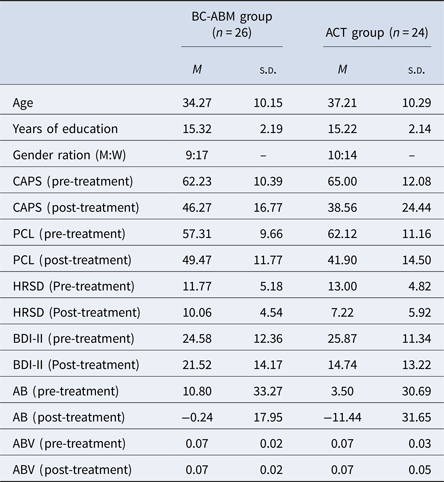
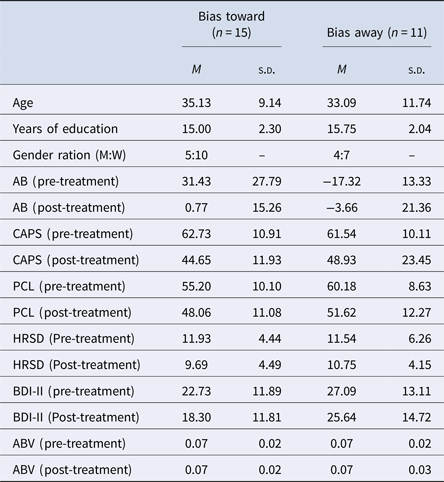
For progress through the study, see CONSORT Fig. 1. Fifty civilian treatment-seeking patients with PTSD (M age = 35.68, s.d. = 10.22; Range = 21–34; 19 males) were randomly assigned to receive ACT or BC-ABM. Groups did not differ on baseline variables ps>0.12 (Table 1). Nine patients (18%) discontinued treatment (ACT = 5, BC-ABM = 4) with no group difference in drop-out, χ2(1) = 0.25, p = 0.62. This dropout rate appears to be lower than prior RCTs of PTSD (Imel et al., Reference Imel, Laska, Jakupcak and Simpson2013; Schoorl et al., Reference Schoorl, Putman and van Der Does2013; Kuckertz et al., Reference Kuckertz, Amir, Boffa, Warren, Rindt, Norman, Ram, Ziajko, Webb-Murphy and McLay2014a; Badura-Brack et al., Reference Badura-Brack, Naim, Ryan, Levy, Abend, Khanna, McDermott, Pine and Bar-Haim2015). Within the BC-ABM group, 15 patients showed bias toward threat at pre-treatment, while 11 showed the opposite pattern (For descriptive statistics of these sub-groups see Table 2). The New York State Psychiatric Institute Institutional Review Board approved the study. Participants provided written informed consent. ClinicalTrials.gov identifier: NCT01888653.
Consort Diagram.

Demographic characteristics, PTSD and depression symptoms, and AB indices by a group at pretreatment and posttreatment

PTSD, Posttraumatic Stress Disorder; BC-ABM, Bias Contingent Attention Bias Modification; ACT, Attention Control Training; CAPS, Clinician-Administered PTSD Scale; PCL, PTSD Checklist; HRSD, Hamilton Rating Scale for Depression; BDI-II, Beck Depression Inventory – II; AB, Attention Bias; ABV, Attention Bias Variability.
Demographic characteristics, PTSD and depression symptoms, and AB indices by BC-ABM sub-group at pre-treatment and post-treatment

PTSD, Posttraumatic Stress Disorder; BC-ABM, Bias-contingent Attention Bias Modification; CAPS, Clinician-Administered PTSD Scale; PCL, PTSD Checklist; HRSD, Hamilton Rating Scale for Depression; BDI-II, Beck Depression Inventory – II; AB, Attention Bias; ABV, Attention Bias Variability.
Diagnoses and inclusion criteria
Participants were recruited via the website of the PTSD Research and Treatment Program, Anxiety Disorders Clinic, New York State Psychiatric Institute and local media. Potential participants were phone-screened using the 17-item PTSD Checklist-Civilian (PCL-C; Weathers et al., Reference Weathers, Litz, Huska and Keane1991). Those with PCL-C scores ⩾30 were invited to the clinic for a complete clinical assessment by an independent evaluator, a PhD-level psychologist trained to 85% reliability with a senior clinician on all interview-based measures. Rater reliability was ascertained based on three test-cases that were independently scored and then reviewed and compared with those of the senior clinician, with Cohen's kappa being above 0.7 for all three. Weekly sessions were conducted to monitor and review diagnostic decisions. Primary and co-morbid diagnoses were ascertained using the Structured Clinical Interview for DSM-IV (SCID; First et al., Reference First, Spitzer, Gibbon and Williams1995). PTSD diagnosis was further established using the Clinician-Administered PTSD Scale (CAPS; Blake et al., Reference Blake, Weathers, Nagy, Kaloupek, Gusman, Charney and Keane1995), with a cutoff score ⩾50 as an inclusion criterion.
Additional inclusion criteria were: (a) primary diagnosis of PTSD; (b) 18–60 years of age; (c) normal or corrected-to-normal vision; and (d) AB toward or away from threat >3 ms. We used the 3 ms criterion as this was the minimum group average bias reported in previous RCTs in PTSD (Schoorl et al., Reference Schoorl, Putman and van Der Does2013; Badura-Brack et al., Reference Badura-Brack, Naim, Ryan, Levy, Abend, Khanna, McDermott, Pine and Bar-Haim2015). Exclusion criteria were: (a) current Axis-I disorder other than PTSD [except for mild-to-moderate major depressive disorder (MDD), indicated by a Hamilton Rating Scale for Depression (HRSD; Hamilton, Reference Hamilton1960) score ⩽25]; (b) history of psychosis; (c) personality disorder; (d) risk for violence to self or others; (e) prior participation in ABM; (f) concurrent psychotropic medication or psychotherapy; and (g) unstable or untreated medical illness. The final sample included 17 participants with co-morbid MDD (9 in BC-ABM).
Outcome measures
Primary outcome – clinician-rated PTSD
The severity of PTSD symptoms, measured by the CAPS (Blake et al., Reference Blake, Weathers, Nagy, Kaloupek, Gusman, Charney and Keane1995), served as the primary outcome. The CAPS is a structured interview diagnosing PTSD based on DSM-IV criteria. It has been widely used in research demonstrating excellent reliability, convergent and discriminant validity, diagnostic utility and sensitivity to change (Weathers et al., Reference Weathers, Keane and Davidson2001). Cronbach's α in the current sample was 0.68.
Clinically significant change (CSC) was taken as ⩾30% reduction in CAPS score at post-treatment as per previous scoring practices for the measurement of CSC in PTSD (Hien et al., Reference Hien, Jiang, Campbell, Hu, Miele, Cohen, Brigham, Capstick, Kulaga, Robinson, Suarez-Morales and Nunes2010).
Secondary outcome – self-reported PTSD
The PCL-C (Weathers et al., Reference Weathers, Litz, Huska and Keane1991) indexed self-reported PTSD symptom severity and served as a secondary outcome. The PCL-C is a 17-item questionnaire assessing the presence and severity of symptoms in civilian populations. The PCL-C has been used extensively in research and clinical settings and has good internal consistency, test-retest reliability, and convergent and discriminant validity (Ruggiero et al., Reference Ruggiero, Del Ben, Scotti and Rabalais2003). Cronbach's α in the current sample was 0.86.
Depression
Clinician-rated depressive symptoms were measured using the HRSD (Hamilton, Reference Hamilton1960), administered using the Structured Interview Guide for the Hamilton Rating Scale for Depression (SIGH-D; Williams, Reference Williams1988). The SIGH-D is a 17-item measure of depression covering core symptoms with strong psychometric properties in clinical samples (Williams, Reference Williams1988). Cronbach's α in the current sample was 0.68. Depression was further assessed using the self-reported Beck Depression Inventory-II (BDI-II; Beck et al., Reference Beck, Steer and Brown1996). The BDI-II assesses the presence of 21 depression-related symptoms. It has high internal consistency in clinical and non-clinical samples, and good test-retest reliability (Beck et al., Reference Beck, Steer and Brown1996). Cronbach's α in the current sample was 0.92.
AB assessment and training
For assessment of AB pre- and post-treatment as well as for ABM we used a faces-based variant of the dot-probe task following the TAU-NIMH ABMT Initiative protocol (http://people.socsci.tau.ac.il/mu/anxietytrauma/research/).
The dot-probe task
In each trial of the dot-probe task used in the study, a fixation cross appeared for 500 ms, followed by a pair of faces of the same actor presented one above the other for 500 ms. Next, a probe display (either ‘<’ or ‘>’) appeared in the location of one of the previously presented faces. The probe remained on the screen until response, which was followed by an inter-trial interval of 500 ms. Participants were instructed to indicate the orientation of the arrowhead probe via a corresponding keyboard press and to perform the task as quickly as possible without compromising accuracy.
The face stimuli were photographs of 20 individuals (10 male, 10 female), with closed-mouth, taken from the NimStim gallery (Tottenham et al., Reference Tottenham, Tanaka, Leon, McCarry, Nurse, Hare, Marcus, Westerlund, Casey and Nelson2009), with each actor contributing one angry and one neutral facial expression. Faces were presented in angry–neutral or neutral–neutral pairs. The face stimuli were split into two sets, A and B, each consisting of 10 actors (5 male).
Threat bias assessment
The bias assessment task included a total of 120 trials, with 80 angry-neutral trials and 40 neutral-neutral trials. For the pre-treatment assessment, participants were randomly assigned to complete the task with either set A or B of face stimuli, with the opposite set used later for training. Angry face location, probe location, and probe type were fully counterbalanced across trials. In line with previous ABM research (Naim et al., Reference Naim, Abend, Wald, Eldar, Levi, Fruchter, Ginat, Halpern, Sipos, Adler, Bliese, Quartana, Pine and Bar-Haim2015; Lazarov et al., Reference Lazarov, Abend, Seidner, Pine and Bar-Haim2017a), for each participant we first excluded inaccurate responses, trials with response latencies <150 ms or >1200 ms, and trials with response latencies ± 2.5 s.d.s from the participant's mean (<2% of all trials, with no group differences).
Attention indices
In line with previous RCTs in PTSD (Badura-Brack et al., Reference Badura-Brack, Naim, Ryan, Levy, Abend, Khanna, McDermott, Pine and Bar-Haim2015), two attention indices were computed: threat-related AB and ABV.
Threat-related AB was calculated for each participant as the differences between the mean reaction time (RT) on threat-incongruent trials (i.e. the probe appeared in the location previously occupied by the neutral face) and mean RT on threat-congruent trials (i.e. the probe appeared in the location previously occupied by the angry face), such that positive values indicate bias toward threat and a negative value reflects a bias away from threat.
Individual ABV scores were calculated in accordance with previous studies employing this measure in PTSD (Badura-Brack et al., Reference Badura-Brack, Naim, Ryan, Levy, Abend, Khanna, McDermott, Pine and Bar-Haim2015; Naim et al., Reference Naim, Abend, Wald, Eldar, Levi, Fruchter, Ginat, Halpern, Sipos, Adler, Bliese, Quartana, Pine and Bar-Haim2015). Specifically, a 4-step process was employed: (1) a trial-by-trial moving average algorithm computed mean RTs for all successive 10 neutral trial blocks and all successive 10 threat trial blocks; (2) successive AB scores were calculated by subtracting the first threat block average from the first neutral block average, the second threat block average from the second neutral block average, etc., forming a series of consecutive AB scores; (3) the standard deviation of these successive bias scores was then calculated, providing an index of variation in AB throughout the session; and (4) this standard deviation score was divided by the participant's mean overall RT to control for associations between mean and variance. Thus, AB variability reflects the within-session variability in threat-related AB, normalized to individual task performance (Badura-Brack et al., Reference Badura-Brack, Naim, Ryan, Levy, Abend, Khanna, McDermott, Pine and Bar-Haim2015; Naim et al., Reference Naim, Abend, Wald, Eldar, Levi, Fruchter, Ginat, Halpern, Sipos, Adler, Bliese, Quartana, Pine and Bar-Haim2015).
Attention bias modification and attention control training
The training protocol consisted of 160 trials per session with 120 angry-neutral and 40 neutral-neutral trials. Each participant was trained with an alternative set of faces to the one used in the assessment task (i.e. if measured with set A then trained with set B and vice-versa). In the ABM condition, training was contingent on the bias measured at pre-treatment. Specifically, for those showing a bias toward the threat, the target appeared at the neutral-face location in 100% of the threat-neutral trials, while for those showing a bias away from the threat, the target appeared at the threat-face location in 100% of the threat-neutral trials. Thus, both BC-ABM variants introduced a contingency between the target location and face valence. In the ACT condition, threat-face location, probe location, and probe type were fully counterbalanced with no contingency between face valence and probe location, thus resembling the assessment task.
General procedure
The study design was a parallel-group RCT: two groups (ACT, BC-ABM) and two assessment points (pre-treatment, post-treatment). Participants were randomly assigned to a treatment condition in a 1:1 ratio, stratified by age and gender, by a staff member not involved in the study. Participants were assessed at each time point using the CAPS (primary outcome measure), PCL-C (secondary outcome measure), HRSD, and BDI-II. Attention indices (AB, ABV) were also measured. All participants were assessed at each time point using the clinician-rated measures, self-report questionnaires, and attention measures. Data collection occurred January 2014 to March 2018.
Consenting participants underwent a clinical assessment at pre-treatment by an independent evaluator blind to group assignment and all aspects of treatment. Participants were informed that the purpose of the study was to evaluate the efficacy of a novel computerized treatment for PTSD. Those meeting clinical inclusion criteria completed the attention assessment task to verify an AB score ⩾3 ms. Sixteen participants were excluded at this stage. Treatment consisted of eight bi-weekly 20-min sessions conducted over 4 weeks. Post-treatment assessment was conducted 1 week after the last training session. Study personnel and participants were blind to treatment group assignment.
Data analysis
Independent samples t tests were used to compare between-groups descriptive characteristics at pre-treatment, with a χ2 test for gender distribution. Treatment effects were tested using Generalized Estimating Equations (GEE; Zeger and Liang, Reference Zeger and Liang1986; Zeger et al., Reference Zeger, Liang and Albert1988), as recommended for RCTs (Vens and Ziegler, Reference Vens and Ziegler2012). GEE accounts for correlated repeated-measurements and accommodates missing data under the missing-at-random assumption, by computing estimated marginal means, thus serving as an intention-to-treat analysis strategy which includes data from all randomized participants who provided at least one data point. To represent within-subject dependencies in the models, we specified an unstructured covariance matrix. Overall effects of ACT relative to BC-ABM on clinician-rated (CAPS, HRSD) and self-reported (PCL-C, BDI-II) PTSD and depression symptoms were estimated using models containing main effects of group and time, and their interaction. The time-by-group interaction terms reflect the outcomes of interest in an intention-to-treat analysis (Badura-Brack et al., Reference Badura-Brack, Naim, Ryan, Levy, Abend, Khanna, McDermott, Pine and Bar-Haim2015) and test the treatment effect hypothesis of greater improvement (decrease) in symptoms over time for one group relative to the other. A χ2 test was used to compare groups on CSC.
Effects of training on attention indices (AB and ABV) were examined per condition, as conditions diverged in training method and goal. Specifically, training-related changes in AB were examined in the BC-ABM group, while changes in ABV were examined in the ACT group.
All statistical tests were 2-sided, using α⩽0.05. Effect sizes are reported using Cohen's d when appropriate.
Results
Primary outcome (CAPS)
Figure 2a illustrates the results of the GEE model for CAPS scores. A main effect of time, Wald = 73.73, p < 0.0001, was qualified by a time-by-group interaction, Wald = 4.51, p = 0.03, reflecting a mean change in CAPS score that is 10.48 points larger for the ACT group (M = 26.44, s.d. = 16.09) relative to the BC-ABM group (M = 15.96, s.d. = 15.75), Cohen's d = 0.60. Follow-up analyses indicated a reduction in CAPS scores from pre- to post-treatment in both groups, with large effect sizes (BC-ABM group, p < 0.0001, d = 1.14; ACT group, p < 0.0001, d = 1.37). Rates of CSC did not differ between groups, χ2 = 2.18, p = 0.14, with 54% of patients in the ACT group and 38% of patients in the BC-ABM demonstrating CSC.
Mean (a) CAPS scores, (b) PCL scores, (c) HRSD scores, and (d) BDI-II scores by group (BC-ABM, ACT) and Time (pretreatment, posttreatment). Note. CAPS, Clinician-Administered PTSD Scale; PCL, PTSD Checklist; HRSD, Hamilton Rating Scale for Depression; BDI-II, Beck Depression Inventory – II; BC-ABM, Bias contingent attention bias modification; ACT, Attention control training. Error bars denote standard error.

Secondary outcome (PCL)
Figure 2b illustrates the results of the GEE model for PCL scores. A main effect of time, Wald = 51.56, p < 0.0001, was qualified by a time-by-group interaction, Wald = 10.04, p = 0.002, reflecting a mean change in PCL scores that is 12.38 points larger for the ACT group (M = 20.22, s.d. = 15.07) relative to the BC-ABM group (M = 7.84, s.d. = 10.24), Cohen's d = 0.90. Follow-up analyses indicated large reductions in PCL scores from pre- to post-treatment in both groups (ACT, p < 0.0001, d = 1.56; BC-ABM, p < 0.0001, d = 0.73).
Depression (HRSD, BDI-II)
Figure 2c illustrates the results of the GEE model for HRSD scores. A main effect of time, Wald = 29.89, p < 0.0001, was qualified by a time-by-group interaction, Wald = 8.84, p = 0.003, reflecting a mean change in HRSD score that is 4.07 points larger for ACT (M = 5.78, s.d. = 4.54) relative to BC-ABM (M = 1.71, s.d. = 4.51), Cohen's d = 0.84. Follow-up analyses indicated a reduction in HRSD scores from pre- to post-treatment for the ACT group (p < 0.0001, d = 1.07), with a non-significant trend-level reduction in the BC-ABM group (p = 0.06, d = 0.35).
Figure 2d illustrates the results of the GEE model for BDI-II scores. A main effect of time, Wald = 15.28, p < 0.0001, was qualified by a time-by-group interaction, Wald = 4.96, p = 0.02, reflecting a mean change in BDI-II score that is 8.07 points larger for ACT (M = 11.13, s.d. = 14.96) relative to BC-ABM (M = 3.06, s.d. = 7.63), Cohen's d = 0.64. Follow-up analyses indicated a significant reduction in BDI-II scores from pre- to posttreatment in both groups (ACT, p = 0.001, d = 1.04; BC-ABM, p = 0.05, d = 0.23).
Treatment-related change in attention measures
Bias-contingent attention bias modification
Analysis of AB at pre-treatment for the two BC-ABM sub-groups (i.e. bias-toward, bias-away) showed the expected group difference, t (24) = 5.36, p < 0.001. One-sample t tests against zero further revealed that at pre-treatment both the bias-toward group, t (14) = 4.38, p = 0.001, and the bias-away group, t (10) = −4.31, p = 0.002 had significant mean ABs in the expected direction (see Table 2 for a description of the two BC-ABM sub-groups).
The results from the GEE model for threat-related AB by sub-group and session is depicted in Fig. 3. A group-by-time interaction, Wald = 15.34, p < 0.001, corroborated a differential training effect in the two sub-groups, with both showing a significant shift in AB in the intended direction, p = 0.001 for the bias-toward sub-group and p = 0.04 for the bias-away group. Follow-up analysis revealed no group difference in AB at post-treatment, p = 0.56, with two separate one-sample t tests against zero indicating non-significant ABs at post-treatment in either the bias-toward or bias-away sub-groups, ps = 0.86 and 0.49, respectively.
Mean Bias scores by group (Bias-toward, Bias-away) and Time (pretreatment, posttreatment) for the bias contingent attention bias modification (BC-ABM) group.

Attention control training
Contrary to predictions, change in ABV from pre- to post-treatment in the ACT group was not significant, Wald = 0.07, p = 0.79. Change in the AB measure was also non-significant, Wald = 1.98, p = 0.16.
Discussion
This RCT compared the efficacy of two attention training protocols in PTSD: a BC-ABM procedure, in which direction of training was contingent upon the direction of AB at pre-treatment, and ACT. ACT was more effective than BC-ABM across all measures of PTSD and depression symptom severity. A significant shift in AB was noted in the intended training direction for both BC-ABM sub-groups. In the ACT group, no significant change was noted in ABV or AB from pre- to post-treatment.
The greater efficacy of ACT over ABM in reducing PTSD symptoms is in line with some but not other RCTs in PTSD. Similar results were obtained in two recent RCTs in veterans with PTSD that applied the same TAU-NIMH ABMT Initiative protocol as a standalone treatment as used in the current study (Badura-Brack et al., Reference Badura-Brack, Naim, Ryan, Levy, Abend, Khanna, McDermott, Pine and Bar-Haim2015). Conversely, our results diverge from two other RCTs using methods that depart from the present study on several important study-design features. The first study recruited patients awaiting another treatment at a mental healthcare department (Schoorl et al., Reference Schoorl, Putman and van Der Does2013), which could limit treatment efficacy. Not choosing ABM a-priori as a treatment avenue might also involve low treatment expectations, which has been associated with low treatment response (Krell et al., Reference Krell, Leuchter, Morgan, Cook and Abrams2004). This study also used pictorial stimuli rather than standard face stimuli as used in the current study. The second study provided ABM/ACT in conjunction with other treatments in an inpatient facility for military personnel with PTSD (Kuckertz et al., Reference Kuckertz, Amir, Boffa, Warren, Rindt, Norman, Ram, Ziajko, Webb-Murphy and McLay2014a), thereupon using attention training as an adjuvant. In light of the extant findings, additional RCTs are needed to determine the relative efficacy of ABM and ACT as adjuvants to other PTSD treatments, as was done in other anxiety disorders (Lazarov et al., Reference Lazarov, Marom, Yahalom, Pine, Hermesh and Bar-Haim2017b).
Here we used the direction of AB at pre-treatment to determine the direction of subsequent attentional training within ABM. We reasoned that ‘normalizing’ ABs may generate better clinical outcomes than training all patients to attend away from threat regardless of their baseline bias. Indeed, BC-ABM produced a significant reduction in symptoms, with both sub-groups demonstrating a reduction in AB following treatment, such that no bias was evident at post-treatment. These results lend support to the distinction between the process of AB change and the ability of specific ABM procedures to evoke this change (Clarke et al., Reference Clarke, Notebaert and MacLeod2014; Basanovic et al., Reference Basanovic, Notebaert, Grafton, Hirsch and Clarke2017). Thus, ABM procedures may be efficacious in symptom reduction only when they also succeed in changing pre-treatment ABs (MacLeod and Clarke, Reference MacLeod and Clarke2015; MacLeod and Grafton, Reference MacLeod and Grafton2016). Hence, ignoring the direction of AB at pre-treatment could contribute to the lower clinical efficacy of ABM relative to ACT reported in previous RCTs (Badura-Brack et al., Reference Badura-Brack, Naim, Ryan, Levy, Abend, Khanna, McDermott, Pine and Bar-Haim2015). However, in line with these RCTs, we again found ACT to be superior to this new bias-contingent treatment, with a between-intervention effect size of 0.60. While the BC-ABM condition generated an effect size of 1.14, the ACT group manifested an even larger effect size of 1.37. Similar patterns emerged for self-reported PTSD symptoms (ds = .73 and 1.56 for BC-ABM and ACT, respectively). Thus, a large clinical effect size for ACT manifested in three independent RCTs, two in military veterans (Badura-Brack et al., Reference Badura-Brack, Naim, Ryan, Levy, Abend, Khanna, McDermott, Pine and Bar-Haim2015) and one in civilians.
The present study also found changes in clinician-rated and self-reported depression symptoms resembling those noted for PTSD symptoms, namely, a reduction in scores in both groups with greater reduction in the ACT compared with the BC-ABM group. This results pattern resembles prior studies that found corresponding changes in PTSD and depression symptoms (Kuckertz et al., Reference Kuckertz, Amir, Boffa, Warren, Rindt, Norman, Ram, Ziajko, Webb-Murphy and McLay2014a; Badura-Brack et al., Reference Badura-Brack, Naim, Ryan, Levy, Abend, Khanna, McDermott, Pine and Bar-Haim2015), while departing from studies examining MDD that typically report poorer clinical outcomes for attention training protocols (Hallion and Ruscio, Reference Hallion and Ruscio2011). This may suggest that attention training is better suited for reducing depressive symptoms co-occurring with PTSD than when occurring as a primary psychiatric condition (Kuckertz et al., Reference Kuckertz, Amir, Boffa, Warren, Rindt, Norman, Ram, Ziajko, Webb-Murphy and McLay2014a). Initiated prior to DSM-5 release, the present study used DSM-IV-based PTSD measures. However, DSM-5 integrates more thoroughly depressive symptoms into the symptomology of PTSD. Thus, current findings may translate seamlessly to the new diagnostic scheme of DSM-5, a prediction that could be verified by additional RCTs applying DSM-5-based PTSD measures.
Despite significant symptom reductions with BC-ABM and corresponding reductions in ABs in this group, reductions in symptoms with ACT were still greater. However, unlike previous RCTs favoring ACT, which noted a mediation of this clinical effect via pre-to-post treatment reduction in ABV (Badura-Brack et al., Reference Badura-Brack, Naim, Ryan, Levy, Abend, Khanna, McDermott, Pine and Bar-Haim2015), we failed to replicate this finding. This may reflect low statistical power, a possibility that could be addressed by future studies employing larger sample sizes. However, what else might be driving enhanced symptom reduction in ACT over ABM? Theory (Eysenck et al., Reference Eysenck, Derakshan, Santos and Calvo2007) and research (Bardeen and Orcutt, Reference Bardeen and Orcutt2011; Bardeen et al., Reference Bardeen, Tull, Daniel, Evenden and Stevens2016; Basanovic et al., Reference Basanovic, Notebaert, Grafton, Hirsch and Clarke2017) suggest that attention control, defined as the capacity to voluntary and effortful execute goal-directed attention deployment while ignoring conflicting attentional demands (Sarapas et al., Reference Sarapas, Weinberg, Langenecker and Shankman2017), is an important modulator of attention. Attention control was found to be positively associated with the magnitude of AB change following ABM (Basanovic et al., Reference Basanovic, Notebaert, Grafton, Hirsch and Clarke2017) and to moderate the association between posttraumatic symptoms and AB. Specifically, among those relatively higher in posttraumatic symptoms (like the current sample), attention control was positively related to the ability to shift attention away from threat stimuli (Bardeen and Orcutt, Reference Bardeen and Orcutt2011; Bardeen et al., Reference Bardeen, Tull, Daniel, Evenden and Stevens2016). In line with such findings, it is possible that ACT enhances attention control, which increased the ability of patients to engage/disengage stimuli at will, possibly leading to better clinical efficacy. Thus, while both training protocols exerted positive therapeutic effects, ACT emerged as favorable, possibly through its more robust effect on attention control in the context of threat (Badura-Brack et al., Reference Badura-Brack, Naim, Ryan, Levy, Abend, Khanna, McDermott, Pine and Bar-Haim2015; Basanovic et al., Reference Basanovic, Notebaert, Grafton, Hirsch and Clarke2017). Still, it remains unclear whether an ACT procedure delivered in a non-threat context would produce similar reductions in symptoms. Future research could further examine this possibility by employing ACT protocols with non-emotional cues such as two different geometrical shapes, thus training attention control in a non-emotional, non-threat context.
Certain study limitations should be considered. First, while ACT is designed to train attention control in the context of attentional threat deployment, we did not directly assess attention control, and hence cannot conclusively determine that it was indeed enhanced in the ACT group. Future research could include specific attention control measures (Bardeen et al., Reference Bardeen, Tull, Daniel, Evenden and Stevens2016; Basanovic et al., Reference Basanovic, Notebaert, Grafton, Hirsch and Clarke2017) to explore this possibility. Second, although lack of follow-up assessment has been noted in previous RCTs in PTSD (Kuckertz et al., Reference Kuckertz, Amir, Boffa, Warren, Rindt, Norman, Ram, Ziajko, Webb-Murphy and McLay2014a; Badura-Brack et al., Reference Badura-Brack, Naim, Ryan, Levy, Abend, Khanna, McDermott, Pine and Bar-Haim2015) we were unable to address this shortcoming in the present study, as patients who did not show clinical improvement at post-treatment were referred for additional treatment within our clinic. Third, and related to the previous shortcoming, while the observed changes in AB from pre- to post-treatment in both BC-ABM sub-groups are perfectly aligned with the trained expectations, these might also simply reflect regression to the mean rather than training effects. Future studies including a follow-up assessment could address this possibility. Fourth, while away-from-threat training comprised a sub-group within BC-ABM, the present study did not include a standard ‘away-from-threat’ ABM group, preventing a direct comparison of its efficacy to that of BC-ABM. However, current results indicated an effect size of 1.14 for BC-ABM, which is considerably larger than previously reported for anxiety disorders (Bar-Haim, Reference Bar-Haim2010; Linetzky et al., Reference Linetzky, Pergamin-Hight, Pine and Bar-Haim2015) and PTSD (Schoorl et al., Reference Schoorl, Putman and van Der Does2013). Relatedly, we did not include a placebo control group with no attention training, designed as a potentially inactive treatment, which would have enabled us to control for placebo or other non-specific treatment effects, especially regarding the BC-ABM group. However, because the effect sizes of both groups (1.37 for the ACT and 1.14 for BC-ABM) are considerably higher than those of waiting list and pill-placebo control groups in PTSD trials (Van Etten and Taylor, Reference Van Etten and Taylor1998; Bradley et al., Reference Bradley, Greene, Russ, Dutra and Westen2005; Schoorl et al., Reference Schoorl, Putman and van Der Does2013) this possibility seems unlikely. Fifth, we recruited patients with PTSD with no co-morbidities except for mild-to-moderate depression, potentially reducing the generalizability of findings as co-morbidity rates in PTSD are high (Brady et al., Reference Brady, Killeen, Brewerton and Lucerini2000). Including only PTSD patients with AB toward or away from threat >3 ms also hinders findings’ generalizability as some PTSD patients do not reach this threshold. Future studies could apply more inclusive criteria to address these issues. In a related vein, while angry faces are considered threatening for PTSD patients with inter-personal traumatic events (Meffert et al., Reference Meffert, Metzler, Henn-Haase, McCaslin, Inslicht, Chemtob, Neylan and Marmar2008), these faces might be less relevant, and hence less effective, for patients with other types of traumatic experiences. Finally, while in accordance with sample sizes employed in previous RCTs in PTSD that compared ABM and ACT using the same training protocol (Badura-Brack et al., Reference Badura-Brack, Naim, Ryan, Levy, Abend, Khanna, McDermott, Pine and Bar-Haim2015), the sample size was not based on a power analysis. Hence, current findings should be considered while acknowledging the relative small sample size used for comparing two potentially active treatments. Still, significant results and large effect sizes emerged, clearly favoring ACT over BC-ABM in PTSD.
Despite the limitations, current results suggest ACT to be advantageous over ABM in reducing PTSD and depression symptoms among a civilian PTSD sample, even when training is contingent upon AB at pre-treatment. As the current study aligns with two recent RCTs also favoring ACT over ABM in combat-related PTSD (Badura-Brack et al., Reference Badura-Brack, Naim, Ryan, Levy, Abend, Khanna, McDermott, Pine and Bar-Haim2015), it appears that current therapeutic efforts, as well as future research, should focus on ACT and its underlying mechanisms of therapeutic change. Future research could explore and develop novel ways to improve the clinical efficacy of ACT, possibly through better understanding the effects of ACT on attention allocation via attention control, aiming to maximize current patient care.
Acknowledgements
We greatly appreciate and thank the patients who agreed to participate in this study. This research was supported by the Stand for the Troops foundation (http://sftt.org) and by the National Institute of Mental Health T32-MH020004 (Amit Lazarov) and T32-MH015144 (Benjamin Suarez-Jimenez). The funding agency had no role in the study design; in the collection, analysis and interpretation of data; in the writing of the report; or in the decision to submit the article for publication.
Conflict of interest
None.
Ethical standards
The authors assert that all procedures contributing to this work comply with the ethical standards of the relevant national and institutional committees on human experimentation and with the Helsinki Declaration of 1975, as revised in 2008.