Introduction
In laying hen husbandry, birds are reared in various production systems. Conventional (unenriched) cage systems are commonly used in Turkey and globally. As rearing and egg production in restricted conventional cages hamper natural behaviour, such as scratching, perching and laying in nests, new regulations have been enacted to protect animal welfare, particularly in European Union (EU) countries. By setting minimum standards for laying hen husbandry and banning the use of conventional cage systems in the member countries as from January 1, 2012, the EU Council ensured the emergence of alternative systems for commercial egg production (Directive EU, 1999).
Major alternative rearing systems used in egg production, such as enriched cages, aviary systems, and free range, have different technical features (Tauson, Reference TAUSON2005; Lay et al., Reference LAY, FULTON, HESTER, KARCHER, KJAER, MENCH, MULLEN, NEWBERRY, NICOL, SULLIVAN and PORTER2011). Such systems are designed to balance animal health and welfare in accordance with the demands of consumers and the poultry sector (Singh et al., Reference SINGH, CHENG and SILVERSIDES2009). Enriched cage systems are one of the alternative systems developed to remedy the deficiencies of conventional cage systems relating to animal welfare. These systems provide each hen with a larger usable area, and are furnished with equipment that helps them exhibit their natural behaviour, such as a nest, scratching area and perching (Sumner et al., Reference SUMNER, ROSEN-MOLINA, MATTHEWS, MENCH and RICHTER2008).
At the end of production using the most advanced models of enriched cage systems, it has been reported that they produced similar results to conventional cage systems in relation to egg productivity, feed conversion ratio and mortality (Abrahamsson et al., 1995a; Reference ABRAHAMSSON, TAUSON and APPLEBY1995b; Guesdon and Faure, Reference GUESDON and FAURE2004; Tauson, Reference TAUSON2005). However, a few studies have reported that average operating costs, total expenses, and investment costs per hen in enriched cage systems are higher than those in conventional cage systems (Van Horne, Reference VAN HORNE2003; Bell, Reference BELL2006; Matthews and Sumner, 2015).
It has been reported that the main determinant in investment and economic feasibility studies for improving animal welfare conditions in enterprises from different animal husbandry sectors is the producer price levels. This has been determined from intensive animal production carried out in the Netherlands, and states that the volatility and precision of the levels of premiums for production are important in taking the decision to convert to alternative production systems (Gocsik et al., Reference GOCSIK, LANSINK, VOERMANS and SAATKAMP2015).
Economic importance and assessment of alternative cage systems for laying hen
The ban imposed by the EU Council has led to the emergence of alternative enriched cage systems, and the increasing investments in equipment and coop modernisation needed have resulted in significant differences in production costs. Various scientific studies have been conducted on the use of alternative cage systems in laying hen husbandry (Sumner et al., Reference SUMNER, ROSEN-MOLINA, MATTHEWS, MENCH and RICHTER2008). These include major factors affecting egg production in conventional or enriched cage systems (Abrahamsson et al., 1995a; Reference ABRAHAMSSON, TAUSON and APPLEBY1995b; Guesdon and Faure, Reference GUESDON and FAURE2004), and costs for different systems (Van Horne and Bondt, Reference VAN HORNE and BONDT2003; Bell, Reference BELL2006; Sumner et al., Reference SUMNER, ROSEN-MOLINA, MATTHEWS, MENCH and RICHTER2008; Matthews and Sumner, 2015).
In a study investigating the effects of cage systems (C: conventional; E: enriched) in 230 enterprises operating in EU member countries, feed consumption (C: 114.97 g/hen/day; E: 113.82 g/hen/day), egg production (C: 85.76% hen/day; E: 84.74% hen/day), feed conversion ratio (C: 2.14; E: 2.14), percentage of broken/cracked eggs (C: 6.50%; E: 7.78%), and egg weight (C: 65.09 g/egg; E: 63.01 g/egg) were monitored. These results suggested lower productivity in enriched cages, but productivity was not a sufficient indicator by itself to determine animal welfare. The study further noted that such systems are economically promising when combined with other measures such as early diagnosis of poultry diseases and elimination of barriers to access of feed and water (Blokhuis et al., Reference BLOKHUIS, FIKS-VAN NIEKERK, BESSEI, ELSON, GUÉMENÉ, KJAER and VAN DE WEERD2007).
Regulations made to improve animal welfare conditions can result in a decrease in the number of hens raised per unit area in enriched cage systems and an increase in egg production costs.
The following comparison between hen housing consists of the technical and economic operating data obtained by comparing the production for Brown (LB) and White (LSL) commercial laying hybrids which were kept in unenriched or alternative cage systems (Onbasılar et al., 2015). These data were applied to a 48-compartment battery cage for each group, and economic parameters used to determine the cost items and revenue items of the unenriched and alternative cage systems in the production period were set. The production period was 399 days starting with 16-week-old commercial beak-trimmed pullets being placed into the cage systems and ending at 73rd weeks of age, when laying hens were removed from production.
Feeding, pullet and labour costs were included in the calculations. The costs of veterinary and health services included vaccine and disinfectant expenses. The egg packaging costs included purchasing and materials used to package the eggs. The water, electricity and fuel cost was calculated by multiplying the unit prices of water, electricity and fuel by the amounts of water, electricity and fuel used throughout the production period. Other expenses included the costs such as transportation of the eggs produced and insurance cost. General administrative expenses were assumed to be 3% of the total costs. Depreciation costs were based on the assumption that the tools and equipment used in production had an economic life of 10 years (Sariozkan and Sakarya, Reference SARIOZKAN and SAKARYA2006). Maintenance and repair expenses consisted of the expenditures made for tools and equipment, with 1% as the maintenance cost, and 2% for repairs (Acil, Reference ACIL1980).
Revenues from sale of broken/cracked eggs and hens removed from production were categorised as ancillary revenues. Sale of broken/cracked eggs was included into the calculations as the total revenue generated, albeit at lower prices. Value of hens removed from production were generated at the end of the laying period from average sale prices. The revenues from sale of eggs, making up the majority of the operating income, was calculated by multiplying the amount of eggs produced and sold by the average sale price throughout the production period. The total cost was obtained by subtracting the ancillary revenues from the grand total costs. Net profit/loss was calculated by subtracting the total costs from egg sales income (Muftuoglu, Reference MUFTUOGLU1989). Production cost of an egg was calculated by subtracting the ancillary revenues from the grand total cost and dividing it by the total amount of eggs sold. These calculations were used to gauge the effect of different cage systems on unit cost of egg production (pcs./US$), production cost per unit area (US$/m2), production cost per hen (US$/number of hens) and total costs.
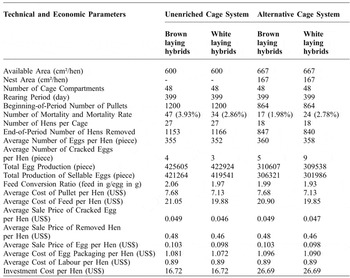
The technical and economic parameters obtained from White and Brown commercial laying hybrids in unenriched and alternative cage systems in the research unit within the rearing period of 399 days, and the average prices are given in Table 1 .
Technical and economic parameters for the rearing period and the average prices to 48 cages/group (adapted from Onbasılar et al., 2015).

*The calculations made in Turkish Lira (

) were converted into US dollar using the exchange rate in the relevant period (Average exchange rate for 2013-2014: US$1=
1.97).
Financial and economic comparison of unenriched and alternative cage systems used in laying hen enterprises
A study was conducted to investigate the socio-economic effects of animal welfare directives issued by the EU Commission in 15 member countries state that there are significant differences between the production costs, and that these differences are associated with the cage systems used in production. When the technical parameters of production in conventional cages (C) and enriched cages (E) (Belgium, Sweden and the United Kingdom) were compared, the production time (E: 449 days; C: 388 days), daily feed consumption (E: 114 g/hen; C: 112 g/hen) and pullet cost (E: €3.49/hen; C: €3.17/hen) were found to be higher in enriched cages (Agra Ceas, 2004).
On the other hand, the number of eggs produced (C: 280 pcs./year; E: 266 pcs./year), mortality rate (C: 6.0%; E: 4.47%), and number of hens raised in unit area (C: 78 hens/m2; E: 49 hens/m2) were found to be higher in conventional cages. Variable costs and fixed costs in conventional cages were 73% and 27%, respectively, whereas in enriched cages the variables costs accounted for the two-thirds of the total cost in Sweden, 70% of the total cost in Belgium and 79% of the total cost in the United Kingdom (Agra Ceas, 2004).
In an investigation of the effect of animal welfare standards imposed by the EU Commission in relation to cage systems used in laying hen husbandry in the Netherlands, the production cost in enriched cage systems was found to result in a cost increase 7.8% lower compared to conventional cage systems, and the reason for this difference was accounted for by supply of feed at lower prices than average in EU countries (Van Horne et al., Reference VAN HORNE, TACKEN, ELLEN, FIKS-VAN NIEKERK, IMMINK and BONDT2007).
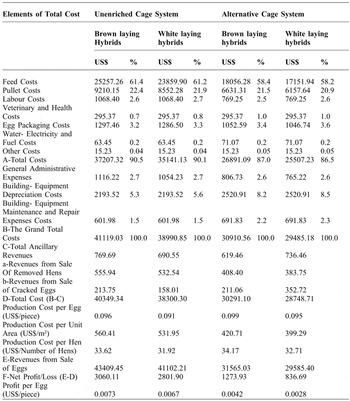
Table 2 presents the effect of inputs used in the current comparison for laying hens in Turkey on the production cost, its distribution in different genotype and cage systems, and the findings obtained in the economic analysis.
Costs in the production period and economic analysis.

Table 2 shows that the feed costs in both cage systems have the highest share in the total cost. The total cost of feed per unit area (US$/m2) in the unenriched system was 12% higher, pullet cost and labour expenses were 11% higher, and total cost 7% higher than that the alternative cage system. On the other hand, the water, electricity and fuel costs in the alternative cage system were 29% higher, and depreciation, maintenance and repair expenses 30% higher than that the unenriched cage system.
Furthermore, in relation to the distribution of production costs, it was found that the ratio of average variable costs in unenriched and alternative cages were 90.3% and 86.8%, respectively, that the fixed costs were 9.7% and 13.2%, respectively. The average variable costs in unit area (US$/m2) in the unenriched cages were 10.51% higher than that in the alternative cages, and that the average fixed costs in the alternative cages were 22.32% higher than that in unenriched cages.
Production cost per egg (US$/egg) and per hen (US$/hen) were the highest in brown laying hybrids kept in alternative cages and the lowest in white laying hybrids kept in unenriched cages. These costs in the alternative cage system were in average 3.80% and 2.03% higher than in the unenriched cage system, respectively.
As for calculated revenue, net profitability per egg (US$/egg) was highest in brown laying hybrids kept in unenriched cages and the lowest in white laying hens kept in alternative cages. In both groups, profitability from brown eggs was found to be higher than that from white eggs. The investment cost in the alternative cage systems was found to be 14.93% higher than that in the unenriched cage systems.
In a study examining the effect of new animal welfare directives on the competitiveness of the egg industry in EU member countries and making a projection for 2012 on the basis of the data for 2001, the production cost in enriched cage systems was estimated to be higher than that in conventional cage systems. Production cost of an egg in enriched cage systems was estimated to be €0.63 higher than that in conventional cage systems (Van Horne and Bondt, Reference VAN HORNE and BONDT2003). In research conducted on enterprises the same region in the US, the effects of three different cage systems on egg production costs were examined on the basis of the data obtained for two production periods from conventional cages with a capacity of 199,680 hens where each compartment contains six hens (516.13 cm2/hen), enriched cages with a capacity of 46,800 hens where each compartment contains 60 hens (753.22 cm2/hen), and a system without cage with a capacity of 50.000 hens (Matthews and Sumner, 2015). The study reported that majority of the costs throughout the production period consisted was feed. Hens raised in enriched cages consumed more feed than those in conventional cages, and egg productivity per unit amount of feed consumed in enriched cages was 1.5% higher than that in conventional cages. Mortality was 5.2% in enriched cages and 4.8% in conventional cages.
It was found that egg production per hen in enriched cages was on average 3.3% higher than that in conventional cages, and pullet costs required to produce a dozen of eggs in enriched cages was 2.7% lower than that in conventional cages. It was reported that operating costs in enriched cage systems were 4% higher than those in conventional cage systems, and that the reason for this difference despite lower feed costs was associated with higher labour costs. The study stated that in conclusion the total cost in enriched cages was 13% higher than that in conventional cages (Matthews and Sumner, 2015).
The reason of mortality was substantially higher in the brown laying hens in unenriched cages compared to brown laying hens in alternative cages in the present study arose from negative animal welfare conditions in cages and more health problems due to this situation.
With the new regulations being introduced in Turkey, farmers will convert conventional cage systems to enriched or other alternative cage systems before January 1, 2023 in accordance with the directives on animal welfare in the EU harmonisation process. The average proportions of cost in the total cost in the production period were calculated to be as follows for unenriched and alternative cages, respectively: pullet 22.17% and 21.17%; feed 61.31% and 58.29%; labour 2.67% and 2.55%; veterinary and health 0.74% and 0.98%; water, electricity and fuel 0.16% and 0.24%; egg packaging 3.23% and 3.48%; other expenses 0.04% and 0.05%; general administrative expenses 2.71% and 2.60%; maintenance and repair expenses 1.50% and 2.29% and depreciation costs 5.48% and 8.35%. The ancillary revenue was found to be US$730.12 and US$677.96, respectively. The average cost of producing one egg was calculated to be US$0.094 and US$0.097, respectively.
The present study found that investment cost in alternative (enriched) cage systems was, on average, 14.9% higher and the production cost per hen (US$/hen) 2.03% higher than for unenriched (conventional) cage systems. In relation to the distribution production costs, the ratio of variable costs to fixed costs was 90.3/9.7 (9.3:1) in unenriched cages and 86.8/13.2 (6.6:1) in alternative cages. Finally, the total cost per unit area (US$/m2) used for egg production in the unenriched cage system was found to be in average 7% higher than that in the alternative cage system.
Conclusions
Subsidies need to be granted to producers to facilitate changes in housing systems, and increases in price levels will play an important role in achieving the conversion. During this transformation, it will be essential to research the practices for animal welfare in the current production conditions and the economic potential of sector investments, in order to convey the data obtained to the enterprises operating in the industry, as this will ensure most efficient change over to enriched cages for laying hens in Turkey.