INTRODUCTION
The Apicomplexa phylum consists of more than 5000 species, most of which are obligate intracellular parasites and include important human and veterinary pathogens, such as Plasmodium spp., Toxoplasma gondii, Cryptosporidium spp., Eimeria tenella and Neospora caninum. The defining feature common to all apicomplexans is the presence of the apical complex, from which secretory organelles (e.g. rhoptries, micronemes) release their contents during cell invasion (Nichols et al. Reference Nichols, Chiappino and O'Connor1983; Carruthers et al. Reference Carruthers, Giddings and Sibley1999). To date, no effective vaccines or treatments are available against the disease-causing apicomplexans such as T. gondii (Zhang et al. Reference Zhang, Chen, Wang, Petersen and Zhu2013) or N. caninum (Reichel and Ellis, Reference Reichel and Ellis2009). Moreover, the development of drug resistance remains a serious threat against the control of malaria (Chong et al. Reference Chong, Basir and Fei2013). In order to drive the discovery of targets for parasite disease control forward we need to invest in the development of new molecular strategies to achieve a better understanding of basic parasite biology.
Several key technologies have emerged that have allowed the molecular dissection of functions in important pathogens (Meissner et al. Reference Meissner, Breinich, Gilson and Crabb2007; Pino, Reference Pino2013). In addition, publication of several apicomplexan parasite genomes in the EuPathDB database (www.eupathdb.org) allows for fast and robust in silico identification of promising candidate genes through comparative genome studies (Aurrecoechea et al. Reference Aurrecoechea, Brestelli, Brunk, Fischer, Gajria, Gao, Gingle, Grant, Harb, Heiges, Innamorato, Iodice, Kissinger, Kraemer, Li, Miller, Nayak, Pennington, Pinney, Roos, Ross, Srinivasamoorthy, Stoeckert, Thibodeau, Treatman and Wang2010). However, not all apicomplexan parasites are amenable to genetic manipulation due to difficulties in continuous in vitro cultivation, transfection or isolation of intracellular developmental stages in sufficient numbers for downstream molecular applications (Oberstaller et al. Reference Oberstaller, Joseph and Kissinger2013). The development of several reverse genetic tools in T. gondii has reinforced its role as a major model system for studying other apicomplexan parasites and also for conserved biological processes in less related organisms (Meissner et al. Reference Meissner, Breinich, Gilson and Crabb2007). Several techniques based on the homologous recombination of exogenous DNA have allowed the generation of knockouts after the removal of the gene of interest (GOI) (reviewed in Jakot et al. Reference Jakot, Meissner, Sheiner, Soldati-Fevre, Striepen, Weiss and Kim2013). Moreover, the efficiency of these approaches has been improved after the generation of strains deficient in the non-homologous end joining repair (NHEJ) pathway (Fox et al. 2009; Huynh and Carruthers 2009) allowing for repeated and efficient stable transfection in T. gondii (Sheiner et al. Reference Sheiner, Demerly, Poulsen, Beatty, Lucas, Behnke, White and Striepen2011; Andenmatten et al. Reference Andenmatten, Egarter, Jackson, Jullien, Herman and Meissner2013; Pieperhoff et al. 2013).
In a haploid organism such as T. gondii, the characterization of essential genes requires the employment of conditional systems that allow a tight and reliable regulation of gene activity. Current approaches for down-regulation of genes in other organisms, such as interference RNA (RNAi) and double-strand RNA (dsRNA), have been unsuccessful to date (Kolev et al. Reference Kolev, Tschudi and Ullu2011). Here we discuss the advantages and disadvantages of the three most commonly used conditional regulation systems in T. gondii: Tet-inducible transcription (Meissner et al. Reference Meissner, Brecht, Bujard and Soldati2001, Reference Meissner, Schluter and Soldati2002), rapid protein destabilization (Herm-Gotz et al. Reference Herm-Gotz, Agop-Nersesian, Munter, Grimley, Wandless, Frischknecht and Meissner2007) and conditional site-specific recombination (Andenmatten et al. Reference Andenmatten, Egarter, Jackson, Jullien, Herman and Meissner2013). With future phenome project development in mind, we will discuss which of these systems allow a high-throughput approach in combination with gene-editing or Recombineering technologies.
WHAT IS THE OPTIMAL SYSTEM TO GENERATE CONDITIONAL MUTANTS?
Conditional regulation systems allow the functional analysis of essential genes for the biology of an organism. When studying an essential gene, one needs to be aware of the intrinsic advantages and disadvantages of each regulation system. In our opinion, the ideal conditional knockout system should have five properties: (i) rapid regulation of the GOI; (ii) reversible and tuneable regulation of gene activity; (iii) efficient regulation of gene function without any residual activity; (iv) generation of a conditional, clonal knockout strain that can be easily analysed; and (v) prior to induction, the introduced modifications should not interfere with the GOI's function.
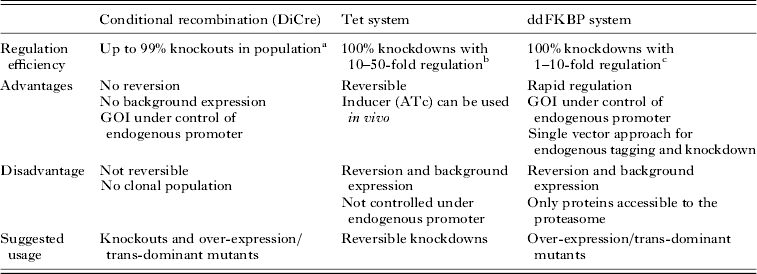
Unfortunately such a conditional regulation system does not yet exist for T. gondii and other model systems and therefore the advantages and disadvantages of each conditional system need to be carefully considered before a lengthy experimental approach is started (Table 1).
Summary of the technologies described in this review

a Andenmatten et al. (Reference Andenmatten, Egarter, Jackson, Jullien, Herman and Meissner2013).
b Meissner et al. (Reference Meissner, Schluter and Soldati2002).
Tetracycline inducible system
The tetracycline resistance operon is recognized in genetic engineering as a useful tool for the manipulation of transcription regulation in eukaryotic cells. Two versions of tetracycline (Tet)-dependent gene regulation find widespread application, allowing either conditional repression or activation of transcription of the GOI. The repression system mimics the bacterial system, by placing Tet operator (TetO) sequences close to the transcriptional start site of a GOI, leading to a block in transcription initiation upon binding of the Tet repressor (TetR). Addition of tetracycline, or tetracycline derivatives such as doxycycline, abolishes DNA-binding and consequently allows transcription. This regulation system has been successfully employed in a variety of eukaryotes (Lovett et al. Reference Lovett, Howe and Sibley2000), including protozoan parasites (Wirtz and Clayton, Reference Wirtz and Clayton1995; Hamann et al. Reference Hamann, Buss and Tannich1997; Ramakrishnan et al. Reference Ramakrishnan, Vines, Mann and Petri1997; Wirtz et al. Reference Wirtz, Leal, Ochatt and Cross1999). An analogous system was developed in T. gondii, but this was not sufficient for the generation of conditional mutants (Meissner et al. Reference Meissner, Brecht, Bujard and Soldati2001). Although the expression of a bulkier version of TetR led to an increased regulation efficiency (van Poppel et al. Reference van Poppel, Welagen, Duisters, Vermeulen and Schaap2006) this system in general suffers from a high residual activity in the repressed state. Furthermore, the necessity of keeping conditional mutants in the presence of the inducer anhydrotetracycline (ATc), less toxic for T. gondii, increases the risk of revertants.
In contrast, the Tet-transactivator system (Gossen and Bujard, Reference Gossen and Bujard1992) is based on a tetracycline-responsive promoter (TRE), where TetO sequences are placed upstream of a minimal promoter. Furthermore, the fusion of TetR to a virion protein 16 (VP16) transactivating domain of the Herpes simplex virus generated an efficient tetracycline-dependent transactivator (tTA). Consequently, binding of tTA to the TRE activates transcription of the GOI, whereas addition of ATc abolishes binding of tTA to TetO resulting in inactivation of transcription.
While this system found widespread employment in diverse eukaryotes, a direct adaptation in apicomplexan parasites was not possible due to the inability of tTA to activate transcription from TRE (Meissner et al. Reference Meissner, Brecht, Bujard and Soldati2001).
To overcome the lack of activity of the transcription activation domain, a screen was performed in T. gondii to identify Toxoplasma sequences that support tTA transcription (Meissner et al. Reference Meissner, Schluter and Soldati2002). The transactivator isolated, TATi-1 (trans-activator trap identified), showed tightly inducible regulation. This artificial transactivator has also been shown to be active in Plasmodium falciparum (Meissner et al. Reference Meissner, Krejany, Gilson, de Koning-Ward, Soldati and Crabb2005). To date, this system has been used to functionally analyse numerous genes in T. gondii (Limenitakis and Soldati-Favre, Reference Limenitakis and Soldati-Favre2011).
A parasite strain expressing this transactivator (RH ΔKu80 TATi-1) was created to aid the targeting of endogenous gene sequences via homologous recombination (Sheiner et al. Reference Sheiner, Demerly, Poulsen, Beatty, Lucas, Behnke, White and Striepen2011). Here, replacement of the endogenous GOI promoter by homologous recombination with a Tet-inducible promoter is sufficient to control the transcription of the GOI.
Recently more powerful transactivators, TRADs (trans-activating domains), derived from ApiAP2 transcription factors have been established. TRAD4 has been shown to be suitable for the study of genes essential for the erythrocytic stages of Plasmodium berghei development (Pino et al. Reference Pino, Sebastian, Kim, Bush, Brochet, Volkmann, Kozlowski, Llinas, Billker and Soldati-Favre2012).
While the Tet-transactivator system will remain one of the workhorses for the functional characterization of essential genes there are some major pitfalls. With this technique gene expression can be reversibly regulated, although a tuneable regulation is not possible. This technology allows generation of clonal knockdown strains that can be easily analysed. However, despite the efficiency in gene regulation observed it usually takes a long time until protein levels of the GOI are undetectable depending on the relative protein stability. Moreover, every minimal promoter tested thus far shows some residual activity (Meissner et al. unpublished results), thus it does not allow complete down-regulation of gene function. In addition, since it does not allow expression of the GOI from its endogenous promoter, certain genes will be expressed at the wrong time and at different expression levels in the ‘ON’ state.
Rapid regulation of protein stability
In order to obtain de-stabilization domains based on the rapamycin-binding protein FKBP-12 (ddFKBP) random mutations were introduced in this protein. The mutated proteins were screened for Shield-1 (Shld-1)-dependent regulation. Addition of Shld-1, an analogue of rapamycin, resulted in rapid stabilization and removal of this ligand in rapid destabilization of ddFKBP (Banaszynski et al. Reference Banaszynski, Chen, Maynard-Smith, Ooi and Wandless2006). Importantly, N- or C-terminal fusion of ddFKBP with a protein of interest allows efficient, rapid and reversible degradation.
This system has been successfully adapted in apicomplexan parasites (Armstrong and Goldberg, Reference Armstrong and Goldberg2007; Herm-Gotz et al. Reference Herm-Gotz, Agop-Nersesian, Munter, Grimley, Wandless, Frischknecht and Meissner2007; de Azevedo et al. Reference de Azevedo, Gilson, Gabriel, Simoes, Angrisano, Baum, Crabb and Wunderlich2012) and has been used successfully in P. falciparum to generate knockdown mutants (Russo et al. Reference Russo, Oksman, Vaupel and Goldberg2009; Dvorin et al. Reference Dvorin, Bei, Coleman and Duraisingh2010).
The rapid response kinetic of the ddFKBP-system is of particular advantage when rapid processes are to be analysed, such as components of trafficking systems or signalling cascades. A disadvantage of this technology is that proteins residing within organelles typically cannot be regulated using this destabilization domain since the fused protein needs to be accessible to the proteasome which resides in the cytosol. It has been reported that administration of Shld-1 can cause delayed parasite growth thus it is an important requirement to include appropriate controls for phenotype interpretation (de Azevedo et al. Reference de Azevedo, Gilson, Gabriel, Simoes, Angrisano, Baum, Crabb and Wunderlich2012).
Other destabilization domains have been developed, such as DHFR-based systems (DDD) (Iwamoto et al. Reference Iwamoto, Bjorklund, Lundberg, Kirik and Wandless2010). This system used Escherichia coli DHFR as a candidate protein to engineer a second destabilizing domain with improved properties. After addition of trimethoprim (TMP), EcDDD showed faster degradation kinetics. Another important advantage of using the DDD system is that TMP ligand is commercially available, is relatively cheap, and possesses good pharmacological characteristics. This system has been demonstrated in P. falciparum combined with GFP and HA sequences to study the role of Rpn6 asparagine repeat (Muralidharan et al. Reference Muralidharan, Oksman, Iwamoto, Wandless and Goldberg2011).
While in principle protein degradation systems should allow a rapid generation of knockdown mutants in T. gondii by simply tagging the endogenous GOI with this domain, our experience with ddFKBP is rather discouraging, since after successful tagging of the protein of interest no efficient destabilization could be observed (Meissner et al. unpublished results). One obstacle might be that during prolonged selection of parasite mutants in the presence of Shld-1 reversions occur, leading to inefficient regulation. Alternatively, it is possible that proteins that are associated in a multi-protein complex might be stabilized due to their interaction with other components of the complex. This was the case for components of the MyoA-motor complex (unpublished). In contrast, the system is particularly well suited for the regulated expression of dominant negative mutants or for the generation of over-expression phenotypes (Herm-Gotz et al. Reference Herm-Gotz, Agop-Nersesian, Munter, Grimley, Wandless, Frischknecht and Meissner2007; Agop-Nersesian et al. Reference Agop-Nersesian, Naissant, Ben Rached, Rauch, Kretzschmar, Thiberge, Menard, Ferguson, Meissner and Langsley2009, Reference Agop-Nersesian, Egarter, Langsley, Foth, Ferguson and Meissner2010; Breinich et al. Reference Breinich, Ferguson, Foth, van Dooren, Lebrun, Quon, Striepen, Bradley, Frischknecht, Carruthers and Meissner2009; van Dooren et al. Reference van Dooren, Reiff, Tomova, Meissner, Humbel and Striepen2009; Daher et al. Reference Daher, Plattner, Carlier and Soldati-Favre2010; Kremer et al. Reference Kremer, Kamin, Rittweger, Wilkes, Flammer, Mahler, Heng, Tonkin, Langsley, Hell, Carruthers, Ferguson and Meissner2013).
An exciting possibility for future forward genetic screens could be the use of a cDNA library fused to ddFKBP to screen for over-expression phenotypes as recently demonstrated on a small scale for apicomplexan Rab-GTPases (Kremer et al. Reference Kremer, Kamin, Rittweger, Wilkes, Flammer, Mahler, Heng, Tonkin, Langsley, Hell, Carruthers, Ferguson and Meissner2013).
Despite the advantages of the ddFKBP-system, major obstacles remain to be solved in order to generate conditional knockdown mutants at a larger scale. One advantage of this system is the possibility of reversible and tuneable regulation. Moreover, it allows the generation of clonal knockdown strains that can be easily analysed. On the contrary, whereas the regulation can be efficient and rapid, the success rate for the regulation of endogenous proteins appears to be low. Inefficient regulation is frequently observed, even for over-expression and dominant negative mutants.
Site-specific recombinase systems (SSR)
Site-specific recombinase systems offer attractive possibilities for genetic manipulations and have found widespread use in different model systems to specifically remove DNA-sequences flanked by recombinase-specific recognition sites (Garcia-Otin and Guillou, Reference Garcia-Otin and Guillou2006). A major bottleneck for the use of SSR in single-celled organisms is the necessity to tightly regulate the excision event. Different methods have been developed to control the expression of recombinases including heat-shock promoters (Combe et al. Reference Combe, Giovannini, Carvalho, Spath, Boisson, Loussert, Thiberge, Lacroix, Gueirard and Menard2009), mutations in the loxP or FRT sites to block the reverse reaction (Arakawa et al. Reference Arakawa, Lodygin and Buerstedde2001), Tet-inducible systems (Plageman and Lang, Reference Plageman and Lang2012) and hormone-binding domain systems (Metzger et al. Reference Metzger, Clifford, Chiba and Chambon1995; Brecht et al. Reference Brecht, Erdhart, Soete and Soldati1999). While in P. berghei temporal control of the excision event is achieved by the stage-specific expression of Flp-recombinase in deletion clones (Carvalho et al. Reference Carvalho, Thiberge, Sakamoto and Menard2004; Lacroix et al. Reference Lacroix, Giovannini, Combe, Bargieri, Spath, Panchal, Tawk, Thiberge, Carvalho, Barale, Bhanot and Menard2011), a ligand-controlled approach has been particularly successful in T. gondii (Andenmatten et al. Reference Andenmatten, Egarter, Jackson, Jullien, Herman and Meissner2013) and P. falciparum (Collins et al. Reference Collins, Das, Wong, Andenmatten, Stallmach, Hackett, Herman, Muller, Meissner and Blackman2013). This approach is known as the DiCre system, in which the Cre recombinase is expressed in the form of two separate polypeptides, each fused to a different rapamycin-binding protein (FKBP12 and FRB). The addition of rapamycin induces heterodimerization of these two components and restores recombinase activity (Jullien et al. Reference Jullien, Sampieri, Enjalbert and Herman2003; Jullien et al. Reference Jullien, Goddard, Selmi-Ruby, Fina, Cremer and Herman2007).
SSR systems have a high versatility and allow multiple applications, such as removal, inversion or integration of DNA sequences (Bouabe and Okkenhaug, Reference Bouabe and Okkenhaug2013). In our experience, the most reliable application in T. gondii is the GeneSwap strategy (Andenmatten et al. Reference Andenmatten, Egarter, Jackson, Jullien, Herman and Meissner2013). Here a vector including the cDNA of the GOI flanked by loxP sites and under control of the endogenous promoter is used. In case of intron-less GOIs it might be worth using a synthetic gene to avoid homologous recombination within the cDNA. Downstream of the second loxP site a reporter gene, YFP, was placed followed by the selectable marker and the 3′-UTR of the GOI. This cassette is introduced into the locus of the GOI by double homologous recombination. Consequently, induction of DiCre results in YFP-positive parasites that have completely lost the GOI. This approach has been successfully used to generate parasites devoid of genes, such as myoA, mic2, act1 (Andenmatten et al. Reference Andenmatten, Egarter, Jackson, Jullien, Herman and Meissner2013), ama1 (Bargieri et al. Reference Bargieri, Andenmatten, Lagal, Thiberge, Whitelaw, Tardieux, Meissner and Menard2013), dhhc7 (Frenal et al. Reference Frenal, Tay, Mueller, Bushell, Jia, Graindorge, Billker, Rayner and Soldati-Favre2013), mlc1, myoA/B/C, gap40, gap45, gap50 (Egarter et al. Reference Egarter, Andenmatten, Jackson, Whitelaw, Pall, Black, Ferguson, Tardieux, Mogilner and Meissner2014) and others. Also, in P. falciparum the induction of DiCre-recombinase results in nearly the whole parasite population excising the floxed DNA sequence (Collins et al. Reference Collins, Das, Wong, Andenmatten, Stallmach, Hackett, Herman, Muller, Meissner and Blackman2013).
While generation of conditional mutants with the DiCre system promises a very high success rate (>90%), there are some advantages and disadvantages that need to be considered. The introduced modifications are less likely to interfere with gene function, since the GOI will be regulated by its own endogenous promoter. Upon excision of the GOI, it is possible to obtain parasites without any residual expression. However, the regulation is irreversible and one has to keep in mind that induction results in a mixed population where 20–96% of the parasites display the desired knockout phenotype. While the GeneSwap strategy allows easy identification of knockouts due to expression of YFP, other approaches, such as proteomics, might be hindered by contamination with non-induced parasites. However, contamination with non-induced parasites could be overcome or minimized by enriching for YFP-positive parasites using sorting methods such as FACS. Despite a short induction of DiCre (<4 h) being sufficient to trigger excision of the GOI, the kinetic of down-regulation can be very slow depending on the stability of the protein, similar to the Tet-transactivation system.
DIRECT COMPARISON OF TATi, DDFKBP AND DICRE
To date the function of only a few genes have been analysed using all three technologies. Strikingly, the observed phenotypes have been different depending upon which technique was used to disrupt the same gene. This has affected the interpretation of data and conclusions, for example the work describing the role of the glideosome in host cell invasion. The glideosome is a macromolecular complex involved in gliding motility which is anchored to the plasma membrane (PM) and the inner membrane complex (IMC) (Frenal et al. Reference Frenal, Polonais, Marq, Stratmann, Limenitakis and Soldati-Favre2010). It is described as essential machinery for host-cell invasion and egress in apicomplexan parasites of which myosin A (MyoA) was thought to play a key role.
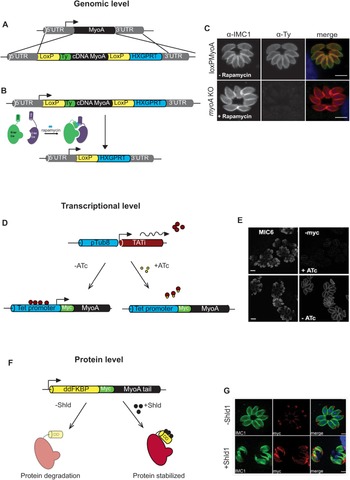
A phenotypic characterization of MyoA was performed using the technologies described above: modification at a genomic level by removal of the gene using DiCre (Fig. 1A–C) (Andenmatten et al. Reference Andenmatten, Egarter, Jackson, Jullien, Herman and Meissner2013; Egarter et al. Reference Egarter, Andenmatten, Jackson, Whitelaw, Pall, Black, Ferguson, Tardieux, Mogilner and Meissner2014); at a transcriptional level, using the Tet-transactivator system (Fig. 1D and E) (Meissner et al. Reference Meissner, Schluter and Soldati2002); and at a protein level, using the ddFKBP-system to over-express the MyoA-tail (Fig. 1F and G) (Agop-Nersesian et al. Reference Agop-Nersesian, Naissant, Ben Rached, Rauch, Kretzschmar, Thiberge, Menard, Ferguson, Meissner and Langsley2009).
Comparative analysis of inducible knockout systems and their applications for the motor protein MyoA (adapted from Meissner et al. Reference Meissner, Schluter and Soldati2002; Herm-Gotz et al. Reference Herm-Gotz, Agop-Nersesian, Munter, Grimley, Wandless, Frischknecht and Meissner2007; Andenmatten et al. Reference Andenmatten, Egarter, Jackson, Jullien, Herman and Meissner2013). Manipulation at the genomic level using the DiCre system (A)/(B). Replacement of endogenous MyoA locus with a cDNA copy (A). Upon rapamycin induction, MyoA is irreversibly removed by excision of the MyoA cDNA (B)/(C). Transcriptional manipulation using the Tet-inducible system, transcription is inhibited by addition of anhydrotetracycline (ATc) preventing transactivator binding to the promoter region and therefore silencing transcription (D). Myc tagged MyoA expression was shown to be disrupted by immunofluorescence assay (IFA) (E). Manipulation of proteins containing the DD domain, addition of Shld-1 allows stability and over-expression (F). Myc tagged MyoA degradation shown by IFA (G).

Reduction in MyoA expression levels using the Tet-transactivator system resulted in significant reduction of gliding motility and host cell invasion, leading to the conclusion that MyoA is the essential motor protein powering these processes (Meissner et al. Reference Meissner, Schluter and Soldati2002). Residual expression of MyoA was interpreted as the cause for the ‘minimal levels of invasion’ detected with this technology.
Intriguingly, over-expression of a ddFKBP-myoA-tail construct not only showed reduced invasion efficiency but also a block in intracellular replication. The over-expressed DD-tagged MyoA may have interacted with critical factors required during IMC biogenesis and acted as a dominant-negative protein. This effect was interpreted as MyoA having a second function during the asexual life cycle that cannot be resolved by reduction of expression levels (Agop-Nersesian et al. Reference Agop-Nersesian, Naissant, Ben Rached, Rauch, Kretzschmar, Thiberge, Menard, Ferguson, Meissner and Langsley2009). While it will be very interesting to identify the putative interaction partners of ddFKBP-myoA-tail, this example demonstrates that great care has to be taken when analysing dominant negative mutants.
Therefore, while the systems provided consistent data on the function of MyoA, using the DiCre system allowed the isolation of a viable myoA null mutant which shed further light on its essentiality, and calls for a more detailed analysis of the mechanisms involved in host cell invasion and for IMC biogenesis (Andenmatten et al. Reference Andenmatten, Egarter, Jackson, Jullien, Herman and Meissner2013; Egarter et al. Reference Egarter, Andenmatten, Jackson, Whitelaw, Pall, Black, Ferguson, Tardieux, Mogilner and Meissner2014).
The role of the rhomboid protease ROM4 in the cleavage of the micronemal proteins MIC2 and AMA1 was also studied using several different genetic systems. Initially down-regulation of ROM4 was established by using the Tet-transactivator system (Buguliskis et al. Reference Buguliskis, Brossier, Shuman and Sibley2010) and resulted in reduced invasion. Surprisingly, expression of a dominant negative version of ROM4 using the ddFKBP system led to a block of intracellular replication. Intriguingly, simultaneous over-expression of the AMA1-tail domain (the presumed cleavage product of ROM4) fused to ddFKBP, was sufficient to release this block and it was concluded that the ROM4-AMA1 processing step is required to trigger a signal for intracellular replication of T. gondii (Santos et al. Reference Santos, Portes Jde, Damasceno-Sa, Caldas, Souza, Damatta and Seabra2011).
Null mutants for rom4, ama1 and mic2 were recently generated using the DiCre system (Andenmatten et al. Reference Andenmatten, Egarter, Jackson, Jullien, Herman and Meissner2013; Bargieri et al. Reference Bargieri, Andenmatten, Lagal, Thiberge, Whitelaw, Tardieux, Meissner and Menard2013; Rugarabamu et al. 2013), surprisingly, showing no intracellular replication defects. A possible explanation for this discrepancy is a non-specific, pleiotropic effect caused by the expression of the dominant negative forms fused to ddFKBP. This explanation is favoured by the observation that neither ROM4 nor AMA1 mutants showed replication defects. The ability to isolate viable null mutants for these genes supports the notion that host cell invasion is more complex than initially perceived.
In summary, discrepancies in phenotypic consequences can be observed especially between mutants generated by ddFKBP and Tet/DiCre. Therefore, it is our recommendation to attempt a characterization using over-expression and knockout/knockdown approaches to identify potential downstream effects or, in the worst case, artefacts.
RECOMBINATION-MEDIATED GENETIC ENGINEERING
Classical characterization of gene function using parasite lines carrying mutations in a single GOI are time consuming and only offer limited information. Improved technologies moving towards high-throughput approaches to study gene function are necessary to allow for progression in the understanding of gene regulation in apicomplexan parasites. Recombineering is an efficient method for DNA engineering using homologous recombination in E. coli. This technique allows modification of DNA at any chosen position based on short regions of sequence homology. Transient expression of the recombinase complex and proofreading activity of lambda red operon allows controlled Recombineering to be initiated (Wang et al. Reference Wang, Sarov, Rientjes, Fu, Hollak, Kranz, Xie, Stewart and Zhang2006). Recently, it was used to modify the apicoplast membrane localized phosphate translocator (APT) using COSMID libraries in T. gondii (Brooks et al. Reference Brooks, Johnsen, van Dooren, Muthalagi, Lin, Bohne, Fischer and Striepen2010). The Recombineering method has been adapted to generate P. berghei vectors for transfection in high throughput (Pfander et al. Reference Pfander, Anar, Schwach, Otto, Brochet, Volkmann, Quail, Pain, Rosen, Skarnes, Rayner and Billker2011). Currently, the Sanger Institute (Genome Campus, Hinxton, UK) maintain the PlasmoGem database (http://plasmogem.sanger.ac.uk) therefore gene knockout and tagged gene vectors produced using Recombineering and GateWay technologies are annotated and can be obtained for downstream functional analysis.
It will be important to establish a similar technology and distribution system for T. gondii large-scale genome manipulation. A combination of Recombineering with the current toolbox described above should be possible to fulfil this goal.
GENOME EDITING IN APICOMPLEXAN PARASITES
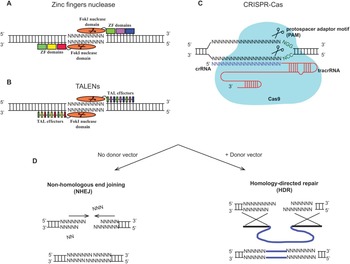
One alternative to Recombineering could be employment of genome editing tools, such as artificially developed zinc finger nucleases (ZFNs) (Kim et al. Reference Kim, Cha and Chandrasegaran1996; Nain et al. Reference Nain, Sahi and Verma2010), transcription activator-like effector (TALE) nucleases from Xanthomonas spp. (Boch et al. Reference Boch, Scholze, Schornack, Landgraf, Hahn, Kay, Lahaye, Nickstadt and Bonas2009; Kay and Bonas, Reference Kay and Bonas2009; Pan et al. Reference Pan, Xiao, Li, Zhang, Sirois, Zhang and Li2013) or clustered regularly interspaced short palindromic repeat (CRISPR) cas9 from Streptococcus pyogenes (Mali et al. Reference Mali, Esvelt and Church2013; Sampson and Weiss, Reference Sampson and Weiss2014). Each ZF domain consists of an array of protein fingers stabilized by zinc ion that recognize a specific triplet of DNA sequence (Fig. 2A). TALE monomers directly bind to DNA via a central domain of tandem repeats (Fig. 2B). The type II CRISPR/Cas system is being used in genetic manipulation of eukaryotic cells, allowing for the introduction of double-strand breaks (DBS) after addition of a small guide RNA into target genomes (Ran et al. Reference Ran, Hsu, Wright, Agarwala, Scott and Zhang2013) (Fig. 2C). The DSB produced by any of these nuclease-based technologies can lead to non-homologous end joining (NHEJ) repair or, in case of the presence of a donor vector, to homology-directed repair (HDR) (Fig. 2D). ZF and TALE monomer construction requires specialist expertise as the probability of mismatch sequences causing off-target mutagenesis is high. The costs for generating the ZF or TALE libraries are relatively high whereas CRISPR/Cas9 technology offers a cheap alternative.
Nuclease-mediated genome editing (adapted from Pan et al. Reference Pan, Xiao, Li, Zhang, Sirois, Zhang and Li2013; Sampson and Weiss, Reference Sampson and Weiss2014). Each monomer of zinc finger nuclease (ZFN) recognizes 3 bp DNA (A). Monomers of the transcription Activator-Like Effectors Nucleases (TALENs) system bind to a specific nucleotide sequence (B). Cas9 nuclease forms a complex with the chimera sgRNA, comprising a crRNA and a tracrRNA. This RNA guides the nuclease to the target locus (C). These nucleases will induce a double strand brake (DSB) in the gene that will be followed by non-homologous end joining (NHEJ) repair if no donor vector is supplied. If a plasmid with homologous regions is added the introduction of foreign DNA can be achieved (D).

The main advantage of using nucleases for genome editing is the ability to directly engineer the genome of the organism being studied without the necessity of prior preparation of constructs with GOI DNA using recombinant DNA technology. Given the possibility for employing these new technologies for the manipulation of a wide range of organisms, adaptation of these technologies to apicomplexan gene studies would allow for greater scale of manipulation of the genome and efforts are being made to establish these new technologies into the current repertoire of molecular tools for the manipulation of T. gondii and Plasmodium spp. parasites.
OUTLOOK
The toolbox for genetic engineering discussed here demonstrates that each technology has its limitations and optimally synergistic technologies (such as knockdown and dominant negative expression) should be used to investigate gene function. However, the examples discussed above are not the only technologies employed to manipulate the genome in eukaryotic cells and several alternatives exist that we did not include in this review, such as the use of ribozymes (Agop-Nersesian et al. Reference Agop-Nersesian, Pfahler, Lanzer and Meissner2008; Prommana et al. Reference Prommana, Uthaipibull, Wongsombat, Kamchonwongpaisan, Yuthavong, Knuepfer, Holder and Shaw2013) or auxin-based degron systems (Jebiwott et al. Reference Jebiwott, Govindaswamy, Mbugua and Bhanot2013).
One aim for the future is the establishment of technologies that will allow the generation of mutants on a large scale. This likely will require the combination of inducible genetic tools, such as the Tet-system or DiCre with CRISPR or Recombineering for the comprehensive analysis of essential genes.
ACKNOWLEDGEMENTS
We would like to thank to Dr Lilach Sheiner for helpful comments on the manuscript.
FINANCIAL SUPPORT
This work is supported by a Wellcome Trust Senior Fellowship [087582/Z/08/Z] and ERC Starting Grant [ERC-2012-StG 309255]. The Wellcome Trust Centre for Molecular Parasitology is supported by core funding from the Wellcome Trust (085349).