INTRODUCTION
Climate change has always mattered in human history (e.g. Weiss et al. Reference Weiss, Courty, Wetterstrom, Guichard, Senior, Meadow and Curnow1993; D’Andrea et al. Reference D’Andrea, Huang, Fritz and Anderson2011; Wu et al. Reference Wu, Zheng, Hou and Ge2018). This is evidenced by the fact that significant climate events, such as droughts and cold periods, have often been the trigger of large-scale migration, social expansion, technological innovation, and cultural collapse (Marshall et al. Reference Marshall, Lamb, Huws, Davies, Bates, Bloemendal, Boyle, Leng, Umer and Bryant2011; Bhattacharya et al. Reference Bhattacharya, Byrne, Böhnel, Wogau, Kienel, Ingram and Zimmerman2015; Timmermann and Friedrich Reference Timmermann and Friedrich2016; Bai et al. Reference Bai, Zhang, Gao, Yu, Zhou and Cheng2017; Staubwasser et al. Reference Staubwasser, Drăguşin, Onac, Assonov, Ersek, Hoffmann and Veres2018; Cui et al. Reference Cui, Liu and Ma2018). Climate changes in the Late Pleistocene and the Early to Mid-Holocene were contemporaneous with the urban decline of many ancient civilizations in Western and Southern Asia, such as Harappa, Mesopotamia, and Egypt (Staubwasser et al. Reference Staubwasser, Sirocko, Grootes and Segl2003; Dong et al. Reference Dong, Liu and Chen2017a). During the late Paleolithic to early Neolithic, a time when the climate was favorable for human survival, anthropological activity markedly increased, and culture flourished in the Liao River region (Hu et al. Reference Hu, Cao, Zhao, Li, Sun and Wang2016). This paper focuses on the two adjacent areas of Northeastern Tibetan Plateau (NETP) and Western Loess Plateau (WLP) in an attempt to illustrate different human responses to the same climatic change.
The way in which human cultures and societies respond to environmental changes are largely dependent on the ecology, current subsistence strategy, and societal pressures of the region in question. These circumstances vary across the planet and between cultures, leading to diverse adaptation strategies, the consequences of which are manifest in the archaeological and environmental records, whether successful or not. The following section is a description of the different ways in which past population groups have responded to similar climatic events across Eurasia, starting with agricultural and political responses to diminished rainfall.
In the Apulia region of southeastern Italy there were major changes in temperature and humidity between 8450 and 5650 cal yr BP, which, despite the frequent alteration of crops cultivated by farmers during each alternating period of wet or dry conditions, caused considerable fluctuations in population density (Fiorentino et al. Reference Fiorentino, Caldara, De Santism, D’Oronzom, Muntoni, Simone, Primavera and Radina2013). On the other hand, though the southeastern Balkan and Aegean region climate altered from predominantly wet (7500–6000 cal yr BP) to a drier period with three continuous droughts (6000–5000 cal yr BP) there was apparently very little actual impact on the human population as the Bronze Age developed: local agricultural and pastoral practices were adjusted sufficiently and people adapted to the change (Lespez et al. Reference Lespez, Glais, Lopez-Saez, Le Drezen, Tsirtsoni, Davidson, Biree and Malamidou2016). To mitigate the effect of increasingly dry conditions in Canaan in the Late Bronze Age (ca. 3200–3050 cal yr BP), local governors formulated policies to facilitate technological innovations such as dry farming and ploughing (Finkelstein et al. Reference Finkelstein, Langgut, Meiri and Sapir-Hen2017), in this instance a political response shaped agricultural methods. In the Indus valley during the post-urban period (3950–3150 cal yr BP), we see increased cultivation of drought-resistant crops (e.g. millet), a shift which had previously been seen in the region during the late Holocene with the decline of the southwest monsoon (Pokharia et al. Reference Pokharia, Kharakwal and Srivastava2014). The development of rain-fed millet agriculture had also occurred in the West Liao River Basin, and during the Lower Xiajiadian period this form of agriculture expanded and allowed the culture to flourish. Ca. 3.5 ka BP conditions became much drier: cultivation of rain-fed millet decreased drastically during the Upper Xiajiadian period and divergent subsistence strategies caused migration of peoples into different environmental niches across the WLR Basin (Jia et al. Reference Jia, Sun, Wang, Sun, Zhao, Lee, Huang, Wu and Lu2016). The opposite is possibly true for the development of the Erlitou culture (ca. 3850–3450 cal yr BP), flooding of the Yangtze and Yellow River Basins may have led to mass migration into the Central Plains. The coalition of divergent populations from several regions, bringing with them differing skills and cultures, may have contributed to the rise of Chinese Bronze Age (Zhang et al. Reference Zhang, Pollard, Rawson, Huan, Liu and Tang2019).
Occasionally human adaptability to climate change occurs differently than expected, as exampled by the following case studies. The Northeast Tibetan Plateau (NETP), already a harsh living environment owing to altitude and air pressure, was permanently occupied at up to 2500 meters above sea level (masl) from 5200 to 3600 cal yr BP and forays into higher altitudes were limited to warmer seasons (Chen et al. Reference Chen, Dong, Zhang, Liu, Jia, An, Ma, Xie, Barton, Ren, Zhao, Wu and Jones2015). During this period, the temperature cooled significantly necessitating the cultivation of frost tolerant crops such as barley and wheat, where previously frost-sensitive millet had been able to grow. The keeping of sheep, horses, dogs, and yaks was also introduced: in short, the population adapted to the cold temperatures rather than migrating to a warmer climate (Marcott et al. Reference Marcott, Shakun, Clark and Mix2013; Dong et al. Reference Dong, Ren, Jia, Liu, Dong, Li, Wang, Xiao and Chen2016). This adaptation also allowed for expansion into higher altitude regions previously only transiently habitable during warm seasons between 3400 and 2450 cal yr BP groups permanently settled altitudes of 2700 to 4700 masl (Dong et al. Reference Dong, Ren, Jia, Liu, Dong, Li, Wang, Xiao and Chen2016). This enlargement of available farming land on the NETP also coincided with an increase in the number of archaeological sites from 4000–2300 cal yr BP (Bronze Age), as compared with the number of Neolithic sites dating between 5200–4000, potentially indicating a flourishing Bronze Age population (Bureau of National Cultural Relics 1996; Dong et al. Reference Dong, Jia, Robert, Chen, Li, Wang, Cai and An2013; Chen et al. Reference Chen, Dong, Zhang, Liu, Jia, An, Ma, Xie, Barton, Ren, Zhao, Wu and Jones2015).
The cultural changes that occurred in the adjacent Western Loess Plateau (WLP) in response to the same period of cooling experienced on the NETP were not the same. Settlement density decreased between 3600 and 2600 cal yr BP, after a period of prosperity in the Neolithic (ca. 6000–4000 cal yr BP) and Chalcolithic (ca. 4300–3600 cal yr BP) periods (Bureau of National Cultural Relics 2011). Theoretically, the lower altitude environment on the WLP is likely to be more suitable for human survival and cultural development than NETP on higher altitudes. As the adaptation of agricultural strategy on the NETP to fit colder and harsher conditions seems to have been a significant factor behind the region’s flourishing Bronze Age, it is necessary to study the parallel changes to subsistence strategies on the WLP to understand whether it is a lack of adaptability that caused the region’s cultural decline, or perhaps the implementation of unsuccessful agricultural adaptation.
In the course of this research, we have attempted to redress the lack of archaeobotanical and chronological data on the WLP by investigating 13,567 charred plant seeds and 19 AMS radiocarbon (14C) dates from 41 Neolithic and Bronze Age sites in the upper Wei River valley (Bureau of National Cultural Relics 2011). In so doing, we have reconstructed the chronology of the local settlements and associated crop subsistence. A more detailed comparative study done between the charred plant seeds of WLP/NETP and its high-resolution paleoclimate record illustrates the differing patterns of social evolution, as influenced by the climate change, in addition to cultural exchanges that occurred around the northeastern area of Tibetan Plateau during this late prehistoric period.
STUDY AREA
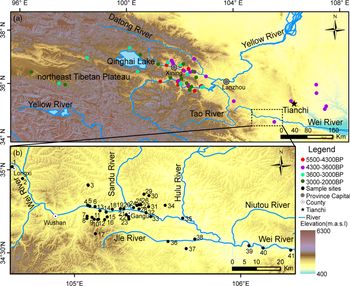
The upper Wei River valley (104°41′–106°18′E, 34°24′–35°8′N) is located in the Gansu Province (Figure 1b), it is approximately 200 km long from west to east, and its trunk stream flows from 1600–900 masl eventually forming a gentle slope and broad river valley. According to the Köppen classification, the climate of this area is classified as continental winter dry (Dwb) (Chan et al. Reference Chan, Wu, Jiang and Dai2016). The mean annual temperature here is 8–10°C with mean annual precipitation of ca. 500–650 mm. Modern agriculture in the region includes crops of millet, wheat, corn and potatoes.
(a) Distribution of prehistoric sites with 14C dates on the NETP (Dong et al. Reference Dong, Wang, Ren, Matuzeviciute, Wang, Ren and Chen2014; Yang Reference Yang2014; Chen et al. Reference Chen, Dong, Zhang, Liu, Jia, An, Ma, Xie, Barton, Ren, Zhao, Wu and Jones2015). (b) Location of the 41 sampled sites in the study area in the paper. Sample sites: 1. Nuanquanshan, 2. Longxixihetan, 3. Lixinzhen, 4. Yingwuwa 5. Wujiaping, 6. Laoyeshan, 7. Yujiawa, 8. Bupo, 9. Majiayao, 10. Dongjiaping, 11. Diantiandi, 12. Qinjiaping, 13. Sishilipu, 14. Wapenyao, 15. Chunshuwan, 16. Beiposi 17. Shuiquangou, 18. Yuangudui, 19. Yierjidianguandi, 20. Huidier, 21. Wayaoding, 22. Shangrenwan, 23. Yangwa, 24. Shizidao, 25. Sanjiaodi, 26. Yangjiaping, 27. Siping, 28. Shipocun, 29. Xiewanding, 30. Zhengjiashanliang, 31. Douwashan, 32. Weishuiyu, 33. Yaoshang, 34. Shanpingli, 35. Fanjiacheng, 36. Shizhaocun, 37. Xishanping, 38. Ruji, 39. Chaijiaping, 40. Caikeding 41. Zhoujiawan.

The Second National Archaeological Survey in China has found more than 200 archaeological sites in the Upper Wei valley, ranging in date from the Late Neolithic to the Bronze Age (Bureau of National Cultural Relics 2011). The late Neolithic and Chalcolithic sites can be further divided into three cultures, namely, 125 sites are attributed to the Late Yangshao Culture (ca. 5500–5000 cal yr BP), 42 to the Majiayao Culture (ca. 5300–4000 cal yr BP), and 371 to the Qijia Culture (ca. 4300–3600 cal yr BP). Only 14 sites date to the Bronze Age Siwa Culture (ca. 3600–2600 cal yr BP) and a single site is distinguishable as Xindian Culture (ca. 3600–2600 cal yr BP).
MATERIALS AND METHODS
In 2016, a total of 41 Late Neolithic and Bronze Age sites on the WLP were investigated by the Gansu Institute of Cultural Relics and Archaeology (Figure 1b). Flotation samples of soil were retrieved from cultural layers and features, such as ash pits, at each site and particular attention was paid to avoid disturbed contexts. The average volume of the 91 sampled soils was 19.78 L. Throughout the flotation procedure, lighter remains, such as charcoal and charred plant seeds, floated upward and were gathered by 80-mesh sifter (with a 0.2-mm aperture). This material was subsequently wrapped in gauze and hung in a shady and cool area for desiccation. The species of the charred plant seeds were identified in the Paleoethnobotany Laboratory, Institute of Archaeology, Chinese Academy of Social Sciences and the MOE Key Laboratory of Western China’s Environmental Systems, College of Earth & Environmental Sciences, Lanzhou University.
In order to analyze the structure of past agricultural activities in the study area, the number of different plant species were recorded. It must be borne in mind, however, that different crop plants can differ considerably in weight and behave rather differently in the process of harvesting, utilization, and carbonization (Yang et al. Reference Yang, Li, Liu, Zhou, Zhao and Sun2011). The simple ratios produced between species may not therefore accurately correspond with the actual proportion of different species in use. To counteract this, we used a modified method of the Weight Ratio Function for different crops, proposed by Zhou (Zhou et al. Reference Zhou, Li, Dodson and Zhao2016).
 $$P(S) = {{Ns \times Fs} \over {N1 \times F1 + N2 \times F2 + N3 \times F3 + N4 \times F4}}$$
Where N1 = number of common millet grains, F1 = 7.5, N2 = number of foxtail millet grains, F2 = 2.6, N3 = number of wheat grains, F3 = 35, N4 = number of barley grains, F4 = 45, and P(S) = actual yield percentage of that particular crop.
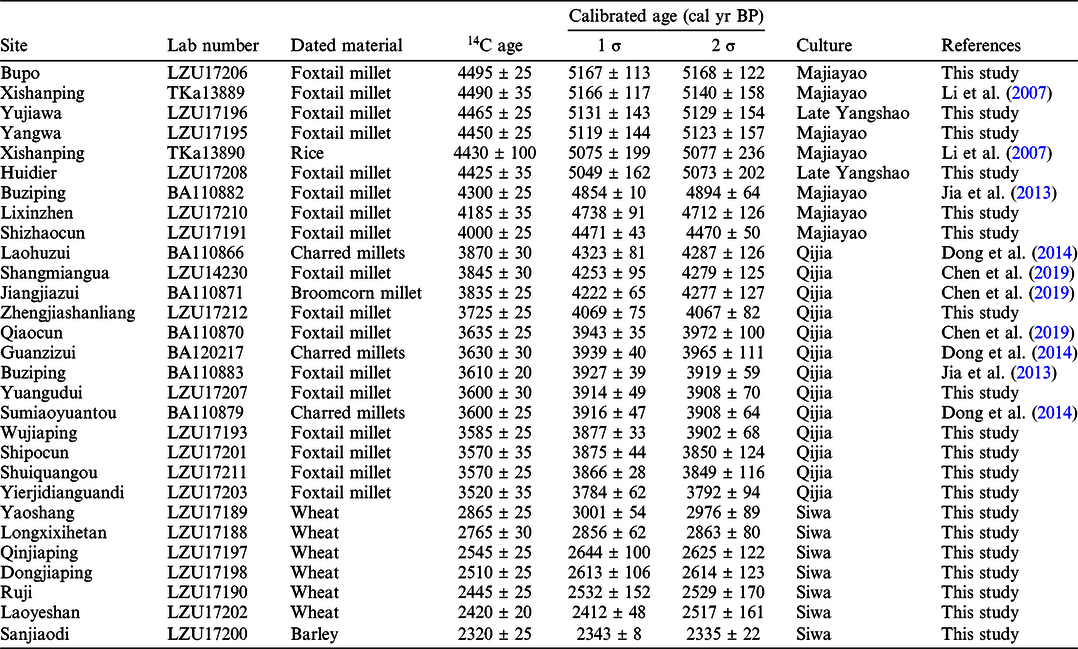
Of the plant remains, 19 samples of foxtail millet, wheat, and barley were selected for 14C dating (Table 1). They were pretreated at the MOE Key Laboratory of Western China’s Environmental Systems, College of Earth & Environmental Sciences, Lanzhou University using standard pretreatment (acid-alkali-acid) after which they were measured by accelerator mass spectrometry (AMS) at Peking University. All dates were calibrated using Calib 7.0.2 calibration software with the IntCal13 calibration curve (Reimer et al. Reference Reimer, Baillie, Bard, Bayliss, Beck, Blackwell, Bronk Ramsey, Buck, Burr, Edwards, Friedrich, Grootes, Guilderson, Hajdas, Heaton, Hogg, Hughen, Kaiser, Kromer, McCormac, Manning, Reimer, Richards, Southon, Talamo, Turney, van der Plicht and Weyhenmeyer2009, Reference Reimer, Bard, Bayliss, Beck, Blackwell, Bronk Ramsey, Buck, Cheng, Edwards, Friedrich, Grootes, Guilderson, Haflidason, Hajdas, Hatte, Heaton, Hoffmann, Hogg, Hughen, Kaiser, Kromer, Manning, Niu, Reimer, Richards, Scott, Southon, Staff, Turney and van der Plicht2013). The cumulative probability distribution (CPD) curve of 14C dates has been applied to estimate the intensity of human activities. (Michczyńska and Pazdur Reference Michczyńska and Pazdur2004).
Calibrated 14C dates and associated information of samples from the sites in WLP.

RESULTS
The 19 AMS 14C dates are presented in Table 1, ranging from 5500 to 2300 cal yr BP. The combination of these new results and their comparison with pottery and other excavated materials, the 41 sites could be divided across four chronological phases: Phase 1, Late Yangshao and Majiayao culture; Phase 2, Qijia culture; Phase 3 and 4, Siwa culture.
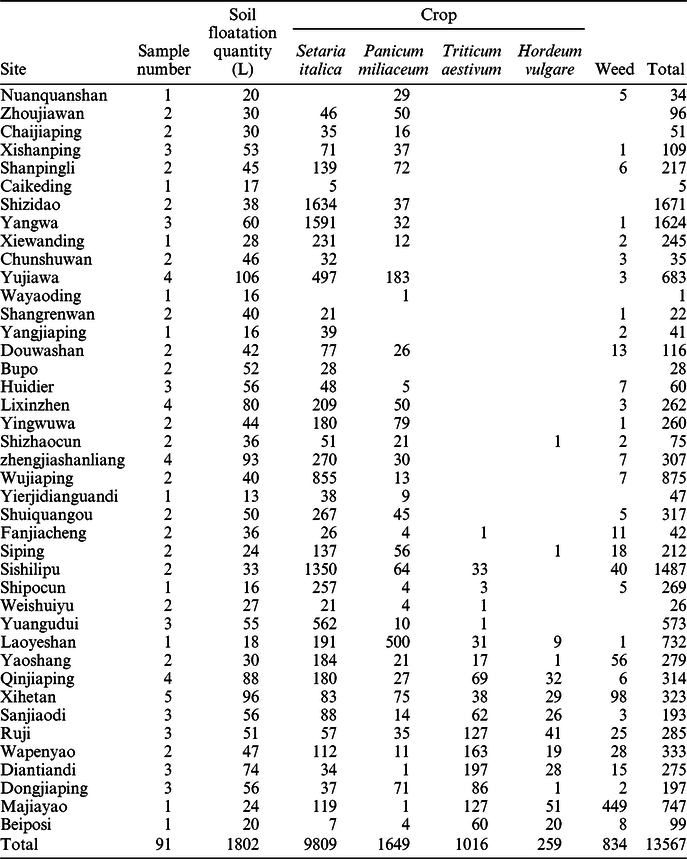
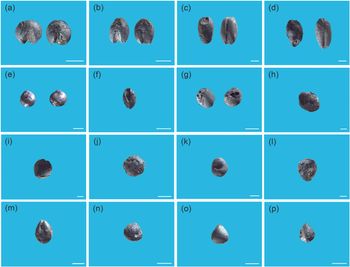
As already noted, a total of 13,567 charred plant seeds were recovered from the 91 flotation sampes (Table 2), including 9809 foxtail millet (Setaria italica) (Figure 2a), 1649 broomcorn millet (Panicum miliaceum) (Figure 2b), 1016 wheat (Triticum aestivum) (Figure 2c) and 259 barley (Hordeum vulgare). The remaining 834 seeds were composed of uncultivated species or weed remains (such as Chenopodium album, Setaria viridis, Melilotus suaveolens, Xanthium sibiricum, Sphaerophysa salsula, Atriplex patens, Galium tricorne, Glycyrrhiza uralensis, Kochia scoparia, Salsolacollina pall, Polygonum nepalense, Rumex acetosa and et al.) (Figure 2d).
Charred plant seeds identified from the 41 archaeological sites during 5500–2300 cal yr BP in WLP.

Charred plant seeds collected from WLP (scale bar: 1 mm): (a) Setaria italica, (b) Panicum miliaceum, (c) Triticum aestivum, (d) Hordeum vulgare, (e) Chenopodium album, (f) Setaria viridis, (g) Melilotus suaveolens, (h) Galium tricorne, (i) Sphaerophysa salsula, (j) Atriplex patens, (k) Galium tricornutum, (l) Glycyrrhiza uralensis, (m) Kochia scoparia, (n) Salsola pestifer, (o) Polygonum nepalense, (p) Rumex acetosa.

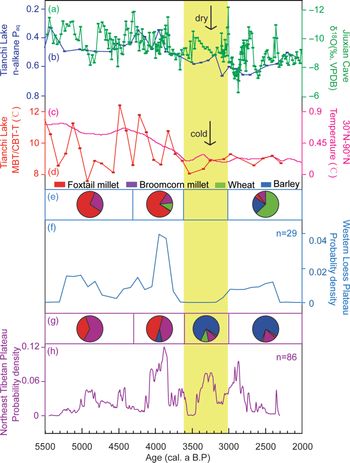
With the above addition to the archaeological record, linking both agricultural practice and chronologically defined context, it is possible to chart agricultural development on the WLP throughout the late prehistoric period (Tables 1, 2; Figure 3e). During Phase 1 (5500–4300 cal yr BP), the 4934 foxtail millet seeds (72.46% of weight) and 650 broomcorn millet seeds (27.54% of weight) identified from 42 samples (855 L of soil in total) indicate the predominance of a millet-based agriculture. Just one charred barley grain was identified from Shizhaocun, likely due to a disturbed context as similar issues were also encountered in previous studies (e.g. Dodson et al. Reference Dodson, Li, Zhou, Zhao, Sun and Atahan2013; Jia et al. Reference Jia, Dong, Li, Brunson, Chen, Ma, Wang, An and Zhang2013). During Phase 2 (4300–3600 cal yr BP), a mixed farming practice gradually emerged: 3783 foxtail millet seeds (75.44% of weight), 239 broomcorn millet seeds (13.75% of weight), and 39 wheat seeds (10.47% of weight) with 1 barley seed, were collected from 21 samples totaling 387 L of soil. Despite the growing diversity in crop type, it is worth noting that the dominant species (foxtail millet) continues to account for three quarters of the total seeds in the assemblage. Phase 3, spanning from 3600 to 3000 cal yr BP, reveals a significant gap in human activities in WLP: no traces of agriculture within the study area are found during this phase. During Phase 4 (3000–2300 cal yr BP), a more mixed agricultural tradition is in evidence, even when compared to the tradition of Phase 2, as the dominant crop has changed from foxtail millet to wheat: 977 wheat (62.98% of weight), 257 barley (21.30% of weight), 760 broomcorn millet (10.50% of weight) and 1092 foxtail millet (5.22% of weight) were identified from 28 samples (560 L of soil).
Human-environment interaction on the WLP and NETP: (a) The δ18O record of the Jiuxian Cave stalagmites (Cai et al. Reference Cai, Tan, Cheng, An, Edwards, Kelly, Kong and Wang2010), (b) Paq values based-on n-alkanes in Liupan Tianchi Lake (Sun et al. Reference Sun, Bendle, Seki and Zhou2018), (c) Northern Hemisphere (30° to 90°N) temperature record compared to 1961–1990 instrumental mean temperature (Marcott et al. Reference Marcott, Shakun, Clark and Mix2013), (d) MBT/CBT-derived MAT in Liupan Tianchi Lake (Sun, Reference Sun2011), (e) the weight percentage of crops in WLP, (f) CPD curve formed by the probability density of 14C dates from charred plant seeds on the WLP (Li et al. Reference Li, Zhou, Zhou, Dodson, Zhang and Shang2007; Jia et al. Reference Jia, Dong, Li, Brunson, Chen, Ma, Wang, An and Zhang2013; Dong et al. Reference Dong, Wang, Ren, Matuzeviciute, Wang, Ren and Chen2014; Chen et al. Reference Chen, Jia, Li and Dong2019), (g) the weight percentage of crops on the NETP (Chen et al. Reference Chen, Dong, Zhang, Liu, Jia, An, Ma, Xie, Barton, Ren, Zhao, Wu and Jones2015), (h) CPD curve formed by the probability density of 14C dates from charred plant seeds on the NETP (Dong et al. Reference Dong, Wang, Ren, Matuzeviciute, Wang, Ren and Chen2014; Chen et al. Reference Chen, Dong, Zhang, Liu, Jia, An, Ma, Xie, Barton, Ren, Zhao, Wu and Jones2015).

DISCUSSION
Different Temporospatial Patterns for Human Activities and Subsistence Strategies on the WLP and NETP during Late Prehistoric Periods
Archaeobotanical studies and 14C dating have contributed greatly to studying the density of human activities and subsistence strategies in prehistoric societies (Hageman and Goldstein Reference Hageman and Goldstein2009; Gaudzinski-Windheuser and Kindler Reference Gaudzinski-Windheuser and Kindler2012; Dong et al. Reference Dong, Ren, Jia, Liu, Dong, Li, Wang, Xiao and Chen2016, Reference Dong, Yang, Liu, Li, Cui, Wang, Chen, Dodson and Chen2018, Reference Dong, Li, Lu, Zhang and James2019). A new chronological framework can be established for the occupation sequence in WLP, based on our novel 14C dating together with the published crop grain dates (Figure 3f). The probability density of 14C dating from Phase 1 (5500–4300 cal yr BP) has a less steep curve than during relative to Phase 2 (4300–3600 cal yr BP), which witnessed a sharp increase and reached a peak between 3900–3800 cal yr BP. The difference in these results possibly represents an early stage of settlement on the WLP during phase 1, followed by rapid intensification of human activities during Phase 2. This theory is reinforced by the results of national archaeological survey (Bureau of National Cultural Relics 2011). The lack of 14C dates between 3600–3000 cal yr BP (Phase 3) could suggest a gap in human activities in WLP, or at least those which are visible from permanent settlements.
In comparison, the history of human activity during the late prehistoric periods on the NETP depicts a similar trajectory of fluctuating lower levels of activity followed by an increase and peak at ca. 4100–3800 cal yr BP before dropping again. However, during next two phases of NETP, the intensity of human practice maintained a relatively high level from ca. 3500–3100 cal yr BP which continued to ca. 2300 cal yr BP (Figure 3h, Chen et al. Reference Chen, Dong, Zhang, Liu, Jia, An, Ma, Xie, Barton, Ren, Zhao, Wu and Jones2015).
Archaeobotanical and zooarchaeological evidence can also make vital contributions to better understanding the subsistence strategy in these two areas during the late prehistoric period (Lee and Bestel Reference Lee and Bestel2007; Yuan et al. Reference Yuan, Flad and Luo2008; Zhao et al. Reference Zhao2010). In Phase 1, the WLP population only cultivated foxtail millet and broomcorn millet, which had been first domesticated in north China (Zhao Reference Zhao2011). As Figure 3e shows, the reliance on foxtail millet far outweighs reliance on any other species. The WLP millet farmers also raised domestic animals (pig and dog) and hunted wild animals (Caprinae and deer) as auxiliary animal resources (Zhou Reference Zhou1999). On the other hand, broomcorn millet was the dominant crop cultivated on the NETP during Phase 1, and this agriculture was supplemented by hunting (Chen et al. Reference Chen, Dong, Zhang, Liu, Jia, An, Ma, Xie, Barton, Ren, Zhao, Wu and Jones2015; Figure 3g). In Phase 2, sheep and wheat and barley initially domesticated in west Asia (Zeder Reference Zeder2008; Riehl et al. Reference Riehl, Zeidi and Conard2013) were introduced into northwest China (Flad et al. Reference Flad, Yuan and Li2007; Dodson et al. Reference Dodson, Li, Zhou, Zhao, Sun and Atahan2013; Dong et al. Reference Dong, Yang, Liu, Li, Cui, Wang, Chen, Dodson and Chen2018). While wheat became the most important cultivated crop in the Hexi Corridor from ~3700 cal yr BP (Zhou et al. Reference Zhou, Li, Dodson and Zhao2016) and was utilized on the WLP from 4300 to 3600 cal yr BP, the most dominant local crop was still millet (Figure 3e). There was also an increase in variety of domestic animals, including sheep, cattle, pig and dog in Phase 2 WLP (Zhou Reference Zhou1999; Jia et al. Reference Jia, Dong, Li, Brunson, Chen, Ma, Wang, An and Zhang2013). Phase 2 on the NETP also demonstrates continuity in use of broomcorn millet at the dominant crop, but with a slight increase in foxtail millet as well as the introduction of barley (Figure 3g). This change is also verified by the stable isotopic analysis of human bones unearthed from sites dated to the same period (Ma et al. Reference Ma, Dong, Lightfoot, Wang, Liu, Jia, Zhang and Chen2014, Reference Ma, Dong, Jia, Wang, Cui and Chen2016). Like Phase 2 in WLP, the NETP population increased domestication of pigs and dogs at this time, and greater reliance on sheep for meat (Ye Reference Ye2015; Ren Reference Ren2017; Wang Reference Wang2017).
In contrast to WLP Phase 3, the years ca. 3600–3000 cal yr BP on the NETP witnessed not only the radical expansion of human living space and the increasing dependence on barley (Figure 3g), but also different subsistence strategies adopted by different groups of people at different altitudes (Zhang and Dong Reference Zhang and Dong2017). This spatial differentiation of the human subsistence was retained in Phase 4 in NETP, the most characteristic pattern being the increasing ratio of barley (Chen et al. Reference Chen, Dong, Zhang, Liu, Jia, An, Ma, Xie, Barton, Ren, Zhao, Wu and Jones2015; Zhang and Dong Reference Zhang and Dong2017).
In summary, the temporospatial difference of human subsistence strategies between the NETP and WLP was mainly revealed by the variation in their cultivated crop types. During Phase 1, the most important crops were foxtail and broomcorn millet in both WLP and NETP. Entering the next phase, the primary crops in the two regions respectively were foxtail millet and broomcorn millet, yet wheat began to increase on the WLP and barley began to increase on the NETP (Figures 3e and 3g). In Phases 3 and 4, barley became the dominant plant cultivated in NETP, while the farmers on the WLP shifted to wheat, followed by barley, broomcorn and foxtail millet (Figures 3e and 3g).
Contrasting Different Human Responses to the Same Climate Change between WLP and NETP
The late Neolithic and Bronze Age are unique periods for studying the evolution of human-land relationships, because these particular time periods witnesses the rise and fall many of the earliest civilizations as well as fluctuations in trans-Eurasian culture exchange, alongside climate data (Spengler et al. Reference Spengler, Frachetti, Doumani, Rouse, Cerasetti, Bullion and Mar’yashev2014; Dong et al. Reference Dong, Yang, Han, Wang and Chen2017b; Liu et al. Reference Liu, Jones, Matuzeviciute, Hunt, Lister, An, Przelomska, Kneale, Zhao and Jones2019). According to high-resolution paleoclimate records in WLP, which include bio-markers from the sediment of the Liupan Tianchi Lake and oxygen isotopic data from stalagmites in the Jiuxian Cave, the temperature remained relatively high between 5500 and 3600 cal yr BP, but was followed by several cold periods between ca. 4900–4500 cal yr BP and 3600–2000 cal yr BP (Figure 3d) (Cai et al. Reference Cai, Tan, Cheng, An, Edwards, Kelly, Kong and Wang2010, Sun Reference Sun2011; Sun et al. Reference Sun, Bendle, Seki and Zhou2018). Meanwhile, four droughts could be identified in the periods of ca. 4900–4700 cal yr BP, ca. 3800–3600 cal yr BP, ca. 3000–2800 cal yr BP and ca. 2700–2500 cal yr BP, respectively (Figures 3a and 3b). The correlation between paleoclimate records and CPD curves of 14C dates suggests that human settlement on the WLP and NETP during the late prehistoric period was mainly affected by the variation in temperature rather than by precipitation. The shortage of water supply caused by decreased precipitation (with fluctuations) can be eased by the abundant local river system, such as the Wei River and its branches, leading to a less dramatic effect than a drop in temperature which affects the flora and fauna of a region. The most notable decline in the CPD distribution of the two areas occurred around 3600 cal yr BP, when the temperature was a minimum (Figures 3c and 3d). On the NETP settlement in the region was continuous but WLP experienced a period of nearly 600 years with virtually no (observable) human activity. During the following phase of settlement in WLP, there were at least two droughts indicated in the isotope and sediment data from the Jiuxian Cave and Tianchi lake (Figures 3a and 3b), but there was no corresponding cessation of human activity. This might be due to the physiological characteristics of foxtail and broomcorn millets, both of which are drought-tolerant but sensitive to low temperature (Baltensperger Reference Baltensperger and Janick1996).
The difference in human lifestyles on the NETP and WLP during the Late Neolithic period was also affected by climate. The temperature is much lower on the NETP than on the WLP due to the higher elevation of NETP. As broomcorn millet is much more resistant to a cold environment than foxtail millet, it is logical that the latter would be the dominant cultivated species in the lower altitude WLP and the former more suitable to the higher altitude of NETP (Baltensperger Reference Baltensperger and Janick1996). When the temperature increased slightly during Phase 2 (Figure 3d), there was a corresponding increase in the use of foxtail millet (Chen et al. Reference Chen, Dong, Zhang, Liu, Jia, An, Ma, Xie, Barton, Ren, Zhao, Wu and Jones2015).
Wheat and barley were introduced into northwest China around 4000 cal yr BP, coinciding with yet another period of cooling (Dodson et al. Reference Dodson, Li, Zhou, Zhao, Sun and Atahan2013; Dong Reference Dong2018). It is possible that it was at this time that these cold-resistant crops were first added to the NETP and WLP repertoire (Figures 3e and 3g), alongside the increased domestication of sheep (Ye Reference Ye2015; Ren Reference Ren2017).
The temperature remained persistently low throughout Phases 3 and 4 (Figures 3c and 3d), which would have significantly affected the yield of millet and therefore may have caused the absence of human activities on the WLP between 3600 and 3000 cal yr BP. However, continued occupation and agriculture is visible at this time on the NETP and the population even successfully expanded into higher-colder areas. Both aspects could be explained by the successful development of new subsistence strategies, namely the cultivation of barley and adopting sheep and yak which not only allowed the population to remain in the region but also prepared them for the climate at different altitudes (Chen et al. Reference Chen, Dong, Zhang, Liu, Jia, An, Ma, Xie, Barton, Ren, Zhao, Wu and Jones2015; Dong et al. Reference Dong, Ren, Jia, Liu, Dong, Li, Wang, Xiao and Chen2016). The shorter growing period of barley and its adaptability to higher and colder regions make it a logical agricultural choice for areas of the Tibetan Plateau (Páldi et al. Reference Páldi, Szalai, Janda, Horváth, Rácz and Lásztity2001; D’Alpoim Guedes et al. Reference D’Alpoim Guedes, Lu, Li, Spengler, Wu and Aldenderfer2014, Reference D’Alpoim Guedes, Lu, Hein and Schmidt2015), whereas wheat may require less intensive agricultural effort and is well suited to WLP and the climate it experienced during Phase 4.
CONCLUSION
New archaeobotanical and 14C results for the upper Wei River valley, combined with previously published data, together demonstrate that people on the WLP were mainly dependent on foxtail millet and, to a lesser extent, broomcorn millet during 5500–4300 cal yr BP. Wheat was subsequently added to the local diet during 4300–3600 cal yr BP. The currently available data shows a pronounced gap of human activity on the WLP during 3600–3000 cal yr BP. The WLP region was repopulated between 3000–2300 cal yr BP, a phase in which wheat became the most important crop, followed by barley, broomcorn and foxtail millet. Further comparisons to high-resolution paleoclimate records suggest that human activity in the late prehistoric WLP was affected not by variation in precipitation levels but rather variation in temperature.
Despite the rapid decline in local temperature, by adopting new crop species with different physiological characteristics, the population successfully adapted to the new climatic conditions on the NETP and WLP during 5500–3600 cal yr BP. The quick adoption of new cold-tolerant barley and sheep, brought into northwest China by trans-Eurasian culture exchange during early Bronze Age, appears to have been one of the main grounds for settlement survival during a period of great climate change. The difference in relative success between the regions, however, indicates that agricultural adaptability alone is not quite sufficient to explain the differences between regions.
ACKNOWLEDGMENTS
This research was supported by the National Key R&D Program of China (2018YFA0606402), Strategic Priority Research Program of the Chinese Academy of Sciences, Pan-Third Pole Environment Study for a Green Silk Road (Pan-TPE) (Grant No. XDA2004010101), the National Natural Science Foundation of China (Grant Nos. 41671077 and 41620104007), the International Partnership Program of Chinese Academy of Sciences (grant no. 131C11KYSB20160061).