I. INTRODUCTION
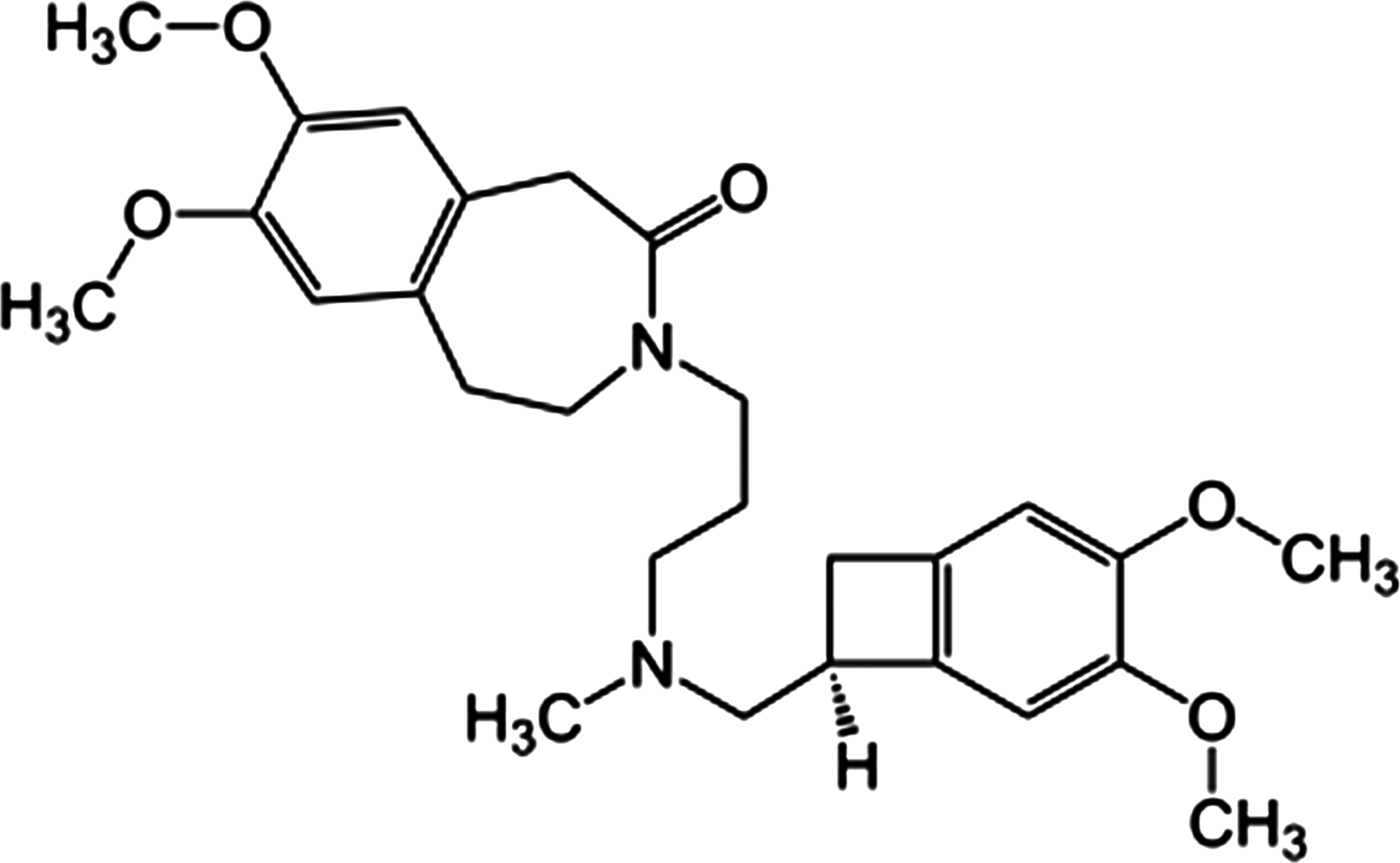
3-[3-({[(7S)-3,4-dimethoxybicyclo[4.2.0]octa-1,3,5-trien-7-yl]methyl}(methyl) amino)propyl]-7,8-dimethoxy-2,3,4,5-tetrahydro-1H-3-benzazepin-2-one], known as Ivabradine (see Figure 1), is a well-known active pharmaceutical ingredient (API) commonly marketed as a hydrochloride salt for symptomatic treatment of a number of diseases, among which are angina pectoris and inappropriate sinus tachycardia. Often, APIs are formulated with a number of excipients and additives, in small tablets for oral ingestion. The nature, composition, and structure of the actual solid form directly influence its chemical stability, solubility, bioavailability, as well as rheological issues at the flowing, pressing, and tablet processing steps. This is particularly true for iabradine hydrochloride (IVAHCL), which, in the scientific literature, and, above all, in many recent patents, has been claimed to exist in a very large number of polymorphic/hydrated/solvated phases (Horvath et al., Reference Horvath, Auguste and Damien2006, Reference Horvath, Auguste and Damien2007, Reference Horvath, Auguste and Damien2011; Dwivedi et al., Reference Dwivedi, Kumar, Patel and Shah2008; Singh et al., Reference Singh, Singh and Wadhwa2012). Their complex labelling (α, β, γ, δ, ζ, K, X, Z, and even Form I or β-d, γ-d, and δ-d forms) indicates the extensive interest in this API, and, possibly, the occurrence of (undetected) mixtures of polymorphs and solvates. Indeed, apart from the single crystal structure of the β form (a tetrahydrate, Duval et al., Reference Duval, Hennig, Bouchet, Vian, Peglion, Volland, Platzer and Guilhem1997), no detailed analysis of the structural features of these forms, for which X-ray powder diffraction (XRPD) patterns are available, has ever been published, not even at the phase-purity level. Aiming at cleaning up this large zoo of IVAHCL-derived species, we prepared a few pure phases (of the α, β, β-d, δ 1, δ 2, and δ-d forms), certified by the uniqueness of their indexed XRPD patterns (M 20 values, cited below, refer to the de Wolff figure of merit for indexing, de Wolff, Reference De Wolff1972).
Structural diagram of the ivabradine molecule.

II. EXPERIMENTAL
A. Preparation
α-form: this anhydrous form of IVAHCL was isolated in a quantitative manner by heating powders of the pure δ-d form at 145 °C for ca. 15′, in air.
β-form: this tetrahydrate form of IVAHCL was isolated in a quantitative manner by exposing powders of the pure δ-d form to water vapours in a sealed environment at room temperature for two days.
β-d form: this anhydrous form of IVAHCL was isolated in a quantitative manner by moderate heating powders of the pure β form at 85 °C for ca. 1 h, in air.
δ 1 form: this solvated form was prepared by precipitating a solid material from concentrated acetonitrile solutions of IVAHCL (0.400 g in 10 ml), heated at 80 °C for ca. 1 h, then cooled to RT on standing.
δ 2 form: this solvated form was prepared by precipitating a solid material from concentrated acetone solutions of IVAHCL (0.200 g in 10 ml), heated at 40 °C for ca. 1 h, then cooled to −78 °C with the aid of solid CO2. This form was also obtained by triturating the acetonitrile solvate in an acetone slurry.
δ-d form: this anhydrous form of IVAHCL was isolated in a quantitative manner by moderately heating powders of the pure δ 1 or δ 2 form at 65 °C for ca. 1 h, in air.
B. Data collection
X-ray diffraction data were collected on a Bruker AXS D8 Advance vertical diffractometer operating in θ:θ mode with Ni-filtered CuKα radiation (λ = 1.5418 Å) from a fine focus tube powered at 40 kV and 40 mA. Fixed divergence slit (0.6°), a stationary sample holder (equipped with a quartz zero-background plate), and a PSD Lynxeye detector were used. Scan ranges from 3 to 103° 2θ were used, with a step size of 0.02° 2θ and a count time of 10 s at each step. Data were collected at 20 °C, apart from the β-d and δ-d forms, collected at 90 and 50 °C, respectively (to prevent rehydration in ambient conditions). Raw data are available in ASCII form upon request to the authors.
III. RESULTS AND DISCUSSION
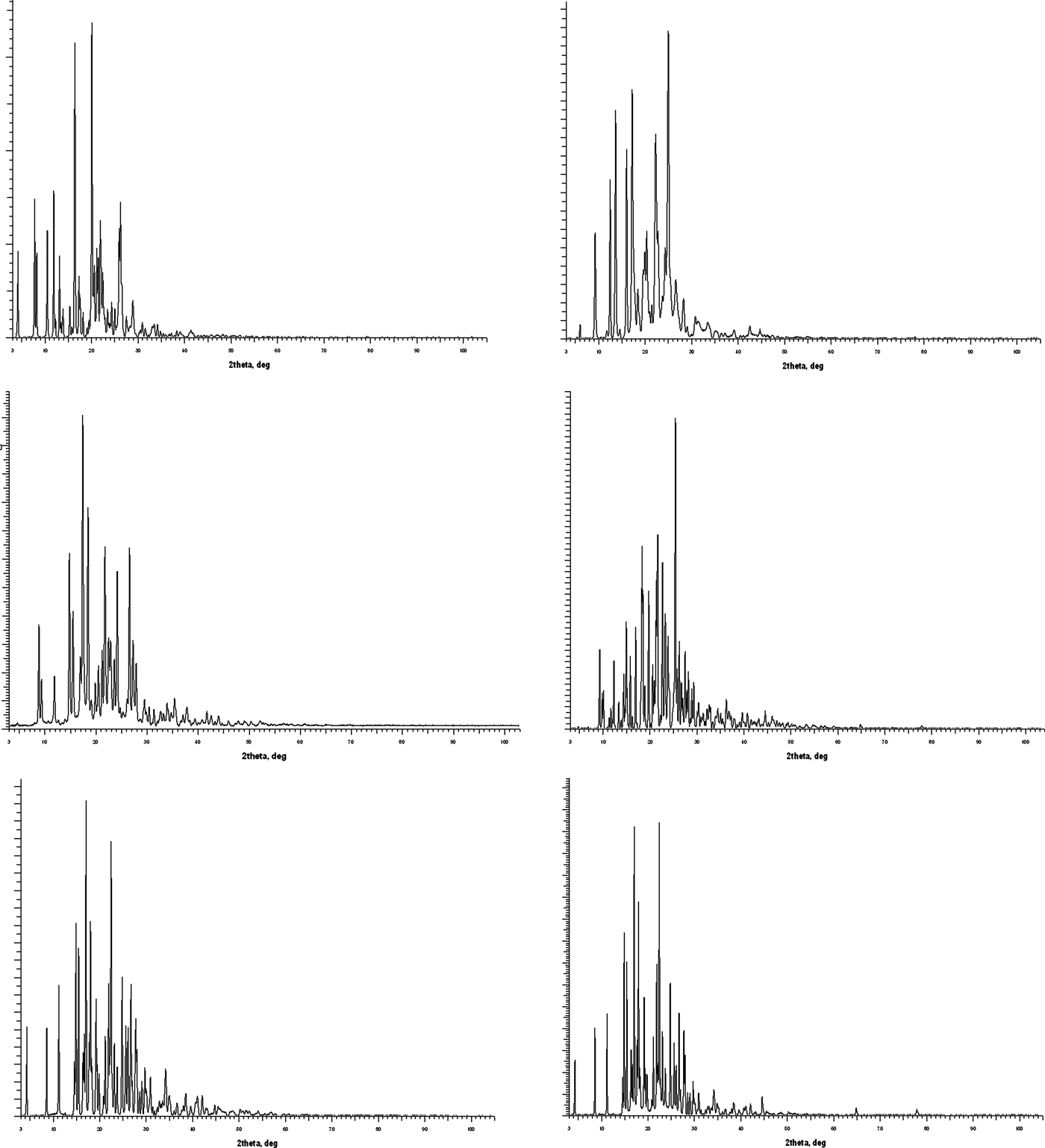
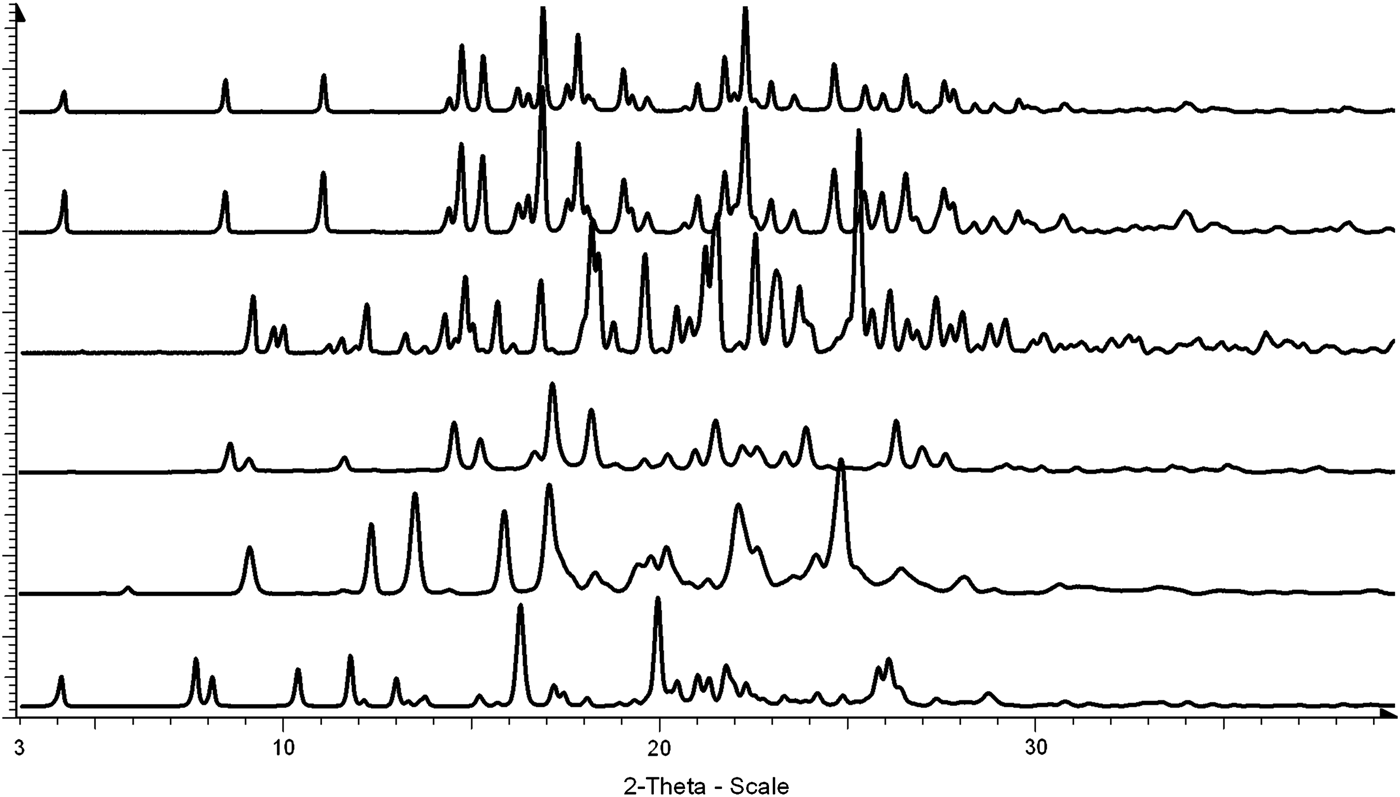
The X-ray powder diffraction patterns are collectively shown in Figure 2. A blow-up, showing the most interesting features in the low-angle region is proposed in Figure 3. Apart from that of the β form, whose structure was known from single crystal diffraction analysis (Duval et al., Reference Duval, Hennig, Bouchet, Vian, Peglion, Volland, Platzer and Guilhem1997), all the remaining ones are here disclosed as pure form XRPD traces for the first time. Indeed, several patents claimed phase nature and purity on complex mixtures of (poly)crystalline materials, without confirming, by ab initio indexing, the monophasic character of the available samples.
Powder diffraction patterns of: (a) pure anhydrous ivabradine.HCl (α form); (b) pure anhydrous ivabradine.HCl (β-d form), (c) pure anhydrous ivabradine.HCl (δ-d form); (d) pure ivabradine.HCl tetrahydrate (β form); (e) pure ivabradine.HCl CH3CN solvate (δ 1 form); and (f) pure ivabradine.HCl CH3COCH3 solvate (δ 2 form).
Low angle section (3–40 °2θ) of powder diffraction patterns of (bottom to top): pure anhydrous ivabradine.HCl (α form); pure anhydrous ivabradine.HCl (β-d form), pure anhydrous ivabradine.HCl (δ-d form); pure ivabradine.HCl tetrahydrate (β form); pure ivabradine.HCl.CH3CN solvate (δ 1 form); and pure ivabradine.HCl.CH3COCH3 solvate (δ 2 form). A vertical offset has been added for sake of clarity.
For each phase, standard peaks search methods, followed by profile fitting (using the Fundamental Parameter Approach, Cheary and Coelho, Reference Cheary and Coelho1992), allowed to fruitfully employ advanced indexing procedures [here, the singular value decomposition method (Coelho, Reference Coelho2003), implemented in TOPAS-R (Bruker AXS, 2005)]. Therefore, we have here firmly assessed the cell parameters and the space groups of all phases here isolated.
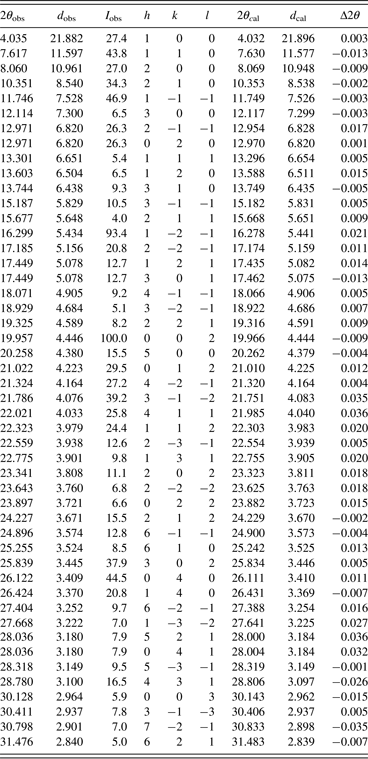
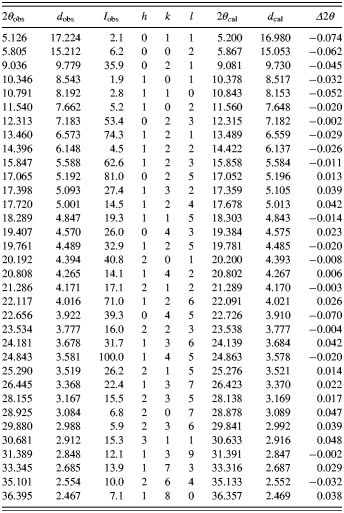
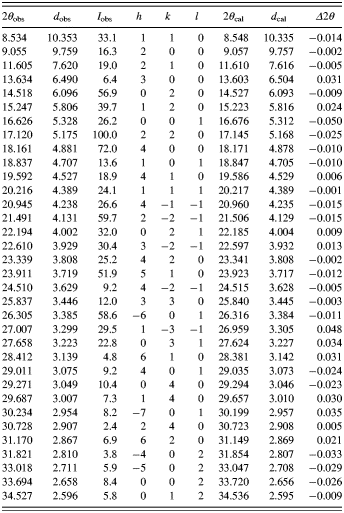
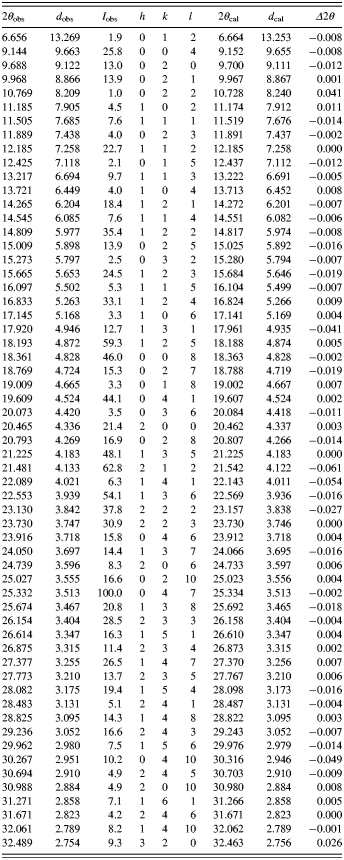
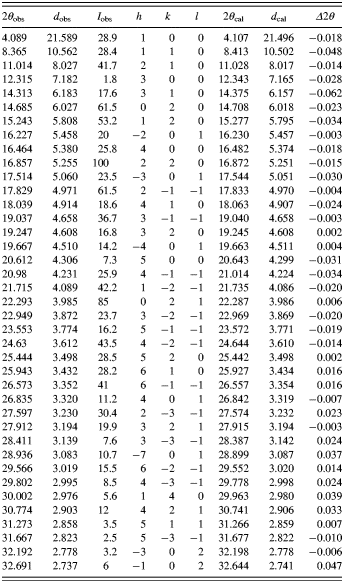
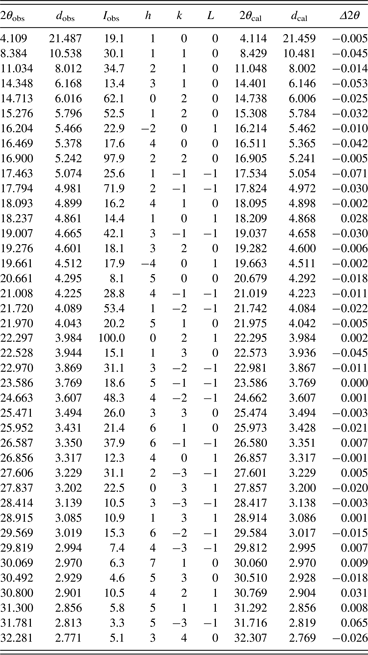
On the basis of the derived cells, Tables I–VI report the 2θ obs, d obs, I obs, hkl, 2θ cal, and Δ2θ values for different monophasic specimens, possessing the following crystal data:
α-form, anhydrous ivabradine hydrochloride, C27H37ClN2O5, F.W. = 505.04. Monoclinic, space group P21 (no. 4). a = 22.555(3), b = 13.641(1), c = 9.155(8) Å, β = 103.884(8), M 20 = 42.3, V = 2734.2(5) Å3, Z = 4, and D calc = 1.227 g cm−3.
β-form, ivabradine hydrochloride tetrahydrate, C27H45ClN2O9, F.W. = 577.11. Orthorhombic, space group P212121 (no. 19). a = 8.6739(8), b = 18.222(2), c = 38.621(4) Å, M 20 = 25.7, V = 6104(1) Å3, Z = 8, and D calc = 1.256 g cm−3.
β-d form, anhydrous ivabradine hydrochloride, C27H37ClN2O5, F.W. = 505.04. Orthorhombic, space group P212121 (no. 19). a = 8.880(2), b = 20.563(7), c = 30.105(6) Å, M 20 = 12.1, V = 5498(3) Å3, Z = 8, and D calc = 1.220 g cm−3.
δ 1 form, ivabradine hydrochloride acetonitrile solvate, C29H40ClN3O5, F.W. = 546.10. Monoclinic, space group P21 (no. 4). a = 22.517(2), b = 12.036(1), c = 5.5722(5) Å, β = 107.320(6), M 20 = 23.4, V = 1441.6(2) Å3, Z = 2, and D calc = 1.257 g cm−3.
δ 2 form, ivabradine hydrochloride acetone solvate, C30H43ClN2O6, F.W. = 563.12. Monoclinic, space group P21 (no. 4). a = 22.481(2), b = 12.011(1), c = 5.5786(4) Å, β = 107.352(6), M 20 = 31.7, V = 1437.9(2) Å3, Z = 2, and D calc = 1.300 g cm−3.
δ-d form, anhydrous ivabradine hydrochloride, C27H37ClN2O5, F.W. = 505.04. Monoclinic, space group P21 (no. 4). a = 20.997(3), b = 12.185(2), c = 5.7138(6) Å, β = 111.622(9), M 20 = 15.2. V = 1359.0(3) Å3, Z = 2, and D calc = 1.233 g cm−3.
XRPD data for anhydrous IVAHCL, α-form (CuKα).
XRPD data for anhydrous IVAHCL, β-d form (CuKα).
XRPD data for anhydrous IVAHCL, δ-d form (CuKα).
XRPD data for IVAHCL tetrahydrate, β form (CuKα).
XRPD data for IVAHCL acetonitrile solvate, δ 1 form (CuKα).
XRPD data for IVAHCL acetone solvate, δ 2 form (CuKα).
As odd as it can appear, the lattice parameters for the solvated phases (δ 1 and δ 2), precipitated form acetonitrile and acetone solutions, respectively, are very similar. This is obviously reflected by the similarity of their powder diffraction traces, which, taking into account that texture effects may be present, can only be distinguished by the accurate estimate of the reflection positions on the 2θ scale. Figure 4 shows a portion of the diffraction patterns of the two phases, properly corrected for instrumental aberrations (cosθ-dependent specimen displacement effect). The occurrence of evident peaks shifts, which are different in size, and sign, for different peaks, witness slight differences of these two (isomorphous) phases. This subtle effect must then be attributed to nearly identical solvent occlusion properties for acetonitrile and acetone. Coherently, the δ 2 (acetone solvated) phase survives, in air, no longer than 24 h, after which it is easily transformed into the anhydrous δ-d phase. As expected, the stability of the acetonitrile solvate is much higher, the δ 1 phase being recovered nearly intact after a few weeks.
Raw powder diffraction patterns (corrected for specimen displacement effects) of pure ivabradine.HCl.CH3CN solvate (δ 1 form) and pure ivabradine.HCl.CH3COCH3 solvate (δ 2 form). Despite the strict similarity, relative shifts of diffraction peaks can be observed, manifesting small differences, which can be traced back to the occlusion of different solvent molecules (of similar steric demand).
As a final comment, one should be aware that the solvent content, whenever strongly stabilizing hydrogen bonds cannot be easily formed (as in the acetonitrile and acetone solvates), the amount of occluded solvent (here, formally, taken as stoichometric) may be variable, and lead to non-negligible changes in the powder pattern. Thus, thermal history and storage conditions may have a deep effect on the nature of the samples, which, per se, may manifest incomplete solvent loss and, depending on the relative humidity values, progressive, though partial rehydration. This has indeed been proved by leaving in open air the anhydrous β-d and δ-d forms, which, within days, progressively degraded.
IV. CONCLUSION
Crystallization of Ivabradine hydrochloride from a variety of solvents results in formation of its hydrated, or differently solvated crystal forms, here labelled β, δ 1, and δ 2 forms. Anhydrous α, β-d, and δ-d forms were also obtained. This work resulted in experimental powder patterns of all these polymorphs/solvates of this drug, which will be of use for industrial and analytical control, as well as for clarifying possible patent litigation issues. Phase purity is certified by determination of the unit cell parameters and space groups of all species, which coherently gave molar volumes in the 680–763 Å range, depending on the nature and amount of occluded solvents. Work can be anticipated in characterizing the chemical stability, the thermal properties, and the crystal structure by state-of-the-art diffraction methods.
Note added in proof: A very recent patent deposition document (Wieser et al., Reference Wieser, Griesser, Enders and Kahlenberg2013) reported on the isolation of an acetone solvate form of IVAHCL, which, though sharing the same space group symmetry, differs from our material (the δ 2 phase). Modeling the powder diffraction data in our hands with a (slightly) relaxed structural molecular fragment (Wieser's single crystals diffraction data were measured at 173 K) showed only partial similarity. We tentatively attribute this discrepancy to the existence of variable-quantities of occluded solvent, as manifested by different molar volumes, and to significantly different molecular conformation. Unfortunately, we were unable to prepare powders of this new form which, stable enough at ambient conditions, could be measured in our RT experimental setup.