INTRODUCTION
There are 17 sepiolid species known in the Mediterranean, belonging to three subfamilies: Heteroteuthinae, Rossiinae and Sepiolinae. Except the subfamily Heteroteuthinae, Mediterranean sepiolids have a benthic reproductive strategy which gives them more of a K type lifestyle resulting in lower potential fecundity and lower relative fecundity. Reproduction of Sepiolidae has been well studied either in the field or in the laboratory (Mangold-Wirz, Reference Mangold-Wirz1963; Boletzky, Reference Boletzky1975, Reference Boletzky and Boyle1983; Gabel-Deickert, Reference Gabel-Deickert1995). Sepiolids have relatively large eggs and females spawn in batches on the ocean bottom (Gabel-Deickert, Reference Gabel-Deickert1995; Boletzky, Reference Boletzky1998). Potential fecundity of the subfamily is about several hundred eggs and the egg diameter is 2 to 4 mm. Continuous spawning with asynchronous ovulation is seen in Sepiolinae and is also reported for other subfamilies, i.e. Rossiinae and Heteroteuthinae (Hoving et al., Reference Hoving, Laptikhovsky, Piatkowski and Önsoy2008; Laptikhovsky et al., Reference Laptikhovsky, Nigmatullin, Hoving, Önsoy, Salman, Zumholz and Shevtsov2008; Önsoy et al., Reference Önsoy, Laptikhovsky and Salman2008).
Lentil bobtail squid, Rondeletiola minor (Naef, 1912) is a sublittoral, demersal, or upper bathyal species distributed in the eastern Atlantic Ocean and Mediterranean Sea between depths of 76 and 496 m (Reid & Jereb, Reference Reid, Jereb, Jereb and Roper2005). Its reproductive biology is poorly known (Volpi et al., Reference Volpi, Borri and Zucchi1995; Salman & Katağan, Reference Salman and Katağan1996) hence this study was aimed at the reproduction of this species in the eastern Mediterranean.
MATERIALS AND METHODS
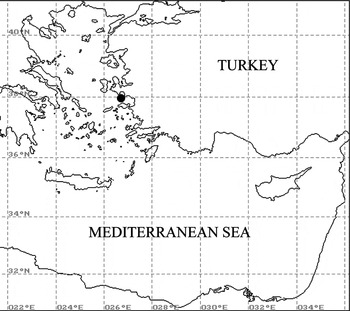
A total of 208 (40 females and 168 males) specimens belonging to Rondeletiola minor were investigated. The samples were caught by bottom trawl with 150, 350 and 550 m depth contours between 2007 and 2009 from the Aegean Sea (the eastern Mediterranean; Figure 1). After collection, the samples were preserved in 4% formalin solution and brought to laboratory for further investigation. The dorsal mantle length (ML) was measured within 0.1 mm and total body weight (BW) was weighed to the nearest 0.01 g. Samples were assigned as immature, maturing, mature and spent (Önsoy et al., Reference Önsoy, Laptikhovsky and Salman2008).
Sampling area in the eastern Mediterranean (Aegean Sea).

Reproductive organs (nidamental glands and ovary of females and spermatophoric complex of organs and testis of males) were weighed to the nearest 0.001 g. All oocytes from the ovary and the oviduct were counted and measured along the major axis within 0.1 mm. In males, spermatophores were counted and measured to the nearest 0.1 mm.
Gonadosomatic index (GSI) was calculated as the ratio between the gonad weights (GW) and BW (GSI = (GW/BW) × 100). Reproductive system index (RSI) was calculated as a ratio between the reproductive system weight (RSW) and BW (RSI = (RSW/BW) × 100). Moreover, relative fecundity (RF) was calculated as a ratio of fecundity (F) and BW (RF = F/BW).
RESULTS
Body size
Female body size ranged from 11.3 to 19.5 mm ML (mean 14.7 mm) whereas mature female size (32 individuals) varied from 11.8 to 19.5 mm ML (mean 15.1 mm). Minimum BW of females was 0.754 g and maximum was 2.44 g (mean 1.447 g). Male size was between 9.7 and 19.1 mm ML (mean 14.9 mm), and mature males ranged from 11.1 to 19.1 mm ML (mean 15.2 mm). A total of 169 males varied from 0.633 to 2.431 g (mean 1.463 g) in BW. There were no significant differences in mature animal sizes between sexes (t = 1.65, P = 0.731).
Male reproduction system
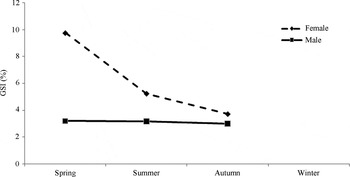
One hundred and twenty-six males were assigned as mature, whereas 19 males were maturing and 16 males were immature. There were 7 spent males which had 1–8 spermatophores. Mature animals were predominant in all the seasons studied. Total number of spermatophores ranged from 15 to 674 (mean 176) in mature animals, 16 to 557 (mean 171) in maturing males. Two males had extremely high spermatophore numbers (557 and 674). Spermatophore length varied from 3.1–5.7 mm (mean 4.7 mm). A slightly positive correlation was found between spermatophore length and ML (R2 = 0.247, P > 0.05). The relative spermatophore size was 22.8–42.8 (mean 30.5) %ML. RSI was calculated as 2.79–14.76% (mean 7.20%) and GSI values ranged from 1.33 to 6.59% (mean 3.17%). Average GSI values did not show big differences depending on seasons covered by this study (spring, autumn and summer; Figure 2).
Seasonal gonadosomatic index (GSI) values of both sexes of Rondeletiola minor.

Female reproduction system
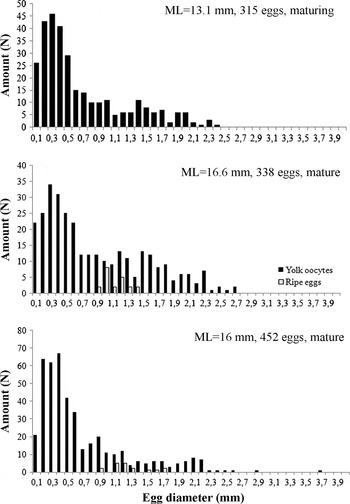
The female reproductive system consists of an ovary, an oviduct, nidamental glands and a bursa copulatrix. The bursa copulatrix was located near the left gill. The RSI values of mature females varied from 7.21% to 45.99% (mean 21.72%) and the GSI values ranged from 2.66% to 23.0% (mean 7.89%). Females of R. minor had an asynchronous ovulation pattern, and protoplasmic eggs were dominant in all maturity stages (egg diameter 0.1–0.5 mm; Figure 3).
Asynchronous ovulation pattern in Rondeletiola minor.

Fecundity and egg size
Potential fecundity of maturing animals ranged from 192 to 315 (mean 240) eggs and the RF was calculated as 166.0–256.1 egg/g (mean 197.9 egg/g). Mature females had 118–434 eggs (mean 279) excluding the ripe eggs. The RF varied from 112.0 egg/g to 352.8 egg/g (mean 189.3 egg/g). The number of ripe eggs ranged between 1 and 52 (mean 24). There was a weak positive correlation between the female size and PF (R2 = 0.210, P > 0.05). Larger females had more ripe eggs in their oviducts (R2 = 0.506). No spent female was found. Some empty follicular sheaths were found in mature animals and their numbers varied from 2 to 13. The size of the eggs in the ovary ranged from 0.1 to 3.8 mm (mean 0.79 mm). Ripe egg size varied between 1.1 and 3.0 mm (mean 2.03 mm). The mean ripe egg size was not related to the respective ML (R2 = 0.053).
About 80% of all females were mature, whereas 75% of males were mature. Mature animals were found in every month of this study. Therefore, one could expect that spawning occurs all year round for R. minor. However, higher GSI values were detected in spring for females (mean 9.76%; Figure 2).
DISCUSSION AND CONCLUSIONS
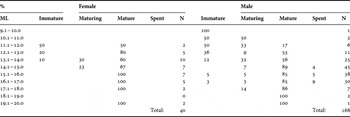
Rondeletiola minor was found to be one of the two smallest sepiolids with Sepiola steenstrupiana in the eastern Mediterranean (Salman & Önsoy, Reference Salman and Önsoy2004; Reid & Jereb, Reference Reid, Jereb, Jereb and Roper2005). Males and females had similar body sizes and 50% of females were mature in the 11.1–12.0 mm ML class, and that of males was 12.1–13.0 mm ML class (Table 1). Salman & Katağan (Reference Salman and Katağan1996) reported similar results from the eastern Mediterranean and Volpi et al. (Reference Volpi, Borri and Zucchi1995) from the western Mediterranean.
The body sizes of female and male specimens of Rondeletiola minor sampled from the Aegean Sea (the eastern Mediterranean Sea) between 2007 and 2009.

N, number; ML, mantle length.
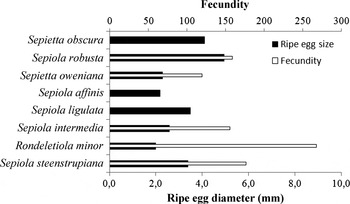
Females had relatively smaller ripe egg sizes (mean 2.03 mm), and higher RF values (mean 189.3 egg/g) compared to other sepiolids in the eastern Mediterranean. Ripe egg sizes of Sepiola affinis, S. ligulata, S. intermedia, S. robusta, S. steenstrupiana, Sepietta obscura and S. oweniana are between 2.2 and 5.1 mm, and their PF ranges from 156 to 177 (Salman, Reference Salman1998; Salman & Önsoy, Reference Salman and Önsoy2004). Even Sepietta oweniana has relatively smaller ripe egg size and larger body size among the species given above—its PF is not as high as that of R. minor (Figure 4). These results could suggest that this species is an r-strategist so the species could attain higher reproductive output. This might depend on pelagic spawning aggregation (Reid & Jereb, Reference Reid, Jereb, Jereb and Roper2005) which is much more risky than a benthic strategy. Even though the species belonging to the subfamily Sepiolinae apart from R. minor could be considered as ‘off shore’ strategists in terms of reproduction pattern, R. minor has a more ‘oceanic’ strategy in consideration of relatively higher fecundity, smaller egg size, and pelagic spawning aggregation. The difference between these two strategies is that in the ‘offshore’ strategy spawning occurs near to, or on the bottom of the continental shelf or slope, whereas in the ‘oceanic’ strategy spawning is not associated with the bottom but is completely pelagic (Rocha et al., Reference Rocha, Guerra and Gonzales2001). Oceanic strategy occurs in the subfamily Heteroteuthinae (Hoving et al., Reference Hoving, Laptikhovsky, Piatkowski and Önsoy2008), and is a result of so called ‘oceanization’ that is an evolutionary process occurring within a cephalopod or fish when it undergoes a distributional expansion from initial shelf biotopes to the open ocean (Nigmatullin & Laptikhovsky, Reference Nigmatullin and Laptikhovsky1994).
Comparison of fecundity and ripe egg size in same sepiolid species (note that the species are in mantle length order).

Average spermatophore number was 176 in mature males and it is probably much lower than total spermatophore production. The number of the ripe eggs in the oviduct was about 8% of total oocyte stock in the ovary. This difference between high fecundity and low oviduct capacity indicates continuous spawning with an extended egg production as occurs in other Sepiolidae members (Önsoy et al., Reference Önsoy, Laptikhovsky and Salman2008). There were some full oviducts with a ratio of 15% of fecundity. Therefore, females have possibly 6–7 egg batches. However, the total oocyte stock probably is not going to be used completely. So, there could be fewer egg batches in nature than is estimated here. Because of its smaller ripe egg size, the hatching period could be shorter in temperate waters. Relatively larger egg sepiolid species may have a life cycle that does not exceed 1 year, whereas smaller egg species might be expected to live about 10 months (Gabel-Deickert, Reference Gabel-Deickert1995). Consequently, R. minor is a continuous spawner with an asynchronous ovulation, and has probably a shorter spawning period individually and a shorter hatchling period. Therefore, one might expect that there would be several reproductive events in the same population that occur throughout the year depending on temperature differences affecting hatching. Even if there is a peak in GSI in spring, the mature animals could be found in other seasons. However, there was no significant difference in the PF in different seasons. The change in energy use for developing gonads (resulting in higher GSI values in spring) is possibly an adaptation to differences in the temperature and food availability/predatory pressures that occur between the seasons.
Although results of the present study provide some important information on the reproductive biology of R. minor in the eastern Mediterranean, further studies and more data are needed to clarify the complete picture of the reproductive strategy of this species.
ACKNOWLEDGEMENTS
We thank Dr Vladimir Laptikhovsky for his valuable comments, Dr Ali Serhan Tarkan for editing the text and Didar Bashelvaci for her help in the laboratory.