INTRODUCTION
Because of the economic value of crop production in agro-ecosystems, most attention has focused on changes in the abundance and diversity of the plant-parasitic nematode community. In contrast, there has been little research on the free-living soil nematode community. However, soil nematodes play an important role in decomposition and nutrient cycling in soil food webs (Bulluck et al., Reference Bulluck, Barker and Ristaino2002) and nematodes occupy a central position in the soil food web (Neher, Reference Neher2001). Although nematodes form only a relatively small biomass in soil, their presence at many trophic levels is vitally important in soil environments and ecosystem processes. So, the nematode community provided an insight into the structure and function of soil food webs (Bongers and Bongers, Reference Bongers and Bongers1998).
In recent years, sustainable agriculture has received increasing attention. Research on relationships between land management and soil organisms is essential for better understanding of soil ecosystems and sustainable development of agro-ecosystems (Ou et al., Reference Ou, Liang, Jiang, Li and Wen2005). Long-term application of chemical fertilizer has been associated with many environmental ills, such as loss of soil fertility, soil erosion, reduction of soil biodiversity and ground water pollution. This may affect soil ecosystem health and sustainable development of agriculture. A key to the success of sustainable agriculture will be conservation of natural resources and greater dependence on natural ecosystem processes (Porazinska et al., Reference Porazinska, Duncanb, McSorley and Graham1999).
Agriculture field managers may play an important role in monitoring and assessing soil quality in agro-ecosystems and could modify their agricultural field management strategies according to their findings. Analysis of nematode community structure may reveal the effect of agricultural management practices on the soil environment. Soil nematodes are a good candidate for a bioindicator of the status and processes of an ecosystem.
There has been little research on the effects of soil amendment (organic and inorganic) on nematode community structure in the North China Plain. The objectives of this study were to examine the nematode community structure under long-term organic and inorganic fertilizer application in the North China Plain.
MATERIALS AND METHODS
Experimental site and design
A long-term field experiment was initiated in 1997 at Qu-Zhou experimental station, China Agricultural University. The station is in a continental temperate monsoon zone and the climate in the region is warm and sub-humid with summer rainfall and dry, cold winters. The mean annual temperature is 13.2 °C and ranges from a minimum of −2.9 °C in January to a maximum of 26.8 °C in July, mean annual precipitation is 542.7 mm, of which 60% occurs from July to September, and the annual non-frost period is 201 days. The spring drought is very severe. Light, heat and water resources are abundant and shallow surface groundwater has a high mineral content. The soil at the study site is an improved silt fluvo-aquic soil.
The experiment was designed with three treatments and three replications, and nine plots laid out in a randomized complete block design. Plots, 3 m × 10.5 m each, were planted with winter wheat (Triticum aestivum) and summer maize (Zea mays) every year from the beginning of 1997. The three treatments were: compost (CM) (15 T ha−1), chemical fertilizer (CF) (265.5 kg N ha−1 and 90 kg P2O5 ha−1) and no amendment (control, CN). Every 50 kg compost was 60% straw (wheat or maize straw), 30% livestock dung, 5% cottonseed-pressed waste and 5% bran. The compost contained 22.8% C, 0.67% N, 96.5 mg kg−1 NH4-N and 215.6 mg kg−1 NO3-N (dry weight basis).
Soil sampling and physico-chemical analysis
The soil samples were taken from soil depths of 0–10 cm and 10–20 cm on 10 June 2005. Composite soil samples consisting of 10 cores (2.5-cm diameter × 10-cm deep) were collected from each plot. The soil samples were stored in insulated, closed plastic bags to prevent moisture loss and transported to the laboratory where they were kept at 4 °C until biological analyses were conducted. Soil samples were prepared by removing root fragments and other organic debris, and thoroughly mixed. Soil moisture in each sample was determined by weight loss at 105 °C for 24 h and expressed as percent dry weight.
Soil subsamples were air-dried for 14 d at room temperature, sieved through a 1-mm screen, mixed, and subsamples were assayed for alkaline hydrolysable N, available P, available K and soil pH. The other air-dried subsamples were ground to pass through a 0.25-mm sieve to determine organic matter content and total N. The potassium dichromate external heating method (Blakemore et al., Reference Blakemore, Searle and Daly1972), the semi-micro Kjeldahl method and the alkaline-hydrolysable diffusion method were used to determine organic matter, total N and alkaline-hydrolysable N. Available P was extracted with 0.5 mol l−1 NaHCO3 (soil:solution = 1:20) and measured with the Olsen method (Blakemore et al., Reference Blakemore, Searle and Daly1972). Available K was extracted with 1 mol l−1 NH4Ac (soil:solution = 1:10) and measured by flame photometry. Soil pH was measured in 0.01 mol l−1 CaCl2 slurry (soil:solution = 1:2.5) using a glass electrode. All the data are expressed on dry mass basis.
Biological analysis
Nematodes were extracted from 100 g composite fresh soil samples using sugar flotation and centrifugation (Bulluck et al., Reference Bulluck, Barker and Ristaino2002). The nematodes recovered were counted and preserved in 4% formalin. The nematode populations were expressed per 100 g dry soil (soil bulk density was 1.24, 1.39 and 1.37 gcm−3 in CM, CF and CN at 0–20cm, respectively) (Pen-Mouratov and Steinberger, Reference Pen-Mouratov and Steinberger2005). A randomly selected 100 specimens per sample were identified, mainly to genus level if possible, using an inverted compound microscope (Forge et al., Reference Forge, Bittman and Kowalenko2005). The abundance of each taxonomic group was estimated from its relative abundance and total nematode abundance, and adjusted to the number of nematodes per 100 g dry soil. The nematodes identified were assigned to four trophic groups: (i) bacterivores (BF); (ii) fungivores (FF); (iii) plant parasites (PP); (iv) omnivores-predators (OP), based on known feeding habitats or stoma and oesophageal morphology (Yeates et al., Reference Yeates, Bongers, de Goede, Freckman and Georgieva1993).
Statistical analysis
Two-way variance analysis (ANOVA) was used to detect overall differences between different treatments and between sampling depth. Difference at p < 0.05 level was considered as statistically significant using the LSD (least significant difference) test. All statistical analyses were performed by SPSS software package.
RESULTS
Total number of nematodes
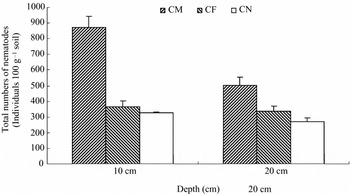
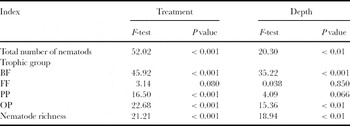
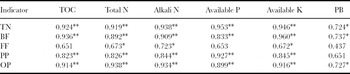
The total number of nematodes is shown in Figure 1. Significant differences in the total number of nematode were found between treatments (p < 0.01) and between depths (p < 0.01; Table 1). The total number of nematodes was significantly greater under CM treatment than under CF treatment and in the CN plot, but no difference was found between CF treatment and the CN plot at 0–10 cm depth. Similar results were obtained for the 10–20 cm depth samples (Figure 1). Under each treatment, the total number of nematodes at 0–10 cm depth was greater than at 10–20 cm (Figure 1). The number of total nematodes was significantly positively correlated with the contents of total organic carbon, total N, alkali-hydrolysable N, available P and available K (p < 0.01; Table 2).
The total number of nematodes in different treatments and depths.

Univariate analysis of variance (ANOVA) for number of nematodes and richness.

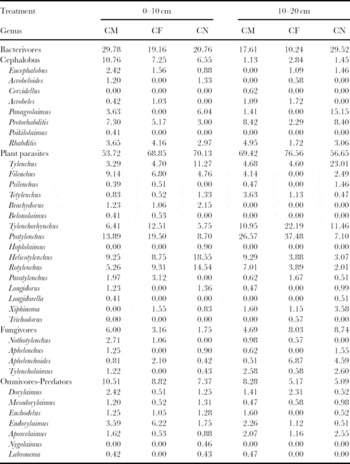
BF: bacterivores; FF, fungivores; PP: plant parasites; OP: omnivores-predators (absolute numbers).
Pearson correlation coefficients between soil nematodes and soil chemical properties and wheat biomass.

TOC, total organic carbon; TN, total number of nematodes; BF, bacterivores; FF, fungivores; PP, plant parasites; OP, omnivores-predators, PB, 10 wheat plant biomass.
*,**significant at p < 0.05 and p < 0.01, respectively.
Trophic groups
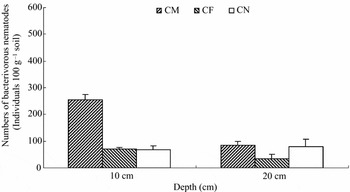
Bacterivores are shown in Figure 2. Significant differences in bacterivores was found between treatments (p < 0.01) and between depths (p < 0.01; Table 1). Bacterivores were significantly greater under CM treatment than that under CF treatment and the control, but no difference was found between CF treatment and the CN plot at 0–10 cm depth. Bacterivores were significantly greater under CM treatment and in the CN plot than under CF treatment, but there was no difference between the CM treatment and CN plot at 10–20 cm depth (Figure 2). Under CM and CF treatments, the bacterivores at 0–10 cm depth were higher than that at 10–20 cm (Figure 2). The relative abundance of bacterivores under CM treatment was greater than under CF treatment at 0–10 cm and 10–20 cm depths (Table 3). The bacterivores were significantly positively correlated with the contents of total organic carbon, total N, alkali-hydrolysable N, available P and available K (p < 0.01, Table 2).
The number of bacterivores in different treatments and depths.

The relative abundance (%) of soil nematode in different treatments and depths.

CM: compost treatment; CF: chemical fertilizer treatment; CN: control.
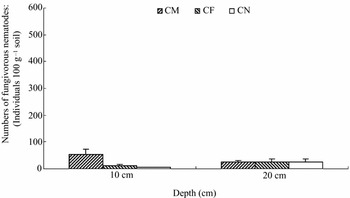
The fungivorous nematodes were the least abundant trophic group in our study (Figure 3). They were significantly greater in CM plots than CF and CN plots, but no difference was found between CF and CN plots in 0–10 cm depth. No difference was found between treatments at 10–20 cm depth (Figure 3). In CF treatment and CN plots, the fungivores at 10–20 cm depth were greater than at 0–10 cm depth, but the fungivores under CM treatment at 10–20 cm depth were less than at 0–10 cm depth (Figure 3). The fungivores was significantly positively correlated with the contents of total N, alkali-hydrolysable N and available K (p < 0.05, Table 2).
The number of fungivores in different treatments and depths.

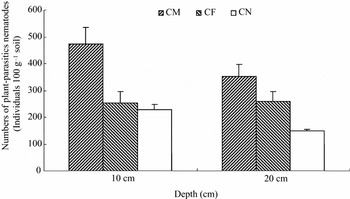
Plant-parasitic nematodes were the dominant trophic group in all treatments (Figure 4). Significant difference in plant parasites was found between treatments (p < 0.01; Table 1), but there was no difference between depths. The plant parasites were significantly greater under CM treatment than CF treatment and in the control CN plot, but no significant difference was found between the CF treatment and CN plots at 0–10 cm depth. The plant parasites were significantly greater under CM treatment than in the CN plot, but no significant difference was found between the CM treatment and CF plots at 10–20 cm depth (Figure 4). In the CM treatment and CN plots, the plant parasites at 0–10 cm depth were greater than at 10–20 cm depth, but under CF treatment the plant parasites at 10–20 cm depth were greater than at 0–10 cm depth (Figure 4). The relative abundance of plant parasites under CM treatment was less than under CF treatment at 0–10 cm and 10–20 cm depths (Table 3). The plant parasites were significantly positively correlated with the contents of total organic carbon, total N, alkali-hydrolysable N, available P and available K (p < 0.01, Table 2).
The number of plant parasites in different treatments and depths.

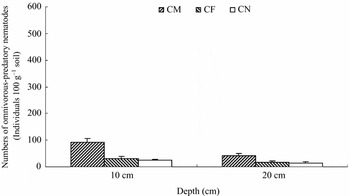
The omnivores-predators are shown in Figure 5. Significant differences in omnivores-predators were found between treatments (p < 0.01) and between depths (p < 0.01; Table 1). The omnivores-predators were significantly greater under CM treatment than in the CF treatment and CN plots, but no difference was found between the CF treatment and CN plots at 0–10 cm and 10–20 cm depths (Figure 5). Under each treatment, the omnivores-predators at 0–10 cm depth were greater than at 10–20 cm (Figure 5). The relative abundance of omnivores-predators under CM treatment was greater than in the CF treatment and CN plots at 0–10 cm and 10–20 cm depths (Table 3). The omnivores-predators were significantly positively correlated with the contents of total N, alkali-hydrolysable N, available P and available K (p < 0.01, Table 2).
The number of omnivores-predators in different treatments and depths.

Nematode richness
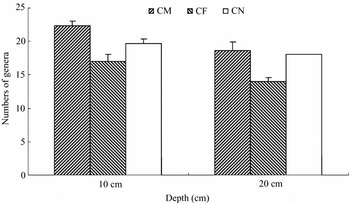
Thirty-six genera were recorded in our study. There were 33, 27, 30 genera, respectively, under CM, CF treatment and CN plot. In the CM treatment, there were nine genera of bacterivores, 14 genera of plant parasites, four genera of fungivores and six genera of omnivores-predators; in the CF treatment, there were six genera of bacterivores, 13 genera of plant parasites, three genera of fungivores and five genera of omnivores-predators; in the CN plot there were six genera of bacterivores, 14 genera of plant parasites, three genera of fungivores and seven genera of omnivores-predators (Table 3). A significant difference in nematode richness was found between treatments (p < 0.01) and depths (p < 0.01, Table 1). Nematode richness was significantly greater under CM treatment than under CF treatment, but no difference was found between the CF treatment and CN plots at 0–10 cm depth. Nematode richness were significantly greater in the CF treatment and CN plots than that under CF treatment, but no difference was found between the CM treatment and CN plots at 10–20 cm depth (Figure 6). Under each treatment, the nematode richness at 0–10 cm depth was greater than that at 10–20 cm depth (Figure 6).
The nematode richness in different treatments and depths.

Wheat biomass and yield
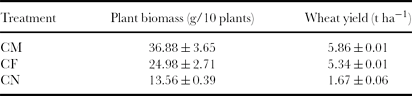
Wheat biomass and yield are shown in Table 4. Wheat biomass and yield were significantly greater under CM than in the CF treatment and CN plots, and significantly greater under CF treatment than in the CN plot. Wheat biomass was positively correlated with total numbers of nematodes, bacterivores and omnivores-predators (p < 0.05).
Wheat biomass and yield in soils different treatments in 2005.
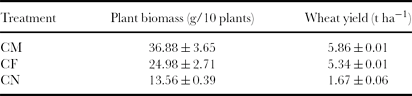
CM: traditional compost, CF: chemical fertilizer, CN: control. Values are means ± s.e.
DISCUSSION
The mean number of nematodes at this experimental site was 269–874 individuals 100 g−1 dry soil, which is greater than that obtained by Liang et al. (Reference Liang, Chen, Li, Wang and Duan2002) in the black soil region of Northeast China (45–260), and by Zolda (Reference Zolda2006) in semi-natural steppe grasslands (185–590). The total number of nematodes in the compost treatment was significantly greater than that in the chemical fertilizer treatment and control plot. This may be due to more abundant food in the compost-treated plots. The total number of nematodes in the chemical fertilizer treatment was greater than that in the control plot, because greater residual plant biomass was produced following chemical fertilizer treatment.
The number of bacterivorous nematodes in the compost treatment was greater than that in the chemical fertilizer treatment and control plots. This increase could be linked directly to higher bacterial populations that were associated with the input of compost in these treatments (Bulluck et al., Reference Bulluck, Barker and Ristaino2002). This is consistent with previous findings that bacterivorous nematodes were more prevalent under compost than chemical fertilizer treatment (Ferris and Matute, Reference Ferris and Matute2003).
Plant-parasitic nematodes were the dominant trophic group in our experiment. This was consistent with the result reported by Ou et al. (Reference Ou, Liang, Jiang, Li and Wen2005) for maize fields, and by Neher (Reference Neher1999). The plant-parasitic nematodes were more abundant in the compost treatment than the chemical fertilizer treatment at both depths, because there was more food for plant-parasitic nematodes under the compost treatment (Wang et al., Reference Wang, Mcsorley, Marshall and Gallaher2006), although the relative abundance of plant-parasitic nematodes was greater in the chemical fertilizer treatment. There was a greater nematode population in chemical fertilizer treatment than the control because more root biomass was produced under chemical fertilizer treatment, thus providing more feeding sites for plant-parasitic nematodes. One major negative impact of chemical fertilizer on soil health was the increase in the relative abundance of plant-parasitic nematodes compared to the compost treatment.
The omnivorous-predatory and fungivorous nematodes were the least abundant trophic group in our study. Compost also stimulated the abundance and percentage of fungivores compared to chemical fertilizer at 10 cm depth. This result is consistent with previous findings (Wang et al., Reference Wang, Mcsorley, Marshall and Gallaher2004), as is our observation of increased omnivorous-predatory nematode abundance in compost treatment (Wang et al., Reference Wang, Mcsorley, Marshall and Gallaher2006). The predatory nematodes may suppress plant-parasitic nematodes through predation. The enhancement of predatory nematodes also may contribute to increased nutrient mineralization as nutrients from microbes consumed by bacterivorous nematodes are released at the predatory trophic levels (Yeates and Wardle, Reference Yeates and Wardle1996). This is an important process in maintaining sustainable soil utilization because availability of nutrients from the soil organic matter to plants relies on the mineralization of nutrients from their immobilized forms. Significant differences were found between treatments for total number of nematodes, bacterivorous and omnivorous-predatory nematodes. These showed that the total number of nematodes, bacterivorous and omnivorous-predatory nematodes were sensitive to soil amendments. Ou et al. (Reference Ou, Liang, Jiang, Li and Wen2005) reported that the number of total nematodes, bacterivorous and plant-parasitic nematodes were positively correlated with the contents of total organic carbon, and alkali-hydrolysable N. This result was in agreement with our study. This indicated that nematodes could enhance soil mineral nutrients.
The number of nematode genera (36) in our experimental site was less than that in alpine habitats (Hoschitz and Kaufmann, Reference Hoschitz and Kaufmann2004) and at an intertidal marsh (Wu et al., Reference Wu, Fu, Lu and Chen2005), but similar to that observed by Thornton and Matlack (Reference Thornton and Matlack2002). Nematode richness, as indicated by the number of genera (Ekschmitt et al., Reference Ekschmitt, Bakonyi, Bongers, Bongers, Boström, Dogan, Harrison, Nagy, O'Donell, Papatheodoru, Sohlenius, Stamou and Wolters2001), reflects biodiversity of soil habitat. There were more nematode genera in the compost treatment than that in the chemical fertilizer treatment, so this reflected a greater biodiversity in compost treatment. The other negative impact of chemical fertilizer on soil health was the decrease soil biodiversity. In particular, application of chemical fertilizer decreased genera of bacterivorous and omnivorous-predatory nematodes, which were tightly correlated with nutrient cycling. Accordingly, sustainable development of agriculture was influenced.
In conclusion, a negative impact of chemical fertilizer on the soil nematode community and soil ecosystem health was found in our study. This experiment was only conducted in the summer. Therefore, further study of the seasonal dynamics of soil nematode community is needed in order to understand better the effect of different fertilizers on soil nematode community, nutrient cycling and the soil ecosystem.
Acknowledgements
This research was supported by the Key Project of the National ‘10th-FiveYear-Plan’ of China (grant no. 2004BA508B01) and Key Discipline Foundation of Ecology in Beijing Municipality (grant no. XK10019440).