Over the past few decades, a flood of historical scholarship has been spawned by the groundbreaking works of Eric Hobsbawm, Terence Ranger, and others who have illustrated how a host of traditions were creations invented in the recent past to inform modern identities. The rituals of the British monarchy, the trappings of Scottish Highland culture, and many other traditions were revealed to have anything but ancient origins. Examination of such inventions, Hobsbawm argued, provided, among other things, a means to observe broader historical shifts.Footnote 1 The intention of this article is not to illustrate another example of a tradition invented in the recent past. Rather, it seeks to examine how longer-standing traditions have been subject to related processes of reinvention.Footnote 2 Some recent work, even if not written to theorize on reinvention, could be read through such a lens. Work in memory studies, for example, has shown how broad notions of national, regional, or local “tradition” could be reshaped based on how and which historical events were remembered. Works on “sites of memory” have similarly shown how conceptions of traditional objects and places can shift due to the fluctuation of memories attached to them.Footnote 3 Beyond memory studies, scholars of theological traditions, often confronted with themes of universal truth and intergenerational change, have also produced works that could be viewed through the prism of reinvention.Footnote 4 Kurt Schori demonstrates, for example, how the transmission of theological tradition through the written word could lead to submerged reformulation as different generations constructed linguistic meanings according to temporally specific circumstances.Footnote 5 While such work could be read through the lens of reinvention, I would argue that more explicit consideration of the dynamics of reinvention is needed both to expand our knowledge of such processes and to develop theoretical models that characterize its diverse occurrences. I would also suggest, as Hobsbawm does with invented traditions, that examination of reinvention provides a means to lay bare symptoms of broader historical shifts.
Through a longue durée study of the Carnival tradition in the German city of Cologne, this article traces different routes of reinvention of performed ritual tradition. It draws particular attention to slippages between form and meaning as a site of reinvention. Like many performed traditions, Cologne Carnival contained a broad host of tropes and symbols that were bound into broader metaphors of meaning. These symbols and outer forms were transmitted across multiple generations, a process that was central to discreet but radical shifts in meaning. Far from being a recently invented tradition, continuous celebration of Cologne Carnival can be documented from 1341 to the present, with Cologne having the largest modern Carnival in Germany.Footnote 6 Since the nineteenth century, however, Carnival has become an integral part of local identity. Indeed, for nearly two centuries, to be a local patriot of Cologne has often meant to be a carnivalist—a development that played a crucial role in Cologne Carnival's historical reinvention.
Previous studies of Carnival in Cologne and the Rhineland have focused primarily on short segments of the festival's history and have used analysis of the tradition as a lens to shed light on politics and social history. The early-nineteenth century and the emergence of bourgeois Carnival associations have been the primary points of interest. This period witnessed significant structural changes in the tradition's organization, with new local elite associations filling the vacuum left by the abolition of the guilds that formerly organized events. Elaine Glovka Spencer has illustrated how, through such associations, the bourgeoisie shaped the tradition according to regimented bourgeois values, and used celebrations both to prop up social hierarchies and to “define and present themselves in public.”Footnote 7 James Brophy has also illustrated how Cologne Carnival in this period facilitated political communication, arguing persuasively that, in an era of repression of political speech, Vormärz popular culture became an important arena of the public sphere.Footnote 8 Christina Frohn likewise demonstrates the politicization of Rhenish Carnival across the century, with 1840–48 representing its radical democratic phase. Frohn further points to the “organized jester” as a microcosm of the modern tradition.Footnote 9
This article does not seek to overturn the notion that bourgeois reorganization and politicization were both critical in the “birth” of modern Carnival.Footnote 10 Rather, it argues for analysis beyond how Carnival became a vehicle of politics and social action to look in-depth at how local citizens constructed and discussed understandings of the meaning of the tradition itself. This article analyzes how radical historical shifts in Carnival's meaning integrated a broad host of continuous Carnival forms and symbols, many of which stretched back to the Middle Ages. I argue that radical diachronic shifts in interpretations of these forms, including the fool's ship (Narrenschiff), the Carnival jester, the Carnival number eleven, and the state symbolism of Carnival, are symptomatic of broad reinvention of the constructed meaning of the tradition.
Exploring such reinvention necessitates a longue durée purview. This article takes as its point of departure works on European Carnival in the Middle Ages and early-modern period by scholars such as Dietz-Rüdiger Moser, Siegfried Wagner, and Werner Mezger, who have shown the medieval origins of the tradition and the connection of its symbols to the metaphor of Carnival as the Kingdom of Hell.Footnote 11 The indulgence and licentiousness of Carnival were, as they have illustrated, parts of a medieval metaphor of man's fallen and evil state. The diabolic Kingdom of Carnival stood across from the Kingdom of God represented by the forty days of Lent. The crux of medieval Carnival's meaning came in its abrupt end on Ash Wednesday when celebrants rejected Carnival diabolism in favor of the purity of the Catholic Church. This deeper meaning was reflected in a host of forms and rituals. Carnival was thus inherently bound up in notions of Christian piety and presented a foil against which the Kingdom of God was to be understood.
Fast-forwarding to Carnival in the early-nineteenth century and zooming in on Cologne, this study illustrates how the meaning of Carnival had undergone radical reinvention. No longer representing a diabolic kingdom to be rejected, Colognians saw it as embodying the “healthful” and positive aspects of Colognian identity, which they argued included local natures of “light-heartedness,” “gaiety,” and “friendliness.” The interpretation of Carnival as an embodiment of positive local values to be promoted, rather than wickedness to be rejected and overcome, constituted an astonishing inversion of the tradition's original meaning. I seek to demonstrate how amidst such reinvention, a panoply of medieval Carnival forms remained, but had become constituent parts of entirely new metaphors of meaning. This article further examines how political communication facilitated by modern Carnival seeped into notions of the meaning of the tradition itself in ongoing processes of reinvention. Conceptions of Carnival as embodying a Colognian democratic character, Rhenish resistance to authority, anti-Prussianism, or nationalism would fluctuate substantially throughout the nineteenth and twentieth centuries.
Such reinvention of meaning continued in the twentieth century. Following an examination of Nazi attempts to coordinate Carnival and define it as an “ancient Germanic festival,” I trace changing conceptions of Cologne Carnival in the postwar period. The turn of Colognian citizens to the local in the face of postwar trauma and tainted national identity led to a magnification of nascent nineteenth-century notions of anti-Prussianism and a democratic spirit as defining the tradition. Simultaneously, Carnival became a crucial point of reference for a new tenet of local identity: the idea of “Colognian tolerance.” The idea emerged as a ubiquitous catchphrase that postwar local enthusiasts used to describe their Colognian character as seen through the refracting lens of Cologne Carnival.
Positing a spectrum of reinventedness upon which different traditions could be placed, the longue durée history of Cologne Carnival revealed its position at the far side of such a scale, possessing a remarkable capacity for reinvention. Different factors informed this “reinventability.” The first factor regarded transmission of memory and Carnival's origins in a distant past of which little was well documented and publically known. As Jan Assmann emphasized in his Vergessenstheorie, intergenerational processes of forgetting are common, with durable transmission of memory requiring effective “intermediate storage,” typically as circulated text. Oral communication alone, in contrast, expires within a few generations. While Assmann categorized festivals and rituals as media of intermediate storage, the example of Cologne Carnival presents a different image.Footnote 12 Mimetic transmission of outer forms proved quite successful. While Carnival could conceivably exist without fools' ships, mystical numbers, etc., such forms traversed several centuries. Notions of their respective meanings, however, proved infinitely more unstable. The scarcity of broad circulating historical documentation, in particular, permitted more unrestrained imaginings of new interpretations of older continuous forms.
Organizational dynamics and Carnival's participatory nature also informed the tradition's reinventability. Carnival, as Bakhtin noted, knows no “footlights” in that it does not draw firm boundaries between performers and observers.Footnote 13 This dynamic often prevented groups from establishing monopolies on celebrations and traditional forms that could be used and shaped by a wide array of groups. In turn, a host of separate Carnival groups and societies often existed in which interpretations of Carnival as a democratic, nationalist, or anti-Prussian tradition, for example, found varying degrees of support. Such structural fragmentation, in short, made defining the meaning of the tradition into a highly participatory process.
In spite of such radical reinventions, however, local enthusiasts have often viewed the tradition's meaning as timeless. Joseph Klersch's definitive work projected the festival back to the Romans and posited it as one whose outward forms developed, but whose inner spirit remained stable.Footnote 14 The medieval idea of Carnival as a representation of sin and human weakness would certainly strike a dissonant chord with modern Colognians accustomed to hearing local Carnival slogans, such as “To everyone well-being and to no one pain!” (“Allem Wohl und Niemand weh!”). It would seem equally odd to suggest that Colognian tolerance, rooted in Carnival, was anything but timeless. One recent work on Carnival projects the idea back to the ancient Ubier—the pre-Roman inhabitants near Cologne.Footnote 15 Uncovering reinvention of tradition, in short, requires not only using longue durée history to tease out evolutions in meaning, but also brushing against the grain of modern identities for which older forms of tradition have been coopted.
Medieval Carnival: Piety, Contrariety, and the Diabolic
The paucity of surviving sources on early Carnival has affected scholars and celebrants alike, with the tradition's origins long standing in a historical haze. Rhenish cities discovered this problem in the early-nineteenth century, when Friedrich Wilhelm III banned Carnival in localities that could not demonstrate a tradition that preceded the Napoleonic occupation. Cities with long Carnival traditions scrambled to collect some sort of written documentation. The absence of written sources has permitted broad speculation on the origins of the festival and its myriad of rituals, with debates even extending to the words for Carnival (Karneval, Fastnacht, Fasching, Fastelovend). Karl Meisen's historical analysis of the terms has convincingly illustrated that Karneval derives from the Latin for meat, or “carne,” signifying the indulgence prior to Lent. The term “Fastnacht” and its regional variations, Meisen demonstrated, derive from the word “fasten,” referring to Carnival as the evening preceding Lent.Footnote 16 These interpretations have debunked theories of the word's etymology that insisted on Carnival's “pre-Christian” origins. Attempts to discover Carnival's “true origins” have long been the focus of research on European Carnival. This scholarship has overturned popular misconceptions that Carnival originated in either the Roman Saturnalia or ancient Germanic spring festivals. The new consensus among historians is that it emerged in the Middle Ages, with a nearly thousand-year gap in sources separating pre-Christian festivals from European Carnival. Dietz-Rüdiger Moser, in particular, has presented substantial evidence of Carnival's Christian origins and the Christian meanings of a host of Carnival rituals and symbols. An examination of his work is called for, as I argue that the original meanings of many Carnival forms that Moser and others have deciphered took on radically different meanings in modern Cologne.
Moser argues that Carnival symbols, such as the number eleven, the “ship of fools,” the “fool's cap,” and the metaphor of Carnival as a state, all originated from the idea that the festival represented the devilish counterpoint to Lent. Its ghosts, devils, witches, and animalistic figures, each symbolizing different vices, were connected to the idea of Carnival as representing the Kingdom of Hell. Dispelling notions that the Carnival number eleven originated in the nineteenth century, for example, Moser illustrated that the number's association with Carnival extends at least to 1530 and that it symbolized the overstepping of the Ten Commandments and the eleventh hour before the return of Christ. Turning to other medieval Carnival symbols, Moser revealed that the ship of fools represented a symbolic foil to the “ship” of the church. The idea of the church as a “ship” is itself reflected not only in the English “nave” and the German “Kirchenschiff,” but also in medieval iconography. By entering the ship of the church on Ash Wednesday, celebrants abandoned the ship of fools, which, in medieval depictions, ultimately sank due to human folly and weakness. The shape of the Carnival cap donned by the Carnival jester, Moser further demonstrated, was reminiscent of the ship of fools, bolstering the symbol's prominence. Moser also presented evidence that the Carnival jester in medieval iconography was depicted as the denier of Christ and a figure of sin and death that appeared in Dance of Death allegories.Footnote 17 The overt connection of Carnival with death in the Middle Ages, I argue, offers us a stark contrast to modern Cologne, where, as we shall see, celebrants imbued Carnival with “life-affirming” powers.
The meaning of medieval Carnival, in short, was defined by its rejection and the ultimate victory of Lent. It reflected the Augustinian two-city model of Christian thought, in which the Civitas Dei was to be understood in contrast to the Civitas Diaboli. Late medieval descriptions, uncovered by Moser, described Carnival as facilitating knowledge of the holy against the foil of the evil—understanding Jerusalem by juxtaposing it with Babylon.Footnote 18 Siegfried Wagner's work on medieval and early-modern Carnival confirmed many of Moser's conclusions. In his study of Narrenliteratur and Fastnachtspiele, he examined a ubiquitous “battle motif” between Carnival and Lent in which Lent always achieved glorious victory. Wagner illustrated how Carnival was bound up in a proliferation of Carnival/Lent binaries, in which the boundary between the two was that between “barbarism and civilization.”Footnote 19
While historians have reached consensus on the emergence of the tradition in the late Middle Ages, debates have continued on how it came into being. While Moser argued that the Catholic Church instituted and controlled Carnival, Wagner explained it as an explosion of the clerical Feast of Fools beyond the bounds of the clergy.Footnote 20 Werner Mezger, in his study of the medieval and early-modern Carnival jester, argued that the tradition began as organic recurring moments of consumption prior to Lent. Carnival was not, he argued, consciously established at any one moment by any one group. Rather, recurring consumptive moments evolved into a full tradition, taking on a host of tropes and figures. It was in this context, Mezger argued, that the religious metaphor of Carnival emerged. He further presented a massive collection of images in which the jester, the microcosm of the festival, appeared as the embodiment of evil, devilishness, a cannibal, oversized monster, violent masochist, or torturer of Christ.Footnote 21 While challenging Moser's narrative of Carnival's emergence, Mezger's work has solidified our understanding of its meaning as a diabolic counterpoint to Lent. This notion also fits with our knowledge of the importance of contrariety and binaries in notions of piety from the late medieval period into the seventeenth century. Stuart Clark, for example, illustrated the prominence of contrariety, dual classification, and binary thinking in the religious and intellectual foundations of witch hunts, in which such figures were needed as a foil against which piety was understood.Footnote 22 Robert Scribner has also illustrated the use of a Carnival “inversion motif” in Protestant and Catholic visual propaganda during the Reformation in attacks of their opposing confession.Footnote 23
The scarcity of sources in these periods does not permit a local case study on the use of Carnival symbols in Cologne, though there is little reason to believe that it deviated from the rest of Catholic Europe. The early sources that we have come from financial and legal documents, and brief accounts in local chronicles. A handful of these sources confirms the presence of the diabolical metaphor in Cologne. A fifteenth-century legal document indicates that in 1441, a resident of Cologne and four costumed companions built a shrine to the devil on Carnival and paraded it through the streets. The devil figure atop the shrine held a banner and an aspergillum, the instrument for sprinkling holy water. A report stated that “some people” took offense at the display, resulting in the men being tied to the pillory for several hours.Footnote 24 As legal documents are one of the few surviving sources on early Carnival, it should not surprise us to find such evidence in the case of a legal infraction. That only some took offense at the building and procession of a devil shrine would lead us to believe that locals were quite familiar with the idea of Carnival as a theatrical representation of evil and that the punishment resulted from the sheer excess of the display. Beyond this incident, legal documents indicate other forms of mockery of piety, such as costuming in the garb of clergy and beguines.Footnote 25 A 1578 reference to Carnival by Hermann Weinsberg also indicates the familiarity of citizens with the idea of Carnival as a representation of sin. The Cologne burgher recorded his decision not to dress up on Carnival, instead deciding to be “narrisch” by vain self-praise in a Carmina. The resulting text, “Von samenfoegung der Weinsbergschen personen und gutter” praised his worldly possessions and family's future.Footnote 26 Such connections of Carnival with the sin of vanity appeared throughout Catholic Europe.Footnote 27
Early Cologne Carnival also included grotesque and violent displays that would have fit within Carnival/Lent binaries. The local historian, Wolfgang Herborn, whose recent work provides a collection of known early sources on the festival, has also uncovered new financial documents that prove that medieval tournaments took place in Cologne Carnival until the end of the fifteenth century.Footnote 28 Tournaments, as David Crouch reminded us, involved not simply jousting, but rather included large and tremendously bloody mock-battles. The rural aristocracy likely held such Carnival tournaments not simply to enjoy the urban atmosphere of Carnival, as Herborn suggested, but because of the existence of a Lentian ban on tournaments, established due to the bloodiness of the displays.Footnote 29 Other violent events also occurred during early Cologne Carnival, such as blindfolded swine-beating, with participants also causing amusement in their accidental beatings of each other. Herborn demonstrated that the practice was common in early Cologne Carnival.Footnote 30 While Herborn did not consider metaphorical meanings of Carnival, his findings, I would argue, demonstrate the presence of violent displays that would have contrasted sharply with the subsequent peace and restraint of Lent.Footnote 31 This duality would have fit closely with a host of binaries that established Carnival and Lent as metaphorical realms of the profane and the holy.
Beyond religious metaphor, early Cologne Carnival also provided a medium of social and political presentation. While historians of the modern tradition have emphasized how Carnival was used for such purposes, this arguably followed a longer-standing pattern. In late medieval Cologne, the Patriziat, an oligarchy of ruling families, hosted prominent festivities until their overthrow in 1396. The subsequent system of rule based on guilds and Gaffeln also took up the organization of Carnival.Footnote 32 The advantage in doing so was clear: it allowed them to keep order in celebrations and use events to demonstrate their local prominence. As Vera Jung pointed out, guilds in numerous cities used Carnival for such purposes.Footnote 33 Having just secured control of Cologne in 1396, the Cologne guilds would have used Carnival as a prime venue to solidify their control and display their authority through symbolic presentation. The guilds, however, did not hold a monopoly on the tradition and had to compete with private celebrations.Footnote 34 Rather than holding joint celebrations, different guilds also held their own decentralized events. The degree to which this decentralized structure encouraged subjective deployment and interpretation of Carnival symbols and rituals can only be a matter of speculation.
By the modern period, however, it is clear that interpretations of Carnival symbols had undergone fundamental reinvention. While historical transmission of outer forms of tradition had been successful, celebrants had dramatically different understandings of their meanings and of the tradition itself. Slippages in intergenerational transmission of memory played a significant role in these changes.Footnote 35 While the concreteness of symbols and forms allowed for greater ease in their mimetic transmission between generations, interpretive meaning relied strongly on oral communication. Such communicative memory, as Jan Assmann has pointed out, is notable for its rapid expiration, compared with transmission through text, which Assmann argued is a form of more durable cultural memory.Footnote 36 If we look to Cologne at the end of the sixteenth century, we see some of the first cracks in the late medieval Carnival metaphor. While some members of the clergy had celebrated Carnival, emerging arguments of Cologne Jesuits against the tradition demonstrated a lack of understanding of Carnival and Lent as a religious metaphor in which Lent triumphed. Rather, the Jesuits conceived of the tradition as representing the triumph of sin, spurring them to hold special sermons during Carnival in protest.Footnote 37 Religious argumentation against Carnival in later centuries followed a similar pattern in not seeing the possibility of a religious metaphor in the Carnival/Lent binary.
Much speculation would be involved in attempting to enumerate all developments in notions of piety, confession, social change, intellectual movements, and the history of mentalities that could have informed intergenerational reformulation of the meanings of Carnival forms. Moderate decline of the festival in the seventeenth century, in the wake of the Thirty Years' War, also makes it difficult to trace such shifts. During the late early modern period, as Peter Burke suggested, however, a process of “weak secularization” began to take hold in the realm of popular culture.Footnote 38Kirchweih festivals present us an example of this. Created to celebrate church anniversaries, the clergy struggled to control unwieldy observances that ultimately failed to serve their intended religious purpose.Footnote 39 New festivals invented in the modern period, moreover, were more secular in nature, attenuating the strength of the Christian calendar.Footnote 40 As we shall see in Cologne Carnival, the festival had undergone a related process by the early-nineteenth century. While the religious metaphor had been displaced, it remained a weak process of secularization in that it did not reflect fundamental rejection of religion in public life. Many locally patriotic celebrants, for example, looked not only to Carnival in fashioning local identity, but also to strong confessional identities.
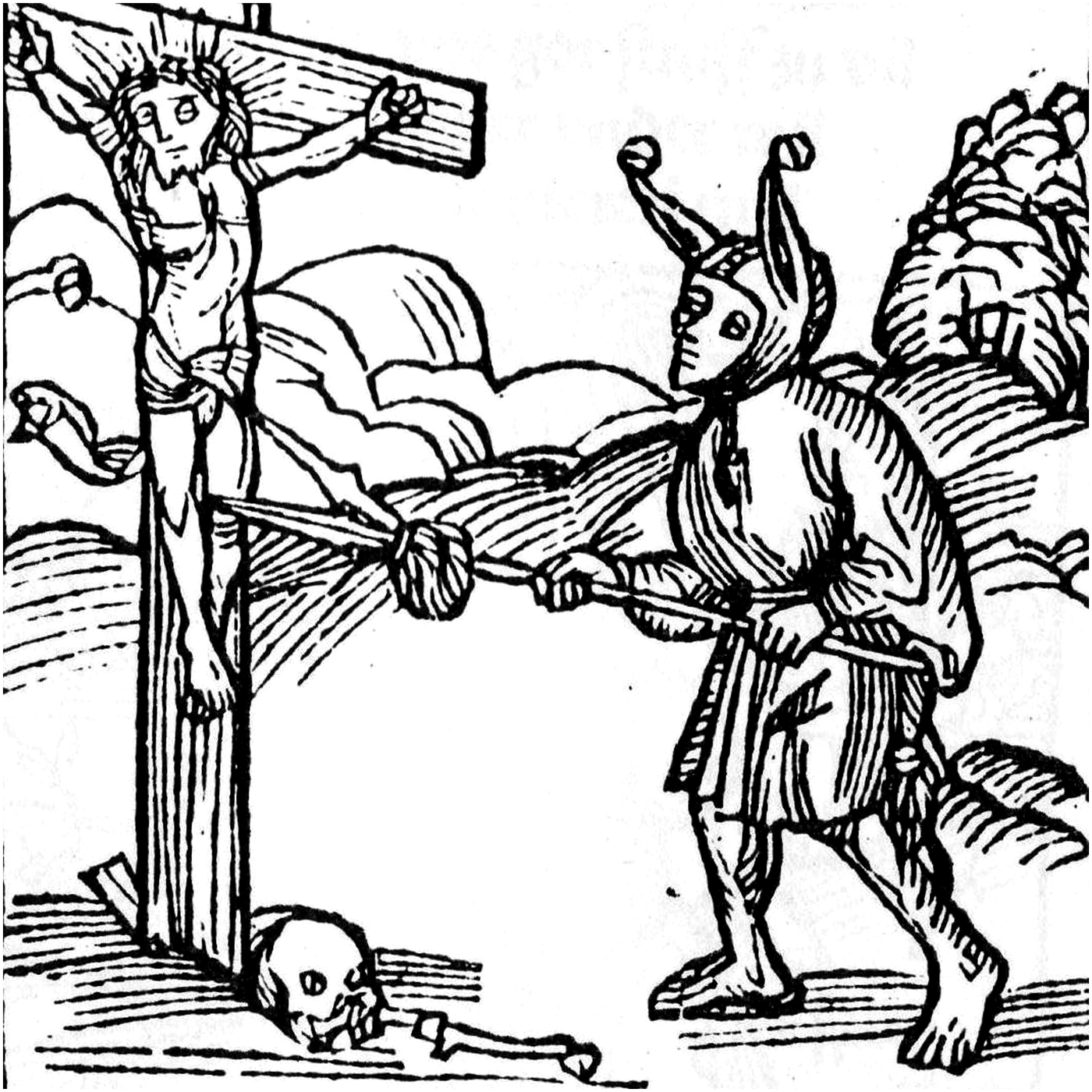
Such changes in modern understandings of the tradition, however, have been overlooked in histories of early Carnival, which have shown little interest in the modern tradition and have not considered the possibility of radical change in the meanings projected onto older forms. While Mezger briefly mentioned a fading of the strength of diabolism in Carnival after the seventeenth century, Moser argued that the tradition's origins and symbolic logic determined its modern meaning.Footnote 41 In concluding his work, Moser referenced a Carl Spitzweg painting of a jester's incarceration after Carnival (Figure 1), writing “The incarceration of the jester, a theme taken up by Carl Spitzweg in his 1855 painting Ash Wednesday, has always meant the liberation of the Christian from all that inhibits his proper beliefs. It has remained so up to the present day.”Footnote 42 An examination of the painting, not reproduced in Moser's work, reveals anything but continuity. What we see are cold stone walls, a sober jug of water, and a colorful jester juxtaposed against a draconian cell. This was not like the jesters of Sebastian Brant's 1492 Narrenschiff, depicted as a devil, torturer of Christ, villain, and masochist (Figure 2). Nor was it the horrific Jester Cannibal that can be found in numerous sixteenth-century images. The viewer sees no evil in the figure, but rather develops a sympathy for his unjust imprisonment. This is not representative of how understandings of Carnival remained the same, but rather how they had radically changed.
(Color online) Carl Spitzweg, “Ash Wednesday,” 1855. Source: Staatsgalerie Stuttgart.

Woodcut from Sebastian Brant's Das Narrenschiff (1494). Source: Sebastian Brant, Das Narrenschiff (Nuremberg: Peter Wagner, 1494), (Enlarged copy of the Exemplar of the Berliner Staatsbibliothek Preußischer Kulturbesitz), 134.
Carnival in Cologne: From the Kingdom of Hell to the Empire of Rhenish Jollity
Historians have long situated the “birth” of modern Cologne Carnival in 1823 with the introduction of structural reforms. Modernization of the festival, as Brophy has demonstrated, involved the use of Carnival as a medium of political communication. Frohn, who also traced modern politicization of Carnival throughout the century, additionally emphasized the importance of bourgeois organizing societies and early attempts to infuse modern Carnival displays with romantic poetics. Bourgeois regimenting of revelry, as Spencer pointed out in her study of the question of social class in Carnival, likewise typified the nineteenth-century festival. Modern Carnival reforms, initiated by the Olympic society, also added new elements to celebrations, such as the first centrally organized parade held on Rose Monday, and a new Carnival triumvirate led by the Carnival monarch, “Hero Carnival.” While historians have focused on the development of new forms, social dynamics, and politics in the modernization of Cologne Carnival, a crucial part of the festival's modernization has been overlooked. In its emergence as the central festival of modern local identities (coming to represent Rhenish and Colognian natures of lightheartedness and jollity), the perceived meaning of the tradition had undergone a radical transformation. Though Carnival continued to be celebrated throughout much of Germany and Europe, Cologne was unique both for having the largest Carnival in Germany and in viewing themselves as the people whose local natures were defined by the tradition. Prominent carnivalists, such as Thomas Liessem, insisted that Colognian children grow up with Carnival in their blood, soaking up local folk humor in their mother's milk.Footnote 43 Anton Keim argued that Rheinländer view Carnival as a “gravely serious matter.”Footnote 44 The wearing of Carnival uniforms to funerals of prominent carnivalists offers evidence that such statements were far from hyperbolic.Footnote 45
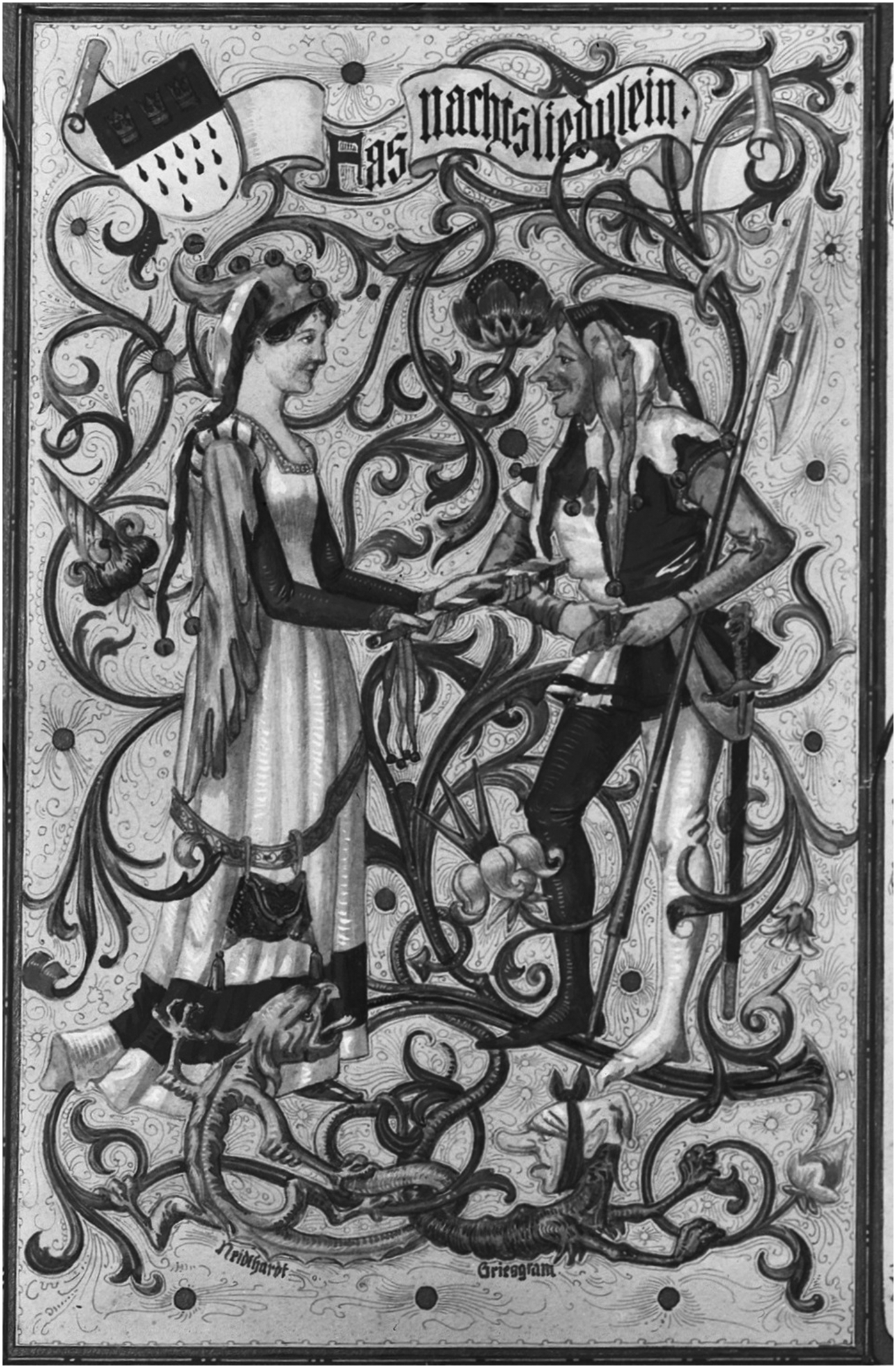
Beyond new societies and organizing structures, the emergence of modern Carnival in Cologne was very much about how its traditional forms acted as sliding signifiers onto which celebrants projected radically new meanings that reflected modern local identity and modern mentalities. Carnival topoi, such as the jester figure, the ship of fools, the number eleven, and the statist metaphors of Carnival, all reveal astonishing transformations in which Carnival went from representing the Kingdom of Hell—embodying values to be rejected—to a metaphor of positive localist values to be enthusiastically embraced. A microcosm of this shift can be seen in a complete transformation in the depiction of the Carnival jester. While hundreds of medieval Carnival images depict the jester as the torturer of Christ, ferocious cannibal, liar, villain, and evil-doer, in nineteenth-century Cologne we see a very a different picture. Examining an image from an early-nineteenth century Cologne Carnival song book, we see that the devil has been radically transformed (Figure 3). In the upper right of the image, we see the crest of Cologne, representing Carnival as an expression of local identity. The jester, far from being devilish, is a gallant and happy figure wooing the Carnival maiden. Below appear two devilish monster figures who have been vanquished, labeled “Neidhardt” and “Griesgram” (curmudgeonry and grumbledom). The luscious vines, a motif that proliferated in modern Cologne Carnival images, associated Carnival with life and fertility. This contrasts starkly with medieval images that overtly associated it with death and barrenness. The jester no longer represented mortal weakness, human folly, sin, and the depravity of human nature; rather, it embodied a positive break with the evil forces of drudgery. Even more, in Cologne, it represented the Colognian citizen and the uniqueness of Colognian identity, rooted, in their minds, in positive Carnival gaiety. It is in this period that many stock phrases of modern local uniqueness emerged, such as the idea of Colognians having only “sunshine in their hearts.” The local Carnival call (Narrenruf) was “Kölle Alaaf” (“Long Live Cologne”), a term that existed prior to the Carnival reforms and proliferated in modern celebrations, appearing in hundreds of Carnival songs.
Carnival Jester and Maiden stand triumphantly over the enemies of Carnival, “Griesgram” and “Neidhard.” Early Nineteenth Century. Source: Rheinisches Bildarchiv, 23216.
The disappearance of the diabolic metaphor of Carnival and the ubiquitous adherence to the notion of Carnival as the Kingdom of Rhenish jollity had already been realized by the early-nineteenth century. Examples of such new notions proliferated. Tickets to a masked Carnival ball in Cologne's Gürzenich in 1830, for example, were inscribed with a Bacchian print that read, “Believe, friends, joy makes one young and healthy. For this reason, foreswear yourself anew to the joyous.”Footnote 46 The author Johanna Schopenhauer described the meaning of Cologne Carnival in a similar vein, writing of Carnival after her 1828 visit to Cologne:
The foundational principle of this festival was the fight of unrestrained joy and freedom against the evil elements, which lie partially in human nature itself and partially in the exterior world, namely moroseness, boredom, fearful adherence to the conventional, and so forth.Footnote 47
During her visit to Cologne, Schopenhauer also noted the strength of local patriotism among the citizenry and the carnivalistic natures of their local character, including “blithe humor,” “friendly character,” “joyousness of life,” and “uninhibited” natures.Footnote 48 Schopenhauer also recalled the enactment of a mock battle during Carnival's Rose Monday parade, which proves particularly revealing. Given the long history of the metaphor of Carnival as an embattled state, it was not the first time that such a mock battle was performed. In Zittau in 1505, for example, there was a mock Carnival battle in which Hanswurst, the symbol of Carnival gluttony, battled a herring, the figure of Lent. The battle ended with the defeat of Hanswurst, who was thrown down a pipe well.Footnote 49 In the battle in Cologne in 1825, however, we see a quite different outcome. In this theatrical battle “Hero Carnival,” the Carnival monarch, engaged in victorious battle against the enemies of Carnival led by “General Isegrimm.” Isegrimm, the medieval figure of evilness and grimness, had as his standard-bearer the devil Mephistopheles, who held a “banner of conspiracy against jovial humor.” He was joined in nefarious battle by representatives of “barbarity and malice” and “indolence and pettiness,” who found ultimate defeat at the hands of carnivalistic forces. The victorious forces of Hero Carnival included local heroes such as Jan von Werth, Jungfrau Colonia, figures of the medieval patriciate, and representatives of the old guilds.Footnote 50
In this metaphorical display, many older forms of tradition had been maintained, such as the idea of Carnival as a state, with a monarch, capable of engaging in battle. Carnival was, however, no longer the Civitas Diaboli that stood in contrast to the holiness of Lent. Rather, the devil, who appeared in earlier Carnival celebrations, went from ally of a diabolic medieval Carnival to the sworn enemy of the festival of Rhenish jollity. The reversal of Carnival from the defeated to the victor inverted the very foundational principle of the medieval tradition. What is most astonishing is the utter lack of surprise or discussion from the public about Carnival being the ultimate victor. No protests or objections to this display came from local citizens, Carnival participants, or the Church. Accounts of the event took the victory of Carnival forces as a given. If the display was notable in any way, it was due to its theatrical poetry. The maintenance of older forms, combined with the process of forgetting older interpretations, allowed for radical reformulation in which the topsy-turvy principle of Carnival had been turned in on itself. The dominant theme of damnation and redemption of medieval Carnival had been displaced in the process.
Looking at a host of other older forms of tradition, we see that the “forest of symbols” of Cologne Carnival had shifted in kind. While the ship of fools in medieval depictions always hovered on the verge of sinking due to human folly, in modern Cologne, it was anything but a ship of weak fools destined to sink. It appeared not as the foil to the Church, but rather as a stalwart battleship prepared to wage war against the forces of unhappiness. A Cologne Carnival song entitled Narrenschiff, which gained cult status by the end of the nineteenth century, depicted the enemies of the ship not as coming from any disorder from within, but rather from pirates and sea robbers from without. The means of survival was not abandoning the ship of fools for the ship of the Mother Church; instead, as the song proclaimed, they would stay afloat if they kept up their “happy song” as they pressed full speed ahead on the “Sea of Joy.”Footnote 51 This ship metaphor can be seen throughout nineteenth-century Cologne Carnival. In the 1897 Rose Monday parade, themed “the Curmudgeondom battle,” a parade float of the ship of fools was drafted not with devilish rowdy fools who sank the ship. Rather it depicted courtly figures in a ship covered with Colognian crests and topped with an Imperial crown.Footnote 52
Reformulation of the metaphor of Carnival as a legal state proved to play a prominent role in new understandings of the tradition, with the empire of Rhenish jollity fully displacing medieval diabolism. The sworn enemy of the empire was no longer the Civitas Dei, but rather the realm of drabness, austerity, and lifelessness. Cologne Carnival songs depicted skirmishes of Carnival warriors who armed themselves with the forces of happiness to destroy the enemy in grand victory. One song refers to the enemy of their Rhenish Carnival Empire to be the “Empire of Slavery,” which wanted to subject Carnival to its yoke. The song declared that they would win their freedom in their “victory festival,” proclaiming “Triumph! Triumph! Joy has conquered!” It was by indulging local jollity that Cologne carnivalists would win the “good war” waged by the Carnival Empire.Footnote 53 This state metaphor continued into the twentieth century, with Carnival princes such as Johann Maria I declaring in the eleven articles of his constitution that grumblers and those who did not chant “Kölle Alaaf” would be photographed and ordered to wear necklaces of sour lemons. Prince Hubert II ordered the creation of a spy ring to incarcerate enemies of his empire who fought against cheerfulness.Footnote 54 Engaging in more than playful banter, such Carnival princes drew on a statist metaphor with centuries of tradition. The way that modern carnivalists understood this long-standing metaphor, however, reveals a process of forgetting what previous generations viewed the original Carnival state as representing. While the exterior signifier remained, new generations had reimagined new enemies for the Jesters' Empire.
Religious engagement with Cologne Carnival in the nineteenth century also demonstrates the extent of processes of forgetting. If we look closely at the nineteenth-century religious and moralist engagement with Carnival presented in Frohn's work, we see an utter absence of the notion that Carnival could itself bear religious meaning. Rather, the moralist's goals were restricted to preventing extremities of disorder, bawdiness, or overstepping the bounds of respectability, rather than channeling Carnival into a religious metaphor.Footnote 55 Squaring religion with Carnival involved not making it bear religious meaning, but rather in arguing, as one Colognian did regarding religion and Carnival, that there was a time and place for everything, including carnivalistic merrymaking.Footnote 56 Religious readings of Carnival became even more unlikely in light of growing beliefs that the tradition originated from the Roman Saturnalia or from a fusion of Roman and ancient Germanic traditions.Footnote 57 As one Colognian carnivalist argued, the Roman tradition was merely integrated into the Christian calendar to “compensate” them for the fasting of Lent.Footnote 58 Such a notion harmonized with local pride in Cologne's Roman origins, while further rendering Christian theology irrelevant to interpretation of Carnival's meaning.
Carnival, Politics, and Contested Meanings
Throughout the nineteenth century, the localist valence of meaning in Cologne Carnival enjoyed a ubiquitous presence. Though the romantic reformers helped to solidify this localist sentiment, they were certainly not the inventors of the idea of Carnival as a localist tradition.Footnote 59 They did, however, introduce new symbolism that promoted popular memory of Cologne as a Free Imperial City, such as the new Carnival triumvirate, which included the figure of the “Kölsche Boor”—the representation of the free citizen of Imperial Cologne. Members of Cologne's new Carnival society, the Rote Funken, moreover, donned the red uniform of the old Imperial city soldiers. Beyond such localist sentiment, however, as James Brophy and Christina Frohn have illustrated, Carnival also became a vehicle of politics. Brophy suggested a growing association of Rhenish identity with an affinity for “constitutional rights and participatory politics,” though he focused primarily on the tradition as a “communicative phenomenon.”Footnote 60 As opposed to simply mirroring political and social realities, Carnival also offered a means to challenge them and advocate for change. As both Werner Mezger and Hermann Bausinger have argued, Carnival did not absolutely affirm or overturn current orders but rather provided a space to engage in dialogue with them.Footnote 61 In addition to facilitating political communication, however, the politicization of Carnival also added new layers of contested meaning onto the festival itself. This included notions of the tradition as containing in its essence a spirit of democracy, anti-Prussianism, and/or nationalism. Unlike the idea of Carnival embodying Colognian jollity, however, I argue that these new layers of political meaning remained in a state of flux throughout the nineteenth century. The contestedness of these political meanings can particularly be seen in unstable and fluctuating understandings of the meaning of yet other Carnival symbols.
The Carnival number eleven provides an excellent example of nascent reinterpretation of Carnival along “democratic” lines. Studies of the politicization of nineteenth-century Carnival have repeatedly pointed to the meaning of the number as symbolizing equality. The symmetry of the number 1:1, so the nineteenth-century narrative went, represented the equality of Carnivalists among each other and the social leveling of Carnival. Another possible interpretation, which surprisingly few adhered to, was that the number came from the eleven flames in Cologne's crest.Footnote 62 Yet another interpretation, whose origins are uncertain, held that the number represented the French revolutionary principles of Egalité, Liberté, Fraternité, whose anagram spelled the German word for eleven. Historians of Rhenish Carnival who have pointed to the number's equality symbolism, however, have not drawn attention to the fact that the jester's number long preceded the nineteenth century. Dietz-Rüdiger Moser, who discovered the number's medieval origins and its symbolism as an overstepping of the Ten Commandments, also brushes over the nineteenth-century interpretations of the number as mere misunderstandings.Footnote 63 I would argue, however, that they constituted not trivial misinterpretations, but rather demonstrated political reinventions of the meaning of the tradition through a reconfiguration of its symbolic elements.
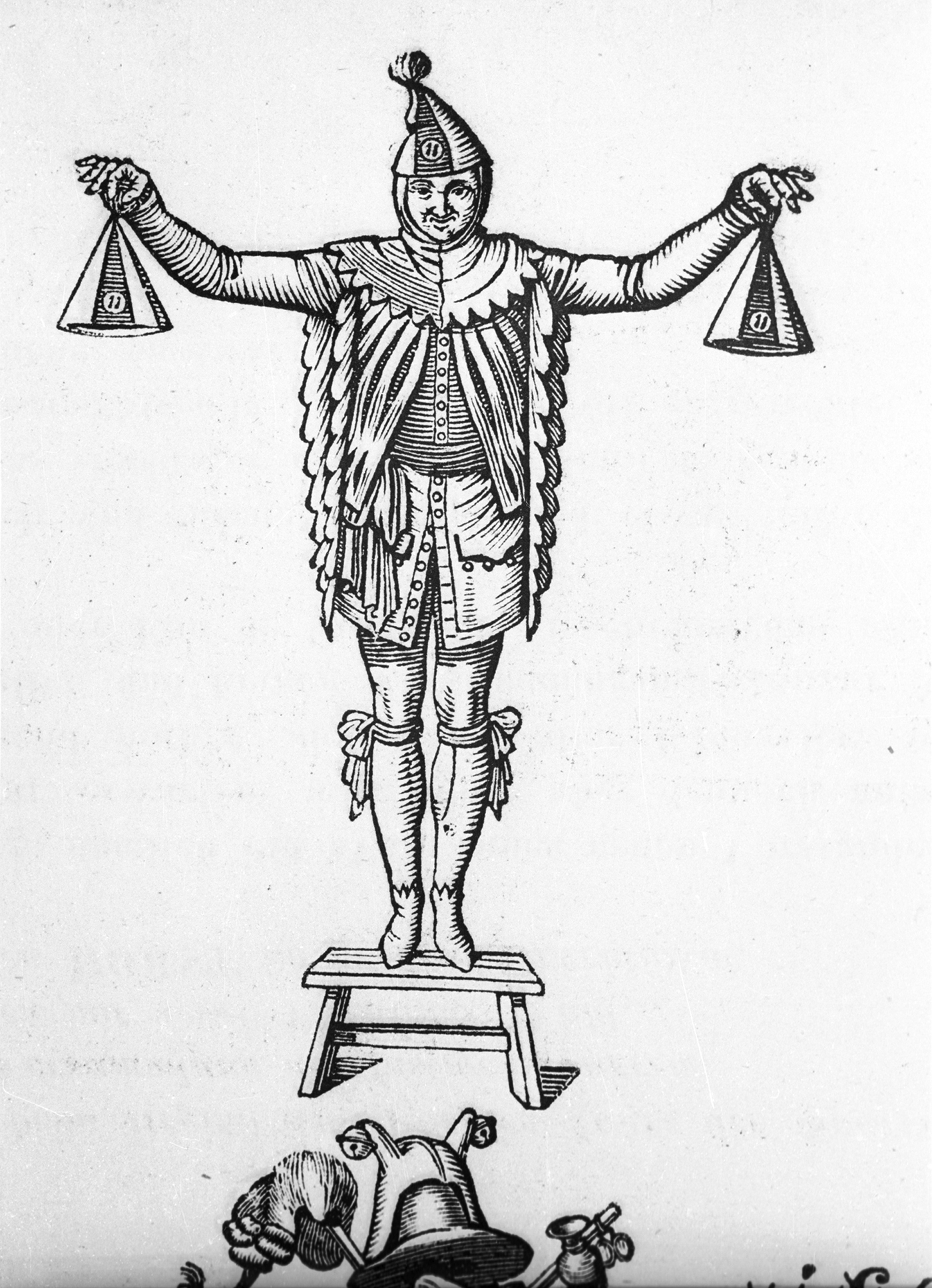
The number's appearance in nineteenth-century celebrations reveals both its ubiquity and the actual instability of its meaning. It proliferated particularly as a symbol on Carnival caps. This was not coincidental as many Carnival societies officially adopted the cap as a symbol of its members' equality.Footnote 64 An 1829 image that appeared in numerous prints combined the cap and “11” by illustrating a carnivalist with a Jacobin-like cap inscribed with the number (Figure 4). Standing on a stool, the figure holds two identical caps at his sides at a perfect ninety-degree angle. The association of both the number and the cap with equality in this image is clear.Footnote 65 It is also clear, however, that many did not understand the meaning of this symbolism. Just one year previously, Johanna Schopenhauer described the number's appearance in Cologne Carnival during her visit in 1828. Reporting the myriad of ways that it entered into celebrations, such as the opening of festivities with eleven cannon shots and the prevalence of caps inscribed with the numeral, she reported that no one whom she encountered seemed to know exactly what the numeral meant.Footnote 66 While democratic leaders of Carnival associations must have pushed these new interpretations, the number eleven remained an empty signifier for many citizens who lacked memory of older meanings.
Sketch of a carnivalist with three Carnival caps inscribed with the number 11. This print appeared in several printed Carnival works after 1823. Source: Rheinisches Bildarchiv, L 2172/50.
Just as modern Rhenish carnivalists imagined new enemies for the Carnival Empire in “Griesgram” and “Muckertum,” some also began to view their tradition as embodying a foil to Prussia, the new sovereigns of the Rhineland. Historical studies have sharply disagreed on the presence of anti-Prussianism in nineteenth-century Carnival. Hildegard Brog has argued that nineteenth-century carnivalists emphasized Rhenish exuberance as a sign of overt opposition to Prussian strictness and rigidity. She argues that an entrenched antiauthoritarian vein existed in Rhenish Carnival that fed into anti-Prussianism.Footnote 67 Other scholars, such as Herbert Schwedt and Max-Leo Schwering, have denied the presence of anti-Prussian sentiment in nineteenth-century Carnival, with Schwering even arguing that, in some ways, Carnival brought Prussians and Colognians closer together.Footnote 68 While the detailed arguments of these scholars cannot be iterated here, the presence of anti-Prussian sentiment in the early-nineteenth-century Rhineland is well established.Footnote 69 I would argue, moreover, that anti-Prussianism in nineteenth-century Cologne Carnival is best understood not in terms of ubiquity or absence, but rather as a new, inchoate layer of meaning projected onto the tradition. The contestedness of this layer of meaning can be seen in varying perceptions of the military uniforms worn by the members of Carnival associations. Notions of Carnival as an “anti-Prussian” tradition have relied heavily on these Carnival military figures (Funken), who supposedly parodied Prussian militarism. Carrying fake wooden rifles and dancing the “Stippeföttche,” a dance consisting largely of posterior rubbing, these military figures are viewed by contemporary Colognians as mocking Prussian militarism.Footnote 70 Historical research, however, demonstrates that Carnival reformers introduced the uniforms in 1823 to promote the memory of Cologne as a Free Imperial city.Footnote 71 Nineteenth-century depictions of the soldier uniforms illustrate the ambiguity of their use for anti-Prussian persiflage. Such depictions vacillated between presenting the soldiers as a respectable Imperial military force or contrarily as a rag-tag disordered group portrayed in the unflattering style of parody.Footnote 72 The notion that Cologne Carnival contained little or no anti-Prussian persiflage is also questionable given our knowledge of nineteenth-century Colognian localism.Footnote 73 Cologne's famous Hänneschen Theater, for example, was well known for its anti-Prussian marionette plays. Two stock characters of their plays, Tünnies and Schäl, invariably performed nasty Carnival tricks on the rigid Prussian policeman, Schnäuzerkowski. Local citizens saw in Tünnies the embodiment of their carnivalistic natures, making him the personification of Cologne in popular folklore.
The nineteenth century also witnessed attempts to imbue Cologne Carnival with a layer of nationalist meaning, presaged by Goethe who advocated that the tradition be made into a national Volksfest. In the first half of the century, these attempts drew on a more open notion of nation. In their attempt to “poeticize” and shape Cologne Carnival as a national Volksfest, organizers made a host of artistic figures into honorary Cologne carnivalists in 1839 and invited them to contribute to the “poetic depiction” of Carnival through new melodies, sketches, or ideas. Such invitations were extended not only to German cultural figures, but also to foreign artists such as Donizetti, Nicolini, Vernet, and Victor Hugo.Footnote 74 By the latter half of the nineteenth century, nationalism in Cologne Carnival took a more exclusionary turn. Alongside the frequent singing of Deutschland über Alles, late-nineteenth-century Carnival songs often contained the topoi of the Watch on the Rhine, and the Germanness of their river. Anti-French Carnival songs denounced the “welsh hen,” while others denounced Denmark and praised the banding together of German brothers to free Schleswig-Holstein from Danish chains.Footnote 75 Such nationalist sentiment in late-nineteenth-century Carnival often intermixed with pro-Prussian sentiment. This was seen in 1870, with the changing of the Carnival monarch's title from “Hero Carnival” to “Prince Carnival” in honor of the Prussian king.Footnote 76 Such nationalist sentiment, however, did not extinguish anti-Prussianism in the festival. Carnival floats in 1904 and 1914, for example, continued persiflage of Prussian militarism and excessive demand for order.Footnote 77
In short, nineteenth-century Cologne Carnival became a contested site in terms of the political meaning projected onto the tradition. The fundamentally participatory dynamic of the tradition and its lack of distinction between performers and observers both did much to encourage the formation and maintenance of such divergent political meanings. Barring state action, rival groups structured their own celebrations according to different political transcripts. The breakup and creation of new Carnival societies very much demonstrated this phenomenon. The first of such splits took place in the 1840s, when the democrat Franz Raveaux led a group of more revolutionary carnivalists in breaking from the main bourgeois organization. The result was a more democratic, critical, and anti-Prussian Allgemeine Karnevalsgesellschaft and a more elitist Große Karnevalsgesellschaft.Footnote 78 After 1870, in addition to the often anti-Prussian Rote Funken, the Blaue Funken became a focal point of nationalist and pro-Prussian carnivalists. By the end of the century, Cologne boasted an array of different Carnival societies, with divergences between the “wild societies,” the disorder of street Carnival, those for a politically critical festival, and the Carnival societies of order and respectability.Footnote 79 The decentralized structures and the festival's participatory nature permitted celebrants space to observe the tradition on their own terms, without having to seize control of central organization in the process.
What remained ubiquitous throughout the nineteenth century, however, was the idea of Carnival as a positive embodiment of a Colognian character of gaiety and breaking with the “evil” forces of rigidity. By the end of the century, these meanings were bolstered and augmented by industrialization, in which Cologne Carnival became an oasis from “exhausted nerves,” “uniformity and monotony,” and “daily work.”Footnote 80 In 1904, Cologne's mayor argued that their Carnival was a “fountain of youth” in which the “worn-out” workers regained their strength.Footnote 81 Another turn-of-the-twentieth-century Cologne Carnival celebration, arranged for patients of a psychiatric ward, revealed a similar mentality. The doctors of the institution argued for the salutary effect of Carnival on the patients, with reporters writing that the organization of the celebration demonstrated a love of neighbor in a society that was bidding farewell to the “straight jacket.”Footnote 82 Into the twentieth century, this valence of meaning remained strong, though, as we shall see, later generations continued to reformulate understandings of older forms of tradition.
“Ancient Germanic” Revelry and “Coordinated” Fastnacht
Cologne Carnival in the first half of the twentieth century was most typified by the absence of celebration. The outbreak of World War I and subsequent allied occupation of the Rhineland led to the cancellation of Carnival from 1914 to 1924. Many approved of the pause during the war while “Colonia's sons” fought in the field.Footnote 83 Locals, however, looked jealously at the explosion of Carnival in unoccupied Düsseldorf in 1919.Footnote 84 Stringent bans prohibited public celebrations or any events that included Carnival poems, games, singing, or costuming.Footnote 85 Local celebrations were relegated to private family events, with the police quickly stopping random Carnival processions.Footnote 86 Locals frequently expressed concern that the long period without observance could lead to the tradition's disappearance. Fervid desire to resume its observance expressed itself, among other places, in the placement of Carnival themes on local emergency currency bills. With the lifting of the ban in 1924, a triumphal spirit of the tradition's invincibility emerged in local discourses. As one commentator wrote, while the thrones of Europe may fall, the throne of Prince Carnival would remain standing. The introduction of children's celebrations reflected new emphasis on passing the tradition on to future generations.Footnote 87 The determined spirit of carnivalists to maintain the tradition demonstrated its continued hold on the local imagination. Nevertheless, a lack of money put a significant damper on celebrations.Footnote 88 Street Carnival during the Weimar Republic paled in comparison to the years of the Empire.Footnote 89 The festival was used, however, to confront some of the trauma of the period. Celebrations could be found, for example, that were dedicated to burned, wounded, and amputee war veterans.Footnote 90
Given the degree of political struggle in the Weimar period, the role of politics in Carnival during this period was surprisingly small. Political societies such as a local society of socialist Carnivalists continued to exist, though Carnival rarely became entangled in the political turbulence of the period. The 1931 celebrations were one of the few exceptions, with Nazis and Communists holding rallies during events. A small group of Hitler Youth also dressed in military uniforms and marched in lockstep through the streets. An article in the Lokalanzeiger argued that there was something “false” and “disharmonious” about the display and reported that it was drowned out by normal Carnival celebrations.Footnote 91 Even when such political moments emerged, however, Carnival during the Weimar Republic was noted for a surprisingly low level of violence and criminality.Footnote 92
Following the Nazi seizure of power in 1933, Cologne Carnival faced Nazi “coordination” as the party moved to take control of its organization, thus ruffling some carnivalist feathers. It also became a moment of attempted top-down reinvention of the tradition as a purely Germanic festival. Historiography of Cologne Carnival during the Third Reich, however, has revolved around debates over the degree to which it became a point of resistance. While Klersch held that Cologne carnivalists demonstrated the incompatibility of their tradition with Nazism, Schwering argued that they only objected to Nazi attempts to restructure Carnival societies.Footnote 93 Schwering argued that the content of events was never a subject of discussion and that carnivalists were often supporters of Nazi goals.Footnote 94 Carl Dietmar and Marcus Leifeld, in a recent work, have convincingly argued for a more nuanced assessment by viewing celebrants as an intermixed group of enthusiastic regime supporters, regime conformers, and those who exercised cautious resistance.Footnote 95
The ambiguity of carnivalist responses to the Nazi regime manifested itself from the first celebrations in 1933. A parliament of Carnival societies met after the seizure of power to decide whether to cancel events given recent political developments. Deciding against cancellation, they sought to shield themselves by asserting Carnival's “unpolitical” nature. Cologne's chief of police followed up on this point by insisting that all Carnival celebrations refrain from politics.Footnote 96 In 1933, Carnival remained peaceful, while the introduction of the new Veedelszoch, a parade of Cologne's city quarters, was added as previously planned to broaden popular involvement in Carnival presentations. In the coming years, however, defining the meaning of Carnival would be anything but broadly participatory. The regime began taking steps to control Carnival, infuse it with propaganda, and portray it as an ancient Germanic festival. The creation of a new national organization, the Bund Deutscher Karneval, permitted more central control. Carnival groups such as the Rote Funken, which formerly had Jewish members, were required to remove them and forbid non-Aryans from joining.Footnote 97 The Nazis also removed prerogatives from traditional societies and placed the festival under the authority of Kraft durch Freude (KdF).
Nazi cultural authorities insisted that the festival would remain a “down-to-earth traditional Carnival,” while simultaneously portraying themselves as the rescuers of the festival who would make it rise like a “phoenix from the ashes.”Footnote 98 In spite of such reassurances, new levels of organizational control alarmed some. The party mandated that Carnival speeches, notorious for political critique, be censored and remain unpolitical. Two Cologne newspapers openly opposed these changes, arguing that they did away with the true spirit of the festival.Footnote 99 The Nazis also clamped down on the long tradition of cross-dressing in Carnival. They decreed that the Jungfrau of the Carnival triumvirate and all dancing maidens, traditionally depicted by men in drag, be played by women.Footnote 100 Arguments against the practice included concerns that it could cause “gender sickness.”Footnote 101 While carnivalists accepted some changes, a push-back occurred against plans for an umbrella society with broad control over local Carnival societies. Five presidents of major societies issued a letter rejecting the plan, which city newspapers printed under the title “Cologne's Jesters Revolt.”Footnote 102 The group insisted, among other things, that the new plans would threaten the local uniqueness of the tradition, though they reiterated the line that Carnival was supposedly unpolitical.Footnote 103 The Westdeutscher Beobachter, the local mouthpiece of the Nazi party, shot back at the carnivalists, insisting that they were poor guardians of the folkish tradition and that their societies had been hotbeds of Jewish influence.Footnote 104 Following Carnival society threats to boycott celebrations, the plans for a new umbrella organization were scrapped.
Beyond this confrontation, however, coordination of Carnival continued without major opposition. Uncooperative carnivalists were firmly dealt with through bans on contributing to celebrations. The famous Carnival speaker Karl Küpper, for example, received such a ban for masking jokes about the regime behind double entendre and Colognian dialect. One of the few appearances of overt anti-Nazi sentiment occurred in 1938 with the publication of a mock Rosenmontagszeitung, the newspaper traditionally distributed to display parade floats. One float depicted a Nazi officer milking Germany portrayed as a malnourished cow, proclaiming his hatred for Jews and milk inspectors. Another float draft depicted a fiendish skeleton and Nazi soldiers, with the caption “With everything around us going up in flames, we have the FÜHRER to thank.”Footnote 105 Such forms of resistance in Carnival, however, were few and far between. It would be as wrong to create a mythology of broad opposition as it would be to ignore moments of its occurrence. No societies, for example, registered any protest to two antisemitic Carnival floats put out by KdF in the late 1930s. While Weimar Cologne had its own Jewish Carnival society, the Kleiner Kölner Klub, no carnivalists protested the exclusion of the Jews from the tradition.Footnote 106
As Nazi cultural figures sought to refashion Carnival as an ancient Germanic tradition, they attempted to negate notions that it had either medieval Christian or Roman origins.Footnote 107 Such attempts were particularly undertaken in the press and often focused on the origin of the term “Fastnacht.” The Nazi line rejected its derivation from the word “fasting,” in spite of Carnival's celebration prior to Lent. Rather, they insisted that it derived from the ancient Germanic word “vaseln,” meaning to thrive or to be joyous, with “Karneval” being a foreign word used to refer to the ancient festival.Footnote 108 A 1938 article, which reiterated such theories, insisted that Carnival was a pagan spring ritual whose meaning was about growth and the fertility of nature, concluding that “ancient memories of a pre-Christian system of belief resonate within it.”Footnote 109 While popular interpretations of Carnival's origins previously held that it emerged from Roman or a mixture of Roman and Germanic traditions, the Nazis sought to isolate and magnify notions of its Germanic origins while suppressing ideas of its Roman origins.Footnote 110 Traces of Carnival's supposed Roman origins were to be extinguished. Rather than giving Carnival monarchs Latin names, such as “Jungfrau Colonia” or “Prinzessin Bonna,” Rhenish cities were instead to opt for Germanic names.Footnote 111 Beyond questions of origins, the Nazis also had little use for notions that Carnival embodied a Rhenish democratic character. The number eleven proved particularly inconvenient, having been historically interpreted as a symbol of equality, democracy, or Christian religion. Rather than drawing on past symbolisms, they argued that it was a lucky number that originated from the mystic science of the stars.Footnote 112 Unlike structural coordination, however, such reinterpretive efforts were not systematically pursued. Adolf Spamer, an academic with Nazi sympathies, for example, argued that attempts to tie Carnival to ancient Germanic festivals lacked sound reasoning.Footnote 113 The brief stint of Nazi control of Carnival and the scattered nature of the Nazis' reinterpretive agenda also left little time to transform public consciousness.
Postwar Cologne Carnival: Democracy, Anti-Prussianism, and Colognian Tolerance
From 1940 to 1945, Carnival celebrations were officially suspended. By the end of the war, absent most of its population, around ninety percent of the city had been destroyed. The Cologne Cathedral, the iconic symbol of the city, amazingly stood nearly untouched, towering over the ruins. As former Colognian citizens flowed back into the city from the haven of the Rhenish countryside, they sang not Deutschland über alles, but rather “Heimweh nach Köln,” a song that recounted how love of their local Heimat always drew them back.Footnote 114 Throughout occupied Germany, the years after 1945 witnessed a broad turn to localism triggered by national disaster and extreme trauma, and Cologne was no exception. The carnivalist Joseph Klersch argued that it was this turn to local sentiment that fueled successful rebuilding of the city.Footnote 115 Cologne Carnival also proved attractive to postwar citizens, given its connection to a sense of local community. The term that postwar Colognians continually used to describe the festival was the word “lebensbejahend” (life affirming). Carnival represented, as one carnivalist proclaimed, the “mobilization of life-affirming forces.”Footnote 116 Heinrich Lützeler, in his history of Colognian humor, insisted that Rhenish humor played an important role in surviving the trauma of the Third Reich.Footnote 117 The idea of Carnival as a source of healing from the trauma and destruction of war is clearly reflected in the theme for the first full postwar Carnival in 1949, “Mer sin widder do un dun wat mer künne” (“We are here again, and will do what we can”).
Small unofficial celebrations took place from 1946 to 1948, thanks in part to the help of a prewar Jewish carnivalist who convinced the British occupiers to permit celebrations.Footnote 118 One Jewish carnivalist, Günther Ginzel, who had been interned in a concentration camp, returned to Cologne and expressed a surprisingly enthusiastic sentiment for Carnival and local “Heimat feeling.” Carnival, he insisted, had an “unusual power of attraction” for Colognian Jews. He promoted it as a point of reconciliation and praised the Jewish actions of convincing the British occupiers that it was not a militarist festival.Footnote 119 Postwar carnivalists proclaimed Carnival to be an “oasis of freedom” where all would have their different views respected.Footnote 120 Gone were the ideas of the tradition as a nationalist celebration, replaced by a renewed emphasis on local sentiment that was viewed as salubrious to a decentralized vision of nation. The president of the postwar Bund Deutscher Karneval argued that Nazi Carnival downplayed the local rootedness of the festival. The postwar aims of the federation would be to reverse the “massification mill” of Kraft durch Freude and tend to the local nature of different Carnival celebrations.Footnote 121
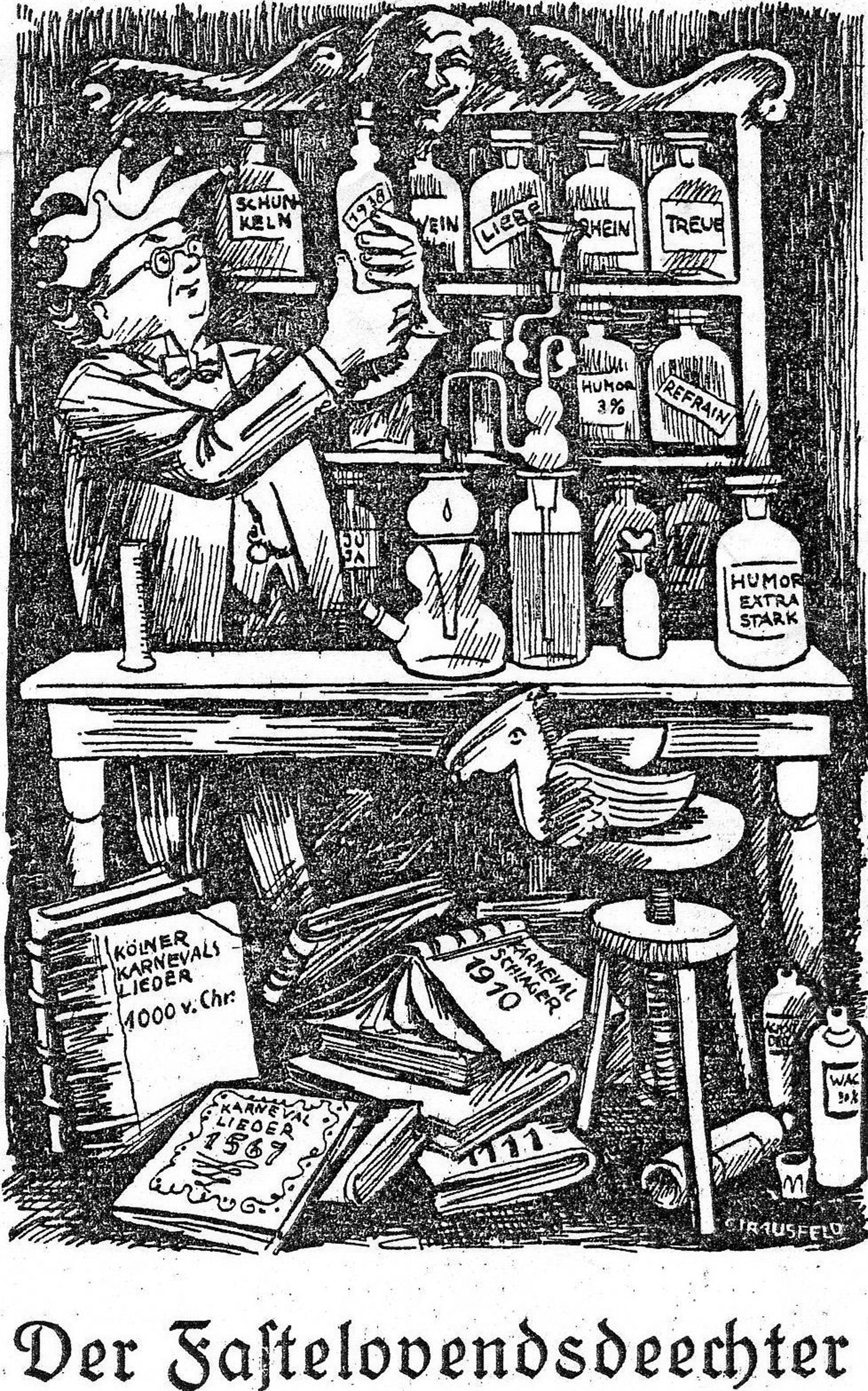
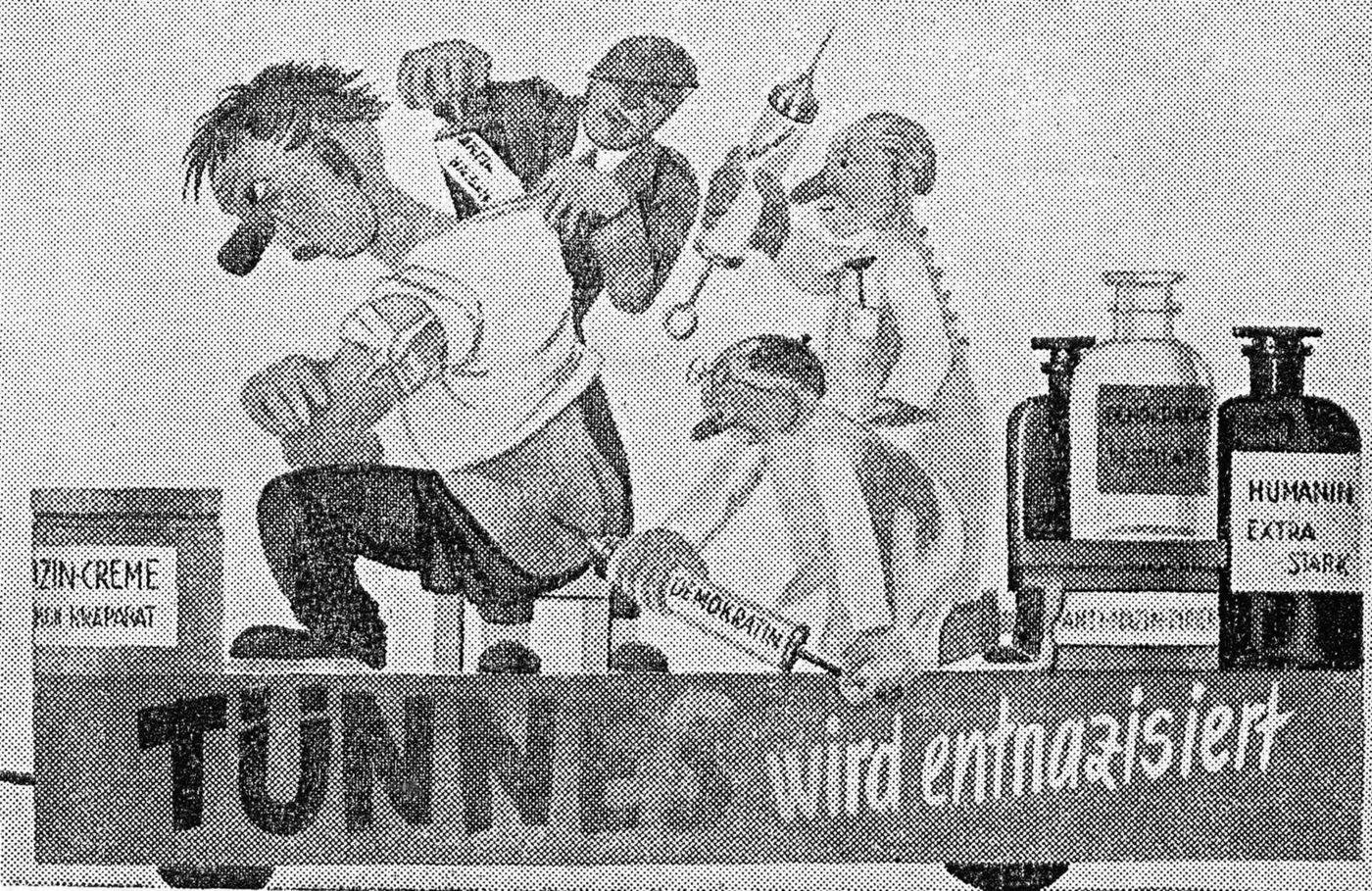
Postwar Cologne Carnival witnessed a strong resurgence of nascent nineteenth-century ideas of the tradition as containing democratic meanings connected to the idea of Colognian democracy. A comparison of two images of pre- and postwar Carnival figures again offers us a microcosm of this reinvention. The first is a 1935 sketch of the Carnival poet, whose shelves were filled with tropes of local carnivalesque identity: humor, the Rhine, the gaiety of wine and sway, Rhenish love, and Carnival songs going back to 1000 B.C. (no doubt a mockery of exaggerations of the length of the tradition) (Figure 5). The second image is a Rosenmontag float from 1950 titled “Tünnies wird entnazisiert” (Figure 6). Here Tünnies, the personification of Cologne's carnivalistic natures, receives a thorough medical treatment after Nazi efforts to inculcate him with negative values. He is surrounded by a team of physicians and medicines, titled “Anti-Nazi Cream,” “Anti-Nazi Powder,” and a few doses of “Demokratin.” The resemblance of one doctor to Cologne's old Lord Mayor and new Chancellor, Konrad Adenauer, is unmistakable. Adenauer quickly became a local democratic hero, appearing on flattering Carnival floats that presented him, for example, in giganticized form sitting arm in arm with “Mother Colonia.”Footnote 122 While both satirical and non-satirical floats appeared in parades, the Tünnies float belonged firmly to the latter.Footnote 123 It was representative of clear attempts to fashion a postwar local identity linked to democracy via definition of their local “Heimat tradition.” Carnivalists such as Joseph Klersch, in the spirit of such interpretations, argued that their tradition was a festival for “democratic upbringing.”Footnote 124
“Der Fastelovendsdeechter.” A 1938 drawing of a carnival song writer, sorting through his arsenal of carnival topoi. Artist: Strausfeld. Source: Historisches Archiv der Stadt Köln, Abt 1162: 3. Zeitungsausschnitte von Karnevalsberichten, 1937, vol. I, 10.
Rosenmontag Carnival Float, “Tünnes wird entnazisiert,” 1950. Source: Rosenmontagszeitung, 1950.
Such notions had public resonance. A letter published in the Kölnische Rundschau emphasized democracy and permissiveness in Cologne Carnival. Drawing on the memory of the distrust that absolutist rulers had of Carnival, the letter insisted that it was no coincidence that the tradition had historically found its most fertile ground in a Free Imperial City. A political lesson, the writer concluded, could be found in the humor of Carnival and its power of disarmament.Footnote 125 Such notions of Carnival as a force to promote and identify with democracy, nascent in the nineteenth century, now echoed strongly throughout the Rhineland and hardened formerly inchoate notions of democratic Colognian and Rhenish identities. Works such as Anton Keim's 11 Mal Politischer Karneval argued that Carnival was a political activity, based on “Jester's Law,” that entailed challenging authority, lifting class boundaries, and permitting freedom of expression.Footnote 126 Lützeler, who propagated notions of Colognian democracy rooted in Carnival, held that it was less a “theory of state” than a “life feeling.”Footnote 127
The strong postwar turn to local sentiment also revived and solidified understandings of Cologne Carnival as embodying “anti-Prussianism.” Hostility to “Prussian tradition” flourished in local postwar discourse and manifested itself in local actions such as suggestions to rename the historic Hohenzollern bridge spanning the Rhine. One-third of Colognians supported the action as a symbolic rejection of “Prussiandom.”Footnote 128 By turning to local traditions, Heimat enthusiasts viewed themselves not as rejecting the national, but as rejecting a centralized “Prussian” vision of nationhood rooted in militarism. While anti-Prussian sentiment was certainly present in nineteenth- and early-twentieth-century Cologne, postwar Cologne carnivalists drew on such memories and thus magnified formerly contested notions of Carnival as being about anti-Prussianism. The surge of this idea manifested itself in interpretations of Carnival uniforms as mocking Prussian militarism. While such interpretations remained inchoate in the nineteenth century, they became unambiguous in the postwar period. In one poll, seventy-three percent of postwar Colognians responded that the military costumes were anti-Prussian persiflage.Footnote 129 Prominent carnivalists such as Joseph Klersch propagated this interpretation. Lützeler did the same, insisting that these Carnival soldier figures embodied pacifism and disrespect for authority, with oranges in their cannons and chocolates in their war sacks.Footnote 130 The Festkomittee Kölner Karneval also promoted anti-Prussian persiflage, arguing that Carnival medals of honor, worn on Carnival uniforms, disparaged Prussian military pomp and critiqued the Prussian “cult of medals.”Footnote 131
While postwar notions of Carnival as democratic and anti-Prussian magnified previously contested notions, the idea of “Colognian tolerance” rooted in Carnival was a new postwar claim that became a ubiquitous catchphrase in the city's self-understandings. The phrase can be found peppered throughout contemporary Cologne Carnival songs and in popular Kölschrock songs, a genre sung in local dialect. In spite of its contemporary ubiquity, the phrase “Kölner Toleranz” is nowhere to be found in prewar Carnival songs, images, discourses, Carnival speeches, and so forth. Yet, by 1960, the Carnival Prince, Peter IV, praised the spirit of “Colognian tolerance” and its “power of assimilation,” while others bragged about the number of selected Carnival princes who were not native to Cologne as affirming the “spirit of Colognian tolerance.”Footnote 132 While the idea of Carnival as embodying “Kölner Toleranz” proliferated after the 1950s, it was preceded by attempts by some to construct a notion of local identity based on inclusion rather than the exclusion of the outsider. In the face of the influx of eastern expellees, a local professor argued during the 1948 Carnival season that Colognian life was about including those from outside the city.Footnote 133 Local Heimatkundler, such as Klersch, pushed the notion of a Colognian tradition that embodied “forbearance” and “world openness,” insisting that Colognian tradition was about embracing those from the outside—“wer vun druuße kütt.”Footnote 134 To the south, Mainzer carnivalist Anton Keim argued similarly that “the true jester practices tolerance!”Footnote 135
Postwar Colognians also attached the locally unique concept of the “Jeck” to notions of Colognian tolerance. The term Jeck, which existed for centuries, was a carnivalistic way of referring to one's fellow man. During the 1954 Carnival season, an article in the Kölnische Rundschau insisted that the local term embodied “good-naturedness,” “tolerance,” and understanding between different people. The author wrote that the idea of the “Jeck” expressed the rights of individuals to their own “Jeckigkeit”—their own individuality, which demanded respect. To be a Jeck, he argued, was to say “you are as you are. . . . no judgment, no exclusion, no offense.”Footnote 136 Aphorisms tied to the Jeck concept proved useful for fashioning such interpretations. Sayings such as “Jeck sin mer all, ävver jede Jeck eß anders” (“We are all Jecks but every Jeck is different”), which existed prior to 1945, became ubiquitous in postwar Cologne.
While the idea of Carnival embodying Colognian tolerance was a recent notion, Carnival proved well suited to bear these new constructions. Being an inherently participatory festival “without footlights,” Carnival was, to use Bakhtin's words, “vividly felt by all its participants.”Footnote 137 It would be wrong, however, to exaggerate the descriptive breadth of the idea of a local tradition of “tolerance” rooted in their Carnival tradition. Carnivalist localism could also take exclusionary turns. One female Carnival enthusiast, for example, insisted in 1953 that only native Colognian girls should participate in Weiberfastnacht, the celebration on Carnival Thursday when male authority is turned upside down.Footnote 138 Some local enthusiasts argued that integrating outsiders into the community was welcome, as long as they did not make native Colognians a minority.Footnote 139 Moreover, notions of Cologne Carnival as containing traditions of democracy, tolerance, and openness did little to assist in coming to grips with the Nazi past—even if they seldom claimed that such notions influenced valuations of their participation in Nazi crimes. Within Colognian local culture, moreover, shibboleths continued to exist that excluded the outsider, such as the idea of the “Imi” or the “imitation Colognian” that was applied to those not native to the city. In spite of the concept usually being used in carnivalistic jest, its power of exclusion was real.
Nevertheless, the impulse of such identity claims had performative potential and, in some sectors, spurred attempts to be more inclusive. By 1960, both the Lord Mayor of Cologne and the president of the Standing Committee of Cologne Carnival stated that the word “Imi” was obsolete and should be done away with.Footnote 140 Later generations, far from being passive receptacles, actively shaped notions of Colognian tolerance. Progressive localists, for instance, argued for the use of Carnival to promote inclusion of immigrants. In 1961 one carnivalist wrote of the importance of considering the city's immigrants in arranging the festival so that they could win over their affections for the city.Footnote 141 Jan Brügelman, the head of the Verein der Freunde und Förderer des Kölnischen Volkstums, argued for vigilance in fighting against all forms of exclusivity in the tradition.Footnote 142 Attempts to extend the idea of carnivalesque tolerance to include the embrace of foreigners, however, remained an ongoing process. In 1976, for example, a controversial float appeared in the Rose Monday parade that portrayed a Turkish immigrant rhapsodizing about the beauty of the Rhine and pushing a pram filled with dozens of babies holding child-benefit money. Immigration supporters subjected the floats to egg attacks, while the float drafters received a stern rebuke from Heinrich Böll, who argued that such mockery was counter to local tradition. Böll argued that Cologne Carnival was about mocking secure authority figures and should not be used against minorities and vulnerable groups.Footnote 143 More tolerant voices won out in 1992, when Cologne Carnival musicians and dialect bands held a concert in response to right-wing attacks on immigrants. The concert entitled “Arsch huh, Zäng Ussenander” (“Stand up and open your mouth!”) was attended by 100,000 participants and denounced intolerance toward foreigners.Footnote 144
Many contemporary carnivalists have also reformulated the notion of Colognian tolerance to mean acceptance of the city's large gay and lesbian community. Indeed, Cologne not only has the largest Christopher Street Day (CSD) celebration in Germany, but is also the only one that includes a locally patriotic Carnival call (“Kölle Aloha!”), which organizers teach celebrants to say with a demonstrably limp wrist. The gay Carnival society, the Rosa Funken, which became a full member of the Festkomitee Kölner Karneval, has appeared in both Carnival and the CSD parade, wearing the eighteenth-century uniform of the Imperial city soldiers—only in pink instead of red. Contemporary Carnival songs, such as the cult-classic Viva Colonia, emphasize Cologne's sexual progressiveness as evidence of its tolerance. Given the origins of the medieval pre-Lentian festival as a religious metaphor, contemporary notions of Cologne Carnival as containing a localist tradition of tolerance that includes sexual minorities demonstrates the sheer capacity of the tradition's meaning to evolve. Such reformulations, furthermore, have not only altered how celebrants understand the meaning of the tradition, but they have also offered a means through which the content of local identities themselves could be changed and modernized.
Conclusion
While much attention has been given to traditions invented in the recent past, examination of longer-standing traditions, such as Cologne Carnival, illustrate the often dynamic processes of reinvention to which such traditions were subject. Though radical changes in meaning could occur over time, the point of this study is not to argue for the “inauthentic” nature of such traditions. As Regina Bendix convincingly argued, the idea of the authentic is itself a discursive construction rather than an objective transcendent category to be wielded by the scholar.Footnote 145 Rather, this study argues for the need for more focused analysis on the routes of reinvention and theoretical consideration of the phenomenon. This study has specifically focused on the case of performed ritual tradition and the need to consider how continuities in outer forms of such traditions can mask radical processes of change. As the case of Cologne Carnival demonstrates, while effective mimetic transmission of historical forms across multiple centuries proved successful, the origins of the tradition in a distant past of which little was documented and publically known permitted broad imaginings and reinvention of meanings. Temporally specific meanings were often projected into the distant past in the process.
Cologne Carnival provides an example of the often radical changes in meaning that could result from such processes. Evolving from a medieval understanding of the tradition as a representation of the evil and fallen state of man (values to be rejected and overcome on Ash Wednesday), nineteenth-century Cologne Carnival demonstrated a fundamental transformation from the medieval to the modern. No longer the metaphor of evil human natures, the tradition had been appropriated by modern local identities and became a metaphor of local and regional natures to be embraced. While many symbols of medieval Carnival remained, constructed understandings of these symbols had undergone substantial reformulation. The notion of Carnival as an embattled state continued, but as a state of a quite different nature. Carnival's devilish figures went from being the allies of the Carnival state, who fell with the ultimate victory of Lent, to symbols of “curmudgeondom” and “lifeless sobriety” that were destroyed by the modern Rhenish “Carnival Empire” in a glorious battle of Rhenish exuberance.
A host of other diachronic slippages between form and meaning reflect these processes. While the ship of fools endured into the modern tradition, it no longer sank as a result of human wickedness. Rather, it stayed afloat as long as local celebrants kept up their “happy song.” The Carnival jester remained, but appeared as a gallant, positive, and locally patriotic figure rather than as a cannibalistic devil, sadist, and torturer of Christ. Yet other slippages in the panoply of Carnival forms demonstrate efforts to instill Carnival with politicized meaning, such as the idea of the Carnival number eleven as a democratic symbol. Even newly invented forms, such as Carnival uniforms, were subject to revisions of their symbolic content, representing at different times and to different people a symbol of Cologne as a Free Imperial City or a critique of Prussian rigidity and militarism. Carnival, moreover, proved capable of reinterpretation as a “national folk festival,” or, due to the haze of its historical origins, as an ancient Germanic tradition. In the postwar period, it lent itself equally well to interpretation not only as an embodiment of Colognian jollity, but also to Colognian tolerance, openness, and democracy. Notions of a local tradition of tolerance rooted in Carnival acted itself as a sliding signifier that meant tolerance toward different groups for different generations of localists.
Longue durée history, I have argued, is a crucial tool in uncovering processes of reinvention. A host of traditions with genuinely long histories could greatly benefit from such treatment with an eye toward reinvention. Sharpshooter festivals, to present but one example, have existed since the Middle Ages and continued through massive changes in military systems, state structures, the rise and fall of a host of ideologies, and appropriation as local or national festivals.Footnote 146 Church anniversary festivals, the origin of the modern Kirmes, would likewise benefit from longue durée analysis, as would a host of long-standing local traditions in the realm of folk culture.Footnote 147 In the European Carnival tradition itself, the tradition of gender inversion has a history extending back centuries and deserves analysis over the long haul. More explicit considerations of how reinvention played out in an array of long-standing traditions would help further expand our knowledge of such processes and elucidate open-ended questions. How, for example, did other constellations of factors regarding public participation, borders between performer and audience, structures of control, the presence or lack of circulating documentation of former meanings, etc., facilitate or hamper processes of reinvention in other traditions? To what extent have the extinction of certain traditions resulted from an inability to be reinvented?
Finally, like research of invented traditions, probing reinvention also entails deconstructing narratives of continuity propped up by modern identities for which traditions have been appropriated. While, in the case of Cologne Carnival, modern localists recognized outward developments of form, in the popular imagination, meaning was timeless. Joseph Hoster, the capitular of Cologne, expressed precisely such a sentiment in 1945 in the face of historic destruction of the city, drawing a metaphor between local tradition and the human body. While every seven years its cells were replaced, in its “inner essence,” he insisted, it never changed.Footnote 148 Here, I have argued precisely the opposite. Indeed, it is often where outer forms of tradition remained continuous that some of the most radical diachronic changes could occur.