Introduction
Few options exist for nonchemical control of weeds during raspberry establishment (Mitchell et al. Reference Mitchell, Hawes, Iannetta, Birch, Begg and Karley2018). Current options typically involve repeated soil cultivation (including hand-hoeing) to kill weeds and various types of mulches (including weed mats) to suppress weed emergence and growth. Specific information for these management techniques is limited. For instance, depth of soil cultivation should not exceed 5 cm to prevent damage to developing roots and cane buds (Barney et al. Reference Barney, Bristow, Cogger, Fitzpatrick, Hart, Kaufman, Miller, Moore, Murray, Rempel, Strik and Tanigoshi2007), but specific methods of cultivation usually are not stated in raspberry production guides. In contrast, more information is available regarding mulches, which can be based on shredded plant materials, woven plant-based (biodegradable) and synthetic fabrics, and polyethylene films (Barney et al. Reference Barney, Bristow, Cogger, Fitzpatrick, Hart, Kaufman, Miller, Moore, Murray, Rempel, Strik and Tanigoshi2007; Hammermeister Reference Hammermeister2016). Although mulches can control weeds effectively, they also are associated with a wide variety of production issues, both physical and biological. For instance, soil cultivation is incompatible with mulches of all types, and polyethylene and biodegradable mulches may increase levels of deleterious nematodes in raspberry plantings (Zhang et al. Reference Zhang, Miles, Ghimire, Benedict, Zasada and DeVetter2019). Polyethylene mulches also present an eventual disposal problem for growers. Another nonchemical form of management, thermal weed control (flaming and steaming), is not common in raspberry production.
Although a few herbicides are labeled for use during raspberry establishment (Peachey Reference Peachey2019), new weed control techniques are needed for growers and consumers who desire fruit produced without the use of synthetic herbicides (Mitchell et al. Reference Mitchell, Hawes, Iannetta, Birch, Begg and Karley2018). Furthermore, given the rapid and extensive evolution of herbicide resistance in recent decades, new strategies of weed control are needed (Beckie et al. Reference Beckie, Ashworth and Flower2019). One possibility for this is the application of abrasive grits for POST weed control. Grits applied at high air pressures (Forcella Reference Forcella2009) can eliminate weed seedlings entirely and abrade and damage larger weeds. Several types of plant- and animal-derived products can be used as abrasive grits, including nitrogen-rich materials such as pelletized poultry manure (Braun et al. Reference Braun, Lovell, Babadoost, Forcella, Clay, Humburg and Wortman2019) and corn gluten meal (Forcella et al. Reference Forcella, James and Rahman2011), as well as many carbon-rich residues like corn cobs, grape pomace, olive pits, and spent coffee grounds (Forcella Reference Forcella2017, Perez-Ruiz et al. Reference Perez-Ruiz, Brenes, Urbano, Slaughter, Forcella and Rodríguez-Lizana2018). To date, abrasive grits have been used successfully to control weeds in agronomic crops such as corn and soybean (Erazo-Barradas et al. Reference Erazo-Barradas, Forcella, Humburg and Clay2018, Reference Erazo-Barradas, Friedrichsen, Forcella, Humburg and Clay2019) and horticultural crops like tomato and pepper (Braun et al. Reference Braun, Lovell, Babadoost, Forcella, Clay, Humburg and Wortman2019; Wortman Reference Wortman2014, Reference Wortman2015). However, the usefulness of this new technique in high-value, perennial crops such as red raspberry is unknown. Accordingly, we explored the use of corn-cob grit to control weeds during the establishment year of red raspberry over 2 to 3 years at three sites in Minnesota.
Materials and Methods
Field experiments were established during May in the following years and sites. Site 1, used in 2017, 2018, and 2019, was at the West Central Research and Outreach Center (WCROC), Stevens County, MN (45.59°N, 95.87°W), which is an experiment station operated by the University of Minnesota. Soil type was a McIntosh silt loam (fine-silty, mixed, superactive, frigid Aquic Calciudoll) in 2017 and an adjacent complex of Langhei loam (fine-loamy, mixed, superactive, frigid Typic Eutrudept) and Barnes loam (fine-loamy, mixed, superactive, frigid Calcic Hapludoll) in 2018 and 2019. Previous crops were grass-based pasture and strawberry [Fragaria × ananassa (Weston) Duchesne ex Rozier ssp. ananassa]. Site 2, used in 2018 and 2019, was at the Fairhaven Farm, Stearns County, MN (45.32°N, 94.22°W), which is a privately owned commercial farm that emphasizes a wide variety of traditional and exotic horticultural crops that can be grown in the region. Soil type was an Arvilla sandy loam (sandy, mixed, frigid Calcic Hapludoll). Previous crops were cucurbits. Site 3, used in 2018 and 2019, was at the Prairie Horizons Farm, Pope County, MN (45.46°N, 95.55°W), which is a certified organic farm specializing in cattle production with incipient interests in organic fruit production. Soil type was a Langhei-Barnes loam. Previous crops were garlic (Allium sativum L.).
Soil was cultivated to produce residue-free beds for transplanting raspberry canes in May each year. Plots were 300 cm long and contained four 30-cm-tall transplants spaced at 75-cm intervals and planted at 10-cm soil depth. Raspberry rows were separated from other rows by at least 200 cm. The raspberry cultivar was ‘Caroline,’ and clonal materials were supplied each year by Nourse Farms, South Deerfield, MA.
Three treatments were implemented: a weedy check, hand-weeded, and grit-weeded, all of which are described in detail in the following paragraphs. Treated plots were arranged in a randomized block design with four replications. Treated areas of each plot were 300 cm long and 60 cm wide.
In the weedy check treatment, weeds grew unimpeded from the transplant date until late July. Weeds in the hand-weeded treatment were hoed manually or pulled by hand semiweekly to biweekly; time spent hand-weeding was recorded with stop watches.
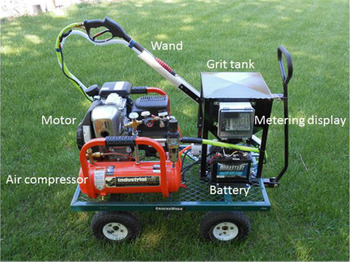
Grit-weeding consisted of applying commercially available corn-cob grit at 700 kPa using a portable grit applicator (Figure 1). The applicator was mounted on a small, hand-pulled, garden wagon. It consisted of a gasoline-powered air compressor, wand tipped with a single nozzle, and grit tank with a battery-powered grit metering system. Flexible nylon tubes connected the air compressor to the nozzle and the grit tank and meter to the nozzle. A vacuum created by air flowing through the nozzle drew grit from the grit tubes into the nozzle. This dual-tube system helped prevent clogging of the air tube by grit.
Single-nozzle grit applicator comprises a gasoline-powered motor and air compressor, a grit tank, and a meter that regulates the amount of grit dispensed to an air stream created by the compressor, which passes through the hand-held wand tipped by a single nozzle.

For WCROC and Fairhaven Farm, grit particles were approximately 0.5 mm in diameter and had a specific gravity (±SE) of 0.43 ± 0.005 g cm−3; these characteristics matched corn-cob grits used by others (Erazo-Barradas et al. Reference Erazo-Barradas, Forcella, Humburg and Clay2018, Reference Erazo-Barradas, Friedrichsen, Forcella, Humburg and Clay2019, Forcella et al. Reference Forcella, Humburg, Wortman and Clay2017). At Prairie Horizon Farm, however, organically certified grit was used, which had a particle diameter of 1 mm and specific gravity of 0.54 ± 0.005 g cm−3.
At all sites, the nozzle of the grit applicator was positioned approximately 30 cm from the target weeds. Time spent applying grit and the amount of grit applied in each plot were recorded. Dates of grit weeding were identical to those of hand-weeding.
Weeds were harvested by clipping at ground level in late July from the entire area of each plot. Weeds were sorted into two groups (grasses and broadleaf plants), and dried at 60 C for 1 wk, and weighed. Number and lengths of raspberry canes were recorded in each plot in late summer of 2018 and 2019. Canes arising from aboveground buds on original transplants and new canes arising from belowground buds were recorded separately. Dry weights of canes also were recorded after clipping at the soil surface and drying at 60 C for 1 wk in late summer of 2017 and 2019.
All data were tested for homogeneity of variances, and treatment means and variances were calculated. Because of significant variation among years and sites for weed biomass data, year- and site-specific means were separated through single-factor ANOVA, with P level set at 0.05, and LSDs calculated. For raspberry cane data, years varied significantly but not sites. Thus, biomass data were combined across sites for 2019, and cane length data were combined across sites for 2018 and 2019. Aggregate means were separated through two-factor ANOVA for 2018 and 2019, whereas single-factor ANOVA was used for 2017 data. P levels were set at 0.10, and LSDs were calculated.
Results and Discussion
Weed control
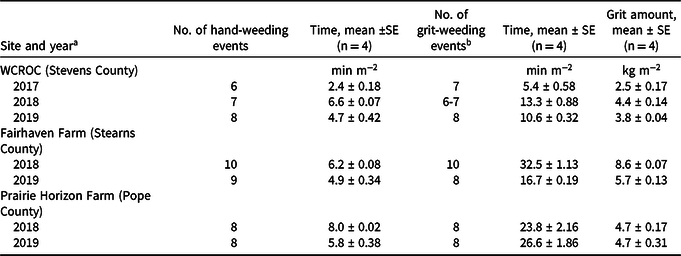
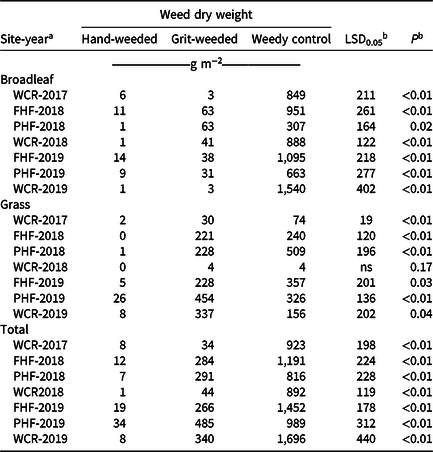
Hand-weeding and grit-weeding occurred six to 10 times (Table 1) during spring to mid-summer, depending on individual plot needs, duration of weed emergence, and weed growth. As expected, hand-weeding nearly eliminated all weeds (Table 2). Grit-weeding also reduced weed biomass appreciably, but some species clearly tolerated abrasion more than others. Dry weights of broadleaf weeds, which were the predominate weeds at all sites, were reduced significantly (P < 0.01) compared with the weedy check treatments in each of the seven site-years (Table 2). Prominent broadleaf species found in the weed-control treatments included primarily annual plants such as common lambsquarters (Chenopodium album L.), redroot pigweed (Amaranthus retroflexus L.), hairy galinsoga [Galinsoga ciliata (Raf) S.F. Blake], common mallow (Malva neglecta Wallr.), wild buckwheat (Polygonum convolvulus L.), and Venice mallow (Hibiscus trionum L.), as well as a perennial, Canada thistle [Cirsium arvense (L.) Scop.].
Number of weeding events per season, cumulative time spent weeding, and total amount of corn-cob grit applied in red raspberry at three sites in central Minnesota over 2 or 3 y.

a Abbreviation: WCROC, West Central Research and Outreach Center of the University of Minnesota.
b Grit used at WCROC and Fairhaven Farm was from conventionally grown corn; grit diameter was 0.5 mm. At Prairie Horizon Farm, grit was from organically grown corn, and grit diameter was 1.0 mm.
Dry weights of broadleaf, grass, and total weeds as influenced by three treatments across seven site-years.

a Abbreviations: FHF, Fairhaven Farm (Stearns County, MN); PHF, Prairie Horizon Farm (Pope County, MN); WCR, West Central Research and Outreach Center (Stevens County, MN).
b LSD and P values derived from ANOVA.
Surviving plants in the grit-weeding treatments were grasses (Table 2). Grit-weeding significantly reduced grass biomass in only two of seven site-years. Surviving grasses included perennials, especially bluegrass (Poa pratensis L.), smooth brome (Bromus inermis Leyss.), and quackgrass [Elytrigia repens (L.) Desv. ex Nevski]. Annual grasses, such as foxtails (Setaria spp.), crabgrass [Digitaria sanguinalis (L.) Scop.], and barnyardgrass [Echinochloa crus-galli (L.) P. Beauv.] also survived abrasion but typically were stunted compared with those in the weedy-check treatment. In some cases (e.g., Prairie Horizon Farm in 2019), control of broadleaf weeds by grit-weeding apparently released grasses from competition so that grass biomass in the grit-weeded treatment was significantly greater than in the weedy check treatment.
Total weed biomass was consistently and significantly reduced by grit-weeding (Table 2). Overall, in terms of weed biomass reduction and when averaged across sites and years (±SE), grit-weeding provided 94% ± 2.5% broadleaf weed control, 6% ± 25.9% grass control, and 78% ± 6.1% total weed control. Last, although supporting data do not exist, observations suggested that the larger diameter (1 mm) organic corn-cob grit used at the Prairie Horizons Farm was not as effective as the smaller diameter (0.5 mm) grit used at Fairhaven Farm and WCROC. These observations are consistent with the comparatively higher weed biomasses in grit-weed treatments at Prairie Horizons Farm, relative to the weedy controls, compared with other sites.
Raspberry growth
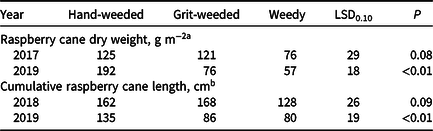
Growth of raspberry canes was affected by weeding treatments (Table 3). Raspberry growth in hand-weeded treatments always was significantly greater (P = 0.10) than that in the nonweeded (control) treatment, and it usually was greater than that in the grit-weeded treatment. The latter treatment also usually allowed significantly greater raspberry cane growth than in the control treatment, but less than in the hand-weeded plots. Thus, grit-weeding usually prevented weeds from reducing raspberry growth, but abrasion by grit may have curtailed cane growth somewhat compared with hand-weeding. Excessive amounts of grit needed for grass suppression (discussed in the next section) may have contributed to reduced cane growth.
Raspberry cane growth as affected by three treatments.

a Dry weight data for 2017 are for canes from only the West Central Research and Outreach Center (WCROC; Stevens County, MN), whereas those for 2019 are for values averaged across three sites in central Minnesota (WCROC and Fairhaven Farm, both in Stearns County; and Prairie Horizon Farm in Pope County).
b For 2018 and 2019, data are for cumulative growth of canes within plots averaged across the same three sites.
Weeding times and grit amounts
Both hand-weeding, which consisted of hoeing and hand-pulling, and grit-weeding were performed six to 10 times each season across site-years (Table 1). Cumulative work times (±SE) averaged 6 ± 0.7 min m−2 of plot area for hand-weeding and 18 ± 3.6 min m−2 for grit-weeding. Grit-weeding also resulted in the use of 5 ± 0.7 kg m−2 of corn cob grit. The large amounts of time and grit used for grit-weeding reflected the efforts expended to suppress abrasion-resistant grass weeds. Weeding times and required grit amounts for control of only broadleaf weeds in raspberry remain unknown.
In corn, only two to three grit-weeding events, and considerably less grit, were needed for season-long weed control (Erazo-Barradas et al. Reference Erazo-Barradas, Forcella, Humburg and Clay2018, Reference Erazo-Barradas, Friedrichsen, Forcella, Humburg and Clay2019). This probably occurred because corn canopies develop quickly and suppress the growth of many weeds, especially late-germinating species. In contrast, horticultural crops, such as raspberry, grown in widely spaced rows separated by alleys composed of mown grass, do not shade weeds as effectively as narrow-row crops like corn. Consequently, physical weed-control efforts are likely to be correspondingly greater in crops such as raspberry.
Grit-weeding clearly has potential to control broadleaf weeds in horticultural crops such as transplanted raspberry. However, it was not effective for controlling grass weeds. Lack of effectiveness for grass control possibly reflected the use of low-density corn-cob grit in these experiments. Denser and more sharply angled grit, such as walnut (Juglans regia L.) shell grit or quartz sand likely would effect better control of grass weeds (Perez-Ruiz et al. Reference Perez-Ruiz, Brenes, Urbano, Slaughter, Forcella and Rodríguez-Lizana2018). Corn-cob grit was used because of its availability in the Upper Midwest, but in high-value horticultural crops, the substitution of walnut-shell grit may be justified. (The retail price for bulk corn-cob grit can be as low as $1 kg−1, whereas 22.7-kg [50-lb] bags of walnut-shell grit are valued at approximately $2 kg−1.) Alternatively, some grits may have little cost for the grower. For instance, quartz sands possibly could be mined on-farm and used to control weeds. Last, grit-weeding leaves soil undisturbed, which may have beneficial effects on growth of crops emanating from rhizomes or root buds.
Acknowledgements
We thank Dave Macgregor and Marsha Anklam (Fairhaven Farm) and Luverne and Mary Jo Forbord (Prairie Horizons Farm) for access to and use of their land. Jim Eklund and Nathan Dalman ably assisted with experiment maintenance and data collection. This project was supported by funds from the North American Bramble Association and the US Department of Agriculture Specialty Crop Block Grant Program through the Minnesota Department of Agriculture.
Conflicts of interest
The authors declare no conflicts of interest.