Implications
This study provides practical and useful information on chicken breast and leg meat quality attributes. It will also be useful to define the differences on physical, chemical and sensory characteristics of roosters and capons, and between breeds. From a nutritional point of view, capon meat could be considered healthier in relation to their fatty acid profile (high monounsaturated fatty acids content and ratio between unsaturated/saturated fatty acids content).
Introduction
In recent years the requirement of consumers per different cuts of poultry meat with better quality and sensory characteristics has been increasing, highlighting the capon meat. Caponisation is surgical removal of the testicles of male chickens before reaching sexual maturity (Sirri et al., Reference Sirri, Bianchi, Petracci and Meluzzi2009) between 8 and 10 weeks of age. Removal of the testes produces a change in the animal’s metabolism that affect the growth (Symeon et al., Reference Symeon, Mantis, Bizelis, Kominakis and Rogdakis2012), behaviour, tissue composition, carcass composition (Miguel et al., Reference Miguel, Ciria, Asenjo and Calvo2008), chemical composition and organoleptic quality of meat (Miguel et al., Reference Miguel, Ciria, Asenjo and Calvo2008; Sirri et al., Reference Sirri, Bianchi, Petracci and Meluzzi2009; Lin and Hsu, Reference Lin and Hsu2013), lipid content and fatty acid profile (Tor et al., Reference Tor, Estany, Francesch and Cubiló2005). Because of the resultant androgen deficiency, male secondary sexual characters including the comb, wattle, fighting behaviour, vocalisation degenerate and maturity regresses to an immature stage (Chen et al., Reference Chen, Chi and Chiou2005). The most important metabolic effect of caponisation is the reduction of plasma testosterone level that increases the accumulation of fat in subcutaneous and intramuscular tissue (Chen et al., Reference Chen, Chi and Chiou2005; Tor et al., Reference Tor, Estany, Francesch and Cubiló2005). Increased fat deposition has been connected to increased hepatic lipogenesis capacity, increased blood lipid concentrations (Hsieh et al., Reference Hsieh, Chen and Chiou2001) and alterations in lipoprotein profile (Hsieh et al., Reference Hsieh, Chen and Chiou2001; Chen et al., Reference Chen, Chi and Chiou2005). Several authors have found significant changes in the fatty acid profile of poultry meat after caponisation (Tor et al., Reference Tor, Estany, Francesch and Cubiló2005; Sirri et al., Reference Sirri, Bianchi, Petracci and Meluzzi2009). Therefore, decreasing the level of saturated fatty acids (SFA) and increasing unsaturated fatty acids, in particular polyunsaturated fatty acids (PUFA) content in poultry meat would be of commercial interest. Caponisation increases the content of lipids in meat, which plays an important role in meat quality, because it enhances flavour, texture and juiciness of meat, compared to intact roosters (Chen et al., Reference Chen, Chi and Chiou2005; Lin and Hsu, Reference Lin and Hsu2013; Calik et al., Reference Calik, Poltowicz, Świątkiewicz, Krawczyk and Nowak2015). However, reports on the caponisation effects on the quality of poultry meat are inconsistent. The objective of this study was the comparison of the physicochemical and sensory characteristics of capons and roosters.
Material and methods
Animals and sampling
Forty chickens of native Amarela Portuguesa breed (20 roosters and 20 capons) and 40 of native Pedrês Portuguesa breed (20 roosters and 20 capons) were used. All birds were caponised at 8 weeks of age that is 16 weeks before the sexual maturation. Feed and water was removed 12 h before the surgical operation. The feathers around the site of incision located between the last two ribs were removed and the skin was disinfected. An incision of 1.5 cm was made and the testes removed using a ribs retractor. The site of incision was then disinfected and stitched. No cases of unsuccessful or incomplete caponisation (slips) of birds were recorded during experimental period and only one bird died just the moment of caponisation.
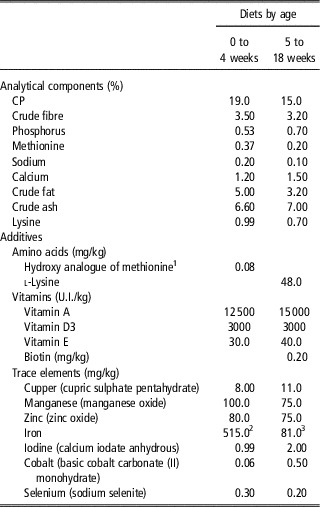
Birds were housed under free range conditions in one pens with 20 m2 with a density of four animals per m2. The basal diets were commercial concentrate (Table 1) with ad libitum feed and water. At 18 weeks of age the chickens, were slaughtered in a local commercial broiler slaughterhouse. In sensory analysis free-range chickens and broilers, bought in a supermarket and from a well-known commercial brand were used.
Composition of the diets during the experiment

1 Acids content 85%; acid monomer 65%.
2 Iron (III) oxide–425 mg/kg and iron (II) sulphate monohydrate – 90 mg/kg.
3 Iron (II) carbonate.
Carcasses were taken to the Carcass and Meat Technology and Quality Laboratory of the Agriculture School (Bragança, Portugal) 24 h after slaughter and were divided in two halves. The right one was reserved for the physicochemical analysis and the left to meat sensory analysis. Then all samples were vacuum packed and frozen at −21°C until analysed. The day before physical and chemical analysis, samples were thawed at 4°C. Physicochemical determinations were performed on breast (Pectoralis major muscle) and leg (thigh and drumstick). Meat dissection separating the skin, meat and bones was executed. All analyses were made in triplicate.
Instrumental analysis
The pH was measured 24 h after slaughter in Pectoralis major muscle using the equipment HANNA, pH meter HI 99163 and a FC 232D spear electrode. Water-holding capacity was evaluated according to the Honikel procedure (Honikel, Reference Honikel1998). Shear force was evaluated, using an INSTRON 5543J-3177 equipped with a Warner-Bratzler device. Pectoralis major muscles were cooked inside plastic bags in a 70°C water bath until reaching to 70°C in muscle centre. Half an hour after, four muscle sub-samples (2 cm2 cross-section) were taken from each Pectoralis major muscle for shear force evaluation. The measurement was recorded as the average yield force in kg required to shear perpendicularly to the direction of the fibres.
Chemical analysis
Moisture content, protein, ash, myoglobin, hydroxyproline, fat determination and fatty acid profile were evaluated. Total SFA, total monounsaturated fatty acids (MUFA) and total PUFA were computed. Myoglobin was obtained using the reflectance of the exposed surface by spectroscopy using a Spectronic Unicam 20 Genesys. The method is based on the muscle pigment content (Hornsey, Reference Hornsey1956). Protein (Kjeldahl N×6.25), moisture, total ash and hydroxyproline determinations were carried out according to Portuguese norms (NP) with recommended standards by International Organization for Standardization (ISO) correspondences: NP 1612:2002 – ISO 937:1978; NP 1614:2002 – ISO 1442:1197; NP 1615:2002 – ISO 936:1998 and NP 1987:2002 – ISO 3496:1994, respectively. Fat determination was performed using the BÜCHI Fat Determination System (AOAC International) described by Teixeira and Rodrigues (Reference Teixeira and Rodrigues2013).
Sensory analysis
Meat sensory analysis of breast, thigh and drumstick samples of Amarela and Pedrês breed roosters and capons, respectively, free-range chicken and broilers, was made by a trained taste panel of nine members. Panel members were selected and trained according to Portuguese guidelines (NP 8586-1:2001 – ISO 8586-1:1993). The day before the sensory session, samples were thawed at 4°C. Samples were separated in breast, thigh and drumstick, deboned and dissected. Samples were wrapped individually in aluminium foil and coded randomly with three digit numbers, then placed in the oven until it reached an internal temperature of around 75°C (NP 8586-1:2001 – ISO 8586-1:1993). Immediately after cooking, samples were divided into 2×2×1 cm3 pieces, wrapped in aluminium foil, identified, placed in a preheated oven at 60°C to 70°C, and evaluated within 10 min. The panel members were seated in individual booths in a temperature and light controlled room. In all sessions, the room temperature was 20°C to 22°C, with 60% to 70% humidity and booths had red light.
After a training period of six sessions, evaluating, describing and discussing chicken meat quality characteristics, panellists were asked to assess each sample for the sensory attribute: odour intensity (odour associated with raw meat, animal species or cooked chicken meat), off-odour (an odour that is not natural or up to standard owing to deterioration or contamination) intensity, colour (colour perceived between whitish and yellowish), toughness (the force needed to chew), juiciness (water perceived during mastication), fibrousness (fibres perceived during mastication), taste intensity (taste of raw meat, associated with the animal species or cooked chicken meat), off-taste intensity, flavour intensity (flavour associated with raw meat, animal species or cooked chicken meat) and off-flavour intensity. An unstructured scale of 10 cm, anchored at the extremes (0 – sensation absence and 10 – extremely intense sensation) was used. Panellists were asked to indicate a point on the scale corresponding to the perceived intensity for each attribute. The sensory evaluation consisted of 10 sessions, where panellists evaluated nine samples of nine different treatments combining breed (Amarela, Pedrês), caponisation (capon and rooster), B, and FRC and anatomical part (breast, thigh and drumstick). Samples were always presented in the same conditions for all panellists, randomly in each session.
Statistical analysis
Physicochemical analysis
The data were analysed using as a 2×2 factorial design using the GLMs procedure of SPSS statistical package version 20. Data were analysed by ANOVA with sex and breed as fixed effects. The least square means were calculated and the Tukey test was used to determine significant differences. All statistical differences were considered significant at a level of P⩽0.05.
Discriminant analysis
To know which variables would be more useful to classify and distinguish the groups (Amarela capon, Amarela rooster, Pedrês capon and Pedrês rooster), a discriminant analysis was performed using the linear, common covariance and the stepwise variable selection methods. For this analysis only the chemical composition of the breast was used, as this is the most representative part of the carcass. The efficiency of the discriminant power of the models selected was assessed by the test of the Wilks’ λ value. Results were analysed in terms of the absolute assignment of individuals to the pre-assigned group, the variance explained by each canonical likelihood and by the analysis of the standardised scoring coefficients. Statistical analysis was performed using the statistical package JMP Pro version 10 (Statistical Analysis Systems, 2012).
Sensory analysis
The model used was a completely randomised factorial design with six groups of bird (Amarela capon, Amarela rooster, Pedrês capon, Pedrês rooster, free-range chicken and broiler) and three anatomical joints (breast, thigh and drumstick) as fixed factors with no random effects. Chickens were assigned to 18 groups according to their specie and anatomic part. Generalised procrustes analysis, a powerful multivariate technique extensively used in sensory evaluation, was performed. The analysis minimises differences between assessors, identifies agreement between them, and summarises the sets of three-dimensional data (objects, characteristics and assessors). Data matrices of 18 meat samples by 10 sensory attribute by nine assessors were matched to find a consensus. These data sets were analysed using XLSTAT software (Addinsoft, 2013).
Results
Meat physical and chemical characteristics
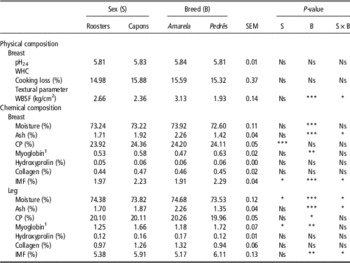
Table 2 shows the effect of chicken sex and breed on physical and chemical composition of breast and chemical composition of leg meat. Pedrês breed presented smaller (P⩽0.001) Warner-Bratzler shear force (WBSF) than Amarela. Capons had higher breast CP (P⩽0.001) and intramuscular fat (IMF) percentage (P⩽0.05) than roosters. Amarela breed had significantly higher breast moisture and ashes (P⩽0.001), smaller breast myoglobin (P⩽0.01) and IMF% (P⩽0.001) than Pedrês. In the leg meat, roosters had higher (P⩽0.05) moisture content but lower (P⩽0.05) myoglobin than capons. Amarela had higher moisture, ashes (P⩽0.001), CP (P⩽0.05), but smaller (P⩽0.01) myoglobin and IMF content than Pedrês. Significant interactions between sex and breed indicated bigger differences on breast ashes between roosters and capons in Amarela breed than Pedrês. The breast WBSF of Amarela roosters was higher than capons, while Pedrês roosters had smaller breast WBSF than capons.
Effect of chicken sex and breed on physical and chemical composition of breast meat (Pectoralis major muscle) and chemical composition of leg meat

pH24=muscle pH 24 h postmortem; WHC=water-holding capacity; WBSF=Warner-Bratzler shear force; IMF=intramuscular fat.
1 Results are expressed in mg myoglobin/g fresh muscle.
Ns=no significant difference (P>0.05); *P⩽0.05; **P⩽0.01; ***P⩽0.001.
Fatty acid composition
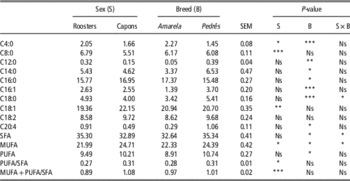
Table 3 shows the effect of chicken sex and breed on fatty acid profile of breast intramuscular fat. Roosters had higher butyric acid (C4:0) and caprylic acid (C8:0) than capons but no differences were found for total SFA. Roosters had smaller oleic acid (C18:1) content and total MUFA than capons. The ratios PUFA/SFA and MUFA+PUFA/SFA were higher in capons than roosters. Pedrês had higher SFA and MUFA contents, particularly lauric acid (C12:0), myristic acid (C14:0), palmitoleic acid (C16:1) and stearic acid (C18:0), but lower values for C4:0, palmitic acid (C16:0) and arachidonic acid (C20:4) than Amarela.
Effect of chicken sex and breed of fatty acid profile in intramuscular fat of breast meat (%)

SFA=saturated fatty acids; MUFA=monounsaturated fatty acids; PUFA=polyunsaturated fatty acids.
Ns=no significant difference (P>0.05); *P⩽0.05; **P⩽0.01; ***P⩽0.001.
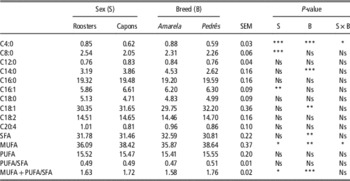
Roosters had higher (P⩽0.001) C4:0 and C8:0 g/100 g leg meat sample, but lower C16:1 (P⩽0.01) MUFA and MUFA+PUFA/SFA (P⩽0.05) than capons (Table 4). Amarela breed expressed higher C4:0, C14:0 and SFA than Pedrês but Pedrês had higher values for MUFA, particularly C18:1, explaining higher value for MUFA+PUFA/SFA ratio.
Effect of chicken sex and breed on fatty acid profile in intramuscular fat of leg meat (%)

SFA=saturated fatty acids; MUFA=monounsaturated fatty acids; PUFA=polyunsaturated fatty acids.
Ns=no significant difference (P>0.05); *P⩽0.05; **P⩽0.01; ***P⩽0.001.
Discriminant analysis
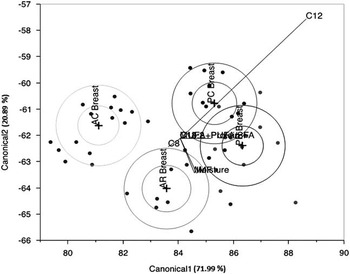
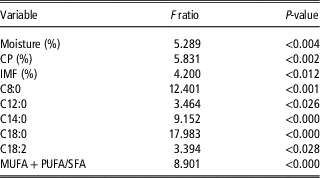
Table 5 shows the F values of the variables used to discriminate the breast meat of the four chicken groups. The stepwise method selected the following variables in nine steps: C18:0, C8:0, C14:0, MUFA+PUFA/SFA, protein, moisture, IMF, C12:0 and linoleic acid (C18:2). Scatter plot of the first two canonical variables, of the four chicken groups considered (Figure 1) showed that groups were discriminated with great accuracy with a total of 92.88% of variance explained. A total of 90% individuals of each group were assigned in the correct pre-assigned group, for 92.9%, 83.3%, 90.0% and 92.9% of classified correctly Amarela capon, Pedrês capon, Amarela rooster and Pedrês rooster, respectively. The model is highly significant (P<0.0001) for 0.047 Wilks’ Lambda value. Analysing the standardised discriminant scores the most important variables were ratio MUFA+PUFA/SFA, C14:0 and C18:0 in the first canonical variable, the IMF, moisture and C8:0 in the second canonical variable and the protein content, C18:2 and C12:0 in the third canonical variable. Results show that the fatty acid profile could be an accurate tool to discriminate and distinguish different meat from different breed and sexes.
Scatter plot of the first two canonical variables, of the four chicken groups breast meat considered. (AC=Amarela capon; AR=Amarela rooster; PC=Pedrês capon; PR=Pedrês rooster).

F values of all variables used in the discriminant analysis of breast meat from the four different groups of chicken

IMF=Intramuscular fat; MUFA=monounsaturated fatty acids; PUFA=polyunsaturated fatty acids; SFA=saturated fatty acids.
Sensory analysis
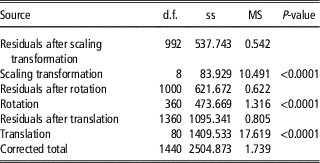
The taste panel used ten attributes to describe the differences between the three anatomical parts (breast, thigh and drumstick) of the different groups of chickens (Amarela capon, Amarela rooster, Pedrês capon, Pedrês rooster, free-range chicken and broiler). Procrustes analysis of Variance for chicken meat sensory analysis (Table 6) shows that all the data transformation steps were efficient since all presented a high significance (P<0.0001).
Procrustes analysis of variance (PANOVA) for chicken meat sensory analysis

ss=sum of squares.
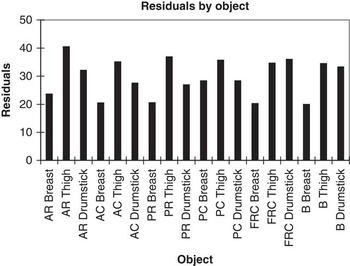
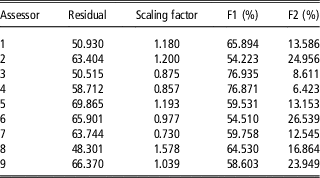
Residuals by group of chicken (Figure 2) show that breast of the Amarela capon, Pedrês rooster, broiler and free-range chicken had the lowest value followed by Amarela rooster with greater consensus among evaluators, whereas the Amarela rooster thigh (greatest residue) has the lowest consensus. Assessor 5 showed the greater residue, which means that their evaluations do not match the consensus (Table 7). Assessors 1, 2, 5, 8 and 9 tend to use a wider scale in their evaluation because they presented scaling factors >1 (Table 7). The others, with scaling factors smaller than one, focus on a narrower part of the scale.
Residual variance for each meat sample (group of chickens and anatomical part) for sensory analysis. (AC=Amarela capon; AR=Amarela rooster; B=broiler; FRC=free-range chicken; PC=Pedrês capon; PR=Pedrês rooster).

Residual variance, scaling factors, and percentage variation explained by the first two principal components for each assessor for each chicken meat group sensory analysis

F1=first principal component of generalised procrustes analysis (GPA); F2=second principal component of GPA.
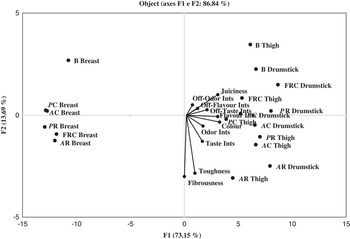
The next results correspond to the Principal Component analysis step. The first two axes represent 86.8% of the total variability; the first dimension explains 73.15% of the variability and the second 13.69%. When the variability is divided by assessors (Table 7) it was noted that the results are consensual among all the panellists except 2, 6 and 9, which show less variability explained by Factor 1, showing greater variability for Factor 2.
Generalised procrustes analysis was used to obtain a consensus (Figure 3). The points are all near the first Cartesian axis, explaining the fact that 73.15% of variability is concentrated in the first dimension. The different groups of chickens were clearly discriminated and identified by the panellists. Breast evaluation is clearly different of drumstick and thigh, mainly on juiciness, flavour intensity and colour. The breast of Amarela and Pedrês capons generated less consensus among panellists, presenting similar organoleptic characteristics. Flavour intensity and colour intensity are related with the Pedrês capon thigh. Free-range chicken thigh obtained the greatest value of juiciness. In general juiciness is associated with leg (thigh and drumstick) of free-range chicken and broiler. Drumstick of Amarela rooster had the greatest toughness and fibrousness, once the vectors representing them direct to the coordinates of Amarela rooster. The breast and thigh of broiler are characterised by having lower toughness and fibrousness. Broiler had the greatest value of juiciness and lower toughness and fibrousness (Figure 3). Amarela roosters’ meat showed lower juiciness, than the other groups of chickens. The Pedrês rooster group had the greatest off-taste intensity, and toughness and fibrousness are also correlated with this group. Caponisation has influenced the Pedrês capon off-taste, whereas colour intensity was associated with Amarela capons. Caponisation has also improved the lipid profile and meat characteristics, making it juicier, tenderer and less fibrous.
Consensus configuration: joint representation of correlation between sensory traits and first two dimensions and groups of chicken’s meat coordinates for anatomical parts of the group of chicken’s sensory analysis. (F1=first principal component of generalised procrustes analysis (GPA); F2=second principal component of GPA; AC=Amarela capon; AR=Amarela rooster; B=broiler); FRC=free-range chicken; PC=Pedrês capon; PR=Pedrês rooster).

Discussion
Meat physical and chemical characteristics
The pH values found were within the expected limits of 5.75 and 5.96 at the end of the postmortem process according to Castellini et al. (Reference Castellini, Mugnai and Dal Bosco2002). The effect of chicken sex and breed on physicochemical composition of breast meat (Table 2) indicates that WHC (cooking loss) and pH were not affected by sex nor breed. Miguel et al. (Reference Miguel, Ciria, Asenjo and Calvo2008) and Symeon et al. (Reference Symeon, Mantis, Bizelis, Kominakis and Rogdakis2010) in capons with 29 weeks (caponisation 8 weeks) and 18 to 24 weeks (early caponisation 3 weeks), respectively, reported that caponisation had no effects on pH and WHC. There were no sex differences for texture, confirming the results obtained by Symeon et al. (Reference Symeon, Mantis, Bizelis, Kominakis and Rogdakis2010) and Calik et al. (Reference Calik, Poltowicz, Świątkiewicz, Krawczyk and Nowak2015) in capons with 18 and 24 weeks of age, respectively. However, Sirri et al. (Reference Sirri, Bianchi, Petracci and Meluzzi2009), Symeon et al. (Reference Symeon, Mantis, Bizelis, Kominakis and Rogdakis2010) and Lin et al. (Reference Lin, Lin and Hsu2011), observed that caponisation decreases texture values in capons with 180 days, 24 and 28 weeks of age, respectively. Breed differences were found and the Amarela had tougher meat than Pedrês. Texture may be associated with stress, quantity, distribution of connective tissue, as well as smaller content of IMF. According to Lyon and Lyon (Reference Lyon and Lyon1991) meat with shear force values <3.62 kg/cm2 is very tender meat, confirming that samples of the present study can be considered very tender, highlighting the Pedrês breed.
Breast moisture (72% to 73%) and protein content (23% to 24%) are within the range values reported by several authors, in cock and capon of Castellana Negra (Miguel et al., Reference Miguel, Ciria, Asenjo and Calvo2008), in hybrid broiler (Sirri et al., Reference Sirri, Bianchi, Petracci and Meluzzi2009) and Taiwan country chickens (Lin et al., Reference Lin, Lin and Hsu2011). Breast meat capon showed greater CP content and IMF, in comparison with roosters, but no differences were found for moisture, myoglobin, ash and collagen contents in contradiction with Miguel et al. (Reference Miguel, Ciria, Asenjo and Calvo2008), Sirri et al. (Reference Sirri, Bianchi, Petracci and Meluzzi2009) and Volk et al. (Reference Volk, Malensêk, Prevolnik, Škrlep, Čandek-Potokar and Bavec2011) that have reported that caponisation had no effect on moisture and CP contents. Miguel et al. (Reference Miguel, Ciria, Asenjo and Calvo2008) and Calik et al. (Reference Calik, Poltowicz, Świątkiewicz, Krawczyk and Nowak2015) indicated no differences between sexes for ash content, whereas Sirri et al. (Reference Sirri, Bianchi, Petracci and Meluzzi2009) registered that caponisation increased its content, which was also found in the present work. Lin and Hsu (Reference Lin and Hsu2013) shown that moisture and ash contents were lower in capon (caponised with 10 weeks) of native Taiwan Country chicken with 28 weeks of age. Miguel et al. (Reference Miguel, Ciria, Asenjo and Calvo2008), Symeon et al. (Reference Symeon, Mantis, Bizelis, Kominakis and Rogdakis2012) and Lin and Hsu (Reference Lin and Hsu2013), confirming that caponisation (early and traditional and slaughter between 26 and 34 weeks) increased IMF content in breast, same resulted was observed in present study (18 weeks). Nevertheless, Volk et al. (Reference Volk, Malensêk, Prevolnik, Škrlep, Čandek-Potokar and Bavec2011) and Calik et al. (Reference Calik, Poltowicz, Świątkiewicz, Krawczyk and Nowak2015) have found no differences in IMF content of breast between cocks and capons, castrated at 8 weeks and slaughtered at 24 weeks of age. Amarela showed greater moisture, ash and IMF contents and smaller myoglobin than Pedrês. No differences were found between breeds for CP and collagen content. The moisture content found in the present study was lower than the value reported by Wattanachant et al. (Reference Wattanachant, Benjakul and Ledward2004) studying hybrid broiler breeds for meat production and Franco et al. (Reference Franco, Rois, Vázquez, Purriños and Lorenzo2013) in indigenous breeds.
The effect of chicken sex and breed in chemical composition of leg meat (Table 2) indicates that caponisation decreased the moisture content (Sirri et al., Reference Sirri, Bianchi, Petracci and Meluzzi2009; Lin et al., Reference Lin, Lin and Hsu2011; Lin and Hsu, Reference Lin and Hsu2013) and myoglobin content (Sirri et al., Reference Sirri, Bianchi, Petracci and Meluzzi2009). No differences were found for ash (Miguel et al., Reference Miguel, Ciria, Asenjo and Calvo2008; Lin et al., Reference Lin, Lin and Hsu2011; Volk et al., Reference Volk, Malensêk, Prevolnik, Škrlep, Čandek-Potokar and Bavec2011) CP (Miguel et al., Reference Miguel, Ciria, Asenjo and Calvo2008; Volk et al., Reference Volk, Malensêk, Prevolnik, Škrlep, Čandek-Potokar and Bavec2011) and collagen contents. According to Miguel et al. (Reference Miguel, Ciria, Asenjo and Calvo2008), Volk et al. (Reference Volk, Malensêk, Prevolnik, Škrlep, Čandek-Potokar and Bavec2011) and Calik et al. (Reference Calik, Poltowicz, Świątkiewicz, Krawczyk and Nowak2015) results, in capons with 24 to 29 weeks of age, found no differences between sexes for the moisture content of leg meat. However, Sirri et al. (Reference Sirri, Bianchi, Petracci and Meluzzi2009) in crossed Hubbard with 180 days of age found that caponisation (7 weeks) promotes the increase of moisture and ash. The leg IMF content was not affected by caponisation, according to Calik et al. (Reference Calik, Poltowicz, Świątkiewicz, Krawczyk and Nowak2015) in Taiwan country capons with 28 weeks of age, contradicting Miguel et al. (Reference Miguel, Ciria, Asenjo and Calvo2008), Sirri et al. (Reference Sirri, Bianchi, Petracci and Meluzzi2009) and Lin and Hsu (Reference Lin and Hsu2013) that reported no differences in IMF content in later slaughter. Amarela breed presented greater moisture content and ash, as well as greater CP content than Pedrês that had greater myoglobin and IMF content. There were no differences between breeds for collagen content.
Fatty acid composition
The effects of sex and breed on fatty acid profile of IMF in breast and leg meat are shown in Tables 3 and 4, respectively. Caponisation did not affect the content of SFA and PUFA, however, capon had greater MUFA content, improving the ratio PUFA/SFA in breast and the relationship MUFA+PUFA/SFA in breast and leg than rooster. Caponisation decreased C4:0 and C8:0 contents breast and leg, however increased C18:1 and C16:1 contents on breast and leg, respectively, improving profile of MUFA content in capon meat. Our results are not in accordance toTor et al. (Reference Tor, Estany, Francesch and Cubiló2005) studying the effect of caponisation (8 weeks) on 28 weeks chickens of Penedesenca Negra breed found no differences in the SFA, PUFA and MUFA+PUFA/SFA contents in breast, however observed decreased of SFA and increased MUFA, PUFA and MUFA+PUFA/SFA contents in leg. Also Sirri et al. (Reference Sirri, Bianchi, Petracci and Meluzzi2009) studying hybrid chickens, found no caponisation effect on SFA, MUFA and PUFA contents in thigh, but increased of SFA content in breast.
Greater content of SFA, MUFA and PUFA was found in breast meat of Pedrês than Amarela breed (Table 3). Amarela features better SFA profile (lower C12:0, C14:0 and C18:0, higher values for C4:0 and C16:0) than Pedrês. Respecting unsaturated fatty acids, Pedrês obtained higher C16:1 and arachidonic acid (C20:4) contents in relation to Amarela. Also Wattanachant et al. (Reference Wattanachant, Benjakul and Ledward2004) reported differences of SFA, MUFA and PUFA contents between broiler chicken and Thai indigenous breed. However, Franco et al. (Reference Franco, Rois, Vázquez, Purriños and Lorenzo2013) only found differences in MUFA and PUFA content between the Mos indigenous and T-44 breeds. In IMF of leg’s meat Amarela breed had greater SFA and lower MUFA contents than Pedrês, but no differences were found for PUFA content. Pedrês presented lower C4:0 and C14:0 contents, however, highest C18:1 content and showed a better ratio MUFA+PUFA/SFA than Amarela (Table 4). Results agree with Díaz et al. (Reference Díaz, Rodríguez, Torres and Cobos2013) who found no differences between the studied breeds but are inconsistent with those described by Wattanachant et al. (Reference Wattanachant, Benjakul and Ledward2004) who found differences in SFA, MUFA and PUFA contents.
Ten individual fatty acids were detected in the breast and leg (Tables 3 and 4). The main fatty acids were C18:1, C16:0 and C18:2, according to Tor et al. (Reference Tor, Estany, Francesch and Cubiló2005), Díaz et al. (Reference Díaz, Rodríguez, Torres and Cobos2013) and Franco et al. (Reference Franco, Rois, Vázquez, Purriños and Lorenzo2013). However, Miguel et al. (Reference Miguel, Ciria, Asenjo and Calvo2008) reported that between 29 weeks cock and capon of Castellana Negra breed, C18:2 was predominant, followed by C16:0 and C18:1. Caponisation decreased the content of C4:0, C8:0 and increased C18:1 of breast meat. Caponisation also decreased the content of C4:0, C8:0 and increased C16:1 in leg meat. There were breed differences in contents of C4:0, C16:1 and C18:0, C12:0, C14:0, C16:0 and C20:4 in breast meat and in C4:0, C14:0 and C18:1 in leg meat. According to the World Health Organization (2003) recommendations, PUFA/SFA ratio should be above 0.4. In this study, the breast values were lower than the recommended.
Discriminant analysis
A discriminant analysis using the stepwise method was performed. The selected variables were C18:0, C8:0, C14:0, MUFA+PUFA/SFA, protein, moisture, IMF, C12:0 and C18:2 (Table 5), which allowed discriminating the four chicken breast meat groups with great correctness (92.88% of variance explained). Results show that the fatty acid profile could be an accurate tool to discriminate and distinguish different meat from different breed and sexes. Accordingly, Berzaghi et al. (Reference Berzaghi, Dalle Zotte, Jansson and Andrighetto2005) used the discriminant analysis to discriminate breast meat from different feeding sources based on the fatty acid composition. Several authors also used discriminant analysis to evaluate broiler chicken performance (Rosário et al., Reference Rosário, Silva, Coelho, Savino and Dias2008); to discriminate between chicken, turkey, pork, beef and lamb (Arnalds et al., Reference Arnalds, McElhinney, Fearn and Downey2004); to classify poultry carcasses (Park et al., Reference Park, Lawrence, Windham, Chen and Chao2002).
Sensory analysis
The training period allowed the assessors to standardise the evaluation methodology. However, no training can eliminate the variation between panellists (Stone and Sidel, Reference Stone and Sidel1985). The first two axes obtained after the principal component analysis step of the Generalised procrustes analysis represent 86.8% of the total variability (Figure 3). This value is superior to the 83.56% recorded by Rodrigues and Teixeira (Reference Rodrigues and Teixeira2014) in pork meat, but lower than the 93% found by Rodrigues and Teixeira (Reference Rodrigues and Teixeira2009) in goat meat of Cabrito Transmontano.
Breast evaluation is clearly different from drumstick and thigh, mainly on juiciness, flavour intensity and colour. Amarela and Pedrês capons’ breast generated less consensus among panellists, presenting similar organoleptic characteristics. The disparity of the breast in relation to the thigh and drumstick was expected, due to its muscle constitution (white fibres), low collagen, IMF and myoglobin content. Flavour intensity and colour intensity are related with the Pedrês capon thigh. In general juiciness is associated with drumstick of free-range chicken and broiler. Amarela rooster drumstick had the greatest toughness and fibrousness. Broiler breast and thigh are characterised by lower toughness and fibrousness.
The Pedrês rooster group had the greatest off-taste intensity, toughness and fibrousness. Caponisation has influenced the off-taste in Pedrês capon, whereas colour intensity was associated with the Amarela capons. Miguel et al. (Reference Miguel, Ciria, Asenjo and Calvo2008) for native breed Castellana Negra, found that 29 weeks capons were juicier and less fibrous than cocks, which might be due to the greater fat content in the capon. Conversely, uncastrated chickens were found to have higher flavour intensity and more conjunctive tissue than castrated ones. However, Lin et al. (Reference Lin, Lin and Hsu2011) found that castrated chickens (28 weeks Taiwan country chicken cockerels) showed greatest flavour and tenderness in the breast, whereas the thigh obtained greater flavour and juiciness. Lin and Hsu (Reference Lin and Hsu2013) in 28 weeks Taiwan native capons’ meat found breast was more tender than roosters, as well as highest juiciness and flavour in meat of breast and leg. Calik et al. (Reference Calik, Poltowicz, Świątkiewicz, Krawczyk and Nowak2015) no differences observed for juiciness and tenderness in breast meat between capons and cocks (24 weeks native Greenleg Partridge), presenting capon’s meat higher value of flavour. However, capon leg meat showed greater juiciness, tenderness and flavour than cocks. Caponisation has improved the lipid profile and characteristics of meat, making it juicier, more tender and less fibrous, improving capon’s meat quality when compared with roosters raised together under the same production system.
Acknowledgments
The authors are grateful to Laboratory of Carcass and Meat Quality of Agriculture School of Polytechnic Institute of Bragança ‘Cantinho do Alfredo’.