Introduction
The definition of, and roles ascribed to, psychiatric intensive care units (PICUs) in England and Wales were formalized when the Department of Health published national minimum standards for general adult services in PICUs (Department of Health, 2002). These standards were not formally adopted within Scotland where 15 such units had earlier been identified (Smith, Reference Smith1997); now 14 units (NHS Quality Improvement Scotland, 2010). The characteristics of patients admitted to PICUs have been reported (Brown & Bass, Reference Brown and Bass2004; Bowers et al. Reference Bowers, Jeffrey, Bilgin, Jarrett, Simpson and Jones2008) and may reflect greatest need but also reflect the adopted inclusion and exclusion admission criteria published by the Department of Health. Admission criteria indicate that patients will not normally be over the age of 65, and patients with a primary diagnosis of dementia are specifically excluded (Department of Health, 2002). There have been calls for learning-disabled patients to be included in the eligible population (Kasmi, Reference Kasmi2007) and that ‘particular attention should be paid to women and younger people who require intensive psychiatric inpatient care.’ (NHS Quality Improvement Scotland, 2010, p. 4). There is also likely to be the need for PICU resources for the older adult population (Stevenson et al. Reference Stevenson, Khan and Perumal2009) and to address the needs of all people requiring PICU care provision specifically in relation to the six equality strands (Great Britain, 2006), in particular to avoid a charge of age discrimination, which in mental health services is more pronounced than in other areas of healthcare (Anderson, Reference Anderson2011).
Patients’ views on involuntary hospital admission (Katsakou & Priebe, Reference Katsakou and Priebe2006; Kallert et al. Reference Kallert, Glockner and Schutzwohl2008; Priebe et al. Reference Priebe, Katsakou, Amos, Leese, Morriss, Rose, Wykes and Yeeles2009, Reference Priebe, Katsakou, Glockner, Dembinskas, Fiorillo, Karastergiou, Kiejna, Kjellin, Nawka, Onchev, Raboch, Schuetzwohl, Solomon, Torres-Gonzalez, Wang and Kallert2010) and their experience of being in PICUs are recorded (Wykes & Carroll, Reference Wykes and Carroll1993; NHS Quality Improvement Scotland, 2010) with the Mental Welfare Commission for Scotland interviewing 50 patients who were being held in a PICU at the time of the interview (NHS Quality Improvement Scotland, 2010). There are reports on the training and experiences of nursing staff within PICUs (Brown and Wellman, Reference Brown and Wellman1998; Lee et al. Reference Lee, Wright, Sayer, Parr, Gray and Gournay2001, Reference Lee, Gray, Gournay, Parr and Sayer2003; Salzmann-Erikson et al. Reference Salzmann-Erikson, Lutzen, Ivarsson and Eriksson2008; Loubser et al. Reference Loubser, Chaplin and Quirk2009) but there is only a single report on the views of acute psychiatric in-patient staff about the PICU (Brown & Langrish, Reference Brown and Langrish2006), and one on comparing the experience and attitudes of staff working within PICUs to those within general psychiatric services (Bowers et al. Reference Bowers, Crowhurst, Alexander, Eales, Guy and McCann2003). There are no comparable reports on PICUs for older adults, or for PICUs in Scotland. Lack of published Scottish data about PICUs in general has been acknowledged (NHS Quality Improvement Scotland, 2010).
Fife, a region in east-central Scotland with a population of 360,000, has three mental health inpatient sites with 402 beds, of which 185 (46%) are for older adults. The majority (55%) of mental health inpatient care is provided at Stratheden Hospital, Cupar, which hosts two PICUs that conform to the Scottish Government's national mental health benchmarking project that defined PICUs as: ‘…a multi-disciplinary team with specialised training; the ratio of nursing staff will be higher than a general psychiatric ward. The service is recovery focused; it provides intensive treatment and interventions to patients who present an increased level of clinical risk and require an increased level of observation.’ (Scottish Government, 2008). The Fife PICUs consist of one ten-bed unit for general adults of both genders that would be typical of PICUs in the United Kingdom (Pereira et al. Reference Pereira, Dawson and Sarsam2006; NHS Quality Improvement Scotland, 2009) and a ten-bed unit for males over the age of 65 years, or younger if the primary diagnosis is of dementia, that was established in 2002 and provides a function for the older adult population similar to the PICU for general adults (Stevenson et al. Reference Stevenson, Menon and Gallacher2006).
The general aim of the current study was to contribute to the research on Scottish PICUs, with the specific aims of: confirming the findings of an earlier English study on psychiatric nurses’ views on criteria for psychiatric intensive care by comparing acute and PICU staff (Bowers et al. Reference Bowers, Crowhurst, Alexander, Eales, Guy and McCann2003); extending this to examine psychiatric nurses’ views on criteria for psychiatric intensive care for older adults by comparing acute and PICU staff in the older adult services; and comparing responses between the general adult and older adult PICUs. This would assist the request that ‘..future research should have as a priority the evaluation of PICU care for specific patient groups with specific problems.’ (Bowers et al. Reference Bowers, Crowhurst, Alexander, Eales, Guy and McCann2003).
Methods
Based partly on previous research findings and local knowledge, questionnaires were devised that examined: staff demographics; experience of working in PICUs; personal experience of physical harm from patients; likely responses to assist in PICU and other non-PICU wards; role in deciding admissions and discharges from PICU; and reasons for admission to the PICU. Questionnaires for staff in the PICU units included an additional question with multiple response options that enquired as to possible reasons for refusing admission or transfer to the PICU. The questionnaires were piloted among other nursing staff groups then sent for approval from the clinical nurse managers at the three hospital sites resulting in minor modifications. The local research ethics service office was consulted.
Following discussion with the ward senior charge nurses, the researchers then visited each of the four general adult (GA) acute admission wards, the three older adult (OA) acute admission wards, the one general adult PICU (GAP), and the one older adult PICU (OAP), to meet the nursing staff during the morning/afternoon shift handover to explain the survey, answer immediate queries and confirm that responses would be anonymous and to leave the survey questionnaire with an explanation sheet. The senior charge nurses were assisted to encourage completion of the questionnaires by staff on their unit, and the researchers visited the wards on a further two occasions to maximise the responder rate.
Statistical analyses were performed using the statistical package for social sciences (SPSS) version 17.0 and Microsoft Excel to carry out the data manipulation, validation and analyses. SPSS was used specifically to create cross-tabulations and carry out chi-square tests and Fisher's exact tests.
Results
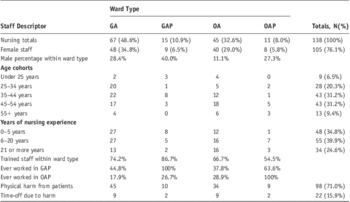
There were 138 nursing staff who completed the questionnaires, a 75% responder rate whose attributes are shown in Table 1. PICUs were felt to be necessary by 96.4% of all staff; 59.4% felt safer at work as a result of having such a resource, but a minority (15.2%) reported that the presence of PICUs potentially deskilled staff on acute admission wards in managing behavioural disturbances in patients. Few staff in either the general adult (8.5%) or older adult (16.1%) services expressed concern about being called to assist in non-specialist acute psychiatry wards; 15.6% of staff in OA wards and 10.4% staff in GA wards would be concerned if called to assist in the OAP ward, with 8.9% and 17.9% of the OA and GA ward staff noting reluctance to assist in the OAP for a shift; no staff in the GAP expressed any such reservations. In contrast, 27.3%, 33.3% and 16.4% of the OAP, OA and GA ward staff respectively recorded being worried if they were requested to assist in the GAP; 36.4%, 15.6% and 19.4% expressed reluctance to attend for a shift in the GAP. The majority (54.3%) of nurses felt that all nurses should rotate to work in PICU and acute wards, although only 23.9% of respondents were currently on rotation. Many staff (44.9%) did not feel adequately trained to work in the PICU, including 42.3% of the combined GAP and OAP staff group; many staff (37.7%) reported not feeling adequately professionally supported more so for the GAP staff (73.3%).
Descriptors for nursing staff in the general adult (GA, n = 67), general adult PICU (GAP, n = 15), older adult (OA, n = 45) and older adult PICU (OAP, n = 11) wards, as numbers (and percentages of total, N = 138)

On average 71% of the staff had experienced actual physical harm from patients during their work with 16% having had time off work as a result. Only 90 (65.2%) nurses reported up-to-date training in safe and therapeutic management of disturbed patients. The majority (52.9%) of staff did not consider that the sex ratio of staffing influenced the level of patient aggression on the wards, but the staff that did considered that a higher male to female staff ratio resulted in a greater level of aggression.
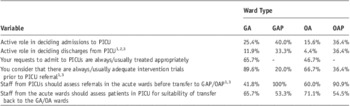
Nursing influences and decisions on admissions to and discharges from PICUs are given in Table 2, where there were no significant differences at the 5% level comparing GAP and OAP. The majority of GAP (73.3%) and OAP (90.9%) staff reported being better at identifying appropriate admissions to the PICU services compared to 50.7% of GA and 35.6% of OA staff reporting that the acute ward staff were better. This compared to the majority of staff in the GAP (86.7%), OAP (90.9%), GA (55.2%) and OA (66.7%) wards reporting that staff in PICUs were better at identifying when a patient should be discharged from a PICU. There were 62.2% of OA and 23.9% of GA responders who were unaware of any admission criteria or policies for the local PICUs, with 51.1% and 67.2% of the OA and GA staff indicating there should be no exclusion criteria for admission to PICU compared with 72.7% and 86.7% of the OAP and GAP staff who did. The majority (93.5%) of all staff confirmed that there should be a separate PICU for older adults, with 87.0% (100% of GAP staff) supportive of a separate PICU for patients with organic brain disorders and dementias.
Nursing influences on admissions to and discharges from PICU, according to staff in the general adult (GA, n = 67), general adult PICU (GAP, n = 15), older adult (OA, n = 45) and older adult PICU (OAP, n = 11) wards, given as a percentage of the ward type responders

1Significant difference at the 5% level comparing GA and GAP
2Significant difference at the 5% level comparing OA and OAP
3Significant difference at the 5% level comparing [GA plus OA] and [GAP plus OAP]
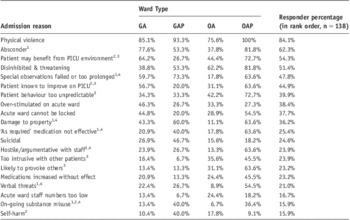
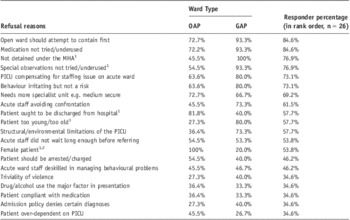
Table 3 displays the twenty most common reasons chosen for admission to the PICUs according to the ward settings, with significant differences between groups noted. Table 4 indicates the twenty most common reasons for refusing admission to the PICU, according to the GAP and OAP staff groups, with significant inter-group differences identified.
The 20 most frequent reasons cited by staff in the general adult (GA, n = 67), general adult PICU (GAP, n = 15), older adult (OA, n = 45) and older adult PICU (OAP, n = 11) wards for admission to the PICU, given as percentage response by ward type

1Significant difference at the 5% level comparing OA and OAP
2Significant difference at the 5% level comparing GA and GAP
3Significant difference at the 5% level comparing GAP and OAP
4Significant difference at the 5% level comparing [GA plus OA] and [GAP plus OAP].
The 20 most frequent reasons cited by staff in the older adult PICU (OAP, n = 11) and general adult PICU (GAP, n = 15) for refusing admission to the PICU by ward type, given as percentage response by ward type

1Significant difference at the 5% level comparing GAP and OAP
2The OAP unit was a male-only provision
Discussion
The majority of staff viewed the PICUs as a necessary resource within the mental health facilities of the local health board, with support for the separate PICU for older adults with dementia. Many staff expressed anxieties about being called to work in a PICU setting, more for the GAP than OAP, with some staff reporting feeling inadequately trained despite having in excess of five years of nursing experience in the majority of cases (65.2%). These anxieties were similar to those reported in a previous study, when 55% of respondents in GA wards expressed reluctance to work on the GAP (Brown & Langrish, Reference Brown and Langrish2006). These anxieties may reflect the high levels of actual physical harm previously encountered by staff (71%) and the reporting that many staff did not feel adequately professionally supported, an issue that needs to be addressed by the local nurse management services.
Staff in the PICUs considered that they were better than acute ward staff at identifying appropriate admissions to the PICU, but statistically they were not any more likely to report having an active role deciding admissions to the PICU. This may reflect the primacy of the medical role in the decision-making process. In keeping with only 20% of GAP staff who reported that there were always/usually adequate intervention trials prior to PICU referral, a previous study reported that at times GAP staff felt that GA colleagues could have done more to prevent the need for transfer to the PICU (Bowers et al. Reference Bowers, Crowhurst, Alexander, Eales, Guy and McCann2003).
Both the GAP and OAP nursing staff reported a more significant influence in deciding on discharges from the PICU facilities compared with staff in the acute wards. There were a greater number of significant differences in nursing influences on admissions to and discharges from PICU for the GA and GAP services than for their older adult counterparts. This may suggest a greater understanding of the role and nature of the PICU by the older adult services with a greater disparity of views in the general adult services, even although 62.7% of GA staff reported that they had worked in a PICU compared to 66.7% of OA staff.
The main reasons for admission to PICU services were physical violence and absconding by the patient, a finding in keeping with other reviews (Bowers et al. Reference Bowers, Jeffrey, Bilgin, Jarrett, Simpson and Jones2008). Compared with GA staff, the GAP staff were more likely to focus on issues of on-going substance misuse and self-harm as reasons for admission to GAP where higher levels of supervision are expected to minimise these behaviours. For the older adult services, the OAP staff were more likely than OA to identify issues of absconding, failed special observations or ineffectiveness of additional medications as reasons for admission to the PICU. This may reflect on the fact that many OA wards act as de facto locked units, or the limited usefulness or indeed scope for pharmacological modification of behaviour disturbance in the context of dementias (Ballard & Corbett, Reference Ballard and Corbett2010). Compared to GAP staff, the OAP staff were more likely to identify that the patient may benefit from the PICU environment, or that the patient was too unpredictable, intrusive or provocative of other patients as reasons for admission to the PICU. These differences may reflect on the differing patient populations of the two types of PICU, with the GAP dealing with primarily young males with psychotic illnesses (Brown & Bass, Reference Brown and Bass2004; Bowers et al. Reference Bowers, Jeffrey, Bilgin, Jarrett, Simpson and Jones2008) and the OAP dealing with older males with dementias (Stevenson et al. Reference Stevenson, Khan and Perumal2009).
There were relatively few differences identified between the OAP and GAP staff when refusing admission to the PICU. The GAP staff identified formal detention status as an absolute requirement compared to the OAP staff, although many of the older adult patient population were appropriately receiving care and treatment under the Scottish Incapacity legislation that may negate the requirement of formal status under the mental health legislation. This reflects the general position in the literature of variable detention rates in the PICU population, with the majority being compulsorily detained under mental health legislation (Bowers et al. Reference Bowers, Jeffrey, Bilgin, Jarrett, Simpson and Jones2008). The OAP unit was a male-only provision due to lack of an identified female need (Stevenson et al. Reference Stevenson, Menon and Gallacher2006) and the existence of the OAP unit further delineated the admission exclusion criteria for the GAP.
The study was limited in participant numbers and in focussing on only one Scottish health board region, but it was in that region that an established PICU for the general adult population and a separate PICU for the older adult population could be identified. The returned questionnaires were anonymous and there was no identified systematic bias in the non-responders.
This study confirms many of the findings of an earlier English study into psychiatric nurses’ views on criteria for psychiatric intensive care (Bowers et al. Reference Bowers, Jeffrey, Bilgin, Jarrett, Simpson and Jones2008). The current study differs in capturing the views of both trained registered mental health nurses (RMN) and non-RMN nurses, both of which are present in each of the ward settings. This study also examines for the first time the views of staff on a PICU for older males, with the majority (93.5%) of all staff surveyed supportive of a separate PICU to serve the differing needs and behavioural challenges of the older adult male population with dementias. This sense is also reflected in a recent Scottish report of general adult PICUs involving service user and carer experience focus groups that note, ‘Mixing groups of service users with very specific needs, for example dementia, was also not seen as ideal.’ (NHS Quality Improvement Scotland, 2010, p. 76). Although there is limited published information on intensive care units for older adults with dementia, these are likely to exist but may not be explicitly identified as such, or may be identified by alternative terminology similar to the previous situation for general adult PICUs (Beer et al. Reference Beer, Pereira and Paton2001, p. 6). However, the demographic shift to an aging population, combined with the identified increase in mental health detentions in the older adult population (Mental Welfare Commission for Scotland, 2008) suggests a need to consider age-appropriate psychiatric intensive care services for older adults.
Acknowledgments
I gratefully acknowledge the assistance of Dr David Chinn (R&D Coordinator, R&D Resource Centre, Lynebank Hospital, Dunfermline, Fife) and Drs Briju Prasad and Ian McClung (psychiatric trainees, South-East Scotland psychiatric rotation).