Almost one-tenth of patients with congenitally malformed hearts have aortic coarctation. If left untreated, life-expectancy is decreased due to cardiac failure and the consequences of hypertension. Current treatment is predominantly surgical. Interventional techniques of balloon angioplasty, with or without implantation of stents, are becoming popular. Complications of surgery are rare, but include death and paraplegia. Recurrent or residual coarctation is seen after surgery, and aneurysms may occur at the site of repair, particularly when prosthetic graft material is used.Reference Gibbs1 Lateral thoracotomies are associated with chest deformity, resulting in pathological findings in lung function testing.Reference Bal, Elshershari, Celiker and Celiker2 Recurrent stenosis after surgery is reported in between one-twentieth and half of patients.Reference Zoghbi, Serraf and Mohammadi3 It depends on the age at repair, the morphology of the stenosis, the combination with a hypoplastic aortic arch, the presence of additional lesions such as ventricular septal defect, and the operative technique. The aim of intervention in coarctation of the aorta must be the early, complete, and persistent relief of the pressure load on the left ventricle. Balloon angioplasty is increasingly accepted as an option for treatment, for patients with both native and recurrent coarctation.Reference Allen, Beekman and Garson4 Angioplasty may also be unsuccessful, due to elastic recoil, kinking, rigidity, and unfavourable anatomy, such as tubular narrowing or hypoplasia of the isthmus. In order to overcome some of these limitations, it has been suggested that stents be implanted, again for both native and recurrent forms of obstruction.Reference Cheatham5 Stents may reduce trauma to the vessel wall by dispersing radial forces over a larger area, control small dissections, and avoid the formation of aneurysms. Intermediate follow-up shows excellent relief of the gradient, with minimal complications.Reference Nienaber and Ince6 Stents were used first in older children and adults because of their rigidity, along with the lack of suitable devices to allow for growth, and the size of the sheaths required for their insertion. Infants were treated only in extreme clinical circumstance.Reference Fink, Peuster and Hausdorf7 More recent designs, however, have permitted stents to maintain a low profile when crimped on the balloon used for dilation, and to be redilated to sizes suitable for adults. In this report, we summarize our preliminary experience with implantation of stents in 9 children weighing less than 20 kilograms.
Patients and methods
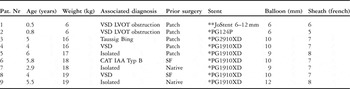
We have assessed all 9 children weighing less than 20 kg who were treated by implantation of stents for relief of native or recurrent coarctation of the aorta. They were treated between the years 2003 and 2006. We excluded patients with functionally univentricular hearts undergoing the after Norwood sequence of operations. In 2 of our patients, the obstructive lesion had not previously been treated, while in 7 it had recurred after a mean interval after surgery of 42.2 months, with a range from 3 to 70 months. Both of the patients with native coarctation were treated with balloon angioplasty prior to implanting the stents. Associated diagnoses, and the characteristics of the patients, are shown in Table 1.
Characteristics of the population studied.

Abbreviations: VSD: ventricular septal defect; LVOT: left ventricular outflow tract; SF: subclavian flap; CAT: common arterial trunk; IAA: interrupted aortic arch; weight in kilogram (Kg); type of stent (PG: Palmaz Genesis); maximum balloon diameter in millimetre (mm) and sheath size in french (F); **Abbott, Wiesbaden, Germany; *Cordis, Johnson & Johnson, Langenfeld, Germany.
Indications
Medical history and clinical examination, including the state of the pulses and monitoring of blood pressure to obtain the non-invasive gradient, were carried out in all patients prior to the intervention. Echocardiographic findings included recording of the acceleration of flow across the stenotic area, in addition to M-Mode measurements of the left ventricle. The electrocardiogram was recorded for signs of abnormalities in repolarization and hypertrophy of the left ventricle.
Irrespective of the gradient measured at catheterization under anaesthesia, the indications for intervention were the non-invasive recording of a gradient greater than 20 millimetres of mercury across the aortic arch at rest or recordings of blood pressure over the 95th centile for age.
Technique
The interventions were all performed under general anaesthesia. All patients received 100 units of heparin per kilogram at the beginning of catheterization, and 3 doses of a cephazoline. Arterial access was obtained, and initially a 4 French sheath was introduced. After haemodynamic evaluation, with recording of the gradient across the aortic arch and the stenosis, angiography was performed. The aorta was measured at the transverse arch, proximal and distal to the site of maximal obstruction and at the level of the diaphragm. The sheath was exchanged for a long sheath after positioning of the guide wire in the right subclavian artery. The size was chosen to exceed that recommended for the balloon catheter, usually by one French dimension. The diameter of the balloon was chosen according to the diameter of the transverse arch, and never exceeded the diameter of the descending aorta.
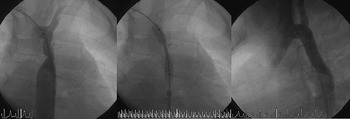
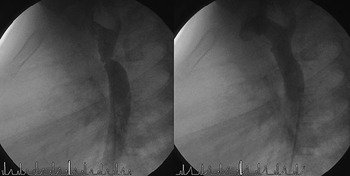
All stents were manually crimped on high pressure balloons, using either OPTA Pro or SAVYY balloons, both manufactured by Cordis, Johnson&Johnson*. A side arm adaptor allowed hand injections of contrast medium to guide positioning of the stent. The balloons were slowly inflated using an indeflator. After deflation, hand injection into the long sheath was performed to ensure accurate positioning and absence of vascular damage before the balloon catheter and guidewire were removed (Fig. 1).
Angiographic findings pre, during and after implantation of stents for recurrent coarctation in our third patient.

All patients were extubated in the catheterization laboratory, and were anticoagulated with 400 units Heparin per kilogram on the first day, and 200 units per kilogram on the second day after stenting. Levels of antithrombin III were kept above 80%. The patients were discharged home two days after the intervention. All patients were treated with aspirin at 2 to 5 milligrams per kilogram) for at least 3 months. Routine follow-up was performed on the day of discharge, 1 month after the intervention, and every 3 months thereafter. The follow-up included a clinical examination, monitoring of blood pressure in the arm and leg, echocardiography, and electrocardiography.
Results
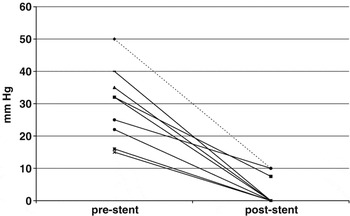
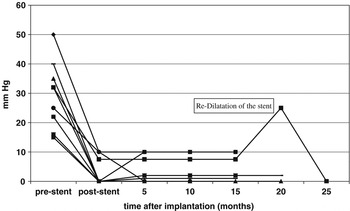
Stents were implanted successfully in all patients. The peak-to-peak gradient was effectively reduced in all patients, as measured both invasively during anaesthesia and non-invasively prior to discharge home. The mean peak systolic gradient during anaesthesia was reduced from 30 millimetres of mercury, with a range from 15 to 50 millimetres of mercury, to 3 millimetres of mercury, with a range from 0 to 10 millimetres of mercury (Fig. 2). The mean follow-up for all patients was 15.8 months, with a range from 8 to 25 months. The extent of residual gradients is shown in Figure 3.
Invasive systolic pressure gradients across the coarctation in millimetres mercury (mmHg) before and after placement of the stents.

Invasive systolic pressure gradients before and after implantation in millimetres of mercury (mmHg) and non-invasive pressure gradients during follow-up (FU).

No dissections or aneursyms, dislocations of the stent, or neurological complications were associated with the procedure. There was no mortality. In 1 patient, the peripheral pulse was weak secondary to arterial access. Treatment with heparin led to complete resolution, and duplex sonography confirmed restoration of arterial patency.
During the last follow-up, there was no evidence of restenosis due to neointimal proliferation. Uneventful re-dilation was needed in 1 patient 24 months after placement of the stent. This patient had weighed 5.5 kilograms at treatment, and required redilation when weighing 11 kilograms. The stent was redilated with a balloon of 8 millimetres, resulting in complete resolution of the gradient.
Discussion
Implantation of stents has been reported to offer excellent relief of coarctation in adolescents and adults.Reference Cheatham5, Reference Nienaber and Ince6 We have now shown that stents can safely and effectively be implanted in patients weighing less than 20 kilograms. The main risk in such patients is vascular complications due to arterial access, this reflecting the size of the sheath required for insertion of the system required to deploy the stents. Only one of our patients had a weak pulse after the intervention, nonetheless, and this resolved completely upon administration of heparin.
The incidence of recurrent stenosis after angioplasty for native coarctation is highly dependent on the age of the patient at the initial balloon angioplasty. In those with isolated native coarctation, balloon dilation is accepted as an effective treatment when the patients are aged three months and above. Balloon angioplasty is feasible in younger infants, but restenosis is frequent.Reference Galal, Schmaltz, Joufan, Benson, Samatou and Halees8, Reference Kothari, Juneja, Saxena, Reddy and Sharma9 Despite the significant incidence of recoarctation in neonates and young infants, Rao et al.Reference Rao, Galal, Smith and Wilson10 still maintain that balloon angioplasty should be the primary therapeutic procedure of choice for native aortic coarctation. In contrast, we recommend initial surgical treatment for patients with native aortic coarctation when they are below 6 months of age. We reserve primary balloon angioplasty, or implantation of stents, for bailout situations at this age.Reference Fink, Peuster and Hausdorf7 In infants aged greater than 6 months, we use balloon angioplasty as the procedure of choice for native coarctation in the absence of hypoplasia of the transverse arch (Fig. 4).Reference Patel, Madani, Paris, Warner and Hijazi11 In older patients with native coarctation, we prefer to insert stents as a primary procedure when the diameter of the aortic arch allows the use of a stent which can be redilated to a size suitable for adults, since elimination of the gradient is superior when using stents compared to balloon angioplasty alone. We believe that implantation of stents carries a lower risk of aneurysmal formation and dissection of the aorta, since it is possible to avoid overdistending the aorta.
Angiographic findings before and after implantation for native coarctation in our ninth patient.

The coarctation had not previously been treated in 2 of our patients, and in both we performed balloon angioplasty before implanting the stent. Restenosis occurred in 1 six months later. The indication for to implant the stent in the other patient was the ineffective angioplasty, which left a residual gradient measured invasively of greater than 20 millimetres mercury. In both patients we used a Palmaz Genesis PG1910 stent, with a maximal diameter of 20 millimetres, with an excellent relief of the gradient.
Since the report of the first successful surgical correction of aortic coarctation in 1945,Reference Crawford and Nylin12 various surgical techniques have been used, including subclavian flap plasty, patch plasty, extended resection, and end-to-end anastomosis. Recurrence of coarctation after surgery has been observed in up to half of patients treated surgically, with the highest incidence seen after patch plasty of the aortic arch.Reference Walhout, Lekkerkerker, Oron, Hitchcock, Meijboom and Bennink13 Balloon angioplasty was introduced in the mid 1980s, initially for recurrent, and subsequently for native coarctation.Reference Cheatham5 Good initial relief of the gradient was achieved in most patients, but recurrence at follow-up is well recognised.Reference Yeltman, Nykanen and Mc Crindle14 The reasons for unsuccessful balloon angioplasty include elastic recoil, obstruction due to kinking, the rigidity of the obstructive lesions, and other unfavourable anatomy, such as tubular narrowing or hypoplasia of the isthmus. In a large study of 970 patients treated with balloon angioplasty, death was reported in 0.7%, aortic disruption in 0.4%, aortic intimal tear in 3.2%, and cerebral problems in 0.6%.Reference Mc Crindle, Jones and Morrow15
Stents were first used to treat obstructive congenital cardiac malformations by Mullins et al. in 1988.Reference Mullins, O′Laughlin and Vick GW16 They described the technique for implantation in pulmonary arteries and systemic veins. Endovascular stents have now been applied in the setting of various malformations. The first report of sucessful treatment of aortic coarctation during infancy appeared in 1993.Reference Redington, Hayes and Yen Ho17 Experimental studies, and more recent clinical studies in children and young adults, have shown excellent immediate results,Reference Morrow, Smith, Ehler, Van Dellen and Mullins18–Reference Marshall, Perry, Keane and Lock22 with our results being comparable even though our patients are much younger.
The potential advantages of implanting stents are the reduction of trauma to the vessel wall by dispersing radial forces over a larger area, better control of small dissections, and avoidance of aneurysmal formation. The rigid endoprosthesis maintains the increase of vessel diameter regardless of the intimal injury. This may decrease the incidence of restenosis, while providing a more palatable solution for tubular or isthmus hypoplasia.Reference Cheatham5 These potential advantages may reflect the low incidence of trauma to the aorta in our patients, and the excellent relief of the gradient. The aim of intervention in patients with aortic coarctation must be early, complete, and persistent relief of pressure load for the ventricle. Stents are suitable to meet these aims. All of our patients had complete and persistent relief of the gradient.
Stents lacking the ability to expand to adult size should only be used for acute stabilization of critically ill patients. In this setting, we used stents with maximal diameters of 10 and 14 millimetres. In both patients, the aim of implantation was to achieve acute relief of the gradient in unstable patients undergoing acute deterioration of left ventricular function. Interventional therapy was preferred as a safer treatment option to surgical treatment in this particular situation to stabilize the patient after an ineffective angioplasty. Stents implanted with these palliative indications need to be explanted when there is a restenosis upon reaching the maximal diameter of the inserted stent. In such circumstances, the stented segment may be removed surgically. Surgical options are implantation of grafts, explantation, or patch enlargement of the stented vessel.
Redilation is theoretically possible, and can be necessary either because of growth related restenosis or because of staged implantation, when primary stent dilatation was submaximal due to severe stenosis to prevent aortic rupture.Reference Duke, Rosenthal and Qureshi23 We have not seen fractures of our stents, or vascular damage. Relevant foreshortening of stents has also been described. Because of their shape, foreshortening is reduced in the new Palmax Genesis XD-generation of stents.Reference Forbes, Rodriguez-Cruz and Amin24 Implantation at an early age will demand further balloon expansion to keep pace with somatic growth. The follow-up in our patients is limited to a mean duration of 16 months. To date, redilation has been needed in only one patient. Previous studies have demonstrated the possibility to re-dilate stents in growing patients. The Palmaz Genesis XD stents which we used in 7 patients are capable of dilation to a diameter of 18 to 20 millimetres. Future follow-up of our patients has to focus on the possibility and number of sequential dilations up to this maximal diameter.
The main risk of implantation in patients weighing less than 20 kilograms is vascular complications due to arterial access. In comparison to balloon angioplasty, the necessary sheath required for insertion of the system is about 1 French dimension larger than the system itself. In our study, one patient weighing 5.5 kilograms had a weak peripheral pulse after intervention. Effective treatment led to complete resolution.
In conclusion, we have shown that stents can be inserted safely and effectively in patients weighing less than 20 kilograms. The future of such treatment will depend on the design and material used to create new stents. We believe that, with the increasing experience in interventional techniques, and the advent new technologies such as biodegradable stents,Reference Peuster, Hesse, Schloo, Fink, Beerbaum and von Schnakenburg25 the necessity for surgical treatment will decrease for patients with aortic coarctation.