Research on second language (L2) variation has been growing rapidly since the introduction of the variationist paradigm into SLA in the 1970s (e.g., Adamson, Reference Adamson1988; Bayley, Reference Bayley, Tarone, Gass and Cohen1994, Reference Bayley, Bayley and Preston1996; Dewaele, Reference Dewaele2004a; Dickerson, Reference Dickerson1974; Geeslin & Gudmestad, Reference Geeslin and Gudmestad2010; Preston, Reference Preston, Bayley and Preston1996, Reference Preston, Swierzbin, Morris, Anderson, Klee and Tarone2000; Regan, Reference Regan, Bayley and Preston1996; Tarone, Reference Tarone1979, Reference Tarone1982, Reference Tarone1985, Reference Tarone2007; Tarone & Parish, Reference Tarone and Parish1988; Wolfram, Reference Wolfram1985; Young, Reference Young1991). The variationist approach regards learner speech as a valid language system that provides a valuable resource to understand L2 acquisition within a social context. According to Romaine (Reference Romaine, Doughty and Long2003), L2 variation studies have “marked an important paradigm shift in the field of SLA” from contrastive and error analysis to “the notion of SLA as a dynamic process characterized in terms of a variable and changing system over time” (pp. 409–410).
The sociolinguistic variable of subject pronominal expression is widely studied in languages such as first language (L1) Spanish and Portuguese (e.g., Ávila-Jiménez, Reference Ávila-Jiménez1996; Bayley & Pease-Alvarez, Reference Bayley, Pease-Alvarez, Arnold, Blake and Davidson1996; Cameron, Reference Cameron1993; Lira, Reference Lira1982; Otheguy, Zentella, & Livert, Reference Otheguy, Zentella and Livert2007), which are inflectional languages. The rich agreement system in inflectional languages helps to identify null subjects (Jaeggli & Hyam, Reference Jaeggli and Hyam1988), whereas noninflectional languages that lack agreement morphology are more discourse oriented (Huang, Reference Huang1984). Indeed, most general interlanguage variation studies have focused on inflectional languages such as English (Bayley, Reference Bayley, Tarone, Gass and Cohen1994, Reference Bayley, Bayley and Preston1996; Wolfram, Reference Wolfram1985; Young, Reference Young1991), French (Dewaele, Reference Dewaele1999, Reference Dewaele2004a, Reference Dewaele2004b; Mougeon & Rehner, Reference Mougeon and Rehner2001; Mougeon, Rehner, & Nadasdi, Reference Mougeon, Rehner and Nadasdi2004; Regan, Reference Regan, Bayley and Preston1996; Rehner & Mougeon, Reference Rehner and Mougeon1999; Rehner, Mougeon, & Nadasdi, Reference Rehner, Mougeon and Nadasdi2003; Sax, Reference Sax2003), and Spanish (Geeslin, Reference Geeslin2003; Geeslin & Gudmestad, Reference Geeslin and Gudmestad2010; Geeslin & Guijarro-Fuentes, Reference Geeslin and Guijarro-Fuentes2006; Gudmestad, Reference Gudmestad, Klee and Face2006, Reference Gudmestad2008). However, few variationist studies of subject pronominal expression have focused on Mandarin Chinese (hereafter Chinese)—a noninflectional language—as a L1 (Jia & Bayley, Reference Jia and Bayley2002; X. Li, Chen, & Chen, Reference Li, Chen and Chen2012), and none has focused on L2 Chinese. Most studies of this language feature in L2 Chinese fall under a principles and parameters framework (J. S. Chen, Reference Chen2001; Jin, Reference Jin1994; Wang, Lillo-Martin, & Best, Reference Wang, Lillo-Martin and Best1992). This study, therefore, adds to our understanding of both Chinese as a second language (CSL) and interlanguage variation by utilizing the variationist paradigm to investigate the use of subject pronominal expression by CSL learners.
In Chinese, pronominal subjects may be expressed by a lexical pronoun or as null, as shown in the example in (1)Footnote 1
(1) 他 没 学 过 汉语, Ø 一点儿 也 不 会 说 (Fen)
tā méi xué guò hànyŭ, Ø yīdiănr yě bù huì shuō
He not learn-expFootnote 2 Chinese, Ø a:little also not can speak
“He has never learned Chinese, and he can’t speak it at all.”
In (1), the first mention of the subject is expressed with a lexical pronoun, 他 “he,” and the second mention of the same subject is omitted. However, because the omission of the lexical pronoun is not obligatory, the purpose of this study is twofold: One purpose is to examine subject pronoun use by high-intermediate and advanced CSL learners; the other is to compare learner patterns with Chinese L1 patterns (X. Li et al., Reference Li, Chen and Chen2012).Footnote 3 The research questions are the following:
1. What are the patterns of variation in CSL learners’ subject pronoun use?
2. Are CSL learner patterns different from those of native speakers (NSs)? If so, how and why?
3. What are the effects of the following factors on CSL learners’ subject pronoun use: (a) coreference, (b) subject person and number, (c) sentence type, (d) specificity of subject referent, (e) discourse context, (f) gender, (g) native language, (h) length of residence in China, and (i) proficiency level?
BACKGROUND
Interlanguage Variation Studies
The variationist paradigm in language study was pioneered by Labov (Reference Labov1963, Reference Labov1966, Reference Labov1972) with the basic assumption that variation in language use is highly systematic and characterized by “orderly heterogeneity” (Weinreich, Labov, & Herzog, Reference Weinreich, Labov, Herzog, Lehmann and Malkiel1968, p. 100). Drawing on the variationist or Labovian approach, in the 1970s, SLA researchers started to examine how and under what conditions L2 learners demonstrate variation in their interlanguage (or learner speech; Selinker, Reference Selinker1992) with the assumptions that (a) interlanguage is a valid language system and (b) L2 variation is also systematic (e.g., Dickerson, Reference Dickerson1974, Reference Dickerson1975; Tarone, Reference Tarone1979, Reference Tarone1982, Reference Tarone1983, Reference Tarone1985; Tarone & Parish, Reference Tarone and Parish1988; Wolfram, Reference Wolfram1985).
So far, studies that examine variation in learner speech fall into two major strands. The first strand focuses on the acquisition of obligatory language structures in the target language (e.g., plural marking in English; see Young, Reference Young1991). The other strand looks at the acquisition of linguistic features in which NSs show variable use (e.g., deletion of the negative particle ne in French; see Regan, Reference Regan and Freed1995, Reference Regan, Bayley and Preston1996; Rehner & Mougeon, Reference Rehner and Mougeon1999). Variable usage of obligatory structures is referred to as vertical variation (Corder, Reference Corder and Anderson1981) or Type 1 variation (Mougeon et al., Reference Mougeon, Rehner and Nadasdi2004), whereas variable usage of variable structures is known as horizontal variation (Corder, Reference Corder and Anderson1981) or Type 2 variation (Mougeon et al., Reference Mougeon, Rehner and Nadasdi2004). In learner production, Type 1 variation can be identified as grammatically correct or incorrect; however, Type 2 variation presents a much more complicated picture in which multiple—often cointeracting—factors come into play. Because learners need to learn not only to produce grammatically correct sentences but also to shift their speech styles according to the social context, knowledge of both types of variation is an integral part of L2 acquisition and the development of sociolinguistic competence. This study focuses on Type 2 variation—that is, the alternation between overt pronoun and null form in the subject position by CSL learners.
According to Bayley and Regan (Reference Bayley and Regan2004), research that investigates Type 2 variation in learner production centers around (a) whether or not learner patterns differ from NS patterns (and, if so, how and why), (b) what the acquisition process looks like, and (c) the effects of social and educational factors. A considerable number of studies have been conducted along this line of research and have demonstrated that, despite the complicated nature of the acquisition process, learner production of Type 2 variation is systematic and constrained by various linguistic, social, educational, and developmental factors (e.g., Bayley, Reference Bayley, Bayley and Preston1996; Dewaele, Reference Dewaele2004a, Reference Dewaele2004b; Dewaele & Mougeon, Reference Dewaele and Mougeon2004; X. Li, Reference Li2010; Mougeon et al., Reference Mougeon, Rehner and Nadasdi2004; Regan, Reference Regan, Bayley and Preston1996; Rehner et al., Reference Rehner, Mougeon and Nadasdi2003). The quantitative variationist research design (i.e., multivariate analysis) adopted by these studies is particularly well suited to L2 learner production because it can account for the effects of multiple factors relative to one another (Bayley, Reference Bayley, Chambers, Trudgill and Schilling-Estes2002).
Existing studies of L2 variation have explored a variety of predictors of learners’ use of variable structures in the target language, among the most common of which is the linguistic environment of the target variant. Other predictors include (but are not limited to) speaker gender (e.g., Adamson & Regan, Reference Adamson and Regan1991; Major, Reference Major2004), interlocutor ethnic identity (Beebe, Reference Beebe1977, Reference Beebe1980), task (Tarone & Parish, Reference Tarone and Parish1988), native language (e.g., Ghafarsamar, Reference Ghafarsamar2000), proficiency level (e.g., Sax, Reference Sax2003), social network (e.g., Bayley, Reference Bayley, Bayley and Preston1996), social class of the speakers (Mougeon & Rehner, Reference Mougeon and Rehner2001), length of residence in the target language environment (e.g., X. Li, Reference Li2010; Rehner et al., Reference Rehner, Mougeon and Nadasdi2003), exposure to target language media (e.g., Mougeon & Rehner, Reference Mougeon and Rehner2001; Mougeon et al., Reference Mougeon, Rehner and Nadasdi2004), educational input (e.g., Mougeon et al., Reference Mougeon, Rehner and Nadasdi2004), interlocutor’s ethnicity (e.g., Bayley, Reference Bayley, Tarone, Gass and Cohen1994; Young, Reference Young1991), and even speaker personality (e.g., Dewaele, Reference Dewaele2004b; Dewaele & Furnham, Reference Dewaele and Furnham1999). In this section, my review focuses on the previous findings that are relevant to the current study—that is, how speaker gender, proficiency level, length of residence in the target language environment, and native language affect the acquisition of target language variation.
The effect of speaker gender on speech has been examined in many studies, and several studies have shown that female learners tend to produce more formal, standard language forms than male learners do (e.g., Adamson & Regan, Reference Adamson and Regan1991; X. Li, Reference Li2010; Major, Reference Major2004). Studies have also shown that learners go through a developmental language change process in that, as their proficiency level increases, their language use patterns become closer to NS patterns (Bayley, Reference Bayley, Bayley and Preston1996; Ghafarsamar, Reference Ghafarsamar2000; X. Li, Reference Li2010; Sax, Reference Sax2003). Additionally, a longer stay in the target language environment favors real-life NS patterns (Nagy, Blondeau, & Auger, Reference Nagy, Blondeau and Auger2003; Regan, Reference Regan and Freed1995, Reference Regan, Bayley and Preston1996, Reference Regan and Dewaele2004; Rehner et al., Reference Rehner, Mougeon and Nadasdi2003; Sax, Reference Sax2003; Thomas, Reference Thomas2004).
Whereas speaker gender, proficiency level, and length of residence tend to yield predictable results, previous studies have not reached a consensus on the effect of the L1 on the acquisition of Type 2 variation. For example, findings from studies of French L2 variation, which have investigated a number of syntactic, lexical, and phonological variables, have demonstrated the importance of the role that the learners’ L1 plays on the acquisition of nativelike sociolinguistic variation in spoken French (Dewaele, Reference Dewaele1999; Mougeon et al., Reference Mougeon, Rehner and Nadasdi2004; Trevise & Noyau, Reference Trevise, Noyau and Andersen1984). In other studies, however, native language has played a relatively trivial role (see Ghafarsamar’s, Reference Ghafarsamar2000, study of the acquisition of the contraction of auxiliary verbs, relative pronouns, and resumptive pronouns by Persian learners of English as a L2). X. Li (Reference Li2010) studied L2 variation in the acquisition of the Chinese morphosyntactic particle de by high-intermediate and advanced learners from four native language backgrounds. Native language was found to play a trivial role in the use of L2 sociolinguistic variants when learners reached a relatively high proficiency level.
Variation of Subject Expressions in the L1 and L2
Studies of subject pronoun use in L1 Spanish and Portuguese have shown that subject person, number, and referent switch are the main linguistic factors that constrain subject expression (Ávila-Jiménez, Reference Ávila-Jiménez1996; Bayley & Pease-Alvarez, Reference Bayley, Pease-Alvarez, Arnold, Blake and Davidson1996, Reference Bayley and Pease-Alvarez1997; Bentivoglio, Reference Bentivoglio1980, Reference Bentivoglio1987; Cameron, Reference Cameron1992; Cameron & Flores-Ferrán, Reference Cameron and Flores-Ferrán2004; Flores-Ferrán, Reference Flores-Ferrán2002, Reference Flores-Ferrán2004, Reference Flores-Ferrán2007; Otheguy et al., Reference Otheguy, Zentella and Livert2007; Silva-Corvalán, Reference Silva-Corvalán, Amastae and Elías-Olivares1982, Reference Silva-Corvalán1994). General patterns show that (a) singular subjects favor overt pronouns, whereas plural subjects favor null pronouns and (b) overt pronouns tend to be used when there is a switch in subject referent, whereas no switch favors null. Another factor that has been explored is specificity of the subject referent, with results varying between different varieties of Spanish (Ávila-Jiménez, Reference Ávila-Jiménez1996; Cameron, Reference Cameron1992; Flores-Ferrán, Reference Flores-Ferrán2002, Reference Flores-Ferrán2004; Otheguy et al., Reference Otheguy, Zentella and Livert2007). Cameron (Reference Cameron1992) found that, in Puerto Rican Spanish, subject pronoun realization is associated more with nonspecific, second-person singular tú than with specific tú, but he found the opposite pattern in Madrilenian Spanish. Additionally, in Puerto Rican Spanish, subject nonspecificity favored an overt pronoun for second- and third-person singular subjects but favored a null pronoun for third-person plural subjects. The effect of specificity was only considered for second-person singular subjects in Otheguy et al. (Reference Otheguy, Zentella and Livert2007). The results showed an effect for different levels of specificity among Spanish speakers in New York City from different regions (i.e., Caribbeans vs. mainlanders) and different generations (i.e., newcomers vs. those born and raised in New York). For newcomer speakers from the Caribbean, both specific and nonspecific subject referents favored overt pronouns; however, for newcomer mainlanders, nonspecific subject referents favored null pronouns, whereas specific subject referents were not significant. For those speakers who were born and raised in New York, specific subject referents favored overt pronouns for both Caribbeans and mainlanders, whereas nonspecific subject referents favored overt pronouns in Caribbean speakers but were neutral for mainlanders.
Jia and Bayley (Reference Jia and Bayley2002) was the first variationist study of subject pronoun use in L1 Chinese, with a dataset comprising telephone conversations and teachers’ classroom speech. On par with the findings in the aforementioned studies, the main constraints were subject person and number and switch in subject referent. Jia and Bayley also examined sentence type and found that overt subject pronouns were favored in statements but disfavored in questions and especially disfavored in imperatives. No significant effects were found for speaker gender or for verbal aspect. An important finding was the interaction between discourse context (i.e., conversations vs. classroom speech) and second-person subjects: Conversations strongly favored overt second-person plural subjects, and teacher speech favored overt second-person singular subjects. Jia and Bayley contended that expected forms in a discourse context —that is, the second-person plural form for classroom teacher speech and second-person singular forms in telephone conversations—tend to be omitted more. In other words, because the teacher often addressed the class as a whole, there was less need to overtly express second-person plural subjects in the classroom setting, whereas because only two speakers were in the telephone conversation, it was the second-person singular pronoun that was so often omitted in the telephone conversation context.
X. Li et al. (Reference Li, Chen and Chen2012) examined subject pronoun use in L1 Chinese by 13 undergraduates and 7 university instructors. Data included conversations, elicited narratives, and instructor speech during classroom teaching. In line with previous studies, the researchers found that (a) singular subjects favored overt pronouns, whereas plurals favored null, and (b) referent switch favored overt pronouns, whereas no switch favored null. Statements favored overt pronoun realization, followed by questions and imperatives. Animate (+human) subjects and specific referents favored overt pronouns, whereas inanimate (–human) subjects and nonspecific referents favored null pronouns. Females tended to use pronouns more than males did. Additionally, students and instructors exhibited different patterns of subject pronoun use—especially along the dimension of subject person and number—with students strongly favoring second-person subjects and instructors favoring first-person subjects. Although the factor of discourse context did not reach significance, a reanalysis of the data showed that discourse played an important role in accounting for the difference between students and instructors.
Studies of subject pronoun use in the L2 are very rare. Polio (Reference Polio1995) investigated null pronoun use in both subject and object positions by learners of Chinese from two native language backgrounds (i.e., English and Japanese) and compared these results with P. Chen’s (Reference Chen1986) NS results. The data were collected from the retelling of The Pear Story (Chafe, Reference Chafe1980).Footnote 4 Polio found that learners used null pronouns less frequently than did NSs and that learners’ use of zero pronouns increased with proficiency level. Learners were also found to overuse full noun phrases (NPs) relative to NSs, and, like NSs, learners tended to use zero pronouns for nonhuman referents. In an attempt to account for these findings, Polio discussed such production constraints as pause, clarity, and input. Speakers sometimes seemed to use pronouns such as 他 (tā “he”) to pause and plan their next utterance. It is also possible that learners overused full NPs or explicit pronouns for the sake of clarity or that these forms are marked—and thus more salient—compared to null forms (therefore allowing the learner to keep track of referents more easily). Finally, Polio proposed that the input that the learners received from their teachers also might have contributed to the learners’ pattern of pronoun use. Native language, however, was not found to have a significant effect on subject pronoun expression.
Abreu (Reference Abreu2009) investigated the use of subject pronominal expressions in Spanish by L1 Puerto Rican Spanish speakers, bilinguals of English and Spanish of Puerto Rican heritage, and advanced English-speaking learners of Spanish. Data were collected through sociolinguistic interviews. The results showed that learners produced overt subject pronouns at a much lower rate than NSs. Abreu stated that there were different findings in existing research regarding the rates of subject pronoun use in different varieties of Spanish. Consequently, this finding provided little information about subject pronoun use in L2 Spanish. She also found that the use of subject pronominal expressions by all three groups had similar constraints, which included switch reference and priming. Additionally, because the study showed that speakers use subject pronouns not only for pragmatic effects but in other contexts as well (e.g., repetition priming, which is a part of psycholinguistic processing), she contended that the grammar explanations of subject pronoun use (only for contrast or emphasis) in Spanish textbooks need to be revised.
Geeslin and Gudmestad (Reference Geeslin and Gudmestad2010) elicited data via sociolinguistic interviews to investigate subject expression in the speech of 16 Spanish NSs and 16 L1 English–L2 Spanish learners. Geeslin and Gudmestad found that, for both groups, null subjects were the most frequent forms, followed by full NPs and personal pronouns. Native speakers used slightly more overt subjects (full NPs plus personal pronouns) than did learners: Specifically, male NSs used null subjects more frequently than female NSs, whereas female NSs used personal pronouns more frequently than male NSs. However, no difference was found among learners for speaker gender, study abroad experience, or length of study.
METHOD
Data
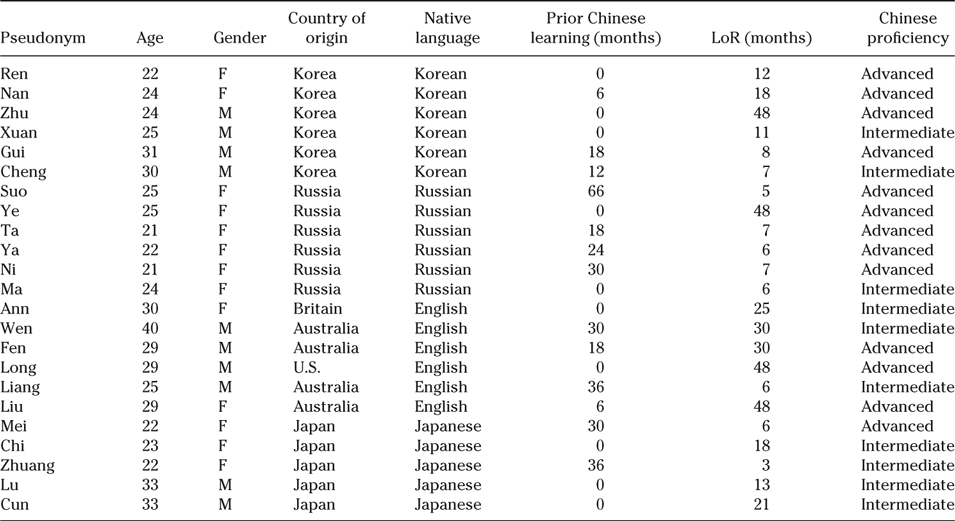
This study is part of a larger project that investigates the use of sociolinguistic variants by both Chinese NSs and CSL learners. As previously mentioned, Chinese NSs’ use of subject pronouns is presented in X. Li et al. (Reference Li, Chen and Chen2012), and this study compares CSL learner production with Chinese NS results. The data were collected in spring 2006 from 23 high-intermediate and advanced CSL learners (females, n = 13; males, n = 10) at Dongbei and Dongfang universities in Harbin, China.Footnote 5 The learners’ proficiency levels were determined not only by class placement but also by my own classroom observations and discussion with the instructors (due to the fact that class placement alone could not reveal the complete picture). In certain cases, although the students started at the beginning-level classes and then progressed to the advanced levels, their actual proficiency level could be considered high-intermediate. There were also cases in which some high-intermediate students requested to enroll in advanced classes to challenge themselves. The learners came from four different native language backgrounds: English, Russian, Korean, and Japanese. The data come from two sources: casual, conversation-style interviews and elicited narratives. Table 1 presents the demographic information of the participants.
CSL learner participants: Demographic characteristics

Note.
LoR = length of residence (in China).
Each learner was interviewed by the author twice, with each interview lasting about 45–60 min and with approximately 10 weeks between interviews. Therefore, a total of approximately 38 hr of CSL learner conversational speech was collected. To enhance the casual nature of the exchange, the interviews took place on the second floor of the students’ residence hall, where they usually met with their friends or tutors. Topics covered in the conversations were those with which the speakers were familiar and about which they felt comfortable talking. This included their hobbies, traveling experiences, favorite place in China, favorite teacher, and favorite book, among others. The interviewer had recourse to a question protocol for guidance, but very often the conversation was either student led or was a follow-up discussion on a particular topic. Following each first interview, the participants were asked to watch The Pear Story (Chafe, Reference Chafe1980) and then retell it in Chinese. The author acted merely as a listener.
Variables
The variables included in this study are informed by the literature on Chinese linguistics and existing studies of subject pronominal expression. According to C. N. Li and Thompson (Reference Li and Thompson1981), the third-person subjects for nonhuman referents in Chinese are rarely used except when they are required syntactically. Therefore, animacy (+/–human) is conflated with person and number, such that third-person singular and plural are each split into separate +animate and –animate categories. In his discussion of empty pronouns in different languages, Huang (Reference Huang1984) claimed that subject drop in Chinese sometimes actually functions as topic drop and that “the distribution of a zero subject pronoun is closely tied to the presence or absence of a potential antecedent rich enough in content (Agreement or an actual NP)” (p. 557). He further explained that, in languages with a rich agreement system such as Spanish and Italian, the agreement helps to identify the null subject, whereas in languages without agreement such as Chinese and Japanese, the null subject is identified by a NP in a superordinate clause. This discussion is relevant to one of the prominent features in Chinese—namely, topic chain (W. Li, Reference Li2004, Reference Li2006)—in which a subject coreference may occur in the preceding clause as an object, as a fronted topic, or in other sentence positions, even though there is a switch in subject referent. Therefore, regarding treatment of coreference in this study, if there is a switch in the subject referent from the one in the preceding clause, it is coded as switch and, if not, as no switch. Additionally, if the underlying entities of the subjects in two adjacent clauses are the same, it is coded as same underlying (as shown in example [2]), or, if they partially overlap, it is coded as partial overlap (as shown in example [3]).
(2) Author:
你 喜欢 吃 什么?
Nǐ xǐhuān chī shénme?
You like eat what
“What do you like to eat?”
Long:
在 东北, 我 最 喜欢 吃 炖 菜
Zài dōngběi, wŏ zuì xǐhuān chī dùn cài
prep northeast, I most like eat stew dish
“In the northeast, I like the stewed dishes the most.”
(3) 我 们 觉得 太 贵 了。然后,我 说, “算了, Ø 不 买 了。” (Mei)
Wŏ men juéde tài guì le. Ránhòu, wŏ shuō, “Suànle, Ø bù măi le”
I pl think too expensive crs. Then, I say, “Never:mind, Ø not buy crs.”
“We thought it was too expensive. Then, I said, ‘Nevermind, I don’t want it.’”
If the subject is mentioned in the object position, fronted topic, or other positions in the preceding clause, it is coded as object → subject (as shown in example [4]), fronted topic (as shown in example [5]), or other → subject (as shown in example [6]).Footnote 6
(4) 他 们 一直 看 着 我,所以 我 有 点 不好意思。 (Ren)
Tā men yīzhí kàn zhe wŏ, suŏyǐ wŏ yŏu diăn bùhăoyìsi
He pl all:the:time look dur I, so I have a:little embarrassed
“They were looking at me all the time, so I was a little embarrassed.”
(5) 那个 骑自行车 的 小孩儿,他 正在 经过 那个地方 (Nan)
Nàgè qí zìxíngchē de xiăoháier, tā zhèngzài jīngguò nàgè dìfāng
That ride bike att child, he dur pass:by that place
“The child who was riding a bike was passing by.”
(6) 他 们 的 退休金 很 少, 所以 他们 没 办法 (Ye)
Tā men de tuìxiūjīn hěn shăo, suŏyǐ tā men méi bànfă
He plgen pension very little, so he pl no method
“They have very little pension, so they had no other choice.”
C. N. Li and Thompson (Reference Li and Thompson1981) claim that subject referent specificity is also a factor that influences speakers’ choice of overt versus null subjects. So, when a subject refers to a specific entity, it is coded as specific, and, when it has a general denotation, it is coded as nonspecific. Previous studies have shown that sentence type affects Chinese NSs’ use of subject pronouns (Jia & Bayley, Reference Jia and Bayley2002; X. Li et al., Reference Li, Chen and Chen2012). Therefore, sentence type is included as one of the factor groups such that I may compare CSL learners’ subject pronoun use with that of NSs’ in this dimension.
In sum, the independent variable in this study is presence or absence of subject pronouns (i.e., overt vs. null). The dependent variables are person, number, and animacy of the subject (i.e., first-, second-, or third-person singular or plural, or third-person +/–animate); coreference (i.e., switch, no switch, same underlying, partial overlap, fronted topic, object → subject, or other → subject); specificity (i.e., specific vs. nonspecific); sentence type (i.e., declarative, question, or imperative); speaker gender (i.e., male vs. female); discourse context (i.e., conversation vs. elicited narrative); native language (Russian, English, Korean, or Japanese), proficiency level (high-intermediate vs. advanced) and length of residence in China (1, 2, 3, or 4 years).
Analytical Approach and Coding
As mentioned earlier, this study is identified with the sociolinguistic variationist approach, which is concerned with understanding the underlying systems of language varieties governed by linguistic and social factors as well as by characteristics of individual speakers (e.g., Bayley, Reference Bayley, Bayley and Lucas2007; Dewaele, Reference Dewaele2004a; Dickerson, Reference Dickerson1975; Labov, Reference Labov1966, Reference Labov1972; Tagliamonte, Reference Tagliamonte2006; Tarone, Reference Tarone1982, Reference Tarone1983, Reference Tarone2007; Young, Reference Young1991). Logistic regression is the analytical approach most widely used in variation studies to tease apart the multiple factors that come into play and their relative strengths. The assumptions that underlie the adoption of logistic regression as the analytical approach for interlanguage variation studies are that (a) variation in learner speech, like variation in any language, is influenced by not one but multiple constraints and (b) these constraints can be analyzed quantitatively (i.e., according to the principles of quantitative modeling and multiple causes as discussed in Young & Bayley, Reference Young, Bayley, Bayley and Preston1996). So far, the VARBRUL program, which is a specialized application of logistic regression and was designed to handle natural speech data, is what most variation studies use (for detailed information, see Bayley, Reference Bayley, Chambers, Trudgill and Schilling-Estes2002; Tagliamonte, Reference Tagliamonte2006; and Young & Bayley, Reference Young, Bayley, Bayley and Preston1996). Specifically, this study utilized the computer program GoldVarb X for Windows (Sankoff, Tagliamonte, & Smith, Reference Sankoff, Tagliamonte and Smith2005). The program provides the results of a frequency analysis as well as factor weights that indicate the relative effect strengths of different factors. A factor weight above .50 indicates a favoring effect, and a factor weight below .50 indicates a disfavoring effect.
The data were first transcribed, and all of the actual and potential occurrences of overt and null pronouns in subject position were coded by a researcher. A second researcher then rechecked the first researcher’s codings, and, finally, a third researcher (the author) examined all the discrepancies. The second and third researchers discussed the discrepancies until they reached consensus on the coding decision. All three researchers are Chinese NSs and experienced coders of Chinese speech data. The interrater reliability between the final version of codings and the ones done by the first researcher reached 91%.
Coding Exclusions
The coding exclusions were as follows: (a) any subject pronoun in a false start was excluded; (b) if a subject pronoun was repeated, it was only coded once; and (c) cases in which a subject pronoun is obligatory or prohibited—such as those found in formulaic expressions (see example [7] and example [8]) or pivotal pronouns in serial verbal constructions (see example [9])—were excluded.
(7) 你 好。
Nǐ hăo
You good
“Hello.”
(8) 谢谢。
Xièxiè
Thank:thank
“Thank you.”
(9) 他 们 不 让 我 在 这儿 学习。
Tā men bù ràng wŏ zài zhèer xuéxí
He pl not let I prep here study
“They do not allow me to study here.”
RESULTS
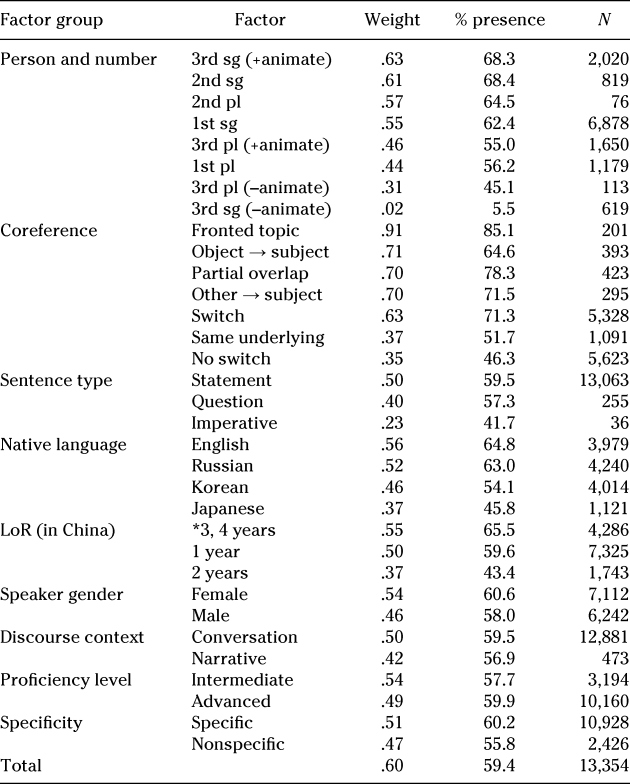
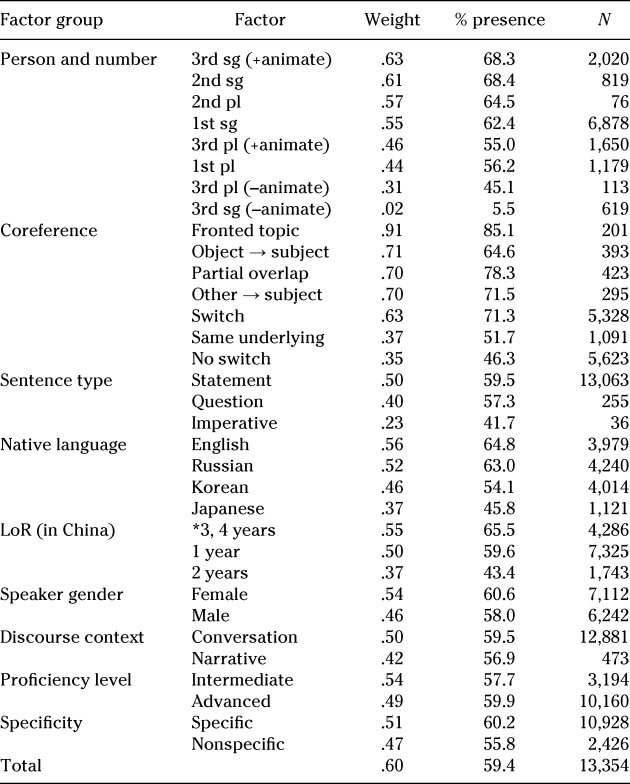
A multivariate analysis of 13,345 tokens extracted from two interviews revealed that all of the variables investigated reached significance. The overall rate of subject pronoun use was 59.4%, with an input value of .60. Subject person and number and referent switch proved to have the strongest effects, followed by sentence type, native language, length of residence in China, gender, discourse context, proficiency level, and specificity.
Table 2 displays the detailed results. Following standard variationist practice (Tagliamonte, Reference Tagliamonte2006; Young & Bayley, Reference Young, Bayley, Bayley and Preston1996), those factors within groups that were not significantly different or that were linguistically—or theoretically—justified to be grouped together were combined; these collapsed factors are indicated with an asterisk in Table 2. For example, the effect of a 3-year residence was not significantly different from that of a 4-year residence, so these two were collapsed into a single 3-to-4-year factor. Because factors with weights above .50 tend to favor overt pronouns, and those with weights below .50 tend to favor null pronouns (i.e., disfavor overt), unless stated otherwise, the application value (i.e., the default dependent variable against which all factors are measured) was set as overt pronoun.
Subject pronoun use by CSL learners
Note.
LoR = length of residence; chi-square/cell: 1.61, Log likelihood: −7,793.34, p < .05; asterisks (*) indicate combined factors.
The results demonstrate several noticeable patterns. Singular and +animate subjects tend to be associated with overt pronouns, whereas plural and –animate ones are associated with null pronouns. Switch in subject surface form favors overt pronouns, and no switch favors null. Statements and questions slightly favor overt pronouns, whereas imperatives favor null. English and Russian speakers tend to pronominally realize subjects more often than Korean and Japanese speakers. A 2-year residence in China favors null pronouns, longer residence favors overt, and 1-year residence favors neither. Females tend to use overt pronouns more than males do. Conversations slightly favor overt pronouns, and narratives, null. Intermediate learners tend to use overt pronouns more than advanced learners do. If the subject referent is specific, overt pronouns tend to be used, but if nonspecific, the null form is used more.
DISCUSSION
Native Language
Accounting for the role of L2 learners’ prior linguistic knowledge (i.e., their native language) is acknowledged to be an important part of SLA theories and an area of focus that provides a better understanding of the L2 learning process. As Bayley (Reference Bayley, Bayley and Lucas2007) notes, one of the advantages that the variationist approach offers for SLA research is “a clear way to study the effects of language transfer” (p. 136). As previously discussed, prior research efforts into the effect of the native language on the acquisition of sociolinguistic variation have yielded inconsistent results. On the one hand, some studies have found that a learner’s L1 plays an important role, in that learners transfer the L1 counterparts of the target structure in their production (Dewaele, Reference Dewaele1999; Mougeon et al., Reference Mougeon, Rehner and Nadasdi2004; Trevise & Noyau, Reference Trevise, Noyau and Andersen1984). On the other hand, studies have found that the L1 does not influence learners’ production of sociolinguistic variants in a significant way (Dewaele, Reference Dewaele1998; Ghafarsamar, Reference Ghafarsamar2000; X. Li, Reference Li2010).
The CSL learners in the current study come from four different native language backgrounds: English, Russian, Korean, and Japanese. Although, according to prescriptive grammars, English does not allow null subjects, in spoken English, the null form does occur in subject position, even if it is a very rare phenomenon (Harvie, Reference Harvie1998). Russian, Korean, and Japanese are all null subject languages.Footnote 7 As a result, we would expect that L1 English speakers would be more likely to use overt subject pronouns, whereas Russian, Korean, and Japanese L1 speakers should favor null subjects. The results showed that learners’ L1 does indeed have a significant effect on subject pronominal expression in L2 Chinese; English (factor weight = .56) and Russian (.52) speakers favor overt pronouns, whereas Korean (.46) and Japanese (.37) speakers favor null. If Russian is a null subject language, what accounts for this slight favoring effect?
I contend that the effect of the native language on subject pronoun use in L2 Chinese depends not only on whether or not the L1 is a null subject language but also on the extensiveness of null subject use in the L1. According to Zdorenko (Reference Zdorenko, Gries, Wulff and Davies2009), the rate of null subjects in Russian speech is 29%, and it is not a feature of all genres and registers. Null subjects are much more common in Korean; for example, when adults talk to children, they tend to use null subjects about 60%Footnote 8 of the time, versus 69% in adult-adult conversations (Kim, Reference Kim2000). The discrepancy between these two contexts reinforces the concept that overt subjects are linked to clarity, as adults may desire to be more careful in making their speech to children clear (see also the baby talk register discussed in Ferguson, Reference Ferguson1964). It may also be the case that adult-adult conversation contains more complex sentences—with more subordination—than adult-child conversation. In Japanese, the null subject rate in adults’ speech to children is about 68% (Nakayama, 1996, as cited in Kim, Reference Kim2000),Footnote 9 and the rate would be expected to be even higher in adult-adult conversations. Therefore, Japanese speakers tend to use overt subject pronouns the least, followed by Korean speakers, then Russian speakers, and finally English speakers. Therefore, the results of this study seem to mirror native language rates of overt pronoun expression, which suggests that the pattern of subject pronoun use in the learners’ native languages may be transferred to their use of L2 Chinese. Indeed, other studies (e.g., Jegerski, VanPatten, & Keating, Reference Jegerski, VanPatten and Keating2011; Tao & Healy, Reference Tao and Healy2005) also showed that the learners’ preexisting referential strategies persist—even when they reach an advanced L2 proficiency level—and may pose a major barrier to nativelike performance in L2 use.
Length of Residence
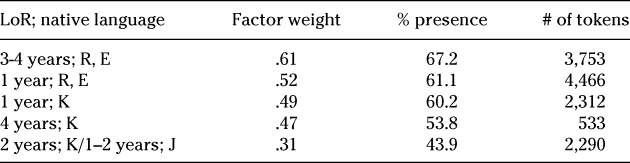
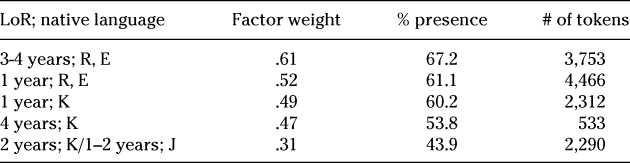
The results of the current study showed that learners who stayed in China for 3 or 4 years are the most likely to use overt pronouns, and those who have stayed for 2 years tend to use the null form. Because the sociolinguistic norm for NSs tends toward omission of subject pronouns, this finding goes against what has been found in previous studies: that a longer stay in the target language environment promotes acquisition of NS patterns (e.g., Regan, Reference Regan and Dewaele2004; Sax, Reference Sax2003). I suggest caution when interpreting this result because the length-of-residence factor group overlaps with native language; that is, six out of seven learners with a 3-to-4-year stay are English and Russian speakers, whereas three out of four learners with a 2-year stay are Japanese speakers. As the effect of native language showed, English and Russian speakers favor overt pronouns, and Japanese speakers favor null. Thus, it is very likely that the effect of native language overrides the effect of length of residence. To further explore this, the factor groups of native language and length of residence were combined (see Table 3), and the results indicated that the effect of native language was much stronger than the effect of length of residence. Therefore, a more balanced dataset is needed in future research to further explore the effect of length of residence.
The effect of native language and length of residence
Note.
R = Russian; E = English; K = Korean; J = Japanese; chi-square/cell: 1.58, Log likelihood: −7,779.20, p < .05.
Gender
Although not very robust, the effect of speaker genderFootnote 10 in this study reached significance, as females are more likely to use overt pronouns than males. A possible explanation for this difference has to do with speech clarity. Some studies have shown that women are more careful to adopt a clearer language style (e.g., Tannen, Reference Tannen1986; Wulf, Dudis, Bayley, & Lucas, Reference Wulf, Dudis, Bayley and Lucas2002). X. Li et al.’s (Reference Li, Chen and Chen2012) study of subject pronoun use by Chinese NSs also showed that females tend to use overt pronouns more than males do. The CSL learners in this study may, to some extent, notice the difference in subject pronoun use by male versus female NSs, which may consequently affect their choice of subject pronoun expression. The female learners may attempt to mitigate misunderstanding or confusion by using more overt pronouns. Additionally, the results showed that instructors use overt pronouns more often during teaching; the learners may thus notice the style difference and consider instructors’ speech as more standard or correct. In particular, female learners may adhere more to standard and formal forms of speech, which has also been documented in other studies (e.g., Adamson & Regan, Reference Adamson and Regan1991; X. Li, Reference Li2010; Major, Reference Major2004). However, it is important to note that learners’ subject pronoun use in terms of gender has not been interpreted with the standard-nonstandard yardstick for two reasons: (a) There is no literature, to date, on the social meanings of subject pronoun use by Chinese NSs and CSL learners (nor is it the target of the current study), and (b) the definition and measure of standard language forms is a controversial issue (e.g., What is standard language? Should the grammar book be considered as the standard or should the actual performance of NSs be considered as the standard?). These topics are well beyond the scope of the present investigation. Regarding the difference between the subject pronoun expression in male versus female learners, I speculate that these learners notice the speech styles of both their NS peers and their instructors and view instructor speech as the norm they need to follow; it may be that female learners do so more often than males. Furthermore, the group constellation in the four native language groups is not well balanced. For example, the Russian group only has female learners, whereas the Korean and English groups have two females and four males. To yield a more complete picture of how subject pronouns are used by CSL learners, more well-balanced learner groups need to be included in future studies.
Discourse Context
This study showed that overt pronouns were used at a slightly higher rate in conversations than in elicited narratives. My speculation is that, in the elicited narrative, The Pear Story (Chafe, Reference Chafe1980), there are a limited number of nominal entities. Consequently, speakers have a limited selection of NPs and thus have more opportunities to omit them in the subject position. When the learners retold the story, the presence of the interviewer, who had shared knowledge with the speakers, might also have encouraged the omission of subjects because it would not affect the understanding of their narration. However, elicited narratives represent a much smaller portion of the dataset than the conversations (i.e., 473 pronominal tokens in narratives and 12,881 in conversations), and the effect of discourse context, although significant, is not large. Future research should explore the effect of discourse context by using a more balanced dataset as well as additional discourse-related dimensions such as formal versus informal contexts.
Proficiency Level
The results showed that less proficient learners tend to use overt pronouns at a greater rate than highly proficient speakers. This finding accords with previous studies (e.g., Ghafarsamar, Reference Ghafarsamar2000; Sax, Reference Sax2003) that have found that, as learners’ L2 proficiency increases, their pattern of target language use more closely approximates that of NSs. However, because the learners in this study are all rather advanced, the effect of proficiency is not very robust.
Native Speaker versus CSL Learner
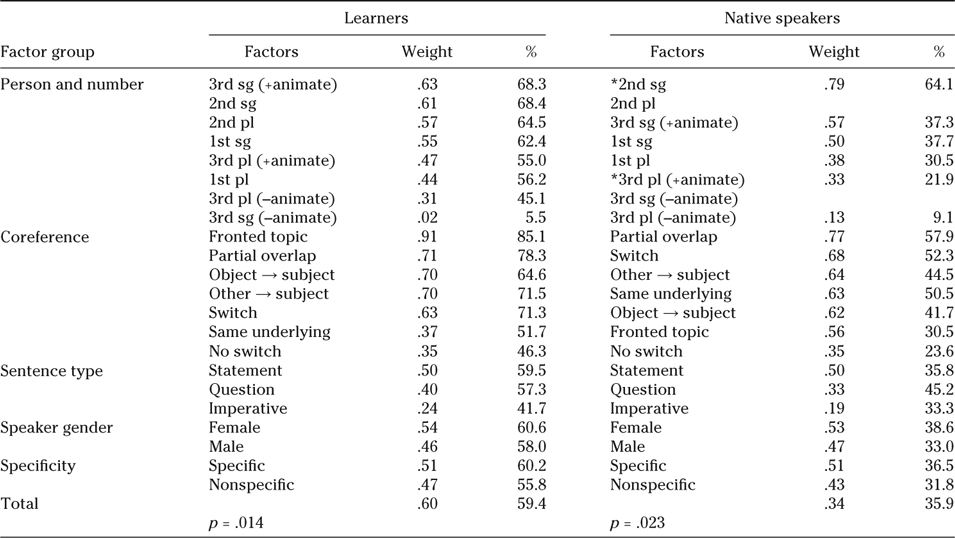
To situate these results within a conception of acquisition and development of sociolinguistic competence, the learner results were compared with X. Li et al.’s (Reference Li, Chen and Chen2012) results on the learners’ NS peers (see Table 4). The overall use of subject pronouns by both groups was tabulated and a chi-square test was conducted. The result indicated that the overall rates by learners and NSs are significantly different, with learners using explicit pronouns more than NSs, χ2(1, N = 17,675) = 723.19, p < .001. Chi-square tests were not conducted for every variable because they can only compare frequencies. As such, most of the variables would be significant due to the large difference between the overall rates by learners and NSs. For example, the factor weights of the variable no switch in the factor group coreference for learners and NSs are the same (.35), which means that the likelihood that these two groups of speakers will use subject pronouns when there is no switch between the two adjacent subject referents is the same. However, their frequencies are significantly different, χ2 (1, N = 7,951) = 353.48, p < .001. Thus, I compared the VARBRUL weights of learners and NSs, which would tell us the strength of each factor relative to other factors in the same factor group. In general, the learners’ pattern of subject pronoun use is similar to that of their NS peers in most of the dimensions examined, except for the factor group coreference. Discourse context did not reach significance in X. Li et al. (Reference Li, Chen and Chen2012), and the difference between conversation and narrative in the learner data is not very robust, so it is not included in this comparison.
As with NSs, learners are generally more likely to use overt pronouns for singular and +animate subjects, but null pronouns are used for plural and –animate subjects. Both groups slightly favor overt pronouns for statements, followed by questions and imperatives. Within both groups, specific referents slightly favor overt pronouns (and nonspecific referents favor null), and females are more likely to use overt pronouns than males, although the specificity and gender differences are not very robust. See Table 4 for a breakdown of NS versus CSL subject pronoun use.
Subject pronoun use by Chinese NSs vs. CSL learners
Note.
Asterisks (*) indicate combined factors.
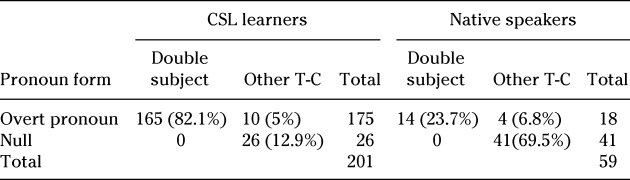
With regard to coreference, the main difference between learners and NSs lies in two factors: fronted topic and same underlying. The factor weights obtained from the multivariate analysis showed that, although learners treat fronted topic as the most favoring environment for overt pronoun use (.91), fronted topic only slightly favors overt pronouns for NSs (.56). Crucially, for learners, fronted topic is the most overt-favoring coreference factor, whereas, for NSs, only no switch favored null more than did fronted topic. When the underlying entities of two adjacent subjects are the same, learners are also likely to use null subjects more (.37), but NSs tend to use explicit pronouns (.63). However, the frequencies of overt pronoun use for same underlying entities by learners (51.7%) and by NSs (50.5%) are not vastly different. The difference in input values might be due to the high overall rate of overt pronoun use by learners.
To explore the difference found in fronted topic, I reexamined the data and found that there are two conditions for fronted topic—namely, double-subject structures (see example [5]) and other topic-comment (T-C) structures (see example [10]):
(10) 语法 方面, Ø 还 没 感觉到 Ø 有 很大 的 进步。 (Xuan)
Yŭffă fāngmiàn, Ø hái méi gănjuédào Ø yŏu hěndà de jìnbù
Grammar aspect, Ø still not feel Ø have very:big att progress
“I don’t feel that I have made much progress in grammar.”
Both learners and NSs categorically use overt pronouns for double-subject structures, which account for 82.1% of learners’ fronted topic utterances but only 23.7% of NSs’. In contradistinction, learners and NSs exhibit a similar pattern of pronoun use in other T-C structures (i.e., both groups had predominantly higher rates of null pronouns in other T-C structures; learners: 72.2% [26/36] vs. NSs: 91.1% [41/45]). Although, together, the CSL learners produced more than three times as many tokens as the NSs (i.e., 13,345 as compared to 4,321), both groups actually use fronted topic at very similar rates (i.e., CSL: 1.5% vs. NSs: 1.4%). Learners’ greater use of overt pronouns in fronted topic environments can be directly traced to a greater rate of double-subject structures in their speech. This is not surprising if we assume that learners may attend more carefully to getting their message across than do NSs, due to the fact that repetition of the topic entity in subject position adds a degree of referential clarity. In other words, this result shows that learners have acquired the subject-in-fronted-topic structures successfully. However, as expected, NSs are able to manage discourse relatively more skillfully than learners by exhibiting more omissions of subjects that have already been mentioned in the topic position. For a summary of these results, see Table 5.
Use of fronted topic by CSL learners and native speakers
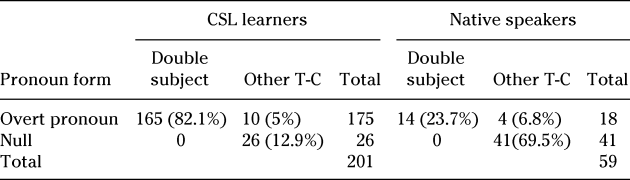
Note.
T-C = topic-comment. The values in parentheses represent percentages of overt pronoun and null pronoun use in double subject and other T-C sentence structures by learners and native speakers.
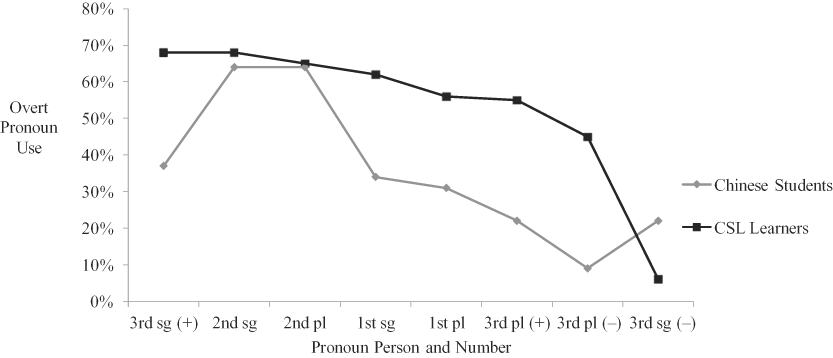
In terms of overall subject pronoun use, learners tend to use overt subject pronouns at a much higher rate than their NS peers (see Table 6 and Figure 1). This is in line with findings from other studies in that learners are more likely to use overt forms in optional contexts. In L2 Chinese, learners were found to overuse the target forms in optional environments such as the aspect marker le (Duff & Li, Reference Duff, Li, Salaberry and Shirai2002), the morphosyntactic particle de (X. Li, Reference Li2010), or overt pronouns (Polio, Reference Polio1992, Reference Polio1995). Studies of other L2s, such as French, also found that learners tend to overuse optional forms such as the preverbal negation particle ne (Rehner & Mougeon, Reference Rehner and Mougeon1999). This phenomenon can be partially attributed to factors of clarity and accuracy that learners would like to achieve in their speech. In optional contexts, learners may choose to overtly express the pronoun to clearly indicate the nominal referent and cause less confusion. Furthermore, they still need time to further develop their sociolinguistic competence so as to fully acquire the target pattern of sociolinguistic variation and to achieve NS performance.
Subject pronoun use by CSL learners, Chinese students, and Chinese teachers

Note.
Asterisks (*) indicate that the Chinese native speaker data come from X. Li et al. (Reference Li, Chen and Chen2012).
Frequency of subject pronoun use by CSL learners and Chinese students.
If we consider the teacher results from X. Li et al. (Reference Li, Chen and Chen2012), we also find that the learners’ pattern of subject pronoun use is very similar to that of teachers (see Table 6). As previously mentioned, the seven teachers in X. Li et al. (Reference Li, Chen and Chen2012) were all language teachers (i.e., either teachers of English as a foreign language, n = 3, or of CSL, n = 4); the four CSL teachers were actually the teachers of the participants in this study. Half of the participants did not have any previous Chinese learning experience before coming to China; the other half did, and the length of their experience varied. Although the learners’ previous Chinese teachers’ input rate of subject pronoun use is unknown, this result at least suggests that teachers’ input may play an important role in learners’ acquisition of the variability of pronominal subjects in Chinese because learners tend to consider teacher speech as the standard form and may adhere more carefully to its style (X. Li, Reference Li2010). In fact, several previous studies have demonstrated an effect of teachers’ input on learners’ acquisition of target language variation (X. Li, Reference Li2010; Mougeon & Rehner, Reference Mougeon and Rehner2001; Mougeon et al., Reference Mougeon, Rehner and Nadasdi2004).
CONCLUSION
In general, CSL learners’ use of pronominal subjects is subject to the same linguistic and nonlinguistic constraints that have been examined in other studies, with the two primary predictors of subject person and number and reference switch. Additionally, because the learners in this study are rather advanced, their pattern is similar to their NS peers’ on most dimensions explored, except that the learners tend to overuse overt pronouns. These results indicate that these learners have acquired the subject pronoun usage pattern in Chinese rather successfully but still need more work on using null pronouns to develop more fully their sociolinguistic competence and to achieve nativelike performance.
Two of the findings in this study merit additional consideration. One is the role of the native language on the acquisition of target language variability. The effect of native language on L2 learning is an issue that SLA researchers have explored for decades (e.g., Gass & Selinker, Reference Gass and Selinker2008; Ghafarsamar, Reference Ghafarsamar2000; Kellerman & Sharwood-Smith, Reference Kellerman and Sharwood-Smith1986; Odlin, Reference Odlin1989). The transfer hypothesis states that prior linguistic knowledge may have positive as well as negative influences on L2 learning. Positive transfer occurs when the native language helps L2 learners to have a general understanding of language and provides various linguistic hypotheses on which they can draw when acquiring a L2. Conversely, negative transfer (or interference) may also occur in the process of L2 learning when the native language misleads L2 learners to form incorrect hypotheses and causes nontargetlike interlanguage use. As mentioned earlier, the effect of the L1 on L2 variation has yielded inconsistent results (Dewaele, Reference Dewaele1999; Ghafarsamar, Reference Ghafarsamar2000; X. Li, Reference Li2010; Mougeon et al., Reference Mougeon, Rehner and Nadasdi2004). For example, in my earlier study of the acquisition of the Chinese morphosyntactic particle de (的) by the same group of learners (X. Li, Reference Li2010), native language did not reach significance. Although Japanese and Korean have a particle that is similar to de (though with fewer functions), Japanese and Korean learners had similar rates of de use as Russian and English speakers. In this study, however, the L1 played a strongly significant role in the learners’ acquisition of subject pronoun use in Chinese, although the extensiveness of the structure usage in the L1 determines the pervasiveness of the null subject in L2 production. Therefore, the role of the L1 in the acquisition of sociolinguistic variation is not dichotomous in nature; that is, it is not the case that the native language either does or does not affect learners’ acquisition of Type 2 variation. Rather, the L1 does not have a uniform effect on L2 variation, as L2 variation depends on many factors, including—but not limited to—(a) the nature of the target structure, (b) whether or not the L1 has a counterpart to a given L2 sociolinguistic variable and how the structure is used variably in the L1, (c) learners’ proficiency level, and (d) with whom the learners interact regularly. What becomes more important, then, is to examine when, under what conditions, and how the L1 does or does not play a role in affecting L2 variation.
The other important finding is the role of teachers’ input in learners’ L2 variation. This study corroborates previous findings that learners’ acquisition of target language variability is influenced by their teachers’ speech (X. Li, Reference Li2010; Mougeon & Rehner, Reference Mougeon and Rehner2001; Mougeon et al., Reference Mougeon, Rehner and Nadasdi2004). In this study, the teachers might have adopted a more careful register—including clearer speech—while teaching, and so they might attempt to avoid confusion by overtly supplying information regarding the subject reference. As the results showed, the learners were following their teachers’ speech styles and patterns in that they tended to use subject pronouns more often than necessary. In many cases, language teachers would like their students to follow what they say, but they may prefer otherwise in this case. This finding then raises the question of what teachers can do to help learners further develop their L2 sociolinguistic competence and use of nativelike variability. It may be rather difficult and unnatural for many teachers to adopt a more casual register during teaching and to talk as if they were interacting with their friends. Because teachers are unlikely to supply this necessary input, it may be helpful to provide or encourage more interactions between learners and their NS peers. Merely leaving the task to learners themselves and asking them to interact with NSs, however, may be insufficient and inefficient; learners could end up taking a long time to develop their sociolinguistic competence and to reach nativelike performance.
As a result, I support the claims made by some SLA scholars (e.g., Lyster, Reference Lyster1993; Mougeon & Rehner, Reference Mougeon and Rehner2001; Mougeon et al., Reference Mougeon, Rehner and Nadasdi2004) who assert the necessity of designing teaching materials specifically targeting L2 variation and explicit instruction on sociolinguistic variables. I envision the use of authentic natural NS speech as the baseline or theme of these teaching materials as well as designing exercises or activities that direct learners’ attention to how NSs use the target structures in optional contexts (and under various conditions). Inviting NSs into language classrooms to interact and discuss sociolinguistic variants with learners is also a good strategy not only to provide more opportunities for learners to interact with target language users but also to offer a NS viewpoint on the use of target language variables. However, these instructional materials will require a serious, systematic research foundation to lay out the NS patterns of variability. Careful planning and design are also needed to assess how instructors can present and teach variable structures in a way that is both accessible and learnable for students and, at the same time, manageable for teachers.
FURTHER INQUIRY
This study examined the use of subject pronominal expressions by CSL learners. Because Chinese allows null objects in addition to null subjects and because both subjects and objects can be expressed as full NPs in addition to overt or null pronouns, future interlanguage variation studies of null pronouns in L2 Chinese may want to include an investigation of how full NPs are used in subject positions (in addition to overt or null pronouns), how objects are expressed, and how subject and object expressions compare. Surely, NS data are needed as the baseline for future study. Studies along these lines will add to our understanding of the variability of subject and object expression in both native and L2 Chinese as well as the development of sociolinguistic competence in L2 acquisition.