Buddhism, first officially adopted by Tibetan royalty in the seventh century, remained confined to court circles and was not widely accepted during the reign of the Tibetan kings between the seventh and ninth centuries. After a dark period of persecution during the late imperial period, the so-called “Second Diffusion” of Buddhism in Tibet began towards the end of the tenth century.
Some iconographic themes and objects of Tibetan Buddhist art testify to the importance of fragrant ritual offerings. Perfumes are associated with the idea of perseverance, through which enlightenment can be achieved.
Among the major rites of Tibetan tantric Buddhism are the offerings of the five senses presented to various religious masters and peaceful deities. They express the desire to please the gods and symbolise the renunciation on the part of the donor of sensory pleasures. The senses can be personified by five goddesses. Perfume (or gandha in Sanskrit) is personified by Gandhā, a goddess who represents the sense of smell. The colour of her skin varies, but her attribute is a conch containing perfumes.
The goddess Dhūpā personifies incense, or dhūp, and belongs to a group of four goddesses embodying the ritual offerings of flowers, incense, light and perfume. Her attribute is the incense burner and her skin colour is usually dark. Gandhā also belongs to this group. Dhūpā and Gandhā, who can have either one face and two hands, or three faces and six hands, appear in different types of maṇḍala. Footnote 1
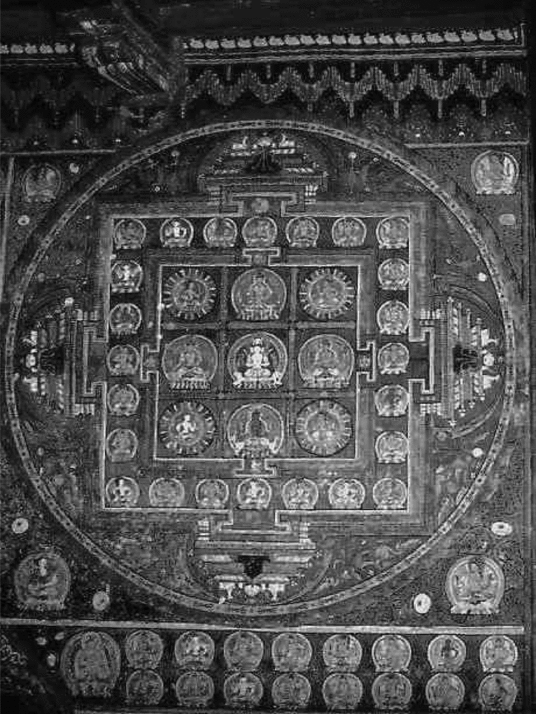
Western Tibet played a major religious and artistic role in the Second Diffusion, and some of the most beautiful mural paintings of Tibetan art history were executed in this region during the eleventh century. In the three storey temple, or Sumtsek, of Alchi monastery, in Ladakh, ten major and magnificent esoteric maṇḍala were painted on the walls of the first upper storey.Footnote 2 On some of these, dedicated to the Buddha Vairocana, “the Shining One”, under his omniscient aspect with four heads Sarvavid Vairocana, Lord of the Vajradhātu maṇḍala, or to Vajriṇī presiding the Vajraguhya maṇḍala, the four offering goddesses are quite visible at the corners of the square surrounding the circles of the diagram, arranged according to the four heavenly directions (Fig. 1).
Vajradhātu maṇḍala, first upper storey, Sumtsek temple, Alchi monastery, 11th century, Ladakh (Picture: Lionel Fournier).

They also appear in western Tibet on fine mural paintings of Buddhist sanctuaries dating back to the eleventh century, excavated in cliffs, as is the case in the cave located above Chiwang (Phyi-wang) village, named the “cave of the offering goddesses”.Footnote 3 The three niches of this cave originally contained a clay sculpture, and the deities depicted on the walls around these niches were part of the maṇḍala dedicated to it. The maṇḍala were illustrated according to the description of Indian texts that were translated into Tibetan at the beginning of the Second Diffusion of Buddhism. Dhūpā, who has a dark skin and is beautifully dressed, appears in two maṇḍala. In one case, she presents in her right hand incense in a bowl that is embellished with a design of birds; in the second, the incense bowl rests on a lotus, and the goddess, in the gesture of prayer (añjali), holds the stem of the flower.
Dhūpā and Gandhā are also widely represented on thang-ka of various periods. On a fourteenth century thang-ka of the Guimet Museum, depicting a complex maṇḍala dedicated to the god Vajrāmṛta,Footnote 4 the “diamond nectar or ambrosia”, the dark Dhūpā sits at the south-east, and the red Gandhā at the north-west of the second circle, so in a quite prominent position.
The two goddesses also appear in three dimensions in the maṇḍala, as is the case in the assembly hall (Tib. ‘du-khang) of the main temple of the famous Tabo monastery, now situated in Himachal Pradesh in north India which was built by the western Tibetan king Yeshe-Ô, in 996. The painted clay sculptures of this assembly hall, renovated in 1042, are parts of a maṇḍala dedicated to the omniscient aspect of Vairocana.Footnote 5
A bodhisattva, Gandhahastin, whose name means he (or she) “who holds the perfume” and who belongs to a group of sixteen bodhisattvas, also appears in various maṇḍala.
The offerings of the five senses can also be symbolised by five objects, related to five buddhas. The sense of smell is related to Amitābha, the buddha of the “Infinite Light”.
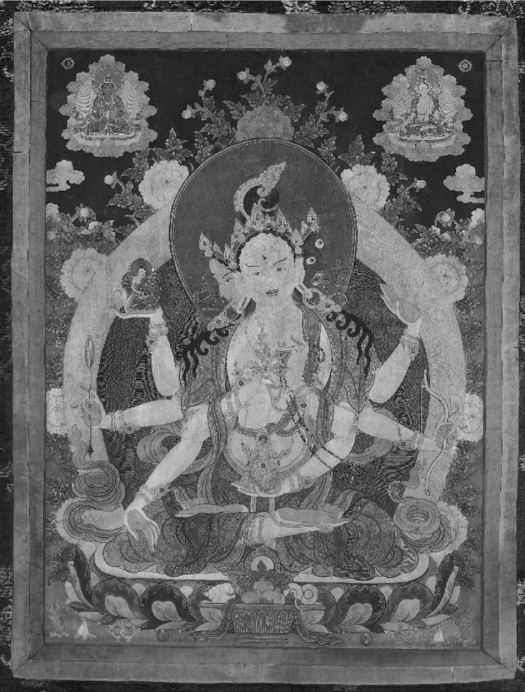
It appears on thang-ka in the form of separate objects, or as a composite group placed within a bowl, a tray (Fig. 2) or on a lotus.Footnote 6 They are usually represented on a table below the main figure, at the centre,Footnote 7 or on a rock depicted at the bottom of the work,Footnote 8 or else to the side.Footnote 9 The sense of smell is evoked by a white conch shell full of perfumes or aromatic liquids, and is always depicted horizontally, as can be observed on many paintings from the Tibetan collection of the Guimet Museum. The conch is sometimes placed on a small tripod and is usually balanced with the fruit offering, symbolising the sense of taste,Footnote 10 but in some cases with a pair of cymbals,Footnote 11 or a lute, evoking the sense of hearing.
Uṣṇīṣavijayā, eastern Tibet, 18th century, distemper on cloth, gift of Ms Roux-Berger-Blanchy, in memory of her husband, 1982, MA 4938 (Picture: Musée Guimet).

It has to be noted that in ancient India, this object was already an important attribute of the Hindu god Viṣṇu and a symbol of spiritual sovereignty. Its powerful sound proclaimed victory over enemies during wars. It was then adopted by the Buddhists as a hand-held attribute proclaiming Buddha's teaching. But as an instrument, the conch is generally depicted vertically in Tibetan iconography. Both kinds of conches can be observed on the same image and must not be confused.
On the paintings, the perfumed water contained in the conch is usually represented as a swirling pale blue offering; only in some examples is the liquid yellow.
In Buddhism, the conch is usually filled with saffron-scented water, but also water perfumed with five fragrant substances: saffron, sandalwood, musk, camphor and nutmeg.
Tibetan incense basically consists of powdered juniper leaves, commonly burned in incense burners. The high altitude juniper (Juniperus recurva) is considered a sacred tree to most peoples of the Himalayas. It grows up to twelve metres high, at heights of three thousand metres and above, and can form large forests called “incense forests”. Its aromatic foliage was appreciated for its fragrant, cinnamon-like scent, and used for rituals of purification. The Reting (Rva-sgreng) monastery, founded in 1057 by the Tibetan master Dromtön (‘Brom-ston) in central Tibet, for example, was set amid a forest of juniper trees (Juniperus tibetica). According to a legend, they were distributed in all directions around the monastery, forming a sacred landscape. Moreover, they were described as having a seven-layered bark, interpreted in Buddhist concepts as being related to seven protector omniscient buddhas; thus, they were considered to be very auspicious. Those seven buddhas became associated with the first seven Dalai Lamas. On many Dromtön thang-ka, the juniper forest of Reting appears prominently and on one of them, seven dark blue trees represent the Dalai Lama's institution. Those trees have remained an object of worship to this day and Reting is still considered to be a very important pilgrimage site, and the cutting of its Juniper trees is prohibited. This species commonly lives for around 1,300 years, and the oldest tree in Reting is now more than a thousand years old.Footnote 12
Juniper incense provides a very nice smell, but is also known for its psychoactive effects. It is traditionally considered to be helpful for the purpose of meditation, and for acquiring a deeper and clearer consciousness. During a Tibetan popular ritual called lhasang (lha-bsang), juniper (bsang) is burned at the top of mountains as an offering to local deities from whom protection is requested. As in the case of many other plants that are used to make incense, juniper also has medical properties.
A paste of juniper powder mixed with medicinal herbs, saffron, sandalwood, agarwood, and musk are the main materials of traditional Tibetan incense sticks, but there are actually many kinds of incenses, sometimes composed of more than thirty different materials.
The agarwood comes primarily from Assam, in north-east India. The essence extracted from the resinous wood of dead trees also emits a psychoactive scent. The Sanskrit name agar related to this wood forms the basis of the word agarbattī or incense sticks.
During some rituals, three incense sticks are offered to the three worlds: the upper world, the middle world and the underworld. The hand holding these sticks between the thumb and the forefinger performs a special mudrā, with the other three fingers stretched. Mantra are also recited, as in every tantric ritual.
Incense sticks are offered in a bowl filled with rice or barley on the Tibetan Buddhist altar, as part of the offering bowls placed there from left to right in a precise order and in a straight line. The fourth bowl contains burning incense to attract the gods and “scent-eaters” or gandharva, who are semi-divine beings and the musicians of the gods. The fifth bowl holds a butter lamp, symbol of the illumination of wisdom, and the sixth contains rosewater or perfumed water to refresh the face. These offerings are consecrated by the recitation of the mantra oṃ āḥ hūṃ.
The art of Tibetan Buddhism has provided some remarkable metal incense burners of different shapes: vase or pot-shaped;Footnote 13 mounted on a tripod; with four feet; suspended upon three chainsFootnote 14 reminiscent of the Christian censer; or shaped like an oblong casket.Footnote 15
Just like the conch filled with perfumes, they usually appear on the paintings, among other offerings in front of the figure to which the work is dedicated.
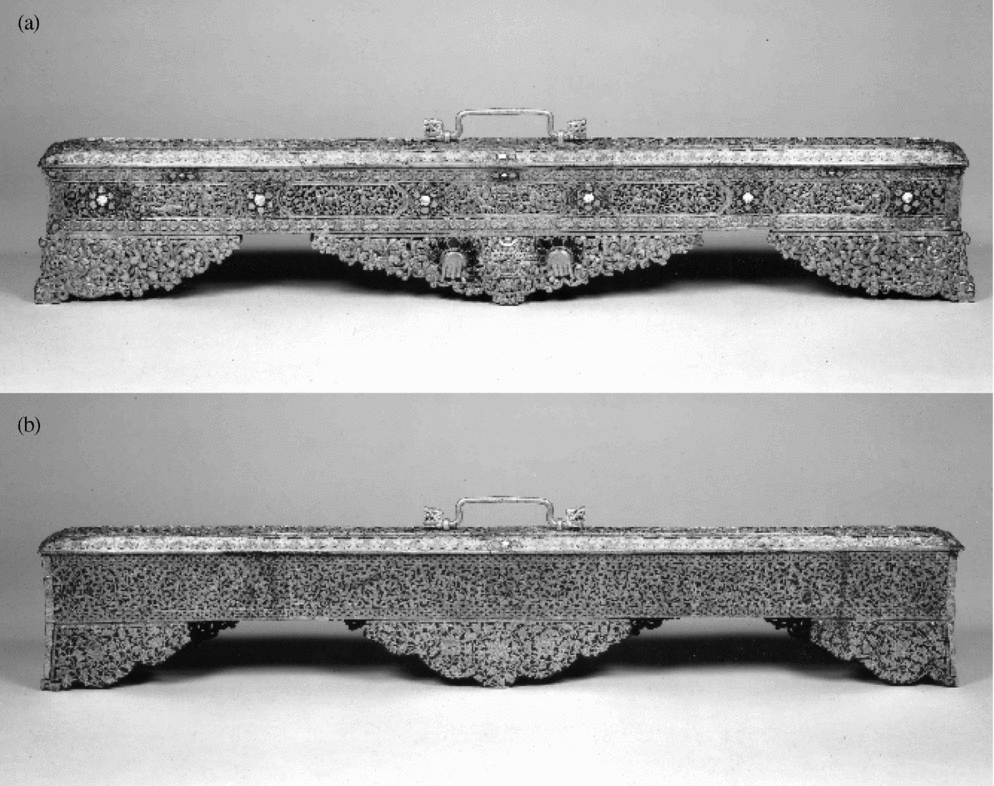
Some of the most beautiful incense burners were made in the eastern part of Tibet, in the Derge (sDe-dge) region, now in Sichuan province. The Guimet Museum possesses a very fine oblong example (80 cm) that could have been made in this region, and is dated from the sixteenth or seventeenth centuryFootnote 16 (Fig. 3). The object is made of gilded iron, inlayed with lapis-lazuli, turquoise, and crystal, with an openwork ornamentation of scrolls, deer and dragons. The scrolls seem to emerge from the mouth of the kīrtimukha (“face of glory”) face, visible at the centre, holding them with both hands. Over his head, the crescent moon is made of bone or ivory. The style of the motifs is strongly influenced by China.
(a) and (b). Incense burner (recto and verso), eastern Tibet (?), 16th–17th century, gilded and inlaid iron, MA 5931 (Picture Musée Guimet).

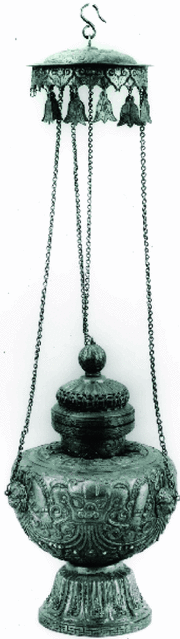
The Guimet Museum also possesses a pair of canopy-shaped copper incense-burners with chains (Fig. 4), dated to the nineteenth century, embellished with rows of lotus petals, and three kīrtimukha faces holding lotus scrolls, with strings of jewels hanging from their jaws. This pair was given to Guimet by Jacques Bacot, the famous French tibetologist, in 1912.
Thurible, Tibet, 19th century, copper, Gift of Jacques Bacot, 1912, MG 21910 (Picture Musée Guimet).

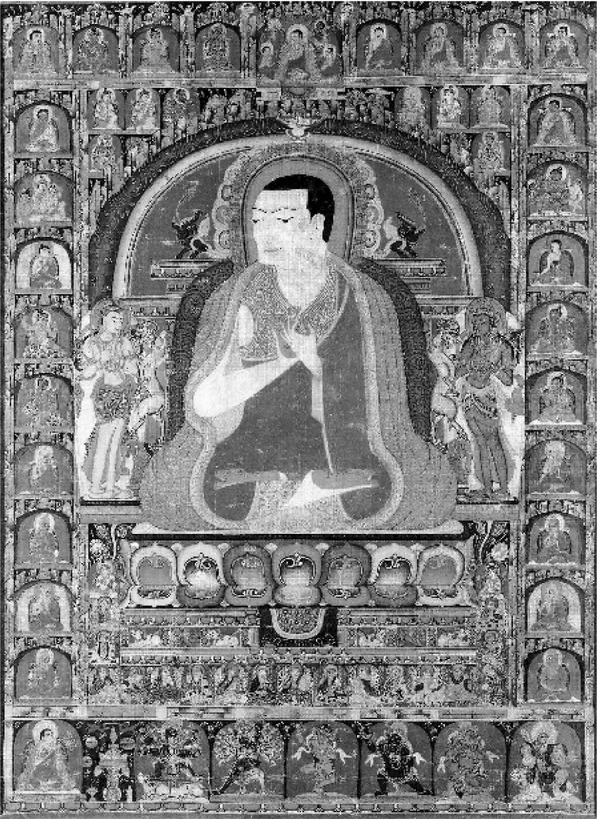
One striking detail is that at the bottom register of some ancient and precious thang-ka dating from the thirteenth or fourteenth century, a consecrating monk, performing a ritual to the religious master or buddha to whom the painting is dedicated, holds a single swinging chain of an incense burner fashioned in a spherical shape (Fig. 5), from which smoke rises, while, in front of him, various offerings have been disposed.Footnote 17 This shape evokes Tang examples from the ninth century, like those made of gilded silver, found in a crypt at the Famen temple, in the Shaanxi province.Footnote 18
Önpo Lama Rinpoche (1251–1296), central Tibet, ca 1300, distemper on cloth, MA 6083 (Picture Musée Guimet).

On other thang-ka from the same period, conches are sometimes displayed horizontally in front of the monk at the bottom register,Footnote 19 but no perfumed liquid is visible inside, though they most probably contained some.
Juniper leaves and branches are also burned in monumental stūpa-shaped incense-burners. They are made of white-washed clay and built upon rooftops as household shrines, or near the entrance of monasteries and temples, for example in front of the most famous temple of Tibet, the Jokhang, in Lhasa.
Ritual vases complete with a sprinkler adorned with peacock feathers, visible among the offerings in the painted iconography, contain saffron water mixed with the so-called “vase substances”, five of them symbolising the speech of the five buddhas: they are the five fragrant incenses of sandalwood, agarwood, pine resin or juniper, camphor and ushira root (vetiver). The camphor tree is also a sacred tree and, in Hinduism, it is the plant of the god Śiva. Camphor is supposed to purify the entire human being. As the peacock is traditionally an enemy of poisonous creatures (snakes, scorpions. . .), in Tibetan Buddhism, the sprinkler adorned with its feathers symbolises the transmutation of negative emotions, considered as poisons, into the ambrosia of wisdom. Those vases are often embellished with lotus petals, and auspicious symbols.
Numerous flowers are also offered, in a basin or a vase, to masters and peaceful deities. Among symbolic plants, which are depicted held in the hand of some buddhas and deities, is the campaka flower, belonging to the magnolia family (Michelia champaka), from which a perfume or incense called nag-campa is made. In Tibetan iconography, the campaka can be the attribute of Maitreya, buddha of the future.Footnote 20 According to the tradition, the tree of awakening (bodhi) for Maitreya will emerge from this flower.
A detailed study of the typology of incense burners, of the materials employed in the creation of fragrant offerings according to rituals, and their significance in Tibetan Buddhism, relying on ancient written Tibetan sources, has yet to be realised. In any case, though they usually appear in painted iconography on only a small scale, fragrant offerings are in fact ubiquitous in Tibetan art from the eleventh to the nineteenth century.