

As The Canadian Journal of Political Science/Revue canadienne de science politique reaches an important milestone, this article offers a retrospective look at how it has developed and what it has told us about the Canadian discipline.
Although I have tried to offer an objective account, as English co-editor, I am hardly a neutral observer. I feel at once affection and respect both for the CJPS/RCSP, as the most visible and influential emanation of the Canadian discipline and for the leading figures of the profession who preceded me as editors and have made the Journal/Revue the notable success it is.
To be sure, the Canadian discipline—by which I mean all political scientists in Canada as well as those elsewhere who work on Canadian politics—goes far beyond what is published in the CJPS/RCSP. Yet what has been published in it and by whom (and also what has not been published), tells us a great deal about the nature of the Canadian discipline: its composition, its priorities and understandings of Canada and of politics, and its methods of “doing” political science.
The article begins with a quick overview of the Journal/Revue’s early days, followed by brief discussions of various aspects of the Journal/Revue: its bilingual character; significant continuities and changes over the years; those who have put it together; and the changing technologies affecting it. The bulk of the article is given over to a largely quantitative analysis of articles published in CJPS/RCSP, with special emphasis on their subject matter.
Readers will make their own judgments as to the meaning and significance of the empirical data in the article and my assessments of them. What seems beyond dispute, however, is the complex mixture of change and continuity that has marked CJPS/RCSP’s first five decades. Opinions will doubtless vary as to whether the changes or the continuities have been more substantial and indeed which have been salutary and which have been retrograde.
Although book reviews have from the outset been integral to CJPS/RCSP, they receive short shrift here. This is not a commentary on their importance, but since the subjects of book reviews are far more heavily influenced by editors than are the subjects of articles, they offer less analytic purchase on the Canadian profession. (Besides, coding and analysing thousands of book reviews would have been far more than my RA could manage.)Footnote 1
Early Days
Volume 1, number 1, of CJPS/RCSP appeared in March 1968. In important ways it was a new venture but it drew on and continued a long and honourable tradition. The Canadian Journal of Economics and Political Science/Revue canadienne d'Economique et de Science politique (CJEPS), dating from 1935, published a wide variety of articles, notes and book reviews about politics in Canada and elsewhere, drawing on a range of theoretical approaches and methodological techniques.Footnote 2
Central as it was to the discipline, by the late 1960s CJEPS could not keep up with the burgeoning of political science in this country. And, as John Meisel notes in his reminiscence of the founding of the Journal/Revue, CJEPS published a good deal more economics than political science. As in other disciplines, student numbers and faculty complement grew steadily through the 1960s as new universities were created—York, Brock, Trent, Calgary and Simon Fraser among others—former colleges were consolidated into universities and established universities expanded. In addition, hiring, promotion and tenure decisions were increasingly turning on publication records. Yet CJEPS had only limited space for the growing stock of research by Canadian political scientists. In its final five years (1963–1967), it published only 44 political science articles in English, along with 13 notes and 192 book reviews.Footnote 3 And CJEPS's status as a bilingual outlet for political science research was problematic: in those same five years, only four articles and one book review (and no notes) were published in French. Some space previously given over to articles in sociology and anthropology had become available with the creation in 1964 of the Canadian Review of Sociology and Anthropology/Revue canadienne de sociologie et d'anthropologie (now the Canadian Review of Sociology/Revue canadienne de sociologie), but it was clear that a stand-alone political science journal was not only viable but badly needed.
The first volume of CJPS/RCSP showcased the best of the Canadian profession; the names of many of the contributors remain prominent to this day. Among those published in volume 1 were “A-list” Canadian academics: Léon Dion, Vincent Lemieux, C.B Macpherson, Hugh Thorburn, Christian Bay, John Wilson, Donald Rowat, Donald Smiley and Alan Cairns (whose still influential “The Electoral System and the Party System in Canada, 1921–1965,” appeared in the first issue). Joining them were esteemed mandarin (and Harvard PhD) Al Johnson and a newly minted PhD who had just won a seat in the House of Commons, Ed Broadbent. The June issue featured articles by Canadian-born David Easton, who was about to begin a stint as president of the American Political Science Association, and Jean Blondel, whose “Party Systems and Patterns of Government in Western Democracies” remains one of the most cited articles ever published in the Journal/Revue, with over 900 full-text views between 2009 and 2016.Footnote 4 That first year established the bilingual bona fides of CJPS/RCSP, with seven of 25 articles (three of six in the first issue) and 23 of 47 book reviews, in French. At the same time, it also highlighted an elemental characteristic of the Canadian political science profession in 1968: none of the 26 authors and only four of 47 book reviewers were women.
A Bilingual JournalFootnote 5
From the outset, one of CJPS/RCSP’s defining characteristics has been its bilingualism. Throughout the 1960's, concern had been expressed in the Canadian Political Science Association (CPSA) about the lack of French content in the nominally bilingual but almost exclusively English CJEPS.Footnote 6 The co-editors' introductory statement in volume 1, number 1, with its alternate—and untranslated—paragraphs in English and French, set out the Journal/Revue’s commitment to fulfilling its bilingual mandate (Bergeron and Meisel, Reference Bergeron and Meisel1968: 1). Over the years, despite good intentions, relations between the English and French editorial teams, while cordial, have often had a distinctly “two solitudes” tenor.
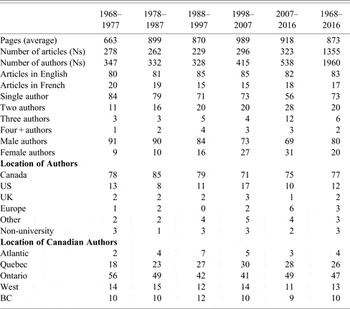
Still, the bilingual character of CJPS/RCSP is evident from the cover to the contents. Since 1968 just over one article in six has been published in French (see Table 1). On occasion, individual issues have been without French articles, but the book review section has consistently featured considerable numbers of French reviews. Volume 1 had 27 English reviews and 22 in French; in 2016 the numbers were 35 and 36; a sampling of intervening years found substantial variation in the percentage of book reviews published in French, from 25 to 47 per cent.
Characteristics of the CJPS/RCSP 1968–2016 (Percentages)

Although, as detailed below, some differences are evident in the subject matter of French and English articles, it should not be assumed that what is published in French defines the interests and publishing activities of francophone Canadian political scientists. Aside from having an alternate French-language venue, Politique et Sociétés, published by La Société québécoise de science politique (SQSP), many francophone Canadian political scientists publish in English in CJPS/RCSP.
Continuity and Change
Leaving actual subject matter aside for the moment, comparing CJPS/RCSP in its first decade with the present-day publication underlines the combination of continuity and change. The Journal/Revue is still published quarterly (five issues in 2003), but issues are substantially longer; the average length of the first ten volumes was 663 pages (volume I was 484 pages), whereas current volumes run close to a thousand pages and have for some time. All issues, from the outset to the present have been overwhelmingly devoted to articles and book reviews (plus a smattering of ads and CPSA notices). However, early issues routinely carried commentaries on previously published articles and rejoinders from authors; such exchanges have all but disappeared from the pages of CJPS/RCSP.Footnote 7 As well, it was common in the early days to come across short research notes running three to five pages printed double-column in a smaller typeface than articles. Some examples: David R. Segal, “Status Inconsistency and Party Choice in Canada: An Attempt to Replicate” (September 1970), Robert Cunningham “The Impact of the Local Candidate in Canadian Federal Elections” (June 1971) and James Lightbody, “Swords and Ploughshares: The Election Prerogative in Canada” (June1972). Other research notes were substantially longer. More recent research notes are fewer in number and typically as long as articles; their format is now identical to that used for articles.
Another contrast between earlier times and today relates to review articles. Whereas few have appeared in recent years—the specially commissioned review articles in this issue excepted—in the first decade most volumes included at least one review article. Topics in the first decade included Pierre Trudeau, John Locke and poverty. An especially notable contribution was a four-part series of review articles by Jean-Charles Bonenfant on the publications of the Royal Commission on Bilingualism and Biculturalism.Footnote 8
Even more striking to present-day readers was the custom, carried over from CJEPS during CJPS/RCSP’s first three years, of listing appointments, promotions, leaves and resignations from Canadian political science departments. It would probably be best for those currently or recently on the job market to avoid looking up these lists, which ran to two or three pages of small type and were dominated by announcements of new appointments. (The Journal/Revue did not continue CJEPS practice of publishing reports of the CPSA annual meetings and/or the reports of the Association's Secretary-Treasurer. Nor did it publish, as CJEPS occasionally did, obituaries of notable members of the profession.)
Two final differences in format are worth noting. Until 1981, abstracts of articles were published in one language—English abstracts for articles in French and vice-versa; they are now published in both French and English (for research notes as well as articles, which was not the case in the early years). In 2002 the look of CJPS/RCSP changed substantially when footnotes disappeared, replaced by in-text references and endnotes for substantive points.Footnote 9
Editors and Advisors
In his 1966 report, CPSA Secretary-Treasurer Stefan Dupré observed “Editing the Journal [CJEPS] is, to say the least, a labour of love in the profession's behalf” (Dupré, Reference Dupré1966: 384). The on-line appendix lists all those who have performed this labour of love. Editors' names were taken from the March issue of each volume, though a person listed for the first time in one year may actually have been in place for part of the previous year. On the English side, the basic pattern is evident: three-year terms for a team located in a single political science department. In some instances, because the book review and article processing functions are quite separate, book review editors have been at different universities. As the current arrangement, with assistant editors at both the University of Toronto and Ryerson University, illustrates, now that CJPS has no physical office (all aspects of the article submission/review/production process are handled on line), it is no longer logistically necessary for the co-editor and assistant editor(s) to be in the same department. However, in terms of securing resources—funding and in-kind support such as course release—it is still beneficial to have team members in one location, since the host department has traditionally been called on to subsidize the English editorial team.
The soon-to-be departing Toronto-Ryerson team will have served for five years, its initial three-year term having been extended; the preceding Concordia team served for two three-year terms. Whether this signals a new pattern is unclear; certainly, the steep learning curve facing new editors and the substantial backlog of accepted articles new editors inherit are good reasons to contemplate extending the standard three-year mandate. Whether editors will be prepared to stay in harness for four or five years and whether their departments will be willing to subsidize their doing so are different questions.
On the French side, three-year terms are standard for co-editors, though a few have served for shorter periods. More than half the RCSP’s co-editors had previously been book review editors, though it is over a decade since a book review editor became co-editor. Only once has this occurred at CJPS when David Hoffman became the second co-editor in 1971. On two occasions, assistant editors stepped in to complete the terms of co-editors who stepped down to take on major administrative responsibilities (Frank Peers for Paul Fox in 1977 and Jim Kelly for Csaba Nikoleyni in 2011).
Two important names are absent from the appendix. When CJPS/RCSP moved from University of Toronto Press to Wilfrid Laurier University Press in 1977, John McMenemy took on critical functions previously performed by UTP. As managing editor (later administrative editor) he looked after all manner of logistical issues, mostly but not entirely related to production. His yeoman service for nearly three decades is recognized in the CPSA's John McMenemy Prize, awarded annually to the author(s) of the best article in CJPS/RCSP. When the association chose Cambridge University Press to publish CJPS/RCSP in 2004, Sandra Burt, who had just completed her term as co-editor, took over as administrative editor until 2009.
Other names absent from the appendix are those of the editorial assistants who take on a wide range of tasks, from the routine—checking that submissions follow CJPS/RCSP format and style—to the abstruse—assisting editors befuddled by our impressive but complex “Editorial Manager” manuscript processing software.
Only one woman—Sandra Burt—has been English co-editor, though the new English editorial team, whose term begins shortly, will be headed by Co-editor Brenda O'Neill. Several women have served as assistant or book review editors. On the French side, four co-editors have been women.
Until the late 1990s, the Editorial Advisory Board (EAB) consisted of six or seven, usually senior, mostly male members of the profession, all or virtually all from Canadian universities (curiously, the CJEPS Editorial Advisory Committee of the 1950s sported no fewer than 22 members). The EAB was expanded to 14 in 1998 and expanded again to its current complement of 28, with 16 appointed by CPSA and 12 by the SQSP. In recent times, appointments have been made with a view to maximizing diversity. Women are appointed in virtually equal numbers as men and as wide a range of the discipline's subfields as possible are represented by EAB members. The EAB now includes both junior and mid-career faculty from all regions of the country as well as academics from universities in the US, the UK and Europe.
Changing Technologies
Save perhaps the expansion of its content to include articles on topics such as women and gender, Aboriginal peoples and politics, and race and ethnicity (discussed below), no facet of CJPS/RCSP has undergone changes as significant as those brought about by developments in the technologies used to produce and distribute it. Technological change, mostly the availability of electronic communications and the internet, has of course transformed virtually all forms of publication and the Journal/Revue could hardly be unaffected. If some effects of such change are evident in hindsight, what the future holds is highly uncertain. Alex Marland explores some of these issues in his article in this issue.
CJPS/RCSP’s first decades were of course pre-internet. Submissions, reviews, correspondence with authors, processing of proofs and virtually everything else relating to CJPS/RCSP’s operations involved hard copy and were transmitted by mail; editors spent a good deal of time on the phone. Although by the late 1980s email was used for some correspondence, sometimes with attachments, it was not until 1994 that the formal instructions to contributors mentioned electronic files and even then only for final versions of accepted papers. To begin the process, would-be authors were asked to submit four hard copies of their manuscripts. By 2003 contributors were asked to submit one hard copy of their papers along with “an electronic version in a standard wordprocessing format.” Two years later, the Journal/Revue moved to an all-electronic submission and review process, using “Author Gateway,” software developed at Simon Fraser University under the direction of Co-editor Michael Howlett. Although a few authors needed help in navigating the system, no significant discontent was registered at the new processes. Within a few years Author Gateway had given way to the Editorial Manager system used by Cambridge University Press, which is still in use.Footnote 10 Along the way, phone calls from editors to authors and to potential and delinquent reviewers, once routine, became all but extinct; in nearly five years, I can't recall making a single phone call to either contributor or (doubtless tardy) reviewer.
The internet has provided at least a partial solution to the perennially vexing question of space limitations. To be sure, present-day editors are no less preoccupied with space issues than their predecessors and enforce restrictions on length as rigorously. However, CJPS/RCSP now has the capacity to post data appendices, research instruments and all manner of supplementary material on line, giving readers access to valuable information that previously would only have been available through roundabout means.
Chronicling changes in manuscript processing and publication associated with ever more sophisticated technology is straightforward. Far less clear are the implications of these changes. Potential reviewers anywhere on the planet can be invited to review manuscripts almost instantaneously. Yet the ease of contacting them on behalf of CJPS/RCSP also means that they are constantly bombarded by review invitations from other journals, requests to assess book manuscripts, tenure and promotion files, plus all manner of legitimate and illegitimate emails, creating serious communication overload as well as reviewer fatigue. So too, since it takes only a few clicks to submit manuscripts, the editors now receive a modest yet steady stream of papers on all manner of subjects that are simply unsuitable for the Journal/Review. These require attention, even though the “reject without review” decision is a foregone conclusion.
Of much greater potential significance are the implications of widespread internet access to CJPS/RCSP—implications that are far from clear. For several years, CPSA members have been offered the option of receiving CJPS/RCSP only in electronic form; only a minority of members now pay the extra fee to also receive the printed version. Will this increase or decrease readership of articles and book reviews beyond those of direct interest to members? Perhaps the greatest potential changes are those arising from the continuing drive to open access. Making available research about Canadian politics and by Canadian political scientists to anyone with an internet connection entails unquestioned benefits, yet what are the long-term implications for publications such as the CJPS/RCSP which are dependent on a membership/subscriber financial model (and indeed for organizations like CPSA and SQSP)? At present the Journal/Revue through its publisher, Cambridge University Press, follows a middle-ground —”green” —open access policy (which meets SSHRC open access requirements) that seems financially viable. But will it be sustainable over the long term? The Marland article addresses this question but, unsurprisingly, offers no definitive answer.
Articles and Authors
A systematic review of articles published during CJPS/RCSP’s first half century reveals a good deal about political science in Canada and about long-term changes and continuities in the discipline.
Before considering what the tables tell us, some points relating to the nature of the data require explication. First, the data don't actually cover 50 years, but 49—up to and including the December 2016 issue (volume 49, number 4). Second, coding of articles into the various subfields was subjective. (Was an article that looked at administrative processes in a single province primarily “public administration” or “provincial/territorial”? Where exactly is the dividing line between “traditional” and “modern” political theory?) No reliability checks were performed. Doubtless in some instances others would have made different but equally reasonable judgments; accordingly, precise figures relating to topics or subtopics are less important than overall trends. Third, the operational definition of article included field analyses but excluded review articles (neither have ever been numerous). More significantly, “notes” or “research notes” were treated as articles; in recent years, research notes have typically been only slightly, if at all, shorter than regular articles but in times past, especially the early days, a number of short notes were published. Some notes were extensive responses to previously published articles and were considered as articles; rejoinders and very brief comments were not.
In counting and coding articles and their authors, I worked off the tables of contents of individual issues, examining the text of articles as necessary to check their authors' institutional affiliation or to make a judgment as to topic/subtopic if the article title left room for doubt. Wonderful as the electronic archives of the Journal/Revue are, it was easier to do this using hard copies. Happily my office is still home to a complete set of CJPS/RCSP, as I was such a keener as an undergrad that I subscribed from day one (student membership in the Association costing all of $3 a year in 1968, with regular membership set at $10).
Table 1 presents data on various characteristics of CJPS/RCSP and of those who have published in it over the years, arrayed in decade-long tranches. Clearly, some characteristics of CJPS/RCSP’s articles and authors have remained relatively stable over the long term, whereas others have changed substantially.
For the past two decades, the CJPS/RCSP has weighed in every year at close to 1000 pages, substantially more than in its first decade. However, the number of articles has not increased to the same extent. To some degree, this reflects the much more frequent recourse to short notes in the early years. Moreover, the expectation of a constant article/page length ratio rests on the dubious assumption that the proportion of published volumes given over to book reviews is invariant, which is patently not the case. The proportion of pages given over to book reviews in the first and most recent volumes are similar—11.2 per cent in 1968 and 12.1 in 2016—but in intervening years the proportions were far higher: in 1988 for example, some 33.1 per cent of the CJPS/RCSP consisted of book reviews.Footnote 11
Of much greater substantive significance has been the balance between articles published in English and in French. In the CJPS/RCSP’s first decade, 20 per cent of all articles were in French; in subsequent eras the proportion of French articles declined somewhat to 15 per cent though in the most recent period, the proportion has risen to 18 per cent, producing an overall figure of 17 per cent.
The data show a substantial, if unsurprising, increase in collaborative publishing. Over the years, the proportion of single-authored articles has declined steadily; whereas in the first decade five of six articles had but a single author, in the most recent period, barely half were single-author. The percentage of authors with two authors has climbed steadily, from 11 per cent in 1968–1977 to 28 per cent most recently. Slight increases in the proportion of articles with three or more authors characterized the Journal/Revue’s first four decades but in the most recent decade some 15 per cent of articles have had more than two authors. Almost all the papers with four or more authors came from the various Canadian Election Study teams.
The place of women in the profession remains an issue of central importance. Certainly, in terms of published authors in CJPS/RCSP progress has been made: in the inaugural (1968) volume all 24 authors were men and in the next year only one of 29 was a woman. But has the undoubted progress been enough? Table 1 demonstrates that the proportion of CJPS/RCSP authors who are women has climbed steadily over the years, though it still remains the case that fewer than a third of all authors are women.Footnote 12 As discussed below, the picture is less positive when it comes to the publication of articles addressing topics relating to women and gender. Erin Tolley's contribution in this issue analyses 50 years of CPSA conferences in terms of papers on women and gender.
Although CJPS/RCSP has begun to publish articles on Aboriginal politics with some regularity, Aboriginal authors have been very scarce, though precise numbers are not available.Footnote 13 For a detailed analysis of the Journal/Revue’s treatment of Aboriginal topics, see Kiera Ladner's article in this issue.
Where are authors located? Overwhelmingly, those who publish in CJPS/RCSP are based at Canadian universities: overall, 77 per cent of all authors, with the percentage ranging between 71 and 85. It is hardly surprising that by a wide margin, the next largest contingent of authors consists of those located at US universities, in total, 12 per cent, compared to 8 per cent for those at universities in the UK, Europe and elsewhere. It remains to be seen whether the data for 2008–2016, which show marginally fewer Americans than those from the UK, Europe and universities elsewhere, is a short-term anomaly or a significant trend.
The way the data are presented somewhat underestimates the proportion of Canadians who publish in CJPS/RCSP. Almost all authors without university affiliation have been Canadian and some authors who were at non-Canadian universities when their articles were published were Canadians who subsequently took up posts at Canadian universities.
Since authors' status is—quite appropriately—not indicated when they publish in CJPS/RCSP, we have no data on numbers or proportions of graduate student authors.
No surprises emerge from the panel of Table 1 which breaks down authors at Canadian universities by region. Some variation is evident across time periods (though the rank order is invariant) but overall by far the largest proportion of authors come from Ontario universities, followed by those from universities in Quebec, Western Canada, British Columbia and Atlantic Canada.
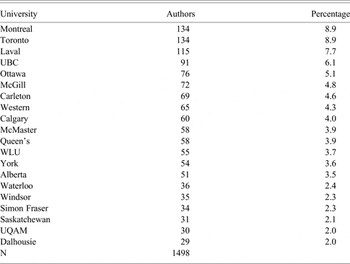
Table 2 presents data on the numbers and percentages of article authors at Canadian universities by their university affiliation (note that percentages are based on Canadian-based authors of all articles, not just those on Canadian topics).Footnote 14 The top 20 universities are included; the drop-off in terms of numbers of authors is fairly dramatic after the last universities listed; the next five universities would have been, in order, Brock, Victoria, Lethbridge, Manitoba and Concordia.
Authors by University 1968–2016

In interpreting the table it is important to recognize that while virtually all articles published by authors based at English-speaking universities were in English, substantial numbers of articles from authors at francophone or bilingual universities were also in English.
For the most part, the numbers in the table speak for themselves; few will be surprised that authors at large research-intensive universities are the most frequently published in CJPS/RCSP (and of course departments in research-intensive universities tend to be larger, often much larger, than other departments). However, whereas the rate at which authors at most universities publish is moderately constant, in some instances, considerable variation is evident. By way of illustration, the first decade saw 22 York authors, surpassed only by Laval and UBC, but in all subsequent decades, York was far down the list. So too with Windsor: from 1968 to 1977 16 authors were based at Windsor but in the next four decades there were only 19 all told. Conversely, between the first two decades, there were only four authors from Victoria, but 10 in each of the following decades.Footnote 15
Although it is obvious that certain university departmentsFootnote 16 are home to substantial numbers of authors, the extent to which a small number are increasingly dominating the lists of authors may not be as clear. In the first decade, 29.1 per cent of all authors came from Montreal, Toronto, Laval or UBC; in the two most recent decades, essentially a third of all authors (33.8 and 32.6%) were based at one of those four departments.
In all this, it must be pointed out that while the Montreal department is large and productive, its first-place ranking owes more than a little to Professor André Blais, a veritable publishing machine, with 20 articles in CJPS/RCSP (13 in English, 7 in French), far outstripping the production of any other contributor. As well, Professor Blais wrote what ranks as the longest single article published in CJPS/RCSP: “Politique agricole et résultats électoraux en milieu agricole au Québec” (June 1978), weighing in at a remarkable 48 pages.
Content
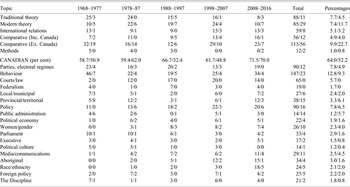
Table 3 presents data on the subject matter of articles published in CJPS/RCSP arrayed by decade. In considering the data in the table it is well to keep in mind the limitations enumerated above and the admonition that the emphasis should be on overall trends rather than on individual entries. For the most part the subtopic categories are self-evident, though, as noted, on occasion characterizing a particular article as falling into one category or another could be problematic. Articles focused primarily on pre-twentieth century writers such as Plato, Hobbes, Locke, Mill, and Marx were classified as “traditional” political theory whereas articles on those writing after 1900 were considered “modern” political theory. The “comparative including Canada” category requires little explanation; in many articles falling under this rubric Canada was one of two or three cases analysed. The “comparative excluding Canada,” by contrast, is a strange, not entirely comfortable amalgam. Some articles looking at one or more non-Canadian jurisdictions were readily coded this way: party identification in Chile, federalism in Germany and Belgium, and the like. Others, however, seemed at best uneasy fits in other categories; these were articles, often quite abstract, that developed typologies, analytic approaches and theoretic frameworks; many were preliminary or exploratory in nature. Some examples: Léon Dion's “The Concept of Political Leadership,” the lead article in volume 1, number 1; L.H.J. Groulx, “L'action communautaire: diversité et ambiguité” in December 1975 and Vincent Lemieux, “Le pouvoir dans les décisions conjointes,” in June 1988. Although it may not be evident from the table, since the category includes traditional area studies articles, a high proportion of articles of this second type were published in French.
Topics of Articles 1969–2016 (Number of Articles–English/French)

The data reflect CJPS/RCSP’s dual mandate as both an omnibus journal publishing articles in all fields of the discipline and the leading venue for research on Canadian government and politics. Overall, political theory accounts for roughly 15 per cent of articles in English, almost evenly split between traditional and modern, International relations for 5 per cent and comparative politics for 15 per cent, with one-third of comparative articles having significant Canadian content; 1 per cent of English articles have dealt with methodology. Articles on Canadian politics have constituted 64 per cent of the total. The distribution of French-language articles has been roughly similar though substantial differences from that of the English articles are evident in two subfields. Political theory articles have constituted effectively the same proportion of all articles in both French and English (15.7% versus 15.1%); however, whereas French theory articles have overwhelmingly been on modern writers (73%), a slight majority of English theory articles (51%) have been in the “traditional” genre. An even greater divergence is found in the “comparative excluding Canada” subcategory. Proportionately more than twice as many French articles as English have been of this kind (21.5% versus 9.9%). Much of this difference reflects the substantially higher tendency for the sort of highly abstract articles mentioned above to be published in French than in English. Decade by decade, not surprisingly given the small numbers, the proportion of French-language articles on Canadian politics has varied a good deal, from 32.4 per cent to 64.2 per cent. Overall French articles have been somewhat less concerned with Canadian politics than those in English (52.2% versus 64.0%).
No point would be served, other than rendering the reader catatonic, in reviewing the data on the various subfields of Canadian politics in detail. Still, some points warrant comment, especially with respect to subfields that essentially did not exist in CJPS/RCSP’s early years (at least in terms of published articles):
-
• In both English and French, political behaviour articles have been the most numerous, though hardly preponderant (12.8% of English articles, 9.3% of French).Footnote 17
-
• After behaviour, the subtopics with the most English articles have been about, in descending order, parties/electoral processes, policy, and courts/law. No other subtopic constituted as much as 4 per cent of the total.
-
• After behaviour, French articles have most frequently been about policy, provincial/territorial politics, public administration, parties/electoral processes, media/communication and women and gender. No other subtopic constituted as much as 4 per cent of the total.
-
• Surprisingly perhaps, less than 2 per cent of all English articles were about Canadian federalism and no French articles whatsoever were published on Canadian federalism.Footnote 18
-
• Unsurprisingly, articles on courts and law became a great deal more numerous once the Charter came into effect in 1982. Whereas only two articles were published in this subfield in the first decade, in all subsequent decades at least a dozen articles were published on courts and law. However, this Charter-inspired research activity only occurred in English: some 65 English articles fell into the courts and law subfield but none at all in French.Footnote 19
-
• In three subfields of Canadian politics which now constitute a substantial proportion of CJPS/RCSP articles (17.4% of English articles and 17.8% of French from 2008 to 2016) —women/gender, Aboriginal politics and race/ethnicity—no articles whatsoever were published in the first decade.
-
• It took over a decade for the first article on Canadian women to appear, Jerome Black and Nancy E. McGlen's “Male-Female Political Involvement Differentials in Canada, 1965–1974” (1979). (In 1972 Ingunn Means had published an article about women in local Norwegian politics). It was some time before the CJPS/RCSP was publishing Canadian articles on women and gender on anything like a regular basis. An important correction to the still limited number of articles will be the forthcoming special issue on “Finding Feminisms.”
-
• The first article on the politics of Canadian Aboriginal peoples did not appear until 1984 (Menno Boldt and J. Anthony Long, “Tribal Traditions and European-Western Political Ideologies: The Dilemma of Canada's Native Indians”).Footnote 20 It took longer for such articles to appear in any numbers than it did for articles on women/gender, but in the last two decades 5 per cent of all English articles have been on Canadian Aboriginal subjects (articles in French have been proportionately somewhat less frequent).
-
• Articles on race/ethnicity in either language have been infrequent until quite recently; from 1968 to 2007, only six English articles and none in French; in the nine years since then 18 articles have been published in English (nearly 7% of all articles) and five in French (nearly 9%).
-
• It would appear that in 49 years just one article was published in CJPS/RCSP on teaching: Stephen Clarkson's 1970 note, “Simulation in Teaching Comparative Politics: Playing French Games.” This issue has two teaching articles, Tracy Summerville and Heather Smith's “Can We Talk? Four Conversations We Need To Have About Teaching and Learning in Canadian Political Science” and Laura Stephenson and Michelle Dion's piece on student training in methodology.
-
• A significant change in content registered in recent years has been the publication of special issues and symposia on particular topics.Footnote 21 It was only in CJPS/RCSP’s fifth decade, in March 2010, that the first such collection appeared: a four-paper symposium on “Electoral Forecasting and the 2007 French Presidential Elections.” The next issue, in June 2010, was entirely given over to “Diversity and Democratic Politics” put together by a team of guest editors. Two symposia followed on similar topics: a five-paper symposium on “Immigration, Multiculturalism, and Identity Politics in Canada and the United States” in September 2012 and “Immigration and Identity Politics in Canada” in June 2015. The December 2016 issue featured a symposium on Richard Simeon's iconic article, “Studying Public Policy,” forty years after it appeared. And of course you have in your hands—or more likely on your computer screen—another special issue, to be followed immediately by a special guest-edited “Finding Feminisms” issue.
-
• To be sure, the very fact that CJPS/RCSP is now publishing special issues and symposia is noteworthy, but far more significant are the topics generating such focused attention: diversity, feminism and identity politics, fields that were all but totally absent in the early decades.
Conclusion
It is trite to conclude by observing that the CJPS/RCSP has experienced both significant continuities and changes in 50 years: all institutions change and all exhibit continuity. And yet identifying what has changed and what has not offers useful insights into the Canadian discipline of political science.
Continuities. In 2017, as in 1968, CJPS/RCSP is a bilingual omnibus journal with a strong focus on Canadian government and politics—then and now, most articles are written by Canadian scholars about Canada—open to a wide range of methodologies and theoretical approaches. An omnibus journal it may be, but some subfields of the discipline are better represented than others and have been throughout the entire run: every volume sees a number of articles on political theory, traditional and modern, but few on IR.
Among the changes evident over half a century have been the drastic decline in the number of review articles, short research notes and exchanges among authors, a noticeable increase in the proportion of articles with more than one author, and the size and composition of the Editorial Advisory Board. Of considerably greater import have been changes in communications technology, widely defined (though the full implications are not at all clear as yet) and the publication of articles in subfields previously outside CJPS/RCSP’s ambit. Unlike in earlier decades, CJPS/RCSP now regularly publishes articles on Aboriginal peoples and their politics, on women, gender and politics, and on race and ethnicity. This is clearly related to the steady, if still less than satisfactory, increase in the proportion of authors who are women. Still, it is telling that an institutional development, the establishment of the Charter in 1982, almost immediately produced an abundance of articles, whereas the increase in the frequency of articles in the “new” subfields just mentioned was painfully slow.
Finally, recognition of a critically important continuity rests not, as do the observations above, on hard evidence but on impressionistic reading; in my view, it is no less valid. The very first issue was characterized by research of the highest quality and for half a century the CJPS/RCSP has maintained the tradition of publishing the very best research by Canadians and about Canadian politics.
Supplementary materials
To view supplementary material for this article, please visit https://doi.org/10.1017/S0008423917000117.