INTRODUCTION
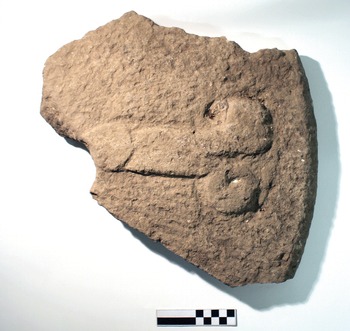
In 2017, a stone fragment was recovered during excavations for the widening of the A14 Road in Cambridgeshire. This was identified as a millstone because its diameter exceeds 500 mm.Footnote 1 The fragment came from a Roman settlement on site ‘TEA 20’ near Godmanchester, part of the River Great Ouse landscape block.Footnote 2 It was one of over 300 querns and millstones found during the course of fieldwork, but it is unusual because there is a phallus carved in relief on its upper surface and two crosses carved into the circumference. Although there are occasional items of sexual imagery from pre-Roman Britain, it was during the Roman period that phallic imagery became widespread. It occurs throughout the Romano-British period on structural stone, on pottery, chiefly Nene Valley colour-coated wares,Footnote 3 and on small portable objects and amulets such as pendants, mounts and seal boxes. A recent PhD project by Adam Parker has sought to identify the magical objects from Roman Britain. In this, he has identified over 450 phallic objects from the province, and 92 phalli carved on stone.Footnote 4
Decoration is defined here as the application of ornament or pattern, with no practical purpose, to an object. This purpose need not necessarily relate to the operation of the object, so, for example, the inscriptions on some Roman military querns served to label them as the property of a contubernium or individual and are therefore not primarily decorative.Footnote 5 Although it is not certain whether the crosses on the millstone from the A14 were a numeric representation or decorative, they are not discussed further in this paper, which focuses only on the phallic decoration.
This work has not included a survey of all Romano-British querns and millstones, many of which languish unpublished in museum archives, but a search has been carried out of databases held by the author and the Yorkshire Quern Survey, which between them cover most of southern England and large parts of northern England. Together these account for in the region of 15,000 querns or millstones. In addition, published surveys of decorated querns from Ireland, Wales and Scotland have also been assessed.Footnote 6 The review indicates that there are a minimum of four examples decorated with phalluses from the UK or Ireland, and all four are from Romano-British sites in England. These four objects are the subject of this paper.
It is rare to find decoration on Romano-British querns and millstones and it was not common on Middle or Late Iron Age forms of rotary quern in England, which were typically in beehive or bun form. Decoration on beehive querns was relatively common on the island of Ireland, where it generally comprised incised curvilinear or rectilinear patterns.Footnote 7 Similar decoration is seen less frequently in parts of northern England and in northern Wales, where querns may be adorned with simple grooving around the hopper, chevron or linear patterns, or spirals.Footnote 8 Decoration appears to have been somewhat more common on Scottish querns, with 63 recorded in a survey of some hundreds of querns.Footnote 9 However, decoration on Scottish querns is mainly confined to the embellishment or decorative development of functional elements.Footnote 10 Curvilinear (La Tène) style decoration is completely absent from Scottish querns and pictorial elements are virtually non-existent. These differences in decorative designs accord well with our understanding that decoration was generally regional in style but sometimes spread across regional barriers.Footnote 11 Iron Age and Roman querns found in England were rarely decorated. The decoration that has been recorded usually consists of either circular grooves around the eye and/or circumference/on the circumference itself, or straight grooves, sometimes radiating from the centre or ribbed.Footnote 12 Rare pictorial elements include a millstone from Verulamium decorated with a spear/leaf, in what was presumed to be a repeating pattern, but for which only one segment survived.Footnote 13
DESCRIPTION
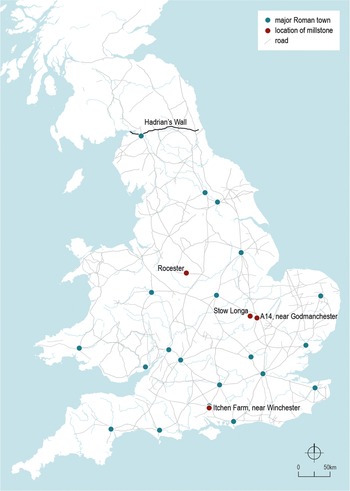
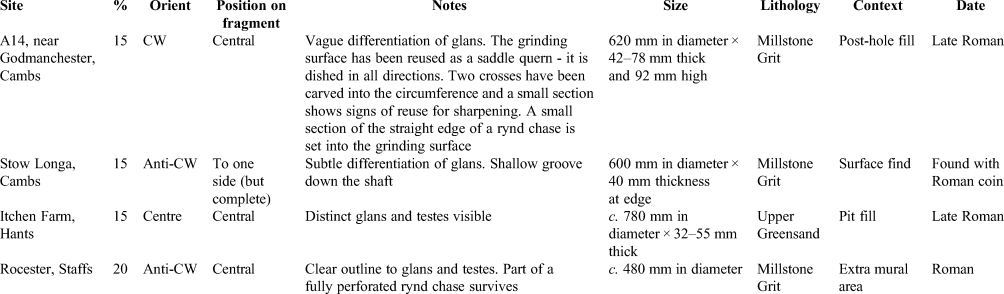
Four items each with a decorative phallus on the upper surface are reported on here (table 1, fig. 1). They comprise an example from near Godmanchester on the A14 widening in Cambridgeshire, one from near Stow Longa (also Cambridgeshire:), one from Rocester (Staffordshire) and one from Itchen Farm near Winchester in Hampshire.Footnote 14
Locations of millstones decorated with phallic imagery.

BRITISH MILLSTONES DECORATED WITH PHALLUSES

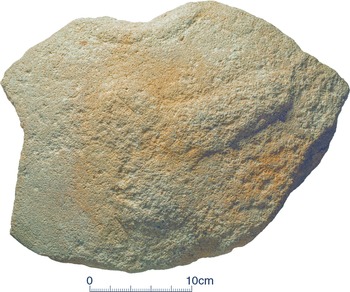
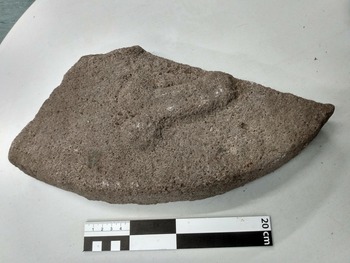
The examples from Stow Longa (fig. 2) and Godmanchester (fig. 3) measure 600–620 mm in diameter and the example from Winchester is c. 780 mm in diameter (fig. 4). This is an amendment to the original estimation of 620 mm, which was based on an assumption that the hole was the eye, when it is actually a socket. This places them firmly in the range of items likely to have been mechanically powered millstones rather than hand-operated rotary querns.Footnote 15 The example from Rocester is smaller at only c. 480 mm in diameter and is likely to have been hand operated (fig. 5). All are of disc type, typical in form for the Romano-British period.
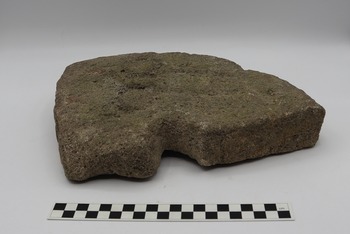
Millstone from the A14, near Godmanchester.

Millstone from Stow Longa.

Millstone from Itchen Farm, near Winchester. (Photograph: Thames Valley Archaeological Services)

Quern from Rocester. (Photograph: The Potteries Museum & Art Gallery, Stoke-on-Trent City Council)

The four items had been fragmented in such a way that the decoration remained intact. The decoration is central to three fragments and to one side of the fourth. Because only a fragment of each survives, it is impossible to determine if there was more than one phallus or if other carvings were associated with the phallus, for example a scallop/fist, commonly associated on fist-and-phallus pendants.Footnote 16 There is no uniformity to the positioning of the phallus, with one orientated clockwise, two orientated anti-clockwise and one directed towards the eye of the millstone.
The phallic decoration has been assigned to type using Collins’ 2019 typology (table 2). Phalluses on the millstones from Godmanchester, Stow Longa and Itchen Farm were sculpted in relief. Each has distinct separate testes. On the examples from Godmanchester and Stow Longa, these merge with the shaft, while on the Itchen Farm example, the testes appear more distinct. The shaft of the Stow Longa phallus has a shallow groove running down the centre of the upper half. The glans on the Godmanchester and Stow Longa examples is barely distinguishable from the shaft, whilst the glans on the Itchen Farm example has a very distinct line separating it from the shaft. The Rocester phallus stands out from the other three because it was incised rather than moulded. It is similar in style to a phallic carving on a piece of architectural stone found in a bath-house rubbish pit at Binchester, with both having a clear outline to the glans, shaft and testes.Footnote 17
DETAILS OF PHALLIC DECORATION (FORM AND TYPE AFTER COLLINS Reference Collins2019)

The positioning of the phalluses may be of further significance. Three of them are orientated to face around the stone. It has not been possible to determine if they ‘pointed’ in the direction of movement or against it, but the former seems a reasonable supposition. The fourth, however, the example from Itchen Farm, is pointed towards a socket near the centre of the stone and as a result towards the eye of the millstone. The symbolism of phallus and urethra meeting is obvious, but the intent less so.
The production of a phallus in relief requires skill and can only have been carved by someone proficient in working stone.Footnote 18 The decoration on the three millstones must be primary sculpture that was created when the millstones were being dressed and finished with pecking because they form part of the overall profile of the millstone. The incised carving on the Rocester example could have been carved much more quickly. This could still have been a primary decoration or a secondary addition to a functional millstone, with the breakage still respecting the carving, but it could also have been a later ‘doodle’ on an already broken quern.Footnote 19
The millstone from Godmanchester shows obvious signs of reuse. It was used as a sharpening stone on part of the circumference following fragmentation, but it had also been inverted and extensively reused as a saddle quern/grinding stone. It is not possible to determine in which order these events happened, but the grinding surface is now dished in all directions and worn smooth as a result of the reuse. This reuse is of additional interest since it means the phallus was underneath the millstone when it was used as a saddle quern. Hidden from view, it could have been deliberately concealed to all, or perhaps only the user was aware of its presence. It is not unusual for fragments of rotary querns or millstones to be inverted and used again as saddle querns, but the presence of the phallus may add further meaning to its use in this way.
PROVENANCE
The millstone from Itchen Farm is made of Upper Greensand and the other three are made of Millstone Grit. The precise source of none of the querns has been identified, but all are likely to have been imported to the sites where they were found. There were four main sources of Greensand querns in southern Britain during the Roman period: Folkestone in Kent, Spilsby in Lincolnshire, Pen Pits in Somerset and Lodsworth in Sussex. The quern is not made from stone from any of these sources. It is likely to be from one of the few hard exposures of Upper Greensand in the Wessex region.Footnote 20 A source at PotterneFootnote 21 is a possibility, although the millstone has not been thin-sectioned for further analysis.
Although the Millstone Grit millstones could conceivably have been manufactured from glacial erratics, it is more likely that they are from a source in the southern Pennines such as that identified at Blackbrook in Derbyshire.Footnote 22 However, they have not been petrographically analysed in detail and because there are many outcrops of Millstone Grit, multiple sources are likely for the millstones.
The millstones are from a range of site types. That from Rocester was associated with the extramural settlement of the fort. Itchen Farm was a rural settlement just outside the town of Winchester and Stow Longa was also a rural settlement, although the millstone was not found during excavations. The A14 millstone was found on a site that during the Late Roman period was on the periphery of a substantial villa in the hinterland of Godmanchester.Footnote 23
Of the four examples, two are from well-dated contexts: the Itchen Farm example from a Late Roman pit and the Godmanchester example from a Late Roman post-hole. That from Rocester is simply noted as being from the extramural area of the Roman fort and that from Stow Longa was a surface find, recovered close to Roman coins. However, most Roman disc millstones (80 per cent) are of third or fourth century a.d. date,Footnote 24 and a Late Roman date can therefore reasonably be assumed for all four examples. This is in keeping with analysis of phallic carvings from Hadrian's wall, which are from contexts dated from the second to the fourth century a.d. and with no first-century examples, even from the Stanegate sites.Footnote 25
DISCUSSION
Putting aside the particular imagery on these four millstones, decoration raises the value of an object out of the purely functional sphere and changes the way people feel when they see or use that object.Footnote 26 Broadly speaking, decoration on querns could have been a marker of status or value, either of the setting in which they were being used, of the individual using them, or of the objects themselves.Footnote 27
As has already been established from the review above, no parallels for this decoration have been recorded on querns or millstones from Scotland, Ireland or Wales. Only a few parallels from mainland Europe are known, too. None were found in a survey of querns and millstones from Flanders, while a study of French millstones uncovered only two certain examples.Footnote 28 A simple phallus had been carved in relief on a complete millstone from a civilian context at Amiens in the Somme, while an incised example was found in a military context on a complete millstone at Arras, Pas-de-Calais. These were orientated anti-clockwise and clockwise respectively, and the Arras carving was accompanied by a cross on the upper surface and a swastika on the circumference.Footnote 29 The implication from this survey is that the decoration on these four millstones was an exception and far from typical behaviour. How might we then interpret it?
Phallic imagery has been variously interpreted as being aesthetic, apotropaic, a reference to sex, or as a symbol of fertility and virility.Footnote 30 It would be simplistic to assume that all phallic images held the same meaning, and their purpose was no doubt dependent on what they were made from and how they were used.Footnote 31 The phallic imagery on millstones should certainly be considered in the context of other phallic symbolism, but it must also be considered alongside the symbolic interpretations attributed to querns and millstones themselves. Watts lists these as: gender/fertility; agricultural productivity or famine; life/death; transformation; the world/heavens; individuals/groups/places.Footnote 32
Decoration could either enhance one or more of the symbolic meanings that are ascribed to querns and millstones, or it could add an additional layer of symbolism. The curvilinear, rectilinear or embellished decoration of Irish, Welsh and Scottish querns has no obvious meaning and such decoration might have been intended as a marker of status or value, or could have increased the symbolism the quern was believed to have held. The depiction of a phallus seems more likely to have carried specific meaning.
Phallic symbols were common in the Roman world and are considered to have been very effective as amulets by their oft-seen association with the ‘evil eye’. Phalli are found in a range of placements, including in association with bakeries. In Pompeii a phallus carved in relief was found at the bakery of N. Popidius Priscus, with the inscription ‘hic habitat felicitas’, roughly translated as ‘you will find happiness here/here lives happiness’.Footnote 33 A baker who specialised in cakes at Herculaneum (Sextus Patulcus Felix) had placed two phalluses over his oven door and two further (ceramic) phalluses in his dough production room.Footnote 34 The example on the Pompeian bakery wall has been interpreted as a charm intended to result in good luck and wealth, or perhaps to protect the bread.Footnote 35 Those at the Herculaneum bakery were thought to be magic charms intended to help the baker produce successful cakes.Footnote 36
Phallic decoration on stonework was usually interacted with in a purely passive sense, in other words, it was viewed but not touched.Footnote 37 Phallic decoration on items of personal adornment was touched when being applied to clothing etc., but once attached to clothing it need not have been much touched but would have been in motion, as demonstrated by Whitmore's experimentations.Footnote 38 Rotary querns and millstones were more obviously moving tools. A hand-powered rotary quern was directly interacted with by the user, who sat adjacent to the quern in order to turn it and was probably regularly touching it. A miller would not have been in as close proximity to the millstones, but they would have been moving for a significant portion of the time. This movement is unique amongst stone carved phalluses and surely heightened the visual impact of the imagery.
It is also surely relevant that the more significant, and more certainly primary moulded phallic decoration has thus far been found only on millstones, which were used when at least some of the grain-processing system had been centralised. Millstones like these may have been operated by two or more people/animals with the aid of additional leverage, or by water. The questions we might pose are: what sort of setting were the millstones installed in, and who was using the millstones and therefore came into close contact with the imagery? The issue of who was able to see the phallic carving is important to our interpretation, but is difficult to answer since we do not know precisely how the centralisation of grain processing was organised. We know, however, that bakeries and brew-houses sometimes had their own small mills. In this sort of setting, we can envisage that the millstones were operated only by those working in that business. Equally, millstones might have been used in a mill that was concerned only with grain processing and was not affiliated with any other business.
In the case of a mill attached to a bakery or brew-house, the millstones could have been in a public setting or in a private mill behind or attached to such a shop. Most phallic decoration was intended to be visible, whether that be over doorways, or suspended about the body.Footnote 39 The decoration could therefore indicate that the mill attached to the shop was a public space, but the presence of phallic imagery in the dough-room in Pompeii implies that the imagery need only have been visible to the person working with the millstone. Indeed, there are instances of phalli placed in positions where they were very difficult to view or were entirely invisible, such as those included in a barrack building at South Shields.Footnote 40 The presence of a hidden phallus suggests that the individual who created the image did so with the absolute belief that its amuletic properties were effective irrespective of who could see it. It was the presence of the image there, and not the act of looking at it, that provided protection.Footnote 41 So, if the millstones were in mills that were attached to other business premises, the millstone could have been on public display or not, and the amuletic or apotropaic properties of the phallic imagery would be unchanged.
If the millstones were in use in a separate mill, the mill could have operated in two ways. Either grain was brought to the mill and ground by the miller, or it was run as a cooperative, and each person who required grain to be ground entered the mill and was responsible for running their own grain through the mill. A publicly accessible mill seems much less likely, because it would necessitate more people entering the mill and slow down the process of grinding. It therefore seems probable that in the case of a mill that was not attached to another business, the decoration was intended to be viewed only by the miller(s). In effect, the phallic imagery was neither hidden nor on public display. Moreover, unlike any other phallic imagery, symbols placed on millstones were in almost constant motion. The phallic design would have highlighted the movement of the upper stone, most obviously in the three with phalluses that were orientated around the stone. The enhanced effect of decoration on rotating querns was observed for some of the Scottish examplesFootnote 42 but the iconography of the phallic decoration was distinctive and obvious in a way that the Scottish decoration was not.Footnote 43 There was a deliberate choice to place the phallic image on the millstone. The movement afforded to the phallus as a result may have intensified the symbolism in the same way that multiple or larger phalli might have been intended to provide a greater level of protection or the movement of ithyphallic pendants might have enhanced their apotropaic function by drawing the evil eye towards the pendant and away from the wearer.Footnote 44 This movement may have had other consequences. The phallus would have been moving between shade and light, and in-and-out of view, (assuming there was only a single phallus per millstone; but there could have been two or three) and the ability to recognise it as a phallus was no doubt dependent on the speed of the stones. Its visual effect was not a constant and although the effects of these changes are not clear to us, we must assume that the movement was highly significant.
This raises another important question: if small phallic objects pertained to the individual, and static structural phalli to the wider community,Footnote 45 then who, or what, was the intended recipient of the protection afforded by phallic imagery on millstones? The phalluses associated with bakeries at Pompeii and Herculaneum are assumed to have been good luck charms intended to protect the produce of the bakery and to make the baker more successful. Given the rarity of phallic imagery on millstones, we might assume that more normal practice was to decorate the structure of the premises concerned with cereal processing so that the mill, no doubt a strategic structure because of its role in feeding the people, was protected. If so, the decoration on these four millstones suggests an additional layer of symbolism. Was the phallic imagery added to the millstones to protect them specifically or to protect the produce of the millstones (typically flour or malt), separately to the mill building? In this case, when the millstones were in operation and grinding the grain, the phallic symbolism and any apotropaic function ascribed to it was heightened. When the millstones were stationary, the protection was reduced because no flour was being produced.
Alternatively, or additionally, if the mill were attached to a bakery and the millstone was in a public setting, then the decoration may have enhanced the desirability of using said bakery, either because of the symbolic protection afforded by the millstone's decoration, or because customers were keen to see the artwork.
Finally, the lifestory of a millstone did not end when it ceased to be used for its original purpose. The carvings may have been preserved by careful fragmenting of the millstones. This would suggest that the phallic symbolism remained important even after the decommissioning of the millstones, although the number of millstones with phallic imagery is rather small for us to be certain that the survival of the artwork was deliberate. The millstone from the A14 near Godmanchester was also subsequently reused as a saddle quern after it had been broken. During this period of its use, the phallic imagery was hidden beneath the stone. Either the imagery was hidden from view to nullify its potency, or the user was aware of the hidden imagery, but its efficacy had been altered by its inversion, as at South Shields where phallic imagery was deliberately hidden.Footnote 46. Is it fanciful to assume that the person using it was particularly needy of amuletic protection? And what is the significance of its final inclusion in a post-hole? As in its final phase of use, the quern had been placed in the post-hole, following its disuse, with the phallic imagery on the underneath side. There is little evidence to suggest that querns were put into post-holes as placed deposits, but it seems likely that in this instance, its inclusion, and orientation, was deliberate.
CONCLUSIONS
While the presence of phallic decoration on these four Roman millstones is interesting, querns and millstones were not generally decorated in Roman Britain, except for a few instances north of Hadrian's Wall and in parts of present-day Wales,Footnote 47 and for the most part, they were therefore not deemed to have needed protection in this way. It is perfectly possible that mill buildings were still afforded some symbolic protection, but that this took other forms, which have not survived. Given the general lack of phallic decoration on querns and millstones, the particular reasons these examples were thus adorned is unclear. With the exception of the Rocester example, which, although from the extramural area, might have been associated with the fort at the point of use, they do not have the military associations that have been established for many other phallic carvings.Footnote 48 The similar lack of such imagery from the near continent suggests that the practice was not transferred by migration from those areas. It could be that travellers from further afield, where phallic imagery was used in mills and bakeries (for example in Italy), brought the association between phallic imagery and millstones with them and applied it to a different form of millstone because Pompeiian millstones were rarely used in Roman Britain. Alternatively, the Roman practice of using phallic imagery for protection was transferred from pottery/jewellery/structural stone to this small number of millstones.
Whatever the explanation for the imagery, and whether these millstones were on public display or not, their decoration clearly marked them out as different from the typically plain Romano-British millstones. The symbolic properties of phallic imagery would have added a layer of symbolism to that already held by the millstone and the movement of the millstone probably served to intensify the symbolism of that decoration. The placement of the phallic image on the millstones rather than on the walls of the mill suggest the symbolism was probably amuletic/apotropaic in nature and intended to afford protection to the produce of the millstones or to the millstones themselves.
ACKNOWLEDGEMENTS
One of the millstones was discovered during works to widen the A14 in Cambridgeshire, a project managed by MHI (Mola Headland Infrastructure). Highways England generously funded further research on the millstone and enabled this research paper to be written. The author is extremely grateful to them. Thanks must also be extended to Rachel Walmsley and Lesley Akeroyd at The Norris Museum, St Ives, who facilitated access to their collections, provided context information and granted permission to photograph the millstone; to Joseph Perry at The Potteries Museum and Art Gallery in Stoke-on-Trent, who provided photographs, drawings and measurements for the Rocester quern, and to Ross Turle of the Hampshire Cultural Trust for access to the Itchen Farm millstone. Thanks to Steve Ford and Thames Valley Archaeological Services for permission to reproduce their photograph of the Itchen Farm millstone. Thank you also to colleagues who shared information from their own data on querns and millstones (with or without phallic decoration): Sibrecht Reniere and Paul Picavet for information about millstones in Flanders and France respectively, John Cruse for information from the Yorkshire Quern Survey, Chris Green from his research in France, and Susan Watts for information on querns in Wales and south-western England. Thank you also to Edward Biddulph and Adam Parker for helpful comments on the text: errors, of course, remain the responsibility of the author.