1. INTRODUCTION
Abundant scientific evidence assessed by the Intergovernmental Panel on Climate Change (IPCC) clearly establishes that anthropogenic greenhouse gas (GHG) emissions are causing profound and irrevocable changes to the climate system.Footnote 1 The adverse impacts of climate change are already observed throughout the world: global warming, changes in precipitation patterns, melting of ice-sheets and glaciers, sea-level rise and ocean acidification. Climate change impacts could affect, among others, food production, human health, human settlement and migration patterns, conflicts, economic prosperity, and cultural practices.
We all suffer as a result of dangerous climate change, albeit in different ways. We also bear different responsibilities. On the one hand, the most recent report of the IPCC confirms that the risks associated with climate change are ‘unevenly distributed and are generally greater for disadvantaged people and communities’.Footnote 2 On the other hand, the activities that cause GHG emissions benefit disproportionately the wealthiest fringes of the world’s population. Most GHG emissions can be traced to just a few states: one quarter of the current GHG emissions originates from China alone (18% of the world’s population); another quarter, from the United States (US) and the European Union (EU) (11% of the world’s population).Footnote 3 Ten countries representing less than 10% of the world’s population cause a quarter of current GHG emissions.Footnote 4 Inequalities are even greater regarding cumulative historical emissions, or where export-oriented GHG emissions are accounted for on the basis of consumption rather than production.Footnote 5
States, followed by international courts and tribunals, have repeatedly interpreted the principle of equal sovereignty as implying a ‘responsibility to ensure that activities within their jurisdiction or control do not cause damage to the environment of other states or of areas beyond the limits of national jurisdiction’.Footnote 6 As discussed in a previous article, the conduct of the states under whose jurisdiction most GHG emissions occur – whether by their own action or by their omission to prevent activities within their territory – constitutes a breach of their obligation under general international law because it inevitably induces significant environmental harm.Footnote 7 These instances of harm threaten the existence of several island states, and also the prosperity, development and viability of many other states, as well as human civilization as a whole.
However, there are formidable political obstacles to the enforcement of general international law principles that might undermine the immediate interests of industrialized nations. International dispute settlement is not only unlikely because of its consensual basis, but it is also ill-suited to a situation where the breach of an obligation affects common goods rather than directly any specific state,Footnote 8 and where non-compliance is widespread. Yet, the greatest obstacle to enforcement of general international law is arguably of a geopolitical nature: climate change results mostly from the conduct of rich, industrial and powerful states; the most vulnerable states are also the weakest geopolitical actors. This unfortunate discordance of legitimate claims and geopolitical power impedes the successful use of classical tools of enforcement, such as adjudication, measures of retorsion, counter-measures, and multilateral sanctions.Footnote 9
Similarly, repeated manoeuvres have prevented an authoritative interpretation of the obligations of industrial states in relation to climate change under general international law.Footnote 10 International negotiations on climate change have been conducted since 1990, but only on the grounds favoured by powerful industrial states. Instead of a duty to cease excessive (that is, unjustifiable) GHG emissions and to repair harm caused by them, the UN Framework Convention on Climate Change (UNFCCC),Footnote 11 its Kyoto ProtocolFootnote 12 and the Paris AgreementFootnote 13 rely on limited measures to encourage international action regarding mitigation, adaptation, and loss and damage. Yet, the actions of states may not even meet these narrow objectives. While the Paris Agreement mentions a collective ambition of ‘[h]olding the increase in global average temperature to well below 2°C [degrees Celsius] above pre-industrial levels’ and ‘efforts to limit the temperature increase to 1.5°C above pre-industrial levels’,Footnote 14 intended nationally determined contributions (NDCs) suggest even more limited efforts,Footnote 15 and neither state participation nor actual implementation can be taken for granted.
More fundamentally, the relevance of general international law to climate change calls into question the need for and the function of specific international agreements on climate change, such as the UNFCCC, its Kyoto Protocol and the Paris Agreement, which together comprise the climate regime for the purposes of this article. Some authors have contended that this climate regime precludes the application of principles of general international law.Footnote 16 Yet, as will be argued below, the conditions to invoke the lex specialis principle are not met: there is no general conflict of norms between general international law and specific international agreements on climate change.
Rather than a specific regime precluding the application of general international law, this article contends that the climate regime is what could be called a ‘compliance regime’ – a legal regime the main purpose of which is to promote state conduct which conforms with pre-existing norms. A compliance regime seeks to initiate processes of international socialization that are intended to raise awareness, set political agendas, and build momentum for action. Compliance regimes are established in issue areas in which applicable pre-existing norms have frequently been disregarded by relevant actors and where systemic challenges to compliance exist. In the context of a compliance regime, a group of states agree that they should work together to fundamentally alter their individual conduct and adopt transitory rules that are less demanding, although often more specific, and the ambition of which can gradually be enhanced to reflect increasing engagement. A compliance regime is by nature a transitory regime: it is set to fix a widespread lack of compliance with general norms; its function ends when the crisis is resolved and compliance is (re)established.Footnote 17
This argument has three main implications. Firstly, it contributes to a better general understanding of the climate regime, including its rationale and challenges. Construing the climate regime as a compliance regime could have concrete implications, for instance, by excluding restitution when a state has voluntarily over-performed under the regime in compliance with its obligations under general international law.Footnote 18 Secondly, this argument suggests a theoretical articulation of general international law consistent with the climate regime. Defining the climate regime in its relationship with general international law is a necessary step in attempting to define a state’s climate-related rights and obligations, whether or not this state is party to specific climate change agreements. Thirdly, this argument could be useful for similar theoretical reflections in other fields of international law, most obviously in relation to other multilateral environmental regimes such as the series of agreements to phase out the production and consumption of ozone-depleting substances.Footnote 19 It may also apply beyond environmental law to regimes such as international humanitarian law or human rights law.Footnote 20
Overall, this article seeks to contribute to the development of a broader vision of the international law on climate change. The context of complex international negotiations has largely confined climate change scholars to the task of commenting on or analyzing the latest development, currently the Paris Agreement. Although such chronicles are useful, they do not provide a strong basis for a systematic understanding of the international law on climate change. Rather, they are likely to invite managerial considerations of international climate change law in isolation from other objectives pursued by, or values embodied in, international law. A critical inquiry into how international climate change agreements relate to general international law appears to be essential for laying the foundations of international law on climate change as an emerging sub-discipline of international law.
This article is articulated in three sections. The first section develops the theoretical argument that the climate regime ought to promote compliance with general international law, in particular the no-harm principle and the law of state responsibility. The following section retraces efforts that have been made to bridge two aspects of the compliance gap – namely a systematic lack of compliance with the no-harm principle (compliance gap on emissions) and a systematic lack of compliance with the remedial obligations of states responsible for a breach of their obligations under the no-harm principle (compliance gap on reparations). The third and final section explores some of the main techniques that the climate regime has implemented in order to promote compliance, in particular through raising awareness, setting political agendas, and building momentum for states to comply with general international law.
2. GENERAL INTERNATIONAL LAW AND THE CLIMATE REGIME
This section reflects on the relationship between general international law and the climate regime. General international law refers to norms applicable in the absence of more specific and prevailing rules. It includes, according to Christan Tomuschat, ‘axiomatic premises of the international legal order’, such as the principle of sovereign equality; ‘systematic features of international law’, which derive almost automatically from these premises, such as the law of state responsibility; and widely accepted values, such as certain human rights.Footnote 21 With the exception of peremptory norms of general international law,Footnote 22 norms of general international law can be overruled by special norms in the event of a conflict of norms under the principle lex specialis derogat lege generali.Footnote 23 I intend first to demonstrate that some norms of general international law – the no-harm principle and the law of state responsibility – are a priori applicable to climate change. I then submit that these norms are not overruled by the climate regime, which should rather be considered as a collective effort to gradually promote compliance with these general norms.
2.1. General International Law
The no-harm principle was characterized by Philippe Sands as the ‘cornerstone of international environmental law’.Footnote 24 First identified by an arbitral award in the Trail Smelter arbitration in 1941,Footnote 25 this principle was endorsed by states in multiple resolutions and treaty preambles as a principle of general international law.Footnote 26 The principle is formulated in the Declaration on Environment and Development adopted in Rio de Janeiro in 1992, whereby states have ‘the responsibility to ensure that activities within their jurisdiction or control do not cause damage to the environment of other states or of areas beyond the limits of national jurisdiction’.Footnote 27 Although some scholars have questioned the consistency of state practice,Footnote 28 the International Court of Justice (ICJ) identified the no-harm principle as a norm of customary international law in its advisory opinion on the Legality of the Threat or Use of Nuclear Weapons.Footnote 29 It is indeed an indispensable corollary of the principle of equal sovereignty that a state must not allow activities that would cause great harm to other states, at least when such harm would cause great peril to the territory, environment or development of those states. It is generally understood that the no-harm principle involves not only an obligation for states not to cause harm by their own action, but also a due diligence obligation to prevent such harmful activities within their jurisdiction.Footnote 30
Massive GHG emissions in industrialized nations cause harm beyond the borders of these states by interfering with the global climate system. Even if taken in isolation, the GHG emissions originating from China or the US alone cause significant harm to the global environment. Some authors have suggested that the no-harm principle applies only in the case of direct transboundary damage, where activities in state A cause damage in state B, but not to indirect, global, or ‘cumulative’ damage.Footnote 31 While the distinction may be relevant in assessing the modalities of implementation of the no-harm principle, it appears immaterial to the application of the principle. As a corollary of the principle of equal sovereignty, the no-harm principle applies equally in circumstances where the causal link between activities in state A and the specific harm in state B is less direct, as long as it is established that activities in state A will inevitably result in significant harm for state B.Footnote 32 The rationale which justifies a prevention of activities that cause local transboundary damage applies a fortiori to circumstances where the stakes include the prosperity, viability or survival of other states and human civilization as a whole.
Yet, there remain large grey zones regarding the application of the no-harm principle to GHG emissions. Vexing questions arise with regard to the appropriate standard of due diligence, the scope of extraterritorial application (if any), the possibility of a de minimis threshold of harm, and the relevance of factors such as population or financial capacity in determining a state’s obligations. Some GHG emissions are obviously justified – activities necessary for a state to fulfil the basic needs of its populationFootnote 33 – but no clear threshold differentiates necessary from ‘excessive’ (hence unlawful) emissions. I have discussed these questions in previous publications.Footnote 34 Suffice it to note here that questions regarding implementation of the no-harm principle do not exclude the applicability of this principle, even though in practice they may hinder both compliance and assessment of its success.
A breach of an international obligation of a state, if attributable to that state under international law, constitutes an internationally wrongful act from which secondary obligations arise under the general law of state responsibility.Footnote 35 Accordingly, a breach of the no-harm principle by a state by encouraging, or failing to prevent excessive GHG emissions from activities within its jurisdiction will trigger secondary obligations under the law of state responsibility. Some excuses precluding wrongfulness could be relevant – in particular, the concept of necessity in relation to activities necessary to satisfy the basic needs of a population.Footnote 36 This raises difficult questions, discussed more thoroughly elsewhere, about the modalities of application of the law of state responsibility in relation to climate change.Footnote 37
Legal consequences arise from the responsibility of states for excessive GHG emissions in breach of the no-harm principle. Firstly, the state responsible for the internationally wrongful act is under an obligation to ‘cease that act, if it is continuing’ and to ‘offer appropriate assurances and guarantees of non-repetition, if circumstances so require’.Footnote 38 With regard to excessive GHG emissions that affect our climate, this suggests drastic steps: the objective should be the immediate cessation of whatever emissions are unjustifiable, although certain delays in implementation could reasonably be considered necessary.
Secondly, the state responsible for the internationally wrongful act is under an obligation to make amends. The study of the law of state responsibility by the International Law Commission (ILC) concluded that this obligation involved ‘full reparation for the injury caused by the internationally wrongful act’Footnote 39 through ‘restitution, compensation and satisfaction, either singly or in combination’.Footnote 40 This codified the common practice of most international jurisdictions,Footnote 41 with the notable exception of the World Trade Organization’s Dispute Settlement Body.Footnote 42 However, state practice suggests tolerance of the less demanding standard of an ‘adequate’ reparation with regard to system-wide harm, such as wars, mass atrocities, nationalization programmes or industrial disasters.Footnote 43
As for the no-harm principle and the circumstances precluding wrongfulness, there are great uncertainties regarding the modalities of application of remedial obligations. The determination of the injury is problematic in circumstances where the most direct harm caused by the wrongful act affects the atmospheric system rather than any state specifically. Similarly, full reparation arguably should be excluded if it is so onerous as to affect the ability of responsible states to protect the rights of their own populations. If so, what would constitute ‘adequate‘ reparation? How is it appropriate to account for the wide temporal disconnect between the wrongful act and its consequences? Answering these questions would require new developments in international law. The indeterminacy of the modalities of implementing the law of state responsibility does not rule out its application to climate change as a matter of principle. In practice, however, the lack of clear normative guidance facilitates processes through which actors can disregard their legal obligations.Footnote 44
Repeated attempts have been made to clarify the norms of general international law applicable to excessive GHG emissions, including the no-harm principle and the law of state responsibility, despite strong opposition by industrialized states.Footnote 45 For example, Palau, a small developing island state, initiated a campaign for the UN General Assembly to request an ICJ advisory opinion on these issues; this campaign was interrupted after threats from the US to suspend the provision of development aid to Palau.Footnote 46 Likewise, the representatives of the most powerful nations strongly protested against the inclusion of a study on the protection of the atmosphere in the programme of work of the ILC. Shortly after the failure of states to reach a substantive agreement at the 2010 Copenhagen summit, they argued that specific political negotiations had already been ‘relatively effective’Footnote 47 and that the topic ‘was already well-served by established legal arrangements’.Footnote 48 The ILC could proceed based only on a narrow compromise which excluded virtually any relevant topic, in particular any possible ‘interference’ with ‘relevant political negotiations … on climate change’ and any discussion of ‘questions such as the liability of states and their nationals’.Footnote 49
2.2. The Climate Regime
Specific rules to address climate change have been intensively negotiated since 1990. In 1992, the UNFCCC declared an ‘ultimate objective’ of achieving ‘stabilization of greenhouse gas concentrations in the atmosphere at a level that would prevent dangerous anthropogenic interference with the climate system’.Footnote 50 It also called on states to take ‘measures to mitigate climate change by addressing anthropogenic emissions by sources and removals by sinks of all greenhouse gases’,Footnote 51 with slightly more specific provisions applicable to developed country parties.Footnote 52 The 1997 Kyoto Protocol defined a ‘quantified emission limitation or reduction commitment’ applicable to developed state parties during an initial commitment period from 2008 to 2012.Footnote 53 The Doha Amendment to the Kyoto Protocol, which was adopted in 2012 and has yet to enter into force, established similar commitments for a second commitment period from 2013 to 2020.Footnote 54 For the same period, the 2009 Copenhagen AccordFootnote 55 and the 2010 Cancún Agreements take note of ‘quantified economy-wide emission reduction targets’ by developed states and ‘nationally appropriate mitigation actions’ by developing states.Footnote 56 The 2015 Paris Agreement requires every state to communicate and implement a ‘nationally determined contribution [NDC] to the global response to climate change’ from 2020 onwards.Footnote 57
In addition to international action on mitigation of climate change, states have progressively considered the need for ‘enhanced action on adaptation’, including through international cooperation, and have looked for ‘means to address loss and damage associated with climate change impacts in developing countries that are particularly vulnerable to the adverse effects of climate change’.Footnote 58 Thus, the UNFCCC recognized, among other things, a vague obligation for developed states to ‘assist’ some developing states ‘in meeting costs of adaptation to those adverse effects’.Footnote 59 The Kyoto Protocol dedicated a fraction of the proceeds of the Clean Development Mechanism (CDM) to assist the most vulnerable developing states to meet the costs of adaptation.Footnote 60 An Adaptation Committee and the Warsaw International Mechanism on Loss and Damage were established in 2010 and 2013, respectively.Footnote 61 Lastly, the Paris Agreement endorsed the ‘global goal on adaptation of enhancing adaptive capacity, strengthening resilience and reducing vulnerability to climate change’Footnote 62 and recognized ‘the importance of averting, minimizing and addressing loss and damage associated with the adverse effects of climate change’.Footnote 63
Although significant, these achievements stop short of fulfilling the obligations of states under general international law. Terms such as ‘mitigation’, ‘enhanced action on adaptation’ or ‘approaches to address loss and damage associated with climate change impacts in developing countries’ suggest less stringent duties than ‘cessation’ and ‘reparation’. While the quantified emissions limitation or reduction commitments inserted in the Kyoto Protocol were adopted through international negotiations based on consensus, the Cancún Pledges and the Paris Agreement endorse commitments that each state self-determines. Efforts to limit or reduce GHG emissions in the last quarter of a century have been slow, even in those industrialized nations with the financial capacity to combat climate change without disproportionately affecting the conditions of subsistence of their populations. Similarly, support for adaptation is currently piecemeal and much less than mitigation allocations within flows of climate finance.Footnote 64 To date, the states most severely affected by the impacts of climate change have been left to meet the costs of adaptation by themselves.
In particular, despite strong claims by developing nations, the most powerful states have resisted any express recognition of their obligations and responsibilities under general international law.Footnote 65 The Preamble to the UNFCCC ‘recalled the pertinent provisions’ of the Stockholm DeclarationFootnote 66 and ‘also’ its provision defining the no-harm principle,Footnote 67 without clearly stating or assessing the relevance of this principle to climate change.Footnote 68 Instead, the UNFCCC referred to equity and the common but differentiated responsibilities and respective capabilities (CBDR) of states to call on developed states to ‘take the lead in combating climate change and the adverse effects thereof’.Footnote 69 Whereas developing nations could view this language as an allusion to states’ responsibilities, the US insisted that CBDR ‘highlights the special leadership role of developed countries, based on their industrial development, experience with environmental protection policies and actions, and wealth, technical expertise and capabilities’.Footnote 70 It took two decades before a recital to the Cancún Agreements mentioned the historical responsibility of developed states as a ground for differentiation, albeit hinting at political rather than legal responsibilities.Footnote 71 In 2015, the decision of the Conference of the Parties (COP) adopting the Paris Agreement expressly provided that Article 8 of the Agreement, which promotes approaches to address loss and damage, did ‘not involve or provide a basis for any liability or compensation’.Footnote 72
Some scholars opine that the climate regime precludes the application of general international law.Footnote 73 The previous subsection established that certain norms of general international law – the no-harm principle and the law of state responsibility – apply a priori in the situation where a state either causes or fails to prevent excessive GHG emissions, which is also the subject matter addressed by the climate regime. Yet, the principle lex specialis derogate lege generali applies only in relation to a conflict between norms dealing with the same subject matter.Footnote 74 As the ILC stated in its Commentary on the Articles on State Responsibility, ‘[f]or the lex specialis principle to apply it is not enough that the same subject matter is dealt with by two provisions; there must be some actual inconsistency between them, or else a discernible intention that one provision is to exclude the other’.Footnote 75 Likewise, the ILC study of the fragmentation of international law recognized the ‘principle of harmonization’ whereby ‘when several norms bear on a single issue they should, to the extent possible, be interpreted so as to give rise to a single set of compatible obligations’.Footnote 76
There appears to be no actual inconsistency between the climate regime and the no-harm principle or the law of state responsibility, and there is certainly no consensus to exclude the application of general international law to climate-related subject matter. Regarding inconsistencies, it should be observed that a rule compelling states to limit their GHG emissions below a particular amount does not necessarily imply any right of states to emit up to that particular amount;Footnote 77 and that an effort by a responsible state to mitigate the damages caused by its wrongful act does not exclude its obligation to make reparation for the actual injury. Alexander Zahar contends, to the contrary, that a recognition that ‘economic and social development and poverty eradication are the first and overriding priorities of the developing country Parties’ in the UNFCCC ‘implicitly affirms the legal right of a sizable number of states to continue to pump out greenhouse gases in ever increasing quantities’.Footnote 78 Yet, a mere observation in the UNFCCC that some states have other and competing priorities is not necessarily inconsistent with the application of general international law principles. It should rather be interpreted as an acknowledgement of some challenges that may be faced during their implementation.
Similarly, the parties to the UNFCCC, the Kyoto Protocol and the Paris Agreement have reached no consensual agreement to exclude the application of general international law. For example, that Article 8 of the Paris Agreement does not ‘provide a basis for any liability or compensation’Footnote 79 neither implies nor excludes a responsibility on the part of industrialized states to do so under general international law. Certainly, small island states have consistently declared over the last quarter of a century that nothing in successive climate change treaties could ‘be interpreted as derogating from principles of general international law or any claims or rights concerning compensation due to the impacts of climate change’.Footnote 80
It is often assumed that when two norms apply to the same subject matter, the more specific norm is either an application of or derogation from the general norm.Footnote 81 The climate regime cannot convincingly be construed as a derogation from norms of general international law such as the no-harm principle and the law of state responsibility. It may be equally misleading – although closer to the truth – to consider the climate regime as purely and simply an application of these norms. Although the climate regime may eventually clarify some of the modalities of application of general international law, it remains for now confined to much less ambitious obligations. International cooperation on climate change mitigation, on the one hand, is certainly less ambitious than the obligation to cease excessive GHG emissions as a continuing wrongful act. Likewise, the meagre support for adaptation to date, and the tentative discussions on possible approaches to address loss and damage in developing countries, do little to mitigate the harm suffered as a consequence of the wrongful act, let alone constitute adequate reparation for it.
Rather than a full application of general international law or a full derogation from it, the climate regime should be construed as a set of steps to gradually overcome political obstacles to compliance with general international law in relation to climate change.
A compliance regime promotes efforts to comply with pre-existing norms. While the climate regime is certainly the clearest example of this, the concept could conceivably extend to other regimes in international environmental law, and beyond.Footnote 82 Instead of attempting to enforce all pre-existing norms at once, a compliance regime initiates diverse processes of international socialization to mobilize relevant actors and spur compliance with international norms. Identifying a given regime as a compliance regime without a detailed analysis is difficult and potentially controversial because the applicability of pre-existing norms may not be clearly established or may be strongly disputed by some states or commentators. However, the distinction is important from an analytical perspective in order to better grasp the function of the regime in question, and also from a doctrinal perspective in order to correctly assess the obligations of states within and beyond the given regime.
3. ADDRESSING PARTICULAR ASPECTS OF THE COMPLIANCE GAP
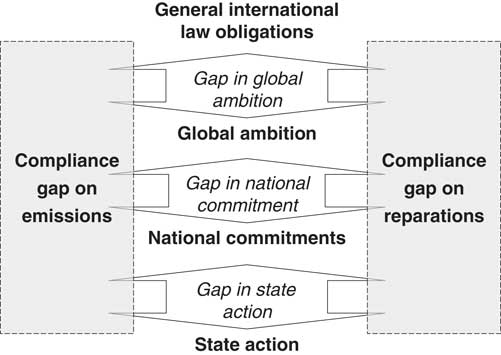
This section details the particular aspects of the compliance gap that the climate regime seeks to address. Two particular gaps in compliance are identified. The compliance gap on emissions is constituted by the failure of states to comply with their obligation to avoid and prevent activities within their jurisdiction from causing serious harm to the environment of other states. International action on climate change mitigation seeks to overcome this gap in compliance by fostering national commitments to gradually limit and reduce GHG emissions. The compliance gap on reparations is constituted by the failure of states to make adequate reparation for the harm caused by the internationally wrongful act of excessive GHG emissions. Calls to address this gap in compliance led to international cooperation on adaptation and, more recently, to discussions on possible approaches to address loss and damage. At present, however, much less has been achieved to overcome the compliance gap on reparations than that on emissions.
The compliance gap between general international law and state conduct can also be divided into three successive gaps (see Figure 1). Firstly, a gap in global ambition appears between general international law and the global ambition embodied in international climate change agreements – for instance, between states’ obligations under the no-harm principle and the objective of holding the increase in global average temperature well below 2°C, and aspirationally to 1.5°C. Secondly, a gap in national commitment appears between global ambition and national commitments – for instance, between the mitigation objective of the Paris Agreement and the predicted aggregate outcome of NDCs. Thirdly, a gap in state action is likely to appear between national commitments and actual state conduct, which may result from non-participation (such as non-ratification of or withdrawal from a treaty) or from lack of implementation.
Breakdown of the Compliance Gap

Overcoming the compliance gap requires that these three gaps are addressed in a coordinated manner. It would be futile and possibly counter-productive to increase global ambition in the climate regime in order to reduce the gap in global ambition if this were not matched by greater national commitments. Similarly, it would be pointless to impose greater national commitments if this were to reduce state willingness to participate in the agreement or to implement these commitments effectively. Successive international agreements have approached this dilemma in different ways and with varying degrees of success.
3.1. The Compliance Gap on Emissions and International Cooperation on Mitigation
The first, and still prevalent, focus of the climate regime is on addressing the gap between states’ current GHG emissions and their due diligence obligation under the no-harm principle. It was clear from the outset that the vague provisions contained in the UNFCCC would not suffice to achieve its ‘ultimate objective’.Footnote 83 Daniel Bodansky observed in 1993 that the Framework Convention was intended to produce ‘positive feedback loops’ whereby the international lawmaking process would take on ‘a momentum of its own’.Footnote 84 Thus, the first decision adopted by the COP to the UNFCCC initiated the negotiation of what would become the Kyoto Protocol, an agreement on quantified emissions limitation and reduction commitments applicable to industrialized states for a first commitment period running from 2008 to 2012.Footnote 85 In turn, the first decision adopted by the COP to the UNFCCC, acting as a meeting of the Parties to the Kyoto Protocol, initiated consideration of commitments for subsequent periods.Footnote 86
The 1997 Kyoto Protocol and its 2012 Doha Amendment outline a ‘top-down’ approach to address the compliance gap on emissions. These agreements focus on the greater historical and current responsibilities of developed states, as recognized in the UNFCCC.Footnote 87 Global ambition is defined as a percentage of reduction in the overall GHG emissions of developed states: 5% reduction below 1990 levels in the first commitment period defined by the Kyoto Protocol (2008–12),Footnote 88 18% reduction below the same levels in the second commitment period added by the Doha Amendment (2013–20).Footnote 89 Annex B of the Kyoto Protocol lists the respective quantified emissions limitation and reduction commitments of developed states, adopted by consensus following difficult international negotiations. These commitments are unquestionably legally binding with regard to states parties to a treaty in force, under the principle pacta sunt servanda.Footnote 90
The inclusion of national commitments for developed states within Annex B of the Kyoto Protocol avoided any possible gap in national commitment: the aggregate of national commitments listed in Annex B equates to the global mitigation objective of a quantified reduction in the GHG emissions of developed states. Yet, resolving the gap in national commitment came at the cost of exacerbating the two other components of the compliance gap. The Kyoto Protocol and its Amendment adopt unambitious global mitigation objectives. A limited decrease in the GHG emissions of developed states falls short of meeting their obligation to cease excessive GHG emissions within a reasonable period of time, and no such quantified commitment is imposed upon emerging economies, the shares of which in global GHG emissions are rapidly increasing. Moreover, the outcome of the Kyoto Protocol was limited by the decision of the US not to ratify it; the withdrawal of Canada during the first commitment period; and the decision of Japan, New Zealand and Russia not to participate in a second commitment period. The over-achievement of emissions limitation and reduction commitments by the parties to the Kyoto Protocol during the first commitment period had more to do with economic circumstances (such as the decrease in GHG emissions in former socialist countries, and the 2009 financial crisis) than with actual mitigation efforts undertaken by states to respect their commitment.Footnote 91
By contrast, the 2009 Copenhagen Accord, the 2010 Cancún Agreements and the 2015 Paris Agreement promote a ‘bottom-up’ determination of national commitments. Instead of attempting to impose national commitments consistent with global ambition, these enactments call upon individual states to determine what they view as an appropriate contribution to the agreed global ambition. States are encouraged to gradually increase their respective commitments,Footnote 92 and the Paris Agreement endorses the principle that successive NDCs ‘will represent a progression over time’.Footnote 93 To facilitate collective emulation, the bottom-up approach relies on mechanisms to promote transparency in national commitments and to take stock of collective progress towards fulfilling global mitigation objectives.Footnote 94 These national commitments also impose obligations on states, whether they are made on the basis of a decision of the Conference of the Parties (Cancún Agreements) or derive their legal force from a treaty (Paris Agreement).Footnote 95 Yet, instead of an obligation of result,Footnote 96 this approach inclines towards obligations of means. The Paris Agreement, in particular, requires states to ‘undertake … ambitious efforts’ and to ‘pursue domestic mitigation measures, with the aim of achieving the objectives’ defined in their NDCs.Footnote 97
This bottom-up approach reduces the gap in global ambition and, possibly, the gap in state action. International agreements can include ambitious global mitigation objectives, even when intended national commitments do not meet these objectives, based on the assumption that national commitments could then be reviewed and gradually increased. Thus, the Copenhagen Accord endorsed the objective of holding the increase in global average temperature below 2°C,Footnote 98 while the Cancún Agreements and the Paris Agreement also mention 1.5°C as a more aspirational target.Footnote 99 It could, furthermore, be anticipated that states, being able to define their respective mitigation commitments, would be more likely to participate in the decision (so as to ratify a treaty) and to actually comply with their commitment. Although Canada, Japan, New Zealand, Russia and the US took no quantified emissions limitation or reduction commitments during the second commitment period of the Kyoto Protocol defined by the Doha Amendment, they – along with most emerging economies – communicated quantified economy-wide emissions reduction targets under the Cancún Agreements, thus condoning a more ambitious objective, a broader participation, and greater flexibility for each party to define its own commitment.Footnote 100 Similarly, in advance of the adoption of the Paris Agreement, more than 160 states, including all major GHG emitters, communicated their intended NDCs.
While reducing the gaps in global ambition and, possibly, in state action, the bottom-up approach adopted in Cancún and in Paris exacerbates the gap in national commitment. Successive decisions of the COP to the UNFCCC have recognized the discrepancy between the Cancún Pledges and the objective of keeping the increase in global average temperature below 2°C (let alone 1.5°C).Footnote 101 Likewise, intended NDCs communicated in advance of the Paris Agreement would commit states to only a fraction of what is assumed to be the most likely least-cost way of realizing this ambition.Footnote 102 The bottom-up approach has been favoured in recent years based on the understanding that the quasi-universal acceptance of an instrument that formulates an ambitious global mitigation objective provides a good basis for promoting compliance with general international law, although further strenuous international haggling will be necessary to gradually increase national commitments. This suggests an increasing emphasis on the ability of the climate regime to leverage fruitful political processes to raise awareness, set agendas and build political momentum for each individual state to commit progressively to stringent mitigation efforts.
3.2. The Compliance Gap on Reparations and International Cooperation on Adaptation
Climate change is already having significant impacts, especially in developing countries.Footnote 103 Industrialized nations responsible for excessive GHG emissions have remedial obligations towards the states that are most severely affected by climate-related impacts. Claims have long been made for efforts within the climate regime to address the gap between the conduct of the states responsible for most GHG emissions and their remedial obligations under the law of state responsibility. These claims met with less success than the attempt to address the compliance gap on emissions because of the lack of political leverage of the states most severely affected by the impacts of climate change and the reluctance of most industrialized nations to admit anything akin to a legal responsibility. Negotiations on these aspects of the climate regime have become more prominent since 2007, often in exchange for greater involvement on the part of developing states in international cooperation on mitigation. Provisions were progressively adopted to promote support for adaptation and ‘approaches to address loss and damage’.
The UNFCCC does not define a global adaptation objective but merely a set of vague requirements, such as the obligation for developed states to ‘assist the developing country Parties that are particularly vulnerable to the adverse effects of climate change in meeting costs of adaptation to those adverse effects’.Footnote 104 ‘Meeting costs’, in contrast to ‘meeting the costs’, does not suggest a comprehensive obligation to support developing states in meeting all the costs of adaptation. Such a provision falls short of fulfilling the obligation of a state responsible for an internationally wrongful act to make adequate reparation. To date, international support for adaptation has been over fifteen times less than international support for mitigation.Footnote 105
The 2007 Bali Action Plan went further by defining an, admittedly elusive, objective of ‘enhanc[ing]’ action on adaptation.Footnote 106 As clarified in the Cancún Agreements, this global objective is limited to ‘reducing vulnerability and building resilience in developing country Parties’, in particular by addressing ‘the urgent and immediate needs of those developing countries that are particularly vulnerable’.Footnote 107 While this surely falls far short of the obligation to provide adequate reparation, the main contribution of the Bali Action Plan was to define support for adaptation as a global objective requiring national commitments – a necessary first step towards addressing the compliance gap in reparations. Technical discussions were held on how to adapt and, more recently, on possible approaches to address loss and damage associated with climate change impacts.
Yet, international cooperation on adaptation has not always been in line with the nature of remedial obligations, and tends to provide technical guidance rather than compensation. From the viewpoint of developing states at least, the crux of the question remains the need for financial (and, to a lesser extent, technical) support from developed states. Financial support could provide something akin to compensation. However, global objectives of substantial financial support for adaptation have not been reflected consistently in the individual commitments made by developed states. Multilateral funds established under the UNFCCC or under the Kyoto Protocol have had limited success.Footnote 108
Spurred by the process initiated by the Bali Action Plan, the Copenhagen Accord and the Cancún Agreements announced an increase in financial support ‘with balanced allocation between adaptation and mitigation’,Footnote 109 and the Green Climate Fund was established to channel some of the financial flow announced.Footnote 110 While the COP has repeatedly ‘urg[ed] all developed country Parties to scale up climate finance’ to meet this objective,Footnote 111 the determination of respective national contributions was left to individual developed states in a bottom-up approach. In 2013, developed states were thus requested to ‘prepare biennial submissions on their updated strategies and approaches for scaling up climate finance’Footnote 112 for the period from 2014 to 2020. Submissions received before the COP-21 reported annual levels of climate finance commitments ranging from US$23 million (Portugal) to US$10.8 billion (Japan).Footnote 113
The Paris Agreement endorsed a similar bottom-up-approach, firstly, by recognizing the importance of support for adaptation effortsFootnote 114 and, secondly, by refraining from defining individual obligations for developed states.Footnote 115 Developed states were requested to ‘biennially communicate indicative quantitative and qualitative information’ on their provision of financial support for mitigation and adaptation.Footnote 116 While developed states committed to jointly mobilize US$100 billion per year by 2020, the Green Climate Fund’s initial resource mobilization gathered less than US$10 billion in its first 18 months.Footnote 117 The financial commitments of developed states have repeatedly fallen short of meeting global objectives and, while the COP has repeatedly called for a balanced distribution of climate finance between mitigation and adaptation, donor states strongly favour the former.
In addition to this quantitative shortcoming, there is also a qualitative gap between international cooperation on adaptation and general international law. Under general international law, the state responsible for an internationally wrongful act must, as the Permanent Court of International Justice stated in the case of the Chorzów Factory, ‘reestablish the situation which would, in all probability, have existed if that act had not been committed’.Footnote 118 By contrast, the very concepts of ‘adaptation’ and ‘approaches to address loss and damage’ suggest international guidance on a domestic process of transformation. Instead of compensation, industrialized nations are inclined to redefine their ‘responsibility’ as a ground for support and assistance, leading to influence and oversight in development policies of developing states. The emphasis of the workstream on loss and damage on migration and insurances may have more to do with the priorities of the donors than with the needs of the states and societies most affected by the adverse impacts of climate change.Footnote 119 Thus, despite long-lasting efforts over the last quarter of a century, much remains to be done for the climate regime to address the compliance gap on reparations.
3.3. Means to Promote Compliance
This last section explores the different techniques implemented in the climate regime in order to promote compliance with states’ obligations under general international law, whether in relation to emissions or (less frequently) reparations. Although they may be useful, classical tools such as adjudication, measures of retorsion, counter-measures, and multilateral sanctions are assumed to be insufficient to ensure compliance with general international law.Footnote 120 Instead, the climate regime represents an attempt to foster compliance through international socialization, in particular through negotiating global ambition and national commitments. Classical enforcement institutions could nevertheless play a role on the basis of intermediary rules defined by the climate regime. The climate regime offers possible bases for dispute settlement, including through the submission of a dispute to the ICJ or to arbitration,Footnote 121 or through establishing a conciliation commission.Footnote 122 It is noteworthy, however, that the annexes on arbitration and on conciliation announced in the UNFCCC to define relevant procedural rulesFootnote 123 have not yet been adopted. This may reflect the low confidence of states in international dispute settlement as a way to enforce climate law.
In addition to external dispute settlement mechanisms, institutions were also established within the climate regime to promote compliance, in particular with mitigation commitments. The compliance mechanism established in the Kyoto Protocol aims specifically ‘to determine and to address cases of non-compliance with provisions’ of the Protocol. However, the Kyoto Protocol provides no basis for the adoption of ‘any procedures and mechanisms … entailing binding consequences’.Footnote 124 Similarly, the ‘mechanism to facilitate implementation of and promote compliance’ with the provisions of the Paris Agreement will be of a ‘non-adversarial and non-punitive’ nature,Footnote 125 seeking to facilitate rather than to impose compliance. Most of the procedures initiated before the compliance mechanism of the Kyoto Protocol concerned technical issues relating to reports on GHG emissions or registry system managements rather than compliance with emissions limitation and reduction commitments.
Unable to force states into any particular conduct, the climate regime creates tools that promote compliance through more innovative means. These means seek to raise awareness, set agendas, and build momentum towards state compliance under general international law. Although largely orchestrated by the UNFCCC and related instruments, these processes often extend beyond the international climate regime proper as they create a public appetite for climate change policies within and across states. In particular, they aspire to tap into national political debates in order to spur national acceptance, support, and demand for climate change policies.
Firstly, through raising awareness and the promotion of further research, as well as the dissemination of knowledge, the climate regime fosters a common understanding of climate change and the legitimacy of costly responses, which is a necessary first step. Treaties and COP decisions make reference to scientific authorities – in particular, to the successive Assessment Reports of the IPCC – as a basis for the determination of global adaptation and mitigation objectives.Footnote 126 Through the UNFCCC and the Paris Agreement, states recognize unequivocally ‘the need for an effective and progressive response to the urgent threat of climate change on the basis of the best available scientific knowledge’.Footnote 127 States are repeatedly called upon ‘to enhance climate change education, training, public awareness, public participation and public access to information’ on the ground of ‘the importance of these steps with respect to enhancing actions’.Footnote 128 One way of raising awareness is to facilitate media coverage and civil society participation in the negotiation process. In addition to 17,000 state representatives, the COP-21 held in Paris in December 2015 gathered more than 8,200 representatives of 2,000 civil society and international organizations, as well as 2,700 journalists.Footnote 129 The ‘Climate Generations’ area adjacent to the conference centre welcomed about 90,000 visitors during the negotiations.Footnote 130 The rotation of the venue of successive COPs is an obvious way to stimulate awareness in different parts of the world.
Secondly, through efforts to set the political agenda of multiple influential actors, the climate regime promotes an active involvement of critical institutional and individual actors. Processes through which states determine their own commitments for climate change mitigation, or to financially support adaptation, open up important political debates on the role and responsibilities of states with regard to climate change. The bottom-up approach adopted in Cancún and Paris could thus foster a greater sense of ownership of responses to climate change among domestic actors. Furthermore, agenda setting extends to a wide range of non-state actors, such as international organizations, national authorities with different responsibilities, local governments, and non-governmental organizations. Linking climate change with other political issues leverages the participation of more institutions – for instance, those with a focus on development, international security, disaster risk management, migration and human rights. It facilitates the mainstreaming of climate change considerations in multiple policy spheres. Efforts have been made to involve other stakeholders, such as civil society organizations, for-profit organizations and subnational authorities, not just through awareness raising, but also by encouraging voluntary commitments by non-state actors, including through investment and ‘divestment’ strategies, technology and innovation, mitigation and adaptation initiatives. In particular, the decision on the adoption of the Paris Agreement encouraged efforts by non-party stakeholders, including profit- and non-profit organizations as well as subnational authorities, and established a platform to document these efforts.Footnote 131
Lastly, through building momentum and trust in the prospects of international cooperation, the climate regime pushes for a progressive upscaling of climate action and genuine steps towards states’ compliance with their obligations under general international law. Climate change mitigation has often been construed as a collective action problem because, from a strictly economic perspective, ‘even if a nation is better off with a treaty than without, it will be better off still if everyone else signs the treaty and it does not’.Footnote 132 This disincentive can be overcome only through confidence building and increasing transparency in respective national actions so that each state can ensure that others are not free-riding at its expense. Within the climate regime, efforts at monitoring and reporting GHG emissions have occupied an important place from the outset. The Paris Agreement further establishes an ‘enhanced transparency framework for action and support’ in order to ‘build mutual trust and confidence and to promote effective implementation’.Footnote 133 Confidence and momentum building accounts in part for the push for international oversight, beyond states’ actual GHG emissions limitation or reduction achievements, to the actual mitigation efforts that they are making. Under the Paris Agreement, for instance, states will report their ‘progress towards achieving [their] individual nationally determined contributions’.Footnote 134 This mechanism will make it less economically risky for a state to comply with its mitigation commitments as it can verify that other states are also making adequate efforts.
No international institution can compel industrialized nations to comply with their obligations under general international law to reduce excessive GHG emissions and pay adequate reparation to developing states. Yet, negotiations conducted over a quarter of a century have progressively established a set of specific rules and institutions which put pressure on states to do so. Compliance with general international law thus becomes gradually viewed as a possible, preferable and – hopefully soon – obvious choice.
4. CONCLUSION
The climate regime is neither a derogation from nor a mere application of norms of general international law. It forms a compliance regime: a regime intended mainly to promote compliance with general norms of international law, in particular with states’ obligations under the no-harm principle and the law of state responsibility. This interpretation is necessary to explain specific rules that do not exclude the application of pre-existing norms, yet apply them only in a partial and selective fashion. This interpretation is also consistent with mechanisms within the climate regime which seek to develop internal support for climate action by raising awareness, setting agendas, and building momentum.
This transitory regime could too easily conceal the existence of relevant norms of general international law, and political haggling could forfeit principles of justice. The project of international law as a promise for justice would suffer greatly if the international responses to a major global crisis such as climate change were viewed as nothing but the outcome of political negotiations dominated by the most powerful states, with no consideration for general international law. Beyond the analysis of the rules and processes established by international climate change agreements, it is therefore essential to have a comprehensive understanding of the ‘general’ international law on climate change, to recognize the achievements of international cooperation to date, as well as to acknowledge the many remaining challenges.