Introduction
Local products are tied to their area of origin and are often considered to be important tools for use in maintaining local culture and traditions and fostering rural development, especially in disadvantaged and mountain areasReference Pacciani, Belletti, Marescotti and Scaramuzzi 1 . Irrespective of many studies and definitions about local food, it has been noted that there is still no single definition of the term, although in recent years, local food has been perceived to be a growing categoryReference Hingley, Boone and Haley 2 . Indeed, several studies conducted in European countries have shown growing consumer and retailer interest in local food products (LFP)Reference Hingley, Boone and Haley 2 – Reference Weatherell, Tregear and Allinson 6 . Irrespective of the lack of a working definition for local food, many researchers have studied the importance of LFP while using various definitions 7 – Reference Ilbery and Kneafsey 10 . Many of them estimate the importance of local food to be much broader than mere consumer perception; local food also has a significant environmental and socio-economic role and is closely linked to broader rural development issues, such as sustaining local businesses, retaining money in the local economy, the presence of successors on farms, and maintaining and preserving agricultural land in mountain areas. In addition, some authorsReference Pacciani, Belletti, Marescotti and Scaramuzzi 1 hold that much empirical evidence shows that the LFP are often used as a fundamental component in the collective strategies of rural development.
In Slovenia, local food still commands no recognizable purchasing power, although the volume of research on local food has increased in recent yearsReference Bratec 11 – Reference Majkovič and Borec 13 . There is also no agreed-upon perspective or results that can point to the exact factors that are hampering the development of the local food concept and its delivery to consumers.
Starting from this, the first step is to study the local food production process and ascertain where in the production process the main bottlenecks exist and how they are inhibiting the development of the local food concept.
For local food products, in terms of consumer and society acceptance, we need to apply modern assessment tools that also include economic parameters that are not directly related only to quantitative values. The multi-criteria decision analysis (MCDA) in this survey was applied because the many aspects of local can behave in conflicting waysReference Rozman, Pažek, Bavec, Bavec, Turk and Majkovič 14 (for instance, some products can be attractive for the market yet difficult to produce or vice versa). One of the most commonly used MCDA methods is the analytical hierarchical process (AHP)Reference Tiwari, Loof and Paudyal 15 – Reference Tojnko, Rozman, Unuk, Pažek and Pamič 22 , which was first presented in 1980 by SaatyReference Saaty 16 and Multi Attribute Theory (MAUT), which was applied to agricultural systems later on, in 2010Reference Pažek, Rozman, Bavec, Borec and Bavec 17 . Both of these use the quantitative assessment of alternatives. In contrast to AHP and MAUT, the DEX method presented by BohanecReference Bohanec 23 uses discrete attribute (criteria) values and utility functions (UFs) in the form of ‘if…then’ decision rulesReference Tojnko, Rozman, Unuk, Pažek and Pamič 22 . These seem to be well-suited for dealing with ‘soft’ decision problems, for which qualitative scales can be more informative than quantitative scoresReference Bohanec 23 , Reference Pelzer, Fortino, Bockstaller, Angevin, Lamine, Moonen, Vasileiadis, Guérin, Guichard, Reau and Messéan 24 .
In the assessment field, an MCDA is more often used as an ex-ante evaluation tool for the examination of alternative projects or strategic solutionsReference Nardo, Saisana, Saltelli, Tarantola, Hoffman and Giovannini 25 . To date, the method has been applied to solve numerous real-life decision problems in agriculture, rural development and environmental protectionReference Tiwari, Loof and Paudyal 15 , Reference Pažek, Rozman, Bavec, Borec and Bavec 17 , Reference Galli, Carbone, Caswell and Sorrentino 21 , Reference Tojnko, Rozman, Unuk, Pažek and Pamič 22 , Reference Rozman, Potočnik, Pažek, Borec, Majkovič and Bohanec 26 – Reference Hermann, Kroeze and Jawjit 31 . As, in this study, the focus is on the assessment of the production and marketing system of local food, MCDA was used as ex-post analysis. Other food attributes, e.g., taste, ingredients and cultural values, were not included in the survey.
Since Slovenian mountain and hilly regions are spread out over more than 70% of that nation's total area, we decided to focus our research only on Alpine and pre-alpine areas in Slovenia. We use the term ‘local mountain food products’ to avoid the dual identity of the products. In mountain areas, mountain products could be considered and sold as local products, but in non-mountain areas, mountain products are mostly considered to be special products reflecting the image of mountain areas 7 . With the term ‘local mountain products’, we attempted to emphasize the local origin of products, as well as local sales/local marketing channels.
For the study, we use four typical mountain food categories in Slovenia: dairy, meat, bakery and fruit. Altogether, ten food products were examined.
First, the aim of the study was to examine whether the DEX method is appropriate for the assessment of the production and marketing systems of local food. Secondly, the study aimed to determine whether the method gives clear directions for overcoming bottlenecks in both systems. The added value of the DEX methodology, as applied in our research, can be recognized in the fact that it is also a useful methodology in comparison with the MCDA methods that have already been used in food systemsReference Galli, Carbone, Caswell and Sorrentino 21 and a suitable tool for assessments in the agro-food sector in general.
In this paper the study area and data sources are defined; this is followed by a description of the methodology and model development, then the application of the model to ten local mountain food products. The results of applying the DEX model to ten local food products, along with a discussion, are described in the next section. The paper concludes with our main findings and recommendations for further study.
Materials and Methods
Data sources
Survey input data are supported by questionnaires prepared for leaders and/or managers of projects linked to the marketing of selected local mountain foods. Altogether, 20 face-to-face interviews were carried out by well-qualified examiners between July and October 2011. As the interviews could be classified as subjective methodsReference Barjolle, Paus and Perret 8 , which we considered a disadvantage for our research, the questions were mostly closed in order to make the answers more objective.
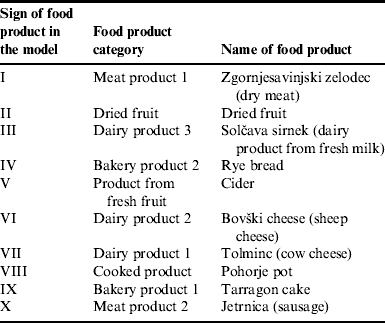
Ten marketing projects and ten LFP (Table 1) were the core of the questionnaire. The selection of each food product was linked more to its existing marketing project than to its ingredients or quality characteristics. Nevertheless, we should mention that some of examined food products, such as Tolmin cheese and Zgornjesavinjski zelodec (dry meat), already belong to the PDO (protected designation of origin) and PGI (protected geographical indication) food quality scheme. One of them is in the process of application (Bovški cheese). The rest are mountain food products that are recognized at a local level. All examined projects were supported by LEADER and realized within Local Action Groups (LAGs).
Food product categories.

Before structuring the questionnaire, the data collection, used for building up the hierarchical tree, was performed by a focus group of five experts involved in the study section of the model development. The questionnaire was designed to gather information about each local food product, project construction and development, realization and project outcomes. The questionnaire combines two types of questions. The first type is based on empirical answers (e.g., ‘the average % sales of yields produced’, ‘the size of the cultivated area on a farm’, ‘the average amount of yields produced’ and ‘number of farms dealing with production’), while the second type of question is based on descriptive answers (e.g., ‘yes/no’, ‘organic/integrated/conventional type of farming’).
Interview answers were further processed and, if necessary, converted into measurable quantitative parameters that were afterwards applied to a multi-criteria decision model. The model, along with the defined value scales, is presented in Figure 1.
The hierarchy tree of the DEX multi-attribute model.

Although the interviews were the main information source, in order to gain complete findings for each local food product, historical, social and spatial backgrounds were examined, as well as the entire food chain.
Multi-attribute assessment methodology DEX
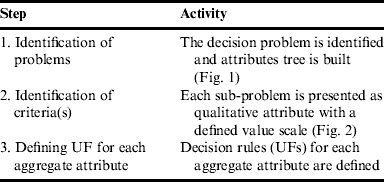
DEX is a methodology for qualitative multi-criteria decision modelling and supportReference Bohanec and Rajkovič 18 , Reference Tojnko, Rozman, Unuk, Pažek and Pamič 22 . The DEX method is implemented via the software program DEX-iReference Bohanec 23 . The combination of Expert Systems, Machine Learning and traditional multi-criteria decision-making represents the elements of DEX methodology. The development of the DEX model is based on three typical steps, as shown in Table 2 Reference Bohanec 23 .
Attribute scales for the problem observed.

Description of steps of the DEX model and activities for each step.

The variable values in DEX are usually represented by words (discrete values) such as ‘yes or no, lower or higher, etc.’ Qualitative values describe basic attributes, as well as aggregate attributes, which are, in our research, on the fifth level of hierarchy, i.e., basic attributes are aggregated to other attributes, and these attributes are aggregated to a final alternative assessment. UFs are an important part of the evaluation and decision process (described in the ‘model development’ section).
Model development
The majority of current multi-criteria methods (MCM) are aimed at the development of quantitative decision modelsReference Bohanec, Zupan and Rajkovič 32 . The first step in MCM development is the structuring of the decision hierarchyReference Rozman and Pažek 28 . The construction of a hierarchical tree is built up from many sub-problems (attributes) that have consequences for the final decision. Figure 1 presents the hierarchical tree of the developed model. Examining it from an abstract point of view, the left side of the model could be perceived as the ‘trunk’ of the tree, and the right side could be perceived as the tree's ‘crown’. The attributes of the tree's ‘crown’ (third level attributes) are combined into aggregate attributes, which are the ‘branches’ (second level attributes) of the tree. These are further combined to create the ‘root system’ of the tree—the final assessments of local food products.
In our research, the hierarchical decision model was structured so as to have aggregate attributes on the higher level and also have aggregate attributes on the lower level. The hierarchy of the model (attributes and UFs) is based on a preliminary literature reviewReference Rozman, Potočnik, Pažek, Borec, Majkovič and Bohanec 26 , Reference Pažek, Rozman and Borec 29 , Reference Pavlovič, Cerenak, Pavlovič, Rozman and Bohanec 30 , relevant research objectives and indicators of performance for local food product schemesReference Hingley, Boone and Haley 2 , Reference Galli, Carbone, Caswell and Sorrentino 21 . The aggregation process is based on the UFs. In the DEX program, the UFs are represented by decision rules, which are acquired from the model developersReference Rozman, Potočnik, Pažek, Borec, Majkovič and Bohanec 26 (more details below). The hierarchical structure of the developed model consists of two complex aggregate attributes (‘Marketing’ and ‘Production’). The ‘Marketing’ attribute further consists of four sub-attributes (‘Consumers’, ‘Price’, ‘Organization of Marketing’ and ‘Product sales’).
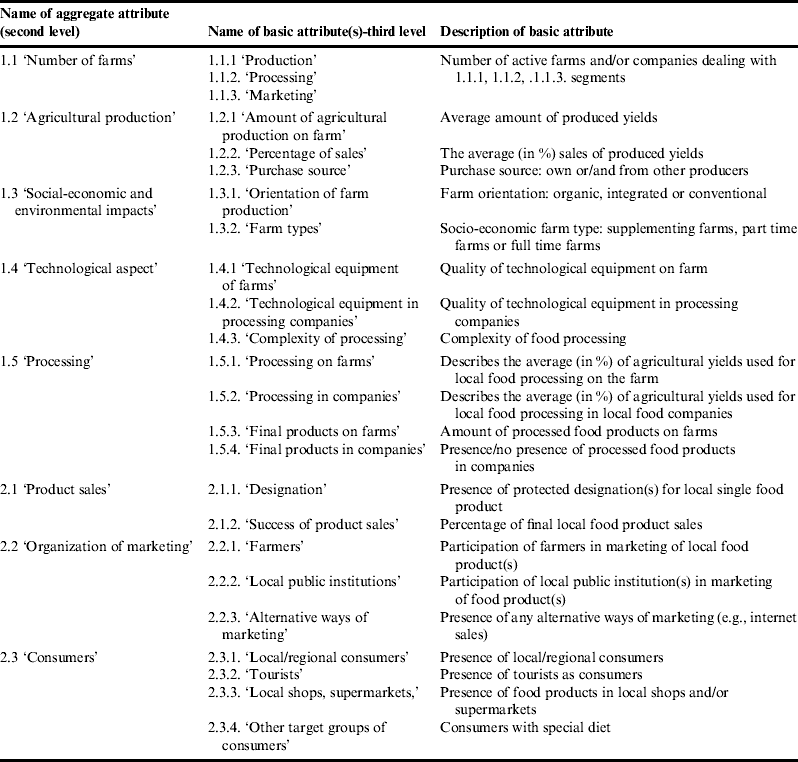
The ‘Production’ aggregate attribute consists of five other aggregate attributes: ‘Number of farms’, ‘Agricultural production’, ‘Social-economic and environmental impacts’, ‘Technological aspect’ and ‘Processing’, and it also has one non-aggregate attribute: ‘Size of cultivated area on farm’. The ‘Marketing’ aggregate attribute consists of the three other aggregate attributes, ‘Product sales’, ‘Organization of marketing’ and ‘Consumers’, and the non-aggregate attribute ‘Price’ on the second level. The construction of all aggregate attributes on the second level is described in Table 3.
Description of aggregate attributes at the second level of the hierarchy.

The second step of the model development was based on a value scale definition for each sub-attribute (Fig. 2). The value scale is discrete and typically consists of wordsReference Bohanec, Zupan and Rajkovič 32 . In the presented model, some attributes are on a numerical scale (i.e., ‘Size of cultivated area on farm’, ‘Price’, ‘Success of product sales’, etc.). With data previously inserted into MS Office Excel, the numerical values (especially basic attributes such as ‘Size of cultivated areas’, ‘Percentage of sales’, etc.) were distributed (preferentially ordered) into three-stage scales (they can also be described as good, neutral or bad), which were, after the definition of the UFs, presented in terms of qualitative values.
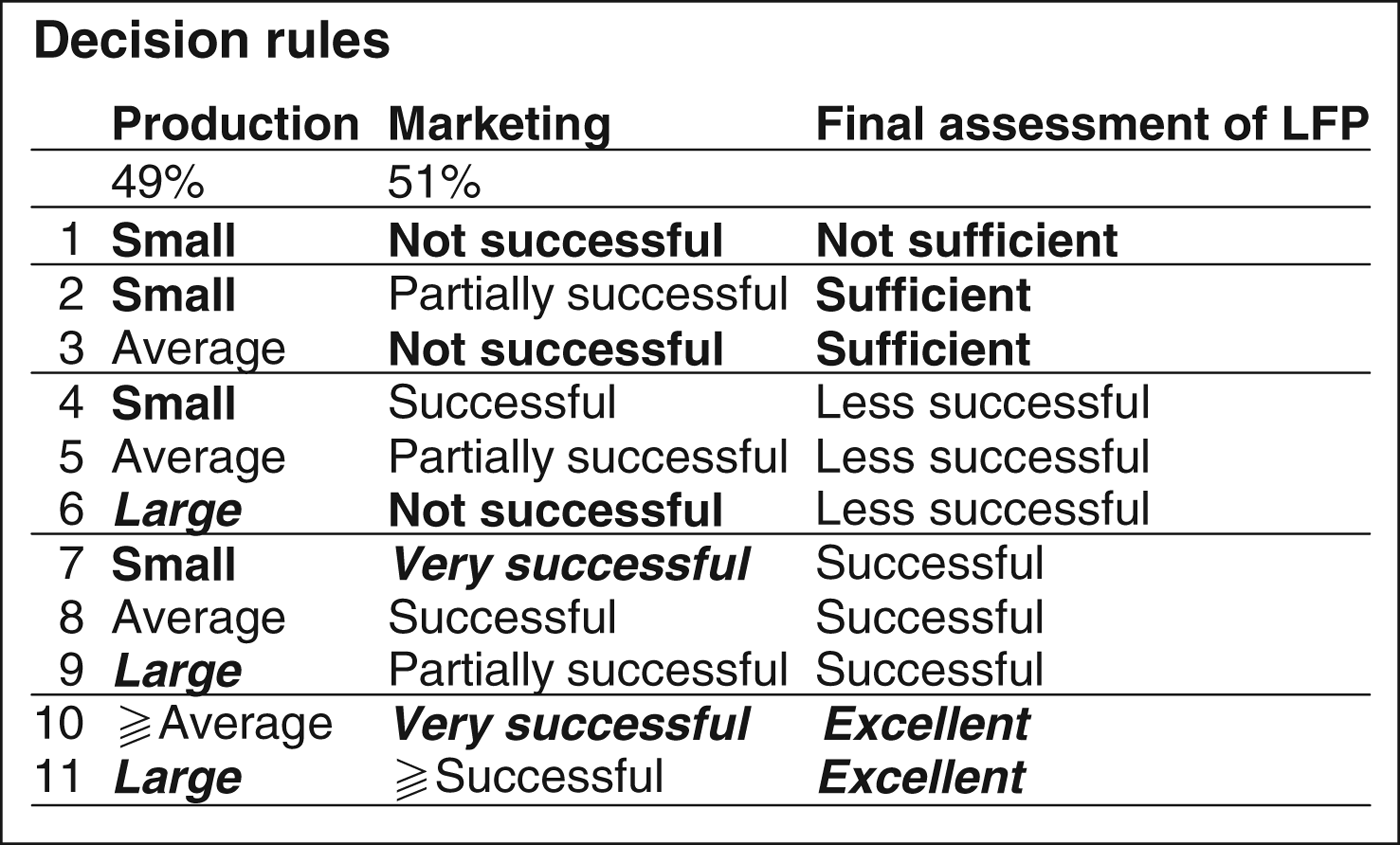
The next step was to define the decision rules (i.e., UFs). The decision rules describe the value of an aggregate attribute for each combination of input attributes and express the relative importance of the individual attributesReference Rozman and Pažek 28 . The relative importance of an individual attribute is represented with a weight value. Setting the weights (49 and 51%) defines the relationship between ‘Production’ and ‘Marketing’ because they have similar impacts on the final assessmentReference Hingley, Boone and Haley 2 , Reference Prišenk 33 . The authors assumed that the relative importance of the ‘Production’ and ‘Marketing’ attribute systems are in balance in the determination process of the final assessment of local food. In the survey, the weights should be 50% for both systems, but the reason for the imbalance lies in the normalization process that is automatically performed by the DEX program. This happened because some attributes’ scales can have more value than othersReference Belton and Stewart 34 . The first and last decision rules were strictly defined by experts, who set the worst (not sufficient) and the best (excellent) assessments of LFP. For example, if the assessment of production is small and that of marketing is not successful, the final assessment is not sufficient. The final assessment of LFP is excellent if the assessment of production is large and marketing is ‘≧’ successful (Fig. 3). Some decision rules are expressed in a more complex form, such as ‘≧’, which means equal to or greater than. Decision rules were defined for all aggregate attributes of the hierarchy; thus, the final sum gives 11 UFs.
Example of decision rules for the assessment of local mountain food products.

Results and Discussion
The final results of the DEX-i evaluation for all food products can be seen in Figures 4 and 5.
Results of the DEX-i evaluation of local mountain food products I–V.

Results of the DEX-i evaluation of local mountain food products VI–X.

Local mountain food products can ultimately be assessed as excellent, successful, less successful, sufficient or not sufficient. Two of the examined LFP (rye bread and dried fruit) were assessed as sufficient or less successful. These dual assessments depend on the basic attribute ‘technological equipment in processing companies’. This basic attribute was indefinite because food processing is mostly performed on small-scale farms. Products Zgornjesavinjski zelodec and Tolminc received the best final assessments (excellent). On the production level, the products Zgornjesavinjski zelodec and Tolminc received the best assessments as well, which were described as large. A production level grade one step lower (average) was ascribed to the food products Bovški cheese and Jetrnica. Only the food product Pohorje pot was assessed as small. The food products Zgornjesavinjski zelodec and Tolminc cheese received the highest grade (successful) in regards to marketing level.
The assessments of the marketing attributes of the food products dried fruit, Solčava sirnek, rye bread, cider, Bovški cheese, tarragon cake and Jetrnica were lower as compared with the marketing assessments of other food products. To achieve the higher final marketing grades, at least two of the three marketing attributes (‘Product sales,’ ‘Organization of marketing’ and ‘Consumers’) must be assessed as good, sufficient or large, which is not the case in any of the previously mentioned food products (dried fruit, Solčava sirnek, rye bread, cider, Bovški cheese, tarragon cake and Jetrnica). Indeed, the high values of these marketing attributes are more linked to the characteristics of high-scale production than to niche local market chains.
To identify bottlenecks in both the production and marketing processes, ‘Plus–minus 1’ (PS-1) analysis was further applied.
Results of the ‘PS-1’ analysis
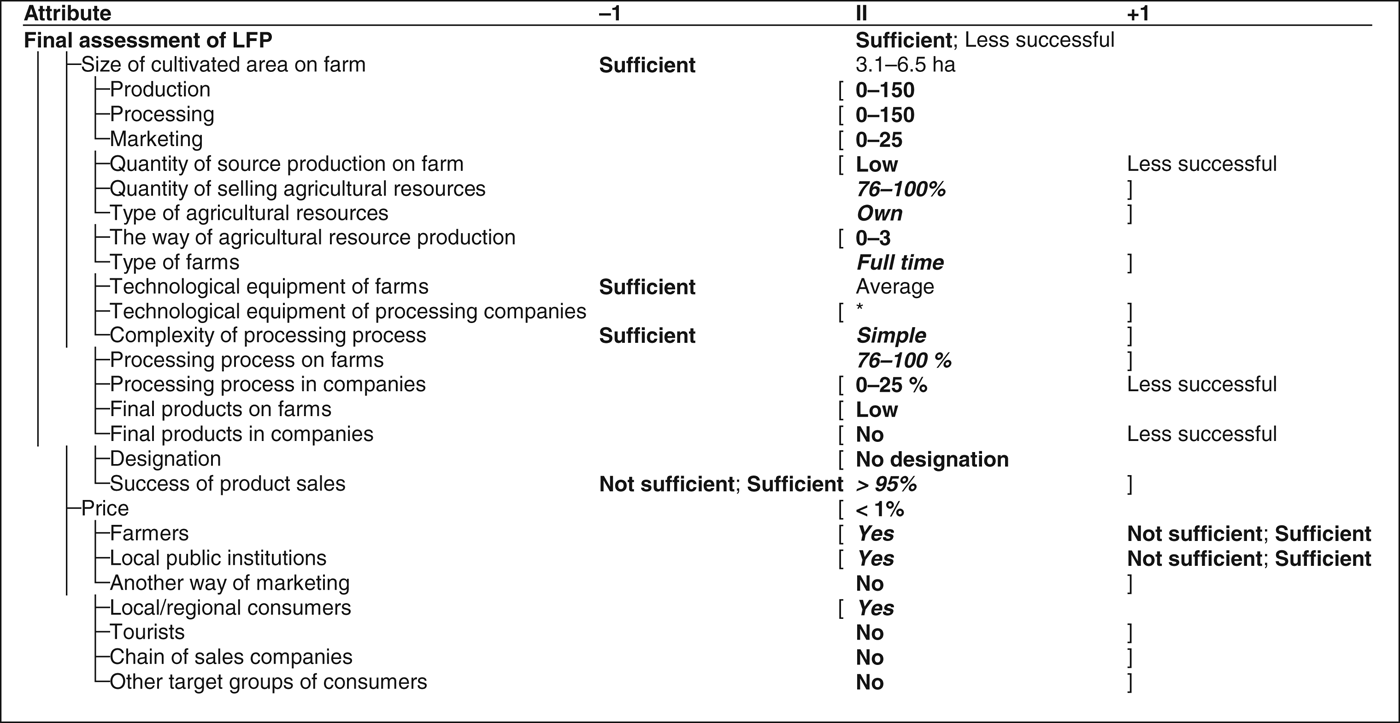
A ‘PS-1’ analysis describes changes in certain basic attributes by one degree upwards or downwards (if possible) that are independent of other attributesReference Bohanec 23 . Dried fruit was chosen for a more detailed explanation because the final assessment was not strictly defined but could be described as sufficient or less successful. The results of the ‘PS-1’ analysis of dried fruit can be seen in Figure 6.
‘PS-1’ analysis of local mountain food product II.

If, on the production level, the basic attribute values (‘Success of product sales’, ‘Size of cultivated area on farm’, ‘Technological equipment of farms’ and ‘Complexity of processing’) change by one degree downwards (−1), this indicates major bottlenecks of dried fruit on the production level. The analysis shows that the final assessment of dried fruit could improve from sufficient to less successful or could move in the opposite direction. If, on the marketing level, the basic attribute values of marketing organization (‘Farmers’ and ‘Local public institutions’) change by one degree downwards, this indicates major bottlenecks in the marketing system. Other attributes of production and marketing do not have any impact on the final assessment if their values change by one degree upwards or downwards.
Examining the PS-1 analysis results (Fig. 6), we can recognize the main bottlenecks that appear in both the production and marketing processes: (a) the number of mountain farms included in any kind of association for the production, processing or sale of LFP is low; (b) there is a lack of sufficient cultivated land and food resources; and (c) a small quantity of final products are offered on farms and local shops. All stated bottlenecks supplement one another and are closely linked. The reasons for the stated bottlenecks are hidden in historical and political backgrounds, the general development situation in the Slovenian mountains and environmental conditions. We also note that if the networking between various actors in the production and/or marketing processes is more powerful, the products appear more strongly in the market, even if there are not high quantities of the final products (Zgornjesavinjski zelodec). For example, cider is perceived as unsuccessful (the final assessment is not sufficient). Although a large number (more than 700) of producers are present in the region, they are not organized at all. The second interesting example is the Pohorje pot (made from local vegetables, herbs, fungi and meat ingredients). There are only 18 producers of the final product, but the product is well-known because of successful networking between public and private actors and marketing in the region. The biggest producer is the private company Unitur-Rogla, which markets the pot for local hotels, spas and restaurants. Other smaller producers market the pot during festivals, on holiday farms and in restaurants.
Sensitivity test of the model
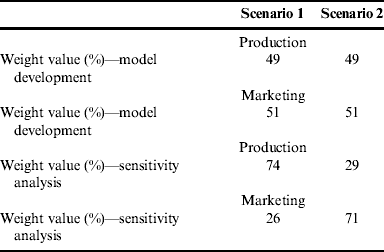
A sensitivity test is used to establish the responsiveness, efficiency and applicability of the developed model. The test, based on a simulation of scenarios with changing weight values, is reported in Table 4. Some authorsReference Butler, Jia and Dyer 35 suggest a simulation approach for a high-dimensional-sensitivity analysis of the weights of multi-criteria decision models. In the first scenario (simulation), the weight values were higher for ‘Production’ and lower for ‘Marketing’ (74%:26%). In the second scenario (simulation), the weight values for production were 29% for ‘Production’ and 71% for ‘Marketing’.
Definition of weight values in the first and second scenarios.

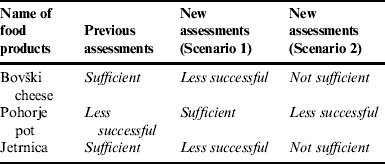
With the changing weight values of production and/or marketing in Scenarios 1 and 2, we attempted to examine how this could influence the final assessment of LFP. The results of the test show that the final assessments were changed by one degree downwards or upwards for three LFP (Table 5). For the first scenario, the assessment of Bovški cheese changed from sufficient to less successful, that of Pohorje pot changed from less successful to sufficient and that of Jetrnica changed from sufficient to less successful. The similar changes could be recognized for the second scenario. For all other food products, the final assessment did not change.
Final results of the DEX evaluation of the first and second scenarios.

The various outputs of Scenarios 1 and 2 for Bovški cheese, Pohorje pot and Jetrnica depend on the different input data, as well as on the weight values. For example, in the cases of Bovški cheese and Jetrnica, the final results of Scenario 2 show a deficiency in the marketing system as compared to Pohorje pot. The opposite results could suggest a deficiency of the production system for Pohorje pot. The results obtained in this sub-section give a clear insight into what main attribute must be changed/improved or further developed to facilitate the successful promotion of local food products.
The results of the sensitivity test show that DEX methodology is suitable for the assessment of the production and marketing systems for local mountain food. With relatively simple usage and good model transparency (hierarchical approach), the DEX method could be recognized as a user-friendly tool. The value of the model also lies in the possibility of upgrading the model with specific attributes for improving the various segments of food systems.
Conclusions
A study of local food from the Slovenian mountains was performed in order to discover precisely where in the production and marketing system the main bottlenecks, which inhibit the development of the local food concept, exist and whether the DEX method is appropriate for the assessment of the production and marketing of local mountain food. The method was applied to ten selected local mountain food products. The multi-criteria DEX model allows for: (i) the critical assessment of the production and marketing of local mountain food products and (ii) acquiring feedback from food chain actors in order to improve certain phases of production and/or marketing. The model expresses a wide range of practical applicability, but to achieve the final success of LFP and a positive impact on rural development (social, economic and environmental) issues, other factors must be taken into consideration (e.g., the creation of a public–private partnership, horizontal and vertical networking between food chain actors and the willingness and enthusiasm of local individuals)Reference Murdoch, Marsden and Banks 36 .
With the exact definition of bottlenecks (attributes), we can also demonstrate how a change in a given attribute (an increase or decrease of attribute values) will affect the final assessment of local food products. This allows us to advise actors along the food chain about how to react and which phase should receive the most attention. Because of its relatively simple usage, the model is suitable for a wide range of users along the food chain, but in particular, it could be applied to local policy decision-makers and extension services. The determination of bottlenecks in the production and marketing processes of all the examined local mountain food products was quite surprising because they arise mostly from historical, political, social and environmental issues. To consider the situation from a different perspective, all stated bottlenecks could also be discussed as opportunities because there still is a great deal of room in the market for quality mountain products, especially in the tourism branch and more extended markets, e.g., regional or national ones. The bottlenecks can also be partially overcome by more-organized production, networking in the food chain, public–private partnerships and more-professional work.