Introduction
Single-sided deafness is a profound sensorineural hearing loss in one ear with normal hearing in the contralateral ear.Reference van Wieringen, Boudewyns, Sangen, Wouters and Desloovere1 The aetiology of single-sided deafness includes acquired factors (e.g. sudden hearing loss) and congenital factors (e.g. cochlear nerve deficiency, congenital cytomegalovirus, inner ear malformation, bacterial and viral meningitis, and other unknown factors).Reference van Wieringen, Boudewyns, Sangen, Wouters and Desloovere1,Reference Rohlfs, Friedhoff, Bohnert, Breitfuss, Hess and Müller2
One survey showed that compared with results from 1988–1994, the prevalence of unilateral hearing loss among US adolescents aged 12–19 years increased by 2.9 per cent in 2005–2006 (from 11.1 to 14.0 per cent).Reference Shargorodsky, Curhan, Curhan and Eavey3 In the past, it was thought that children with single-sided deafness could acquire normal verbal communication because they have one normal-hearing ear. Accordingly, at-risk children were not identified in time. It is now recognised that unilateral deafness not only impacts the auditory and linguistic development of children, but also their cognitive functioning,Reference van Wieringen, Boudewyns, Sangen, Wouters and Desloovere1 academic performance, communication and quality of life (QoL).Reference Rohlfs, Friedhoff, Bohnert, Breitfuss, Hess and Müller2 Most studies have found that patients with single-sided deafness have poor sound localisation abilities and reduced speech perception abilities in noisy environments due to only receiving unilateral input.Reference van Wieringen, Boudewyns, Sangen, Wouters and Desloovere1,Reference Galvin, Fu, Wilkinson, Mills, Hagan and Lupo4–Reference Anne, Lieu and Cohen6
Traditionally, the contralateral routing of signal (‘CROS’) hearing aid, which was first introduced by Harford and Barry in 1965, was used to improve hearing in patients with single-sided deafness.Reference Harford and Barry7 Many patients complain that the contralateral routing of signal device causes poor sound quality, discomfort and occlusion in the normal ear.Reference Williams, McArdle and Chisolm8,Reference Ericson, Svärd, Högset, Devert and Ekström9 And the contralateral routing of signal device could improve speech recognition ability for patients with single-sided deafness in noisy environments.Reference Kitterick, Smith and Lucas10 However, the sound localisation performance of patients with the contralateral routing of signal system has not been enhanced.Reference Snapp, Holt, Liu and Rajguru11
Another method used to improve hearing for patients with single-sided deafness is the bone-conduction hearing aid devices, which include bone-anchored hearing aids (BAHA; Cochlear®), the Baha® Attract system (Cochlear®) and the Sophono®, which make the amplified sound stimulate the contralateral normal-hearing cochlea via transcranial direct bone-conduction.Reference Kim, Ju, Lee, Kim, Kwon and Seo12–Reference Kiringoda and Lustig16 Data have shown that bone-conduction hearing aid devices can provide important amplification in hearing performance for single-sided deafness, improve patients’ speech discrimination abilities in noisy environments and improve their QoL. While the bone-conduction hearing aid has led to certain benefits in hearing gain and patient satisfaction, it also results in some complications because of the percutaneous coupling that is required for fitting, including skin infection, soft tissue overgrowth of the abutment, failure to osseointegrate and loss of the titanium implant.Reference Kiringoda and Lustig16
Moreover, the sound localisation performance of bone-conduction hearing aid devices remains controversial. Agterberg et al. investigated the localisation abilities of bone-conduction hearing aid devices for broadband, low-pass and high-pass filtered noises of varying intensities among patients with single-sided deafness. It has been reported that bone-conduction hearing aid devices neither improve nor deteriorate the localisation abilities of patients with single-sided deafness;Reference Agterberg, Snik, Van de Goor, Hol and Van Opstal15 however, Grantham et al. report that localisation abilities do deteriorate in adults with single-sided deafness. They suggest that worse performance could be related to the degradation of monaural spectral cues, which is caused by the coaction of air-conducted and bone-conducted signals on the side of the normal-hearing ear.Reference Grantham, Ashmead, Haynes, Hornsby, Labadie and Ricketts17 Conversely, another report states that localisation abilities can be improved and may be related to a change in monaural spectral cues processing.Reference Bonne, Hanson, Gauvrit, Risoud and Vincent14
Cochlear implantation is another option for patients with single-sided deafness. Studies have shown that cochlear implantation devices used in adults with single-sided deafness significantly decrease tinnitus and improve localisation, speech perception in noise and QoL.Reference van Wieringen, Boudewyns, Sangen, Wouters and Desloovere1,Reference Galvin, Fu, Wilkinson, Mills, Hagan and Lupo4,Reference Anne, Lieu and Cohen6,Reference Seebacher, Franke-Trieger, Weichbold, Zorowka and Stephan18 Similarly, some children with single-sided deafness have obtained significant audiological and subjective benefits from cochlear implantation.Reference Galvin, Fu, Wilkinson, Mills, Hagan and Lupo4,Reference Ramos Macias, Borkoski-Barreiro, Falcón González, de Miguel Martínez and Ramos de Miguel5,Reference Choi, Moon, Kim, Park, Kim and Chung19 Unlike the contralateral routing of signal and BAHA devices, cochlear implantation helps patients with single-sided deafness obtain bilateral input and restores bilateral hearing, rather than simply transmitting sound signals to the normal ear.Reference van Wieringen, Boudewyns, Sangen, Wouters and Desloovere1,Reference Galvin, Fu, Wilkinson, Mills, Hagan and Lupo4 However, patients with single-sided deafness who received cochlear implantation experienced different stimulation of their ears when electrical and acoustic stimulations arose from their impaired ear and normal-hearing ear separately. The two different stimulations were not synchronised and, though possible, it took patients more time to adapt to the device. Additionally, the cost of cochlear implantation is higher.
In recent years, the Bonebridge® semi-implantable transcutaneous device, another bone-conduction hearing aid for patients with single-sided deafness, has emerged. It was introduced in China in 2016 and consisted of an audio processor (Amadé Bonebridge) and an implanted part, including an active bone-conduction-floating mass transducer, a receiver coil and an electrical demodulator section. The sound signals are collected by the microphone and converted into electrical signals in the audio processor, then transmitted to the cochlea through the vibration of the bone conduction floating mass transducer.Reference Huber, Sim, Xie, Chatzimichalis, Ullrich and Roosli20 A pre-operative temporal bone computed tomography (CT) scan using three-dimensional software is used to accurately assess the most suitable position for the bone conduction floating mass transducer, which is localised to two positions: the retrosigmoid region or the sinodural angle (presigmoid region) according to different factors such as mastoid hypoplasia, previous mastoid surgery and sigmoid sinus exposure.Reference Law, Bhatia, Tsang, Tong and Shi21 Many studies have reported positively on the efficacy, safety and acoustic benefit of the device in conductive hearing loss, mixed hearing loss and single-sided deafness.Reference Vogt, Frenzel, Ausili, Hollfelder, Wollenberg and Snik22,Reference Schmerber, Deguine, Marx, Van de Heyning, Sterkers and Mosnier23 Vogt et al. suggested that the sound localisation abilities of children with congenital unilateral conductive hearing loss improved when acoustic stimuli were presented to the impaired (Bonebridge implanted) side.Reference Vogt, Frenzel, Ausili, Hollfelder, Wollenberg and Snik22
Some studies have evaluated speech perception abilities of patients with single-sided deafness using a Bonebridge implant in different types of noise environments.Reference Schmerber, Deguine, Marx, Van de Heyning, Sterkers and Mosnier23 The results showed that the speech recognition thresholds in 5 of 7 patients with single-sided deafness in a noisy environment is lower when speech comes from the front and Bonebridge side separately, which is in contrast to the outcomes in one patient in these two conditions. Another study demonstrated that a Bonebridge implant can greatly benefit patients’ speech recognition thresholds in quiet and noise in three different listening environments when a Bonebridge floating mass transducer is located in the retrosigmoid region.Reference Salcher, Zimmermann, Giere, Lenarz and Maier24 However, the level of sound localisation is not evaluated in these articles.
Therefore, the purpose of this study was to assess the benefit of Bonebridge devices used in patients with single-sided deafness. Sound localisation in the horizontal plane was measured in different signal levels with Bonebridge on or off states. Speech perception assessment was performed in various conditions whereby noise and speech were presented from different directions, including noise and speech from the front only, speech from the front but noise from the normal-hearing side, and speech and noise from both sides separately.
Materials and methods
Participants
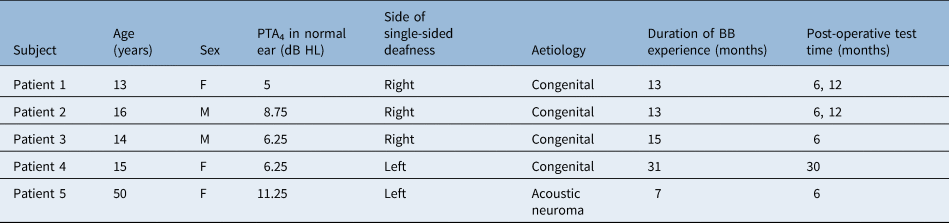
Our study reviewed 5 deafened participants (mean age: 22 years; range: 13–50 years) who were implanted with a Bonebridge device (MED-EL, Innsbruck, Austria) after receiving a single-sided deafness diagnosis of differing aetiologies. The participants included two males and three females who had been implanted with Bonebridge devices for diverse durations (range: 7–31 months) in our institute between 2017 and 2019. Clinically, the criterion for Bonebridge implantation was single-sided deafness, and the demographic data of the participants are shown in Table 1. All participants were recipients of the Amadé Bonebridge audio processor, and their performance was evaluated pre- and post-operatively. Data were split into two groups according to the test time: 6 months (n = 4) and more than 12 months (n = 3) post-implantation.
Subject demographics

PTA = pure tone audiometry; BB = Bonebridge; F = female; M = male
This study was approved by the medical ethics committee (permit number: TRECKY2018-067). All patients gave written informed consent before participating in this study.
Speech perception
Speech perception using Mandarin speech test materials was assessed in a double-walled and sound-isolated room. All loudspeakers were approximately one metre away from the participants at head level. Monosyllabic speech intelligibility in a quiet environment was analysed at 65 dB SPL to determine the word recognition score (percentage). The speech loudspeaker was located in front of the subject (at 0° azimuth), and the normal hearing ear was plugged and muffled during this testing.Reference Salcher, Zimmermann, Giere, Lenarz and Maier24,Reference Van de Heyning, Távora-Vieira, Mertens, Van Rompaey, Rajan and Müller25
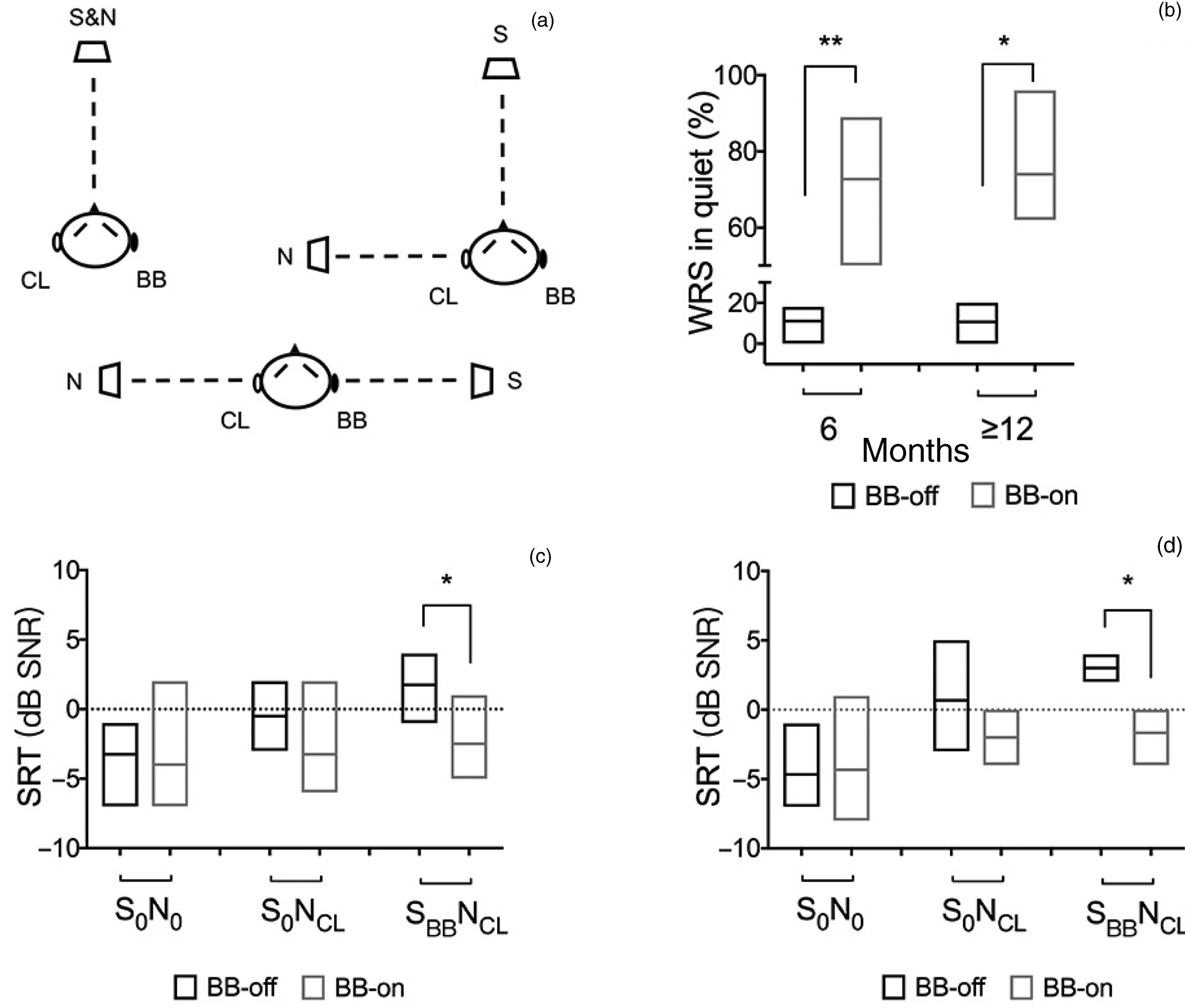
Additionally, the speech recognition threshold of disyllabic words was examined in noise using the Mandarin speech test materials in three different conditions: (1) speech and noise presented from the front (0°); (2) speech and noise presented from the front and contralateral (normal ear) side separately; and (3) speech presented from the ipsilateral (implanted Bonebridge) side and noise from the contralateral side (see Figure 1a). During speech recognition threshold tests, the head should not move and needs to face the loudspeaker in the middle (0° azimuth), and the normal ear (contralateral ear) should be kept open. Noise presentation was at a fixed level of 65 dB SPL, and the level of speech was adjusted in 2 dB steps according to the rate of correct words. The speech recognition threshold was defined as the participant giving 50 per cent correct word responses. The speech-to-noise ratio was calculated as the difference between the speech and noise levels. Speech perception in quiet and noise was evaluated in both states: on (Bonebridge-aided) and off (Bonebridge-unaided).
Graphs showing word recognition score in quiet environments and speech recognition thresholds in noisy environments. (a) Description of three listening modalities in noise: (top left) speech and noise presented from the front; (top right) speech and noise presented from the front and contralateral side, respectively; and (bottom) speech presented from the Bonebridge-implanted side and noise from the contralateral side. (b) Aided and unaided word recognition score in Bonebridge users in a quiet environment. The normal hearing ear was plugged and muffled. Mean performance in terms of speech recognition thresholds among participants with single-sided deafness assessed at (c) 6-month follow up and (d) 12-month follow up after surgery. The dashed line shows the level of speech being equal to the level of noise. The contralateral ear was kept open during speech recognition threshold tests. S = speech; N = noise; CL = contralateral ear; BB = Bonebridge-implanted ear; WRS = word recognition scores; SRT = speech recognition threshold; SNR = speech-to-noise ratio. *p < 0.05; **p < 0.01

Sound localisation
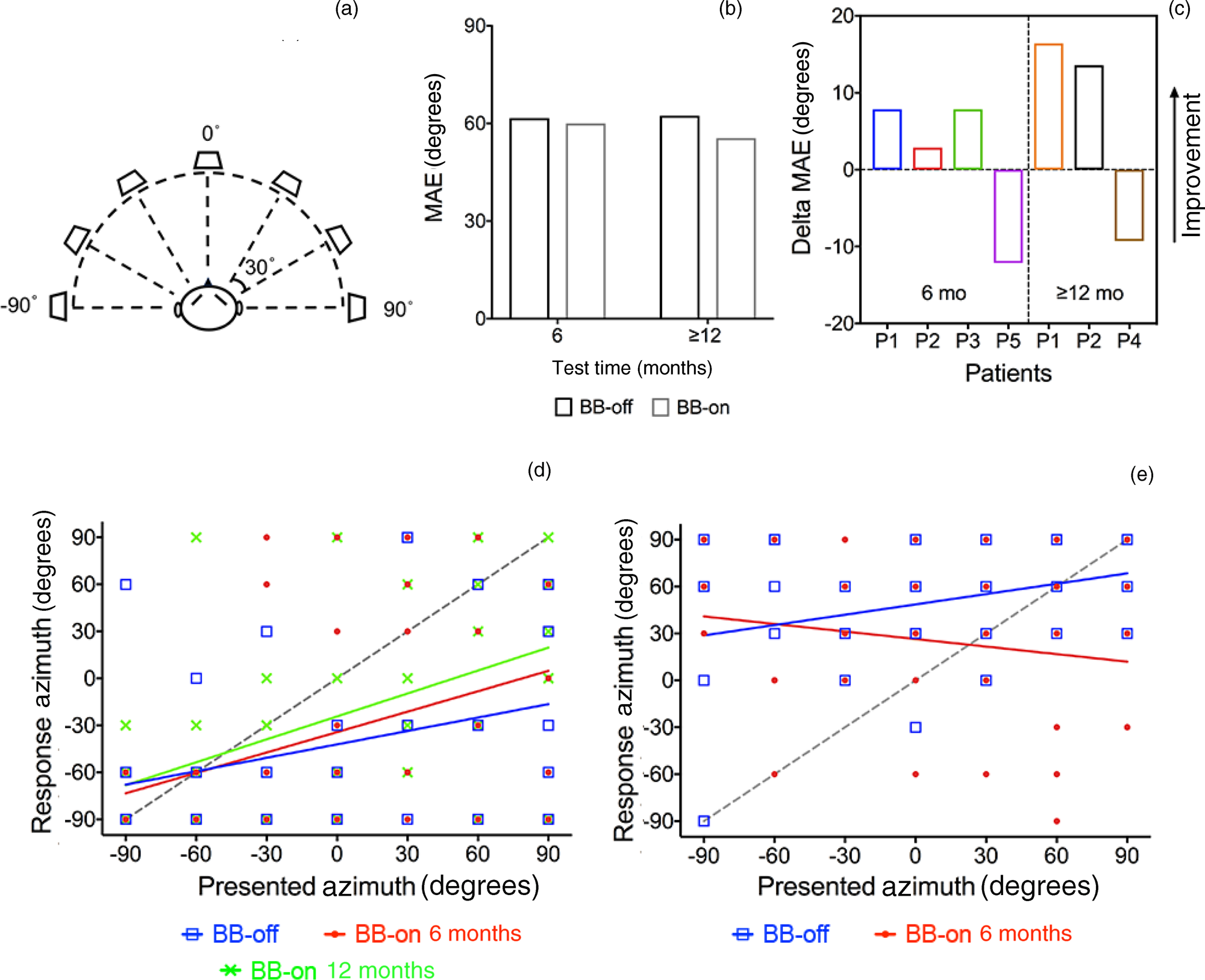
Measurements were performed in a sound-proof room. Seven loudspeakers were located in a horizontal plane in front of the patient's ears and ranging between −90° and +90°. The average interval of all loudspeakers in a frontal semicircle was 30°. Participants were seated and asked to face the middle loudspeaker (at 0° azimuth) (Figure 2a). The method applied in the current study followed the description in a recent consensus paper.Reference Van de Heyning, Távora-Vieira, Mertens, Van Rompaey, Rajan and Müller25 The sound was presented at three different sound levels (65, 70 and 75 dB SPL). At every stimuli level, seven loudspeakers presented the stimuli twice in random sequence. Therefore, a total of 42 presentations were performed for each condition. The test was performed in two different conditions (Bonebridge-unaided and Bonebridge-aided).
The accuracy of sound localisation in the horizontal plane. (a) Schematic diagram of the setup for testing sound localisation. Seven loudspeakers were positioned at 30° intervals in a semicircle. (b) Mean absolute error in Bonebridge-aided and unaided conditions at two testing times (6 months and 12 months after surgery). (c) Improvement in mean absolute error, which is calculated as the difference between the Bonebridge-unaided and Bonebridge-aided conditions. Different colours represent different patients at different times after surgery. Response plots of (d) patient 1 and (e) patient 5 are shown. Linear regression is represented by solid lines of different colours at different testing times. MAE = mean absolute error; BB = Bonebridge-implanted ear; P = patient

After the sound was played, all participants were asked to indicate the number of loudspeakers that were presenting the stimuli. Additionally, the participants were required to wear an eye mask and not move their heads during testing. The mean absolute error (Equation 1) was used to evaluate the accuracy of the sound source localisation. The result of the stimulus-response relationship was quantified by the line of best fit (Equation 2), where αRESP is the response azimuth (in degrees), αSTIM is the stimulus azimuth (in degrees), b is the response bias (in degrees) and g is the response gain (dimensionless).
 $${\rm Mean}\,{\rm absolute\ error} = \displaystyle{{\sum\nolimits_{i = 1}^n {} \vert \alpha _{RESP}^i -\alpha _{STIM}^i \vert } \over n}$$
 $$\alpha _{RESP} = g \times \alpha _{STIM} + b$$
Statistical analysis
The paired-sample t-test was used to identify statistical differences using GraphPad Prism 7.0 statistical software. The results are presented as means in the present study. A p-value less than 0.05 was considered to be statistically significant.
Results
Speech perception in quiet and noise
Speech intelligibility was evaluated in two conditions: in quiet and in noise. Participants showed significant amelioration of word recognition in the Bonebridge-aided condition, with a monosyllabic word recognition score level of 72.75 per cent in quiet conditions at 6-months post-operatively. Even the enhanced level was improved from pre-operative levels (mean 11.00 per cent; p < 0.01). Compared with the Bonebridge-unaided condition, speech perception in the Bonebridge-aided condition improved over the 12 months after surgery (mean 10.67 per cent vs 74.00 per cent; p < 0.05). There was no significant difference between short- and long-term follow-up assessments (p > 0.05; Figure 1b).
Additionally, we assessed the performance of participants in terms of disyllabic speech recognition thresholds in three conditions (speech and noise presented from the front, speech and noise presented from the front and contralateral (normal ear) side separately, and speech presented from the ipsilateral (implanted Bonebridge) side and noise from the contralateral side) in noise after Bonebridge implantation. At 6-months post-operatively, the mean speech recognition thresholds in the Bonebridge-unaided and aided conditions was a −3.25 dB speech-to-noise ratio and a −4.00 dB speech-to-noise ratio, respectively, and showed a −0.75 dB improvement in the speech and noise presented from the front condition. For the speech and noise presented from the front and contralateral (normal ear) side separately status, the average speech recognition threshold decreased from a −0.50 dB speech-to-noise ratio to a −3.25 dB speech-to-noise ratio, showing an improvement of −2.75 dB in the Bonebridge-aided condition.
Although the aided-speech recognition thresholds seemed to be better than unaided-speech recognition thresholds at six months after surgery, there was no statistical difference in any conditions for speech and noise presented from the front, or speech and noise presented from the front and contralateral (normal ear) side separately. Interestingly, the mean disyllabic speech recognition thresholds in the speech presented from the ipsilateral (implanted Bonebridge) side and noise from the contralateral side condition was diminished from a 1.75 dB speech-to-noise ratio without the Bonebridge to a −2.50 dB speech-to-noise ratio with the Bonebridge.
The speech recognition threshold was different only in the speech presented from the ipsilateral (implanted Bonebridge) side and noise from the contralateral side condition at the six month follow up (Figure 1c). Compared to that in the Bonebridge-unaided condition, the speech recognition thresholds at the 12-month follow up were not significantly different in the aided condition in any state for speech and noise presented from the front, or speech and noise presented from the front and contralateral (normal ear) side separately (p > 0.05 for both states; Figure 1d). Furthermore, the speech recognition thresholds in the Bonebridge-aided condition were noticeably better than that in the Bonebridge-unaided condition for speech presented from the ipsilateral (implanted Bonebridge) side and noise from the contralateral side (p < 0.05) (Figure 1c and d). An improvement of a −4.67 dB speech-to-noise ratio in Bonebridge users tested after more than 12 months after surgery was observed in the speech presented from the ipsilateral (implanted Bonebridge) side and noise from the contralateral side condition.
Sound localisation
The localisation results in patients with single-sided deafness under aided and unaided conditions are displayed in Figure 2 and Figure 3. The performance of participants with and without Bonebridge devices is shown by stimulus-response plots (patient 1 and patient 5; Figure 2d and e). Sound localisation ability in Bonebridge users was increased at 6 months after surgery (patient 1: Δmean absolute error = 7.86°, Δgain = 0.15; patient 2: Δmean absolute error = 2.86°, Δgain = 0.04), and the ability was enhanced at the 12-month follow up in contrast to that in the pre-operative test (patient 1: Δmean absolute error = 16.43°, Δgain = 0.20; patient 2: Δmean absolute error = 13.57°, Δgain = 0.24) (Figure 2c). A similar result was observed in patient 3; however, compared with pre-operative measurements, the performance of localisation in patient 4 was poorer after implantation (Δmean absolute error = −9.29°, Δgain = -0.03). Similarly, in another participant (patient 5, Figure 2c and e) who had acoustic neuroma and received an implanted Bonebridge device six months later, the level of localisation performance (mean absolute error = 72.14°) deteriorated compared with the pre-operative results (mean absolute error = 60.00°). To reinforce this observation, we statistically analysed all the data obtained in the Bonebridge-aided condition and those in the Bonebridge-unaided condition. No significant difference in mean absolute error in the unaided condition was observed compared with that at six months after surgery (p > 0.05). When the mean absolute error was evaluated at the 12-month follow-up, participants in the Bonebridge-aided condition showed lower values of the mean absolute error in contrast to that in the Bonebridge-unaided condition; however, this difference was not statistically significant (Δmean absolute error = 6.90°; p > 0.05) (Figure 2b).
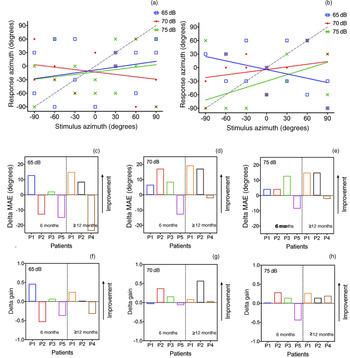
Sound localisation performance in three different stimulus conditions. Localisation results of patient 2 at the sound levels 65 dB SPL, 70 dB SPL and 75 dB SPL in (a) Bonebridge-unaided and (b) Bonebridge-aided conditions. Improvement in mean absolute error obtained at (c) 65 dB SPL, (d) 70 dB SPL and (e) 75 dB SPL. Change in gain assessed at (f) 65 dB SPL, (g) 70 dB SPL and (h) 75 dB SPL. BB = Bonebridge; MAE = mean absolute error; P = patient

In addition to the mean absolute error assessment in the Bonebridge-unaided and Bonebridge-aided conditions, we also analysed the localisation ability when exposed to three different sound intensity stimuli (65, 70, and 75 dB SPL; Figure 3). Although stimulation with various sound intensities did not induce a statistically significant improvement in mean absolute error, we found that the level of mean absolute error in the unaided condition was much higher than that obtained using the Bonebridge at 70 dB SPL and 75 dB SPL (Figure 3c, d and e). The gain improvement in patient 2 at 6 months after implantation was −0.54, 0.38 and 0.29 for each sound level, respectively. Although the individual gain was high at higher sound levels, there were no dramatic changes at six-month follow up according to various sound intensities (p > 0.05). In order to compare the change in gain over the long-term, these tests were performed at 12 months after Bonebridge implantation. The gain increased in patient 1 with the three different sound intensities (0.25, 0.09 and 0.27, respectively). Compared with the unaided-gain, the aided gain was increased at 12 months after surgery at any level for 70 dB SPL and 75 dB SPL (Δgain = 0.23 and 0.20, respectively Figure 3f, g and h); however, there was no significant statistical difference.
Discussion
This study aimed to evaluate the benefit of Bonebridge implants in patients with single-sided deafness. It should be noted that our outcomes were based on data obtained from a small sample of patients with single-sided deafness. Unsurprisingly, the results demonstrated that the benefit of word recognition score in quiet environments was significantly improved in the Bonebridge-aided condition. The average monosyllabic word recognition score in quiet environments was greatly increased at 65 dB SPL, which is consistent with a previous study on patients with single-sided deafness using Bonebridge devices reported by Salcher et al.Reference Salcher, Zimmermann, Giere, Lenarz and Maier24 Their results showed that the median word recognition score improved significantly in the Bonebridge-aided condition (80 per cent) as opposed to that in the Bonebridge-unaided condition (0 per cent), and no complications occurred in the present study. A multicenter retrospective study by Schmerber et al. also evaluated the safety of the Bonebridge device at one-year follow up and concluded that it was an effective and safe transcutaneous device.Reference Schmerber, Deguine, Marx, Van de Heyning, Sterkers and Mosnier23
In this study, we assessed speech perception when speech and noise were presented from different directions. In general, speech perception of binaural effects in predominantly noisy environments is improved for three reasons: (1) the head-shadow effect, (2) binaural squelch and (3) binaural summation.
The head-shadow effect occurs when the sound source is located on one side, and the intensity of sound in the contralateral ear is reduced due to the blockage of the head, especially at high frequencies.Reference Galvin, Fu, Wilkinson, Mills, Hagan and Lupo4,Reference Schafer, Amlani, Paiva, Nozari and Verret26 The central auditory system can selectively suppress the impact of noise and improve speech perception when there is binaural hearing input from different directions. This phenomenon is called the binaural squelch effect,Reference Choi, Moon, Kim, Park, Kim and Chung19 whereas binaural summation is the integration of the acoustic signal by the central auditory system, improving the perceptual loudness of the acoustic signal when hearing binaurally.
The present study showed that the improvement with Bonebridge implantation, with respect to the perception of speech in noisy environments, can be affected by the fact that patients with single-sided deafness show low-performance thresholds for speech recognition after surgery. A significant difference in speech perception was noted in the speech presented from the ipsilateral (implanted Bonebridge) side and noise from the contralateral side condition, and this result was consistent with that in previous studies. Salcher et al. showed a significant improvement of a −2.5 dB speech-to-noise ratio in the head-shadow condition where speech was presented from the impaired side and noise from the contralateral side.Reference Salcher, Zimmermann, Giere, Lenarz and Maier24 Speech recognition in Bonebridge-aided patients with single-sided deafness in various noise conditions was also evaluated previously by Laske et al., who demonstrated that the mean speech-to-noise ratio in the aided condition was improved by −1.65 dB when speech and noise came from the Bonebridge-aided side and the front, respectively.Reference Laske, Röösli, Pfiffner, Veraguth and Huber27 These results suggested that the head-shadow effect helped improve speech perception in noisy environments under the Bonebridge-aided condition. Moreover, when speech was presented from the front and noise was presented at 65 dB SPL to the contralateral side (speech and noise presented from the front and contralateral (normal ear) side separately), the speech-to-noise ratio was −1.77 dB and −3.08 dB in the Bonebridge-aided and Bonebridge-unaided conditions, respectively.Reference Salcher, Zimmermann, Giere, Lenarz and Maier24 Furthermore, the mean speech recognition thresholds were reduced after implantation when both speech and noise were presented from the front.Reference Hassepass, Bulla, Aschendorff, Maier, Traser and Steinmetz28 However, Laske et al. state that speech perception was not improved in patients with single-sided deafness in the speech and noise presented from the front condition irrespective of the use of a Bonebridge device.Reference Laske, Röösli, Pfiffner, Veraguth and Huber27 The improvement of speech-to-noise ratio was not statistically significant in the speech and noise presented from the front, and speech and noise presented from the front and contralateral (normal ear) side separately conditions in this study, which is in contrast to that shown in previous studies. Moreover, the speech recognition thresholds did not attain the same level of improvement in Bonebridge-aided participants. These differences may be attributable to differences in experimental setups (e.g. speech test materials) and study populations (e.g. the position of Bonebridge floating mass transducer, time after implantation and number of patients).
We also analysed the auditory localisation accuracy in free-field audiometry among patients with single-sided deafness. The purpose was to decrease the head-shadow effect when sounds were presented from the Bonebridge side by stimulating the contralateral healthy cochlea via bone-conduction. The findings showed that the Bonebridge device neither improved nor deteriorated the sound localisation abilities of these patients. In normal-hearing, binaural cues to sound localisation in the horizontal plane depend on the interaural level differences (representing high frequencies, ranging from 0 to 30 dB) and interaural time differences (representing low frequencies, ranging from 0 to 700 μs).Reference Hassepass, Bulla, Aschendorff, Maier, Traser and Steinmetz28 These cues are presented binaurally from the periphery through complex processing and subsequent coding by neurons between the brain stem and the cerebral cortex.Reference Grothe, Pecka and McAlpine29 Because binaural hearing is not restored in patients with single-sided deafness using the Bonebridge, only having one functioning cochlea may be the reason that their sound source localisation abilities could not be improved. This result was comparable with those of previous studies on bone-conduction hearing aids in patients with single-sided deafness. A systematic review concluded that sound localisation abilities were not sufficiently enhanced by the contralateral routing of signal and BAHA systems because the sound was transmitted via these devices from the impaired side to the normal-hearing side without the head-shadow effect.Reference Kim, Ju, Lee, Kim, Kwon and Seo12 Similarly, Agterberg et al. indicated no improvement in the sound localisation performance in patients with single-sided deafness with bone conduction devices.Reference Agterberg, Snik, Van de Goor, Hol and Van Opstal15 In their experiments, sound localisation abilities were evaluated using broadband, low-pass, and high-pass filtered noises of diverse intensities. They also observed that 5 of 19 patients with single-sided deafness could localise broadband and high-pass filtered noises in the unaided condition, and their localisation abilities were not deteriorated in the aided condition. One possible explanation was that the provision of high-frequency sounds by bone-conduction devices was not adequate, and therefore the spectral signals from the normal-hearing side were not disturbed. Another explanation could be that although the spectral signal was affected by the bone conduction device, the ‘good localisers’ have learned to localise the changed spectral input.
• Bonebridge bone conduction implants provide crucial audiological benefits for patients with single-sided deafness
• The performance of sound source localisation was neither improved nor worsened in patients with single-sided deafness who were implanted with the Bonebridge device
• The Bonebridge device is still a promising option for patients with single-sided deafness
However, Bonne et al. have demonstrated that localisation abilities in the horizontal planes are effectively enhanced in patients with single-sided deafness using BAHA devices during an average follow up of eight years.Reference Bonne, Hanson, Gauvrit, Risoud and Vincent14 Further, Bonne et al. suggested that the improvement may be related to the influence of device training and learning, the design of testing, the employment of distorted temporal cues and the reconstruction of the body map. Additionally, binaural benefits could be related to the duration of auditory deprivation, asymmetrical degeneration in binaural neural pathways and maturation of binaural temporal processing in the auditory cortex.Reference Choi, Moon, Kim, Park, Kim and Chung19 Wieringen et al. discussed the neural processing of adults and children and highlighted that children's brains were highly sensitive to the loss of auditory input and that the growth and development of the cerebral cortex among these patients are diverse according to the varying degrees of congenital and acquired unilateral deafness as a result of imbalanced auditory input.Reference Rohlfs, Friedhoff, Bohnert, Breitfuss, Hess and Müller2
The results of the present study further demonstrated the short- and long-term performance of Bonebridge implantation in patients with single-sided deafness. We compared the effectiveness of the Bonebridge on the hearing and speech performance to the unaided condition as well as the sound localisation ability. However, there were several limitations in the present study. There was a difference in sound localisation performance between patients with congenital and acquired single-sided deafness. However, only five patients were included in this study: four with congenital single-sided deafness and only one with acquired single-sided deafness. Future research should investigate whether there is a significant difference in the sound-source localisation ability between congenital single-sided deafness and acquired single-sided deafness after Bonebridge implantation. There was also some variability in the testing point between the subjects with only two of them having a 6- and 12-month test. Further study is needed to compare the speech and sound localisation abilities of the same patient between short- and long-term follow up. In order to effectively evaluate the benefit of Bonebridge devices among patients with single-sided deafness, the sample size should be enlarged in future studies.
Conclusion
Altogether, the results from this study emphasise the role of Bonebridge devices for patients with single-sided deafness because it improves their ability to recognise speech, leading to higher monosyllabic word recognition scores in quiet environments and decreased speech recognition thresholds in noisy environments (speech presented from the ipsilateral (implanted Bonebridge) side and noise from the contralateral side). Although the localisation abilities of patients with single-sided deafness were not improved, it also did not deteriorate with Bonebridge implantation. From a clinical viewpoint, the Bonebridge device can provide crucial audiological benefits for patients with single-sided deafness and other users. Therefore, we believe that the Bonebridge device is still a promising choice for patients with single-sided deafness.
Acknowledgements
This work was supported by grants from Project of Capital Clinical Characteristic Application Research of Beijing Municipal Science and Technology Commission (Z171100001017079) and National Natural Science Foundation of China (81770989).
Competing interests
None declared