African Historians and Archives
I want to bracket this essay noting about how smug African historians have been in their use of archives. For at least twenty-five years those of us who studied African social history and sought to rescue ordinary Africans from the condescension of the present (and even better, the condescension of our stodgy senior colleagues) boasted that we did not need the linguistic turn to interrogate archives: we’d been reading against the grain for years. Ever since the history of colonial Africa separated itself from imperial histories, we have tasked ourselves with the most critical of readings, with refracting what we read, with going against the grain or reading with the grain but always at odds with the master narratives with which documents were conceived and written. And because of our judicious reading, we prided ourselves on using the writings of the people who got it wrong to get it right. Indeed, African colonial history is often a history of identifying errors and misunderstandings: our own work has often been filled with “aha!” moments: it was our understanding of African societies and histories allowed us to see what district officers missed.Footnote 1
But for those of us who are now concerned with researching the history of Africa after colonial rule, and who found ourselves looking at questions of states and governments and who could participate in both those entities, the question shifted from being about how to read inaccurate or inconsistent archives, but how to find any archive at all. What do we do when archives aren’t there? What do we do when material was never accessioned, or was lost, or when it was mutilated or destroyed or filed under the wrong ministry or the wrong year or decade? How do we write the history of events that were never written down? What do we do when there’s no archive?
Where There Is No Archive
I’ve been working in Zimbabwe for quite some time, mainly interested in the 1960s and 1970s, the era of Rhodesia’s renegade independence. Zimbabwe has a thirty-five ban on accessioning documents, but, for reasons not unique to that country, nothing has been accessioned since 1984, and while a few documents from the early 1960s are available – nobody seems to know why – the archive stops in the late 1950s.Footnote 2 Or does it? If the archive of Rhodesia’s apostate governance isn’t in Zimbabwe, does it mean it doesn’t exist?
How absent are the documents in the absent archive? And what does this do to our definition of archive? Do we mean a national collection, a local collection, a private collection, or a library that has materials because someone gave them to them? Does an archive require an archivist or someone to see the relationship between the documents therein, or can it contain whatever someone handed over as they were leaving a country in great haste? Is archive simply the shorthand we use for any and all sites in which there are documents that we need? And if we obsess over the archive does that mean we are less concerned with the documents found or not found therein? To be fair, historians love to find documents, and the pride and excitement we feel when we imagine we have discovered the sole copy of a document everyone thought was lost is undeniable. But what kind of discoveries are these? Surely there are almost no twentieth century documents of which there was only one copy. Something that may or may not be accessioned in Harare is in Lusaka, or perhaps was buried by the foreign office in London, but it might be sitting in the otherwise nondescript papers of a former CIA agent deposited in the Hoover institution at Stanford. For example, in March 1979, Rhodesia made concrete its nutty internal settlement with its hyphenated name, with a new constitution, an election, and observers to sanitize it. Before the year was out, this had been made even more ridiculous when it was undone by the Lancaster House agreement in December. In April 1979, however, four different groups observed the election. The reports that were critical of the electoral process were mimeographed and sold (I have no idea what the right word is here, but I list these as publications in my bibliography) right away, by the Minority Rights Group and the Catholic Institute of International Relations, both in London. None of the observers – or the organizations that funded them – who declared it free and fair seem to have been eager to see their reports made public, however. The British report – by Alan Lennox-Boyd, by then a Viscount – was finally thrown into the back of a foreign office file on the 1979 election, and the glowing report of the American-African Institute, whose observers included Max Yergin and Bayard Rustin, can only be found in the papers of George Loft, who represented the American Friends Service in Salisbury and Lusaka in the 1960s. Loft’s papers are in the Hoover Institution at Stanford as is one of the two copies I’ve found of the 1979 constitution: they are in fact the only thing in the papers of one Kent B. Crane. How they got to Stanford is a bit of a mystery to me: Crane had been retired for several years in 1979, but before that he was a CIA agent with considerable experience in Southeast Asia who served as the foreign policy advisor to Vice President Spiro Agnew. Was he in Rhodesia during the constitutional negotiations? Did someone give him a copy of the constitution and he always wondered what to do with it before he gave it to Stanford?
I could go on and on about documents in unexpected places. What made me decide to write about the assassination of Herbert Chitepo, head the external mission of the Zimbabwe African National Union (ZANU) in Lusaka in 1975,Footnote 3 were a bunch of pamphlets I found in the Borthwick Historical Institute in York, which was where the Centre for Southern African Studies at the University of York gave its materials when it closed. What I hadn’t realized was that when ZANU and ZAPU closed their respective British offices in 1980 they gave boxes and boxes of material to the Centre at York. I had come to the Borthwick to look at something else – the papers of the Capricorn Africa Society – but when I found these pamphlets I almost fell off my chair. After Chitepo’s murder, Zambia had detained most of the military leadership of ZANU. Zambia held a commission of enquiry in which many of those sixty were interrogated; the commission’s report was published in May 1976.Footnote 4 And after that, the men in detention literally responded to the report in these pamphlets. By the time I saw them, in 2001, I had already read the two published confessions, such as they are, to the Chitepo assassination, both of which made grand and dumb claims about the Chitepo commission report, that it was either in sixty volumes or had never been made public. But the papers in York made it clear that the report was published (all sixty pages of it); indeed, it had been serialized in the Zambian press as soon as it appeared. What was so important about these pamphlets – which were printed and offered for sale in the UK and then US – was that in these men in detention wrote back to the published report. Some parts of one of the texts seems to have been written with a lawyer, arguing about law, translation, and the allocation of responsibility, but most appear to have been written by the detainees, often in contentious discussion. And these were less concerned about their current status than they were with the conditions that got them there, most especially the practices with which cadres identified informers in the struggle.
Yes, I was surprised to read seasoned cadres saying they didn’t think informers were a big a problem – it was a fact of life, one they could best deal with without the interference of the party – but that wasn’t what me fall off the metaphorical and historiographic chair. It was seeing that the struggles that were such an important part of national liberation – struggles normally depicted as ethnic or ideological strife – were in fact more grounded, and more intensely aware of the conditions of guerrilla warfare than I had thought. Moreover, these struggles did not take just take place when guerrillas were on patrol or infiltrating into Rhodesia; they were articulated in a back-and-forth in print. What made me fall off that chair was seeing that a liberation movement and its aftermath could be studied through its texts as much as through its actions.
Would I have had the same idea without going to York and Harare? Would I have been able to write this new book without combining Harare and York and Stanford?Footnote 5 That now strikes me as the wrong question, that there is instead a plus side of writing postcolonial history beyond the frequent flyer miles, and beyond the triangulation of records on three continents and in five archives that produces an analysis. The right question is how do Stanford and Harare and York tell a story, that the hodgepodge of records and their situation is critically important to the task of history writing, that the fissures in record-keeping and the unlikely spaces in which records are kept and not kept tells a story of its own, of governance by fits and starts and false starts, of a degree of sloppiness we otherwise never attribute to settler states, and a kind of live-and-let-live practices we almost never attribute to liberation armies, all of which were missing from the almost hagiographical historiographies of liberation movements that were part and parcel of the writing of African history not so long ago. As for the accident of where things end up – well, that’s not so accidental after all, documents and papers and reports end up in archives because someone put them there, and it’s through these migrations and mix-ups and important texts in funny places that we see relationships at work and the fragments of factional politics. That ZANU sent its papers to the University of York reminds us of the seepage between doctoral programs in the US and Britain and the functionaries who ran ZANU abroad. Who cared enough to save a superficial report on an election that had virtually no legitimacy gives us some sense of who thought the short-lived events of 1979 might last a little longer.
The pathways and itineraries by which papers end up in odd places animate other itineraries. Lewis Gann, formerly on the National Archives in Southern Rhodesia and maybe even Rhodesia for a few years, was the Africa collection curator at the Hoover Institution at Stanford beginning in 1967. He traveled in what were essentially moderate white circles in Salisbury in the early 1960s, and presumably for that reason the Hoover Institution was given the George Loft papers and those of Diana Mitchell, the institutional memory and all-around manager of the Centre Party, Rhodesia’s long-lived and pretty clueless multiracial party that nevertheless sent Africans to parliament well into the 1970s.
On the Grandeur of the Hodgepodge
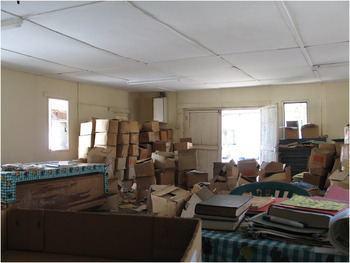
This cursory tracing of the genealogies and itineraries of texts might well serve as a way to triangulate between colonial and metropolitan archives and events, but it is also, and I think most importantly, should encourage us to read various archives in all their disorganized and displaced splendor. At the risk of sounding like someone from the 1990s who constantly reminded historians to listen to silences, I want to ask scholars of the postcolonial to take the mess as their starting point. When we do that, the gaps and the fissures are not simply problems or absences in the archival record, they are clues to what the gaps and fissures were in official thinking and policies. Every misfiled document and missing five pages is not the key to political history, of course, but taken together they provide a lens, a way to enter into a world of disregarded protocols and slapdash paperwork, of policies made up as governance went along. At the risk of being too cute I want to say that just as transnational history requires transnational archives, messy history – a phrase I take from Todd Shephard’s study of AlgeriaFootnote 6 – is best written from messy archives.
United National Independent Party Archives, Sekeseke Road, Lusaka, August 2006. Photo by Luise White.

Is there a way around the mess? Maybe not, but there may be a way to make the mess a more coherent, if still messy, narrative. A hodgepodge historiography begins with understanding states and policies and plans as a bricolage. And a hodgepodge historiography requires sources found outside of archives. Stephen Ellis has made a strong case for journalists as a kind of grounded postcolonial source.Footnote 7 Let me make a case for memoirs as an ungrounded but nevertheless invaluable postcolonial source. The production of memoirs out of Africa since the 1980s has been staggering, and in Southern Africa war memoirs have taken the place of operational histories of military campaigns. These are intertextual in the extreme and they tend to borrow liberally from each other, as well as from the occasional Second World War movie. I would hesitate to call them credible; I tend to read them alongside fiction. But however they are read, these memoirs give us personal accounts that are no less messy than archives and no less constructed and constrained than official documents.Footnote 8 But they do something else, something I don’t think memoirs anywhere else do: they engage with the official version of events, they engage with documents and reports and conventional wisdoms.Footnote 9 They argue with received histories. Memoirs and personal accounts aren’t great sources because they tell us about individual experience but because they tell us how individuals engaged with and commented on states and wars.
The roundtable in which these papers were first presented had “the oral” in the title. When we took questions, someone in the audience asked why we didn’t talk about oral history. It seems to me I answered that, but whatever I said was so inconsequential that I don’t remember it. Twenty-four hours later, I wished I’d talked a little more about what oral history has meant in African history. (Clearly I wasn’t the only panelist who felt this way: see Greg Mann’s intervention in the introduction to these papers). The canonical origins of oral history – when the Kuba elder told Jan Vansina “we know our past too because we carry our newspapers in our heads”Footnote 10 – made oral traditions and written documents alternatives, if not opposites. Interpreting oral traditions required rigorous methods, but once properly interrogated they were said to as good as, as reliable as, as accurate as any document might be. However naïve this might sound in 2015, it shaped many doctoral programs in African history in North America, and produced a history of precolonial Africa that had not been considered possible in 1960.Footnote 11 Colonial historians, by which I mean historians of Africa before 1960, relied on oral history – by which they meant mainly interviews – to literally correct the written record, to flesh out, to give voice to what was left out of the archival record: colonialists might say one thing, but the experience of ordinary Africans told us something different and that different thing was the right answer. We had the words of the colonized: those words made us smug, as I’ve said, and more often than not these words could correct the confidence and ignorance of colonial records.Footnote 12The Comforts of Home may well be the most arrogant example of this trend.Footnote 13 Looking back at this, it may not have been the most nuanced method but it served the profession well for years, producing some of the best social history I know, the texture of which grew out of Africans’ description of their own lives and their own experiences. But it also made written words and spoken words opposing subject positions that could never fully be reconciled at least not in the colonial era. (It made for some very flawed histories of African nationalism which I won’t bother talking about.)
What then is the way forward to write the history of postcolonial Africa? I recommend we think about two diverse observations, the first of which is the South African literary scholar, Isabel Hofmeyr, who reminded us that creating the category of oral history simply privileged the media in which evidence was presented.Footnote 14 Hofmeyr was perhaps too kind, insofar as the we who did the social history of colonial Africa privileged a lot more than media: we gave African voices an authority and a power all their own: our work had that odd but never questioned phrase “Africans themselves” in it. The second is by Arlo Guthrie, quoted in an episode of the salutary, ten episode, six-volume DVD, The History of Rock ‘n’ Roll. When he was asked about the controversy over Bob Dylan going electric, Guthrie observed that the issue wasn’t one of rock music vs. folk music but of the assertion that a specific kind of music had integrity.Footnote 15 African historians have done this: we’ve given oral history integrity and grudgingly admitted there were things worth knowing to be found in archives; we could be smug in the archives because we had talked to the people who had made this history, we knew what really happened. Over the last few years, as I wrote Unpopular Sovereignty it struck me how difficult it was to write political history. It turns out I had to learn the story before I did anything analytical with it, and I often reflected on my younger self and her somewhat happier and definitely more comfortable disdain for archives. In looking for and at all the things officials got wrong, I missed how the wrong itself told a story, a story about officials, that I had failed to see messy archives for what they are, fragmented records of shambolic events, of false starts and donor-driven policies and impossible development schemes and missed opportunities.
Luise White is Professor of History at the University of Florida. Her most recent book is Unpopular Sovereignty: Rhodesian Independence and African Decolonization (Chicago: The University of Chicago Press, 2015). Email: lswhite@ufl.edu