Kawasaki disease is an acute febrile disease affecting children mainly under five years of age. In Japan, in recent years, about 6 to 8,000 patients developed Kawasaki disease each year.1 Its cause remains unknown, but it is a systemic vasculitis involving the medium-sized vessels. In the 1970s, it was observed that about one-fifth of patients developed coronary arterial aneurysms immediately after the acute illness. Both dilations of the coronary arteries, and small aneurysms, usually regress after the acute phase, but some moderate-sized aneurysms may persist for years, while most giant aneurysms evolve into stenotic lesions.2 Severe coronary arterial lesions leading to ischaemic heart disease, including acute myocardial infarction, develop in 2 to 3%, about one third of whom are females.1, 3 Some of these females with coronary arterial lesions caused by Kawasaki disease are now of childbearing age, and their number, while small, is slowly increasing. Except for case reports, there is no literature about pregnancy and delivery in this population, and little information on their management.4–8 With this in mind, therefore, we surveyed the Japanese experience of pregnancy and delivery in a group of patients with Kawasaki disease and coronary arterial lesions. Our purpose was to determine the outcome of pregnancy and delivery in this special population.
Methods
We surveyed the institutions belonging to the perinatal registration system of the Japanese Association for Obstetrics and Gynecology, and some Institutions of Paediatrics, by mail in August 2004. The first survey asked each institution about their experience in delivering patients with coronary arterial lesions caused by Kawasaki disease. We subsequently sent a second questionnaire to the institutions with experience delivering such patients requesting the following details:
- Date of birth
- Date of onset of Kawasaki disease
- Presence of coronary arterial lesions
- Left ventricular ejection fraction
- History of myocardial infarction
- Coronary revascularization
- Date of delivery
- Mode of delivery
- Anaesthesia
- History of pregnancy and delivery
- Risk factors for atherosclerosis
- Cardiac events
- Obstetric complications
- Medications
- Arrhythmia
- Investigative findings, such as treadmill test, radioisotope myocardial imaging, computed tomography, magnetic resonance imaging
- Gestational age of the neonate
- Apgar score
- Birth weight of the neonate
- Planning of the pregnancy and delivery.
We especially focused on the type of coronary arterial lesion, medication during pregnancy, and the mode of delivery in each patient. Coronary arterial lesions caused by Kawasaki disease include dilations, aneurysms and stenoses. Dilation denotes a dilated coronary artery in which the diameter is less than one and half times that of the adjacent arteries. Aneurysms indicate enlargements greater than one and a half times the adjacent artery, and when the diameter is more than or equal to 8.0 millimetres, they are defined as giant aneurysms. Stenosis usually is called localized stenosis. Occlusion implies complete obstruction of the coronary artery. Segmental stenosis represents recanalization after occlusion of the coronary artery, and consists of several small coronary arteries, and is one of the characteristic lesions of Kawasaki disease. Segmental stenosis often causes asymptomatic myocardial infarction.
We divided the coronary arterial lesions into four groups for the purpose of this study, and determined the mode of delivery and medication during pregnancy for each of the four groups. The first group, of 8 patients, was made up of patients with both significant stenotic lesions and giant aneurysms. For our purposes, a significant stenotic lesion meant localized stenosis of more than or equal to 75%, including occlusion and segmental stenosis. The second group, of 6 patients, was made up of those with giant aneurysms, and the third group, containing 7 patients, was formed from those with significant stenotic lesions. The final group, also of 7 patients, comprised those with dilated lesions. This last group included the patients with dilated lesions but no giant aneurysms.
Results
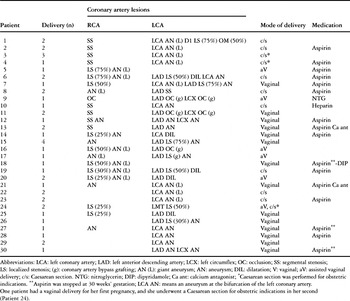
The first questionnaire was returned by 154 of 207 (74%) institutions, and 16 of these had records of deliveries in patients known to have had Kawasaki disease. For the second questionnaire, we received replies from 14 of these 16 institutions (88%). These institutions had records of 44 deliveries in 28 patients. To these, we added 2 deliveries in 2 patients from previous Japanese case reports. Thus, we analyzed details of 46 deliveries in 30 patients since 1993. The maternal age at delivery ranged from 18 to 35 years, with a median of 27 years, and the number of deliveries per patient is shown in Table 1.
Table 1. Coronary arterial lesions, mode of delivery, and medications in each patient.

Cardiac evaluation
The coronary arterial lesions in each patient are shown in Table 1, the lesions being diagnosed by selective coronary angiography. The interval from the latest coronary angiograms to delivery ranged from 4 months to 15 years, with a median of 4 years. Coronary arterial bypass grafting had been performed in 4 patients (#9, 11, 16, 17) because of stenotic lesions caused by Kawasaki disease. The interval from surgery to delivery ranged from 6 to 23 years, with a median of 8 years. All 4 patients had grafting to the left anterior descending artery, employing the internal thoracic artery in three patients, and the saphenous vein in the fourth. In one patient (#26), there had been directional coronary atherectomy because of a 75% localized stenosis 3 years before delivery. Segmental stenosis, or complete occlusion, of the right coronary artery was found in 9, and of the left anterior descending artery in one. Localized stenosis of the right coronary artery of 75% was present in two, and of the left anterior descending artery in two. A giant aneurysm of the right coronary artery was found in 8, and at the bifurcation of the left coronary artery in another 8. Neither symptomatic myocardial infarction, nor significant chest pain prior to pregnancy, occurred in any patient. All patients were in the first grade of the classification of the New York Heart Association. One patient, #9, had been in the second class before surgery. No patient had significant ischaemic changes on examination before pregnancy, and none had risk factors for atherosclerosis, such as hypercholesterolaemia, diabetes, obesity, or hypertension. In 2 patients, there was a history of smoking before pregnancy. The left ventricular ejection fraction was within normal limits in 29 patients, and was 43% in patient #9. Perfusion defects on radioisotope myocardial imaging at rest were detected in 4 patients before pregnancy (#1, 9, 11, 13).
Delivery
There were 27 vaginal deliveries in 20 patients, and 19 Caesarean sections in 11 patients (Table. 1). The number of each mode of delivery each year is shown in Figure 1. Although the incidence of Caesarean sections in the first 6 years was 6 of 13 (46%), it fell in the next 6 years to 6 of 26 (23%). In 7 of the 27 vaginal deliveries, assistance was needed, by forceps in 6, and one by vacuum extraction. Of the vaginal deliveries, 9 were performed under epidural anesthesia. In the 11 patients undergoing Caesarean section, 3 had obstetric indications. Another patient (#6) complained of frequent chest discomfort without ST-T changes in the electrocardiogram after 30 weeks gestation. She underwent Caesarean section at 33 weeks. After delivery, her symptoms and signs improved spontaneously. The remaining 7 patients had a Caesarean section because of known coronary arterial lesions. Anaesthesia was general in 3 deliveries, epidural in 6, spinal in 7, epidural and spinal in 2, and unrecorded in 1. The number of each mode of delivery in the four groups based on coronary arterial lesions is shown in Figure 2. Vaginal delivery was performed in all the patients making up the group with dilated lesions.

Figure 1. The number and mode of delivery in each year Vaginal; vaginal delivery; c/s, Caesarean section. c/s*, Caesarean section was performed for obstetric indications.

Figure 2. The number of each mode of delivery in the four groups based on coronary arterial lesions Vaginal; vaginal delivery; c/s, Caesarean section. c/s*, Caesarean section was performed for obstetric indications.
Medications
Medications were administered during pregnancy in 18 patients (60%). Of these, 15 had been taking medicine before pregnancy. Medication was started after pregnancy in three (#5, 10, 23). One received heparin, 16 took low-dose aspirin at a dose of 81 to 100 milligrams per day, and 1 was on nitrates. A calcium antagonist was given in 2, and dipyridamole in one other (Table 1). Aspirin was stopped in 1 patient because of a vaginal hemorrhage at 23 weeks gestation. Aspirin was discontinued at 30 weeks gestation in 3 patients, and was stopped 1 to 7 days before delivery, and restarted 1 to 7 days after delivery, in a further 12 patients. Of these 12, when aspirin was stopped, 3 were given heparin before delivery. The use of aspirin in the four groups is shown in Figure 3.

Figure 3. The use of aspirin in the four groups based on coronary arterial lesions.
In 12 patients, no medication was given. Of these 12 patients, one (#24) had discontinued aspirin several years before pregnancy, and aspirin was re-started after delivery. Aspirin was stopped after pregnancy in patients 1 and 26.
Cardiac events
None of the 30 patients had a cardiac event. No patient developed electrocardiographic ST-T changes during pregnancy, and significant ventricular arrhythmias were not detected before or after delivery. Premature ventricular contractions were detected in 10 patients. Unifocal premature ventricular contractions increased during pregnancy, and in period following delivery in 2 patients.
Obstetric complications
Delivery occurred at 23 weeks gestation in Patient 14 because of premature rupture of the membranes. She developed a vaginal haemorrhage at 21weeks, and was admitted after 2 days and discontinued aspirin. She delivered an extremely premature baby weighing 679 grams. The eighth patient, who had heparin before delivery, underwent Caesarean section. She required a re-operation because of abdominal haemorrhage 1 day after delivery.
The Neonates
Of the 40 babies born at term, all were healthy, albeit that one, born to patient #5, had a very small muscular ventricular septal defect, and another, born to patient #26, had agenesis of the corpus callosum. There were 3 premature babies born by Caesarean section, but again there were no complications. The extremely premature baby delivered by patient #14 developed a retinopathy of prematurity.
Discussion
Although acute myocardial infarction in pregnancy is unusual, it is a serious event, and greatly affects the prognosis of both mother and fetus.9–11 Whether pregnancy or delivery increases the risk of myocardial infarction in patients with coronary arterial lesions caused by Kawasaki disease had previously been unknown. To the best of our knowledge, there is but a single report of a patient presumed to have Kawasaki disease with a coronary aneurysm who suffered an acute myocardial infarction at term.4 In the past decade, obstetricians and paediatric cardiologists have debated how best to manage this population. Our survey reflects the results of their decisions on the mode of delivery and use of medications. Despite similar coronary arterial lesions in the patients, the mode of delivery and medication use varied greatly. None of the 46 reported deliveries, however, was complicated by a cardiac event, including acute myocardial infarction.
While the precise prevalence of acute myocardial infarction in young adults with coronary arterial lesions caused by Kawasaki disease is unknown, it is probably very low, making it difficult to determine any benefit from anti-coagulation. It is worthy of emphasis that no anticoagulation was given in over two-fifths of the patients surveyed, while obstetric complications occurred in 2 surveyed patients who were receiving anticoagulants. The relation, if any, between vaginal haemorrhage and the use of aspirin is also unknown, but aspirin at low doses is considered to be safe in pregnancy in the second and third trimester, and during delivery.12–14 Excessive anticoagulant therapy, such as heparin used throughout pregnancy and delivery, may not be needed for this population.5 The dilemma raised between avoiding obstetric complications and preventing cardiac events by using anti-thrombotic therapy in this population remains unresolved.15 Anticoagulant therapy based on the degree of coronary arterial lesions should be further investigated to determine its value in preventing cardiac and obstetric complications.
Previous reports suggest that, for myocardial infarction in the third trimester caused by other types of coronary arterial disease, the mortality is lower for Caesarean section than for vaginal delivery.11, 16, 17 Mortality tended to be high when delivery occurred within 14 days of the initial myocardial infarction. Recently, successful vaginal deliveries have been reported employing medical management after myocardial infarction in the third trimester.9, 18, 19 It is questionable if Caesarean section can prevent cardiac events in patients with coronary arterial lesions caused by Kawasaki disease. We believe that Caesarean section does not always prevent myocardial infarction during delivery.20 We believe our survey shows that coronary arterial lesions caused by Kawasaki disease in stable patients are not necessarily an indication for Caesarean section. The mode of delivery should be primarily determined by obstetrical considerations, rather than the coronary arterial lesions caused by Kawasaki disease. If the patients are symptomatic because of worsening haemodynamics in late pregnancy, Caesarean section should be recommended based on their general condition.
An assisted second stage of labour using epidural anaesthesia is recommended in patients with a low left ventricular ejection fraction and significant localized stenosis of a coronary artery. In regards to cardiac function, childbearing is considered to be possible by patients with a left ventricular ejection fraction greater than 40%.17, 21, 22
Although the number of patients in our survey is small, our findings suggest that successful deliveries in this population, all in the first class of the system of the New York Heart Association, are possible by conventional management, even for those patients with coronary arterial stenoses or giant aneurysms. For the rare occurrence of acute myocardial infarction, prompt diagnosis is essential. Careful monitoring of the vital signs and facilities for emergency care are needed, in addition to a multidisciplinary team of obstetricians and cardiologists. Most myocardial infarctions reported in the literature occurred in patients with multiple risk factors for atherosclerosis.21 We must educate these patients to decrease their risks for atherosclerosis.
We recognize that our study has its limitations. The number of the patients was not enough to analyse statistically the incidence of myocardial infarction and the need for anticoagulant therapy during pregnancy. The number of patients was also far smaller than the expected number calculated on the past incidence of Kawasaki disease in Japan. The other limitation is that the study is based on multi-institutional data obtained using a limited questionnaire. The selective coronary angiograms were not always performed within several years prior to deliveries. We must continue to accumulate collective clinical data on these patients in the future as a basis for safe guidelines, because this population is extremely small in the world, and fatal complications occur rarely.
Conclusion
The results of pregnancy and delivery in the studied population were favourable. The mode of delivery should be primarily determined by obstetrical considerations, rather than on the basis of the coronary arterial lesions caused by Kawasaki disease. Excessive anticoagulant therapy, for example with heparin, may not be needed for this population. Anticoagulant therapy based on the degree of coronary arterial lesions should be further investigated to determine its value in preventing cardiac and obstetric complications.
Acknowledgments
We greatly appreciate the cooperation of all paediatricians and gynaecologists who participated in this survey. We also thank Professor Peter Olley for his kind help with the English language. The Departments of Obstetrics and Gynaecology, or of Paediatrics of the 17 participating institutions in this survey were from Kurume University Hospital, Wakako Himeno, MD, Prefectual Amagasaki Hospital, Hisanori Sakazaki, MD, Nihon University Hospital, Kensuke Karasawa, MD, Nishi-kobe Medical Center, Takashi Fukaya, MD, Shimane University Hospital, Atsushi Manabe, MD, Gunma University Hospital, Tsuyoshi Takagi, MD, Nara Prefectual Medical College Hospital, Yoshiro Yoshikawa, MD, Kyusyu University Hospital, Takayuki Fujita, MD, Hiroshima Municipal Hospital, Masahiro Kamata, MD, Tokyo-Jikeikai University Hospital, Yuko Fujiwara, MD, Hamamatsu Seirei Hospital, Hiroo Naruse, MD, Niigata University Hospital, Akira Kikuchi, MD, Shinsyu University Hospital, Kenji Oka, MD, Nagoya Higashi Municipal Hospital, Isamu Murakami, MD, Kurobe Municipal Hospital, Hiroshi Tsuda, MD, Yodogawa Christian Hospital, Masataka Mukubou, MD, National Cardiovascular Center.
The survey was supported by a grant from the Japanese Cardiovascular Research Foundation.