Introduction
Obstructive sleep apnea (OSA) is a nocturnal respiratory disorder in which breathing is intermittently partially or completely blocked during sleep, resulting in increased respiratory effort, sleep disturbance, and periods of hypoxia and hypercarbia. Although population prevalence rates are estimated at 1–4% of otherwise healthy children and adults (Ali & Stradling, Reference Ali and Stradling2000; Arens, Reference Arens2000), OSA refers only to the most extreme end of a continuum of sleep-disordered breathing (SDB). Certain subgroups of individuals, including those who are overweight, appear to be at disproportionate risk. Specifically, Beebe and colleagues (Reference Beebe, Lewin, Zeller, McCabe, MacLeod, Daniels and Amin2007) reported that half of overweight adolescents met criteria for broadly defined SDB, and 1 in 8 met strict criteria for OSA; in contrast, no demographically matched healthy-weight controls met strict OSA cutoffs, and only 14% met the broader criteria for SDB.
SDB in children and adolescents is associated with inattention and learning problems, as well as lower academic grades (Beebe, Ris, Kramer, Long, & Amin, Reference Beebe, Ris, Kramer, Long and Amin2010). Behavioral studies document that children with SDB demonstrate problems regulating mood, impulses, and behaviors (Beebe, Reference Beebe2006). Cognitive test findings have been less consistent, although several studies have suggested an association between SDB and impairment in executive functions (EF; Beebe, Reference Beebe2006). Although the adult and pediatric OSA research literature is substantial, the vast majority of neuropsychological studies have focused on EFs that are generally thought to be mediated by the dorsolateral prefrontal cortex (PFC), including set-shifting, working memory, and generative fluency. According to one classification, these types of tasks are thought of as “cool,” relatively emotion-neutral cognitive aspects of EF, which contrast to the “hot” aspects of EF thought to be mediated by the ventral and medial aspects of the PFC (Zelazo & Mueller, Reference Zelazo and Mueller2002). In this framework, cool EF is thought to be elicited by abstract, decontextualized problems, whereas hot EF is related to problems that involve the regulation of affect and motivation. Individuals with lesions to the ventromedial PFC often perform normally on traditional measures of EF; however, they tend to exhibit functional impairments in their social and emotional decision-making, as measured both by performance-based tasks and in real-life situations (e.g., Anderson, Bechara, Damasio, Tranel, & Damasio, Reference Anderson, Bechara, Damasio, Tranel and Damasio1999).
While no previous studies have explicitly studied the effects of SDB on hot EF per se, a substantial body of research on sleep deprivation has indicated that sleep loss is associated with impairments in emotional regulation (Horne, Reference Horne1993), decision making (Killgore, Balkin, & Wesensten, Reference Killgore, Balkin and Wesensten2006), and moral judgment (Killgore et al., Reference Killgore, Killgore, Day, Li, Kamimori and Balkin2007). Thus, it is plausible that SDB and its associated disturbances of the restorative aspects of sleep are associated with dysfunction of hot EF and may help explain why children with SDB tend to have increased social and behavioral problems (Beebe, Reference Beebe2006; Beebe et al., Reference Beebe, Ris, Kramer, Long and Amin2010).
One of the most widely used measures of hot EF is the Iowa Gambling Task (IGT; Bechara, Damasio, Damasio, & Anderson, 1994). This task was specifically developed to be sensitive to the deficits in perceived risk- and reward-based decision-making shown by patients with lesions to the ventromedial PFC. During this “card game,” test-taker's choices are associated with risk and reward contingencies that are not initially evident, but which can be learned across the course of the task, resulting in improved decisions over time in healthy individuals. Although it remains one of only a few standardized tests that have been demonstrated to be sensitive to such lesions (e.g., Bechara et al., Reference Bechara, Damaisio, Damasio and Anderson1994; Bechara, Tranel, & Damasio, Reference Bechara, Tranel and Damasio2000), poor IGT performance has also been documented in other patient populations with behaviors that are characterized by excessive risk-taking and poor decision-making, such as those with substance abuse (Bechara, Dolan, Denburg, Hindes, Anderson, & Nathan, Reference Bechara, Dolan, Denburg, Hindes, Anderson and Nathan2001), pathological gambling (Cavedini, Riboldi, Keller, D'Annucci, & Bellodi, 2000), and adolescents with externalizing behavior disorders (Blair, Colledge, & Mitchell, Reference Blair, Colledge and Mitchell2001).
The IGT may also be a particularly important tool in studying adolescents, among whom developmental shifts in risk-taking and decision-making can yield consequences with long-term implications for both the individual and society (Dahl, Reference Dahl2004). Cross-sectional studies using the IGT or a very similar task have documented improved decision-making and reduced risk-taking as children move through adolescence (Crone, Vendel, & van der Molen, Reference Crone, Vendel and van der Molen2003; Hooper, Luciana, Conklin, & Yarger, Reference Hooper, Luciana, Conklin and Yarger2004). What is not known, however, is whether sleep pathology during this developmentally sensitive period impacts “hot” EF, which could have significant implications for sleep screening and intervention.
The goal of the present study was to characterize the IGT performance pattern in a group of children and adolescents who, because they were overweight, were at high risk for SDB. In line with previous literature, it was predicted that participants would make better choices over the course of the task and that older adolescents would do so more quickly than younger participants. Furthermore, we predicted that participants with objective evidence of SDB would have more impaired performance on the IGT than those without such evidence.
Methods
Participants
Participants were drawn from a larger study investigating the broad neurobehavioral effects of OSA and other sleep disturbances in children and adolescents. The IGT was added to the protocol approximately a year into the study, so this task was not considered in the prior paper that described the full sample (Beebe et al., Reference Beebe, Ris, Kramer, Long and Amin2010). Results of overnight PSG, parent- and self-report of school grades and sleep, parent- and teacher-report of daytime behaviors, and neuropsychological test results from the larger sample have been previously described (Beebe et al., Reference Beebe, Ris, Kramer, Long and Amin2010). Like the full sample, the 111 participants who completed the IGT were overweight (BMI > 95th percentile for age and sex) and between the ages of 10.0 and 16.9 years. Participants were recruited from a weight management clinic (n = 82) or the sleep clinic (n = 29) at Cincinnati Children's Hospital Medical Center. The effects reported below did not appreciably differ between recruitment sources, so data were pooled to maximize statistical power. Exclusion criteria included diagnosis of a neurodevelopmental disorder (e.g., autism spectrum disorder; n = 2); current or prior neurological condition (e.g., epilepsy, head injury that resulted in loss of consciousness; n = 19); treatment for OSA by positive airway pressure or adenotonsillectomy within the past 2 years (n = 17); and use of psychoactive medications (n = 26), with the exception of stimulant medication (n = 4), which was discontinued at least 36 hr before assessment.
Procedure
All procedures were approved and overseen by the Cincinnati Children's Hospital Medical Center Institutional Review Board. Parents and participants were initially introduced to the study during clinic visits, then contacted by phone with detailed information on study procedures. Written informed parent consent and child assent were obtained at the study visit. Families were compensated $50 for their time and travel to the assessment, and each received individualized feedback on findings from neuropsychological testing and sleep assessment procedures.
Participants were administered a neuropsychological assessment battery, which included the IGT, beginning between approximately 3:30 and 4:30 p.m., to minimize variability due to circadian rhythm effects on test performance. In most cases, participants were then fed dinner and underwent overnight polysomnography (PSG) to assess for SDB. In a few cases, scheduling limitations precluded conducting both assessments on the same evening; in these cases, the neuropsychological testing was conducted on an afternoon other than the one immediately following the PSG to avoid the potential adverse effects of having slept in an unfamiliar setting.
Measures
Polysomnography (PSG)
Participants underwent overnight inpatient PSG, widely considered the “gold-standard” for assessing OSA and other forms of SDB. During PSG, the following parameters were monitored using a computerized system (Astro-Med Grass System; Heritage, West Warwick, RI): Electroencephalogram (EEG; C3- A2, C4-A1, O1-A2, O2-A1), right and left electroculgram (EOG), submental electromyogram (EMG), tibial EMG, electrocardiography (ECG), nasal/oral airflow through a three pronged thermistor and/or nasal pressure transducer, end tidal CO2 (at the nose via infrared capnometry), snoring microphone, O2 saturation by pulse oximeter, oximeter pulse waveform, actigraphy to measure limb movements, infrared video monitoring, and rib cage and abdominal volume changes (computer-assisted respiratory inductance plethysmograph).
All PSG scoring was conducted blind to IGT results. Sleep staging was scored according to standardized criteria (Rechtschaffen & Kales, Reference Rechtschaffen and Kales1968). Consistent with convention at the time of the study (American Thoracic Society, 1996; Marcus et al., Reference Marcus, Omlin, Basinki, Bailey, Rachal, Von Pechmann and Ward1992; Uliel, Tauman, Greenfield, & Sivan, Reference Uliel, Tauman, Greenfield and Sivan2004), obstructive apneas were defined as >80% decline in airflow over two respiratory cycles, despite chest/abdominal wall movement (indicating continued respiratory effort). Obstructive hypopneas were defined as a 50–80% decline in airflow over two respiratory cycles, (a) accompanied by chest/abdominal wall movement and (b) associated with oxygen desaturation or followed by arousal. Our primary index of SDB, the apnea + hypopnea index (AHI), was defined as the total number of obstructive apneas and hypopneas, divided by the number of hours in sleep.
Iowa Gambling Task (IGT)
A computerized version of the IGT was administered (Bechara et al., 1994), using a pre-publication version of software that was recently made commercially available through Pearson. Participants were presented with four decks of cards on a computer screen, from which participants could “draw” cards by clicking on each deck. Participants began the task with a $2,000 loan of hypothetical money. With each card drawn, participants won some amount of “money”; however, with some cards they also lost money. Participants were instructed that the object of the game was to win as much money as possible by trying to figure out which decks of cards were better than the others. As participants “drew” each card, they received visual and auditory feedback on the money they won and any they might have lost in that draw. Colored bars at the top of the screen provided continuous information regarding overall performance. The two card decks on the left (A and B) gave relatively high payouts with each draw (an average of $100), but also carried greater monetary risk as well, such that repeated draws resulted in a net loss. The two card decks on the right (C and D) gave lower payouts with each draw (an average of $50), but carried even less risk, such that repeated draws resulted in a net gain. Regardless of choices, the task continued until participants drew 100 cards.
The task is conventionally scored in 5 blocks of 20 card-pulling trials. Within each block, the number of draws from disadvantageous decks (A and B) is subtracted from the number of draws from advantageous decks (C and D). Thus, there are 5 primary data points for each participant, with positive scores representing a pattern of more advantageous draws, and negative scores representing more disadvantageous draws.
Developmental level
Although prior research suggests a relationship between adolescent development and IGT performance, it is not yet clear whether this is best indexed by chronological age or markers of pubertal development. Consequently, both were examined in separate, parallel analyses. Age was based upon the date of testing, and pubertal development was assessed via a previously validated, non-invasive, and non-pictorial self-report questionnaire (Carskadon & Acebo, Reference Carskadon and Acebo1993). Questions related to changes in height, changes to skin, presence of body hair, changes in voice and facial hair (boys only), and breast development and menarche (girls only). The pubertal development scale score was computed by taking an average of the sex-relevant items and was used as a continuous variable ranging from 0 to 4.
Other demographics and descriptive characteristics
Demographic information was collected by parent report. As in the larger study (Beebe et al., Reference Beebe, Ris, Kramer, Long and Amin2010), overall socioeconomic status (SES) was computed as the average Z-score within the sample across four variables: mother and father education level, family income, and median income from the family's zip code of residence. Scores were prorated for any missing data (e.g., father education unreported). Participants’ height and weight were measured using a calibrated stadiometer and hospital scale immediately before the PSG. This information was used to calculate body mass index (BMI = mass in centimeters/squared height in meters) and a BMI Z-score based upon normative data for the child's age and sex provided by the US Centers for Disease Control and Prevention. An estimate of IQ was obtained using the Block Design and Vocabulary subtests from the Wechsler Intelligence Scale for Children, fourth edition (WISC-IV; Wechsler, Reference Wechsler2003).
Analytic Strategy
To examine performance changes over the course of the task, a General Linear Mixed Modeling (GLMM) approach was used with a random coefficients model. Analyses were conducted using the SAS Mixed Procedure (SAS Institute, 1990) using restricted maximum likelihood estimation. This approach seeks to find the best line or curve that fits change over time in scores in each individual, an entire sample, and specified subsamples. Before all analyses, each predictor variable was centered on its mean value and each of the five “block” variables was transformed, such that time 0 represents performance on the first block of the IGT.
GLMM analysis is typically conducted in two levels. The Level 1 analysis, which described how IGT performance changed over time within each subject and across the population, examined a model in which time period (IGT “block”) was the only predictor. To determine the covariance matrix that best fit the data, several models were constructed with different covariance structures, and model fit statistics (Akaike's Information Criterion or AIC) were compared. The AIC values, a measure of relative goodness of fit, were examined to determine which models were associated with better fit. AIC values provide a means of comparing models; thus, values must be interpreted relative to one another. Models with better fit are associated with relative lower AIC values (Brown & Prescott, 2004). Linear, quadratic, and cubic effects were tested to establish the final Level 1 model of best fit.
The Level 2 analysis first investigated whether inter-individual variability in Level 1 parameters varied systematically with developmental level (age and pubertal rating, entered into separate analyses), SES, and sex, entering each potential covariate in a step-wise manner. Variables that improved model fit statistics (i.e., reduced AIC values) were retained as covariates in all subsequent analyses. Variables that worsened model fit (i.e., increased AIC values) were dropped. Finally, to determine the relationship between SDB and IGT performance above and beyond these covariates, AHI and associated interaction terms were added to the model.
Results
Preliminary Analyses
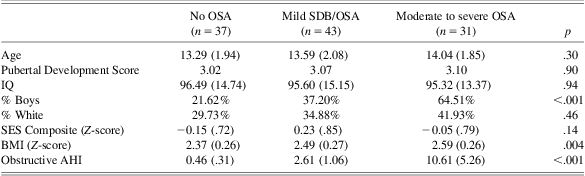
Like traditional regression and general linear model (GLM) analyses, GLMM assumes that the entered variables are normally distributed. Raw AHI was markedly positively skewed, which is common in studies of pediatric OSA. Consequently, the AHI variable was trichotomized based on clinically relevant criteria and following previous research in the field (Amin et al., Reference Amin, Kimball, Bean, Jeffries, Willging, Cotton and Daniels2002; Beebe et al., Reference Beebe, Wells, Jeffries, Chini, Kalra and Amin2004; Owens, Spirito, Marcotte, McGuinn, & Berkelhammer, Reference Owens, Spirito, Marcotte, McGuinn and Berkelhammer2000). The sample was divided into three groups: individuals with AHI<1 (n = 37; no OSA); those with AHI between 1 and 5 (n = 43; mild SDB/OSA) and those with AHI > 5 (n = 31; moderate to severe OSA). A comparison of groups on demographic and sleep variables is presented in Table 1. Analysis of Variance and χ 2 analyses indicated that groups did not significantly differ in age, IQ, pubertal status, SES, or race. By design, AHI was significantly different across groups F(2,108) = 116.35, p < .001. Increases in OSA severity were associated with an increased proportion of boys, χ 2(2) = 13.14; p < .001, and more severe obesity, F(2,108) = 5.95; p < .01, although the mean BMI Z-score was quite high in all three groups, reflecting average adiposity beyond the 99th percentile for age and sex. BMI was not related to IGT performance in this sample (r 2 = .08; p = .62), although it is possible this negative result was due to inclusion criteria that required all participants to be obese.
Demographic and sleep characteristics

Data are percentages and mean (standard deviation). AHI = apnea + hypopnea index; SES = socioeconomic status; BMI = body mass index.
Level 1 Analysis: Overall Trends in IGT Performance
Comparisons of model fit statistics revealed that an unstructured covariance matrix (AIC = 3506.31) better fit the data than compound symmetry (AIC = 3514.99), autoregressive (AIC = 3514.99), and topleitz (AIC = 3514.99). Results of the GLMM analysis revealed a significant linear effect (p = .01), but non-significant quadratic (p = .06) and cubic (p = .15) effects. Because the quadratic effect approached significance, preliminary analyses included this term; however, in no cases did the quadratic effect reach significance, so it was dropped from final models.
IGT performance was then predicted from task period or “block” using an unstructured covariance matrix and linear estimation. As predicted, the slope of the resulting model indicated that, on average, participants’ performance significantly improved over the course of the IGT (slope estimate = 0.52; p = .01). During the first block of the task, participants drew an average of 2.79 (SD = 5.41) more disadvantageous cards than advantageous cards. By the conclusion of the task, on average, participants drew an equal number of advantageous and disadvantageous cards (mean = 0.00; SD = 7.76).
Level 2 Analysis: SES, Sex, and Developmental Level and IGT Performance
SES, participant sex, and developmental level were examined as potential IGT covariates in Level 2 analyses. SES improved model fit (AIC = 3320.75) and was related to model slope (p = .001), but not intercept (p = .66); children with higher SES tended to make greater improvements in their choices over time than those with lower SES. In contrast, when sex was entered, model fit was worsened (AIC = 3490.78), and sex was not significantly related to model intercept (p = .17) or slope (p = .89). Finally, development was modeled by age and pubertal level in separate analyses. Model fit was unexpectedly worsened with the addition of the age variable (AIC = 3509.67), and there was no significant effect of age on the linear model intercept (p = .73) or slope (p = .65). Although fit statistics improved when entering pubertal level rather than age (AIC = 3333.43), pubertal level did not significantly predict model intercept (p = .14) or slope (p = .67).
Because addition of both pubertal rating and SES improved model fit statistics, both of these variables were retained and entered as potential covariates when examining the relationship between AHI and IGT performance. Age and sex were not retained as covariates because they did not improve model fit.
Level 2 Analysis: OSA Group and IGT Performance
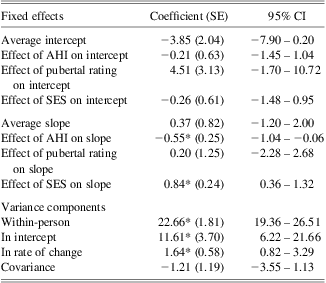
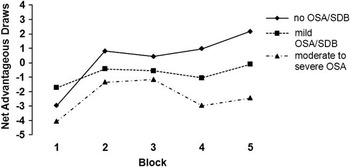
Entering the SDB grouping improved model fit (AIC = 3312.63) over and above the model in which with task period, SES, and pubertal rating were the only predictors (AIC = 3320.75). Model estimates are presented in Table 2. As illustrated in Figure 1, SDB Group had a significant effect (p = .02) on the rate of change in IGT performance (slope), even after taking into account SES and pubertal level in the model. Simple effects analyses revealed that individuals in the no OSA group tended to make better choices as the task progressed (slope = 1.04; p < .01), whereas individuals in the mild SDB/OSA and moderate to severe OSA groups showed little change in their pattern of choices across the course of the task (mild SDB/OSA slope = 0.31; p = .33; moderate to severe OSA slope = 0.16; p = .70). There was no significant effect of SDB Group on the model intercept (p = .99). To estimate the effect size for the model, r 2 was calculated by correlating the predicted values with the observed values. The resulting estimate of effect size was .31, which can be interpreted as a moderate effect (Brown & Prescott, Reference Brown and Prescott2006).
GLMM: Predicting IGT performance from sleep variables

*Significant p < .05.
GLMM = General Linear Mixed Model; IGT = Iowa Gambling Task; CI = confidence interval; AHI = apnea + hypopnea index; SES = socioeconomic status.
Iowa Gambling Task (IGT) performance by sleep-disordered breathing (SDB) group. General Linear Mixed Modeling (GLMM) analysis revealed that SDB grouping had a significant effect on rate of change in IGT performance. OSA = obstructive sleep apnea.

Level 2 Analysis: OSA Group as a Possible Moderator of the Relationship Between Developmental Level and IGT Performance
As noted above, when considering the sample as a whole, we did not replicate previously published findings that late adolescents would perform better on the IGT as compared to children earlier in development. However, those prior studies were of healthy individuals and, given that OSA appeared to suppress performance on the task, it remained possible that developmental effects might be evident in children without OSA that were nullified in the presence of OSA. A final, exploratory analysis examined whether OSA status moderated the relationship between developmental level and IGT performance by entering a three-way block-by-development-by-OSA group interaction term into the model predicting IGT performance. As before, development was indexed alternatively by age and pubertal level in separate analyses.
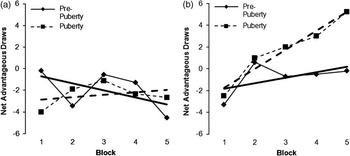
The three-way interaction term of age, OSA group, and task period was not significant (p = .50). However, there was a significant three-way interaction between pubertal rating, OSA group, and task period (p = .047). This finding suggests that OSA group moderates the relationship between IGT performance and pubertal status. Figure 2 illustrates this effect. As shown in Figure 2a, there was no apparent relationship between puberty status and IGT performance in participants with moderate to severe OSA. In contrast, Figure 2b illustrates that, among participants with no OSA, the expected relationship between development and IGT emerged; participants with higher pubertal status are associated with a positive slope, or improving choices on the IGT over the course of the task (slope = 1.42; p = .02), whereas IGT performance does not significantly change over the task in participants with lower pubertal ratings (slope = 0.65; p = .14).
Relationship between pubertal status and Iowa Gambling Task (IGT) performance is moderated by obstructive sleep apnea (OSA) status. Figure 2a includes only individuals from the moderate to severe OSA group and Figure 2b. includes only individuals from the group with no evidence of OSA. The pre-puberty group depicts individuals from the lower quartile of pubertal ratings whereas the post-puberty group includes individuals from the upper quartile of pubertal ratings. Linear trend lines are included. 2a. In individuals with moderate to severe OSA there is no relationship between developmental level (pubertal status) and IGT performance. 2b. In individuals without OSA (AHI <1), higher pubertal ratings (upper quartile shown) are associated with increasing performance on IGT; performance did not significantly change in individuals with lower pubertal ratings (lower quartile shown).

Discussion
In this study, we examined IGT performance in a group of children and adolescents aged 10–16 years old who, by virtue of being considerably overweight, were at high risk for SDB, including frank OSA. As expected, early in the IGT, participants chose from the disadvantageous decks more frequently, and choices generally improved over the course of the task. Despite this improvement, even in the final portion of the task (card draws 80–100), participants on average drew an equal number of disadvantageous and advantageous cards, such that most participants never recouped the losses they incurred earlier in the task. This level of performance toward the end of the task is somewhat lower than was reported in sample of healthy individuals of a similar age range by Hooper and colleagues (2004). The risk level for SDB may be a critical difference between these studies; although Hooper and colleagues did not assess sleep, it is likely that few if any of their participants had SDB, because it is uncommon in otherwise healthy, normal-weight teens.
Sleep-Disordered Breathing (SDB) and IGT Performance
The most novel aim of this study was to investigate the effects of SDB on IGT performance. In line with our predictions, we found that the presence and severity of SDB was related to IGT performance; individuals with OSA (the most severe end of the spectrum of SDB) failed to benefit from experience across the task, whereas those with little to no evidence of SDB showed the expected improvement in performance over its course. To our knowledge, this is the first study to assess performance of individuals with SDB on a standardized test sensitive to hot executive functioning. Our results are consistent with those of Killgore et al. (Reference Killgore, Balkin and Wesensten2006) who reported IGT impairments and impaired moral decision making (2007) in adults exposed to experimental sleep deprivation. Thus, impairments in hot EF and social cognition may be present in multiple types of sleep pathology. Indeed, emotional regulation has long been cited as a deleterious effect of sleep deprivation, with studies early in the 20th century documenting irritability, impatience, immature humor, lack of regard for normal social conventions, and inappropriate interpersonal behavior associated with sleep loss (Horne, Reference Horne1993).
It is worth noting that the impact of SDB on IGT performance contrasts with our previously published findings that SDB was unrelated to scores on performance-based tests of other constructs, including intelligence and memory, within an expanded version of the current sample (Beebe et al., Reference Beebe, Ris, Kramer, Long and Amin2010). It may be that aspects of the prefrontal cortex are differentially impacted by SDB (e.g., Beebe & Gozal, Reference Beebe and Gozal2002). According to the model of Beebe and Gozal (Reference Beebe and Gozal2002), sleep disruption and blood gas abnormalities prevent the restorative process of sleep, differentially impacting the prefrontal cortex. In animal models, intermittent hypoxia has been linked to increased oxidative stress, inflammatory processes and neurochemical changes in the prefrontal cortex as well as the hippocampus, a limbic structure with important reciprocal connections to medial and orbitofrontal cortex, (Kheirandish, Gozal, Pequignot, Pequignot, & Row, Reference Kheirandish, Gozal, Pequignot, Pequignot and Row2005; Row, Liu, Xu, Kheirandish, & Gozal, Reference Row, Liu, Xu, Kheirandish and Gozal2002; Row, Kheirandish, Neville, & Gozal, Reference Row, Kheirandish, Neville and Gozal2003). Sleep disruption may also play an important role and may, in fact, operate via similar pathophysiological mechanisms involving oxidative stress and inflammation (Beebe, Reference Beebe2006).
A further finding in the present study was that the presence and severity of SDB moderated the relationship between developmental level, as measured by pubertal ratings, and IGT performance. Individuals with OSA did not seem to benefit from experience with the task, regardless of their developmental level. Whether this is due to an immediate (potentially reversible) effect of OSA versus a more insidious impact on the development of brain systems such as the ventromedial and/or orbitofrontal cortex is not known. However, even if reversible, the impact of OSA during adolescence remains important for two reasons. First, OSA is unlikely to be transient in this population because (a) the primary contributor to OSA in adolescents, obesity, tends to persist over time (Wang, Chyen, Lee, & Lowry, Reference Wang, Chyen, Lee and Lowry2008); (b) surgical interventions for OSA in obese adolescents are much less likely to be curative than in lean, younger children (Mitchell & Kelly, Reference Mitchell and Kelly2004); and (c) non-surgical interventions, such as positive airway pressure (PAP) are often unsuccessful because adolescents have notoriously poor adherence to these interventions (Budhiraja et al., Reference Budhiraja, Parthasarathy, Drake, Roth, Sharief, Budhiraja and Hudgel2007). Second, even if OSA were to remit, short-term poor decision-making might have long-term consequences. Even short-lived periods of poor decision-making during adolescence can result, for example, in a criminal record, incarceration, addiction, poor school record or drop-out, early parenthood, sexually transmitted disease, or injury (Moffitt, Caspi, Harrington, & Milne, Reference Moffitt, Caspi, Harrington and Milne2002).
In contrast to participants with OSA, participants with minimal evidence of SDB showed the expected relationship between IGT performance and developmental level: participants who were more advanced developmentally performed better over time on the IGT. This is in line with previous reports suggesting that adolescence is an important period for the development of skills mediated by the PFC, including the ventromedial PFC (Crone et al., Reference Crone, Vendel and van der Molen2003; Hooper et al., Reference Hooper, Luciana, Conklin and Yarger2004). To our knowledge, no other studies have investigated the role of pubertal development on IGT performance. There is neuroimaging evidence suggesting that the development of the PFC may be linked more closely with pubertal level than age (Blakemore & Choudhury, Reference Blakemore and Choudhury2006; Lenroot & Giedd, Reference Lenroot and Giedd2006). Adolescence is a dynamic period for brain development. Although it remains unknown whether sleep pathology might impact the structural development of the brain in a longitudinal manner, current findings provide cross-sectional evidence of at least dampened functional development in the presence of untreated OSA.
Demographic Predictors of IGT Performance
Socioeconomic status (SES) was significantly related to IGT performance in the current sample. This relationship is not unique to the IGT, as there is a large body of literature indicating associations between SES and neuropsychological test performance (e.g., Gottfried, Gottfried, Bathurst, Guerin, & Parramore, Reference Gottfried, Gottfried, Bathurst, Guerin and Parramore2003). Although the exact mechanism for this relationship is unclear (e.g., differences in scores may be related to many factors including differences in experiences that impact brain development, genetic differences, or cultural biases in test instruments), it is common to include SES as a covariate in research to minimize the chances that demographic confounds could account for findings. Consistent with this, we controlled for SES in all subsequent models of IGT performance.
Previous research on sex disparities in IGT performance has been somewhat mixed. Reavis and Overman (Reference Reavis and Overman2001) reported that adult men consistently outperformed women on a version of the IGT. On a similar task, Crone and van der Mollen (Reference Crone and van der Molen2007) reported that younger boys (ages, 8–12 years) and older adolescent boys (ages, 16–18 years) outperformed girls, but no sex differences were present in children ages 12–14 years. In contrast, Hooper and colleagues (2004) did not report a sex difference in IGT performance in youth ages 9–17 years, across age groups. Similarly, we did not find any effect of sex in the present study. One explanation for the differences in findings may be variations in task parameters. Reavis and Overman (Reference Reavis and Overman2001) used a version of the IGT with 150 card selections, rather than the traditional 100, and they reported the largest sex disparity occurring in the final 50 draws. Crone and van der Mollen (Reference Crone, Vendel and van der Molen2003) also used a variation on the IGT, whereas Hooper and colleagues (2004) used the traditional 100 selection version of the IGT (Bechara et al., Reference Bechara, Damaisio, Damasio and Anderson1994), as was used in the present study. Further research is necessary to fully understand whether and when sex differences might be evident.
Limitations and Future Directions
Conclusions are tempered by several design limitations. The first lies in the sample characteristics. Because we focused on a clinical and obese sample, it is possible that even those participants without objective evidence of SDB demonstrated cognitive impairments related to other health complications associated with excess weight. It may have been informative to include a group of lean adolescents with SDB to separate the effects of obesity and SDB on IGT performance. However, given that excess weight is a powerful risk factor for SDB by adolescence, obtaining an otherwise healthy lean group of adolescents with OSA would be difficult. It is unclear if the current findings may pertain to other children who are not overweight but have SDB, such as children with severe asthma (Julien et al., Reference Julien, Martin, Ernst, Olivenstein, Hamid, Lemiere and Kimoff2009). A second limitation is with the cross-sectional design of the study. To fully understand the effects of OSA on cognitive development, a longitudinal design is necessary. Further research is also required to determine of the effects of OSA on decision-making ability in adolescence persist into adulthood.
Despite these limitations, the present study provides further evidence to support the growing body of literature suggesting that OSA in children and adolescents is associated with cognitive impairments. This report expands upon previous findings by suggesting that hot executive functioning, including emotional decision-making, is significantly affected in children and adolescents with OSA. This impairment in decision-making ability may be related to some of the behavioral manifestations of OSA in adolescents. This study also provides preliminary evidence that OSA may impact the development of critical aspects of executive functioning. In light of this, present results provide further evidence to support early detection and treatment in children and adolescents with OSA. These results also highlight the importance of developing interventions to improve adherence to PAP therapy in this vulnerable population with known poor adherence rates. In other populations, such as adolescents with type 1 diabetes, executive functioning has been shown to be a predictor of treatment adherence (McNally, Rohan, Pendley, Delameter, & Drotar, Reference McNally, Rohan, Pendley, Delameter and Drotar2010). Thus, assessment of cognitive functions, including hot executive functioning, may be an important component to consider in developing interventions to promote PAP adherence.
Acknowledgments
The information in this manuscript and the manuscript itself has not been previously published either electronically or in print. The authors have no conflicts of interest to disclose. The larger project from which the research was derived was supported by grants K23HL075369 and M01RR08084 from the National Institutes of Health to the final author.