On June 2, 1874, Japanese soldiers pursuing aboriginal groups across the treacherous terrain of southern Taiwan entered the village of Ernai 爾乃 (J. Ninai). They found the area deserted, save for an elderly woman and a young girl. The soldiers took both into custody before setting fire to the village. By this point most of the major battles had already been fought in the “Taiwan Expedition,” the brief campaign Japan had launched that spring ostensibly to seek redress for the slaughter of its shipwrecked subjects by Taiwan's indigenes.Footnote 1 Many of the indigenous groups had already surrendered to the Japanese, but hostilities with a few, notably the Mudan 牡丹 (J. Botan), would continue for another month. Perhaps, thought the Japanese soldiers, these two captives could help direct them toward the Mudan, who were based nearby. Such hopes soon came to naught, however, for the older woman promptly eluded her captors and the little girl proved unable to help the Japanese troops find their way through the dense vegetation.
A note of frustration is evident in the field report submitted two days later by Generals Kabayama Sukenori 樺山資紀 and Tani Tateki 谷干城 to Expedition Commander Saigō Tsugumichi 西郷従道: “June 3 … The old woman whom we captured alive yesterday tricked us and escaped. And now there is no one who knows the way to the Mudan village.”Footnote 2 Such consternation was echoed by American journalist Edward House, a staunch supporter of modern Japan's first overseas military campaign. The Japanese government had given House permission to report from the front, and his account of this episode appears under the dismissive heading “Useless Captives”:
General Tani had not been able to reach Ninai until the evening of the 2nd. His men, also, had been attacked, but without serious results. They found only a woman and a child in the village, whom they detained with the intention of using them as guides the next day – but the woman escaped, and the child was too young to be of service.Footnote 3
While she may have been useless to the Japanese soldiers in their immediate objective of defeating the Mudan, the aboriginal girl captured that day nevertheless went on to play an important symbolic role in the Taiwan Expedition. She was first taken to the Japanese base camp and then escorted to Tokyo, where she was put in the charge of a governess, instructed in the Japanese language, and given lessons in everything from etiquette to needlework. Her stay in the metropole lasted but a few months; once hostilities had ceased on Taiwan and the governments of Japan and the Qing had reached a settlement, she was sent home. As the Taiwan campaign was being waged, however, her story was disseminated widely in Japan, where she was often identified simply as the “Taiwan Botan shōjo” 臺灣牡丹少女 (“Taiwanese Mudan/Peony girl”) – the name of Japan's presumed adversary in the conflict also signifying the flower.Footnote 4 She soon became a sensational press spectacle, as visual representations of the “Peony Girl” were propagated in all manner of traditional and emergent media, even those that did not usually include illustrations.Footnote 5 These texts and images apprised the Japanese public of how the “Peony Girl” had been plucked from the Taiwanese wilderness and nurtured by the Japanese forces, encouraging readers to anticipate her blossoming under Japanese cultivation.
Having read this far, even one who has never heard of the Peony Girl and knows nothing of Japan's Taiwan Expedition may have nevertheless begun to experience a sense of déjà lu. The most basic contours of the Peony Girl's tale, her redemption from “savagery” and journey toward “civilization,” are familiar features of stories that have come down to us from various colonial archives, including Japan's. But while such narratives (and postcolonial deconstructions of them) now form well-established points on our referential palette, how did contemporary Japanese see the matter? It is important not to lose sight of the fact that this episode took place in 1874, just as a new universalizing framework that explained the diversity of human cultures around the globe in terms of their progress from “savagery” to “civilization” was first filtering into Japanese popular consciousness.Footnote 6 A further generation would pass before Japan itself became a colonial power. While there has been much scholarship on Taiwan's colonial period (1895–1945) and on Japanese colonial policy toward the Taiwanese aboriginal population during this time, comparatively little attention has been given to the events of the 1870s. At a time when Japanese knowledge of Taiwan and its indigenous population was extremely limited, when the very idea of a shokuminchi 植民地 (殖民地) or “colony” was still an unstable neologism,Footnote 7 and when Japan's newly constituted state had only begun to consider the possibility of transplanting its people or culture overseas, what were the available images and narratives through which contemporary Japanese could make sense of the Peony Girl and her story?
“SAVAGERY” IN THE ERA OF CIVILIZATION AND ENLIGHTENMENT
Just a few years before the Peony Girl arrived in Japan, journalist and educator Fukuzawa Yukichi 福澤諭吉 had published several of the seminal texts that would be instrumental in marking the first decade of the Meiji era as the period of bunmei kaika 文明開化 or “civilization and enlightenment.” Readers of the second, auxiliary volume (gaihen 外編) of his best-selling Seiyō jijō 西洋事情 (“Conditions in the West,” 1866–1870), published in 1868, would have encountered the neologism bunmei kaika as the title of a section that opened by concisely summarizing a view of human social development that had become axiomatic in the mid-nineteenth-century Western geographical and historical texts Fukuzawa was reading: “Consideration of history shows that human life begins in benightedness and gradually advances toward civilization and enlightenment.”Footnote 8 In two works appearing the following year, he further elaborated upon this trajectory of progress. In both Shōchū bankoku ichiran 掌中萬國一覧 (“Handbook of the Myriad Countries”) as well as in a work intended for a younger audience, Sekai kunizukushi 世界國盡 (“All the Countries of the World”), he translated a lengthy passage from an American high school textbook that first posited a basic distinction between “barbarism” and “civilization” and then went on to outline a sequence of five discrete stages into which all human societies could be classified: “Savage, Barbarous, Half-Civilized, Civilized, and Enlightened.”Footnote 9 Fukuzawa's two separate 1869 translations of the passage correspond closely to the original, although he combined the textbook's final two classes into a single category to which he gave the term bunmei kaika.Footnote 10
On the opposite end of the spectrum, Fukuzawa followed his American source in explaining “savagery” as “the lowest stratum of humanity, not far removed from beasts,” noting that “some of them even eat human flesh,” and stating that “they are fond of warfare … ignorant of agriculture … illiterate, and unaware of laws.” As we shall see, the bestializing language of the passage, as well as each of the specific attributes mentioned here, most notably the assertion of cannibalism, would figure prominently in early Japanese reports concerning the Taiwanese aboriginal population. While the “savages” of Fukuzawa's text could still be located on the grand ladder of human progress (albeit occupying its lowest rung), they are also virtually detemporalized: imagined as though entirely disengaged from the very notion of progress. Fittingly, the term Fukuzawa chose to translate “savagery,” konton 渾沌, refers in its original sense to “primordial chaos”: a disordered state anterior to the onset of historical time.
Where then might Japan be placed on the spectrum between these two poles of “civilization” and “savagery”? Cautious to avoid becoming the target of nationalist zealots, Fukuzawa refrained from explicitly revealing in these early works his conviction that Japan presently occupied the “half-civilized” stage in the hierarchy, although his primary source plainly identified Japan along with China, Turkey, and Persia as one of the “principal countries” of the “half-civilized” class. Perceptive contemporary readers of Fukuzawa's text would likely have been able to surmise Japan's position from analogy with China, which Fukuzawa identified as an exemplary “half-civilized” (hankai 半開) or “not-yet-civilized” (mikai 未開) society.
Fukuzawa's definitive disquisition on the topic of “civilization” would not appear until a few months after the conclusion of the Taiwan Expedition, when he published Bunmeiron no gairyaku 文明論之概略 (“Outline of Theories of Civilization”) in the spring of 1875. Nevertheless, the array of early writings he had released to great popular acclaim prior to the Expedition had helped in various ways to establish the basic poles of “civilization” and “savagery” in the minds of the reading public. As the Japanese populace's attention turned toward Taiwan in 1874, this general framework served as a grid of legibility onto which the specific figure of the Taiwanese aboriginal could be incorporated (often in reference to Japanese figures). Many of the images of the Taiwan Expedition circulating in Japan at the time, for example, portrayed savage belligerents miserably vanquished by triumphant Japanese soldiers. In his illuminating examination of such materials, Robert Eskildsen interprets them in the context of Japan's emergence as a modern state and its concurrent mimesis of Western imperialism. By emphasizing Japanese military sophistication and exaggerating Taiwanese aboriginal savagery, he argues, such representations “increased the perceived cultural distance that separated the Japanese from the aborigines” and could thereby bolster Japanese claims to “civilization” – a paramount concern in this era when Japan aimed to prove itself worthy of a place among the “civilized” powers.Footnote 11
Komori Yōichi has similarly analyzed the rhetorical use of “savagery” in early Meiji Japan, but whereas Eskildsen posits Japan's strategic “elimination” of the “middle ground between civilization and savagery,” Komori instead sees this medial position as necessary (for Japan was still denied full membership among the “civilized” powers as the persistence of the “unequal treaties” demonstrates), and indeed “catalytic,” for it drove the discovery of new “savages” on a steadily receding frontier. The distinction is subtle but important because it provokes us to think about the extent to which Japan's own recent encounter with the Western imperialist powers informed both its self-image and its actions in early Meiji. Komori and Eskilden agree that Japan's emergence as a colonial power can best be understood as part of a larger mimetic process, but Komori sees this mimesis as itself a form of “self-colonization.” While an explicit ideology of outward-directed imperialism, what Komori terms “colonialist consciousness” (shokuminchi-shugiteki ishiki 植民地主義的意識), became overt during the Meiji period, a partially suppressed memory of Japan's self-colonization, what Komori terms “colonial unconscious” (shokuminchiteki muishiki 植民地的無意識), lingered just below the surface.Footnote 12
The story of the Peony Girl merits our attention because it provides us a rare point of access to the construction of Japanese colonial ideology in its formative stages, a full twenty-one years before Taiwan became a Japanese colony. While the images of Taiwanese aboriginal savagery that Eskildsen has so skillfully analyzed were essential factors in shaping popular Japanese understandings of the 1874 Taiwan Expedition, the Peony Girl put a different face on both the aboriginal people and on the Expedition as a whole. The images of the Peony Girl were predicated on the indigene's submission to Japanese authority, just like the images of defeated aboriginal soldiers, but in the former case this authority was portrayed not as punitive but as compassionate, salutary, and most of all transformative. As with the other representations of Taiwan's indigenes, the images surrounding the Peony Girl also clearly marked Japan as civilized, but more important was their role in casting Japan as civilizing. Rather than simply calling attention to her supposed savagery, these representations of the Peony Girl also narrated her transcendence of it and promised that she would flourish under Japanese tutelage. Significantly, some accounts of the Peony Girl's capture even drew analogies to Japan's own recent cultural transformations, affirming that the memory of Japan's “self-colonization” was only incompletely suppressed. Whereas Eskildsen has argued that the images of Taiwanese aborigines circulating in Japan at the time of the Taiwan Expedition portrayed “Japan's and the aborigines' experiences with imperialism [as] incommensurate” and that they “foreclosed the possibility of solidarity between the Japanese and the aborigines,” the accounts of the Peony Girl show that this was not the only mode of representation in operation.Footnote 13
This article analyzes how the Peony Girl's story was disseminated in early Meiji Japan and how this context informed its reading. It assumes neither the transparent intelligibility of her story to Japanese readers of the time nor a fore-ordained telos that guided the actions of the authorities, but instead focuses tightly on contemporaneous accounts of Taiwan's aborigines that functioned as intertexts to her narrative and lent it coherence. It argues that media representations of the Peony Girl exemplify a rhetorical mode that was distinct from yet synergistic with the oft-noted rhetoric of aboriginal savagery within the early Meiji discursive sphere. Whereas “savagery” approached a virtually detemporalized primordial state, “civilization” explicitly incorporated the aboriginal into a transformative process: a process that had domestic analogues lingering within recent memory. This rhetoric of aboriginal civilization saw the “savage” as one defined by a capacity, even propensity, to become the target of the self's “civilizing.” The dynamism operative between these two ostensibly antonymous rhetorical poles is emblematic of what Leo Ching has discussed as “the contradictory mechanics of colonial discourse,” which delimits categories of “self and other … civilization and savagery” and yet also depends on recognizing the native's capacity for incorporation into the colonial order.Footnote 14 While rooted in a preliminary postulation of aboriginal savagery, the rhetoric of aboriginal civilization hinged on the indigene's ripeness for transformation: the basis upon which the Taiwan Expedition could be understood as a benevolent campaign to impart civilization to the indigenous population.
THE RHETORIC OF ABORIGINAL CIVILIZATION IN JAPAN'S NEWSPAPERS
Japanese readers back home first learned about the capture of the Peony Girl three weeks after it happened. Their source was the reportage of Kishida Ginkō 岸田吟香 (Figure 1), who had accompanied the troops to Taiwan as the first Japanese war correspondent.Footnote 15 Ginkō sent regular dispatches from the front to his newspaper, the Tōkyō nichi nichi shinbun 東京日々新聞, which published them under the title “News from Taiwan.” In these reports as well as in pieces he wrote after his return to Japan, Ginkō consistently attempted to situate the Taiwan Expedition in a larger regional frame, making the case for establishing a colony on Taiwan in terms of Japan's long-term strategy in East Asia. He also emphasized the mission's importance for enhancing Japan's status vis-à-vis the Western powers. Just prior to departing Nagasaki for the Taiwanese front, for example, he wrote with excitement about how the soldiers and campaign support staff went about their preparations with a sense of common cause and a shared urgency only heightened by the keen awareness that the Western powers were closely scrutinizing Japan's efforts:
Everyone is conscious of the fact that this is the first overseas mission for our country since Hideyoshi's campaign against Korea, and thus each and every man devotes himself to his task with enthusiasm, saying that we must not become a laughingstock for the foreigners and expose Japan to shame.Footnote 16
On multiple occasions during his coverage of the Taiwan Expedition, Ginkō even invited his readers to imagine the roles that they could play in contributing to the campaign's success.
Kishida Ginkō (1833–1905) (reproduced by kind permission of the Library of the Graduate School of Interdisciplinary Information Studies, The University of Tokyo).

There was, moreover, an important resonance between Ginkō's writings and selective appropriations of Western and Chinese discourse about the Taiwanese aboriginal population appearing simultaneously in Japanese translation in his newspaper's pages. These intertwined threads created a complex web of ideas, and together they clearly constructed the aboriginal lands of Taiwan, particularly the southernmost areas that were furthest spatially from Qing influence, as savage regions that lay beyond the pale of civilization. Yet in Ginkō's newspaper, the attribution of savagery to the indigenes was no more than the premise of a larger argument. Once their savagery had been postulated, it became possible to charge that by allowing the indigenes to languish in their benighted condition, especially when they were manifestly civilizable, the Qing government had shirked its responsibility, leaving it up to Japan to undertake this noble task.
To be sure, rubrics that mapped the aboriginal regions of Taiwan in terms of their remoteness from civilization appeared early and frequently in the pages of Tokyo's newspapers. In Ginkō's inaugural contribution to “News from Taiwan,” published just as he was leaving Tokyo for the front, he wrote that “The domain of the raw savages in Taiwan is, after all, a place where moral inculcation has not been practiced.”Footnote 17 The phrase “raw savages” (J. seiban 生蕃; Ch. shengfan) and its counterpart “cooked” or “mature savages” (J. jukuban 熟蕃; Ch. shufan) occur throughout a range of Japanese accounts of Taiwan published in early Meiji and show the widespread adoption of Qing terminology for distinguishing between aboriginals who had not assimilated Chinese cultural practices from those who had. Such schema based upon propinquity to Chineseness were also recapitulated in Japan's English language press, and went on to find their way into Japanese from these sources as well. Just a few days earlier, for example, Ginkō's newspaper had printed a translation of an editorial from the Japan Gazette stating that, “The level of savagery of the natives varies naturally in proportion to their distance from [Qing] jurisdiction.”Footnote 18 In this way, the idea that the island of Taiwan could best be understood in terms of a civilization gradient was widely shared among Chinese, Japanese, and Western commentators. Tracing the inexorable logic of the axiom, the editorial translated from the Japan Gazette went on to single out the southernmost aboriginals as the ultimate savages, insisting that Japan must “punish” these “cannibal tribes” who had slaughtered its stranded seafarers.
While Japanese newspapers did at times marshal such materials to exaggerate indigenous savagery (as the fallacious assertion of cannibalism epitomizes), they also drew upon them to argue for the indigenes' tractability. On June 2, for example, Ginkō's newspaper printed an item entitled “Recent events in the Qing capital” that began by briefly rehearsing the Chinese government's response to questions raised in the diplomatic community about the status of Taiwan's aboriginal areas: “In our nation,” the Qing representative replied, “we do not concern ourselves with the bizarre customs of these savage lands, nor do we force them to follow our laws. Nevertheless, the land that the natives occupy is all part of China.” This was no more than a restatement of the standard trope that defined the indigenes in terms of their distance from Chinese influence, but in the spirited refutation that followed, the Japanese editorial writer suggested the possibility of forging a new relationship with the indigenes:
The Qing response is nonsense! It is as untenable as gossamer heat waves on a spring day … Let us imagine there is a child. This child injures the child of another. The family of the injured child seeks redress from the father of the first child. Imagine that the father of the first child then said, “The place where the child lives is my home. But it is not I who has educated him. Because his violent behavior is simply the result of his natural temperament, I have ignored him and made no attempt to deal with him.” Would the aggrieved family regard such a man as the child's father? Or the child as his son? Or the house where the child dwells as the man's residence? After all, it is only when the father exercises authority that one can consider the child to be his son.Footnote 19
In positing a disjunction between the Qing claim to Taiwanese territorial integrity on the one hand and the cultural separation between Chinese settlers and aboriginals that they conceded on the other, the argument presented here bears close similarities to those that underlay the boldly expansionist positions advanced by the American advisor to the Japanese Foreign Ministry, Charles LeGendre. But in framing its rebuttal through the telling analogy to the traditional household, the Japanese editorial shifted attention to the process of “civilizing” the aboriginal population. Following the terms of the analogy, the only way the dysfunctional family could be mended would be for someone to assume the task of “educating” the misbehaving “son,” thereby laying claim to the role of “father.” Whereas the translated Japan Gazette editorial spoke in terms of meting out “punishment” to savage aggressors, we see here the emergence of a parallel rhetoric that imagined the “savages” in less menacing terms: as children susceptible to moral inculcation.
OVERTURE: THE INTERTEXTUAL NARRATIVE OF THOMAS FRANCIS HUGHES
That Taiwan's indigenes were indeed amenable to such a civilizing effort was a point made most cogently by a series that appeared in Ginkō's newspaper in the interim between the war correspondent's departure for the front and the arrival by post of his first reports. On June 7, as readers anticipated Ginkō's journey into the “domain of the raw savages,” his newspaper began publishing another foreigner's parallel journey into Taiwan's aboriginal regions under the title “Taiwan Travelogue.” This piece recorded the 1869 trip of Thomas Hughes, a customs official, to the village of Tok-e-Tok, the supreme chief of the Paiwan peoples of southern Taiwan. It was a fairly close translation of a report Hughes had recently published in the Proceedings of the Royal Geographical Society, though as we shall see, the Japanese version made a few noteworthy departures from the original.Footnote 20 The translator of the Hughes narrative is unidentified, but we do know that Ginkō translated another Westerner's Taiwan travelogue and published it in the newspaper's pages a few months later, suggesting that he may also have prepared the Hughes translation prior to his departure.Footnote 21
Whether or not Ginkō himself translated the Hughes narrative, it functioned as a vital intertext for his readership. The handful of scholars who have examined Japanese press coverage of the Taiwan Expedition have tended to ignore this and other Western narratives that were concurrently interpolated into Japanese newspapers.Footnote 22 Yet not only did the appearance of the Hughes narrative coincide chronologically with Ginkō's reportage, but its content also bore structural resemblances to the Taiwan Expedition as a whole and its theme of redeeming Taiwanese indigenes from their putative savagery foregrounded the “civilizing” component of the mission. The Hughes intertext performed important work in presenting Ginkō's readers with new frames for understanding Taiwan's indigenes and demonstrably left a lasting impression on them. A close examination of the Hughes narrative as it appeared in Japanese translation during the Taiwan Expedition is essential if we hope to reconstruct the referential context in which contemporary Japanese readers would have made sense of the Peony Girl's story that they encountered just a few weeks later in the same newspaper's pages.
Hughes undertook his journey as part of a small group that sought to negotiate with Tok-e-Tok for the release of eighteen castaways who had been shipwrecked on the southern coast. A few years earlier, Charles LeGendre (then serving as an American consular official in Xiamen) had negotiated an agreement with Tok-e-Tok to protect the lives of castaways who came into the chieftain's custody. The impetus of the Hughes mission thus resembled that of the subsequent Japanese expedition, a fact that readers of the Japanese newspaper could scarcely fail to recognize, and that would have facilitated identification of the Hughes travel narrative with the arrival of Japanese forces on Taiwan. Some earlier depictions of the Taiwanese aboriginals to which Japanese readers of the time had access caricatured them as brutal and incorrigible savages.Footnote 23 While by no means free of stereotype, the overall attitude Hughes adopted in his account, patronizing though it was, provided Japanese readers with a fresh perspective, for even as he referred repeatedly in his account to the wildness of the aboriginal people, equally striking was his emphasis on the bright prospect of their civilization. Whereas the aborigines had once countenanced no incursions into their territory, Hughes was pleased to note that they had recently grown less resistant to contact:
It is to be hoped that such a disposition on their part will be encouraged as much as possible by all who have an opportunity of exercising a beneficial influence upon them; for there can be no doubt that contact with civilized people will, gradually but surely, exercise happy results upon these unsophisticated, and, in many respects interesting, children of nature …Footnote 24
When he wrote these lines, Hughes may well not have foreseen the possibility that Japan might soon adopt the role of the “civilized people” who could elicit such “happy results” on the “interesting children of nature,” yet when these words were translated and published in the Tōkyō nichi nichi shinbun as the Taiwan Expedition was getting underway, they encouraged readers to understand the mission, and Japan's larger project on Taiwan, in precisely such terms.Footnote 25
There were several correspondences also between the Hughes account and Chinese reports about Taiwan with which educated Japanese readers would have been familiar. In her discussion of Chinese discourse on Taiwanese aboriginals, Emma Teng distinguishes two basic modes of representation: the “rhetoric of privation,” which emphasizes the savage's backwardness and cultural inferiority, and the “rhetoric of primitivism,” in which the savage is romanticized as a “‘Noble Savage’ of sorts.”Footnote 26 As descriptors in this passage such as “unsophisticated” and “children of nature” suggest, Hughes operated mainly in the latter mode. Journeying southward through the aboriginal regions, he described his surroundings as places where “Nature, in its grandest and most sublime attitude, reigned supreme.” His reference to the dense forests covering the hills as “primeval” calls our attention to the ways in which he projected a temporal component onto his spatial trajectory, an element of the “rhetoric of primitivism” that the largely faithful Japanese translation duly reflected when it stated that the dense forests “preserved the vestiges of antiquity.”Footnote 27 Such temporal encoding of the landscape would have struck a familiar chord with Japanese readers of early Meiji, for as Tessa Morris-Suzuki has discerned, the influx of Western notions of “progress” was at the time contributing to a paradigm shift in Japan from spatially determined notions of culture to temporally structured ideas of universal civilization.Footnote 28
Hughes further echoed familiar Qing rhetorical formulae when he fixed distance from Chinese cultural and racial characteristics as the indigenes' defining feature: “It was interesting to observe the gradual disappearance of the true Chinese type of countenance the farther we penetrated into the hills.” Yet Hughes parted company from all but the most romanticizing of the Qing writers in that his sympathies lay almost exclusively with the aboriginal populations. The Hakka Chinese who dwelt nearby appeared in his account as poor stewards of both the land and its indigenes; they were “wily, plotting, [and] avaricious”; fighting was “constantly occurring” between the two groups, and, in an echo of arguments that emphasized the lack of Qing legal authority over aboriginal Taiwan, no adjudicating authority intervened to settle disputes. Hughes called attention to the limits and failures of Chinese oversight by noting that whereas the Chinese were terrified of the indigenes, from whom they maintained an armed and wary distance, Hughes and his party were graciously welcomed by a gregarious Tok-e-Tok. His narrative ends with a lavish description of a banquet, complete with an impromptu musical concert, held by the chieftain:
These rude vocalists, who could become on occasions fierce and cruel as tigers, yielded to the gentle influence of the muse, and appeared to us as quiet and tractable as little children. In fact, with the one exception already alluded to, we saw little of the savage temperament amongst Tok-e-Tok's people.Footnote 29
The “one exception” Hughes mentions in this passage to qualify his overall impression of the natives as “quiet and tractable as little children” occurred when he encountered a Koa-lut man, “apparently the worse for liquor,” who waved a spear menacingly at him; glancing backward as he walked away, Hughes saw that the man had “got his bows and arrows in readiness”:
Knowing, as we did, that there was a strong difference of opinion amongst the savages as to the advisability of taking off strange heads that might happen to come in their way, we did not feel particularly comfortable as we walked away with this wild Koa-lut performing a war-dance at our heels.Footnote 30
The Japanese translator made a subtle but significant modification in rendering the passage as follows: “Although we believe the theory that states it is not true that the native savages cut off the heads of foreigners whenever they encounter them, when we looked back and saw one coming up behind us waving a naked blade, we felt extremely uncomfortable.”Footnote 31 In the original English, Hughes in general denied the assumed predilection of the aboriginals for unprovoked violence, but nevertheless suggested that headhunting was indeed practiced by some when he posited a “strong difference of opinion amongst” them on the matter. The translation, by contrast, portrayed Hughes as rejecting this possibility, thus presenting the aboriginals as intimidating but not unpredictably violent. Whether the discrepancy between the original text and the translation was intentional or not, its effect could only lend credence to the claim that Taiwan's indigenes were not incorrigible savages.
As a whole, the Hughes narrative was framed as a test: would the indigenes remain faithful to the agreement that LeGendre had negotiated with Tok-e-Tok a few years earlier and release the castaways in their custody? The answer to this question, as the festive finale suggests, was affirmative, a result that Hughes saw as a testament to the potential for “civilizing” them:
When we consider that there is, as far as we can ascertain, a total absence of cannibalism amongst this primitive people, and that they are even showing a disposition to abandon their inclination to slaughter, wantonly, strangers who give them no grounds for provocation, we may safely infer that they have made, at all events, some progress, however slight, on the road to enlightenment and civilization.Footnote 32
The defining term of 1870s Japan was of course bunmei kaika, or “civilization and enlightenment,” a term that the Japanese translation of the above passage rendered in the abbreviated form kaimei 開明.Footnote 33 By publishing the Hughes narrative in its pages, Ginkō's newspaper thus invited readers to see the indigenes of Taiwan not simply as timeless savages, but as primitives slowly advancing (albeit with help) along a path that eventually would lead them toward Japan's present moment. As Hughes stated at the outset of the text, “contact with civilized people” was the catalyst that facilitated such progress. He asserted that the Chinese had failed to accept this burden to promote the “civilization” of the indigenes, but his narrative had also shown that it was possible. The Chinese refusal to take up this “civilizing” role, in other words, left the position conspicuously vacant.
Just before the serialization of the Hughes report concluded, the newspaper resumed its publication of Ginkō's “News from Taiwan,” which provided readers back home with their primary source of information about how the Taiwan Expedition was proceeding. The chronological overlap in their appearance effectively superimposed the figure of Ginkō onto the figure of Hughes, a link that was only underscored by the fact that the term of self-reference that Hughes used, “the writer,” was rendered in the Japanese translation as kisha 記者 (‘reporter’; ‘the present writer’), the same term that the newspaper and Ginkō himself used to identify his role in Taiwan.Footnote 34 There was also an important interplay between the content of the Hughes narrative and that of Ginkō's reports about Japan's Taiwan Expedition. It was through the Hughes account, for example, that readers would have come to know Tok-e-Tok, who would figure prominently from the very first of Ginkō's dispatches from the front.Footnote 35 As in the Hughes narrative, Tok-e-Tok appeared in Ginkō's reports as an ally of the Japanese forces: one who affirmed the possibility of the “civilizing” agenda through his symbolic acceptance of Japanese authority.
That the content of the Hughes narrative did in fact shape the ways in which Japanese readers of Ginkō's newspaper read and understood Ginkō's own coverage of the Taiwan Expedition is confirmed by the letter one reader sent in to the newspaper. To welcome Ginkō back to Japan, Ishii Nankyō 石井南橋 wrote a whimsical Chinese poem to celebrate Ginkō's accomplishment in serving as the first Japanese war correspondent; its final couplet reads:
記中數語今猶悸 I recall words in your account that still make me shiver – 背後醉獠弓滿彎 The drunken savage behind you draws his bow taut.Footnote 36
Though it clearly lingered in the poet's mind as a memorable scene from Ginkō's reportage, no such event occurs in “News from Taiwan” or in any of Ginkō's other Taiwan writings, where his encounters with the aboriginal population are more likely to induce a smile than a shiver.Footnote 37 Rather, the reference the newspaper reader makes in this poem is surely to the Hughes narrative: specifically to the timid backward glance Hughes took at the drunken Koa-lut who had “got his bow and arrows in readiness.” The Hughes narrative served as a functional interlude while the Tōkyō nichi nichi shinbun waited for Ginkō's first reports to arrive, but it also clearly left its mark as a prelude to coverage of Japan's own civilizing mission and as a cogent argument about its feasibility.
THE “PEONY GIRL”
Even before Ginkō's first dispatches from the Taiwanese battlefront appeared in his newspaper, its readers had thus been exposed not only to caricatures of aboriginal savagery, but to narratives like the Hughes travelogue that, while romanticizing and infantilizing the indigenes, also accorded them a measure of temporality. It was in the context of such views stressing the possibility of aboriginal “civilization” that Japan's assumption of protective responsibility for the “Peony Girl,” a story recounted repeatedly in this newspaper and other contemporary media, acquired intelligibility. This particular mode of representation did not look to the “savage” simply as the consummate constitutive Other who served to affirm the self as “civilized.” Instead, it emphasized the indigene's latent potential and often also included some discovery of common humanity or hint of nascent affinity with Japan, a structure we see clearly in Ginkō's first account of the Peony Girl's capture:
Recently, when the troops advanced along the road from Fenggang into Mudan, they set fire to the raw savages' settlement at Ninai, and two females were captured alive. One, an elderly woman, was mistakenly allowed to escape, but the other, a young girl of about twelve years, was led here. Her complexion was dark and her face round; her eyes were slightly sunken and located very close to her eyebrows. Her nose was flat and her mouth was unexceptional. I thought that such a face was not to be found in our Great Japan, but then when I reflected a moment, I realized that it was in fact a face that we see from time to time. These barbarians after all seldom wash their faces and hands; they go around barefoot, walking over rocks and gravel, and thus the soles of their feet are like a cat's paws, toughened by treading the earth. She was brought to camp, and presented by the Commander with two plain white yukata and a woman's obi made of crimson muslin. The clothing that she had originally been wearing was confiscated and the instant that she changed into Japanese garments, the visage of a Japanese maiden, the sight of which we have been long deprived, appeared before us. As soon as the men in camp saw her they immediately had thoughts of home.Footnote 38
In a move that would be repeated elsewhere in his reportage on Taiwan's indigenes, Ginkō's initial focus on the phenotypic features that marked the girl as ethnically other gradually gave way to his recognition of her familiarity, and her similarity to unwashed and wilder elements within Japan's own shores.Footnote 39 Obscured by dirt and her native garments, the girl had at first appeared irreconcilable with “Great Japan.” Yet once these layers were peeled away, her potential for assimilation was revealed, a process that could then be enacted symbolically by her donning of Japanese clothing. Certainly the girl's youth, and her gender as well, underscored her malleability: a sharp contrast to the intransigence associated with the savage aboriginal male warriors.
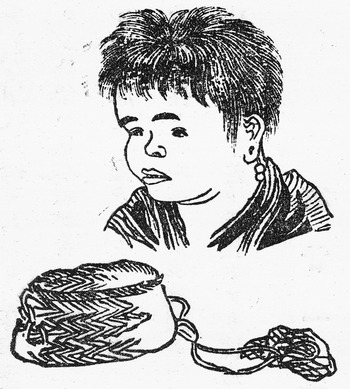
The girl's stay among her military captors did not last long, for she was soon placed in the custody of campaign provisions coordinator Ōkura Kihachirō 大倉喜八郎 to be escorted to Japan. According to a letter the Bureau of Savage Lands presented to Ōkura, the girl was sent to Japan because “though a child, she is female, and thus it would be improper for her to stay in the base camp.”Footnote 40 This letter calling attention to the girl's gender (and the sexual threat that had implicitly been averted by her removal from the men's presence) was reprinted in Ginkō's newspaper just a few days after it first reported her capture. The same issue also gave readers their first glimpse of the girl when it printed Ginkō's sketch of her (Figure 2), allowing them to vicariously share the male gaze that had figured so prominently in his earlier report. The illustration appeared along with accompanying text that reiterated Ginkō's belated discovery of her affinity with rural Japanese and the soldiers' stirred memories of home: “Her looks are not so different from the folk who live in the hills and valleys of remote regions.”
Sketch, believed to be by Kishida Ginkō, of the Taiwan aboriginal girl and the small vegetable basket she carried when she was taken into Japanese custody. TNNS, June 29, 1874.

Not long after this first sketch had appeared, the image of the “Peony Girl” began to be disseminated through another emergent medium: commercial photography. Just as Ginkō made history as the first Japanese war reporter, pioneering photographer Matsuzaki Shinji 松崎晋二 had been chosen to travel along with the Expedition, documenting its progress with his camera.Footnote 41 Ginkō frequently referred to the photographer's activities in his newspaper. After describing in one dispatch how Matsuzaki had captured a “panoramic view” of the Shimen 石門 battle site, an image of Japanese “tents lined up along the beach at Langqiao 琅 ,” and photographs revealing the appearance of “both male and female natives,” Ginkō went on to impress upon his readers the significance that Matsuzaki's visual record held, for it would allow the domestic audience to learn of the campaign's “bitter trials” and also to “see the actual scenes of the Taiwan savage regions before their very eyes.”Footnote 42 There is much in Ginkō's statement that recalls the uses to which European nations put photography both on the battlefield and in the colony. James Ryan notes how panoramic battle scenes were “designed to show the scope and order of the campaign,” an effect presumably also conveyed by the photograph of the tents that Ginkō mentions.Footnote 43 The photographs of “male and female natives” sound very much like the anthropometric photographs popular in nineteenth-century England, a category of image that Ryan argues was often consumed with specific comparison to lower social orders at home: much in the same way that an analogy was drawn between the features of the “Peony Girl” and those dwelling in Japan's “remote regions.”
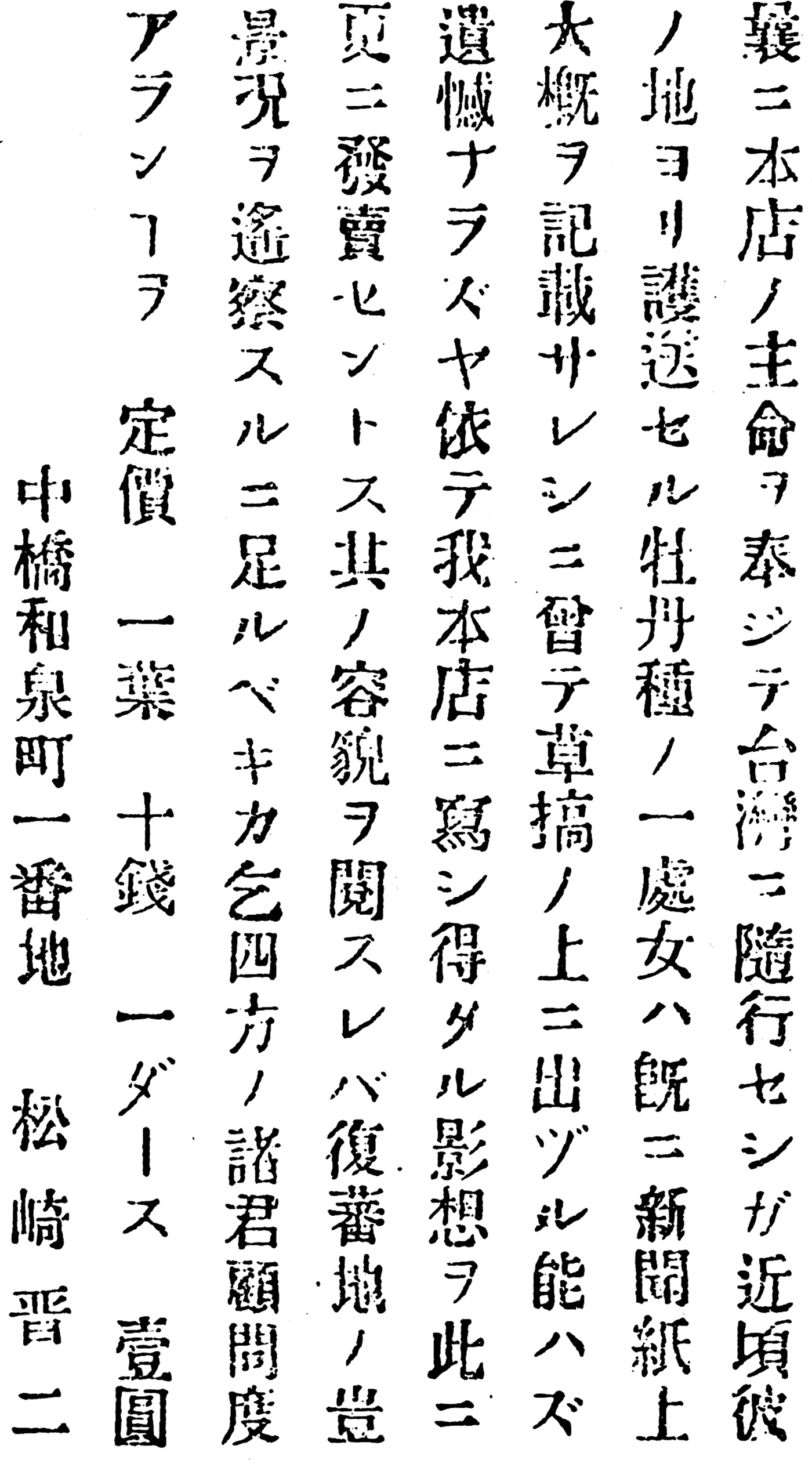
Unfortunately, almost all of the photographs Matsuzaki took during his stay in Taiwan are no longer extant. The sole exception is his photograph of the “Peony Girl” (Figure 3). That the photograph of the “Peony Girl” survives while the other photographs Matsuzaki took during the campaign have been lost indicates that it enjoyed particularly widespread circulation. In fact, even before Matsuzaki himself had returned from Taiwan, his photography studio was already selling her photograph. A newspaper advertisement (Figure 4) invited consumers to purchase the photograph of the “Mudan maiden,” either individually or by the dozen, so that they might gaze upon her and thereby glimpse “the far-off savage regions.”Footnote 44 Both the appeal to exotic voyeurism that this advertisement makes as well as the mode of consumption Ginkō suggested for Matsuzaki's Taiwan photographs partake of the rhetoric of aboriginal savagery. They allowed the viewer to contrast “people who live in its savage regions” to “people like us” and thereby reconfirm their sense of their own and Japan's status as civilized. At the same time, however, as the advertisement copy noted, the Peony Girl's story was already familiar to potential consumers from the detailed coverage about her in the newspapers. While it resembled a generic ethnotype image, Matsuzaki's image was also a photograph of a specific individual with a well-known history. A cognizance of the events that had transpired subsequent to her capture and the taking of the photograph would have been the premise through which many consumers encountered it.Footnote 45
Wantō Botan shōjo; toshi 12 sai (“Mudan/Peony girl from the island of Taiwan, age 12 years”; reproduced by kind permission of Morita Mineko 森田峰子, Morita Photography Office). Albumen print of a photograph believed to have been taken by Matsuzaki Shinji in June 1874. From the album of Kitashirakawanomiya Yoshihisa 北白川宮能久 (1847–1895). Morita Mineko explains that the hand visible to the left of the image has been placed atop the girl's head to prevent her from moving while the photograph was taken. The verso of the photograph is inscribed: “This is the girl who was standing in the middle of the road when the houses of the Niinai tribe in the savage lands of Taiwan were burned on June 3, 1874”; see Morita Reference Morita Mineko2002, esp. pp. 54–60.

Advertisement, TNNS, July 15, 1874. The text reads “Not long ago, the master of our shop received an order and was sent to accompany the expedition to Taiwan. The story of the Mudan maiden who has recently been escorted forth from those shores has been recorded in its basic outline on the pages of the newspaper. But is it not regrettable that she was unable to appear in anything more than a sketch? For this reason, we are planning to make available for sale the image that our shop took of her. By just examining her appearance, surely one can catch a glimpse of the scenery of the far-off barbarian regions. We hope that people from all over will take an interest. The price of the print is ten sen, or one yen for a dozen. Nakahashi Izumichō Ichibanchi Matsuzaki Shinji.” As historian of Japanese photography Morita Mineko notes, this advertisement offers the best evidence that the extant image of the Taiwanese aboriginal girl was taken by Matsuzaki Shinji, but his name is not inscribed on the photograph itself (Morita Reference Morita Mineko2002, pp. 55–56).

The spectacle of “savagery” to which the advertisement appeals was invoked not only to peddle the Peony Girl's photographs, but, at least in the earliest stages of her stay in Japan, it was also adduced by some newspapers to explain the government's decision to send her to Japan in the first place.Footnote 46 An item appearing in a Yokohama paper a few days prior to the girl's arrival in Tokyo stated that it was Commander Saigō's intention to “clearly inform the government about the savage nature of the barbarian tribes by sending a girl of about twelve so that they might have a glimpse.”Footnote 47 Yet even while suggesting the Peony Girl might serve as a visual embodiment of the “savage nature” of the Taiwanese indigenes, this article nevertheless went on to draw the same domestic connection that Ginkō had made, quoting the opinion of an eyewitness who stated: “She seemed no different from a Japanese of the lower orders. Her dark skin was also like that of a Japanese laborer exposed to the sun … She will no doubt be completely acclimated to Japan in no time.”
Any further agenda for the Peony Girl's stay had yet to be clearly articulated at this point, but it is worth noting that the phrase translated here as “acclimated to Japan” (Nihon no fūki ni kasuru 日本の風氣に化する) is suggestively ambiguous. It could either indicate adjustment to Japan's natural climate or “assimilation to Japanese customs.” Ultimately it was the latter meaning that prevailed in defining the program for the Peony Girl's stay in Japan, as a letter sent by the Bureau of Savage Lands to Saigō a few weeks later on 17 July proves: “It is improper for her to be simply detained. Yet it is also pointless to vainly return her to the savage lands, and thus it is desirable for her to be guided and acculturated here so that she may be of service to our long-term plans.”Footnote 48 While the Bureau did not disclose what these long-term plans might be, it ordered the girl transferred to the care of Tokyo resident Ueda Hatsutarō 上田発太郎, who would oversee this program of acculturation.
Yamamoto Yoshimi has concluded from her survey of related Japanese government documents that the authorities initially had no clearly defined aim of “acculturation,” and suggests that they decided upon this course after the fact, “in order to keep up appearances.”Footnote 49 Given the widespread circulation of her story and dissemination of her images, it would not be surprising if the authorities were attentive to popular opinion about the girl.Footnote 50 Moreover, as we have seen, alongside the caricatures of savagery that were rife in contemporary newspapers was a countervailing portrayal of the aboriginal population in a docile, amenable, and even childlike guise. This rhetoric of aboriginal civilization made “acculturation” a readily available narrative arc for the Peony Girl's story to trace. However belated the authorities' articulation of this aim may have been, they acted quickly to make it public. Newspaper readers learned of it just a few days later when the Tōkyō nichi nichi shinbun introduced Ueda as the girl's new guardian, vouching for his “supreme kindness,” not to mention the government's “supreme benevolence.” The newspaper even quoted the document outlining the conditions under which the girl had been released to Ueda, which unmistakably focused on promoting her assimilation and “civilization”:
1. The nature of her treatment while in your care shall be devoted to inculcating in her the customs and manners of the Imperial nation, and she shall therefore be given instruction that is based upon reverence and civility.
2. With regard to eating and drinking, dress, and comportment, it will be necessary to appoint an honest and pure woman to be beside her always and carefully guide her, accustoming both her speech and her conduct to the fine ways of the Imperial nation.
3. Her governess shall teach her to write and sew.Footnote 51
The remaining items went on to stress Ueda's responsibility for the girl's wellbeing and noted that expenses associated with her care would be borne by Japan's treasury. One aspect of Japanese society that had received especial attention in the early years of Meiji was the education of women. Inasmuch as the inferior status of women had been identified by Fukuzawa and other Meiji intellectuals as a characteristic of “half-civilized” societies, providing this sort of educational program for the young girl thus took on particular significance as a means of demonstrating Japan's civilizing role.Footnote 52
Though extensive, the coverage of the “Peony Girl” in the Tōkyō nichi nichi shinbun reached mainly the educated audience that could read serious newspapers. A broad readership nevertheless had access to her story in part through the illustrated books about the Taiwan Expedition that began to appear even before the mission had formally concluded. The five-volume Taiwan gunki 臺灣軍記, for example, was published in August 1874, and drew heavily upon Ginkō's dispatches, integrating them into a smooth and easily understandable narrative. In recounting the Peony Girl's capture, Taiwan gunki joined Ginkō in speculating that perhaps the girl's “feeble-minded nature” explained why she had not instinctively fled from the Japanese soldiers. The girl's hair, earrings, expression, and posture in the accompanying illustration likewise resembled Ginkō's sketch, but by showing her abandoned and clutching her basket beneath a Japanese soldier, the Taiwan gunki illustration made the girl seem even meeker (Figure 5).Footnote 53 As had Ginkō, the Taiwan gunki text focused particular attention on the presentation of the yukata and obi that occasioned her transformation in the presence of the assembled soldiers:
When they dressed her in these garments, it seemed – for she was a human being too after all – that they beheld a Japanese maiden before them. So long had they been deprived of seeing one that immediately feelings of homesickness arose in their hearts.Footnote 54
The explicitly stated awareness that “she was a human being too” counterbalances some of the bestializing language that contemporary newspapers used in reference to the girl, and similar discoveries of shared humanity would become a standard feature of future reports about her.Footnote 55 In his analysis of the Japanese colonial discourse about Taiwan that developed a generation later, Leo Ching points out how the recognition of “a common humanity” was indispensable to “affirming the savage's potential for civilization.”Footnote 56 The text of Taiwan gunki further highlighted this potential by detailing the girl's escort to Tokyo and the education that she was to receive there. Distilling the official directive that had been published in Ginkō's newspaper, Taiwan gunki explained that the girl would “learn language and comportment of course, but also handwriting, sewing, and all of the occupations a woman ought to pursue,” her caretakers bound to make “single-minded efforts to assimilate her to the customs of the Imperial land.”Footnote 57
Illustration from Tashiro 1874, IIIa, pp. 9b–10a (reproduced by kind permission of the Institute for Research in Humanities, Kyoto University). The caption reads “When the imperial army was about to strike the Mudan, they captured one girl.”

Bringing the girl to Tokyo so that she might undergo such a program made sense within the rhetoric of aboriginal civilization that had been elaborated in the city's newspapers prior to her arrival. The “civilizing” component of Japan's campaign against Taiwan and its feasibility had been prefigured most pointedly by the scene of transformation described in Ginkō's reports and recapitulated in popular works such as Taiwan gunki. Given the episode's symbolism, it was not surprising that this scene was chosen as the subject of a color newspaper woodblock print (shinbun nishikie 新聞錦絵) just a few months later. Published in October, the image depicts the girl's metamorphosis at the Taiwan battle camp and identifies her as the “Peony Girl” in its single cartouche (Figure 6). Some of the newspaper reports about the girl had mentioned her confusion and inability to communicate with her captors as evidence of supposed dim-wittedness; as art historian John Szostak has pointed out, the illustrator's rendering of her facial features as “small in proportion to the size of her head” gave her “a dull look” that visually manifested such descriptions.Footnote 58 Certainly the broadsheet, like the Taiwan gunki illustration, made her look vulnerable, which served to underscore the mercy that the Japanese government, represented here by Commander Saigō, had shown to her. Yet in this representation, Saigō's munificence entailed not just the garments, but his decision to send her to Japan, for her journey there is specifically referenced in the broadsheet's inscription:
Who first called the peony “twenty-days-grass”? Though she is shy to speak, leaving words unsaid, the Peony Girl has been kindly presented by the battle chief with fine clothing. Not eight-fold, but opening singularly, it is an august age full of blessings profound as the Yashio seas that she has traversed, and this is the portrait of the docile little girl. The details can be found in the newspaper.Footnote 59
Elaborate wordplay characterized the texts of such newspaper broadsheets, and the profusion of floral and numeric terms that we see here is a form of engo 縁語 (related wordplay). The term hitoe 一重, moreover, suggests “single-petal” in contrast to the typical peony's yae 八重 (lit. “eight-fold”) double-petals, but the same term also indicates a “single layer garment” such as the yukata she receives, and is further used to describe the “steady” or “progressive” (hitoeni ひと重に) development that is held to define the era.Footnote 60 In this way, the text's various devices, puns, and double meanings offer not just lexical diversion, but also stress the “civilizing” dimension of the episode. The Peony Girl's incorporation into Japan's august age (miyo 御代; lit. “imperial reign”) of civilization was encoded by her new Japanese garments and arrival on its shores, but underscored in the inscription's use of the term matsurau, an archaic term for “follow” or “submit” typically used in reference to a subject's obedience to the imperial sovereign.
Tōkyō nichi nichi shinbun 726 gō (Rikken Collection, reproduced by kind permission of Chiba City Museum of Art). The print was made in October of 1874, and is based on an article from the June 26, 1874 newspaper. The artist is Ikkeisai Yoshiiku, the carver is Watanabe Chōei, and the publisher is Gusokuya. The author of the inscription is identified with a red stamp as Momokuri Sanjin (1828–1898). See Chiba-shi Bijutsukan Reference Chiba-shi Bijutsukan2008, p. 33. (A color version is available at journal.cambridge.org/ASI).

These images of the Peony Girl proliferated in Japan at a time when hostilities on Taiwan had virtually ceased. The Mudan and other indigenous groups had already surrendered and Japanese newspapers had declared the success of the effort to pacify the aboriginal regions. A formal conclusion to the Taiwan Expedition had yet to be reached, however, and negotiations with the Qing dragged on through the summer months. During this time, the girl's caretaker submitted occasional reports to the authorities detailing the course of her education and answering their queries as to the extent of her naturalization (kōka 向化).Footnote 61 In the first, submitted in August, Ueda explained that “she is almost able to communicate, and she also comprehends manners and interaction; when she sees someone she shows affection and she also seems to grasp the feelings of people from our Imperial land.”Footnote 62 Ueda also wrote that her progress had left him optimistic about the course of her naturalization, but that it was his intent to proceed slowly. Several weeks later, he reported to the authorities that she had begun receiving instruction in calligraphy and reading at a local academy.Footnote 63 The girl continued this curriculum into the autumn, but by then a consensus had begun to solidify in the Japanese government that it should negotiate for an indemnity and withdraw its beleaguered troops from Taiwan.Footnote 64 No sooner had these negotiations been concluded in Beijing than the decision was made to send the Peony Girl back home, and Ueda was ordered to submit his final report. Shifting his tone slightly, Ueda wrote that in spite of the best efforts of her teacher, governess, and Ueda himself, she had made little progress in reading and seemed to have no interest in studying calligraphy or sewing, perhaps on account of her “rustic temperament and dull nature.” Nevertheless, he concluded, the girl had “become adjusted in her everyday language and behavior,” had come to grasp social distinctions, was emotionally responsive, and “could be naturalized with more time.”Footnote 65
Clearly Ueda understood his charge in terms of assimilating the girl to Japanese cultural practices, and it is significant that he remained optimistic about the possibility. The contemporary discursive context, awash though it was with the exaggerated rhetoric of aboriginal savagery, lent support to Ueda's conclusion because it also included narratives of aboriginal civilization. Written many years later, Saigō Tsugumichi's biography states that it was with the hope that “she would pave the way for the inculcation of the savages” that the Peony Girl had been brought to Japan, and notes that when she returned to Taiwan “in the form of a splendid Japanese maiden … everyone was surprised by the impressive results of her education.”Footnote 66 While we lack any firm evidence of Saigō's initial intent in sending the Peony Girl to Japan, by the time she had returned, the program of “civilization” was unquestionably the official narrative. Upon conveying the girl to the aboriginal headmen, Saigō presented a letter in Chinese to them that made this aim explicit:
The girl whom we apprehended was still quite young in years, and naturally of a simple temperament; if we taught her, she could be led; if we trained her, she could be transformed. For this reason, we sent her to our country.Footnote 67
After detailing her teachers' various efforts, Saigō praised her progress and admonished the aboriginals to look to her as a model:
It is clear that the schoolwork she has studied and the forms of proper behavior she has cultivated will develop further as time goes on … Having returned to her native land, she can be a symbol of the principle of enlightenment and a first step toward the transformation of barbarity.
The Qing officials who observed the girl's return for their part seemed reluctant to fully embrace Saigō's sweeping claims, but they did offer the following terse response: “Your honorable country's benevolent authority has certainly extended to this savage girl. We express our utmost admiration.”Footnote 68
While this civilizing project culminated in the apparent transformation of the “savage” girl into a recognizable “Japanese maiden,” the intertwining of the rhetoric of savagery and civilization in the discursive sphere of the time meant that a complete transformation would forever be deferred. In spite of her refiguration as a Japanese maiden, the girl nevertheless continued to be known in Japanese by generic names that specified her “savage” origins. Associating her with Japan's presumed adversary in the conflict, many texts dubbed her the “Mudan/Peony girl.” Her adoptive father Ueda Hatsutarō gave her the name “Otai” (written in katakana), calling her to stand for an even larger entity, Taiwan. Her re-integration into her native village seems to have been no easier. According to the biography of Saigō, “Otai became sick and died a few years after she returned to the Ninai village.”Footnote 69
CONCLUSION
The aim of this article has been to recuperate a neglected dimension of early Meiji discourse about Taiwan's indigenes, showing how a rhetoric of aboriginal civilization had begun to be articulated in Japanese media prior to the Peony Girl's arrival and arguing that it gave coherence to narratives focused upon her acculturation. Recognition of a common humanity was one consistent element of this rhetoric, but it was also characterized by the postulation of a more specific affinity with Japan, as adduced by the Peony Girl's resemblance to ethnic Japanese or by her assimilation of Japanese cultural forms. Such emphasis on resemblance and assimilability merits attention because several scholars who have situated Japanese imperialism in a comparative context identify precisely this stress on similarity between colonized and colonizer as an aspect that sets the Japanese case apart from the Western colonial powers that have largely informed postcolonial theory. To take the most recent example, in his 2010 study of representations of the “savage” during Japan's formal colonial period (1895–1945), Robert Tierney identifies the “rhetoric of similarity” as a distinguishing feature of Japanese colonial discourse, a point that Karatani Kōjin and others have made as well.Footnote 70 Moreover, we know that during the height of the colonial era, such rhetoric was applied not just to Japan's more ethnically similar East Asian colonial subjects in Korea and Taiwan, but to the indigenes inhabiting Japan's colonies in Taiwan and the South Seas. That this more capacious rhetoric should so clearly manifest itself in 1874 is all the more remarkable because we tend to associate it with much later developments.Footnote 71 We might also consider the mode of representation that looked upon the Taiwanese indigenes as docile and tractable. In his monographic study of Japanese colonial rule on Taiwan, Yamaji Katsuhiko posits a “rhetoric” portraying the Taiwanese indigenes as “cute children” that he argues became prominent from the late 1920s onward.Footnote 72 As we have seen, infantilizing rhetoric was mobilized to represent the Taiwanese aboriginal population in the 1870s as well, the Peony Girl being perhaps the clearest example.Footnote 73
Recent research has begun to demonstrate the ways in which the events of the 1870s cast a long shadow over Japan's subsequent policies toward the indigenous population. A special series published in the journal Taiwan genjūmin kenkyū 台湾原住民研究 in 2007 offered three scholars the chance to re-examine the incident from a variety of disciplinary orientations but with the shared goal of understanding the events from the perspective of the indigenous Taiwanese. Devoting particular attention to the Peony Girl's story, Yamamoto Yoshimi's article examines documents in government archives, using them to reconstruct the girl's experience. Contemporary commentators and later scholars alike have speculated that the Peony Girl was “mentally impaired,” but Yamamoto suggests instead that she may have suffered from something akin to “post-traumatic stress disorder.”Footnote 74 In the same way that Yamamoto sees the Taiwan Expedition as “foreshadowing” Japan's future colonization of Taiwan, another Japanese anthropologist contributing to this series, Yamaji Katsuhiko, connects the events of the 1870s to those of the 1890s and beyond. He argues on the one hand that the “lurid” and “shocking” “figure of the savage” that emerged during the Taiwan Expedition would be “called to mind” again twenty years later, while on the other that the effort to educate the Peony Girl was an early appearance of principles that would guide later policy toward the aboriginal population in the colonial era.Footnote 75 Finally, Taiwanese aboriginal historian Valjeluk Mavaliu discusses his research into surviving oral traditions with the aim of recounting the events of the 1870s from a vantage point thus far ignored.Footnote 76 Field interviews enabled Valjeluk and his son to determine that the family name of the Peony Girl/Otai was Pasedjam and they also collected orally transmitted accounts concerning her frustrated attempts to introduce Japanese cultural practices to her village. In this and other writings, Valjeluk portrays the girl as something of a forerunner, and ponders how Japan's future colonization of Taiwan might have turned out differently had the girl's efforts been accepted at this stage by her fellow villagers.Footnote 77 The work of these scholars, all of whom have a deep knowledge of aboriginal Taiwanese culture, has illuminated the episode and contextualized it in new and important ways.
This article has also sought to contextualize the Peony Girl's story, but has taken a different approach. Rather than seeing her experience in Japan as a prelude to later developments, it has sought to analyze the event in its early Meiji context, showing how images and narratives of the event drew upon the twin rhetorical modes of aboriginal civilization and savagery. It has resisted assuming a pre-ordained arc for the Peony Girl's narrative, instead seeking to shed light on how this evolving discursive context established the basis for its intelligibility and even shaped its unfolding. In the same way that Saigō's act of sending the Peony Girl to Japan could be read as either an opportunity to make a spectacle of her supposed “savage nature” or as part of an ambitious project of “civilization,” the basic events of the Peony Girl's story did not belong intrinsically to either rhetorical mode. One of the first illustrated books to give a complete account of the Expedition was Tai Shin kiji 臺清紀事, published in the year after the settlement had been reached. This text, which was mainly concerned with celebrating modern Japan's first overseas military triumph, held that the Peony Girl was “truly a little savage child,” an otherness heightened in its comparatively traumatic rendition of her capture (Figure 7). While Tai Shin kiji did narrate Saigō's presentation of garments, it made no mention of any ensuing transformation, and dwelt not on her acculturation but on her “great fortune” in receiving the Japanese government's material munificence.Footnote 78
Illustration from Tsue Reference Tsue Satarō1875, I: 19b–20a (reproduced by kind permission of the Institute for Research in Humanities, Kyoto University). The caption reads “An image of the imperial forces capturing a savage girl as they prepared to strike the Mudan.” This image was subsequently included in Imbault-Huart Reference Imbault-Huart1893, plate 18, p. 137. Curiously, however, the French text does not narrate her capture nor does it make any reference to her subsequent “civilizing” journey to Japan. The text opposite her image instead focuses on a different form of “barbarity”: that of the Japanese soldiers who gathered Mudan heads. Seeing this as a “revival of the ancient customs of the old days of feudal Japan” by which enemy heads were collected as “trophies”, the French text observes: “The little Japanese soldiers, excited by the victory, returned to these old traditions, reported to camp and triumphantly exposed the heads of the Botan … It was in vain, claims one author, for General Saigō to try to abolish this barbaric custom.”

As Tai Shin kiji confirms, the widespread circulation of the Peony Girl's story and the rhetoric of aboriginal civilization through which it could be read had by no means put an end to the rhetoric of aboriginal savagery. These modes were intertwined and interdependent, often appearing alongside each other within a single text. The popular children's series Meiji taiheiki 明治太平記, for example, contained a ghoulish image of Taiwanese aboriginal cannibalism, yet the rhetoric of aboriginal civilization also figured prominently in the text's recounting of the Peony Girl's story.Footnote 79 In reporting her capture, the text closely followed the content and diction of Kishida Ginkō's reportage, retelling her famous donning of the yukata and obi before the Japanese soldiers. The illustration accompanying the scene (Figure 8) uses roughly the same composition as the shinbun nishikie image, but with several changes that enhance the portrayal of the mission as a benevolent and successful effort to civilize the indigenes. The soldiers' posture and facial expressions convey greater softness and warmth, their weapons are much less prominent, and one even holds her hand as he seems to speak to her solicitously. Gone from the foreground are the Peony Girl's discarded native garments, she wears a furisode that makes her seem even more childlike, she holds her head up, and her facial features are noticeably more Japanese. In the Meiji taiheiki account, the Peony Girl was far from a fearsome savage lurking off on the periphery, but was instead a familiar and immediate presence in Tokyo, a point the text brought home when it suggested that “there are surely those who have seen her in person.”Footnote 80 When the same text narrated the Peony Girl's return to Taiwan, it closely followed Tai Shin kiji in its description of the material comforts she had enjoyed in Tokyo, but noted her Japanese language study and Ueda's “most heartfelt instruction” of her.Footnote 81 The accompanying illustration (Figure 9) likewise depicted her in Japanese dress, eating with chopsticks, and receiving a range of distinctly Japanese gifts. As the narrative and illustrations in Meiji taiheiki clearly show, the representations of the Peony Girl often focused not on aboriginal alterity but rather on the aboriginals' latent affinity with Japan and their potential for assimilation.
Illustration by Kobayashi Eitaku 小林永濯 (Sensai 鮮斎, 1843–1890), appearing in Murai Reference Murai Shizuma1876, IXb: 8b–9a (reproduced by kind permission of the University of Tokyo Library System). The caption reads “At the base camp, the Commander presents a little girl from the savage areas with clothing.”

Illustration by Kobayashi Eitaku, appearing in Murai Reference Murai Shizuma1876, XIa:14b–15a (reproduced by kind permission of the University of Tokyo Library System). The caption reads “A young girl from the savage regions stayed in Tokyo for a while. When peace negotiations were concluded, she was given a hearty send-off.”

Fukuzawa Yukichi's early best-selling writings had provided Japanese readers at the time of the Taiwan Expedition with a basic framework that distinguished poles of “savagery” and “civilization” and suggested that present-day Japan might be located somewhere in between. In the treatise that he published just a few months after the Taiwan Expedition had ended, Bunmeiron no gairyaku (“Outline of Theories of Civilization”), Fukuzawa further simplified his schema of human development to just three stages – barbarous, half-civilized (hankai), and civilized – and stated clearly that Japan occupied the middle position. Far from disavowing this medial position, Fukuzawa reaffirmed it and even put forth arguments for its strategic potential. While he titled the book's second chapter “Western civilization as our goal,” Fukuzawa was no mere Western apologist; he repeatedly qualified the link between the West and “civilization,” emphasizing that such designations were inherently unstable. Since civilization was constantly moving forward, he observed, what was now considered “civilized” in the West might well be judged “barbarous” at some point in the future. By the same token, those nations of the West that were now at the pinnacle of “civilization” had once been the lowest “savages.”Footnote 82 Moreover, in addition to being variable, these designations were also relative:
Present-day China has to be called half-civilized in comparison with Western countries. But if we compare China with countries of South Africa, or, to take an example more at hand, if we compare the people who dwell near the capital of our Japan with the Ainu, then both China and Japan can be called civilized.Footnote 83
Fukuzawa's choice to restrict his discussion to Japanese “who dwell near the capital” rather than simply to compare all Japanese with all Ainu reminds us of how conceptions of civilization and barbarism were internalized in the Meiji period. Regional and class differences among the Japanese population were recast in the language of civilization, setting lower social orders and rural populations apart from the urban elite. We have seen many instances in which contemporary newspapers describe the Peony Girl as resembling precisely these domestic subjects, reminding us that the process of constructing a homogenous “civilized” image of self against which ethnic others might be definitively contrasted was not yet complete in the early Meiji period. As these parallels suggest, the agenda of civilization that the Peony Girl underwent in Japan – focused as it was on educating her and instilling in her Japanese customs – was in many ways an extension abroad of a program that was already in full swing domestically.