I. INTRODUCTION
Crystalline yttria-stabilized zirconia (YSZ) is commonly used as the electrolyte material in solid oxide fuel cells (SOFC) due to its high oxygen ion conductivity and its stability in both oxidant and fuel environments. However, problems related to cost and reliability require lowering SOFC operating temperatures. To maintain optimal SOFC performance, a number of ways to improve the conductivity of YSZ at these reduced temperatures are being investigated. Doping YSZ with Al2O3 was reported to enhance the low-temperature sintering behaviorReference Radford and Bratton1, Reference Verkerk, Winnubst and Burggraaf2 and scavenge Si impurities,Reference Butler and Drennan3 leading to improvements of mechanical stabilityReference Tsukuma, Ueda and Shimada4 and to a lowering of the thermal expansion coefficient.Reference Badwal5 There are also studies exploring the ionic conductivity of heterogeneous YSZ/Al2O3 composites. A number of studies show that the total conductivity of stabilized zirconia/Al2O3 composites changes with Al2O3 content due to an oxygen ion conductivity in the interfaces different from the bulk (percolation). For multilayers of Ca-stabilized zirconia (CSZ) and Al2O3, an increase by a factor of 60 of the total conductivity is found when decreasing the individual thickness of the CSZ layers from 780 to 40 nm.Reference Peters, Korte, Hesse, Zakharov and Janek6
Differential scanning calorimetry (DSC) is a promising technique to study the kinetics and thermodynamics of reactions in thin films and multilayers.Reference Michaelsen, Barmak and Weihs7, Reference Spaepen and Thompson8 Using this method, Michaelsen et al.Reference Michaelsen, Barmak and Weihs7 calculated the enthalpy of interfaces in metallic Cu/Zr multilayers by investigating the enthalpy of phase transformation as a function of layer thickness.
Only a limited number of calorimetric studies on thin films and multilayers of oxides have been reported in the literature. Zhou et al.Reference Zhou, Ushakov, Wang, Ekerdt, Demkov and Navrotsky9 showed that the crystallization temperature of HfO2 films increased as the layer thickness decreased. The surface and interfacial enthalpies of ZrO2 systems have been reported in previous studies using oxide melt solution calorimetry and DSC. Ushakov et al.Reference Ushakov, Navrotsky, Yang, Stemmer, Kukli, Ritala, Leskelä, Fejes, Demkov, Wang, Nguyen, Triyoso and Tobin10 reported the interfacial energy between tetragonal ZrO2 and amorphous SiO2 as 0.13 ± 0.07 J/m2, which was calculated from the crystallization enthalpies of samples with different crystallite sizes. A recent work showed that the interfacial energy in Zr0.86Y0.16O1.96 samples was 0.73 ± 0.19 J/m2.Reference Chen, Avila-Paredes, Kim, Zhao, Munir and Navrotsky11 Costa et al. found that the interfacial enthalpy of cubic stabilized zirconia with varying yttria content lies in the range 0.9 ± 0.5 J/m2.Reference Costa, Ushakov, Castro, Navrotsky and Muccillo12
In our previous work,Reference Kemik, Ushakov, Schichtel, Korte, Takamura and Navrotsky13 we studied the crystallization of amorphous Al2O3 into a transitional phase in YSZ/Al2O3 multilayers. This crystallization reaction took place around 920 °C, and the presence of YSZ/ Al2O3 interfaces suppressed the crystallization of amorphous Al2O3 such that it occurred at higher temperatures with a less exothermic enthalpy. In the present study, we investigated the effect of interfaces on the YSZ crystallization process in YSZ/Al2O3 multilayers using DSC. Compared to Al2O3, the transition of amorphous YSZ is more distinct, occurs at lower temperatures, and produces only one crystalline phase. This work demonstrates the successful application of thermal analysis to study crystallization in oxide films with thicknesses of individual layers below 10 nm.
II. EXPERIMENTAL METHODS
YSZ/Al2O3 multilayers were deposited at Universität Giessen by pulsed laser depositionReference Chrisey and Hubler14, Reference Willmott and Huber15 using 248-nm KrF excimer laser, 10-Hz pulse rate, and 200-mJ pulse energy. The deposition was performed using 800, 400, and 200 pulses per layer at room temperature with 6 × 10⁻² mbar O2 pressure inside the chamber. The samples are listed in Table I, where the number in the notation represents the YSZ layer thickness in nanometers. The top layer was YSZ for all samples except the YSZ-15A multilayer sample, which had Al2O3 as the top layer. Samples used for thermal analysis and x-ray diffraction (XRD) were deposited on 100-μm-thick Pt foil. A sample for scanning transmission electron microscopy (STEM) with fewer repeats of the layers was deposited on a Si/SiO2 substrate using the same number of pulses per layer as the YSZ-15 samples.
Individual layer thickness (t), number of YSZ/Al2O3 interfaces, mass of YSZ, mole of YSZ, grain size after crystallization, crystallization temperature, and enthalpy for each multilayer sample.

a Calculated using thickness values from STEM images and densities of 3.97 g/cm3 (Al2O3) and 5.93 g/cm3 (YSZ). See text for details.
XRD patterns of the multilayers on Pt foils before and after heating in the DSC apparatus were collected using a Bruker AXS D8 Advance diffractometer (Madison, WI), operated at an accelerating voltage of 40 kV and an emission current of 40 mA with CuKα radiation (λ = 1.5406 Å).
A Cameca SX-100 wave length dispersive electron microprobe (Madison, WI) at accelerating voltage of 15 kV, a beam current of 20 nA, and beam size of 1 μm was used for quantitative chemical analysis. Homogeneity and impurity content were examined by x-ray dot mapping and backscattered electron images.
Preparation of cross-sectional samples for electron microscopy was performed using grinding, dimpling, and ion milling methods. STEM was performed on a sample deposited on a Si/SiO2 substrate and heated to 1000 °C in the DSC apparatus using the same conditions as for the multilayers on Pt foil. The images were collected using a high-angle annular dark-field (HAADF) detector (70 mrads collection semiangle) on JEOL 2500 TEM/STEM (Peabody, MA) at 200 kV.
Thermal analysis was performed using a Setaram Labsys thermal analyzer (Lyon, France) in Ar flow of 20 °C/min with a heat flow sensor with two differential S-type thermocouples. As-received multilayer samples were pressed into disks or folded into squares of ∼5 mm in length with films on the inside surfaces and weighed on a microbalance. Platinum disks with samples were placed directly on the sensor plate, without using crucibles. This provided better contact with a sensor plate and higher sensitivity. To calibrate sensitivity in the experimental conditions, 2–5 mg of quartz (ground single crystal from Gem Dugout, State College, PA) and zirconia (Puratronic from Alfa Aesar, Ward Hill, MA) were wrapped in Pt foil and the α−β transition in quartz (8.3 J/g at 575 °C) and monoclinic–tetragonal transition in zirconia (44.07 J/g at 1199 °C) were used as reference heat effects.
III. RESULTS
From microprobe analysis, the Y/Zr ratio in YSZ films was determined to be 0.18 ± 0.02, which is within experimental uncertainty of the target composition, Zr0.83Y0.17 O1.915 (9.5 mol% Y2O3). Homogeneity of the sample was confirmed by x-ray dot mapping.
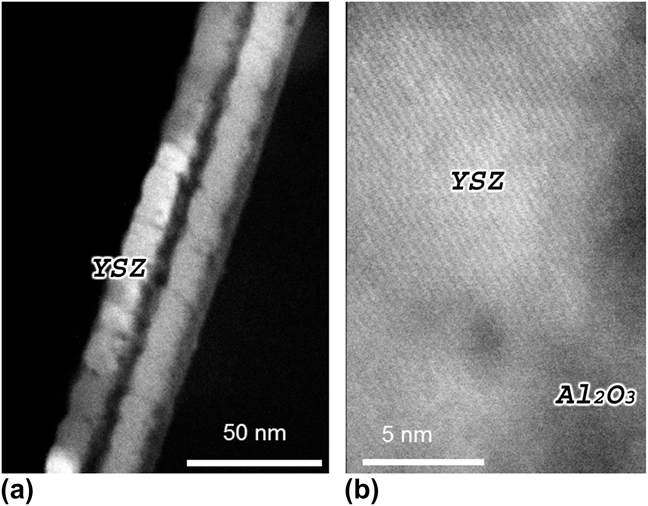
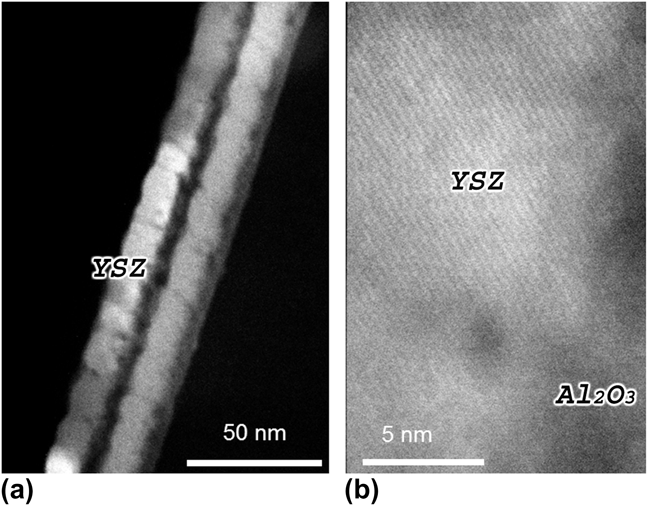
The YSZ growth rate was obtained from STEM images (Fig. 1) of the multilayer deposited on a Si/SiO2 substrate using the same number of pulses per layer as the YSZ-15 samples. Layer thicknesses in the YSZ-8 and YSZ-4 samples are calculated based on the number of pulses assuming a constant growth rate. Figure 1 shows a HAADF image of the multilayer displaying the layered structure with sharp interfaces and negligible intermixing between layers. The bright layers correspond to the YSZ layers and the dark layers to the Al2O3 layers because the contrast in the Z-contrast images approaches the Rutherford cross section (∼Z 2).Reference Browning, Chisholm and Pennycook16, Reference Pennycook and Jesson17 Within the YSZ layers, electron channeling in regions near or in the zone axis make these regions appear brighter than regions further from the zone axis.Reference Pennycook and Jesson17 In addition, lattice fringes are observed in the YSZ layers, which confirm that the YSZ layers crystallized during the heat treatment. The lattice fringes correspond to the [111] planar spacing of cubic YSZ, ∼2.97 A.
(a) Z-contrast scanning transmission electron microscopy (STEM) images of multilayers on Si/SiO2 substrate after heating to 1000 °C in Ar. The bright layers are yttria-stabilized zirconia (YSZ) and the dark layers are Al2O3. YSZ thickness was determined to be 15 nm. (b) Higher magnification image showing the lattice fringes in the YSZ layer.
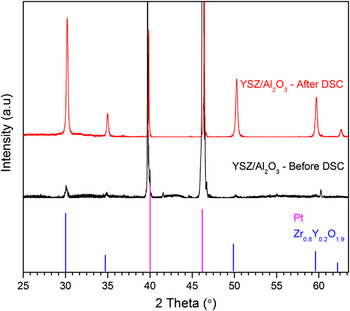
XRD patterns of as-received samples indicate traces of crystalline YSZ in addition to the peaks corresponding to the (100) and (111) reflections from the Pt foil. After heating in the DSC, only the peaks corresponding to the Pt foil and crystalline YSZ with lattice parameters consistent with a composition Zr0.8Y0.2O1.9 (Fig. 2) are observed. The average grain size after crystallization was calculated using the Scherrer formula based on the full width half maxima of the (111), (200), (220), and (311) reflections (Table I).
X-ray diffraction patterns of YSZ-15A before and after heating in differential scanning calorimetry apparatus. The reference powder diffraction lines are Pt (PDF #040802) and Zr0.8Y0.2O1.9 (PDF #821246).

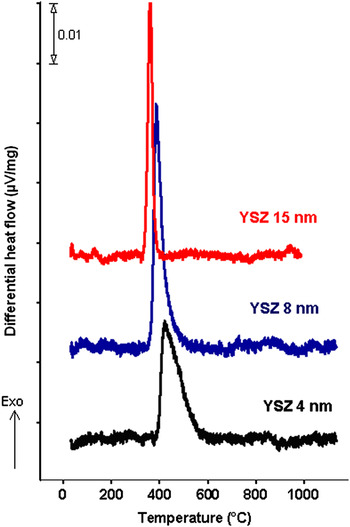
DSC traces of the multilayer samples are shown in Fig. 3. A single exothermic peak is observed on the first heating for all samples. Based on the XRD and STEM analysis, the peak is assigned to the crystallization of the YSZ layers. The Al2O3 layers remain amorphous after the heat treatment. As the YSZ layer thickness increases from 4 to 15 nm, the YSZ crystallization peak becomes narrower, the onset temperature decreases from 404 to 343 ± 1 °C, and the crystallization enthalpy changes from −26 to −12 ± 2 kJ/mol. This variation is significant compared to the uncertainties obtained from the analysis of two YSZ-15 samples. The temperature and the enthalpy of crystallization from the DSC measurements for each multilayer sample are listed in Table I.
Differential heat flow on heating of multilayers on Pt foil substrate with 4-, 8-, and 15-nm-thick YSZ and 2–6-nm-thick Al2O3. The exothermic peaks correspond to the crystallization of YSZ, Al2O3 layers remain amorphous at this temperature.

IV. DISCUSSION
Increasing crystallization temperature with decreasing size or film thickness has been observed in many amorphous material systems: Al2O3, ZrO2, HfO2 films and nanoparticles,Reference Zhou, Ushakov, Wang, Ekerdt, Demkov and Navrotsky9, Reference Ushakov, Navrotsky, Yang, Stemmer, Kukli, Ritala, Leskelä, Fejes, Demkov, Wang, Nguyen, Triyoso and Tobin10, Reference Kemik, Ushakov, Schichtel, Korte, Takamura and Navrotsky13 and for Si in amorphous Si/SiO2Reference Lu, Lockwood and Baribeau18, Reference Zacharias, Blasing, Veit, Tsybeskov, Hirschman and Fauchet19 and in Ge/SiO2Reference Williams, Bittar and Trodahl20 multilayers. In this study, we observe a similar trend for YSZ crystallization temperature in YSZ/Al2O3 multilayers.
The crystallization enthalpy of nanomaterials and layered structures is expected to be different than that of the bulk due to the presence of surface and interface areas. The interface related effects in crystallization enthalpy can be expressed with the following relation:

where ΔH cryst nano is the crystallization enthalpy of a material with a high surface or interfacial area and ΔH cryst bulk is the hypothetical crystallization enthalpy of the same material with negligible contribution from surfaces/interfaces. IAcryst and IAam are the interface area of the crystalline and amorphous material, respectively, and γcryst and γam are the interfacial enthalpies of crystalline and amorphous material, respectively, where interfaces include grain boundaries, surfaces, or interfaces in multilayers.
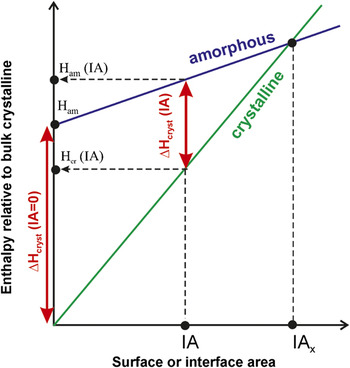
Unless the interface area is reduced upon crystallization, which is excluded in the multilayer geometry, one would expect that the enthalpy of crystallization becomes less exothermic with increasing surface/interface area. Figure 4 schematically illustrates these relations. Such a change in crystallization enthalpy was reported for ZrO2 nanoparticles, HfO2 films, and Al2O3 films.Reference Michaelsen, Barmak and Weihs7, Reference Ushakov, Navrotsky, Yang, Stemmer, Kukli, Ritala, Leskelä, Fejes, Demkov, Wang, Nguyen, Triyoso and Tobin10, Reference Kemik, Ushakov, Schichtel, Korte, Takamura and Navrotsky13 The increase in crystallization temperature of Al2O3 films with decreasing thickness reported in our previous studyReference Kemik, Ushakov, Schichtel, Korte, Takamura and Navrotsky13 and the persistence of amorphous Al2O3 films with thicknesses below 6 nm for temperatures up to 1000 °C observed in this work are in agreement with these earlier observations.
Interface effects on crystallization enthalpy. H cr(IA) and H am(IA) represent enthalpies of crystalline and amorphous phases, respectively, with interface area (IA) and with respect to bulk crystalline phase. The slopes of the solid lines represent the interface enthalpies of amorphous and crystalline phases. ΔH cryst(IA), indicated by the arrow, is the crystallization enthalpy observed for a fixed geometry in thin films or multilayers. IAx is interface area at the stability cross-over above which amorphous phase becomes thermodynamically stable.

However, for the YSZ layers studied in this work, the trend described above in the crystallization enthalpy is reversed. The most exothermic crystallization enthalpy of −26 kJ/mol is observed for the 4-nm-thick layers, which possess the largest interface area per mole of YSZ among the samples studied. Notably, this value of enthalpy is more exothermic than the previously reported values for the crystallization of amorphous YSZ powder of similar composition obtained by precipitation (−11 to −13 kJ/mol,12 −20 kJ/molReference Ushakov, Brown and Navrotsky21). If the difference in enthalpy of crystallization for the multilayer samples with varying thicknesses is due to an interfacial effect, this would imply that the enthalpy of amorphous Al2O3/amorphous YSZ interfaces exceeds the enthalpy of amorphous Al2O3/cubic YSZ interfaces.Reference Kemik22 However, interfacial enthalpies for amorphous solids are typically smaller than those of crystalline solids. In addition to experimental evidence in numerous systems, this fact follows from a simple consideration that at room temperature, the density of an amorphous solid will be lower than that of crystalline solid of the same composition and thus the number of bonds that need to be broken to create a new surface will be smaller.
A more likely explanation is that the observed enthalpy variation arises due to the difference in ΔH cryst bulk of YSZ layers of different thickness. Ideally, this term would correspond to the crystallization enthalpy of the totally amorphous phase, analogous to a glass, of the same composition. Since neither YSZ nor other oxides such as Al2O3, HfO2, and ZrO2 can be quenched to a glass phase, this term is not directly measurable and the only constraint on its value, representing an upper bound in magnitude, would be the fusion enthalpy. For this composition, the fusion enthalpy is likely to be close to 100 kJ/mol.Reference Bergeron and Risbud23 The increasingly exothermic enthalpy observed as the YSZ film thickness decreases may be due to the presence of a truly amorphous film only in the multilayers with the thinnest YSZ layers.
The experimental study of thermodynamics of thin oxide films and multilayers is a largely unexplored field. We demonstrated that the energetics of thin films and multilayers on Pt foils can be studied by traditional thermal analysis. The detailed characterization of the initial and final states of the multilayers and the structure of the interfaces is essential to determine values for the interfacial enthalpies.
V. CONCLUSIONS
DSC was used to measure the crystallization temperatures and enthalpies of Zr0.83Y0.17O1.915/Al2O3 multilayers on Pt foil. Decreasing the YSZ layer thickness from 15 to 4 nm caused an increase in the crystallization temperature by ∼60 °C and the crystallization enthalpy become ∼10 kJ/mol more exothermic. The results suggest a higher degree of disorder, or absence of crystallinity, exists in thinner YSZ layers.
ACKNOWLEDGMENTS
The authors thank Ricardo Castro for insightful discussions of the calorimetric data. The work at UC Davis was supported by the U.S. Department of Energy (for DSC) (Office of Basic Energy Sciences Grant No. DEFG-02-03ER46053) and by the National Science Foundation (for sample preparation) (grant DMR 0747896).