Introduction
Despite adequate efforts to treat obsessive–compulsive disorder (OCD), a significant number of patients remain symptomatic and live a life with significant disability and compromised quality.Reference Lambert 1 To enhance the therapeutic effect of antiobsessional medications, various treatment strategies have been tried with varying degrees of success. Classically, the treatment strategies for management of OCD follow strategies such as dose optimization, switching to another medication, augmentation, and combining different antiobsessional medications or psychotherapy (cognitive behavior therapy or exposure response prevention).Reference Skapinakis, Caldwell and Hollingworth 2 Existing evidence support that a combination of antiobsessive medications with psychotherapy is superior to drug therapy or psychotherapy alone.Reference Skapinakis, Caldwell and Hollingworth 2 Various neuromodulation techniques such as repetitive transcranial magnetic stimulation (rTMS) and transcranial direct current stimulation (tDCS) have also been used in the treatment with varying levels of evidence.Reference Berlim, Neufeld and Van den Eynde 3
Evidence from basic science research suggests that multiple neurotransmitters may be relevant in the pathophysiology of OCD. Hence, various augmentation strategies have been tried in patients with OCD.Reference Arumugham and Reddy 4 It is generally recommended that augmentation with other treatments, either medications or CBT, is suitable for people with partial response while switching over to a different Selective Serotonin Reuptake Inhibitor (SSRI) is recommended for people who do not respond.Reference Rehn, Eslick and Brakoulias 5
To date by traditional treatment guidelines, the role of neuromodulation methods in OCD is recommended as augmenting strategies (mostly) in the management of treatment-resistant/refractory cases. The role of rTMS/deep TMS is explored in the patients of treatment-resistant OCD at various sites of the brain such as orbitofrontal cortex (OFC), pre-supplementary motor area (Pre-SMA), supplementary motor area (SMA), right dorso-lateral pre-frontal cortex (Rt. DLPFC), left dorso-lateral pre-frontal cortex (Lt. DLPFC), and bi-lateral dorso-lateral pre-frontal cortex (B/l DLPFC).Reference Lefaucheur, André-Obadia and Antal 6 In our study, we chose SMA as the findings of functional neuroimaging studies indicate that OCD is associated with increased activity in SMA, and an important region that has a role in the pathophysiology of this disorder.Reference Lee, Koo, Seo, Kim, Kim and Cheon 7 A meta-analysis suggested that the SMA and OFC are more appropriate rTMS targets than the DLPFC,Reference Berlim, Neufeld and Van den Eynde 3 however, a more recent meta-analysis failed to find methodological predictors (including cortical targets) of rTMS responsiveness.Reference Trevizol, Shiozawa and Cook 8
Despite the fact that augmenting strategies are used later in the treatment, recent evidence suggests that achieving remission early in the treatment course is a key to better patient outcomes because it leads to early return to work (lower absenteeism) and subsequently early regaining of functionality. As a result, the idea of early augmentation emerges.Reference Sharma and Math 9 Early augmentation is relatively a newer concept concerning OCD. The length of the symptomatic cycle may be shortened by early augmentation. It may help in the early reduction of the symptoms and long-term successful outcomes.Reference Menon, Kar, Suthar and Nebhinani 10
We did an extensive literature search to review the response of early augmentation in psychiatric disorders. We found a single study in which early augmentation was tried in patients with depression. In that study, patients with major depressive disorder with inadequate response to antidepressants received early augmentation with antipsychotic medications.Reference Singh, Singh, Kar and Pahuja 11 It was found that the patients receiving early augmentation had reduced healthcare expenditure. It is also seen that the effect of the combination of antidepressants (SSRIs) along with nonpharmacological interventions such as CBT, early in the treatment yielded the early response and a greater benefit than either of the treatment.Reference Reddy, Sundar, Narayanaswamy and Math 12 However, we did not find any relevant study which discusses the role of early augmentation in the management of OCD. Using the above concept, we hypothesized that if we use rTMS early along with the antiobsessional medications in the treatment of OCD, it may lead to an early and greater reduction in OCD symptoms. Given this, we used early augmentation in patients of OCD attending a tertiary care teaching hospital in North India. We aimed to study the safety and efficacy of rTMS as an early augmentation strategy in the drug-naïve patients of OCD.
Materials and Methods
Study design
This study was a double-blind randomized trial in the drug-naïve patients of OCD who attended tertiary care center in North India during the period November 2019 to September 2020 after being approved by the ethical committee on November 2019 (Ref. Code: 97th ECM 2 B-Thesis/P135).
Recruitment of participants
Patients aged ≥18 years attending Adult Psychiatry Outpatient Department (on fixed days) in a tertiary care teaching hospital in North India, diagnosed with OCD were screened for a period of 12 months. Those patients who fulfilled the criteria of OCD as per International Classification of Diseases, Tenth Revision (ICD-10) and if drug-free to the antiobsessive medication, while not meeting any of the exclusion criteria were included in the study with a written informed consent. The operational definition of drug-free patient was kept as those who either had never taken antiobsessional medication or had not taken such medications in past 4 weeks. Patients having any comorbid psychiatric illness except (major depressive disorder and tobacco use disorder), severe medical comorbidity requiring prior treatment, any contraindication for rTMS, or not being able to come daily for rTMS sessions were excluded from the study. Patients on whom <10 sessions were done, who became nonadherent to medications (<80% adherence to ongoing medications), reported substantial side effects of rTMS, or would suffer from the severe medical condition during therapy sessions were considered as dropouts.
Randomization
Utilizing computer-generated random tables (block randomization), patients were randomized into group A and group B. Patients of both the groups were started on escitalopram 10 mg at night and subsequently increased to 20 mg after 10 days. Simultaneously, daily rTMS sessions were planned from the next day of the initiation of the above medication. Subjects of group A received active rTMS, whereas group B subjects received sham rTMS, for which the primary investigator and patients were kept blinded. Double blinding was ensured by using morphologically similar coils. To provide sham stimulation, a sham coil was used. In addition, we gave Zolpidem tablet (10 mg) for sleep disturbances and etizolam tablet (0.25 mg) for anxiety (as required) as rescue medications in both groups.
Baseline assessments
The standardized tools were used for the study and were applied by the primary investigator. Patient’s sociodemographic details were assessed on semi-structured proforma. Mini International Neuropsychiatric Interview [MINI 6.0] was applied to rule out psychiatric comorbidities. Safety for using rTMS in the patient was assessed by TMS Adult Safety Screen (TASS)Reference Keel, Smith and Wassermann 13 and TMS patient screening form.Reference Rossi, Hallett, Rossini and Pascual-Leone 14 Patients were evaluated on the Yale-Brown Obsessive–Compulsive Scale (Y-BOCS)Reference Goodman, Price and Rasmussen 15 for monitoring the severity of the symptoms. To check the side effects of antidepressants, an Antidepressant Side-Effect ChecklistReference Uher, Farmer and Henigsberg 16 was applied. Finally, to assess the compliance of medications, the Medication Adherence Rating Scale (MARS)Reference Thompson, Kulkarni and Sergejew 17 was used.
The sample size was calculated through priori analysis using “G*Power (version 3.1.9.7),” a statistical power analyses application. Therefore, the required sample size was 35. However, due to COVID-19 pandemic and lockdown, recruitment was not possible further. Therefore, the final sample reached at the end of the study is 24 (13 in active rTMS arm and 12 in sham rTMS).
rTMS Methods
Motor threshold
Resting motor threshold (RMT) was identified by the thumb movement visualization method by stimulating the nondominant primary motor cortex. Similar coils were used for both groups for the identification of RMT.
Site of stimulation
SMA was chosen as the site of stimulation. For SMA rTMS, the coil was positioned over the SMA, which was taken as 15% of the distance between nasion and inion anterior to the vertex in the sagittal plane.
SMA-rTMS protocol
TMS was delivered at 100% RMT, daily session (six/week with Sunday off), for a total of 20 (minimum 10 sessions), with a protocol of (1-Hz; 20 trains [80 pulses/train]; 1600 pulses per session at 100% RMT) for 28 minutes on each session were given to the patients of both groups. rTMS was administered over the SMA using the MediStim (MS-30) TMS therapy system (Medicaid Systems, India).
Assessment on subsequent visits
Following the baseline evaluation, serial assessments were performed after every sixth rTMS session and at the end of the therapy sessions, resulting in a six-session assessment interval. RMT was reidentified on every assessment. Patients were reassessed on Y-BOCS for assessing change in symptom severity. Antidepressant Side-Effect Checklists and rTMS Side-Effect Checklists were applied to monitor their side effects, respectively. Adherence to the medications was assessed on MARS.
Statistical analyses
The data collected were tabulated using computer software and statistically evaluated using Statistical Package for the Social Sciences (SPSS) version 24. The mean and standard deviation of the different variables were calculated. Shapiro–Wilkis test was used to test the normality of the data. Most of the data of different variables were normally distributed. The Chi-Square test was applied to test the association between categorical variables. To test the significance, an independent (unpaired) sample t-test was applied. For the intragroup comparison, repeated measures ANOVA was applied. Mixed model ANOVA was applied to check the effect of time and intervention on the therapeutic response.
Results
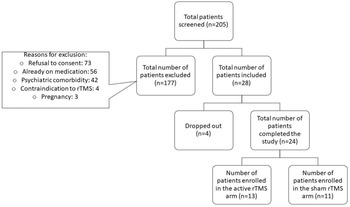
In our study, we screened 205 patients, out of which 177 were excluded while 28 patients were included in the study (Figure 1). The most common reasons for exclusion were the inability to come daily for rTMS sessions due to travel distance (N = 73), followed by patients already taking antiobsessive medication (N = 56). Thus, the total enrolled drug-naïve OCD patients were 28, out of which four were dropped out. The reason for the dropout from the study was the inability to come due to lockdown (N = 3) and due to medical illness (typhoid) (N = 1). After considering dropouts, a total of 24 patients completed the study. Thirteen patients received active rTMS (group A) and 11 patients received sham rTMS (group B).
Flow diagram showing recruitment of the patients.

Demographics and baseline clinical characteristics of the study population
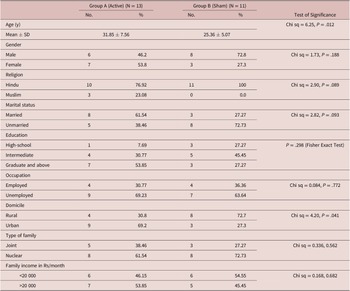
As shown in Table 1, the active and sham groups did not differ significantly in demographics or baseline clinical ratings except age. While comparing the total duration of the illness across the groups, greater duration was accorded in the patients of the active group (6.06 ± 5.68) as compared to the sham group (4.05 ± 2.65) but it was not significant (P-value .293). Age of the onset of illness was also higher in the active group (25.29 ± 6.50 in years) as compared to the sham group (21.32 ± 6.27 in years) but was not significant (P-value .102). Family history was present in 33.3% of the total patients.
Comparison of Demographic and Clinical Characteristics Between Active and Sham Group

Outcome measures
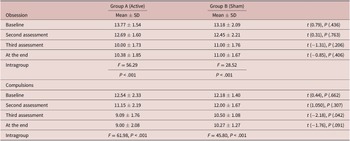
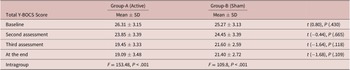
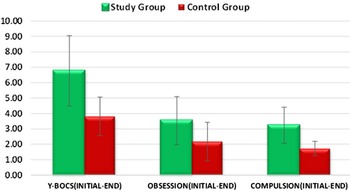
As shown in Table 2, the obsession and compulsion scores were compared between the active and sham groups. At the baseline and in any of the serial evaluations, there was no significant difference in obsession scores between the active and sham groups (P > .05). In the intragroup comparison, however, there is a substantial reduction in obsession from baseline through the completion of therapy (P < .001) in the active group and (P < .001) in the sham group. While the comparison of compulsion scores across the two groups showed the absence of statistically significant results at the baseline or in any of the serial assessments. However, a significant reduction in compulsion scores was found in the intragroup comparison between the two groups. Table 3 shows the comparison of scores of total Y-BOCS between the active and sham groups in the serial assessments. No significant difference in the total Y-BOCS scores was found between the two groups in any serial assessments. In the intragroup comparison, the reduction of total Y-BOCS from baseline at intervals is significant (F = 153.48, P < .001) in the active group and (F = 109.8, P < .001) in the sham group. We also compared the reduction of scores from baseline till the end of the intervention, as shown in Table 4. Its results showed a significant reduction in the scores of obsessions (P-value .001), compulsion (P-value .030), and total Y-BOCS (P-value .001) in the active group as compared to the sham group (Figure 2). In order to reduce the bias concerning the total number of sessions received by the patients in different groups, we compared the mean number of the sessions received in the active (19.15 ± 2.08) and sham group (19.27 ± 2.41), found no significant difference (P-value .898) in it. The difference, the absolute risk reduction, is 15.38%. The 95% confidence interval for this difference ranges from −4.23% to 35.00%. The number needed to treat (NNT) by rTMS, an early augmenting agent, was found to be 7. Standardized difference between two means was measured, which revealed Cohen’s d of 1.6. Table 5 shows the changes in the RMT at various points of time during the therapy.
Comparison of Scores of Obsessions and Compulsions Between the Active and the Sham Group

Comparison of Scores of Total Y-BOCS Between the Active and the Sham Group

Abbreviation: Y-BOCS, Yale-Brown Obsessive–Compulsive Scale.
Comparison of Scores of Obsessions, Compulsion and Total Y-BOCS from Baseline Till the End of the Intervention Between the Active and the Sham Group

Abbreviation: Y-BOCS, Yale-Brown Obsessive–Compulsive Scale.
Shows the comparison of overall change in scores of total Y-BOCS, obsession and compulsion from baseline to the end between the groups.

Comparison of RMT Changes Between the Study Group and the Control Group

Abbreviation: RMT, resting motor threshold.
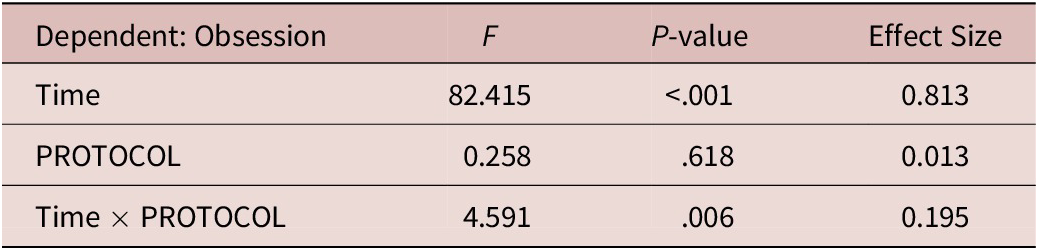
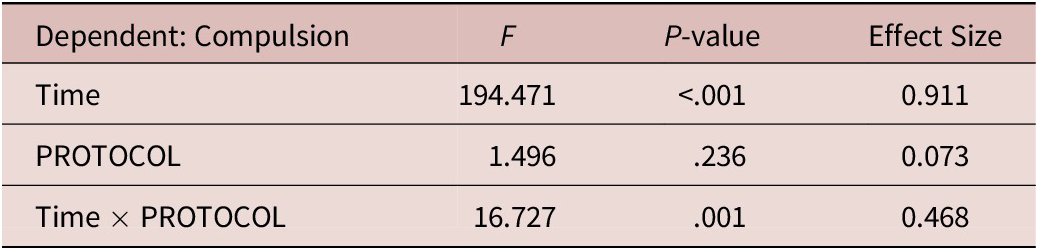
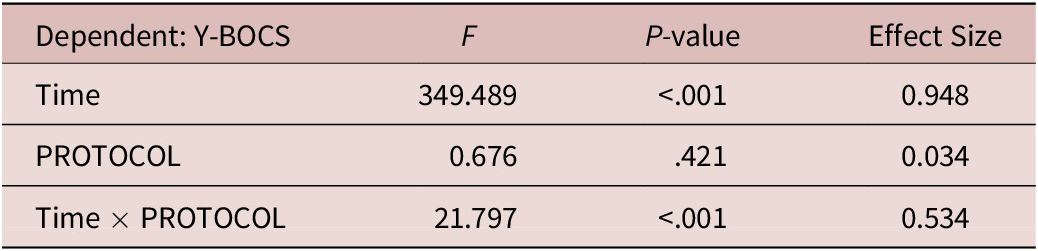
The mixed model ANOVA analysis showed a significant effect of time (η = 0.813, P < .001) and time-protocol interaction (η = 0.195, P = .006) with respect to the obsession score, but an insignificant effect of protocol type (η = 0.013, P = .618) (Table 6). When the compulsion score was taken as a dependent variable, the mixed model ANOVA analysis showed a significant effect of time (η = 0.911, P < .001) and time-protocol interaction (η = 0.468, P = .001) but the insignificant effect of protocol type (η = 0.073, P = .236) (Table 7). Similarly, when the total Y-BOCS score was taken as a dependent variable, the mixed model ANOVA analysis showed a significant effect of time (η = 0.948, P < .001) and time-protocol interaction (η = 0.534, P < .001) but insignificant effect of protocol type (η = 0.034, P = .421) (Table 8).
Comparison of Obsession Between the Groups at Time Intervals (Mixed Model ANOVA Analysis)

Comparison of Compulsion Between the Groups at Time Intervals (Mixed Model ANOVA Analysis)

Comparison of Total Y-BOCS Scores Between the Groups at Time Intervals (Mixed Model ANOVA Analysis)

Abbreviation: Y-BOCS, Yale-Brown Obsessive–Compulsive Scale.
Safety
In the first week, five patients in the active group and four from the sham group reported headaches from rTMS, which reduced to only one in the sham group in the next assessment. On the last assessment, none of the patient-reported any of the side effects of rTMS. Therefore, the relative risk was calculated, which was 1.06. The serial evaluation of the side effect profile for antidepressants revealed that in the active group, nausea or vomiting and constipation were the most common side effects on the first assessment, followed by headache, insomnia, and dry mouth. In the sham group, headache was the most common side effect on the first assessment, followed by constipation, insomnia, and drowsiness.
Discussion
In the present sham-controlled study, we targeted SMA with low-frequency rTMS and safely delivered active and sham treatment for 24 adults who were drug-free patients of OCD. Early augmentation has been done in this study which refers to the use of augmentation strategy and the initiation of standard treatment (in this study, rTMS was used as an early augmentation strategy along with SSRI at the initiation of treatment). Our findings of the significant reduction in the scores of total Y-BOCS, obsession, and compulsion at the end of the therapy sessions measured after 3 weeks, suggests the benefit of augmentation of rTMS in the early phase of the treatment itself in patients of OCD. Throughout treatment, the scores were reduced in our study in both the groups, but a more significant reduction was found in the active group compared to the sham group, which was significant. The finding was comparable to the previous studies, which also demonstrated the role of active rTMS to be more efficacious in improving OCD symptoms.Reference Perera, Mallawaarachchi, Miljevic, Bailey, Herring and Fitzgerald 18 We kept the dose of escitalopram to 20 mg in both groups. Literature suggests that the effect of 20 mg dose of escitalopram was higher than placebo on Y-BOCS from 6 weeks onwards, while the 10 mg dose of escitalopram was segregated from placebo only at 16 weeks on secondary endpoint measures.Reference Schirmbeck, Esslinger, Rausch, Englisch, Meyer-Lindenberg and Zink 19 As a result, there is a possibility that active rTMS, in addition to the medication, played a role in the significant reduction in scores in our study. However, quantifying the level of individual effect of rTMS and medication on the above was not feasible in our study. It is difficult to precisely distinguish the extent of individual effects of rTMS and medication. In our study, NNT is 7 (which suggests that if seven patients are treated with an rTMS, one can be expected to respond who would not have responded to placebo). Literature refers to NNT ≤ 10 as clinically relevant because this difference in treatment is commonly encountered in day-to-day clinical practice, suggesting the efficacy of rTMS as an early augmenting agent.Reference Citrome and Ketter 20 In the comparison of the effect size (Hedges g) of different treatments used in OCD by previous studies, SSRI has a negligible effect size (0.43); similarly, an effect size of augmentation with antipsychotic to the ongoing treatment with SSRI is also small (0.2-0.49), while hedges g with rTMS in treatment-resistant OCD have shown variable results ranging from 0.56 to 2.86, indicating good effect size.Reference Berlim, Neufeld and Van den Eynde 3 In our study, an effect size of rTMS as an early augmentation with SSRI in drug-naïve OCD patients came out to be 1.6, which indicates a large effect size. These findings support our hypothesis that the modulation of SMA through rTMS (early augmentation) and SSRI may alter symptom expression, lead to an early reduction of symptoms, helps to reduce the length, severity, and encourage further work on the therapeutic potential of this intervention in OCD.
Finally, we observed that rTMS is generally safe and well tolerated by patients which is similar to other studies evaluating the safety of rTMS.Reference Jaafari, Rachid and Rotge 21 Only a few patients reported minor side effects, local pain and headache being the commonest ones.
Evidence suggests that achieving a good therapeutic response and complete remission early on the treatment are two critical criteria linked to a better prognosis.Reference Sharma and Math 9 As a result, early intensive treatment involving the augmentation strategy may aid in achieving a better outcome in OCD. Considering the viewpoint mentioned above, it may be relevant to implement an early augmentation technique. It may, however, not be required in all cases of OCD. Patients having multiple predictors of poor response such as adolescent or later age of onset, higher baseline symptom severity, presence of multiple obsessions, presence of sexual or blasphemous obsessions, longer duration of illness, and comorbid psychiatric conditions, are the candidates who may benefit from an early augmentation strategy in addition to standard treatment.Reference Sharma and Math 9 Early augmentation in these patients will help in early functional recovery, improve the quality of life, and reduce illness duration.Reference Menon, Kar, Suthar and Nebhinani 10
Limitations
Small sample size is a major limitation of the study. Due to the COVID-19 pandemic, we were not able to reach the estimated sample size. During the serial assessments, patients with comorbid depression were not evaluated on any depression-specific rating scale. The lack of a depression-specific instrument, the presence of inclusion criteria for comorbid depression, and providing medication to both groups make it difficult to assert that any improvement was solely attributable to rTMS. Particularly as there was improvement observed in both groups. We only investigated the short-term effects of rTMS on OCD patients; no long-term follow-up was done after the 20 sessions were completed. Similarly, multiple factors may predict the early augmentation response, and it should not be solely attributed to the rTMS.
Conclusion
The study revealed that rTMS is generally safe and tolerated well among the patients. This study is one of the first studies to test the rTMS as an early augmenting agent in drug-free patients of OCD. Future protocols with improved stimulation procedures and more participants need to be tested in adults with this condition.
Disclosure
The authors do not have any competing interests to disclose.
Author Contributions
Conceptualization: S.K.K., P.K.D.; Data curation: M.J., S.K.K.; Formal analysis: M.J., S.K.K., P.K.D.; Investigation: M.J.; Methodology: M.J., S.K.K., P.K.D.; Supervision: S.K.K., P.K.D.; Writing—original draft: M.J., S.K.K., P.K.D.; Writing—review and editing: M.J., S.K.K., P.K.D.