The mouth and price lexical sets (Wells, Reference Wells1982), otherwise known as the variables (aʊ) and (aɪ), display a good deal of variation in English. Much work has focused on an allophonic split between raised onsets before voiceless consonants and more open onsets in other environments. This phenomenon has been referred to as Canadian raising, given the categorical status of this alternation in varieties of Canadian English. However, as documented in Moreton and Thomas (Reference Moreton, Thomas, Cole and Hualde2007), several varieties of English exhibit this kind of variation. It has been reported across the United States (e.g., Allen, Reference Allen1989; Currie Hall, Reference Currie Hall, Alderete, Han and Kochetov2005; Dailey-O'Cain, Reference Dailey-O'Cain1997; Kinloch & Ismail, Reference Kinloch and Ismail2013; Vance, Reference Vance1987), in the British Fens (Britain, Reference Britain1997), and in several insular varieties of English, including those of Martha's Vineyard (Labov, Reference Labov1963), St. Helena (Schreier, Reference Schreier, Schreier, Trudgill, Schneider and Williams2010a), Tristan de Cunha (Schreier, Reference Schreier, Schreier, Trudgill, Schneider and Williams2010b), the Falkland Islands (Britain & Sudbury, Reference Britain and Sudbury2008), and Mersea Island in Essex, England (Amos, Reference Amos2011).
As this summary suggests, an allophonic raising split for these lexical sets tends to occur in forms of “non-creolised, mixed, colonial English” (as in North America, or the South Atlantic) or in “mixed dialects” of relatively recently settled or newly developed English locations, such as the English Fens or Mersea Island (Trudgill, Reference Trudgill1986:160; Reference Trudgill2004:88). Both Trudgill (Reference Trudgill1986, Reference Trudgill2004) and Britain (Reference Britain1997) argued that the dialect mixture situation that preceded the formation of these varieties most likely included varied inputs for mouth and price—some with central onsets and some with lowered onsets. A leveling process may have followed in which both inputs were preserved, but as allophones. Such an outcome is “phonologically natural” (Britain, Reference Britain1997), given the tendency in English to find shorter vowels before voiceless consonants and longer vowels before voiced consonants. This pattern can involve reducing the distance between the onset and offglide before voiceless consonants, making the offglide more open, and/or increasing the distance between the onset and offglide before voiced consonants. Consequently, the occurrence of an allophonic split in multiple locations is explained as the operation of similar processes of “contact, focusing, and reallocation” (Britain, Reference Britain1997) that operate in line with the “natural phonetic tendencies” of language (Trudgill, Reference Trudgill1986:159).
There remain, however, some unexplained discrepancies in precisely how the allophonic split develops in different locations. For instance, Amos (Reference Amos2011) observed that the alternation is much less common for mouth than for price outside Canadian English. Nonetheless, the former has been reported in the United States (e.g., Allen, Reference Allen1989; Dailey-O'Cain, Reference Dailey-O'Cain1997; Labov, Reference Labov1963; Sadlier-Brown, Reference Sadlier-Brown2012) and in the British territories of the Falkland Islands and Mersea Island. Its presence in the latter location disputes Trudgill's (Reference Trudgill1986:156) claim that “we nowhere find different allophones of /au/ in voiced and voiceless environments” in England. Furthermore, it suggests that, while “natural phonetic tendencies” might explain how an allophonic split arises in the first place, the ongoing trajectory of the split (and its ability to affect one lexical set over another) may be dependent upon the peculiarities of the precise locations in which the linguistic forms occur. For instance, in their real-time comparison with Labov's (Reference Labov1963) original Martha's Vineyard study, Pope, Meyeroff, and Ladd (Reference Pope, Meyerhoff and Ladd2007) speculated that mouth—which showed a more robust upward trajectory than price—had taken over from the latter “as the strongest index of MV identity” (Pope et al., Reference Pope, Meyerhoff and Ladd2007:623). However, few studies of the allophonic raising split have considered how its trajectory is affected by the social meanings of the forms involved and the way in which these social meanings might interact with local community ideologies. This paper attempts to combine phonological and social analysis in order to provide just such an account.
In doing so, we provide evidence of an, as yet, unstudied British variety—that spoken on the Isles of Scilly off the southwest coast of England—that exhibits an allophonic raising split for both mouth and price. This makes Scilly's variety different from that of the closest southwest English mainland where there is no evidence for an allophonic raising split.Footnote 1 Instead, Wakelin (Reference Wakelin1986:27–28) noted the tendency for all traditional varieties of southwestern English to have a centralized and retracted quality for price irrespective of following voicing context, whereas the quality of the mouth vowel is more variable in the region (it is variably centralized, lowered, or fronted), again with no corresponding voicing context effects.
Like the Martha's Vineyard data, our data will show that Scilly exhibits a raising pattern for mouth that is more resilient than the raising pattern for price. In seeking to explain why mouth and price differ, we focus on the differences in the social meanings associated with these two variables that result from Scilly's status as an island community, its historical development, and the patterns of variation found in neighboring communities. We begin our paper by describing the research location, paying particular attention to what is unique about Scilly, but also noting what it shares with the other insular locations that exhibit an allophonic raising split for price and/or mouth. We then go on to describe the data and methods used in the analysis, before presenting and explaining our results. Finally, we draw on a perception experiment that suggests that a raised mouth vowel is more positively associated with an islander persona than a raised price vowel is. The perception testing suggests that a raised price vowel also carries social associations that extend well beyond local island practices. So, while the allophonic splits for both mouth and price seem to be decreasing over time (in line with a more general process of dialect leveling on the islands), we argue that the social meanings associated with a raised price vowel may be accelerating the loss of this particular allophonic split on the Isles of Scilly.
RESEARCH LOCATION
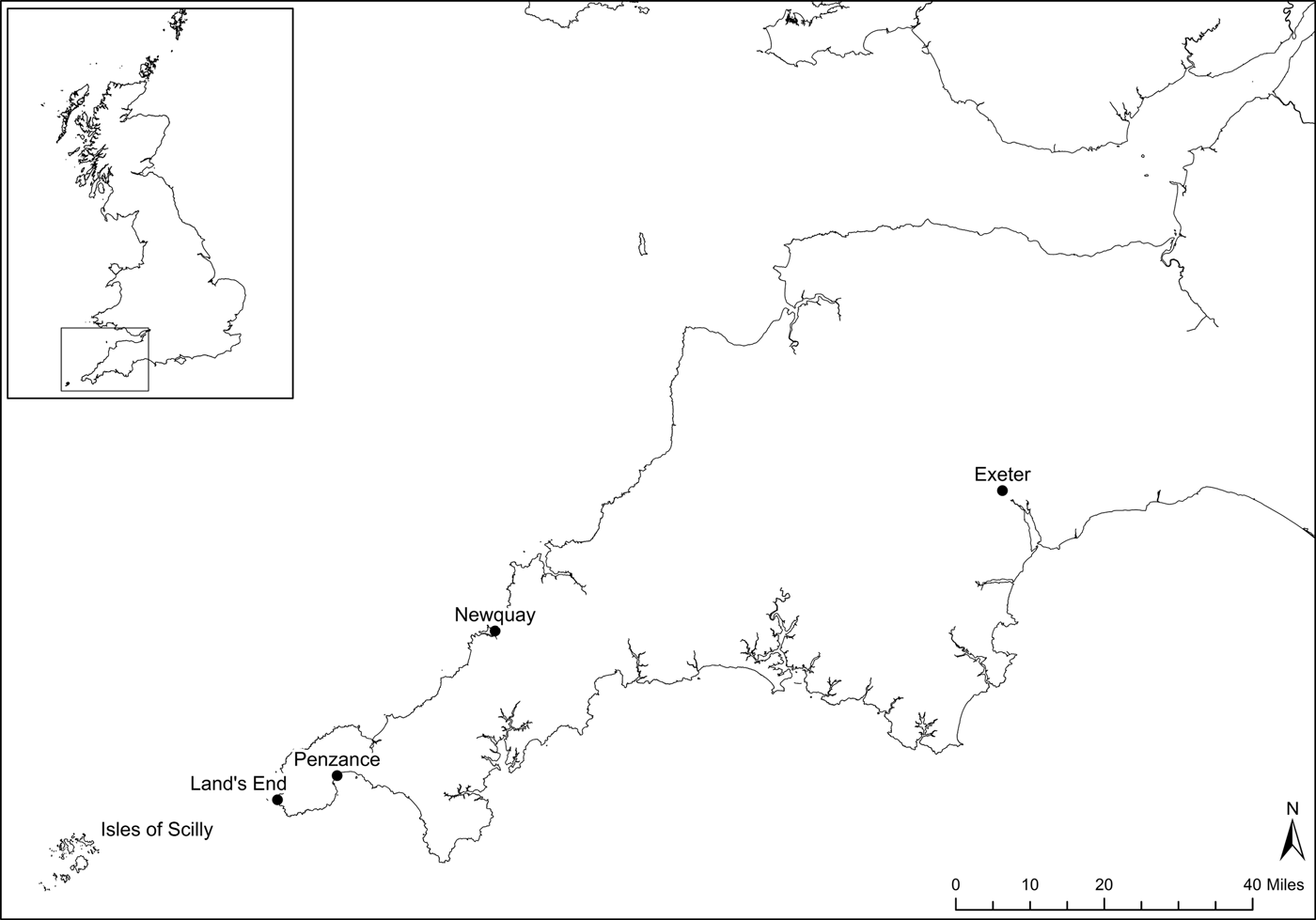
The Isles of Scilly are the westernmost point of England, situated appropriately 28 miles off the southwest tip of the English mainland, as shown in Figure 1. They are one of 46 Areas of Outstanding Beauty in the United KingdomFootnote 2 and are currently accessible by air and freight boat all year round, as well as by passenger ferry between Easter and October. The first scheduled flights to the islands began in 1937, and now 8- and 19-seater planes fly from Land's End and Newquay (all year round) and from Exeter (March to November). The boats sail from Penzance. (These locations are shown in Figure 1). There have always been “visitors” to the islands (the islanders’ name for tourists), but the arrival of the railway in Penzance in 1867, combined with the replacement of sailing vessels by a steamer service in 1859, greatly facilitated travel to the islands after this time. Tourism is now the islands’ main industry. It provides 85% of the islands’ income (Isles of Scilly Council, 2005:14), although there is still some farming and fishing.
Location of the Isles of Scilly, relative to the British mainland and the southwest coast. © Crown Copyright/database right 2017. An Ordnance Survey/EDINA supplied service. This work is based on data provided through EDINA UKBORDERS with the support of the ESRC and JISC and uses boundary material that is copyright of the Crown and the ED-LINE Consortium.

Scilly consists of many islands, but only five are currently inhabited: St. Mary's, Tresco, St. Martin's, Bryher, and St. Agnes. St. Mary's is the largest island by size and population (almost 80% of the islands’ population of 2203 people live there) (Office for National Statistics, National Records of Scotland, & Northern Ireland Statistics and Research Agency, 2017); it is the only island to have an airport (although there is a helipad on the second largest island, Tresco), a secondary school, a supermarket, a health center and pharmacy, and banks. It is also where the main harbor is situated and where the passenger and freight boats dock. St. Mary's dominance is reflected in the designation “off-islands,” a term used locally to refer to the other inhabited islands in the archipelago.
Most of the freehold on the islands is owned by the Duchy of Cornwall, His Royal Highness the Prince of Wales, the exception being the main town on St. Mary's, Hugh Town (the lease for which was sold off in 1949). Between 1571 and 1920, the islands were leased from the crown by a series of “governors,” the first of which was Sir Francis Godolphin. It is commonly believed that Godolphin repopulated the islands and that the current indigenous population was founded at this time (Banfield, Reference Banfield and Urban1888:43-45; Borlase, Reference Borlase1753:86; Bowley, Reference Bowley1964:69; Mumford, Reference Mumford1967:62). The Godolphin family held the lease until 1834, when it passed to Hertfordshire landowner, Augustus Smith, who is generally credited with improving the social and economic circumstances on the islands in the 19th century. He introduced compulsory education before it was instigated on the mainland, improved infrastructure, and it is reported that he removed islanders who were not effective tenants (Collins, Reference Collins1861:93; Mothersole, Reference Mothersole1914:48; Uren, Reference Uren1907:67). The island of Tresco is the only island still leased from the Duchy, run by the Dorrien Smith family (direct descendants of Augustus Smith) as the “Tresco Estate.”
Scilly's proximity to Cornwall means that there has always been Cornish migration into the islands. The 1901 census shows that Scilly's population was 1877, and 276 of the 571 incomers (48.3%) were born in Cornwall (The Isles of Scilly Museum, 2007). The next largest influx was much less substantial (60 people born in Devon). Despite this presence, which presumably also pertained prior to the first census data, and the existence of Cornish place-names on Scilly (Heath-Coleman, Reference Heath-Coleman1995:60), there is no substantial evidence of the Cornish language having been in use on the islands (Thomas Reference Thomas1985:36).
Cornish died out in Cornwall sometime in the 18th century (not withstanding ongoing revival efforts; see Jenner [Reference Jenner2010] for a full account of the history of the Cornish language). As Wakelin (Reference Wakelin1975:202–205) reported, English was introduced earlier (and Cornish died out sooner) in the East of the county, meaning that the English spoken in the East reflects an earlier stage of the language than that spoken in the West. So, while the West retains more Cornish lexis, the morphological and phonological aspects of the dialect are more similar to Standard English, given that the language was acquired as a second “foreign” language in this region.Footnote 3 As there is no record of Cornish being spoken in Scilly after the 17th century, this led Thomas (Reference Thomas1979:141–145) to claim that, lexically at least (and perhaps phonologically, too), Scilly's dialect is more similar to East Cornish English than West Cornish English. He described the variety as “an isolated pocket of early Modern English; it exhibits in its phonology certain modifications which are not found in west Cornwall, the closest mainland” (Thomas, Reference Thomas1979:142).
However, while the islands’ history (the likely repopulation in the 16th century) supports Thomas's observations, the extent of dialect contact on the islands complicates its status as “an isolated pocket of early Modern English.” Dialect contact has chiefly been of two kinds: that linked to ongoing Cornish migration into the islands (mostly from West Cornwall) and that associated with the elite social networks on the islands (facilitated by the islands’ governors). Our study of variation in the vowels found in the trap and bath lexical sets (Moore & Carter, Reference Moore and Carter2015) suggests corresponding influences from Cornish English and Standard English, respectively. This is supported by the historical metalinguistic commentary about the islands’ variety, which stresses Cornish English influence on the one hand, and Standard English influence on the other, as shown in and the following extracts.
The Language spoken in Scilly is a Mixture of the West-Country Dialect, with the common English … the Language of Scilly refines upon what is spoken in many Parts of Cornwall; probably from the more frequent Intercourse of the Inhabitants, some more than others, with those who speak the Standard English best. (Heath, Reference Heath1750:173, 436)
even the English they speak lacks a marked peculiarity. … Yet one can trace in it, not unnaturally, a tinge of Cornish dialect and dialectal usage; and a collection of island words—never yet made so far as I know, though there are several still in use—might reveal the islanders’ linguistic kinship with Cornwall. (Grigson, Reference Grigson1948:20)
While Scilly is undoubtedly geographically isolated and relatively autonomous from the mainland, the history of dialect contact suggests that it is not socially and culturally isolated. Other factors add to the open or exocentric (Andersen, Reference Andersen and Fisiak1988) nature of the community. Scilly's location makes it the first English landfall for eastbound vessels in the Western Approaches, and a small shipbuilding industry in the 18th and 19th centuries also encouraged sailing commerce (Larn & Banfield, Reference Larn and Banfield2015). The islands’ location also means that Scilly has hosted various members of the military across time (a Garrison was built and manned on the islands in the 16th century, and a naval and seaplane base was established during both World Wars). The tourist industry, in addition to supplying a constant source of visitors, is supported by a number of seasonal workers (many of whom return year after year). Also, prior to 1966, the islands did not have their own secondary school. While some children remained on the islands until the age of 14, others were sent away to private boarding schools on the mainland between the ages of 11 and 16. These were typically children from the wealthier Scillonian families, but after the introduction of the 11-plus examination in Britain in 1944, the council paid for any child who passed the 11-plus to attend mainland schooling.
Montgomery (Reference Montgomery2000) argued that linguists have tended to use the term “isolated” in simplistic ways to describe the language patterns found in “geographically peripheral” communities. Indeed all of the insular locations that exhibit raising patterns for price and/or mouth have complex histories of dialect contact. So, while aspects of Scilly's history—such as the nature of island governance and education, and its unique location—are specific to these islands, other aspects are shared with locations already mentioned; for instance, a “tabula rasa” situation (Trudgill Reference Trudgill2004:26) with diverse input varieties is found in Tristan de Cunha and St. Helena, tourism is important in both Martha's Vineyard and Mersea Island, and both the Falkland Islands and Mersea Island have military associations. As such, Scilly's history is concordant with the “contact, focusing, and reallocation” hypothesis proposed by Britain (Reference Britain1997) to explain the emergence of an allophonic raising split in the mouth and price lexical sets. With this in mind, we now turn to our data analysis of price and mouth on the Isles of Scilly.
DATA AND METHODOLOGY
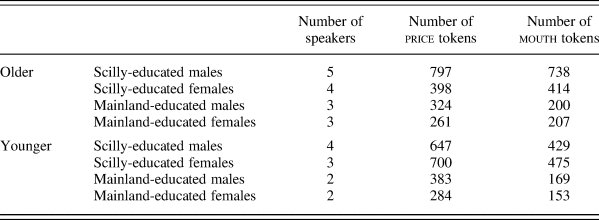
Our data is drawn from the Isles of Scilly Museum's Oral History Archive, which contains recordings of islanders interviewed by other islanders, dating from the 1970s onward. The purpose of the archive is to record the experiences of Scillonians, and the informants are identified by museum volunteers and fieldworkers on the basis of their “Scillonian character” (a vague criterion, but one that includes consideration of Scillonian heritage, community roles, and how well-known someone is within the community). We sampled 26 speakers all born and living on St. Mary's, Scilly's main island. We categorized our Scillonian speakers according to gender, generation, and education type, as shown in Table 1. All the speakers in our older generation were born between 1901 and 1931 and were part of the first wave of interviews undertaken for the archive. Speakers in our younger generation were born between 1932 and 1962, and this category includes descendants of the older group. The generational split reflects the relationships between speakers and natural peer groups that can sometimes incorporate relatively large age differences because of Scilly's small population. The generational split also reflects self-selected interview pairs and ethnographic knowledge of the speakers’ friendships. Speakers are categorized by education type to account for whether or not an individual was sent to the mainland for schooling between the ages of 11 and 16. Discrepancies in numbers within categories reflect the sociocultural reality that fewer islanders were mainland-educated than island-educated (especially in the younger generation), fewer women were sent away for mainland schooling than men, and fewer women born and raised on the islands remain there in later life.
The sample of data used in the analysis of price and mouth in Scillonian English

To compare the relative height of the vowel onsets in our price and mouth tokens, following Currie Hall (Reference Currie Hall, Alderete, Han and Kochetov2005), Moreton and Thomas (Reference Moreton, Thomas, Cole and Hualde2007), and Sadlier-Brown (Reference Sadlier-Brown2012), we extracted formant data at the point of maximum F1 (greatest vocalic openness, given that F1 has been found to correlate with vowel height; see Ladefoged [Reference Ladefoged1982], among others). However, Idsardi (Reference Idsardi2006:22) noted that other factors, such as “overall length of the diphthong, the relative length of the nuclear and glide components, and the dynamics of the formant movements,” affect the perception of a raised diphthong. Consequently, we also sampled formant tracks every millisecond through each vowel before normalizing in the time domain in order to be able to visually inspect the trajectory of the diphthongs. F1 was normalized using the revised Watt and Fabricius method (Fabricius, Watt, & Johnson, Reference Fabricius, Watt and Johnson2009).
The most obvious phonological factor in a possible case of an allophonic raising split is the voicing of the following sound. Therefore, we coded for two possible interpretations of voicing context. The first interpretation was a simple encoding of voicing in the following sound. The second involved an alternative phonological account of voicing in which voicing is a property of the syllable rhyme as a whole. In most cases, this is exactly equivalent to the first definition, but rhymes that consist of a sonorant plus a plosive (such as [-nt] or [-nd]) are taken to have the voicing value of the plosive, since sonorants do not contrast in voicing. In this way [-nt] counts as a voiceless context and [-nd] as a voiced context, whereas by the first definition they would both count as voiced (see Dailey-O'Cain [Reference Dailey-O'Cain1997:111] and Vance [Reference Vance1987:199] for evidence of raising in this sonorant plus voiceless obstruent context).
We also coded for stress, for the presence or absence of a coda in the rhyme and for the manner of articulation of any following consonant. Vowel duration and other factors that might have influenced vowel duration were also included, such as the location of the syllable in the utterance. This is because vowels of greater duration have a greater time for achieving an open target. Other things being equal, longer vowels are likely to have a higher F1.
In employing linear mixed-effects regression, we began with models that had natural class as a fixed-effect predictor and a maximal random effects structure with a random intercept and a random slope for natural class. We then constructed a model that additionally had voicing as a fixed-effects predictor and used a log-likelihood test to determine whether the addition of voicing as a predictor significantly improved the goodness of fit of the model. It is the results of these log-likelihood tests that we use as evidence (or otherwise) for the impact of voicing on F1. More complex linear regression incorporating the other variables proved impossible to perform robustly given the size of the dataset, so we incorporated other variables in decision tree/random forest analyses.Footnote 4
For each subgroup of the dataset (divided by gender, place of education, generation, and lexical set) we incorporated other possible predictor variables in conditional inference decision trees to determine whether voicing context (in either definition) had a significant effect on F1 at its maximum (that is, at the maximally open point in the vowel). Since there are a number of possible predictor variables that are not independent of each other (most obviously natural class is not independent because sonorants lack a voicing contrast), and more complex decision trees did not always produce easily interpretable results, we also constructed random forests of conditional inference decision trees. We constructed five forests of 500 trees each in the first instance, rising where necessary to produce a robust result, and subjected them to a conditional variable importance analysis, conditional because the predictor variables are known to be correlated. The method we use to estimate how important each variable is in the model is as suggested by Strobl, Malley, and Tutz (Reference Strobl, Malley and Tutz2009:342).Footnote 5
RESULTS OF THE PRODUCTION ANALYSIS
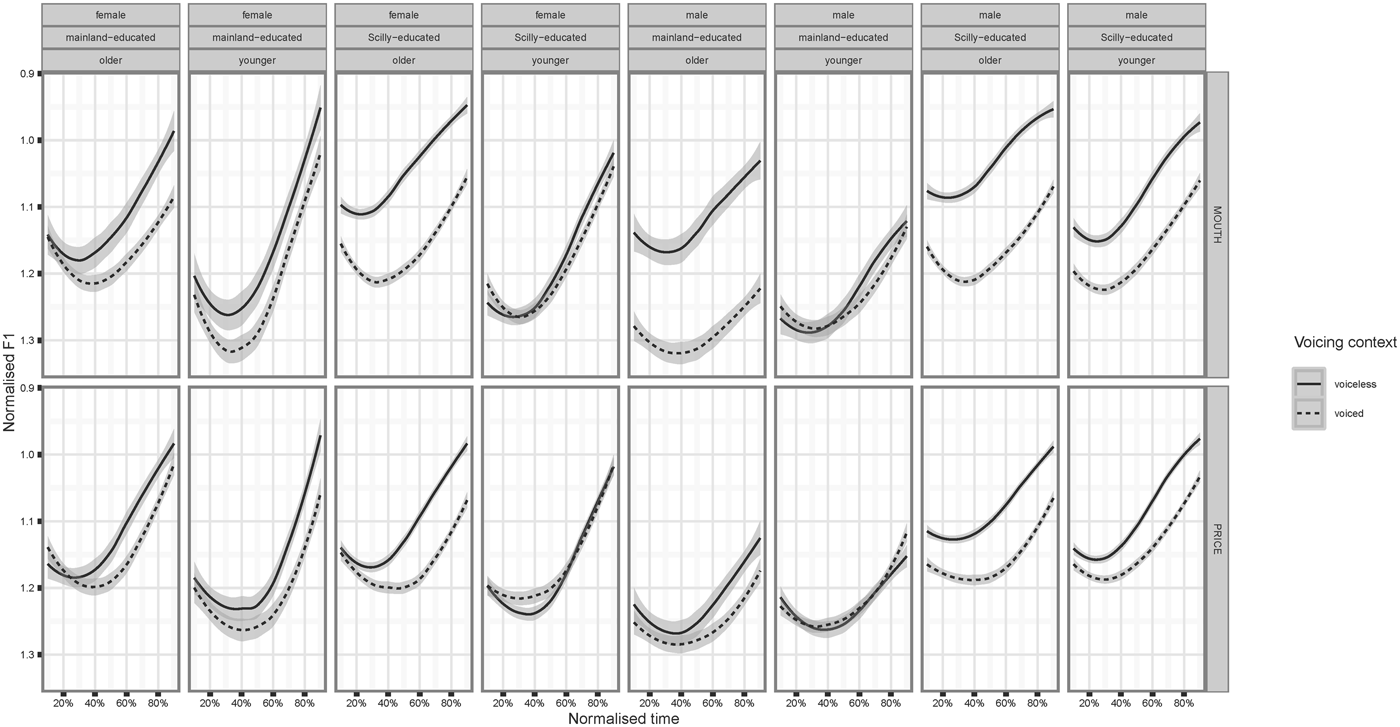
In general, the diphthongs in the data have onsets that are audibly reasonably close, although mainland-educated speakers in general seem to have more open onsets. Figure 2 shows formant tracks in normalized time for groups of speakers arranged by gender, place of education, and generation. The tracks are smoothed representations of samples taken at 10% intervals through the vowels. It is clear from the figure that some groups of speakers have a noticeable difference between voiced and voiceless contexts (e.g., the older, male, mainland-educated speakers in mouth words) while others have little or no noticeable difference (e.g., the younger, male, mainland-educated speakers in mouth words).
Formant tracks in normalized time for groups of speakers arranged by gender, place of education, and generation. Instances from mouth words are plotted in the upper panels; instances from price words are plotted in the lower panels. The shaded zone shows a 95% confidence interval around the mean.

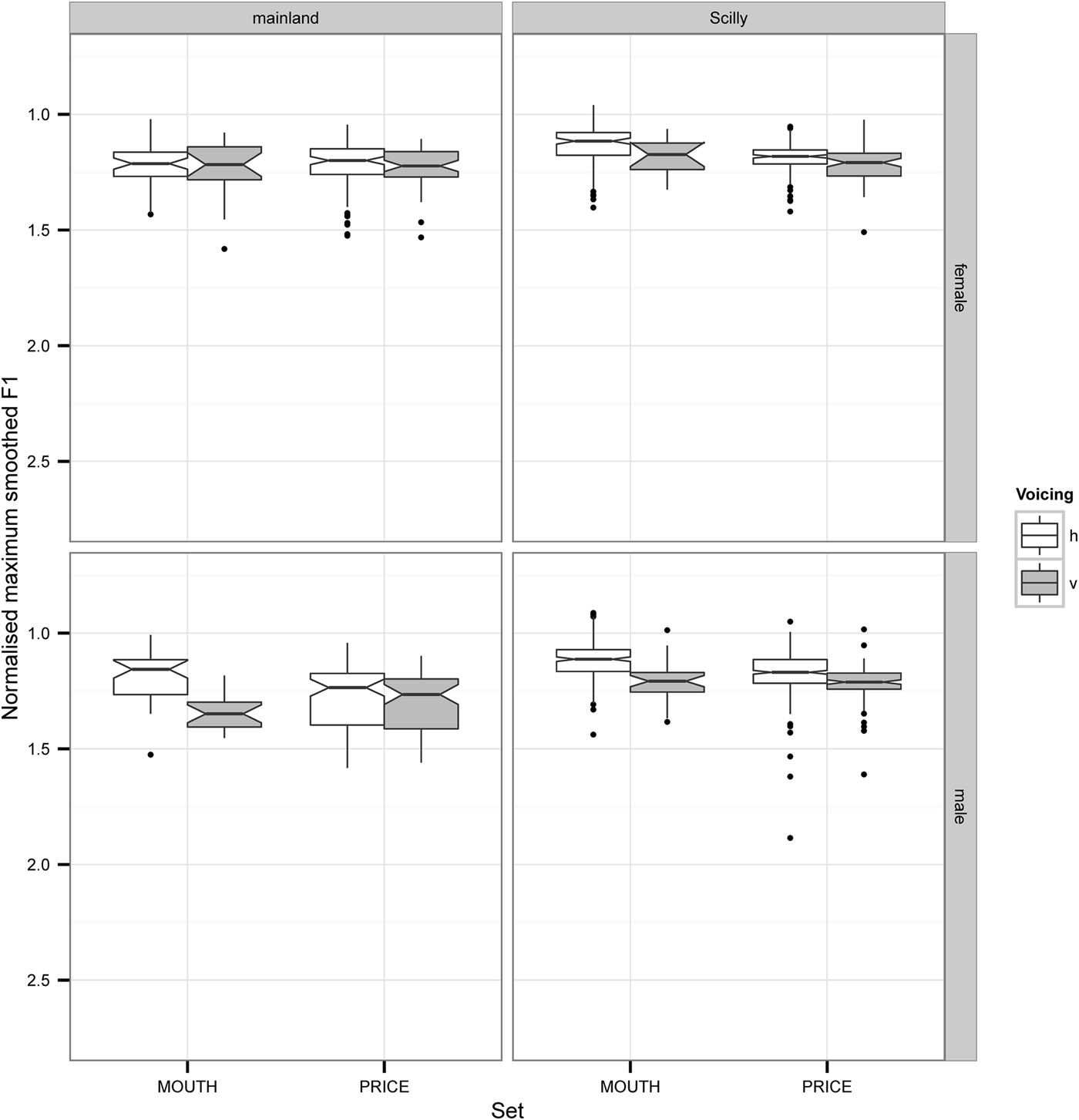
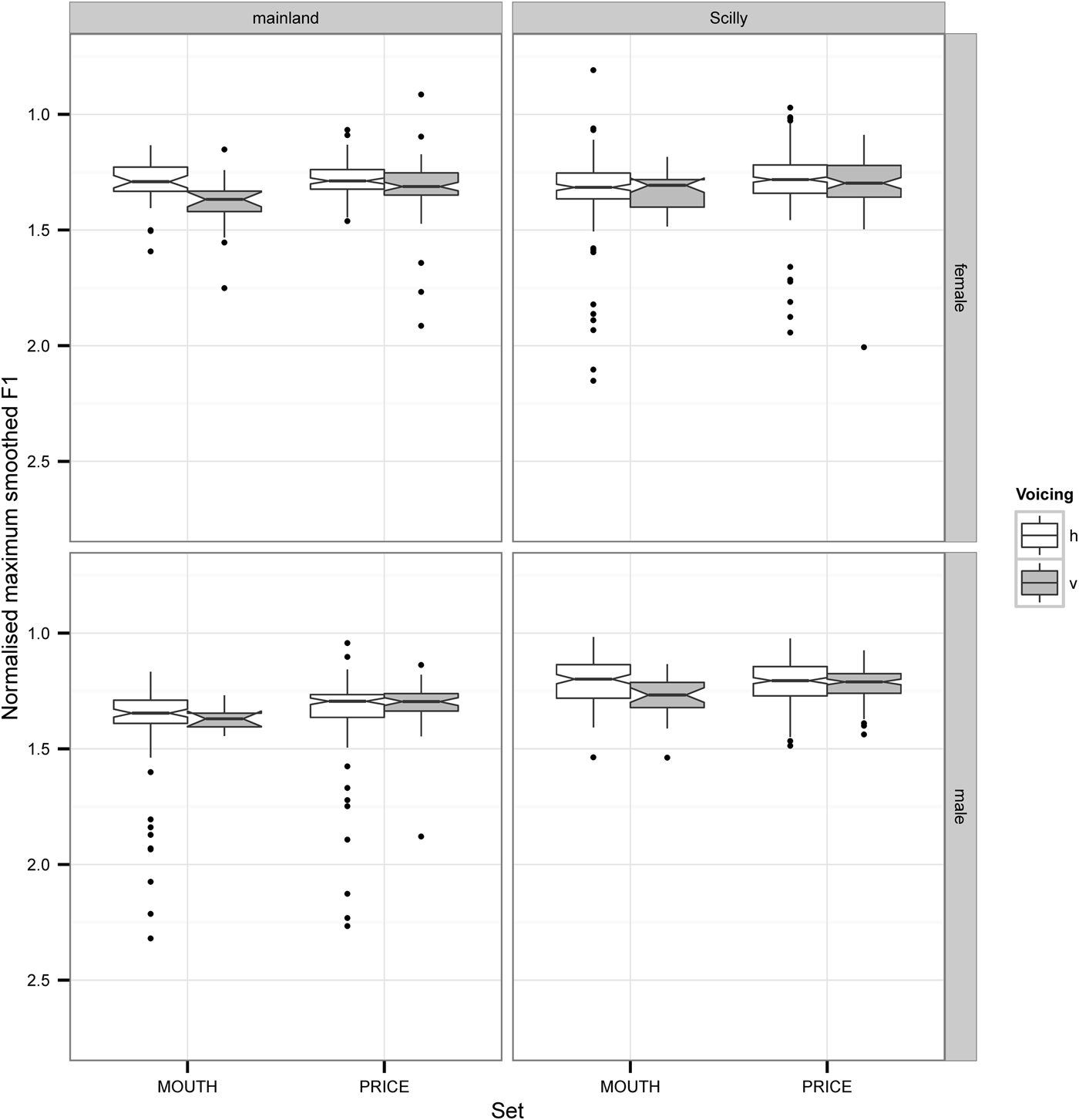
Figures 3 and 4 contain box plots summarizing the data at the point of maximal F1 in each vowel (that is, as far as it is possible to tell from the acoustics, at the most open point of the articulation). In this instance, we include only vowels in the context of a following obstruent to demonstrate that the effect is not simply due to the obstruent/sonorant difference in natural class.
Box plots of the maximum F1 in mouth and price words for speakers from the older generation. Two voicing contexts are shown: “h” represents voiceless contexts and “v” represents voiced contexts.

Box plots of the maximum F1 in mouth and price words for speakers from the younger generation. Two voicing contexts are shown: “h” represents voiceless contexts and “v” represents voiced contexts.

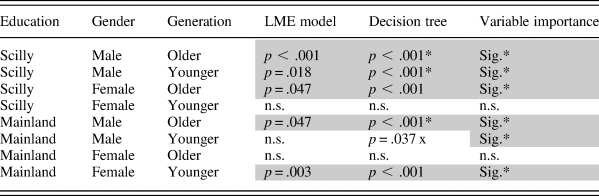
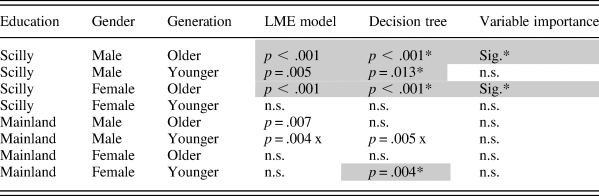
The figures suggest that raising patterns do exist but that the effects are variable across different speaker groups. Figure 3 suggests that there is raising split for all the older speakers, with the exception of the older mainland-educated women, and that there is a generally greater effect for mouth than for price. However, the patterns are much less easy to discern for the younger speakers. To accurately disentangle this variation, Tables 2 and 3 provide summaries of the results of the statistical testing for mouth and price, respectively. In the supplementary material, we provide a worked example of one of the subsets of the data for which we provide summaries in Tables 2 and 3, namely the older Scilly-educated males producing mouth vowels.
The significance of voicing comparisons at the point of maximum normalized F1 in the mouth lexical set

p-values for voicing comparisons at the point of maximum normalized F1 in the price lexical set

Note: Shading indicates statistically significant differences. An asterisk means that voicing is still a significant predictor somewhere in a larger tree or forest where voicing context is included along with a number of potential predictors. An “x” indicates the effect is in the opposite direction to that predicted. n.s., not significant.
There was little evidence in this corpus for choosing a phonological account of voicing in which voicing is a property of the syllable rhyme as a whole (i.e., [-nt] counts as a voiceless context) over a simple encoding of voicing in the following sound (i.e., [-nt] counts as a voiced context)—the results of two separate analyses were, in fact, remarkably similar. Therefore, we only report on the results using a simple account of voicing in the following sound.
In the tables, shaded cells give p-values for statistically significant differences between voiced and voiceless contexts in the vowel, unless we can be sure the effect is in the opposite direction to that predicted (as with the cases marked “x”).Footnote 6 As noted earlier, the linear mixed-effects regression results (LME model column) come from a log-likelihood comparison between a model that predicts normalized maximum F1 only on the basis of natural class (with a random intercept and a random slope for natural class per speaker) with a model that additionally has voicing as a predictor. In other words, a significant result in this test shows that voicing adds predictive power to any predictive power already accounted for by natural class. For the variable importance measure, cells only show significance or lack of significance (because the variable importance measure provides mean importance values, not p-values). An asterisk on a significant result in the decision tree and variable importance columns means that voicing is still a significant predictor somewhere in a larger tree or forest where voicing context is included along with a number of potential predictors. Here we can be sure that the effect is related to the voicing contrast itself rather than to other confounds such as manner of articulation of the following consonant or the duration of the vowel. In many instances, other variables were found to be the most important predictor of F1 (most commonly duration or stress) but we only wished to confirm whether voicing had a significant effect, so we do not report on these here.
The clearest evidence for an allophonic raising split is found in Scilly-educated male speakers. Older speakers from this group have the pattern in both mouth and price words; younger speakers may not have it in price words. Older Scilly-educated female speakers also show strong evidence of an allophonic raising split, but there is much less evidence of this pattern in the younger Scilly-educated female speakers. For the mainland-educated male speakers, it seems that older speakers may be more likely to have the split than younger speakers, and it may be more likely to be found in mouth words than in price words. The mainland-educated female speakers share the pattern of stronger evidence for an effect in mouth words than in price words but, conversely, it seems the younger speakers are more likely to have the pattern than the older speakers are. In sum, and reading these statistical results in conjunction with Figure 2, we can most confidently say that the allophonic raising split is most pronounced for Scilly-educated men, Scilly-educated older women, and (for mouth only) mainland-educated older men. Overall, our apparent time data suggest that there was an allophonic split between raised onsets before voiceless consonants and more open onsets in other environments for the mouth and price lexical sets in this community, but that it has reduced over time. This can be seen in the raw data in Figures 3 and 4 and is confirmed by the statistical tests that suggest that the raising split we describe is a real effect and not just a side effect of natural class. A comparison of Tables 2 and 3 suggests that the effect seems to be stronger for mouth than for price, given that five out of eight speaker groups (all groups except the Scilly-educated younger females, the mainland-educated younger males, and the mainland-educated older females) show statistically significant differences between voiced and voiceless contexts in all tests on the mouth lexical sets, whereas only two out of eight speaker groups (the Scilly-educated older speakers of both genders) show statistically significant differences between voiced and voiceless contexts in all tests on the price lexical sets. The results also suggest that the patterns of variation interact with gender and education type in predictable ways, such that, generally speaking, men and those solely educated on the islands tend to exhibit a more significant raising split.
Inspection of Figure 2, where F1 measurements have been normalized, also suggests that the absence of an allophonic raising split may be accompanied—for our younger speakers at least—by generally lower onsets overall. Compare, for instance, the mouth formant tracks for the Scilly-educated younger men, who do have an allophonic split, with those for the mainland-educated younger men, who do not have an allophonic split; or the price formant tracks for the Scilly-educated older females, who do have an allophonic split, with those for their younger counterparts, who do not. This suggests that loss of the allophonic raising split may result in onsets that are more Received Pronunciation–like (i.e., with lower onsets) irrespective of following voicing context.
While the general effects of education and gender are as expected, the differing status of mouth and price requires further explanation—especially given that the raising pattern has been more typically found for the latter than the former, as noted ‘in the Introduction’. Differences in the perceptions of these two vowels offer clues as to why they might pattern differently in Scillonian English. Next, we discuss the outcomes of perception testing.
RESULTS OF THE PERCEPTION ANALYSIS
As part of a more extended study of salience, stereotypes, and speech perception (see Montgomery & Moore, Reference Montgomery and Moore2018), the perceptions of this variety were examined using a real-time perception experiment that variably primed listeners about the geographical prominence of the voices they heard. The study found that listeners reacted differently to a number of phonological variants dependent upon the discourse context in which they heard the variants. We reflect further on these results in this paper (incorporating new analysis of the results from the Scillonian participants) in order to explain the patterns of variation observed.
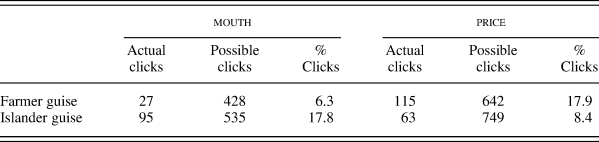
In the perception study, participants were played two different samples of talk taken from the same interview with one of the younger generation Scilly-educated males analyzed in this paper. The two Scillonian guises were edited in Praat (Boersma & Weenick, Reference Boersma and Weenick2015) so that they were of broadly equal length. The first of the guises dealt largely with a discussion of farming practices (referred to as the Farmer guise), and contained no location cues for listeners. The second dealt with Scillonian traditions and contained a number of location cues (referred to as the Islander guise). Despite topic differences, both guises included a similar range of linguistic features found in traditional Scillonian speech. These included fronted trap and bath vowels, with bath generally longer than trap (see Moore & Carter, Reference Moore and Carter2015), and mouth and price vowels with raised onsets. Reflecting the patterns outlined, all of the speaker's mouth vowels were audibly reasonably close, but they still tended toward an allophonic raising pattern, with vowels ranging from [ε̈ʉ] to [əʉ] according to following voicing context. The speaker's price vowels were also audibly raised, ranging from [ɑ̝ɪ] to [oɪ], but with no apparent effect of following context. These ranges were replicated in both samples as closely as possible to ensure similarity in vowel qualities across the samples, although it is worth noting that the closest price onsets were only found in the Islander guise as shown in Table 4.
mouth and price tokens in each guise

Listeners were presented with the guises via a real-time reaction and evaluation tool that was administered via a web browser interface, and responses were gathered from 112 native speakers of English. In order to assess their geographical spread and wider geographical experience, respondents were asked for the postcode of the place in which they currently lived, the number of towns/cities in which they had lived, and their travel experience via a question about which of 10 regions they had visited (based on the Regions of England [ONS Geography, 2010], plus the Isle of Wight and the Isles of Scilly). Respondents were drawn from 44 of the 124 postcode areas in the United Kindgom, had lived in an average of 3.2 places (SD = 1.9) and generally had a good amount of travel experience, visiting 7 of the regions on average. Nine of our listeners were resident on the Isles of Scilly.Footnote 7
The guises were presented alongside two distractor guises. Listeners were initially asked to listen to the guises and provide evaluation data that included locating the speaker geographically, and rating him along status and solidarity dimensions. After providing the evaluation data, listeners were asked to listen to the sample again and to click a button on the screen when they heard “anything in the way this person sounds which makes you wonder where he is from (or confirms where you already think he is from).” Listeners were then asked to review their clicks using a transcript with linked audio and, where possible, provide explanations for why they had clicked where they had.
We begin by reviewing the location and ratings data. As expected, given the discourse-context priming, the Farmer guise was most frequently identified as being from the countryside (by 87.5% of participants). This guise was most frequently identified as being from the southwest in particular (by 85.7% of participants), but only 8% of participants accurately guessed Scilly. The Islander guise was also most frequently identified as being from the southwest (by 53.6% of participants), but nearly one-third also accurately guessed Scilly (29.5%). The discourse context also primed listeners about the Islander guise, which was most frequently identified as being from the coast (by 54.5% of participants).
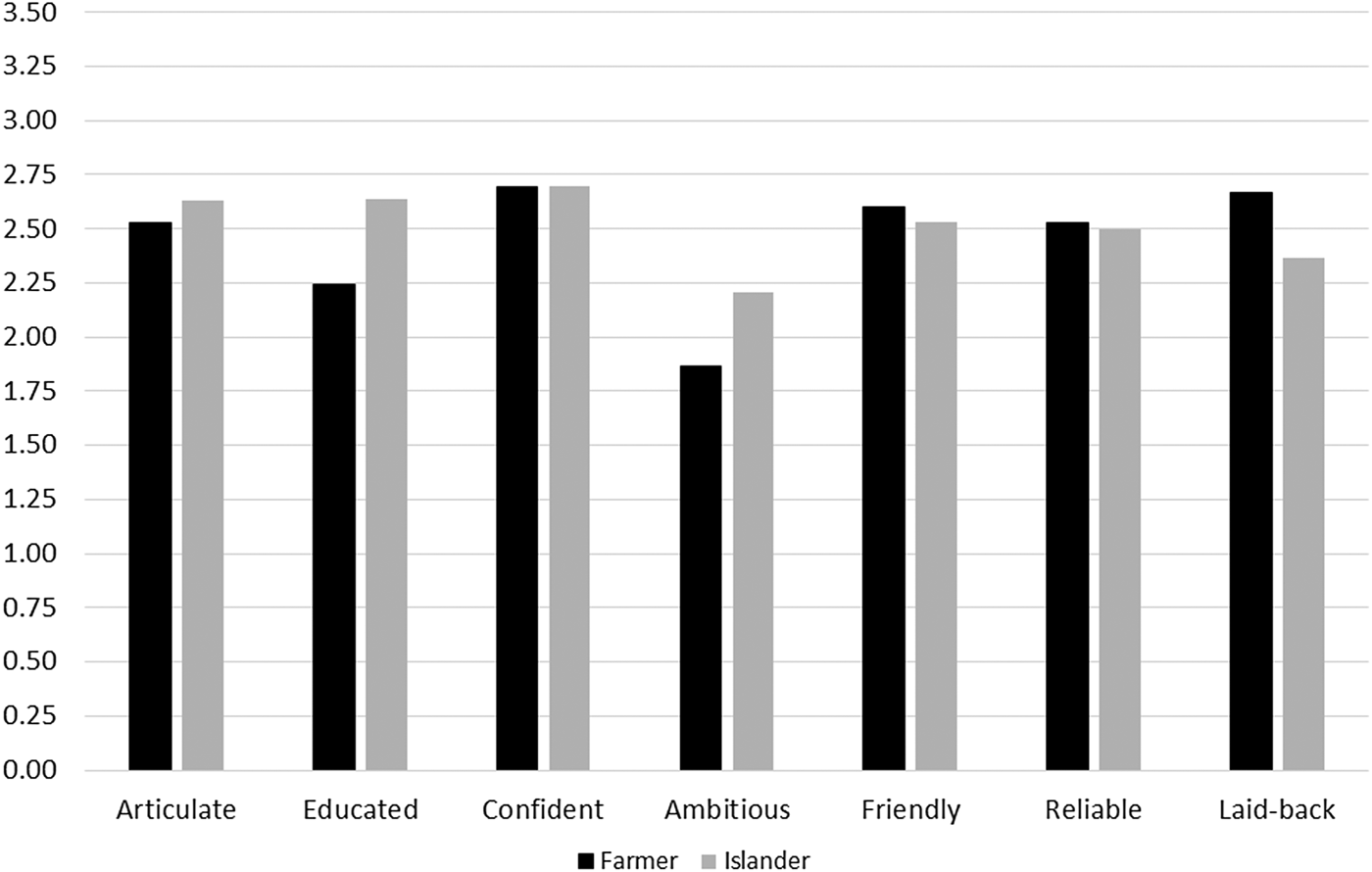
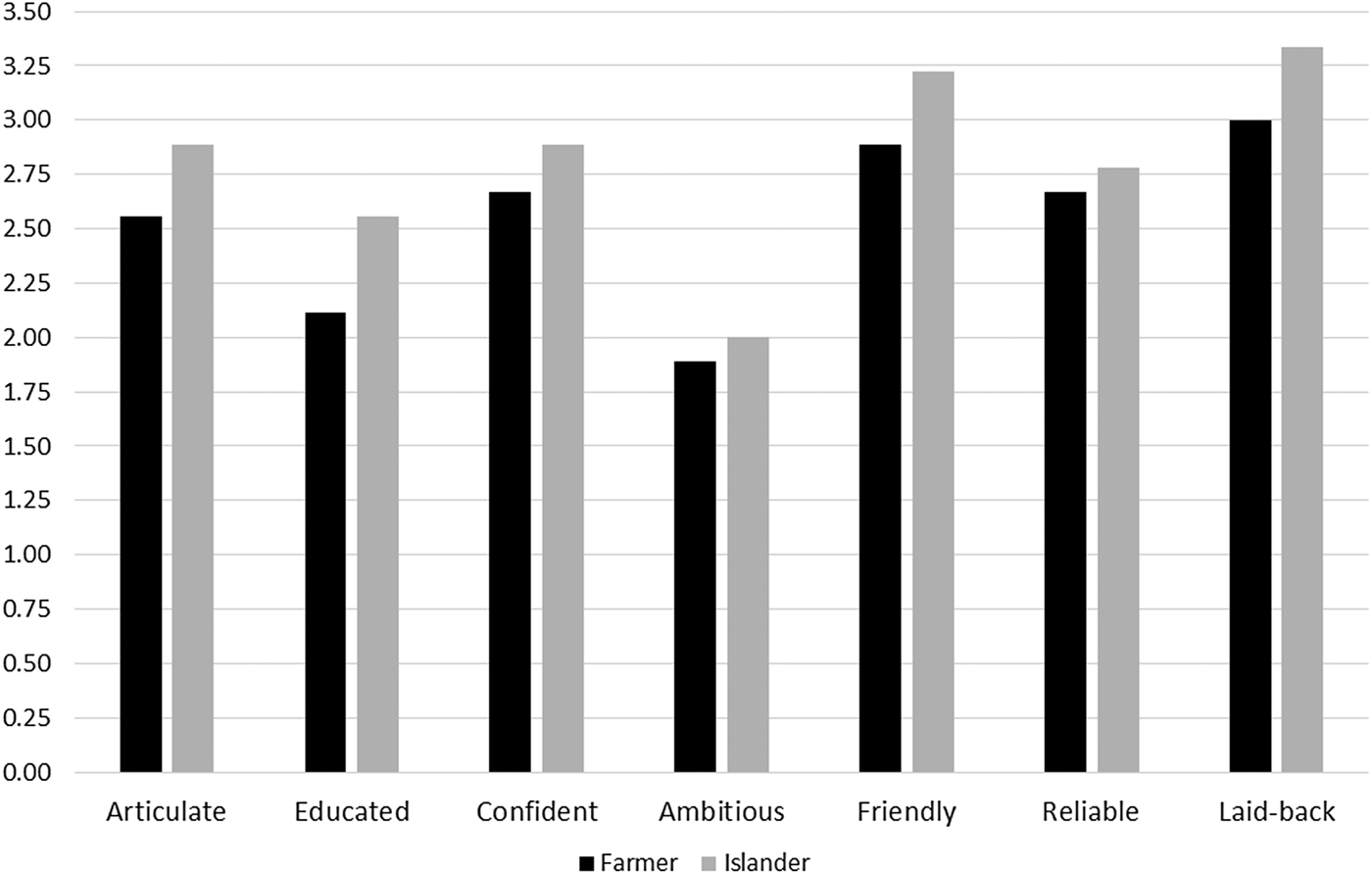
In addition to these differences in where the guises were located, Figure 5 shows that the Farmer guise tended to be more highly rated with regard to friendliness, reliability, and being laid-back (solidarity dimensions), and the Islander guise tended to be more highly rated with regard to articulacy, education, and ambition (status dimensions). Using paired t-tests, Montgomery and Moore (Reference Montgomery and Moore2018) found significant differences between the two guises for the ratings factors, with highly significant differences between ratings grouped according to status and solidarity.
Attitudes toward the Scillonian Farmer and Islander guises (all respondents, n = 112).

Our Scillonian respondents followed the same general pattern found in the larger sample, although, unsurprisingly, they were slightly more accurate across both guises and they were much better at identifying the Islander guise as being from Scilly. The numbers must be interpreted cautiously, given the low number of Scilly residents who participated in the perception testing, but for the Farmer guise, 77.8% (seven of nine) of Scilly residents guessed southwest, but 44.4% (four of nine) also guessed Scilly, with the same proportions guessing countryside and coastal, respectively. For the Islander guise, all but one speaker (eight of nine) accurately guessed that the speaker was from Scilly and everyone identified the speaker as being from a coastal location. Our Scilly respondents also showed a more nuanced response to the two guises in the ratings task. Figure 6—which, again, should be interpreted cautiously, given the very low number of participants—shows that, not only do the nine Scilly respondents rate both guises higher than the average rankings in the general sample, they also rate the Islander guise more highly than the Farmer guise on every single dimension. That is to say, the Islander guise is ranked higher than the Farmer guise for articulacy, education, confidence, and ambition (status dimensions) and friendliness, reliability, and being laid-back (solidarity dimensions).
Attitudes toward the Scillonian Farmer and Islander guises (Scilly respondents only, n = 9).

These findings suggest that, despite both guises being spoken by the same Scillonian male, during the same interview, the topic content of the guises caused them to be perceived differently (see, e.g., Hay, Nolan, & Drager [Reference Hay, Nolan and Drager2006], Levon [Reference Levon2014], Preston [Reference Preston, Gilles, Ziegler and Scharloth2010], and Rácz [Reference Rácz2013] for the effects of topic on perception). The references to farming and rural life more readily primed listeners to hear a southwestern, rural accent in the Farmer guise, and led them to evaluate the speaker more positively in terms of solidarity. On the other hand, the references to island life and the sea more readily primed listeners to select a coastal and specifically Scillonian location for the speaker in the Islander guise. This speaker was also evaluated more positively in terms of status than the Farmer guise in the general sample. These evaluations were amplified in the responses from the Scilly residents, and their superior rating of the Islander guise across all dimensions suggests that they positioned this speaker as more statusful and more like themselves (if we interpret solidarity as a marker of alignment) than they did the Farmer guise. The differences in their ratings and, indeed, their comments on the guises, also suggests that none of the Scilly speakers actually realized they were hearing the same voice in both guises—despite the fact that one Scilly resident claimed to “know the bloke” heard in the Islander guise.
Turning now to the click task, where listeners were asked to click and then comment on the elements of the sample that made them wonder where the speaker was from, using generalized linear mixed-effect regression models for each feature, Montgomery and Moore (Reference Montgomery and Moore2018) found statistically significant differences in the rates of recognition for price and mouth dependent upon the specific Scillonian guise in which they appeared: listeners clicked for price significantly more frequently in the Farmer guise, and for mouth significantly more frequently in the Islander guise, as can be seen in Table 5.Footnote 8
Percentage of clicks received for mouth and price in each guise for all participants (n = 108, following the exclusion of participants who provided no reaction data)

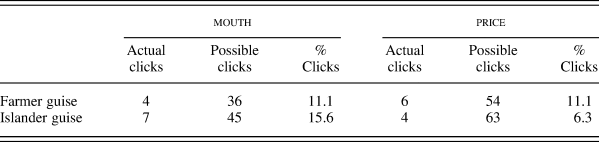
The Scilly respondents also showed different rates of recognition for mouth and price according to the guise in which they appeared. Again, these results need to be treated cautiously because of the low number of participants, but Scilly respondents clicked on mouth and price to the same extent in the Farmer guise. However, following the pattern in the general sample, they recognized mouth much more readily than price in the Islander sample. This was despite the fact that the Islander guise had more extreme tokens of raised price onsets than the Farmer guise did, as noted in Table 4.
Given that listeners were instructed to click a button on the screen when they heard “anything in the way this person sounds which makes you wonder where he is from (or confirms where you already think he is from),” these results suggest that a raised price onset may be more readily associated with a southwestern farmer persona than it is with a coastal (Scilly) islander persona. This is entirely in line with what we know about the distribution of raised price vowels in the southwest of England and the ideological associations of southwestern English and its links to farming. Earlier we noted that the price vowel is recorded as being variably centralized and retracted throughout the southwest region (Wakelin, Reference Wakelin1986:26–27). Furthermore, listeners specifically noted the “southwestern” quality of this vowel in the free comments they provided during the task, while also making links to the idea that the speaker “sounded very rural” and “like a farmer.”
On the other hand, in the general sample, a raised mouth onset seems to be more readily associated with a coastal (Scilly) islander persona than it is with a southwestern farmer persona. Again, this seems to be in line with what we know about the regional qualities of the mouth vowel, which are much more variable—such that a raised onset is not distinctively and unambiguously southwestern, given that a range of lowered, fronted, and centralized forms are also found across the southwest, and that centralized forms are also shared with the southeast of England (Wakelin, Reference Wakelin1986:28). Consequently, the quality of the Scillonian vowel may be notable to respondents (with comments noting its “distinctiveness” or its “interesting quality,” rather than its regional associations), but it may be less obviously linked to region in the way that the raised price onset appears to be.
Table 6 suggests that the Scilly respondents seem to be more willing than other respondents to consider a raised mouth vowel as compatible with a southwestern farmer persona. This may reflect the reality that there are farmers on Scilly (indeed, the speaker used in the perception test was one). However, what is interesting in the Scilly residents’ responses is that in the Islander guise, a raised onset in mouth more specifically locates him as Scillonian than a raised onset in price does. That is to say, Scilly respondents more actively recognize the unusual or distinctive raised pronunciation of mouth in the context where Scillonian identity is unambiguous.
Percentage of clicks received for mouth and price in each guise for Scilly respondents (n = 8, following the exclusion of participants who provided no reaction data)

Given that Scillonians perceive themselves as distinctive from the southwest mainland (and that outsiders have also perceived them in this way as noted in the historical metalinguistic commentary presented in the Research context section), it makes sense that they (and indeed, others) more readily recognize what distinguishes their speech from the mainland when speech is recognized as unequivocally Scillonian. It is possible that this finding has implications on the trajectories of mouth and price on the islands, and we consider this in the Discussion.
DISCUSSION
Our production analysis revealed that the dialect of English spoken on the Isles of Scilly has historically exhibited an allophonic raising split in the mouth and price lexical sets. While the pattern seems to be in decline for both lexical sets, Scilly exhibits a more resilient raising pattern for mouth than it does for price. A perception experiment suggested that raised variants of these two lexical sets are differentially associated with persona types, such that—to outsiders at least (i.e., the majority of the general sample)—price is more compatible with the image of a rural, southwest farmer than mouth is, whereas mouth is more compatible with the image of a more prestigious islander than price is. For the Scilly residents, both mouth and price are compatible with the image of the southwest farmer (perhaps reflecting the fact that Scilly farmers can, and do, have raised onsets in both lexical sets as evidenced by the speaker in the perception experiment), but a raised price onset is less compatible with the image of the archetypal islander than a raised mouth onset when rural associations are not primed by the discourse context.
Britain (Reference Britain, Montgomery and Moore2017:174) noted that rural areas are typically stereotyped as “backward, conservative, boring, dangerous, threatening, ‘uncultured’ and uneducated.” These characteristics are precisely the opposite of the dominant Scillonian character type we find in the historical metalinguistic commentary. See, for instance, this quote from the Gentleman's Magazine written by a Scillonian living in London in the late 19th century:
the Scillonian is very much a man of the world. He is rarely utterly uninformed. In many cases he is a person who has read with much judgment, if not widely. He is more philosophical than humorous … I hope that it may be gathered from what I have written that, if he has a good opinion of himself, there is ground for his self satisfaction. (Banfield, Reference Banfield and Urban1888:54)
It is possible that the allophonic raising split for mouth has some resilience on the Isles of Scilly because a raised mouth onset is less strongly associated with negative “rural” characteristics than a raised price onset is. That is to say, while there may be something at stake for a Scillonian to use a raised price onset (with regard to how they are evaluated by fellow islanders and those with whom they come into contact), there is little at stake in using a raised mouth onset. In this way, ideologies about Scilly and Scillonian speakers (and the uniqueness of both) may have interacted with the different social and regional qualities indexed by raised allophones of mouth and price. This, in turn, may have had some influence on the patterns of language variation and change that we have observed in this paper.
While speculative, our explanation for the different trajectories of mouth and price on the Isles of Scilly attempts to incorporate knowledge of the unique sociohistorical context of the islands into an explanation of language variation. One argument against the account we have proposed is that the allophonic mouth split seems to be receding in the younger generation. Even if it is doing so at a slower rate than the allophonic price split, this brings into question its ability to serve as a symbol of Scilly's uniqueness. However, it is important to note that the association between the Scilly islander persona and the mouth lexical set is not necessarily agentively exploited by Scillonians, either now or historically. More research (and different kinds of data) would be required to determine whether this were the case. On the other hand, a much clearer case can be made for (some) Scillonians actively avoiding raised price onsets, given that the perception testing revealed them to be explicitly associated with the negative characteristics linked to the “rural southwestern farmer.” Consequently, while the allophonic raising split may be being lost for both mouth and price as a consequence of the processes of dialect leveling, which have affected many traditional varieties of English, the more clearly defined and stereotypical social meanings of price may have led to the processes being accelerated for this variable, when compared to mouth.Footnote 9
CONCLUSION
Overall, in this paper, we have attempted to demonstrate how local considerations may affect the outcomes of otherwise probabilistic processes of language variation and change. We began by noting the commonalities across varieties that exhibit the kind of allophonic raising pattern we have observed on the Isles of Scilly. As noted, there are two environments in which the allophonic raising split seems to occur with some regularity: in colonial contexts where leveling processes occur due to varied input (Trudgill, Reference Trudgill2004:88) and in insular communities. In the Research context section, we discussed how Scilly is similar to other island communities exhibiting this pattern with regard to population structures, migration patterns, and tourism, and in being geographically isolated but exocentric. As Amos (Reference Amos2011:76) observed, “in insular communities where there is increasing contact between dialect varieties, these types of allophonic alterations may arise as a result of phonological reallocation.” Island communities are often a combination of tradition and innovation, given that they frequently exhibit historical continuity in their population alongside significant migration. If the allophonic raising split studied in this paper is considered to be a combination of innovative and conservative linguistic forms (as has been suggested in, for instance, Britain [1997]), then this profile might fit an island community very well.
While this helps to explain how the allophonic raising split emerged, it does not account for the ways in which the pattern has developed over time. In this paper, we have attempted to add to our understanding of the allophonic raising split by closely examining a specific community in which this pattern persists and reflecting on the interaction between linguistic processes and social meaning to explain its trajectory. There is much more to be said about the nuances of social meaning that affect how mouth and price are utilized on the Isles of Scilly (and elsewhere), but we offer this paper to demonstrate that the language change that has occurred in the use of these variables on these islands seems to correlate with the quite distinctive social meanings of the mouth and price lexical sets. So, while our paper corroborates previous work on the allophonic raising split found for these variables, which encourages us to see the replication of patterns worldwide as the outcome of independent developments generated in situations of contact, we hope to have provided an illustration of the benefits of reflecting on the localized social meanings that might influence how such patterns play out in a specific community.
SUPPLEMENTARY MATERIAL
To view supplementary material for this article, please visit https://doi.org/10.1017/S0954394518000157.