1. Introduction
Current world migration is disrupting conceptual boundaries of national democratic polities. One area where international migration is challenging the traditional sense of political community concerns electoral rights for ‘non-resident citizens’ (i.e., expatriates) and ‘non-citizen residents’ (i.e., resident foreigners).Footnote 1 With the right to vote being an ultimate expression of political membership in a democratic nation-state, any debates about these two groups’ suffrage rights provide fertile ground for analyzing a particular community's ‘identity struggle’ under the pressure of globalization, which would otherwise remain dormant, vague, or simply assumed away without systematic inquiries. In other words, such debates constitute an important source of empirical insights into how democracies re-imagine themselves away from fixed identities.
This line of research has focused on various European countries. A similar trend has not yet started in East Asia.Footnote 2 In regard to South Korea, no systematic and unified analyses of this sort exist, despite recent heated debates on the question of extending voting rights to overseas citizens and resident foreigners (mainly ethnic Chinese) within its territory. This paper takes the first step to fill this gap, using the most systematic theoretical framework currently available for this line of research: one developed by Rainer Bauböck (Reference Bauböck2005), primarily with European cases in mind.
The paper's central contribution is that it provides direct empirical evidence that undermines the established conventional wisdom that Koreans define their polity purely on the basis of their ethnicity. Contrary to general expectations, ethno-nationalist arguments do not prevail in the Korean debates in question. Rather, this paper finds ample references to the civic ideals of political community, which emphasize responsibilities towards the well-being of the polity, instead of ‘Korean blood’. It was this line of reasoning that has produced powerful justifications for denying franchise to overseas compatriots, while granting limited electoral rights to qualified resident foreigners. The conventional wisdom of Korean ethno-national identity would have led us to find the opposite pattern: at least more sympathetic responses by the political authorities to the idea of extending voting rights to overseas Korean nationals given their lineage (manifested in citizenship), if not an outright granting of such rights; and a firm rejection by the Seoul government of the resident foreigners’ entitlement to voting rights despite their residency in South Korea, especially when Korean compatriots themselves had not been enfranchised.
A broader implication of this major empirical finding is that it highlights one fundamental limitation of Bauböck's theoretical framework: it conceives political franchise only as an expression of people's rights in regard to law-making, while the right to vote may also be viewed as conditional upon their duties and obligations towards the state.Footnote 3 In fact, as the paper will demonstrate later, the line of reasoning found in the South Korean case falls outside Bauböck's framework. In other words, there is no category among those advanced by Bauböck that adequately captures the Korean duty-based logic of granting or not granting voting rights. Thus, this East Asian case helps to advance the discipline as it suggests that revisions to Bauböck's framework are necessary to address both rights-based and duty-based logics of franchise extension. Such an enhanced analytical tool should serve us better in cross-regional future research.
To avoid confusion, however, some caveats are needed. It is necessary to stress that this paper does not aim to tell a causal story and definitively pinpoint the reason for the variance in the outcome of the two suffrage debates in question.Footnote 4 This would require a different research design and methodology. The primary point here is rather to isolate from these Korean debates conceptual arguments on franchise rights that have been used in public to justify a particular course of action, so as to gauge a normative ideal that the polity believes is important. The debates about political franchise for non-resident citizens and non-citizen residents provide particularly fertile ground for this because these two groups are at the margins of South Korea's polity, provoking government officials to articulate some logics for their inclusion or exclusion. That is, a concept that is to serve as a normative standard should be justified and defended by reference to arguments about principals.Footnote 5 It is for this very purpose that Bauböck's ideal-typical framework – the only such systematic tool available in the existing literature – is adopted (and its limitations addressed). The conceptual arguments distilled from the debates, therefore, represent merely ideal-cases, which, of course, if taken strictly to their logical conclusion, pose baffling conceptual, legal, and ethical dilemmas.Footnote 6 Nonetheless, these arguments challenge our expectations and hence the long-established understanding of the Korean collective ethnic identity.
This paper will start by reviewing existing understandings of the Korean ethno-national community. It will then introduce the theoretical framework on franchise extension developed by Bauböck, point to its limitations, and generate hypotheses for the case of South Korea. The next section will examine the country's public debates about the electoral rights for non-resident citizens and non-citizen residents. The study will conclude by discussing the implications of its findings and possible directions for further research.
2. Korean ethnic community: the state of the art
South Korea, it has been routinely argued, is a classic contemporary example of a democratic polity that maintains a strong sense of attachment to ethnic (national) identity and sentiments (e.g., Shin, Reference Shin2005, Reference Shin2006a, Reference Shin2006b, Reference Shin2007; Shin and Chang, Reference Shin and Chang2004; Shin et al., Reference Shin, Freda and Yi1999; Park, Reference Park2006). This was exhibited, for example, by the Korean government's and public's response to the Virginia Tech massacre (Shin, Reference Shin2007). This modern tribalism, the argument goes, has long been central to the Korean imagining of its national community. That is to say, the Korean polity is commonly viewed as formed around ethnic nationalism, in keeping with Liah Greenfeld's argument that ‘nationalism may be distinguished according to criteria of membership in the national collectivity’ (Reference Greenfeld1992: 11).
Gi-Wook Shin is perhaps the most representative scholar of this position in recent years. As he explains in his principal work, Ethnic Nationalism in Korea: Genealogy, Politics, and Legacy, Sin Ch'aeho, a leading nationalist, began advocating in the early twentieth century the notion of Korean history as one of the ‘ethnic nation’ (minjoksa). He argued that Korea was ‘an organic body formed out of the spirit of a people . . . descended through a single pure blood line’, which would last even in the absence of the formal state (quoted in Shin, Reference Shin2006a: 38, emphases in original). This notion of an ethnically homogenous nation, whose origins can be traced to the mythical figure of Tan'gun, was further popularized and deeply rooted among Koreans during Korea's bumpy transition to a modern state. Over time, the resultant ‘blood-based ethnic national identity became a totalitarian force in politics, culture, and society. It came to override other competing identities and led to the poverty of modern thought . . .’ (Shin, Reference Shin2006b: 4). Recent polls by the Korea Broadcasting Station (KBS) and by Hallym University suggest that an overwhelming majority of South Koreans agree that ‘Koreans are all brothers and sisters regardless of residence or ideology’ (quoted in Shin, Reference Shin2006a: 2). They feel stronger attachment to ethnic Koreans living overseas, even if they have attained foreign citizenship, and to Korean descendents in foreign countries, than to ethnic non-Koreans resident in Korea. Therefore, it is hardly surprising that the exclusionary principle of ius sanguinis (citizenship by blood) continues to define Korean nationhood; and it has been argued that the concepts of ethnic nationhood and citizenship are largely inseparable for most Koreans (Shin, Reference Shin2006b).
This perspective is by no means unchallenged. For example, Skrentny et al. (Reference Skrentny, Chan, Fox and Kim2007) examine foreign ethnic preference policy in an attempt to cast fresh light on how boundaries of nationhood in East Asia and Europe are being redrawn. They suggest that (unlike in Europe where ethnic preferences are a kind of ‘expressive nationalism’) East Asian governments, including that of South Korea, have somewhat diluted their approach towards ethnic nationalism for instrumental reasons – in order to promote economic development. Nonetheless, the fact remains that the Korean government's return migration policy explicitly recognizes ethnic bonds by giving preferences to Korean descendents. Thus, all in all, the conventional view about what constitutes Korean nationhood seems well established in the existing literature. Yet, this view comes under challenge if we examine the contentious question of political franchise for those at the boundaries of the South Korean demos: its non-resident citizens and non-citizen residents.
3. Electoral rights for non-resident citizens and non-citizen residents: analytical framework
Robert Dahl contends that one of the necessary criteria of polyarchy – the system of government in the real world that comes closest to an unattainable ideal of democracy – is that ‘[p]ractically all adults have the right to vote’ (Reference Dahl1989: 233). Many scholars have argued that the ideal of universal suffrage has been achieved and that ‘de jure restrictions on the right to vote are not found in current democracies’ (Munck and Verkuilen, Reference Munck and Verkuilen2002: 11). However, we are reminded by Dahl that ‘[i]n practice, every demos is exclusive’ (Reference Dahl1982: 97). Likewise, Katz rightly asserts that ‘[n]o country allows all adults to vote . . . Although the basic trend over the last 200 years has been to remove one barrier to voting after another, many restrictions remain’ (Reference Katz1997: 216). Without doubt, political franchise has undergone an enormous expansion all over the democratic world. Gender, race, education, or social standing, for example, no longer constitute a justifiable basis for exclusion from electoral participation. Still, participation in the democratic process in a great number of democracies cannot be taken for granted by prison inmates, people who are mentally deficient, expatriates, resident foreigners, and, of course, non-adults (see, e.g., Beckman, Reference Beckman2007; Blais et al., Reference Blais, Massoicotte and Yoshinaka2001). But whereas disenfranchisement of children and people with cognitive impairments is commonly justified on the grounds of their not fulfilling the requirement of personal autonomy, and prisoners are excluded on the grounds of their not satisfying the criterion of law-abidingness, the issue of suffrage rights for expatriates and resident foreigners is fuzzy. The criteria for their political franchise remain contested and as a result they are applied variously in different democratic systems.Footnote 7 There have been some explicit attempts made in recent years at untangling these diverse criteria of their inclusion/exclusion (see especially Beckman, Reference Beckman2006; López-Guerra, Reference López-Guerra2005). But it is Rainer Bauböck's (2005) typology that provides a succinct yet most comprehensive conceptualization of this issue.
Bauböck's typology
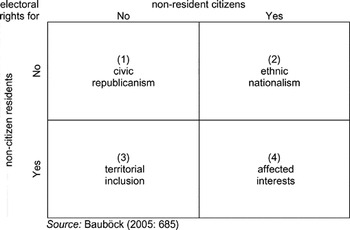
Bauböck (Reference Bauböck2005) has proposed four contrasting ideal-typical perspectives on expansion of electoral rights for non-resident citizens and non-citizen residents: (1) ‘civic republicanism’, (2) ‘ethnic nationalism’, and two liberal principles of (3) ‘territorial inclusion’, and (4) ‘affected interests’. The paper will first discuss the ethnic nationalism and territorial inclusion positions, and then civic republicanism and the principle of affected interests.
Ethnic nationalism: voting is a proof of ‘blood lineage’. For ethnic nationalists, the only thing that matters is ethnic lineage, i.e. ‘blood line.’ Ethnic nationalism, in its purest form, is not concerned with physical presence or formal citizenship – or, for that matter, the nature of issues at hand – when granting voting rights. Therefore, it not only supports the inclusion of non-resident nationals (‘blood brothers and sisters’) but regards it as essential since ‘[i]t conceives of the nation as a community of culture, imagined descent, and destiny that has a right to self-determination’ (Bauböck, Reference Bauböck2005: 685). It follows from this premise that it is fully ‘legitimate to exclude non-citizens who have not assimilated into the national community’ (Bauböck, Reference Bauböck2005: 685); hence, the ethno-nationalist conception rejects in principle the expansion of electoral rights to resident foreigners. The political community that ethnic nationalism envisions is for ‘blood relatives only’ and is not limited by geography.
Territorial inclusion: physical presence alone is sufficient. The opposite of ethnic nationalism is territorial inclusion. This perspective argues that physical presence in the polity alone constitutes sufficient grounds for someone to acquire voting rights. ‘Blood line’ is irrelevant, and no formal citizenship is required; only permanent or long-term physical presence matters. Thus, the territorial inclusion position supports suffrage rights for resident foreigners, just as for any other residents, as long as they live legally in the polity. By the same logic, it rejects the granting of voting rights to expatriates.
The principle of territorial inclusion stems from the liberal vision that ‘regards a democratic polity as a community of individuals who are subjected to the same political authority and its laws and who have therefore equal rights to representation and participation in the making of these laws’ (Bauböck, Reference Bauböck2005: 686). In fact, from this perspective, granting voting rights to expatriates is not only non-essential but even undesirable, given that they have a potential of ‘undermining the integrity of the democratic process since those who live permanently abroad should not be able to influence the making of laws to which only internal residents will be subjected’ (Bauböck, Reference Bauböck2005: 686).
Civic republicanism: voting is a privilege to self-govern. The civic republican position rejects the extension of political franchise to both expatriates and resident foreigners, because ‘[o]nly citizens who are present in the polity can govern themselves by participating in making its laws’ (Bauböck, Reference Bauböck2005: 685). Resident foreigners, while physically present in the polity, are not formal citizens. On the other hand, expatriates may be formal citizens but do not satisfy the condition of physical presence. (Only those who are abroad for a limited time – i.e., those who intend to come back to their homeland – may receive some leeway and participate in elections). In short, according to this perspective, only those who satisfy these two conditions – formal citizenship and physical presence – are allowed to vote.
Thus, electoral rights are regarded as a privilege for citizens, as well as a tool to participate in the process of law-making. There are two underlying assumptions here: (1) physical presence is required to participate in law-making; and (2) such a privilege (or right) to participate in collective decision-making (or self-governing) is not automatically granted, but is restricted to those who can satisfy a set of conditions (e.g., age) to ensure that only those who are responsible for and capable of self-governing participate in law-making. Such conditions include, but are not limited to, formal citizenship. Civic republicanism, in other words, specifies formal citizenship as the minimum requirement for such conditions.Footnote 8
Affected interests: it depends on issues. All three positions discussed thus far specify some pre-set conditions for acquiring voting rights, whether ethnic heritage, physical presence, or formal citizenship (or a combination of them). The final position of what Bauböck calls ‘affected interests’, in sharp contrast, does not specify such conditions a priori. It presents an issue-specific argument: certain issues affect some people but not others, and those who are affected, then, should have voting rights on these issues.Footnote 9 If, for example, particular homeland issues affect expatriates, they should be granted voting rights on those issues, but not on others. By the same token, if particular issues affect resident foreigners, these residents should be eligible to vote on them. In practice, however, the vast majority of issues for law-making are directly relevant to resident foreigners; this means that the affected interests perspective grants voting rights to these non-citizen residents just as to citizen residents. In other words, as far as resident foreigners are concerned, affected interests and territorial inclusion perspectives usually have the same outcome. However, they differ in regard to expatriates’ voting rights: the territorial inclusion position rejects such rights outright, whereas the affected interests position argues that ‘it depends on the issues’.Footnote 10
In sum, Bauböck's conceptual framework is represented in Table 1.
Bauböck's typology of expansive electoral rights

The limitation of Bauböck's framework
Thus far, the paper has briefly explicated the typology put forward by Bauböck. As noted earlier, this framework is implicitly biased toward a liberal view of voting in the sense that it views the act of voting as merely an expression of people's rights (and not also entailing responsibilities/duties). The underlying image here is a group of people participating in law-making – a self-governing community in which the members are exercising their rights of electoral participation. Thus the question that Bauböck asks is ‘Who has rights to participate?’
What is missing in this framework is the ‘other side’ of what the right to vote entails: duties. Rights pertaining to, and in fact defining, political membership have for a long time been seen as conditional upon certain duties defined as acts ‘inspired by a lively sense of responsibility towards the welfare of the community’ (Marshall, Reference Marshall1964: 112). Hence, suffrage qualifications have been recognized as a reward only after civic duties, such as paying tax and serving the military, have been satisfied.Footnote 11 Indeed, among other restrictions, tax contribution has historically defined eligibility for voting in leading Western democracies, including France, Great Britain, and the US. Even after formal barriers to political franchise had been abolished in the US, payment of a poll tax remained to be a prerequisite to voting (Bartolini, Reference Bartolini and Rose2000; Kousser, Reference Kousser and Rose2000). It is also not surprising to see that some democratic polities (the primary example being the US) have granted electoral rights to foreigners after serving in their militaries, or that military service constituted a basis for expanding political franchise overseas (Coleman, Reference Coleman and Avaliktos2004; Keyssar, Reference Keyssar2000; Raskin, Reference Raskin1993; Shklar, Reference Shklar1991). In short, enfranchisement is not only a matter of rights, but may also be seen as conditional upon certain duties. Bauböck, however, focuses only on rights.
Generating hypotheses for the Korean case
Bauböck's four perspectives on granting electoral rights, as well as the additional emphasis on duties, will be examined in the Korean case; but they first need to be contextualized and operationalized.
Until the mid-1990s, South Koreans were required to maintain both their citizenship and resident registration number to be eligible to cast a ballot. These regulations excluded from voting both overseas Korean nationals and resident foreigners; only formal citizens resident in South Korea were vested with the right to vote. This ostensibly seemed to be explicitly based on civic republicanism. However, the rationale for this situation had not been clearly considered, but was simply taken for granted. After all, the vast majority of the population living in South Korea comprises ethnic Koreans, and despite the gradual outflow of South Korean citizens to foreign countries, no major political voices were heard challenging the status quo until relatively recently. When such voices finally emerged, even defenders of the status quo had to articulate their logic. Debates emerged about the electoral rights of overseas Koreans and resident foreigners. As a result of the latter debate, qualified resident foreigners can now vote in certain types of elections; however, the disfranchisement of Korean expatriates still continues.
In formulating and testing hypotheses for the case of expatriates’ voting rights, which have not changed in over ten years, the paper will conduct a within-case comparison; that is, I will identify and test various scenarios generated by Bauböck's framework, and propose a new one that addresses the limitation of the framework. I will then utilize a similar technique for the case of resident foreigners’ voting rights which have changed. Thus the paper will test different expectations as to the nature of the ‘challengers” and ‘defenders” arguments advanced in the course of the debates.
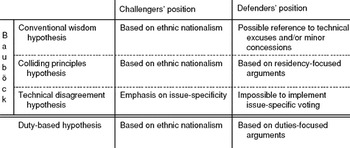
The expatriates’ franchise debate. Conventional wisdom hypothesis: A Korean supporter of ethnic nationalism would be expected to argue that, regardless of the place of residence and formal citizenship, all ‘Koreans’ (i.e., those with Korean heritage) must be eligible to vote (notwithstanding some logistical complications). Realistically, this would not be supported by defenders of the status quo (e.g., government officials) because it undermines the twin conditions (formal citizenship and physical residence) of the old franchise regime. However, given the prominence of the ethnic-based conception of the Korean nationhood, as established in the literature, one would expect that the rhetorical power of ethno-nationalist arguments was great, resonating in many sectors of the Korean society, and that these arguments have received sympathetic responses even from defenders of the status quo. In fact, in the case of Japan, the rhetorical power of such ethno-nationalist arguments has facilitated an actual policy change, resulting in the enfranchisement of overseas Japanese (Kalicki, Reference Kalicki2009). While the case of South Korea does not have the same outcome, the conventional wisdom would lead one to expect that the ethno-nationalist logic was quite powerful in South Korea nonetheless. As such, defenders of the old regime would have to resort to using technical objections to implementing voting processes, or perhaps indicating willingness to make minor concessions by extending voting rights to short-term Korean expatriates, such as overseas students, rather than opposing the ethno-nationalist arguments on principle.
Colliding principles hypothesis: An alternative scenario is that in face of the ethno-nationalist call for policy change, defenders of the old regime forcefully presented an alternative philosophical basis. These defenders might, for example, have utilized the territorial inclusion principle by simply rejecting voting rights to overseas Koreans on the grounds of their lack of physical residency. They might have also used the language of ‘voting rights as privileges’ in articulating the civic-republican basis of the old regime, which had earlier only been implicit. Either way, the bottom line for these defenders must have been the question of physical presence.
Technical disagreement hypothesis: Yet another scenario centers on the principle of affected interests: a more nuanced argument that non-resident citizens could vote on particular issues. However, challengers and defenders would be unlikely to reach a ‘technical agreement’ on how to implement issue-based voting procedures, rather than colliding on principle.
Duty-based hypothesis: These three scenarios – the ‘conventional wisdom’ hypothesis, the ‘colliding principles’ hypothesis, and the ‘technical disagreement’ hypothesis – all fall within the framework set by Bauböck. The final scenario, in contrast, singles out duty-based arguments, rather than physical residency-based arguments, as the most important philosophical grounds presented by defenders of the status quo. That is, these arguments would put strong emphasis on civic duties such as tax payments and military service as the prerequisite for extending electoral rights. Since overseas Koreans did not perform these duties as much as domestic residents did, the argument would go, they should not be allowed to cast votes on South Korea's political affairs. Alternatively, challengers might have argued that those overseas Koreans who completed their military duties (and/or are still paying taxes to the Seoul government) should be entitled to vote. In this particular scenario, just as in the case of the aforementioned colliding principles hypothesis, the status quo defenders are assumed to have prevailed by articulating the hitherto vague rationales underlying the old franchise regime.
These four hypotheses can be summarized in Table 2.
The hypotheses in the expatriates’ franchise debate

The resident foreigners’ franchise debate. In sharp contrast to the instance of expatriates, in the case of resident foreigners we have witnessed a change of the old electoral policy: the initial ban on their (limited) enfranchisement has been overturned. Furthermore, this case generates an even greater departure from, and a more serious challenge to, the conventional wisdom of the centrality of ethnic nationalism in Korean political affairs. If Koreans are such strong ethnic nationalists, how did they ever come to grant electoral rights to resident foreigners while continuing to ban the right to vote for their own compatriots abroad?
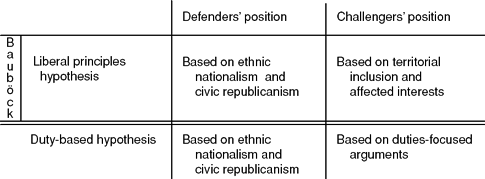
Liberal principles hypothesis: Unlike in the previous case, the ethno-nationalist line of arguments – i.e., ‘only Koreans should be able to vote’ – must have been employed in this case by defenders of the status quo. Furthermore, these defenders might have resorted to the civic republican argument with a special focus on formal citizenship as a requirement for enfranchisement. One could even imagine an amalgamation of these two arguments: for example, the formal citizenship argument constituting a ‘primary argument’ with some ethno-nationalist tones attached, since bringing ethno-nationalist considerations upfront could be seen as politically sensitive or inappropriate. In any event, defenders of the old regime are likely to have utilized the ethno-nationalist and civic republican principles.
While defenders are likely to have highlighted ‘what is lacking’ on the part of resident foreigners to be enfranchised, challengers might have singled out the conditions satisfied by these long-term non-citizen residents for the right to vote. For example, one such condition can be drawn from the principle of territorial inclusion: physical residency must be the only criterion for extending electoral rights in a democracy. The principle of affected interests would generate another condition: those who are continually affected by the government's decisions should be enfranchised because they are perennial constituents of the community. In both cases, long-term resident foreigners fulfill these conditions (which are ideologically very similar). Challengers of the old regime, one can thus conclude, might have resorted to the principles of territorial inclusion and affected interests. In sum, the scenario would involve the two sides colliding on principle: defenders clinging to ethnic nationalism and civic republicanism on the one hand, and challengers (who were ultimately victorious) espousing the more liberal principles of territorial inclusion and affected interests on the other. This hypothesis stems from Bauböck's framework.
Duty-based hypothesis: An alternative scenario, which is not derived from his framework, focuses on duty-based arguments. That is to say, it envisions that challengers might have argued that resident foreigners, just like their Korean neighbors, pay taxes (i.e., satisfy their duties to the polity whose power controls their lives) and hence deserve the same electoral rights that their neighbors enjoy. Such an argument, one can imagine, appealed to the sense of fairness and justice among Koreans. In fact, duty-based arguments are more articulate and single out more specific rationales for why foreign residents deserve voting rights, in comparison with arguments based on territorial inclusion and affected interests. They assume reciprocity between duties and rights – satisfying duties (e.g., paying taxes) must be rewarded with rights (e.g., eligibility to vote).Footnote 12
Thus, I have two general hypotheses to test in the case of resident foreigners: the ‘liberal principles’ hypothesis derived from Bauböck's framework and the ‘duty-based’ hypothesis. They can be summarized in Table 3.
The hypotheses in the resident foreigners’ franchise debate
4. Research results
Electoral rights for non-resident citizens
South Korea fits neither of Stein Rokkan's (Reference Rokkan1970) two ideal patterns explaining the development and adoption of universal, equal, and secret suffrage in the democracies of the West. Rather, the South Koreans’ ‘popular sovereignty’ was realized by attaining universal and equal rights to vote in one fell swoop, during the post-war US military occupation period (1945–47). From 1948, the country underwent several stages of political evolution from authoritarian dictatorship to democracy, culminating in a genuine civilian democratic government only in 1993. Since its institutionalization, however, universal suffrage has never been retracted or suspended – not even under dictatorship (Choe, Reference Choe1997; Kil, Reference Kil, Kil and Moon2001; Lee and Moon, Reference Lee and Moon2006). Nonetheless, the question of granting – or in fact, reinstating – overseas electoral rights has been a subject of controversy in Korea for many years. Since the abolition of the overseas voting system, which had existed in South Korea during the late 1960s and early 1970s,Footnote 13 South Koreans have been required to maintain both their citizenship and resident registration number in order to qualify to participate in elections. Thus, South Korea's non-resident citizens currently remain fully disenfranchised.Footnote 14
Early efforts to challenge this law came in 1997, when Kim Je-wan, a Paris-based journalist, published the first newspaper article on Korean expatriates’ right to vote. In the same year, a group of Korean nationals resident in Japan filed a constitutional petition. These efforts resonated among some opposition politicians. In the following year, the issue was once again raised by the then-governing National Congress for New Politics (NCNP), which made a proposal to reform Korea's political sector, extending electoral rights to Korean citizens temporarily resident overseas (such as students, corporate representatives, and public officials). These efforts, however, received a serious blow from the Constitutional Court, which ruled in 1999 that excluding non-resident citizens from voting was not unconstitutional (Ahn, Reference Ahn2007c; Cho, Reference Cho2006b; Korea Times, 21 September 1998; Shin, Reference Shin2004).
Nonetheless, civic groups and some politicians continued to call for an extension of political franchise to overseas nationals, despite repeated declarations from the National Election Commission (NEC) that it had no plans to restore such rights. This campaign, arguably, influenced the government's plan announced in December 2002 to launch a study with the NEC on an overseas absentee voting system. Towards the end of 2004, in the aftermath of a previous setback – a Seoul District Court's ruling in favour of the state in a case filed by Koreans resident in Japan – Yoo Ki-june of the opposition Grand National Party (GNP) submitted a bill that would allow Korean citizens resident abroad to participate in national elections through absentee ballots. Some other lawmakers revealed their intentions to present similar proposals. Shortly after, the NEC submitted to the National Assembly a revision of the election law, which would grant the right to vote in both presidential and parliamentary elections to citizenship holders staying abroad for a short period of time (Jung, Reference Jung2005; Seo, Reference Seo2005).
Notwithstanding these efforts, various civic groups carried on with their campaigns. These included the Federation of Korean Associations, an organization representing nearly 200 ethnic Korean associations in the United States, and Mindan, the pro-South Korea association of Korean residents in Japan. They opposed any legislative solutions that would prevent all South Korean passport holders, regardless of the time spent abroad, from voting in domestic elections (e.g., Lee J.W., Reference Lee2005; Lee S.Y., Reference Lee2005; Shin, Reference Shin2004). In June 2006, however, the calls directed at government officials and President Roh Moo-hyun were explicitly rejected by the Foreign Ministry officials. Even so, by the end of the year the NEC again recommended to the National Assembly to enfranchise Korean nationals temporarily resident abroad. Both the governing Uri Party and the main opposition GNP were, at that time, reportedly supportive of the NEC recommendations (Ryu, Reference Ryu2006). And yet, shortly afterwards, Kim Deog-ryong of the GNP and Kim Sung-gon of the Uri Party submitted separate bills aimed at revision of the election law. The former sought to include all overseas Korean nationals, while the latter called for voting rights only for those temporarily residing abroad. Some minor parties declared that they would file their own proposals. In another endeavor to push for an overseas voting system, leaders of overseas communities formed an Alliance for Suffrage for Overseas Koreans so as to lobby lawmakers and raise public awareness of the issue (Ahn, Reference Ahn2007a).
The quest for a right to an overseas vote was accelerated when on 28 June 2007, with five suffrage bills pending in parliament, the Constitutional Court made a ruling on petitions filed by Korean expatriates (Ahn, Reference Ahn2007d). In it, the court overturned its 1999 decision, declaring that denying voting rights to overseas Korean nationals was against the Constitution and urging the National Assembly to revise the appropriate laws by the end of 2008. The court stopped short, however, of pronouncing an immediate invalidation of the existing laws and, more importantly, did not conclude unequivocally that all overseas citizens should be entitled to suffrage without any restrictions.Footnote 15 The prospect of unlimited overseas voting was further jeopardized due to differences among the major parties on the specifics of the future law. However, the ongoing debate suggests that at least some South Korean nationals resident abroad will eventually gain overseas electoral rights.
Overall, the response of the state authorities to the overseas franchise question has been fairly counterintuitive in South Korea, as suggested by the nature of the arguments advanced in the democratic deliberation on this issue. To illustrate this, the paper unpacks below the key issues that have driven this debate and shaped its present outcome.
To be sure – as supposed in most of my hypotheses – the challenges to the existing state of affairs have echoed ethno-nationalist sentiments. Calls for policy change have been most frequently put forward by various civic groups engaged in the campaign. For instance, in a call on the government to enfranchise all Korean expatriates, Kwon Byong-hyon, chairman of the Overseas Koreans Foundation, argued that in the twenty-first century the traditional concept of national boundaries was shifting toward economic and cultural bodies dispersed around the world but bound by a common national identity (Kim K.H., Reference Kim2003), which has long been rooted in Korea principally in the concept of shared ethnicity. Likewise, Kim Young-man, president of the Federation of Korean Associations, has maintained that being deprived of the right to cast a ballot has led to a feeling among those domiciled overseas that they have been forgotten by their motherland, which in turn affects their sense of identity. Similarly, Kim Je-wan, who was involved in the establishment of the Alliance for Suffrage for Overseas Koreans, suggests that the inaction of the South Korean government contributes to the high number of Koreans seeking to acquire Japanese citizenship:
If you think about it, Koreans living in Japan have never been allowed to vote for four generations, whether in Japan or Korea. They identify their nationality with identity. Nowadays more than 10,000 Koreans go through the naturalization process each year to receive Japanese citizenship. [The Korean government] should give them voting rights, instead of aggravating the situation. (quoted in Ahn, Reference Ahn2007c: 4)
Some defenders of the status quo have, at times, refrained from opposing this ethno-nationalist call for new franchise rules, but have instead justified the existing regime on the grounds of economic practicality and avoiding the technical difficulties (particularly time-related) involved in managing election campaigns for those residing abroad. A constitutional provision that makes North Koreans automatically South Korean citizens and fears of election tampering have further been portrayed as technical obstacles to the legislative changes desired by overseas vote-seekers and their supporters. Finally, the unsuccessful attempts on the part of the NEC and various political parties to extend electoral rights to those temporarily abroad can be further seen as minor concessions on the part of the defenders of the status quo; this extends support to the conventional wisdom hypothesis.
However, the contentiousness of this issue and the conceptual roots of resistance to a major policy shift are located elsewhere. A close examination of the collected data indicates that for the most part the government officials’ stance has in fact plainly defied the ethno-nationalist logic of franchise expansion to non-resident citizens. This attitude has been overtly manifested in the argument that amending the election law so as to embrace (long-term) expatriates would make them focus excessively on their motherland rather than settle in the countries where they were domiciled. As Lee Joon-gyu, director of the Foreign Ministry's Consular Affairs Bureau, publically stated, ‘[Such a law] would have a bad impact on their lives in foreign countries, since it would provoke nationalism’ (Cho, Reference Cho2006a: 3). But more importantly, the guiding consideration of the wide range of state authorities that have opposed the extension of the political franchise to overseas compatriots is revealed in their repeated and blunt repudiation of the ethno-nationalist-driven assertions on the grounds of duties and obligations towards the polity. That is to say, this paper finds ample evidence that the existing status quo has been repeatedly justified by claims that mirror the duty-based hypothesis. Consider, for instance, that both the Constitutional Court, in 1999, and the Seoul District Court, in 2003, argued that it was difficult to endorse suffrage for overseas Koreans who did not carry out the duty of paying taxes or performing military service. Moreover, the fact that non-resident citizens are exempt from military obligations and, especially, taxation has been regularly cited by the Uri Party. Thus, the party has only supported the franchise for Koreans temporarily residing abroad. When the NEC proposed in December 2006 that the National Assembly amend the election law so as to enable overseas absentee voting for citizens domiciled temporarily outside their national territory, the previously skeptical Uri Party welcomed the recommendation. Kang Bong-kyun, the party's chief policymaker explained this stance by saying that it was ‘natural to guarantee the voting right of people who pay tax’ (quoted in Chosun Ilbo Online, 13 December 2006). Elsewhere on the same occasion he asked rhetorically: ‘Shouldn't we guarantee all taxpayers the right to vote?’ (quoted in Ryu, Reference Ryu2006: 4).
It has been reported, furthermore, that a significant portion of the public and some members of the national academic community also believe that overseas compatriots should remain disenfranchised since they are not fulfilling the basic duties of tax-paying and serving in the army (e.g., Ahn, Reference Ahn2007b; Kim H.J., Reference Kim2002). The advocates of overseas voting rights have tried to undermine such arguments in various ways. Overseas communities’ leaders have argued, for instance, that expatriates were ready to discuss paying taxes to the homeland government so as to fulfill their duties, but only after being ‘recognized as real Koreans by having the right to vote’Footnote 16 (quoted in Moon, Reference Moon2005: 3). In contrast, some politicians, like Kim Deog-ryong of the GNP, maintained that ‘[s]uffrage is not something that can only be given to those who completed all their duties to the nation’ (quoted in Ahn, Reference Ahn2007b: 4). He argued that only slightly over ten million of the 27 million eligible voters in South Korea paid their due taxes in 2005, and that those citizens who reside overseas are formally required to pay taxes if they have a source of revenue in Korea. In any case, the question of civic virtues of those aspiring to membership in the Korean democratic polity has served as a foremost conceptual consideration in the public debate over electoral rights for non-resident citizens. Moreover, the arguments stressing the entitlement to the right to vote in exchange for paying taxes and serving in the military have been most strongly articulated by a range of state authorities.
To summarize, this examination of the South Korean debate over non-resident citizens’ electoral rights confirms that the upset to the status quo rested on the ethno-nationalist grounds, a supposition reflected in the majority of the hypotheses on attitudes of challengers. I find no evidence regarding challengers that would support the technical disagreement hypothesis. More precisely, given the attitude of the defenders, my findings lend support to two conjectures: the conventional wisdom hypothesis and the duty-based hypothesis. The bulk of evidence amassed from the public records, however, singles out the question of polity members’ civic duties as the conceptual backbone of the debate in question.
Electoral rights for non-citizen residents
The conventional view of Koreans being prisoners of ethnic nationalism faces an even graver challenge from the findings pertaining to the question of electoral rights for South Korea's population of non-citizen residents. The counterintuitive character of the state officials’ reaction is all the more apparent in this case. Like other present-day democracies with growing numbers of resident foreigners, the South Korean government has been confronted with the dilemma of providing to non-citizens some opportunities to participate in the politics of their communities of residence. As a result, in an unprecedented move, which followed a vigorous nationwide debate initiated by the political elites themselves,Footnote 17 qualified permanent foreign residents have recently been granted electoral rights in South Korea's local elections.Footnote 18
The plan was first declared in 1998 by President Kim Dae-jung. After receiving a degree of attention, the issue faded from public view until the interest in it was revived in 1999, when Kim urged officials of the Justice Ministry, headed by Park Sang-cheon, to revise the election laws so as to enable resident foreigners to participate in local elections (Fouser, Reference Fouser2000; Kim Reference Kim2001; Korea Herald, 26 March 1999; Lee, Reference Lee1999). Although seen by some as a strategic maneuver in light of the dispute with Tokyo over electoral rights for non-citizen ethnic Koreans permanently resident in Japan, or a symbolic move aimed at improving the international image of Korea, Kim's proposal nonetheless sparked a lively national discussion. A number of academics, election experts, and even high-ranking Ministry of Justice officials questioned the feasibility of Kim's recommendation on the grounds of that it contravened the Constitution. And yet, in November 2000, a bill was submitted to the parliament and the ruling Millennium Democratic Party (MDP; a successor of the NCNP), along with the opposition, pushed for its approval (Kim Reference Kim2001; Korea Times, 6 February 2001). By early 2002, following an agreement reached earlier by a National Assembly panel, the parliamentary committee on political reforms approved revisions to the election laws concerning enfranchisement of long-term foreign residents in local elections. In the presidential campaign that year, two leading contestants, GNP's candidate Lee Hoi-chang and Roh Moo-hyun of the MDP, expressed their support for the plan to allot limited voting rights to qualified non-citizens. In justifying his position, Lee hinted at the possibility of departing from the conventional view of the polity's conceptual boundaries: ‘[g]lobalization has sharply increased the number of cross-border travelers and migrants and our perception of foreigners should change accordingly’ (quoted in Korea Herald, 3 December 2002: 3; see also Kwak, Reference Kwak2002).
Finally, with an August 2005 revision of Article 15 paragraph 2 of the Public Office Election Act, foreigners’ voting in local elections in South Korea became possible. In order to vote, however, foreign residents must satisfy three requirements: they must be over 19 years old; have permanent resident status (i.e., hold a so-called F-5 visa); and have resided in the country for at least three years as permanent residents. Currently, due to these restrictions, less than ten thousand non-citizens are believed to have qualified for voting (Chung, Reference Chung2006). Predominately ethnic Chinese with Taiwanese nationality (hwagyo), they were consequently entitled to participate for the first time in South Korea's general local elections that were held in June 2006.Footnote 19
This brief chronological summary suggests, surprisingly, that despite a far greater inconsistency with the conventional presumption of Korea's ethnic separateness, the resident foreigners’ franchise debate was in fact somewhat less fervent than the one over overseas electoral rights. However, it would be incorrect to suppose that the political elites’ plans to depart from the existing, long-established state of affairs were wholly uncontested. In line with the hypotheses, the collected data reveal, the defenders of the status quo did resort in their efforts to both ethno-nationalist and civic republican considerations. Such arguments are clearly apparent in the suggestion that the government recommendations for non-citizen residents’ suffrage breach the Constitution, which ‘allows only citizens of Korean nationality to have electoral rights’ (anonymous ministry official, quoted in Choe, Reference Choe1999: 1). Although this claim is seemingly rooted in the civic republican conception of political membership, one ought to bear in mind that citizenship acquired ‘by blood’, as is the case in South Korea, which was assumed to entail political rights, is for ethno-nationalists merely an expression of the ethnic conception of the demos or simply supersedes it. Given the language employed, therefore, it is more accurate (and safer) to consider the aforementioned line of reasoning as an amalgamation of the two ideological standpoints. It is, furthermore, important to stress that such assertions, despite being put forward by state authorities, were rather sporadic and in the end relatively quickly overcome.
Challengers of the status quo, just like its defenders in the case of the expatriates’ franchise debate, justified their cause on the grounds of civic ideals of political membership. That is to say, the philosophical underpinnings of this debate are indicated by repeated references by numerous state authorities to the value of the foreign residents’ contribution to the national community, and in particular to the duty of paying taxes as an entitlement to the right to vote. For example, early in the debate, an aide to President Kim stated that the proposal was entirely justifiable given that long-term non-citizen residents are faced with the same responsibilities as South Korean citizens – particularly to pay taxes – but did not enjoy comparable rights (Lee, Reference Lee1999). Moreover, when the government disclosed its initial plan to grant local suffrage to qualified foreigners, an official of the Ministry of Government Administration described it as an affirmative action for those who had no rights as residents in Korea, despite their payment of taxes and contribution to business activities (Kim Y.B., Reference Kim1999). Consider also the statement made by Seo In-deg, a NEC official, in an assessment of the election law revisions approved by the parliamentary committee on political reforms in February 2002: ‘[u]nder the principle of reciprocity, it is not only reasonable but also desirable to give voting rights to foreigners. As foreigners are obliged to pay taxes here, the government should give them the right to vote’ (quoted in Kim K.T., Reference Kim2002b: 2). The rationale of these state officials rests on the same conceptual foundation as the arguments prevalent in the overseas franchise debate.
In conclusion, as anticipated, the evidence suggests that the opposition to the expansion of electoral participation to South Korea's resident foreigners focused on the importance of formal citizenship status, and had ethno-nationalist undertones. These civic republican and ethno-nationalist positions were not countered on the grounds of liberal principles, such as territorial inclusion or affected interests, as Bauböck's framework would suggest. Rather, these are duties-focused arguments that have enabled the status quo challengers to make their case forcefully and carry out their policy plans.
Conclusion
While the restrictive principle of ius sanguinis continues to govern the South Korean nationality law, fuelling the traditional image of Korea as a self-ascribed ethnic community, the empirical findings of this paper pose a challenge to this conventional picture. The recent nation-wide debates over electoral rights for non-resident citizens and non-citizen residents reveal a pattern of contestation among South Koreans over the collective self-understanding of their democratic polity. The bulk of the conceptual arguments made in the two debates, and the current situation, echo the utilitarian, rather than ethno-nationalist, sentiments for political inclusion. This prevailing question of public virtue as a prerequisite for electoral participation is in line with the hypotheses regarding reciprocity between duties and rights of the polity members. Moreover, this highlights the limitations of Bauböck's typology (which is otherwise a novel and valuable heuristic device in the emerging academic study of overseas/non-citizen voting). In fact, the findings in the case of South Korea fall outside the range of Bauböck's categories. By exemplifying the underlying assumption of Bauböck's theory, therefore, this East Asian case justifies its revisions, and by doing so makes a broader contribution to the field as a whole.
Further research ought to explore other instances of controversy over Korea's self-identity. For example, it should carefully scrutinize the latest changes to its immigration policy in which foreign nationals have become eligible to acquire permanent residency in South Korea upon a substantial financial investment in the economy that results in job creation.Footnote 20 Attention should also be given to the latest national debate on military responsibilities, which followed the 2005 Korean Nationality Act revision that prevents dual nationality holders from avoiding military duty by giving up their Korean citizenship.Footnote 21 The issue has been further re-ignited by a controversial follow-up measure to punish draft dodgers by stripping them of their special legal status as overseas ethnic Koreans.Footnote 22 At first glance, these developments appear to mirror the ideological assertions dominant in the franchise debates. But more research is needed to determine this conclusively. Likewise, it goes beyond the scope of this study to pinpoint the source of the identified contestation or seek to explain conditions that induce this process. For one, the pursuit of economic well-being in the increasingly competitive global environment may have played a role in guiding the South Korean state authorities’ perception of the community of voters. This possibility could be further explored.
At present, the forces of globalization are disrupting long-established boundaries of national democratic communities. This tendency can be explicitly observed, for example, in evolving immigration and citizenship laws and policies determining access to labor markets and special investment privileges. It is, however, the contentious question of the voting rights of non-resident citizens and non-citizen residents that calls for special attention in this momentous period. After all, it is the right to select those who decide on the aforesaid policies and laws that ultimately defines the boundaries of a modern democratic polity.
About the author
Konrad Kalicki is a Ph.D. student in the Department of Political Science at the University of British Columbia, and a recipient of the prestigious Joseph-Armand Bombardier Graduate Scholarship from the Government of Canada Social Sciences and Humanities Research Council (SSHRC). His comparative research focuses on nationalism and national identities, race and ethnic relations, diasporas, migration and citizenship, constitutional politics, political socialization and culture, and politics of historical memory, particularly in relation to East Asia and Europe. His recent articles appeared in Ethnopolitics and Asian Studies Review.